e99 Online Shopping Mall

Geometry.Net - the online learning center Help  
Home  - Philosophers - Boethius (Books)

  1-20 of 100 | Next 20
A  B  C  D  E  F  G  H  I  J  K  L  M  N  O  P  Q  R  S  T  U  V  W  X  Y  Z  

click price to see details     click image to enlarge     click link to go to the store

$8.25
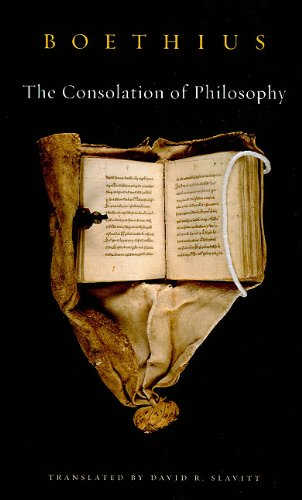
1. The Consolation of Philosophy:
$5.95
2. The Consolation of Philosophy:
$7.11
3. The Consolation of Philosophy
$11.76
4. The Theological Tractates and
$4.16
5. The Consolation of Philosophy
$15.99
6. Queen Elizabeth's Englishings
$27.11
7. The Prisoner's Philosophy: Life
 
$17.95
8. Boethius Consolatio Philosophiae
 
9. The Commentaries on Boethius by
$172.63
10. Kommentar zu Boethius 'De consolatione
$86.00
11. Music Theory from Boethius to
$19.62
12. Boethius (Great Medieval Thinkers)
 
13. The Tradition of Boethius: A Study
$1.99
14. The Consolation of Philosophy
$11.75
15. The Paris Psalter and the Meters
$19.95
16. An Exposition of the 'on the Hebdomads'
$59.95
17. Understanding The Medieval Meditative
$9.71
18. Consolation of Philosophy
 
$9.99
19. Job, Boethius, and Epic Truth
 
$127.79
20. Boethius: The Consolations of

1. The Consolation of Philosophy: Revised Edition (Penguin Classics)
by Ancius Boethius
Paperback: 192 Pages (2000-05-01)
list price: US$15.00 -- used & new: US$8.25
(price subject to change: see help)
Asin: 0140447806
Average Customer Review: 4.5 out of 5 stars
Canada | United Kingdom | Germany | France | Japan

Customer Reviews (19)

5-0 out of 5 stars The Last Classsical Man
The Consolation is a philosophical treatise written by Boethius (c. 480-524 A.D.) while awaiting his execution after being imprisoned by the Gothic emperor Theodoric.The first time I heard of Boethius and his most famous composition was, as so often is the case, when I was reading another work.The work in question is A Confederacy of Dunces by John Kennedy O'Toole.The main character of O'Toole's novel, one Ignatius J. Reilly, had based his entire life and worldview around the philosophy of Boethius and his assessment of Fortune.A great work in its own right, A Confederacy of Dunces left a lasting impression in my mind and, when by chance I came across a copy of the Consolation in the used bookstore I jumped at the opportunity to see for myself what Boethius had to say.


The work is composed of five books beginning with Boethius struggling to make sense of his imprisonment and pending execution.Confronted with a fate that is seemingly at odds with the virtue and faith with which he has conducted his life, Boethius is about to succumb to the sorrow that is filling his thoughts.Just then he notices the presence of a woman in his cell, the awe-inspiring Philosophy.She bemoans that Boethius, once such an avid student of hers, is now about to abandon all that he had previously gained.Thus begins a journey of reason and contemplation between the two until Boethius in the end finds the consolation that he had almost given up upon.Interspersed between the dialogues of Boethius and Philosophy are a number of poems that range in subject matter and content.More numerous at the beginning of the work, the poems often times serve as transitions between arguments or help to put difficult concepts into a clearer light.Thus a remarkable harmony is reached between prose and poetry that can be appreciated even in an English translation, a rare feat indeed.


It is perhaps significant to understand the time in which Boethius lived a bit better to gain a more accurate reading of his work.Living long after Constantine's conversion to Christianity in the 4th century A.D., it is widely accepted that Boethius was a Christian and believer of the tenants of the Catholic Church (at a time when the Gothic emperor Theodoric, also a Christian but belonging like all Goths to the heretical Arian sect that believed that the father and son were not of one substance).One must find it a bit peculiar than that at no point in Boethius' text is Christianity mentioned in any overt context.To find a believer in his last days before death turning not to theology for comfort, as one might expect, but rather to philosophy has raised many questions about the nature of Boethius' belief.But one only has to look to the title of the work to see that Boethius is choosing philosophy for the subject of his work and could very well indeed have thought theology a better consolation, although one that would be and should be treated in an altogether separate treatise.With this in mind, Boethius draws on the works of the great philosophers and thinkers of antiquity; Homer, Plato, Aristotle, Cicero, Seneca, St. Augustine, the Stoics, and the Neo-Platonists.This feat being all the more remarkable because Boethius apparently relied on his own memory to produce the arguments and passages seeing as he had no access to any literary sources while imprisoned.


Boethius has rightly been called the last classical man.Indeed his thoughts and works can be seen as forming a bridge etween the classical world and the Middle Ages.The Consolation influenced countless numbers of theologians throughout the Middle Ages and direct references are to be found in the works of masters such as Dante and Chaucer.His lonely contemplation of good and evil, fate and free will, fortune and the nature of happiness certainly still have an allure to inquisitive minds to this day.

5-0 out of 5 stars truly consoling
I don't read a lot of philosophy texts, but I read this one after my father died and was surprised to find it very meaningful and truly consoling.

5-0 out of 5 stars A Literary and Philosophical Masterpiece
Boethius, in his "Consolation" written in prison shortly before his death, turns to the pre-Christian philosophers and the tradition of Rome and Greece for aid and comfort.The work is one of the most historically important works ever written: it is through Boethius that we had knowledge of Aristotle during the middle ages.

The work takes the form of a Platonic dialogue, mixing prose and poetry as the author slowly convalesces with the aid of Philosophy, his "nurse."This literary style has been imitated many times since.

The work ought to be read not only for its historical and literary appeal, but for its arguments, which are as cogent as they were nearly two thousand years ago.

5-0 out of 5 stars The One and the Good
_Here you find the unequivocal declaration that not riches, not high position, not fame, not physical pleasure are worth pursuing in-and-of themselves. Such things are of value only if they are obtained in the pursuit of the highest Good. This highest Good is demonstrated to be God. Moreover, Boethius points out that when evil men succeed in obtaining such goals over the righteous, then they cease to truly be men- they are beasts and subhuman. This is a refreshing reminder in the modern world, a world not unlike that of late Roman times.

_All happiness, all worth, all reason for being, lies in the One and the Good. Even when we commit immoral acts, it is a result of ignorance on our part in seeking this ultimate goal. Indeed, to turn from the quest of finding the One is to cease to exist at any meaningful level. There is no "fire and brimstone", or talk of eternal torment in hell here. There doesn't need to be. As long as you willfully or ignorantly stray from the Path then you are in hell. And to not find reconnection with the One and the Good is to cease to exist. All of our earthly existence is for the purpose of reawakening to our true nature. This truth lies within all of us and it is only reached by personal introspection (Know thyself.) Only in this way will we return to the eternal Source that lies beyond time itself.

_The consolation of the Consolatio lies in the fact that suffering serves a purpose if it puts us back on the true Path. Moreover, earthly recognition of virtue is irrelevent. God always recognises the man of virtue if the masses do not.

5-0 out of 5 stars A Philosopher for the Hard Questions
Boethius: The Consolation of Philosophy
Translation and Introduction by V.E. Watts

There is no excuse for anyone to *not* read this book: it is a quick read, with a very thorough and enlightening introduction by V.E. Watts. However, it is profound, and Boethius, with his gentle tone and elegant style, by means of a Socratic dialogue thoroughly and irrefutably answers the most troubling questions we have about life and God.

As mentioned earlier, Boethius wrote this while unjustly imprisoned. His life prior had been spent in the study of the great philosophers. From what historians gather, he later died a death of torture. His situation was the gravest imaginable; he went from a position of wealth and respect to the worst fate possible. Ironically, that makes his argument that much more persuasive: that a man suffering the worst of life could still come to the conclusions that he does gives comfort and hope to anyone who has ever suffered.

Boethius didactically addresses:
How do we know God exists?
How do we know God is Divine?
What is the meaning of life? (And for all of you Adams fans, no, the answer is not 42. :-)
If God is good, how can evil exist?
What is the nature of evil?
If God is good, how come bad things happen to good people, and good things happen to bad people?
Why do so many in the world suffer?
How can God be omniscient and humans still have free will? Why is foreknowledge not equated with predestination?

I came to this precious book for more understanding in Medieval study. When I discovered that this book is also appropriate--nay, necessary--to life today, I became greatly annoyed that it is not more well-known and more widely read. This book is a great comfort, and one worthy of lifelong meditation.

--The Medieval Chick ... Read more


2. The Consolation of Philosophy: Boethius
by Richard H. Green
Paperback: 160 Pages (1962-01-11)
list price: US$19.60 -- used & new: US$5.95
(price subject to change: see help)
Asin: 002346450X
Average Customer Review: 5.0 out of 5 stars
Canada | United Kingdom | Germany | France | Japan

Customer Reviews (4)

5-0 out of 5 stars The One and the Good
_Here you find the unequivocal declaration that not riches, not high position, not fame, not physical pleasure are worth pursuing in-and-of themselves. Such things are of value only if they are obtained in the pursuit of the highest Good. This highest Good is demonstrated to be God. Moreover, Boethius points out that when evil men succeed in obtaining such goals over the righteous, then they cease to truly be men- they are beasts and subhuman. This is a refreshing reminder in the modern world, a world not unlike that of late Roman times.

_All happiness, all worth, all reason for being, lies in the One and the Good. Even when we commit immoral acts, it is a result of ignorance on our part in seeking this ultimate goal. Indeed, to turn from the quest of finding the One is to cease to exist at any meaningful level. There is no "fire and brimstone", or talk of eternal torment in hell here. There doesn't need to be. As long as you willfully or ignorantly stray from the Path then you are in hell. And to not find reconnection with the One and the Good is to cease to exist. All of our earthly existence is for the purpose of reawakening to our true nature. This truth lies within all of us and it is only reached by personal introspection (Know thyself.) Only in this way will we return to the eternal Source that lies beyond time itself.

_The consolation of the Consolatio lies in the fact that suffering serves a purpose if it puts us back on the true Path. Moreover, earthly recognition of virtue is irrelevent. God always recognises the man of virtue if the masses do not.

4-0 out of 5 stars Providence, Fortune, and Fate.
This is an account of the ability of the human mind to rise above a man's material failures and the external evils that assault him. Boethius (c 480-524 AD), a Roman scholar and philosopher/statesman, has led a life of privilege and influence. He has taken a stand of conscience in support of the integrity of the Roman senate and, in doing so, has taken a stand contrary to the designs of the Ostrogothic king Theodoric. He is imprisoned (and eventually executed), presumably for subversion or treason, on the strength of perjured testimony against him.
Boethius laments his adverse 'fortunes' and has a vision in which a majestic woman appears to counsel him. She tells him "it is time for medicine rather than complaint," and that he suffers from "the common illness of deceived minds." Boethius recognizes her -- "I saw that she was Philosophy, my nurse, in whose house I had lived from my youth." The consolations that follow are structured in five books (i.e., chapters).
In Book Two, Lady Philosophy examines the nature of the gifts of Fortune. These gifts of Fortune cannot be "good in themselves; whatever goodness is associated with them is to be found in the personal probity of those who happen to possess them." In Book Three, evil is seen as merely the absence of the Good, as Augustine of Hippo had earlier argued. In Book Four, the question of whether virtue is rewarded and evil is punished is examined. At first look it certainly appears that evil often succeeds. Here Providence is contrasted to Fate. For this reader, books three and four were rather weakly argued and tedious, although I am always reluctant to say this about a classic work such as this. The strengths of The Consolation are books 1, 2, and 5.
Book Five is an excellent consideration of the determinism versus freedom problem. If goodness and evil are pre-assigned by Providence, then God cannot be omnibenevolent; in this view, God has willfully authored and imposed evil. There is no such thing as choice or judgment, no such thing as virtue, and all evil must be traced directly to a perverse divine evil. This is a pill that is almost impossible to swallow. It runs contrary to our ideas about God, it runs contrary to our common experiences for we do in fact exercise judgment, make choices, recognize virtue to be something quite at odds with vice. Goodness cannot be devoid of freedom, the Supreme Good cannot, by definition, deny the freedom of the human will. The problem is satisfactorily disposed by carefully considering the nature of Absolute knowledge and by not confusing it, as a flawed theology often does, with 'foreknowledge', a humanly impoverished idea not sufficient to describe the nature of knowledge for a temporally independent and omniscient Being. While the problematic idea of divine 'foreknowledge' suggests both temporal/spatial restraints ("fore") and fake choices, the idea of Absolute knowledge poses no obstacle for the freedom of the will or true omnipresence in both space and time. The general argument of this chapter is one of Boethius' best.

5-0 out of 5 stars Philosophy as Religion
That Boethius was the "last of the Romans and the first of the scholastics", as has often been said of him, makes him a most unusual character in the history of thought. Serving as a bridge between two worlds, his writings, infused with the ideas of both Aristotle and Plato -- the two giants of ancient Greek philosophy -- allowed for the transmission of Neoplatonism into the emerging Christian intellectual tradition. Through the figure of Boethius the Latin West came to inherit many of the achievements of Greek learning.

The Consolation of Philosophy, Boethius's magnum opus, was one of the most widely read works in medieval Europe, especially in the twelfth century.No doubt, the dramatic context in which the work was written must have greatly accentuated its popularity. But there is more to the Consolation then simply a dramatic background, and this feature in itself would hardly explain the influence of the work on figures ranging from King Alfred to St.Thomas Aquinas.Boethius, being at once a Christian and a philosopher, was confident that reason and faith were reconcilable, and his entire literary enterprise can be summarised in his own words: fidem rationemque coniunge (show the harmony of reason and faith). An inheritor of the Greek tradition, he held that the world was a KOSMOS -- rationally structured, therefore rationally knowable. What makes the Consolation unique is that although it is a religious text, it doesn't make recourse to revealed religion; in Boethius's case, Christianity. That Boethius sought to answer religious questions without reference to Christianity, relying solely on natural philosophy, caused some later figures to question his religious allegiance prior to his death. But Boethius, as has been pointed out, believed in the harmony of faith and reason; being a Christian-Neoplatonic philosopher, for him to have found solace in philosophy does not imply that he left Christianity. For the truths found in Christianity would be no different than the truths found in philosophy, and whether consolation was found in the religion of Christ or Socrates would make no great difference. In the words of Henry Chadwick, "If the Consolation contains nothing distinctively Christian, it is also relevant that it contains nothing specifically pagan either...[it] is a work written by a Platonist who is also a Christian, but is not a Christianwork."

The Consolation begins with Boethius lamenting his plight. Dame Philosophy descends to provide consolance to his bereaved soul, cure him of the extreme melancholy, and rid him of his misfortune, not that of his imprisonment and loss of worldly goods and status, but the spiritual ailment clouding his intellectual vision.

Boethius's troubles, Lady Philosophy tells him, lie within himself. He has been driven into exile by himself. "For if you can remember your true country...'it has one ruler and one king'" and the "oldest law of your true city, [is] that the citizen who has chosen to establish his home there has a sacred right not to be driven away". Dame Philosophy is here referring to his self, the mind. For Boethius, being distracted by external matters, (both the fortunes of his luxurious life and the misfortunes of his political imprisonment), has forgotten his real source of happiness, whose fountain lies within.

In short, the Consolation examines the raison d'etre of philosophy, and its capacity to bring about true and complete happiness -- a happiness which can be acquired by unearthing the hidden treasures which dwell within. Hence philosophy is not an end in itself -- a fruitless game of mental acrobatics -- anymore than a shovel is for one in search of Sophia's treasures.

Boethius expresses the Socratic idea that all men seek the Good, and the Aristotelian idea that this Good is eudaimonia. The attainment of happiness is found through a return of the soul to its primordial state, since "You, too, who are creatures dream of your origin". By the end of the Consolation, Boethius, remembering who he truly is --a rational being endowed with a purpose, to actualise the good and fulfil his true nature -- recovers from his spiritual amnesia through a discovery of the remedy for his extreme sickness: philosophy.

5-0 out of 5 stars Forgotten who you really are? So has Boethius...
This is the greatest self-help book of all time. It tells the story of Boethius, a prominent Roman who has been thrown in prison. There, he isvisited by Lady Philosophy, and begins to become free.

It is very movingstuff. If you ever wonder where The Shawshank Redemption and The Green Milecome from, this is it.

The language is very easy to read. And youwouldn't be doing yourself justice - to not read it in one sitting. It is arollercoaster that you won't want to get off. It is that good. ... Read more


3. The Consolation of Philosophy (Oxford World's Classics)
by Boethius
Paperback: 240 Pages (2000-03-30)
list price: US$14.95 -- used & new: US$7.11
(price subject to change: see help)
Asin: 0192838830
Average Customer Review: 5.0 out of 5 stars
Canada | United Kingdom | Germany | France | Japan
Editorial Review

Book Description
Boethius composed De Consolation Philosophiae in the sixth century A.D. while awaiting death by torture, condemned on a charge of plotting against Gothic rule, which he protested as manifestly unjust. Though a Christian, Boethius details the true end of life as the soul's knowledge of God, and
consoles himself with the tenets of Greek philosophy, not with Christian precepts.Written in a form called Meippean Satire that alternates between prose and verse, Boethius' work often consists of a story told by Ovid or Horace to illustrate the philosophy being expounded.The Consolation of
Philosophy dominated the intellectual world of the Middle Ages; it inspired writers as diverse Thomas Aquinas, Jean de Meun, and Dante.In England it was rendered into Old English by Alfred the Great, into Middle English by Geoffrey Chaucer, and later Queen Elizabeth I made her own translation.
The circumstances of composition, the heroic demeanor of the author, and the Meippean texture of part prose, part verse have been a fascination for students of philosophy, literature, and religion ever since. ... Read more

Customer Reviews (7)

5-0 out of 5 stars A Path to Personal Peace
In 524 AD Boethius was confined under severe house arrest while awaiting trial for treason. The imprisonment did apparently permit access to some books and writing materials. He had been a very honored Roman aristocrat, and had received an excellent classical education in his youth. He had translated several Greek books into Latin.

His present situation left him very depressed; it was not at all the future that he had expected. Then Lady Philosophy appeared in his imagination. She was commanding, and chased away the muses of the theater who had been occupying his attention with tragedy and superficial entertainment. He at first did not recognize Philosophy. Then he remembered her as the teacher of his youth. She had come to claim her own, and to nurse him back to mental health.

Boethius and Philosophy had an extended discourse. Boethius recorded it in "The Consolation of Philosophy" (translated by P. G. Walsh, Oxford, 2000). He was troubled by the frequent apparent absence of justice and goodness in human affairs. Boethius was a Christian, but this book utilized dialectics as practiced by Socrates and recounted by Plato in his "Republic". The Christian point of view is founded on faith that God, goodness, and a final purpose exist because they are revealed in the Bible. In the Platonic view taken by Boethius, the presence in human affairs of God and purpose ("purpose" appears in Richard Green's translation of "The Consolation of Philosophy".) can be established by reasoning. The reasoning does require faith in something, namely in the orderly and lawful progression of events in the natural world, as suggested for instance in the orderly motions of the heavenly bodies (Walsh, p. 17, "...this tiniest of sparks will cause life's heat to be resuscitated in you."). In the language of the time, orderly progression was determined by divine reason.

"The Consolation of Philosophy" was little noticed in the turmoil following the final collapse of the Western Empire. But it was transcribed under Charlemagne in the eighth century, and it remained thereafter a very influential book for a thousand years. Chaucer translated it into English. One can imagine that its very deterministic outlook was too constraining as the later Renaissance burst forth and demanded unbounded freedom for the individual.

We may be entering more sober times. Some of us may find that our present realities do not meet our expectations. We share this with Boethius. If we have never achieved the success or fame accorded Boethius, we still may have reverses due to the economy or old age. Can "The Consolation of Philosophy" help us? If we turn to it as a reasoned approach, does it hold up in the light of modern science?

Our most highly developed science is physics. How does a modern physicist regard the world? Based first of all on quantum mechanics, he is apt to feel that reality at the fundamental level is probabilistic rather than deterministic. But there have been those who seem to disagree, most notably Einstein and Schrödinger. Einstein's vision of reality involves a space-time continuum. Doesn't this imply that any part of the whole is predetermined by the requirement that it fit adjacent parts? This corresponds with the medieval belief that the world, present, past, and future, is known to God. Boethius felt that this is compatible with free will for humans, in a way that is not immediately evident to out human reason. He resolves this after finding why human affairs do not seem to be guided by the hand of God, as is the material world.

Physics is not the only science. Biology is much closer to human concerns. The most spectacular aspect of modern biology is the discovery of the structure of DNA and the mode of its expression in the body. DNA bridges the gap between organismic biology and evolutionary biology. The structure of DNA is described with a mechanistic model, and its expression results from causal relationships. This is very deterministic.

In organismic biology perhaps the greatest accomplishment in the twentieth century was the theoretical and quantitative explication of the firing of the giant neuron in the Atlantic squid, since the same model can be applied to many other neurons and species simply by adjusting parameters. Eric Kandel has extended the quantitative and molecular understanding of neural behavior further in his work on synapses. This establishes the molecular basis of memory. In his Nobel address ("Science", 2 November 2001, pp. 1030-1038), Kandel noted that the solution of the general problem of neural functioning in memory will require a systems approach, and he is confident that this and other questions in the biology of learning will be addressed in the near future. I wonder if Kandel is too optimistic?

A neuropsychological theory of memory and learning was advanced by Donald Hebb in 1949, and used by Hebb in his teaching of psychology (Hebb, D.O., "Textbook of Psychology" (3rd Ed.), Saunders, Philadelphia, 1972. See also Hebb, D.O., "The Organization of Behavior", Lawrence Erlbaum Associates, 2002.). Hebb's theory introduced cell assemblies in neural networks, but was nonmathematical. Hebb was not a mathematician, and in addition the tools for putting the theory in mathematical form were not available. Powerful computers did not exist (a modern PC would suffice for a small idealized network), and the mathematical field of nonlinear dynamics was relatively undeveloped. Now those tools exist, but apparently the approach has never been tried. Has contemporary science gone beyond such fundamental things?

Now let's consider a bit of social science. Going back 56 years, the Second World War had been over long enough to give people time to think about how to change human culture and prevent another war. One idea for changing social behavior was offered by the behavioral psychologist B.F. Skinner. He presented it in the form of a novel, titled "Walden Two" (reissued 1976, Prentice-Hall). Walden Two was an imagined utopian community. The description and history of such communities is interesting in itself, but my purpose here is to compare the formative influences in Walden Two with those that our society has brought to bear in recent decades. Walden Two had been in existence for ten years, and its population after the war was about 1000. At that time its educational procedures for children had been worked out. They began at birth, and were so thorough in instilling cooperative attitudes that male aggression never appeared in early childhood. I wonder whether that might interfere with normal male hormonal balance. Maybe, if the cooperative attitude is desirable, training should begin after proper male development. At any rate, if we aimed to develop a socialist society, training for reduction of male aggression should be introduced at some age. We are now going in the opposite direction. In our society, fathers encourage aggressive behavior in their sons, so that they will be able to get their share in the capitalistic culture. The development of aggressive instincts does not stop there. The influence of television on all ages promotes violent attitudes. Whether Skinner considered this in his later years I don't know. He did not live long enough to see the development of violent computer games, but surely he would be appalled. As things stand, we appear to be committed irrevocably to an unrestrained capitalistic society, in which waste could be unbounded. Can we halt this with recycling? Or are we headed for social disaster? The wise course for the individual is to prepare for acceptance, whatever comes.

Coming back to the present, many of us are disappointed, and are looking for encouragement or consolation. Some will find it in religion based on faith, especially the forgiving Christian faith revealed in the Bible. There will also be mystics, who have a direct experience of God, and therefore don't need a conscious act of faith. Others may turn to a more secular view. Notable is the outlook expressed by Stephen Jay Gould in "Wonderful Life" (Norton, 1989). Gould sees precious value in human life precisely because its origin was dependent on contingent events, and hence was so unlikely. This is very different from the deterministic view I have taken. Gould draws further assurance from the apparent release of the free will from determinism.

Finally there is the path chosen by Boethius. It is the way of a rational mind that has been confronted with the harsh reality of reversals or deprivations. It is the path of acceptance, as a higher value becomes evident. Again we question whether this view makes sense in the light of modern science. Is there something about the human mind that makes it override material values? Many have tried to define the source of the difference between human perception and that of other animals. One current view is that consciousness is the special human resource. But do we really know that other animals don't possess consciousness?

The difference between humans and animals may be that humans have passed a threshold in symbolic activity. When our ape-like ancestors left the forest, and began hunting on the hilly savannas, they became more social, both to hunt big game in groups and to prepare food at the camp. This promoted a dramatic development of language. Brain regions involved in symbolic activity expanded. It became possible to tell stories of hunting adventures. Stories cultivated imagination, and imagination led to visions of what might be over the next hill. This in turn led to the concept of a space beyond all hills, an abstract space. The regularity of the Sun and Moon demonstrated order in the abstract space. Maintained by what agency? There must be a divine will that promotes order. At that point our ancestors were DISCOVERING the spiritual realm.

Ages later writing appeared, which made it possible to transmit precise knowledge, and so led to advanced culture. We discovered mathematical relations, and made a start in learning physical laws. These developments depended on the conscious mind, but also involved the subconscious in an essential way. The subconscious is not limited by sequential logic. Like nature, it considers everything at once. And so we draw closer to God. It is the above characteristics that make the individual human mind precious. It depends on culture, but rises above culture. The individual mind comprehends a whole world. Except perhaps when we pass our threshold of tolerable pain, the mind is able to rise above physical discomforts and deprivations, and find refuge in comtemplation of the world within.

5-0 out of 5 stars Remains vital after fifteen hundred years
The particular edition I am reviewing is the Oxford World's Classics translation by P. G. Walsh.

This is one of those classics that can catch an unsuspecting reader completely by surprise, especially if one has read many other works by near contemporaries.The circumstances under which it was composed are legendary, and lend the work a legitimacy granted to few other works.Boethius was among the foremost government officials in what was essentially the successor government to the end of the Roman Empire.Rome and much of the rest of what would later become Italy was under the control of the Ostrogoth king Theodoric.A product of one of the leading Roman familes, Boethius ascended to a power of great honor and authority under Theodoric, only to be accused of treason late in the latter's life, at which point Boethius was imprisoned and condemned to death.While awaiting his fate (including whether Theodoric actually intended on carrying out the sentence), Boethius wrote this remarkable dialog between a prisoner whose situation closely resembles Boethius' and Philosophy personified as a woman.Although many topics are discussed, the heart of the dialog is the nature of true happiness.

Although few of its readers are likely to face circumstances as dire as Boethius', the work remains remarkably pertinent in an age where ideals of happiness are dictated almost entirely by our modern consumer society.Philosophy carefully explains to the prisoner that that happiness can never be found in such things as fame or power or riches and other things that are confused with the true source of happiness.For Boethius' Philosophy, happiness is ultimately rooted in the Christian God, but even for non-Christians, the lightly theological tone of the work provides much reflection on the nature of happiness in almost any kind of situation.

The Walsh edition of this work is, in my opinion, the finest readily available edition in English.The notes are marvelous, both providing overviews to each upcoming section as well as providing detailed comments on specific lines in the text.The introduction gives any new reader of the work all the context and background that he or she would need to digest the work.Best of all, the translation is exceptionally readable, and the translations of the many poems far above the average for most academic translations of verse.

I recommend this work strongly to either of two kinds of readers.First, for anyone who is a student of intellectual history the work remains for an understanding of a host of writers in the middle ages, as well as for many 19th century poets.Second, anyone interested in devotional or reflectional works, whether religious or philosophical, this remains one of the most essential works in the history of thought.By almost any standard, this is a work that demands careful reading and study.

5-0 out of 5 stars An essential and poignant work
For a long time, this would stand as the last major work in which philosophy played the role it was accustomed to play in Antiquity; most medieval thinkers would make philosophy the servant of theology and strip it of its profoundly ethical roots - after all, Christianity became the philosophical way of life par excellence. By using philosophy as a character, Boethius emphasizes its vital role in everyday life and the choices that life entails. Although Boethius is usually mentioned in conjunction with Aristotelian and Christian thought, this work is especially linked to Platonism, Stoicism and Neoplatonism: a) it follows the progression of Socratic discourse in a journey that leads one from the suppression of false beliefs towards a gradually clearer approximation of what Good is, and Philosophy is akin to the priestess Diotima of Plato's Symposium; b) the harrowing context in which it was written mirrors the composition of Seneca's Letters to Lucilius; c) its frequent allegorical use of poetry and myths follows the path set forth by the Stoics and Neoplatonists. The first few books free Philosophy's interlocutor from his errors, and Boethius then explores the work's central subjects: justice, the nature of good and evil, providence (themes that also intensely preoccupied Plotinus late in his life). Treating 'Consolation...' only as a compendium of ancient Greek philosophy would be doing it a major disservice, as it would underscore the personal dimension lying at the very heart of the work. Those who forgot that philosophy is a lot more than the mere juggling of concepts should definitely read this key book.

5-0 out of 5 stars The One and the Good
Here you find the unequivocal declaration that not riches, not high position, not fame, not physical pleasure are worth pursuing in-and-of themselves. Such things are of value only if they are obtained in the pursuit of the highest Good. This highest Good is demonstrated to be God. Moreover, Boethius points out that when evil men succeed in obtaining such goals over the righteous, then they cease to truly be men- they are beasts and subhuman. This is a refreshing reminder in the modern world, a world not unlike that of late Roman times.

All happyness, all worth, all reason for being, lies in the One and the Good. Even when we commit immoral acts, it is a result of ignorance on our part in seeking this ultimate goal. Indeed, to turn from the quest of finding the One is to cease to exist at any meaningful level. There is no "fire and brimstone", or talk of eternal torment in hell here. There doesn't need to be. As long as you willfully or ignorantly stray from the Path then you are in hell. And to not find reconnection with the One and the Good is to cease to exist. All of our earthly existence is for the purpose of reawakening to our true nature. This truth lies within all of us and it is only reached by personal introspection (Know thyself.) Only in this way will we return to the eternal Source that lies beyond time itself.

The consolation of the Consolatio lies in the fact that suffering serves a purpose if it puts us back on the true Path. Moreover, earthly recognition of virtue is irrelevent. God always recognises the man of virtue if the masses do not.

5-0 out of 5 stars A must for a seeker of truth
This work doesn't raise issues beyond what had been the subject of discourse by Plato and Aristotle. However, as a manual for the student of philosophy, it's bar none. Systematically Boethius scrutinizes the id driven, pleasure-seeking paths to happiness and exposes the flaws inherent in them all. Money creates more anxiety (articulated so eloquently by Bad Boy Entertainment's production of "Mo Money, Mo Problems.") Hedonism similarly leads to dependancy and fear of the loss of the pleasing object. Philosophy, then is the soundness means to indivdual happiness as it is the least dependant upon external sources for its fuel. Self-sufficiency as the key to happiness is of course not a new point, but the means Boethius utilizes to reach this conclusion are straightfoward and the section explaning how self-sufficiency brings us closer to happiness by making us more like God is novel. This book affected me powerfully, as it forced me to examine the sustainablity of my then lifestyle.I have since realized that be it as it may, I'm not a philosopher and can't rely on Boethius' template exclusively. ... Read more


4. The Theological Tractates and The Consolation of Philosophy
by Boethius
Paperback: 112 Pages (2007-01-01)
list price: US$12.99 -- used & new: US$11.76
(price subject to change: see help)
Asin: 1420929755
Average Customer Review: 5.0 out of 5 stars
Canada | United Kingdom | Germany | France | Japan
Editorial Review

Book Description
Boethius's "Consolation of Philosophy" is considered as one of the most important and influential works of medieval times. Written during Boethius's year-long imprisonment for treason which would ultimately lead to his tortuous execution, "Consolation of Philosophy" is a classical exposition of human nature as Boethius reflects on the treacherous betrayal by his friends that led to him quickly falling out of the favor with his lord. Presented here in this volume is H. F. Stewart's translation of "Consolation of Philosophy" and "The Theological Tractates". ... Read more

Customer Reviews (5)

5-0 out of 5 stars A Worthy Consolation to Remember
Lady Philosophy poses the question to the wearied and worried Boethius: "Then can you say, what is a man?"Boethius answers that he knows for certain that he is a "mortal, rational animal.""And do you not know," Lady Philosophy asks further, "that you are anything more?""I am nothing more," Boethius replies."Now I know," Lady Philosophy charges, "you have forgotten what you are" (Book I, Prose VI).In this Loeb Classical Library translation (translated by S.J. Tester), Boethius' Consolation of Philosophy and his theological tractates are rendered accessible to both the serious student as well as the leisured reader.The very fine English translation (save a few arguable points) is set side by side the Latin text which allows the student to pay deeper attention to Boethius himself as well as enter into a conversation with the translator.The notes offered throughout the Consolation help the reader to see just how embedded this work is within the ancient philosophical traditions of the Greco-Roman world.However, there is unfortunately only one explicit reference to the Book of Wisdom (following Aquinas), but it seems that the Consolation is equally indebted to the Jewish wisdom tradition.Although this link is under-represented in the notes, it is still a wonderfully referenced translation.The Consolation deals with the basic questions of the human condition and of reality as such.Journeying from the outward to the inner human being, which is also the journey of ascent to the divine, Boethius tackles the basic questions of what constitutes the good and its identity with happiness, which is all a part of deification.This is the lighter medicine of Boethius' consoling philosophy that increases in strength until Lady Philosophy brings Boethius to the question of divine foreknowledge and human freedom.If God foreknows all things, then is there ever a truly free act among voluntary beings?This is the great dilemma not only of Boethius' time but also of our time.Boethius will not stand for chaos or determinism; rather, he argues for the distinct intelligence of God that is in eternity (as he classically defined it) and which "with one glance of his mind distinguishes both those things necessarily coming to be and those not necessarily coming to be..." (Book V, Prose VI).This distinction between two intelligences (human and divine) brings Boethius to the point of prayer: "Nor vainly are our hopes placed in God, nor our prayers, which when they are right cannot be ineffectual" (Book V, Prose VI).In the history of human thought Boethius has not had the last word on this persistent question, but any student of philosophy or theology must spend time with Boethius before moving on.In the theological tractates (private correspondence) Boethius writes in a more explicitly Christian manner.Although, calling them "theological" tractates seems to imply that the Consolation is not theological which would be a wrong conclusion and one foreign to Boethius.The tractates speak to the same philosophical truth iterated in the Consolation, simply now within the specific economy of Christian language.Indeed, reading the tractates and the Consolation together makes for a fuller understanding of Boethius.The work of Boethius wielded enormous influence upon the emerging medieval and European civilization.Although a bit forgotten now, Boethius offers every student of theology, philosophy, literature or any other discipline concerned with the common good essential food for thought.This fine translation renders this enormously important work accessible to the widest possible readership.For that, this work is to be praised, bought and read.

5-0 out of 5 stars From Stoicism to Scholasticism
"The last of the Romans and the first of the scholastics" is a term often used of Boethius, a Christian of the late 5th, early 6th centuries.In fact, similar appellations are used for Augustine, who lived a century earlier.I suppose it is fair to say that the period from Augustine to Boethius represents the transition from classical to medieval thinking, and for an appreciation of how European thought evolved, you need to make the acquaintance of both.

Boethius's most famous work is The Consolation of Philosophy.The tone and content of the work are distinctively Stoical.I have said in another review that Marcus Aurelius's "Meditations" is Stoicism for monarchs, whereas "The Imitation of Christ" by Thomas A Kempis is Stoicism for monks.If so, then "Consolation" is Stoicism for martyrs.It has been argued that Stoicism formed the rational basis for the fledgling Christian theology and "Consolation" is strong evidence for that.So it is remarkable that the work, written by a Christian, makes no mention of Christianity.Boethius wanted to show (himself and his readers) that Reason alone, unaided by Faith could enable one to come to terms with the most dreadful suffering.Coming from a man who has lost status, wealth, everything, and is rotting in a prison cell, facing torture and death, it is an extraordinary achievement.

A believer in an omnipotent and omniscient god has a problem explaining the existence of free will.Actually, the atheist has just the same problem, reconciling determinism with free will.Boethius tackles the question head on, along with the related one of how evil can exist in a world designed by a god of perfect goodness.His is not the last word on these subjects -- nothing ever will be - but it is an indispensable contribution.

The Loeb Library edition includes some theological works by Boethius, to give a broader view of his thought, and has a parallel Latin text, which is nice to have even if, like me, your knowledge of the language is slight.Contrary to what the Amazon editorial suggests, the translation of "Consolation" in this edition is by SJ Tester.It is an accurate translation with a kind of taut elegance that is often more admirable than readable.If you want an authoritative edition of the works of Boethius, go with Loeb.If you want a more readable rendering of just the "Consolation", you may be better with another edition.


5-0 out of 5 stars "A Collection of Masterworks"
Boethius was certainly a bright spot in the midst of a darkening world flooded by barbarians and intellectually on the decline. Boethius was among the few commentators and compilers of his age who endeavored to preserve the tenets of Greek Philosophy. His commentaries and translations of the original Greek texts of Aristotle were the only Latin translations known to the Western world until the renaissance and ultimately paved the way for Aquinas' "Summa Theologia." So, with this in mind, Boethius' works made a very significant impact upon the later scholastic philosophers, and to the whole of Catholic tradition as well. Italy, during Boethius' time, was under the rule of Theoderic the Ostrogoth, who unjustly imprisoned the statesman/philosopher, falsely accusing him of treason. While waiting for his execution, Boethius wrote his "Consolation of Philosophy." The book itself is among the masterpieces of all time, and the only thing as tragic as Boethius' untimely death is the fact that we were not able to obtain anymore works from this genius with the golden pen. Had he remained alive, it is very likely that we would have seen a sublime synthesis, in Latin, of Plato and Aristotle, not contradicting each other but complimenting one another. However, in short, this book is a small manifestation of what may have happened if he lived longer. What is interesting about this book is that it handles several different perspectives, namely that of the sorrowful Boethius and the consoling wisdom of Lady Philosophy, written both in eloquent prose and dazzling verse, which together ultimately culminates into a one of the most moving, inspiring, and thought provoking philosophical works of all time. The book is indefatigable, in that it never seems to quit opening new corridors of thought; and it is essential, because it is the philosopher's ideal breviary. It is interesting to note - and this is certainly not a negation to his Christian convictions - that while this Saint was awaiting his execution he remembered Athens, not Calvary.The other works contained in the volume are some minor Theological tractates: namely, "De Trinitate," "Utrem Pater Et Filius," "De Fide Catholica," "Quomodo Substanitiae," and "Contra Eutychen."While many individuals attempt to downplay Boethius' Christianity since "The Consolation" makes no direct mention of Christ, it nevertheless cannot be denied that many Christian elements underlay the theme of the work; and also it must be noted that when Boethius writes philosophy he is strictly writing philosophy and he writes theology he is strictly writing theology.Boethius is without a doubt the Christian Socrates.

4-0 out of 5 stars Precursor of Medieval Scholasticism
This volume contains the five little Tractates (De Trinitate, Utrum Pater et Filius, Quomodo Substantiae, De Fide Catholica, and Contra Eutychen), plus the monumental "Consolation of Philosophy" written by Anicius Manlius Severinus Boethius (A.D. 480-524) as he awaited his brutal execution. Most of the translation is the work of S.J. Tester, whose aim was "to produce throughout the volume a homogeneous rendering, reasonably literal, which would make philosophical sense." De Trinitate is a purely philosophical defense of the Christian doctrine of the Trinity. The "Consolation" is considered the last example of purely literary Latin of ancient times; a mingling of alternate dialogue and poems.

5-0 out of 5 stars The Best Book You'll Ever Read?
The Consolation of Philosophy is among the best books I have ever read. I understand from a friend and authority that virtually every educated person in the West read this book until the 19th century and that there have been hundreds of translations. It is a pity that the work has all but droppedfrom the syllabus of Higher Education in the United States. ... Read more


5. The Consolation of Philosophy
by Boethius
Paperback: 128 Pages (2002-04-10)
list price: US$6.95 -- used & new: US$4.16
(price subject to change: see help)
Asin: 0486421635
Average Customer Review: 5.0 out of 5 stars
Canada | United Kingdom | Germany | France | Japan
Editorial Review

Book Description

Landmark of Western thought written by a 6th-century Roman statesman and philosopher awaiting execution. Comprising a dialogue in alternating prose and verse between Boethius and his spiritual guardian, the book concerns happiness: how to achieve and maintain it amid life's inevitable pain. A cornerstone of medieval humanism.
... Read more

Customer Reviews (3)

5-0 out of 5 stars Faith and philosophy in the early Middle Ages
Awaiting his execution on trumpted up charges, Boethius attempts to reconcile his unjust sentence with concepts of "justice", "power", "happiness" and of course, "faith."Considered the first truly medieval philosopher, Boethius conducts a Platonic dialogue with Lady Philosophy, attempting to reconcile his Christian faith with the classical rationalist philosophy of Artistotle and Plato.What results is the first elucidation of "scholasticism" - and Boethius' conclusion that faith and reason are reconcilable.

Beyond the philosophical, I was struck by Boethius' resignation to his fate and his quiet confidence in the wrongs being righted."No one can doubt that God is almighty" Philosophy began."Certainly not, unless he is mad" I answered."But nothing is impossible for one who is almighty.""Nothing.""Then can God do evil?""No, of course not.""Then evil is nothing, since God, who can do all things, cannot do evil."

Both an excellent philosophical tract and a testament to the strength of human reason and belief, I highly recommend it.

5-0 out of 5 stars When you find yourself in times of trouble....
The truly amazing thing about this work is that it was written in PRISON as Boethius awaited execution (following judgment and conviction based upon spurious charges). Bearing that in mind as I read "The Consolation of Philosophy" (if anyone ever needed consolation, it was an innocent man awaiting his own death; Christians should be able to relate to that idea) made it all the more remarkable. If you ever feel that life isn't fair, that others have it "in" for you, that it's tough to get an even break, maybe reading this will put things in better perspective. If not, it won't be due to Boethius' shortcomings....

5-0 out of 5 stars The One and the Good
_Here you find the unequivocal declaration that not riches, not high position, not fame, not physical pleasure are worth pursuing in-and-of themselves. Such things are of value only if they are obtained in the pursuit of the highest Good. This highest Good is demonstrated to be God. Moreover, Boethius points out that when evil men succeed in obtaining such goals over the righteous, then they cease to truly be men- they are beasts and subhuman. This is a refreshing reminder in the modern world, a world not unlike that of late Roman times.

_All happyness, all worth, all reason for being, lies in the One and the Good. Even when we commit immoral acts, it is a result of ignorance on our part in seeking this ultimate goal. Indeed, to turn from the quest of finding the One is to cease to exist at any meaningful level. There is no "fire and brimstone", or talk of eternal torment in hell here. There doesn't need to be. As long as you willfully or ignorantly stray from the Path then you are in hell. And to not find reconnection with the One and the Good is to cease to exist. All of our earthly existence is for the purpose of reawakening to our true nature. This truth lies within all of us and it is only reached by personal introspection (Know thyself.) Only in this way will we return to the eternal Source that lies beyond time itself.

_The consolation of the Consolatio lies in the fact that suffering serves a purpose if it puts us back on the true Path. Moreover, earthly recognition of virtue is irrelevent. God always recognises the man of virtue if the masses do not. ... Read more


6. Queen Elizabeth's Englishings of Boethius, De Consolatione Philosophiae, A.D. 1593, Plutarch, De Curiositate, Horace, De Arte Poetica (Part), A.D. 1598
by Elizabeth I
Paperback: 199 Pages (2001-07-12)
list price: US$15.99 -- used & new: US$15.99
(price subject to change: see help)
Asin: 1402196318
Canada | United Kingdom | Germany | France | Japan
Editorial Review

Product Description
This Elibron Classics book is a facsimile reprint of a 1899 edition by Kegan Paul, Trench, Trübner & Co., London. ... Read more


7. The Prisoner's Philosophy: Life and Death in Boethius's Consolation
by Joel C. Relihan
Paperback: 240 Pages (2006-11-15)
list price: US$30.00 -- used & new: US$27.11
(price subject to change: see help)
Asin: 0268040249
Canada | United Kingdom | Germany | France | Japan
Editorial Review

Book Description
"Acknowledging that the Consolation of Philosophyis `over-familiar and under-read,' Joel Relihan puts to the side old bromides about the work and instead pays careful attention to the narrative(s) Boethius constructs, grounding his readings in the contexts the work cultivates, especially its Menippean elements. The result is perhaps the first satisfying reading of the Consolation to be produced, a satisfaction felt also in the ways Relihan mirrors Boethius himself in the thoroughness of his scholarship and the elegance of his exposition. No one who studies Boethius will be able to ignore this book." — Joseph Pucci, Brown University

"Anyone who has been fascinated, intrigued, or perhaps puzzled by the meaning, structure or argument of Boethius' Consolation of Philosophy will find Joel Relihan's new book, The Prisoner's Philosophy: Life and Death in Boethius's Consolation, a welcome addition to the study of this core text of the early medieval world whose influence extends to the present time. Relihan's study is a tour de force that belongs in the library of all those who appreciate Boethius' depth and subtlety. Fortune's wheel has indeed turned in the favor of those who wish to explore with Relihan the intricacies and brilliance of the Consolation." —Fr. John Fortin, O.S.B., Saint Anselm College

"The Prisoner's Philosophy is an excellent work both of scholarship and of communication in support of a provocative thesis. Relihan and Heise present the Consolation as a new beginning for philosophy within a Christian context—a beginning only rarely appreciated since it enlists philosophy in aid of human affairs and resists the lure of an other worldly escape.Boethius not only despoiled Cynics, Satirists and Neoplatonists of their gold, but also crafted out of it a new Christian realism. Through a close reading of the text and of its reception, Relihan and Heise attend to the challenge that Boethius' Christian vision and literary genius posed to rationalist conceptions throughout the Middle Ages." —Paul LaChance, College of Saint Elizabeth

In this book, Joel C. Relihan delivers a genuinely new reading of the Consolation. He argues that it is a Christian work dramatizing not the truths of philosophy as a whole, but the limits of pagan philosophy in particular. He views it as one of a number of literary experiments of late antiquity, taking its place alongside Augustine's Confessions and Soliloquies as a spiritual meditation, as an attempt by Boethius to speak objectively about the life of the mind and its relation to God. ... Read more


8. Boethius Consolatio Philosophiae (Latin Commentaries Series)
by James J. O'Donnell
 Plastic Comb: 2 Pages (1984-12)
list price: US$17.95 -- used & new: US$17.95
(price subject to change: see help)
Asin: 0929524373
Canada | United Kingdom | Germany | France | Japan

9. The Commentaries on Boethius by Gilbert of Poitiers
by Nikolaus M. Haring
 Hardcover: Pages (1966)

Asin: B000K1W5I4
Canada | United Kingdom | Germany | France | Japan

10. Kommentar zu Boethius 'De consolatione philosophiae' (Texte und Kommentare 9)
by Joachim Gruber
Hardcover: 520 Pages (2006-12-30)
list price: US$172.80 -- used & new: US$172.63
(price subject to change: see help)
Asin: 3110177404
Canada | United Kingdom | Germany | France | Japan
Editorial Review

Book Description
The final work of the statesman and philosopher Boethius notonly represents both a climax and the end of philosophy from Late Antiquityin Latin, but also combines numerous literary prose forms such as dialogue,satire, speeches of defence and consolation with an extraordinary wealth oflyric and metrical elements to weave a rich literary tapestry which hascontinually attracted new readers right up to the present day. This is thefirst modern commentary on the Consolatio Philosophiae, and beside offeringa detailed introduction it also provides a detailed philological andphilosophical key to the text of the consolation which proceeds fromkeyword to keyword. There is a full documentation of the manifoldreferences to related texts. This is the second fully revised and extendededition of the commentary, which first appeared in 1978; it is regarded asone of the standard works in Late Latin studies. ... Read more


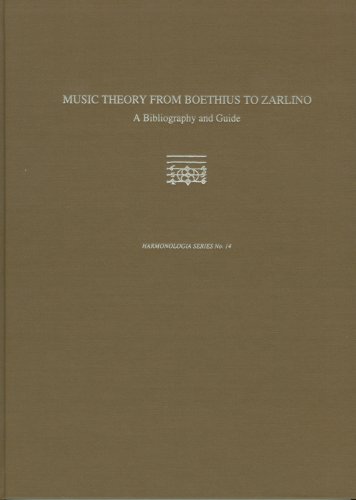
11. Music Theory from Boethius to Zarlino: A Bibliography and Guide (Harmonologia)
by David Russell Williams, C. Matthew Balenseula
Hardcover: 341 Pages (2007-10-31)
list price: US$86.00 -- used & new: US$86.00
(price subject to change: see help)
Asin: 1576471578
Average Customer Review: 5.0 out of 5 stars
Canada | United Kingdom | Germany | France | Japan

Customer Reviews (1)

5-0 out of 5 stars A wonderful resource for finding ancient materials about music and the study of music
This wonderful volume complements the earlier (and just as wonderful) "Music Theory from Zarlino to Schenker and follows the same format.Both are wonderful introductions to materials on music theory, their subject matter, and a couple of paragraphs about what we know about the people who wrote them.What I have quite enjoyed about both volumes is the way the authors have made the material accessible to all interested parties.Some of these materials may seem obscure to those not studying musicology or music theory, especially the ancient texts discussed here.With Boethius, we are back into the fifth and sixth centuries and discussing the core ideas of musical proportions and their place in the study of the liberal arts.His writings had a profound impact on the way Western education was formed during the middle ages and still has a residual impact today.

This is a rich resource with many helps and useful collections of information.It begins by listing the abbreviations of periodicals, special series, and so forth.There are many abbreviations to know and since you can't really know them all, this list is very helpful to anyone doing research in this area (granted specialists will know those relevant to their field already).The authors also provide sections on reports of musicological congress reports and important festschrifts (celebratory collections of articles in honor of a person or event).These are all from the 20th Century and most after the Second World War.It seems that these gatherings of scholars for the purpose of presenting papers around a unifying subject and publishing the papers as a collection is a recent invention.

The bulk of the book is a "Dictionary of Theorists".These articles provide the name, birth year, a short article about the theorist and his work, important editions of those works, and literature about the theorist and his work.There is also a literature supplement listing other works with a more general application.The Topical Index lets you find a subject such as modes, notation, and solmizattion and the theorists related to those subjects.The chronological index starts Augustine of Hippo circ 387 AD and lists the theorists and works of any given year and takes the reader through Hoffman of 1605.So, the title is not a strict delineation of the time covered, but gives the idea of the range of the book by using the most famous names.

Next is a title index, which helps tremendously if you know a work and are trying to find its author. The following name index helps you find not only the theorist, but also the pages in which he or she is mentioned in this book.

I think this book is very cool, very useful, and very well done.No, I don't think it is a book for everyone, but I think it is for people who don't suspect it is for them.Given the importance of the musical arts, anyone interested in ancient history and culture would benefit from consulting this great book.

I also think that if most serious musicians would think about it for a minute and get past their residual anxiety from their music theory courses, they would realize that they could get some benefit from reading a bit more deeply about their art.This resource could help them find works and material that could be or true interest and great use to them.Really!

Reviewed by Craig Matteson, Ann Arbor, MI
Here is the companion volume:
Music Theory from Zarlino to Schenker: A Bibliography and Guide (Harmonologia) ... Read more


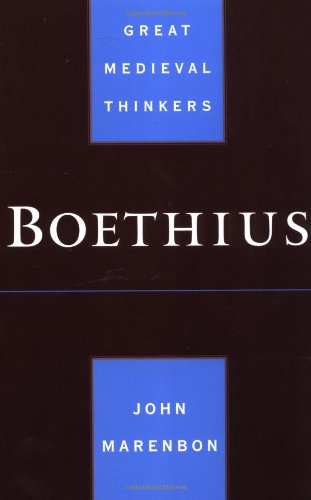
12. Boethius (Great Medieval Thinkers)
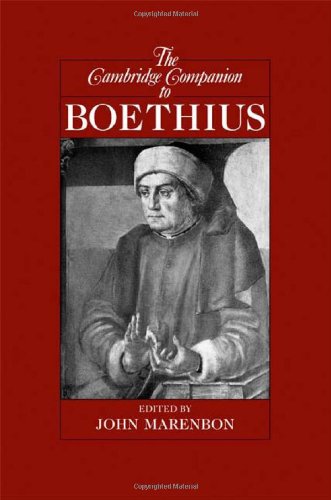
by John Marenbon
Paperback: 272 Pages (2003-02-13)
list price: US$29.95 -- used & new: US$19.62
(price subject to change: see help)
Asin: 0195134079
Average Customer Review: 4.5 out of 5 stars
Canada | United Kingdom | Germany | France | Japan
Editorial Review

Book Description
This book offers a brief, accessible introduction to the thought of Boethius. After a survey of Boethius's life and work, Marenbon explicates his theological method, and devotes separate chapters to his arguments about good and evil, fortune, fate and free will, and the problem of divine foreknowledge. Marenbon also traces Boethius's influence on the work of such thinkers as Aquinas and Duns Scotus. ... Read more

Customer Reviews (3)

5-0 out of 5 stars Solid introduction to Boethius
Unfortunately until fairly recently, medieval philosophy was a fairly neglected and obscure area of philosophy, regarded by many as an era of stagnation and decadence in philosophy, brought on mainly by its servile obedience to the beliefs of medieval religion.However, this series of books helps show that medievals seriously engaged in philosophical reflection on many issues philosophers still debate today.

This volume of the series examines Boethius, a fifth century Latin Philosopher who was executed for treason.It offers a valuable overview of Boethius's philosophy, which is often under-rated in its depth and seriousness, and examines Boethius's attempts to examine logical questions and puzzles and his vast projects aiming to bring Aristotle and Plato back to Philosophy's central concerns, and his work on theology, God, and providence.

This volume will be useful to any student of medieval philosophy or of Boethius.

5-0 out of 5 stars Why Boethius?
You know I was watching a cartoon the other day with a bear in it.The bear looked all jolly and nice.Then I was thinking, "Why am I reading Boethius?"Some kid is watching this same cartoon and one day while in the woods a black bear is going to come up to him and the kid's going to think, "look it's a jolly nice bear."Then the next thing you know the bear is going to maul the kid and his mother is going to be heart broken.And you know who is to blame?Society, that's who.So I can go on reading Boethius or I can save some kid from the ravages of a wild bear.Why Boethius?

4-0 out of 5 stars A Comprehensive Study of Boethius
For anyone interested in the thought of the Late Antique world, or in the intellectual milieu of the early and high Middle Ages, then this book will be of inestimable value.John Marenbon's Boethius (Great Medieval Thinkers) is a storehouse for the main principles of Boethius' Greek Neo-Platonism, Christian Theology, Aristotelian Logic, and Latin literature, all of which left there mark upon later thinkers.In this work, Marenbon begins by reconstructing the historical aspects of Boethius' life, such as his rise to being elected Consul up to his tradgic fall on account of the trumped-up charges of treason placed upon him by the Gothic regime.Also in this historical sketch, Marenbon vindicates the Christianity of Boethius while detailing the intricacies of his famous text the Consolation, which makes no outward mention of any alliance with Christianity.Also detailedsummaries are given as to his musical, astrological, mathematical, logical, theological, and philosophical works.Of these, particular attention is paid to Boethius' logical and philosophical writings, for the obvious reason that this is what consumed most of his time.Despite this, Marenbon's is a study which is most comprehensive and well-rounded, one that is quite similar to Henry Chadwick's in scope and worth.Overall, it should be said that this work should be used foremost as a model for the interpretation of the Consolation, in respect of the insights and suggestions he throws upon the text.Also the reader will be impressed with a more than satisfactory understanding of Boethius' logical, theological and philosophical systems as well.Marenbon's 'Boethius' is highly recommended. ... Read more


13. The Tradition of Boethius: A Study of His Importance in Medieval Culture
by Howard Rollin Patch
 Hardcover: 200 Pages (1935)

Asin: B0006AN4OI
Canada | United Kingdom | Germany | France | Japan

14. The Consolation of Philosophy
by Boethius
Kindle Edition: Pages (2007-09-22)
list price: US$1.99 -- used & new: US$1.99
(price subject to change: see help)
Asin: B001083BIY
Canada | United Kingdom | Germany | France | Japan
Editorial Review

Book Description
The Consolation of Philosophy is considered widely to be the single most important work from the West during Medieval and early Renaissance Christianity. Often called the last great Classical work, authored by Boethius while a prisoner awaiting execution, had the goal and intent of preserving ancient classical knowledge, specifically relating to philosophy. This is a key work in the field of philosophy and is highly recommened for both students of philosophy as well as those who are interested in reading the important philosophical writings of Boethius. ... Read more


15. The Paris Psalter and the Meters of Boethius
by George P. Krapp
Hardcover: 239 Pages (1932-10-15)
list price: US$84.00 -- used & new: US$11.75
(price subject to change: see help)
Asin: 0231087691
Canada | United Kingdom | Germany | France | Japan

16. An Exposition of the 'on the Hebdomads' of Boethius (Thomas Aquinas in Translation)
by Aquinas, Saint Thomas
Paperback: 65 Pages (2001-03)
list price: US$19.95 -- used & new: US$19.95
(price subject to change: see help)
Asin: 0813209951
Canada | United Kingdom | Germany | France | Japan
Editorial Review

Book Description
In his sixth-century work commonly known as the "De hebdomadibus," Boethius (ca. 480-524) poses the question of how created things or substances can be good just as they are—that is, good just by existing—without being the same as the source of all goodness, God, who is understood to be Goodness Itself. In his commentary written in the thirteenth century, St. Thomas Aquinas sets out to explain the problem Boethius is treating as well as to explicate Boethius's solution. In doing so, however, the Angelic Doctor suggests a more developed analysis of goodness, based on his own metaphysical perspective. Still, his view can be seen to continue the emphasis Boethius himself placed on the notion of creation—bringing into "being"—as crucial to understanding the issues at hand.

The introduction to this translation provides critical historical background, including an account of the influence of Cicero and Augustine, for understanding Boethius's view of being, or "esse." Based on historical and textual analysis, the authors reaffirm the "traditional" interpretation, which holds that for Boethius esse indicates form rather than a distinct act of being. In articulating the difference between Boethius's and Aquinas's positions on "esse" and on goodness, and hence the relation of "esse" and goodness, Schultz and Synan show not only that Aquinas wasrespectful of Boethius's stance, but that his own position could be seen as a development in harmony with his predecessor's thought.

The English translation itself, in facing-page format with the 1992 Leonine critical edition of Aquinas's Latin text, remains faithful to the text and at the same time clear and readable. The work will be valuable to those interested in the fundamental philosophical and theological questions facing mediaeval thinkers and also to those interested in Aquinas's metaphysical thought. ... Read more


17. Understanding The Medieval Meditative Ascent: Augustine, Anselm, Boethius, & Dante
by Robert McMahon
Hardcover: 284 Pages (2006-03-06)
list price: US$59.95 -- used & new: US$59.95
(price subject to change: see help)
Asin: 0813214378
Canada | United Kingdom | Germany | France | Japan
Editorial Review

Book Description
The Confessions, Proslogion, and Consolation of Philosophy, like the Divine Comedy, all enact Platonist ascents. Each has a pilgrim figure, guided dialogically on a journey of understanding. Each rises to progressively higher levels of understanding and culminates in a supreme intellectual vision. The higher levels contain and surpass earlier understandings and thereby reconfigure them, but implicitly, for the questing pilgrim rarely stops to reflect on the stages of his ascent. Augustine's conclusions about time in book 11, for example, embrace memory as "time past," but he does not reconsider his account of memory in book 10 from this new perspective. He leaves this task for his reader's meditation, as a spiritual exercise.

In this way, a Platonist ascent generates implied meditative meanings, which scholars have explored only in part. Each work calls us to read forward, on its journey of understanding, and to meditate backwards on the stages of the ascent and the relations between them. Augustine, Anselm, Boethius, and Dante wrote for readers experienced in meditating on the Bible, adept at exploring relations between far distant passages. They designed these works as spiritual exercises for the same kind of reading and meditation.

Understanding the Medieval Meditative Ascent uses literary analysis to discover new philosophical meanings in these works. Clearly written in nontechnical language, its account of their literary structures and of the hidden meanings they generate will inform nonspecialist and specialist alike. ... Read more


18. Consolation of Philosophy
by Boethius
Paperback: 240 Pages (2001-09)
list price: US$13.95 -- used & new: US$9.71
(price subject to change: see help)
Asin: 0872205835
Average Customer Review: 5.0 out of 5 stars
Canada | United Kingdom | Germany | France | Japan
Editorial Review

Amazon.com
Unjustly imprisoned and waiting to die, Boethius penned his last and greatest work, Consolation of Philosophy, an imaginary dialogue between himself and Philosophy, personified as a woman. Reminiscent of Dante in places, Boethius's fiction is an ode-to-philosophy-cum-Socratic-dialogue. Joel Relihan's skillful rendering, smoother to the modern ear than previous translations, preserves the book's heart-rending clarity and Boethius's knack for getting it just right. Listen to him on fortune: "We spin in an ever-turning circle, and it is our delight to change the bottom for the top and the top for the bottom. You may climb up if you wish, but on this condition: Don't think it an injustice when the rules of the game require you to go back down."

Consolation of Philosophy recalls the transience of the material world, the eternality of wisdom, and the life of the philosopher. Boethius was deeply influenced by the Platonist tradition, and this piece is one of the more powerful and artful defenses of a detachment that feels almost Buddhist. For anyone who's felt at odds with the world, Consolation is a reminder that the best things in life are eternal. Boethius must be right: the book is just as meaningful today as it was in the sixth century when he wrote it. --Eric de Place Book Description
Joel Relihan's translation highlights the poetry of the Consolation while remaining faithful to Boethius' Latin. ... Read more

Customer Reviews (2)

5-0 out of 5 stars The One and the Good
Here you find the unequivocal declaration that not riches, not high position, not fame, not physical pleasure are worth pursuing in-and-of themselves. Such things are of value only if they are obtained in the pursuit of the highest Good. This highest Good is demonstrated to be God. Moreover, Boethius points out that when evil men succeed in obtaining such goals over the righteous, then they cease to truly be men- they are beasts and subhuman. This is a refreshing reminder in the modern world, a world not unlike that of late Roman times.

All happyness, all worth, all reason for being, lies in the One and the Good. Even when we commit immoral acts, it is a result of ignorance on our part in seeking this ultimate goal. Indeed, to turn from the quest of finding the One is to cease to exist at any meaningful level. There is no "fire and brimstone", or talk of eternal torment in hell here. There doesn't need to be. As long as you willfully or ignorantly stray from the Path then you are in hell. And to not find reconnection with the One and the Good is to cease to exist. All of our earthly existence is for the purpose of reawakening to our true nature. This truth lies within all of us and it is only reached by personal introspection (Know thyself.) Only in this way will we return to the eternal Source that lies beyond time itself.

The consolation of the Consolatio lies in the fact that suffering serves a purpose if it puts us back on the true Path. Moreover, earthly recognition of virtue is irrelevent. God always recognises the man of virtue if the masses do not.

5-0 out of 5 stars Relihan's 'Consolation' Should Not Go Unoticed
The Relihan translation emphasizes the philosophical depth of Boethius' Consolation, while faithfully and artfully reproducing the original beauty of his verse and the sublimity of its meaning.With this edition comes a detailed and informative introduction, along with exhaustive notes and a definitive glossary.Joel C. Relihan is one of the leading authorities in Boethian studies; his rendition of the Consolation is one that anyone serious about its study can hardly pass. ... Read more


19. Job, Boethius, and Epic Truth
by Ann W. Astell
 Hardcover: 240 Pages (1994-04)
list price: US$46.50 -- used & new: US$9.99
(price subject to change: see help)
Asin: 0801429110
Canada | United Kingdom | Germany | France | Japan
Editorial Review

Book Description
"Though present-day critics, who concentrate on form, generally find the epic discontinuous in the Middle Ages, Astell argues that the genre persisted as the biblical book of Job and Boethius's Consolation of Philosophy were imitated and alluded to as examples throughout the period. . . . The scholarship is prodigious, the argument convincing, and the Christian stance congenial to the subject. Highly recommended."--Choice ... Read more


20. Boethius: The Consolations of Music, Logic, Theology, and Philosophy (Clarendon Paperbacks)
by Henry Chadwick
 Paperback: 336 Pages (1990-11-08)
list price: US$29.95 -- used & new: US$127.79
(price subject to change: see help)
Asin: 0198265492
Average Customer Review: 4.0 out of 5 stars
Canada | United Kingdom | Germany | France | Japan
Editorial Review

Book Description
The Consolations of Philosophy by Boethius, whose English translators include King Alfred, Geoffrey Chaucer, and Queen Elizabeth I, ranks among the most remarkable books to be written by a prisoner awaiting the execution of a tyrannical death sentence.Its interpretation is bound up with his other writings on mathematics and music, on Aristotelian and propositional logic, and on central themes of Christian dogma. Chadwick begins by tracing the career of Boethius, a Roman rising to high office under the Gothic King Theoderic the Great, and suggests that his death may be seen as a cruel by-product of Byzantine ambitions to restore Roman imperial rule after its elimination in the West in AD 476. Subsequent chapters examine in detail his educational programme in the liberal arts designed to avert a threatened collapse of culture and his ambition to translate into Latin everything he could find on Plato and Aristotle.Boethius has been called `last of the Romans, first of the scholastics'.This book is the first major study in English of a writer who was of critical importance in the history of thought. ... Read more

Customer Reviews (1)

4-0 out of 5 stars A Well-Rounded Study on the Life,Thought, and Work of Boethius