e99 Online Shopping Mall

Geometry.Net - the online learning center Help  
Home  - Philosophers - Buber Martin (Books)

  1-20 of 100 | Next 20
A  B  C  D  E  F  G  H  I  J  K  L  M  N  O  P  Q  R  S  T  U  V  W  X  Y  Z  

click price to see details     click image to enlarge     click link to go to the store

$26.45
1. I And Thou
$11.90
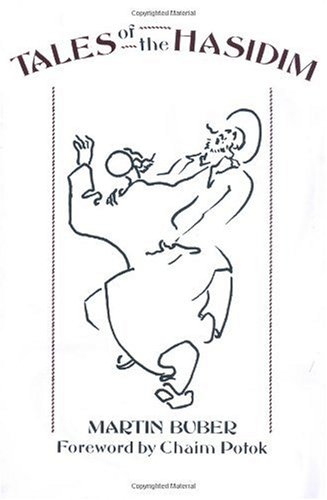
2. Tales of the Hasidim
$14.99
3. On the Bible: Eighteen Studies
$5.73
4. The Ten Rungs & The Way Of
$12.94
5. Martin Buber on Psychology and
$12.86
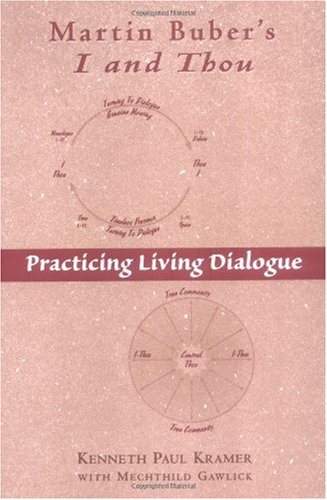
6. Martin Buber's I and Thou: Practicing
$10.00
7. Ecstatic Confessions: The Heart
$12.47
8. Good and Evil
 
$7.94
9. The Legend of the Baal-Shem
 
10. I and Thou
 
11. I & Thou 2ND Edition
$27.14
12. The Martin Buber Reader
 
13. Good and Evil, Two Interpretations:
$10.41
14. On Zion: The History of an Idea
$10.90
15. Between Man and Man (Routledge
 
16. On the Bible
 
17. THE WAY OF RESPONSE:MARTIN BUBER
$14.74
18. The Way Of Man: According to the
 
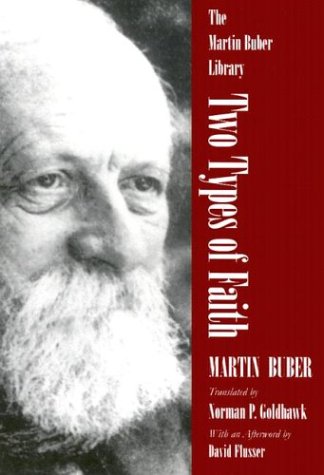
19. Two types of faith;
 
20. Martin Buber, Jewish Existentialist

1. I And Thou
by Martin Buber
Paperback: 136 Pages (2006-11-12)
list price: US$26.45 -- used & new: US$26.45
(price subject to change: see help)
Asin: 140672730X
Average Customer Review: 4.5 out of 5 stars
Canada | United Kingdom | Germany | France | Japan
Editorial Review

Amazon.com
I and Thou, Martin Buber's classic philosophical work, is among the 20th century's foundational documents of religious ethics. "The close association of the relation to God with the relation to one's fellow-men ... is my most essential concern," Buber explains in the Afterword. Before discussing that relationship, in the book's final chapter, Buber explains at length the range and ramifications of the ways people treat one another, and the ways they bear themselves in the natural world. "One should beware altogether of understanding the conversation with God ... as something that occurs merely apart from or above the everyday," Buber explains. "God's address to man penetrates the events in all our lives and all the events in the world around us, everything biographical and everything historical, and turns it into instruction, into demands for you and me." Throughout I and Thou, Buber argues for an ethic that does not use other people (or books, or trees, or God), and does not consider them objects of one's own personal experience. Instead, Buber writes, we must learn to consider everything around us as "You" speaking to "me," and requiring a response. Buber's dense arguments can be rough going at times, but Walter Kaufmann's definitive 1970 translation contains hundreds of helpful footnotes providing Buber's own explanations of the book's most difficult passages. --Michael Joseph GrossBook Description
I AND THOU BY MARTIN BUBER TRANSLATORS INTRODUCTION HIS work in its original, German form has already, since its publication fourteen years ago, exercised on the Continent an influence, quite out of proportion to its slender size. In view of this influence alone it may be affirmed that I and Thou will rank as one of the epochmaking books of our generation. It has hitherto been comparatively unknown among Englishspeaking students of philosophy and theology. I and Thou is to be understood in the context of Bubers previous intensive study, chiefly of Jewish mystical writings. It is not an isolated phenomenon among his works, but represents the culmination of the intensely religious interest that characterises them all. It is, indeed, philosophical but it is not an academic work of discursive philosophy. It is mystical, but it belongs to what PringlePattison has termed the higher Mysticism of real communion with God, as distinguished from the debased1 mysticism that sub stitutes for the real present world a world of illusory delights, where absorption in the Diym is experi enced. The decrying of mysticism as a whole, fashion able today among Protestant writers, has a weighty retort in the present work. For an indubitably real mystical experience is here set forth, not with contempt for the means of human expression but with finished and delicate power. For this reason, though we might call and Thou a philosophicalreligious poem, it belongs essentially to no single specialised class of learned work. It has a direct appeal to all those who are interested in living religious experience rather than in theological debates and the rise and fall of philosophical schools. It has first and foremost to be judged on its intrinsic meritsby the impact, that is to say, which it makes on our actual, responsible life, as persons and as groups, in the modern world. This immediate value of Bubers work becomes clear if we consider its main thesis. There is, Buber shows, a radical difference between a mans attitude to other men and his attitude to things. The attitude to other men is a relation between persons, to things it is a connexion with objects. In the personal relation one subject I confronts another subjectThou, in the connexion with things the subject contemplates and experiences an object. These two attitudes represent the basic twofold situation of human life, the former constituting the. world of Thou , and the latter the world of It The content and relation of these two worlds is the theme of and Thou. The other person, the Thou, ,is shown to be a realitythat is, it is given to me, but it is not bounded by me: Thou has no boundsthe 1 Though the second person singular pronoun has almost dis appeared from modern English usage, it remains in one important spherein prayer. By its retention in the English text, therefore, far from suggesting an obscure situation, it keeps the whole thought iii the personal and responsible sphere in which alone it is truly to be understood. TJiou cannot be appropriated, but I am brought up short against it. ... Read more

Customer Reviews (35)

1-0 out of 5 stars This book has to be a hoax
This book is difficult to read or to understand. Perhaps something has been greatly lost in the translation or else it is a complete hoax. I found it to be full of disjointed ideas and apparent nonsense.

4-0 out of 5 stars A half-departure from liberal theology
Ich und Du ("I and Thou") is one of those philosophical texts which, like Schopenhauer's Die Welt als Wille und Vorstellung, consist of the elaboration of a single thought. The thought is stated up front: human beings have a double relation to the world: Ich-Du and Ich-Es. The Ich-Es relation reifies and separates things out (whether they be "internal" or "external" things), while the Ich-Du relation is nothing but relation itself. The Eswelt is a world of nebeneinander and the laws that govern nebeneinander, while the Duwelt is a seamless experience of "presence." The Ich that reaches out and the Du that reaches back (neither of which reflects on "what" they individually are) constitute an exclusive circular reality (Ausschließlickheit) untroubled by causal and spatiotemporal regress. To be sure, the Duwelt collapses into the Eswelt, which means that the Ich and the Du degenerate into so many instances of Es, but there is always the possibility of resurrecting the Ich & Du hidden within the Es.

There are different kinds of Ich-Du relation: 1) with nature (presumably before we know to call it "nature"), in which case we stand at the "threshold of speech"; 2) with human beings, in which case speech coincides with the Ich-Du relation; and 3) with "spiritual beings," in which case the relation itself is speechless, but it can generate speech. (This third relation is very much in the spirit of romantic poesis.) A special subset of the third relation is the relation to God, who is the Du beyond every particular Du. God is the only Du with whom our relation cannot degrade into an Ich-Es relation, because there is no Es beyond every individual Es for which God could be mistaken. (There are, too be sure, many things which people falsely call "God," things which are really part of nature or of ourselves, such as Schleiermacher's Abhangigkeitsgefühl or Rudolf Otto's Kreaturgefühl, as Buber specifically points out).

What is essential in every case is the duality of the relation. Buber warns against interpreting the Ich-Du as a self-relation of the Ich (i.e. Hegel) or as a kind of "symmetry breaking" (to use a term from physics), which can be restored to oneness at the proper mystical "heat."

One of the explicit objects of this text is to move beyond liberal Protestant theology, i.e. beyond a theology that grounds the religious in some quality of subjective experience. For Buber, religion occurs before there is a subject, and once we arrive at the subject, we find it impossible to even think of religion apart from the subject's relation to another. Buber exploits the pronoun Du ("you") to draw our attention to an experience of encounter (rather than reflection or feeling) inadequately addressed by rational philosophy, and he employs this experience in the service of religion.

Buber may not go far enough, however. He moves beyond the subject, but he does not move beyond religion-as-experience, which is the real drawback of liberal theology. In a sense, Buber is freeing God from the subject only to bind him down to "relation" (Beziehung), which hovers somewhere between subject and object, and is not obviously "religious" at all. There is nothing in Buber's argument protecting it, for example, from a biological-evolutionary explanation of the Ich-Du relation, or a psychoanalytic one. Buber overcomes one obstacle only to land himself before another one.

Sorry if that was a little technical.

4-0 out of 5 stars a baffler
This book is for intellectual heavy-hitters, and unfortunately I am not one of them, thus am forced to rely on others' interpretations for the answer to the question: What was Buber talking about? I have absolutely no idea - the text rambles on as if it were about something...but is very abstract. I could not find anything in it with which to identify or relate to my experience, except for a few comments about creative acts. This book is for readers accustomed to philosophical texts. It is not for the untrained or casual reader - it is for the academic reader.

5-0 out of 5 stars Unending Bloom
This is a difficult book that (purposefully) subverts all the standard modes of philosophical discourse in favor of metaphorical imagery.It does this because its subject matter, the spiritual happening that gives life its meaning, cannot be contained in static, philosophical concepts.The occurrence of the I/Thou, the event of meaningful relation, defies all notions of matter and logic.Matter and logic belong to the I/It world- the necessary but spiritually void public world.As the It world grows in strength, this book serves as a beautiful reminder of who we are and what we can be.And as philosophy again loses its soul and degenerates into mere technique, this little book can remind us what philosophy's true domain is- wisdom.

5-0 out of 5 stars .
How can you describe such a book?Through his prose, Buber takes the reader to a place that is almost holy.I'd been waiting my entire life for this text. ... Read more


2. Tales of the Hasidim
by Martin Buber
Paperback: 736 Pages (1991-07-23)
list price: US$20.00 -- used & new: US$11.90
(price subject to change: see help)
Asin: 0805209956
Average Customer Review: 4.5 out of 5 stars
Canada | United Kingdom | Germany | France | Japan
Editorial Review

Book Description
This edition, bringing together Volumes One and Two of Buber's classic work, contains marvelous tales - terse, vigorous, often cryptic - of the Hasidic masters. ... Read more

Customer Reviews (7)

4-0 out of 5 stars Literary, Not Historical, Merit
In translating and publishing Hasidic tales in early twentieth century Germany, Buber was attempting to present Hasidism as an untapped repository of the authentic Ashkenazic Jewish folk legacy, a bulwark against secularism. His Hasidic leaders were folk heroes who had uplifted the downtrodden and revitalized Jewish culture. He hoped that his stylized renditions of Hasidic tales, which are much more gritty in their orignal forms, would spawn a Jewish national renaissance. When sifting through tale collections, he privileged episodes that portrayed their protagonists in revolt against the elite. His Tales of the Hasidim achieved such wide currency that their portrayal was for many years accepted as historical. While we can sympathize with Buber's mission to forge a modern Jewish culture out of what appeared to be authentic Jewish folkways, much in the way that the Grimm brothers employed fairytales, Buber's neo-romantic Hasidism is historically speaking, quite distorted. Recently, more realistic and ideologically neutral studies of Hasidism have appeared which seek to capture the movement's lived experience. See, for example, "Men of Silk", by Glenn Dynner or "The Regal Way", by David Assaf.

5-0 out of 5 stars A pioneering work
This work has great historical importance. Buber more than any other person conveyed to the general Western even Christian culture something of the feeling and taste of 'Hasidism'. This movement which has its origins with the teachings of Israel Baal- Shem Tov ( 1700- 1760) came at a critical time in the history of the Jewish people and infused in it new spirit and hope. Buber who came from a scholarly Galician background and the discovery of the world of Hasidism opened up to him personally a whole new way of thinking and feeling about Judaism.
He is such a great writer and storyteller that he makes these tales which in themselves are moving come alive doubly.
A historic, classic collection which is also a literary treasure.

5-0 out of 5 stars Khasiduth as metaphor
Martin Buber was one of the great humanists of the modern era and his extraction and retelling of a small part of the Hasidic corpus is a great poetic and ethical achievement. Readers should keep in mind, though, that in this book Buber was using traditional Ashkenazic pietism to represent a more cosmopolitan and higher reality. When he composed this book, there was every reason to believe that the Hasidim who survived the genocide perpetrated by National Socialism would fall prey to Communism or, more slowly, to secular education and one or another form of democracy. Hence sentimentality led Buber to transfigure Khasiduth into something as etherialized as Platonism or his ally Paul Tillich's Protestantism.
History has astonished us. Hasidic courts of one kind or another are common in America and Israel and may even be encountered in Europe. It is a reality, not just a historical memory.
This reality in its folkloric aspect may be found, at least for the Hebrewless reader, in Jerome Mintz' "Legends of the Hasidim : an introduction to Hasidic culture and oral tradition in the New World", published by the University of Chicago Press. Unlike Buber, Mintz is a professional folklorist and not only presents the tales in their veritable form but fully contextualizes them by informant, court, place and time, with other cultural information supplied as appropriate.
Readers of Mintz' book will experience Hasidic folklore in its present variety and become acquainted with the bigotry, ignorance, viciousness and pomposity found among the Hasidim just as they are in most living religions. Folklore, like religion, is not just a vehicle for a particular individual's view of the universe but an intimate part of some real sociology, lived by some real people in some real context. Mintz gives us a picture of Khasiduth which the great Buber in his goodness and humanity could not.

4-0 out of 5 stars Surprisingly good.
I used to own this book over 20 years ago, and because I have been doing some work on chassidic stories based on those I have heard and read in primary sources, I purchased this work. I was surprised at how accurate the stories were, and how they have been close to the original. The only problem is that because of the age of the book, he translates many words that today are just transliterated with a glossary. For example, he uses 'son of the commandments' for 'bar mitzvah'. There are a number of cases where this problem of translation does effect the understanding of the story. However in general it is a good work.

4-0 out of 5 stars Charming and Informative but Not Historically Accurate
One of the major phases of Jewish literature is that produced by Hasidim, a sect founded in the eighteenth century by Israel ben Eliezer, also known as the Ba'al Shem Tov of Besht.After his death in 1760, one of his disciples compiled a collection of legends and folktales that had become associated with him.

During the twentieth century, Martin Buber undertook the task of retelling the legends of the Ba'al Shem Tov.Although Buber's retelling of these Hasidic folktales has been beneficial in allowing the reader to focus on finding the seed of relevancy behind the historical context, they remain only one scholar's interpretation of the folktales and therefore, not a truly objective work.

In assessing these folktales we must ask ourselves if one should strive to preserve original intent at the cost of modern accessibility or whether one should allow an historical text to evolve and change with the times.

Although Buber certainly performed a service by bringing translations and interpretations of Hasidic tales to modern readers, the problem with these tales is that, when reading them, one is inclined to forget that Buber is projecting his own opinions on the historical reality of the folktales, an historical reality that others might interpret in a very different light.Without examining primary source documents, we might be inclined to accept all that Buber says as true.

Buber, in his translations, seems to intentionally manipulate these primary source documents, documents to which most of us have no access, in order to align them to his own beliefs regarding Hasidim.Thus, the spiritual message Buber reads into these folktales is far too closely tied to his own philosophy of religious anarchism and existentialism.

This raises great problems for those who are not aware of Buber's own biases as a scholar as well as misleading the more casual reader.Buber stressed the legends of Hasidim as our main source of understanding while greatly ignoring the large body of theoretical writings.He reasoned that the theoretical writings were "far too dependent on the older Kabbalistic literature to be regarded as genuinely Hasidic."

The legends and folktales presented in Tales of the Hasidim are certainly extremely interesting and do possess general human interest, however, if we truly want to know what they meant in their original context we would still have to revert to the primary sources which Buber pushes aside as merely secondary.

Despite Buber's obvious biases, he did endeavor to transform the Hasidic tradition from something stultifying to something rewarding, even if in doing so he ended up diluting parts of this tradition in order to make it more palatable to modern readers.

This presentation has, however, stood the test of time, and perhaps "standing the test of time" is really the greatest thing that can be asked for in terms of the transmission of a tradition.If we only keep in mind the fact that Buber's tales are interpretations only and are not necessarily representative of historical Hasidim, his folktales become interesting and charming not only to the literary community but also to anyone interested in studying a modern version of the Hasidic message. ... Read more


3. On the Bible: Eighteen Studies by Martin Buber (Martin Buber Library)
Paperback: 247 Pages (2000-04)
list price: US$22.95 -- used & new: US$14.99
(price subject to change: see help)
Asin: 0815628404
Average Customer Review: 5.0 out of 5 stars
Canada | United Kingdom | Germany | France | Japan

Customer Reviews (1)

5-0 out of 5 stars This will give you a deeper understanding of the Bible
This volume contains eighteen essays by Martin Buber on the Bible.Some of the essays are excerpted from works of previous works of his on Biblical themes, such as " Moses' and " The Prophetic Faith". The work has an extraordinarily rich introductory essay by Harold Bloom in which he often compares the work of his mentor, Gershom Scholem to Buber both on Hasidism, and on Biblical study. It has an afterword by a pupil of Buber, the volume's editor Nahum N. Glatzer.
Bloom contains among other things that Buber is one of the greatest of all writers on illuminating the literary greatness of the Biblical Text. For Buber though, Biblical Literature is not about the creation of Character or the development of plot, but rather about the Encounter between Man and God.
Among the essays in the volume are : The Man of Today and the Jewish BibleThe Tree of KnowledgeAbraham the Seer
The Burning Bush (Exodus 3)Holy Event ( Exodus 19-27)The Election of IsraelThe Words on the Tablets (Exodus 20)What are we to do about the Ten Commandments? The Prayer of the Frist FruitsSamuel and the ArkBiblical Leadership Plato and IsaiahRedemption( Isaiah and Deuteroro- Isaiah)False Prophets ( Jeremiah 28)Prophecy, Apocalyptic, and the Historical HourJobThe Heart Determines (Psalm 73)Biblical Humanism.

I will just cite one passage to give a bit of the flavor to this very deep and instructive work.
In his essay on leadership he writes, " The biblical question of leadership is concerned with something greater than moral perfection. The biblical leaders are the foreshadowings of the dialogicalman , of the man who commits his whole being to God's dialogue with the world, and who stands firm throughout the dialogue. The life of those people .. is absorbed in this dialogue, whether the dialogue comes about through an intervention as in Abraham's talk with God about Sodom, or Moses after the sin of the Golden Calf: or whether it comes about through a resistance they offer against that which comes upon them and tries to overpower them.(as in Jeremiah and Moses)....... or whether the dialogue comes about through the struggle for a purpose and a task , as we know from that dialogue which took place between David and God. Whatever the way, man enters into the dialogue again and again; imperfect entry, but yet one that is not refused, an entry that is determined to persevere in the dialogical world. All that happens here is here experienced as dialogue; what befalls man is taken as a sign; what man tries to doand what miscarries is taken as an attempt and failure to answer, as a stammering attempt to respond as well as one can. ... Read more


4. The Ten Rungs & The Way Of Man: Ten Rungs
by Martin Buber
Paperback: 176 Pages (2006-06-01)
list price: US$11.95 -- used & new: US$5.73
(price subject to change: see help)
Asin: 0806527897
Canada | United Kingdom | Germany | France | Japan

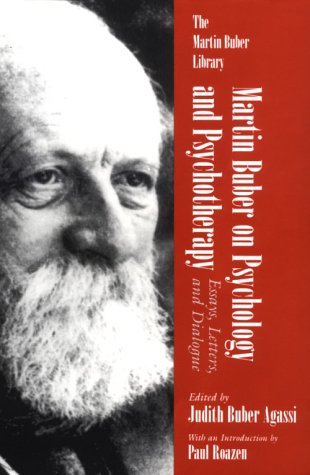
5. Martin Buber on Psychology and Psychotherapy: Essays, Letters and Dialogue (The Martin Buber Library)
Paperback: 256 Pages (1999-06)
list price: US$19.95 -- used & new: US$12.94
(price subject to change: see help)
Asin: 081560596X
Average Customer Review: 4.0 out of 5 stars
Canada | United Kingdom | Germany | France | Japan

Customer Reviews (1)

4-0 out of 5 stars Martin Buber's contribution to physchology and phychotherapy
This new title is most interesting for those of us who are aware of Martin Buber's many sided interests and his philososophical contributions to physchology and phychotherapy. The book contains essays he wrote over theyears, his connection and exchange of thoughts and opinions with Jung andmany others. The final chapter is the dialogue about the history of theunconscious . Altogether a most interesting and inspiring read. ... Read more


6. Martin Buber's I and Thou: Practicing Living Dialogue
by Kenneth Paul Kramer
Paperback: 240 Pages (2004-01-05)
list price: US$19.95 -- used & new: US$12.86
(price subject to change: see help)
Asin: 0809141582
Average Customer Review: 5.0 out of 5 stars
Canada | United Kingdom | Germany | France | Japan
Editorial Review

Book Description
Martin Buber's classic philosophy of dialogue, I and Thou, is at the core of Kenneth Paul Kramer's scholarly and impressive Living Dialogue: Practicing Buber's I and Thou. In three main parts, paralleling the three of I and Thou, and focusing upon Buber's key concepts --"nature," "spirit becoming forms," "true community," the "real I," the "eternal Thou," "turning,"--and the two fundamental dialogues--the "I-Thou" and the "I-It"--the book clarifies, puts into practice and vigorously affirms the moral validity of Buber's philosophy, with its extension to love, marriage, the family, the community, and God, in the conviction that "genuine dialogue" will effect better relations with one another, the world and God.

Well-researched, and replete with a glossary of Buberian terms, practice exercises for true dialoguing, and discussion questions, Living Dialogue emerges as an invaluable guide to I and Thou.

Highlights:

· a lens through which to see and understand the philosopher and his work anew · a must-read for undergraduates, as well as relationship counselors, therapists, and general readers, who will benefit from the work's clarity and ease of expression · includes a foreword by Maurice Friedman ... Read more

Customer Reviews (1)

5-0 out of 5 stars A Classic Companion
Martin Buber's I and Thou: Practicing Living Dialogue is an excellent introduction and overview of Buber's I and Thou.Kenneth Kramer is extremely readable and conveys complex ideas in a manner that allows the reader to grasp the concepts with much more facility.Through the use of illustrations, referencing other work by Buber, side by side exerpts of Smith's and Kaufmann's translations, and additional insights offered by Kenneth Kramer and Mechthild Gawlick, Buber's challenging masterpiece is presented in a way that is engaging and understandable.I highly recommend this book to anyone who is looking for a "user friendly" introduction to Buberian thought.It is a great resource for students and teachers of philosophy,theology, or modern thought.This book made such an impact upon me, that I am keeping multiple copies on hand so that I don't have to lend my own. ... Read more


7. Ecstatic Confessions: The Heart of Mysticism (Martin Buber Library)
Paperback: 160 Pages (1996-09)
list price: US$19.95 -- used & new: US$10.00
(price subject to change: see help)
Asin: 081560422X
Average Customer Review: 5.0 out of 5 stars
Canada | United Kingdom | Germany | France | Japan

Customer Reviews (2)

5-0 out of 5 stars Commotion and unity
This is one of those rare anthologies that is worth its price more for the editor's introductory remarks than for the anthologized essays.Don't misunderstand me.Buber does a wonderful job of selecting mystical "ecstatic confessions" from the world's religious traditions.He includes passages from writers such as Rumi, Rabia, Symeon the New Theologian, Hildegard of Bingen, the Beguines, Julian of Norwich, and Catherine of Siena, as well as representative selections from works such as the Mahabharata.For the most part the selections are judicious--although, because the book was published in 1909, twentieth century mystics such as Simone Weil and Thomas Kelley naturally aren't included.Curiously, too, only a tiny snippet from Meister Eckhart makes it into Buber's book.

But what really makes the book invaluable is Buber's Introduction, in which he spells out his distinction between the "commotion" that distracts us from a unitive experience of God and the nature of the "unity" sought by the mystics.The distinction is one that, under the guise of other terms (such as "many" and "one") is well-known in mystical literature.But Buber's beautiful prose, and especially his sensitivity to the importance of silence, are unmatchable.Here's an example (p. 7):"Silence is our symbolon which protects us from the gods and angels of the commotion, our guard against its aberrations, our purification against its purity.We ensilence our experience, and it is a star that travels along its path.We speak it, and it is thrown down under the thread of the market."

A book that deserves to be better known.

5-0 out of 5 stars Encounters with the Divine
Martin Buber gives us collected writings of well known and unknown mystics.First published in German in 1909 this wonderful work gives a good introduction for anyone who wants more knowledge and confirmation ofthe existence of the Divine in our finite lives. LK 11:9 "And I tellyou, ask and you will receive; seek and you will find; knock and the doorwill be opened to you.Other works that have passed the test of times are"The Interior Castle:St.Theresa of Avila", "Dark Night of the Soul:St.John of the Cross", "The Dialogue of Saint Catherine of Siena" and "TheSpiritual Life:Evelyn Underhill. ... Read more


8. Good and Evil
by Martin Buber
Paperback: 143 Pages (1980-12-01)
list price: US$14.00 -- used & new: US$12.47
(price subject to change: see help)
Asin: 0023162805
Average Customer Review: 5.0 out of 5 stars
Canada | United Kingdom | Germany | France | Japan

Customer Reviews (2)

5-0 out of 5 stars Profound & Deep
After reading several Carl Rogers books and papers I was led to Martin Buber's works.Martin Buber was one of the most profound thinkers of our times. Not an easy read but a one well worth the time and effort.Illuminating and insight on the subject of good and evil.

5-0 out of 5 stars A oasis in the dryness of my time
There is a sense that this is one of the most important book in my life.I have re-read it for the last 3 summers and i have found different things that i needed.Buber has a distinct method of communication that pullsfrom you who you are... i hear his subtlety in my ear even now.Buber isbrilliant. ... Read more


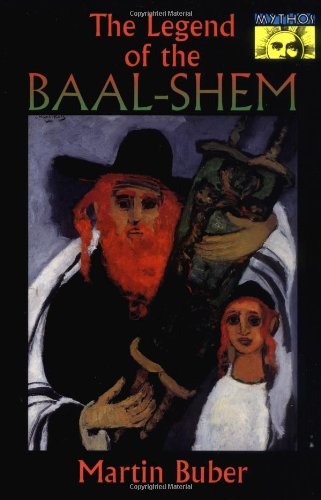
9. The Legend of the Baal-Shem
by Martin Buber
 Paperback: 223 Pages (1995-04-17)
list price: US$19.95 -- used & new: US$7.94
(price subject to change: see help)
Asin: 0691043892
Average Customer Review: 3.5 out of 5 stars
Canada | United Kingdom | Germany | France | Japan
Editorial Review

Book Description

The Jewish philosopher Martin Buber spoke directly to the most profound human concerns in all his works, including his discussions of Hasidism, a mystical-religious movement founded in Eastern Europe by Israel ben Eliezer, called the Baal-Shem (the Master of God's Name). Living in the first part of the eighteenth century in Podolia and Wolhynia, the Baal-Shem braved scorn and rejection from the rabbinical establishment and attracted followers from among the common people, the poor, and the mystically inclined. Here Buber offers a sensitive and intuitive account of Hasidism, followed by twenty stories about the life of the Baal-Shem. This book is the earliest and one of the most delightful of Buber's seven volumes on Hasidism and can be read not only as a collection of myth but as a key to understanding the central theme of Buber's thought: the I-Thou, or dialogical, relationship.

"All positive religion rests on an enormous simplification of the manifold and wildly engulfing forces that invade us: it is the subduing of the fullness of existence. All myth, in contrast, is the expression of the fullness of existence, its image, its sign; it drinks incessantly from the gushing fountains of life."--Martin Buber, from the introduction

... Read more

Customer Reviews (5)

1-0 out of 5 stars This is Not the Best Choice
I was originally drawn to Judaism by Martin Buber's wonderful "Tales of the Hasidim" (which has a good section on the Baal Shem Tov). But Buber disavowed his earlier "Legend of the Baal Shem" because it was too flowery and departed too far from the original material; it is also only a mere snippet from the sources. My book "The Light and Fire of the Baal Shem Tov," which is the only comprehensive book on the founder of Hasidism, is a better choice. I'm sure Buber would agree. (Although it's a big book and may be daunting to a beginner.) -- Yitzhak Buxbaum

5-0 out of 5 stars A Hasid on the great founder of Hasidism
Buber is the Jewish teacher who more than any other helped bring the attention of the West to Hasidism. The Baal Shem Tov (1700-1760)is the founding teacher of Hasidism. In this work Buber tells twenty stories of the Baal Shem and reveals to us a world of deep faith, of deep connection of the Jew with nature and all creation, of the special hitlahavut or enthusiasm which the Hasid brings in his relation to the Divine. Buber is a Hasid of Hasidism, and he tells the stories of its great founder with the same kind of enthusiasm the movement itself generated throughout the Jewish world.

1-0 out of 5 stars This book was good for me spiritually....
This book was good for me spiritually: it bored the hell out of me!

5-0 out of 5 stars Greet the day which enchains thee . . .
Martin Buber (1878 - 1965) was a German Jewish philosopher-theologian and one of the most original and influential thinkers of the 20th Century.In this work, he does not set forth his own theology so much as trace one of its roots."The [Hasidic] legend is the myth of I and Thou [the title of Buber's most famous work], of the caller and the called, the finite which enters into the infinite and the infinite which has need of the finite." (13)Buber provides a brief introduction and an essay on the spiritual life of the Hasidim (both written in somewhat difficult, mystical language), but the bulk of this book is Buber's retelling of 20 stories from the life of the Ba'al Shem Tov.The stories are beautiful, told in simple and direct language, and convey the lessons that the Ba'al Shem taught (or was taught -- the Ba'al Shem occasionally errs himself and has to be guided back to the correct path).The lessons are about living with dedication, uniting with God in joy, overcoming the evil impulse, and finding the holy in everything around us.Greet the day which enchains thee . . . art thou not already freed?

These stories are for everyone who is interested in the mystical experience.You will need to have some basic background in Kabbala to understand some aspects of some of the stories (the chapter on Kabbala in Barry Holtz' "Back to the Sources" is probably enough), and you may want to review the Glossary before starting on the stories if you are not familiar with basic Jewish religious terms.Highly recommended.

5-0 out of 5 stars Beautiful
Buber begins the book by giving an introduction to the Hasidim, the ultra-orthodox, mystically inclined branch of Judaism founded by Rabbi Israel ben Eliezer, a.k.a. the Baal-Shem Tov (which literally means"master of the good name" = master of God's name).Buber thenproceeds to relate 20 stories/legends about the Baal-Shem's life andteaching, followed by a glossary of the key terms in the book.

Thewonderful thing about this book is its beautiful, poetic simplicity.Thelanguage is poetic, and the stories are profound because they show that inthe middle of the 1700's, God became a vibrant, living reality to a groupof common folk in eastern Europe."God desires the heart,"taught the Baal-Shem.

On a personal note, this book opened my eyes to aside of both life and God that I have never seen before.Live life withjoy and humility, live it deeply and with passion.God rejoices and danceswith us in our joy.

"God desires the heart."How simple, yethow utterly profound. ... Read more


10. I and Thou
by Martin Buber
 Paperback: 137 Pages (1958)

Asin: B000NQA4PM
Canada | United Kingdom | Germany | France | Japan

11. I & Thou 2ND Edition
by Martin Buber
 Paperback: Pages (1958)

Asin: B000Q0VRWE
Average Customer Review: 5.0 out of 5 stars
Canada | United Kingdom | Germany | France | Japan

Customer Reviews (1)

5-0 out of 5 stars It deserves 10 stars!
Martin Buber's "I and Thou" has long been acclaimed as a classic. Many prominent writers have acknowledged its influence on their work; students of intellectual history consider it a landmark; and the generation born since World War II considers Buber as one of its prophets.
"The publication of Martin Buber's 'I and Thou' a quarter of a century ago was a great event in the religious life of the West." -- Reinhold Niebuhr ... Read more


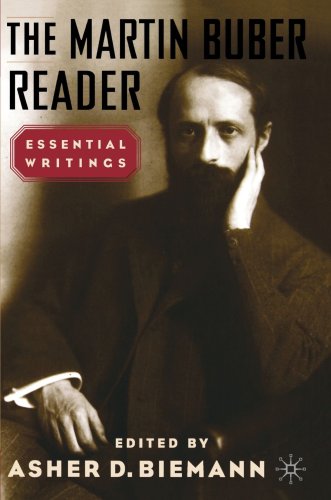
12. The Martin Buber Reader
Paperback: 288 Pages (2002-09-21)
list price: US$29.95 -- used & new: US$27.14
(price subject to change: see help)
Asin: 0312292902
Canada | United Kingdom | Germany | France | Japan
Editorial Review

Book Description
There is no adequate understanding of contemporary Jewish and Christian theology without reference to Martin Buber. Buber wrote numerous books during his lifetime (1878-1965) and is best known for I and Thou and Good and Evil. Buber has influenced important Protestant theologians like Karl Barth, Emil Brunner, Paul Tillich, and Reinhold Niebuhr. His appeal is vast--not only is he renowned for his translations of the Hebrew Bible but also for his interpretation of Hasidism, his role in Zionism, and his writings in psychotherapy and political philosophy.In addition to a general introduction, each chapter is individually introduced, illuminating the historical and philosophical context of the readings. Footnotes explain difficult concepts, providing the reader with necessary references, plus a selective bibliography and subject index. ... Read more


13. Good and Evil, Two Interpretations: !. Right and Wrong 11. Images of Good and Evil
by MARTIN BUBER
 Paperback: Pages (1953)

Asin: B000GK0W0M
Canada | United Kingdom | Germany | France | Japan

14. On Zion: The History of an Idea (Martin Buber Library)
by Martin Buber
Paperback: 165 Pages (1997-09)
list price: US$16.95 -- used & new: US$10.41
(price subject to change: see help)
Asin: 0815604823
Canada | United Kingdom | Germany | France | Japan

15. Between Man and Man (Routledge Classics)
by Martin Buber
Paperback: 320 Pages (2002-05-03)
list price: US$17.95 -- used & new: US$10.90
(price subject to change: see help)
Asin: 0415278279
Average Customer Review: 3.5 out of 5 stars
Canada | United Kingdom | Germany | France | Japan
Editorial Review

Book Description
Martin Buber believed that life's deepest truth lies in human relationships. In this classic work he puts this belief into practice, applying it to the concrete problems of contemporary society. ... Read more

Customer Reviews (2)

2-0 out of 5 stars Between Man to Man By Martin Burber
I likethis author very much but I have not had time to read this one as I am back in classes at Pfeiffer University.

5-0 out of 5 stars the most important book of my life
I read this book as part of a high school class, and the conversations within our class as a result of it were just amazing.a very deep and spiritual book.buber believes that there are three relationships peoplecan have:relationships between man and things, between man and god, andbetween man and man.to put it simply, to have a relationship with things,you must go to them.to have a relationship with god, god has to come toyou.but in relationships between man and man, we can come to eachother...

read "Dialogue" ... Read more


16. On the Bible
by Martin Buber
 Paperback: 247 Pages (1982-01-13)
list price: US$14.00
Isbn: 0805206914
Canada | United Kingdom | Germany | France | Japan

17. THE WAY OF RESPONSE:MARTIN BUBER
by N.N. GLATZER
 Hardcover: Pages (1966)

Asin: B000J56ENI
Canada | United Kingdom | Germany | France | Japan

18. The Way Of Man: According to the Teaching of Hasidism
by Martin Buber
Paperback: 46 Pages (2000-10-01)
list price: US$6.95 -- used & new: US$14.74
(price subject to change: see help)
Asin: 0806500247
Average Customer Review: 5.0 out of 5 stars
Canada | United Kingdom | Germany | France | Japan

Customer Reviews (5)

5-0 out of 5 stars The wisdom of Buber
Buber is one of the great original thinkers of modern Judaism. He reads here six Hasidic tales and infuses them with his own fundamental perceptions as to the nature of the religious life. He writes with grace and power. And there is in his interpretations and retellings a sense of the holy and the inspired.

5-0 out of 5 stars From the Existential to the Spiritual
Martin Buber has a way of speaking to my heart. He speaks as a human who has always struggled with the cynicism and skeptical spirituality of our age. Yet he has retained a strong faith in God, and a strong faith in God's real presence in our struggling human everyday life. We may not always feel His presence...but in Buber's words we hear another's testimony that God is with us even when He seems absent. In these short parables, Buber introduces us to other humans...ordinary men...who likewise have struggled to walk with God. Their walk is grounded in the existential. But unlike other ways such as Zen, their walk gradually reveals the real presence of God who has been walking with us since day one. It is as if in our faithful walk God gradually becomes trulu felt as walking beside us...and in our hearts.

5-0 out of 5 stars With the depth and simplicity of a true seer...
...Martin Buber encompasses the whole world in the span of 50 pages.He relates new interpretations of a handful of old myths and stories, making each one reflect the individual's personal journey towards enlightenment.Poignant and marvellously efficient and concise in his style and vocabulary, Buber has created a book which is accessible to small children, but which will resonate with anyone even slightly interested in spirituality.It can be read in an hour, and is a book to which I return again and again for guidance and inspiration.Truly, a miracle of a book.

5-0 out of 5 stars short and sweet
41 pages of wisdom from the standpoint of Hasidism (from "hasidut":allegiance, piety)--but Hasidism seen through the heart of Martin Buber.

This too-brief book really asks only one question:why are we here?

Buber responds with thoughts, anecdotes, and reflections, all of it extraordinarily condensed and yet marvelously lucid.

Here are two quotations:

"Our treasure is hidden beneath the hearth of our own home."

"Man was created for the purpose of unifying the two worlds.He contributes towards this unity by holy living, in relationship to the world in which he has been set, at the place on which he stands."

5-0 out of 5 stars short but powerful taste of Jewish philosophy
This book is comprised of several short essays that are each about ten pages or so in length. It is difficult to explain exactly what the book talks about. But it basically is a series of discussions about what our lives mean in relation to G-d. Why we are here on this planet, how you can think of your life and the lives of others, and lessons from other great Jewish thinkers about these same topics. I read this book, which is tiny and small, maybe 80 or so pages, and it changed my life. It opened for me a new way to explore my Jewish identity that was discrete from the mechanics of the religious observances. I am now very interested in Jewish philosophy and epistemology and want to read further. I would highly, highly recommend this book to anyone, Jewish or not. ... Read more


19. Two types of faith;
by Martin Buber
 Unknown Binding: 177 Pages (1961)

Asin: B0007F0EBS
Average Customer Review: 5.0 out of 5 stars
Canada | United Kingdom | Germany | France | Japan

Customer Reviews (2)

5-0 out of 5 stars A Shift of Emphasis; Communal to Personal Faith
Epilogue; Faith Vs Faith:
Emil Brunner who once said that Buber's discovery and analysis of the I-Thou relationship set up a Copernician revolution in the thinking of the whole of mankind, described Buber's 'faith versus faith' essay as; "An all-out attack on Christianity", and an attempt by Buber to clarify why he came short of becoming a Christian! (Dogmatic Theology, E. Brunner)
It may be that Buber glittering philosophic rhetoric, at once attracted and repelled, despite his literary talent, as his best analytical critic, Monsignor Oesterreicher described him, borrowing william James useful taxonomy, "Buber seemed 'tender minded' to one whose nature and philosophical nurture honor by preference 'tough minded' thinkers!

A shift Of emphasis:
It may be to my support for Amazon.com readership and the theologically trained Practical.Org review visitors, to recall a similar reaction to mine, by Thieme, a German theologian.
The late Karl Thieme joined Catholicism, leaving his Lutheran Church due to the latter adjustment to Nazi policy, excluding clergy of Jewish origins from its service. Thieme, rejecting the 'two types of faith' whimsical view, asserted that Christian's faith differed from Jewish faith by a 'Shift of emphasis.' He criticized Buber's reading of Paul's theology, encountering in his letter to the Romans 'A wrathful God' rather than 'A Loving Father.'
"I am saddened that Buber's aversion to Paul was so strong that he was unable to appreciate the Apostle's loving avowal of God's special bond to His people in Romans 9 to 11...I am at a loss to understand why Buber did not give Paul the regard that is his due.' comments Oesterreicher on Thieme parallel views.

Buber's faith Vs Torah:
In his exploration of the 'two forms' of faith, first as a member of community, whose covenant with the unconditioned, trusts in a person, vs. an individual converted to faith, in acceptance of a truth, associating with other converts to form a community.
While Hillel, the great rabbi, held his Golden rule of Jewish faith as; "The whole Torah, and, the rest is commentary," Buber writes, "I do not believe that revelation is ever a formulation of law. It is only through Man in his self-contradiction that revelation becomes legislation." Buber' Letter to Rosenzweig

The Risen Christ:
It is clear why the resurrection was such a stumbling block to Buber, that he took offense debating; "the Jew of Paul's time,...believed in the resurrection of the dead as a great community at the end of time; but the resurrection of an individual was unknown to the Jew from scripture..." Buber's conclusion against the core of Christian faith is : "Theresurrection of an individual (Jesus) is incredible to Jews,"
Shmuel Bergmann, a great Jewish thinker, and a friend of Buber whom he asked to review the manuscript (Two Types of Faith), wrote in 1949; "If the resurrection (of Jesus) really happened, it was such a decisive event-the fact that a human being conquered death-such a new beginning in human history that Paul was right to attribute to faith in that fact a decisive significance."

Martin Buber:
One of the foremost religious thinkers of the twentieth century, M. Buber made a tremendous impact, not only on Jewish but also on Christian thinkers. Reinhold Niebuhr has described him as "the greatest Jewish philosopher of our time"
In nominating Buber for a Nobel Prize in literature in 1949, H. Hesse stated that, "He has enriched world-literature with a genuine treasure as has no other living author."

5-0 out of 5 stars Jewish Emunah and Christian Pistis
Buber outlines here the difference between two kinds of faith the emunah of the Jews, and the pistis of the Christians. In doing so he also writes sympathetically about Jesus who he sees in some way as part of the spiritual history of Israel. For Buber the Jews faith is communal and centers on their persistence in history in continuing their communal religious life. He sees Christianity as having a different kind of faith one which focuses on individuals, and the individual salvation. In his concluding chapter he suggests that in the future each might take a bit more of the character of the other( not in doctrine) but in the Jewish faith becoming more pistis and the Christians moving more toward a communal faith. In the introduction to the work Buber thanks great Christian scholars with whom he was in dialogue, Rudolf Bultmann, Schweitzer, and Rudolf Otto. Clearly he was living and working toward Jewish- Christian dialogue as extension of his belief in the importance of meeting and making relationships with others in which the full humanity of both parties could be lived and expressed.
... Read more


20. Martin Buber, Jewish Existentialist
by Malcolm L. Diamond
 Paperback: Pages (1960)

Asin: B000JV2X50
Canada | United Kingdom | Germany | France | Japan

  1-20 of 100 | Next 20
A  B  C  D  E  F  G  H  I  J  K  L  M  N  O  P  Q  R  S  T  U  V  W  X  Y  Z  

Prices listed on this site are subject to change without notice.
Questions on ordering or shipping? click here for help.

site stats