
|
Help |
| Home - Philosophers - Burke Edmund (Books) | |
e99 Online Shopping Mall
|
|
Help |
| Home - Philosophers - Burke Edmund (Books) | |
| 1-20 of 98 | Next 20 |
click price to see details click image to enlarge click link to go to the store
| 1. Burke's speech on conciliation with America by Edmund Burke, Sidney Carleton Newsom | |
 | Paperback: 176
Pages
(2010-08-09)
list price: US$22.75 -- used & new: US$16.74 (price subject to change: see help) Asin: 1177139774 Canada | United Kingdom | Germany | France | Japan |
|
Editorial Review Product Description | |
| 2. The Portable Edmund Burke (Portable Library) by Edmund Burke | |
 | Paperback: 573
Pages
(1999-07-01)
list price: US$20.00 -- used & new: US$8.84 (price subject to change: see help) Asin: 0140267603 Average Customer Review: 
Canada | United Kingdom | Germany | France | Japan |
|
Editorial Review Product Description Customer Reviews (4)
| |
| 3. A Philosophical Enquiry into the Origin of our Ideas of the Sublime and Beautiful (Oxford World's Classics) by Edmund Burke | |
 | Paperback: 208
Pages
(2009-01-15)
list price: US$15.95 -- used & new: US$5.89 (price subject to change: see help) Asin: 0199537887 Average Customer Review: 
Canada | United Kingdom | Germany | France | Japan |
|
Editorial Review Product Description Customer Reviews (5)
Burke's "Enquiry" is divided into five parts, with an introduction.The introduction is perhaps his most witty segment, as he tries, as Shaftesbury, Addison, and Hume before him, to formulate a standard of Taste, a popular subject of conjecture in the 18th century.Physically, and not without some irony, he chooses to speak of Taste primarily as a feature of eating.In response to his predecessors, though, he does say that since our attitudes toward the world come from our senses, that the majority of people can see (sight being very important) and react; thus all people are capable of some degree of Taste.Education and experience, he must admit, though, do refine Taste.In Part One, Burke examines the individual and social causes which arouse our sense of the sublime and the beautiful, those being the primal feelings of terror/pain and love/pleasure, respectively.Throughout the "Enquiry," Burke insists that these are not opposites strictly speaking - that pain and pleasure are mediated by a neutral state of indifference, which is the natural state of man.(Compare that idea to Hobbes and Locke!) Parts Two, Three, and Four find Burke explaining his notion of the passions in relation to his basis of the physical world.Grandeur, potential threat, darkness, and ignorance for Burke excite our nerves and produce the sublime, a feeling of terror which is simultaneously delightful as long as it does not cause immediate pain.These he finds both in the physical world and in tragedies of literature and history.Smallness, softness, clarity, and weakness delimit the beautiful, which produces affection and sympathy.The contrasts and interventions that Burke makes throughout the "Enquiry" on these bases are variously inflected with issues of anxiety over gender roles, race, and power.Burke's politics give the work a joyful and troubling complexity to the literary minded. Part Five, then, is a look at the effect that words, language, and poetry can have in influencing our affect in regards to the sublime and the beautiful.In it, he gathers together statements he sprinkles throughout the treatise on the nature of poetry - that its emphasis on representation of emotion, rather than imitation of objects, gives it a power that is perhaps unequalled even by nature.In Burke's "Enquiry," one can see a nascent fascination with landscape, mystery, and sensation that would find its flowering in the Gothic and Romantic movements of the late 18th and early 19th centuries.His insistent break with earlier philosphers who combined aesthetics and morality is a serious challenge to moral philosophy with regard to art and Taste.His physical descriptions of emotional response prefigures Freud's psychological ponderings in "Three Essays on Sexuality" and "Beyond the Pleasure Principle," as well as linguistic theory.In all, a fascinating and complicated work for being as short as it is. This review is dedicated to the memory of Vernon Lau.Unfortunately, Burke did not deal in the "Enquiry" with the pain or terror of immediate personal loss.One can only wonder if Burke's obsession with philosophical distance between people and fear wasn't motivated by a loss of his own.
This book can berepetitious as Burke attempts to make, especially on taste, his pointabsolutely clear (I've got one of the later editions -1772.). Additionally, some of the lines in the book are near-timeless andare good to have around to reference from. ... Read more | |
| 4. Reflections on the Revolution in France (Dover Value Editions) by Edmund Burke | |
 | Paperback: 256
Pages
(2006-02-10)
list price: US$6.95 -- used & new: US$3.70 (price subject to change: see help) Asin: 0486445070 Average Customer Review:
Canada | United Kingdom | Germany | France | Japan |
|
Editorial Review Product Description Customer Reviews (4)
| |
| 5. The Works of the Right Honourable Edmund Burke, Vol. 02 (of 12) by Edmund Burke | |
 | Paperback: 284
Pages
(2010-07-12)
list price: US$9.99 -- used & new: US$9.99 (price subject to change: see help) Asin: B003YL3DEM Canada | United Kingdom | Germany | France | Japan |
|
Editorial Review Product Description | |
| 6. Reflections on the Revolution in France (Oxford World's Classics) by Edmund Burke | |
 | Paperback: 352
Pages
(2009-06-15)
list price: US$12.95 -- used & new: US$5.24 (price subject to change: see help) Asin: 0199539022 Average Customer Review: 
Canada | United Kingdom | Germany | France | Japan |
|
Editorial Review Product Description Customer Reviews (3)
| |
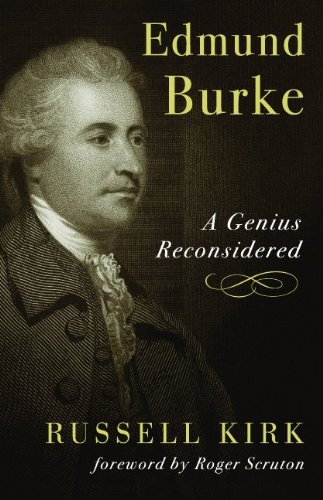
| 7. Edmund Burke: A Genius Reconsidered by Russell Kirk | |
 | Paperback: 300
Pages
(2009-12-17)
list price: US$22.00 -- used & new: US$14.00 (price subject to change: see help) Asin: 1935191764 Average Customer Review:
Canada | United Kingdom | Germany | France | Japan |
|
Editorial Review Product Description Customer Reviews (4)
Edmund Burke: A Genius Reconsidered" does have its good points.It's well-written -- far more accessible than the Conor Cruise O'Brien biography "The Great Melody".(To be fair to O'Brien, his biography is not a straightforward work, but presents Burke's life thematically.)Kirk's book also makes some valid points about Burke's legacy, convincing the reader that Burke's philosophy is underappreciated by modern audiences.But a more balanced approach to Burke's life - without all the Great Man gloss -- would have made this point just as effectively.
| |
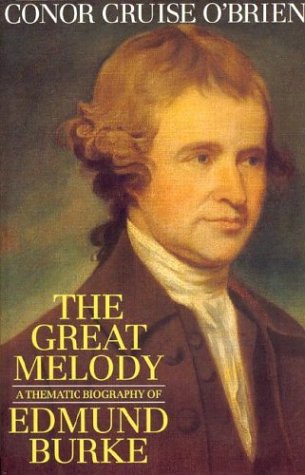
| 8. The Great Melody: A Thematic Biography of Edmund Burke by Conor Cruise O'Brien | |
 | Paperback: 768
Pages
(1994-03-20)
list price: US$35.00 -- used & new: US$26.99 (price subject to change: see help) Asin: 0226616517 Average Customer Review: 
Canada | United Kingdom | Germany | France | Japan |
|
Editorial Review Product Description Customer Reviews (8)
O'Bien's book takes an in-depth look at Burke's career in parliament and as a member of the Whig party through an extensive analysis of his letters, speeches, political relationships, and writings, specifically, as they relate to his struggle on behalf of the American colonists, the struggle of the Irish Catholics, the people of India suffering at the hands of the rapacious East India Co., and the French Revolution. The work can be a little dry at times and tends to quote in an overly lengthy manner, but the immense erudition and scholarship and the insightful picture of Burke that emerges more than compensate for this.I do wish, however, that O'Brien had spent more time on "Reflections On The Revolution in France," but he feels that since it is so readily available to the reader there is no need. Finally we see an Edmund Burke as he really was and not the "old reactionary" that is so often depicted.We come to understand that Burke always believed that "the people are the true legislator," that Burke did not want to see Americans in Parliament who were slave holders, that he was a life-long opponent of increased powers for the Crown and the corruption such power entailed, that he was one of the few who consistently fought against injustice toward the American colonials, that he found all authoritaianism abhorrent, and that he opposed commercial monopolies and the abuse of power in all its forms.But, because he opposed the overturning of society and its reengineering on the basis of "metaphysical abstractions," he was often portrayed as a reactionary by later pundits.Lewis Namier and his followers are particularly taken to task by O'Brien for this tendency.In the end we see a Burke who always supported basic human rights, but remained constantly aware that real life circumstances must make social and political change possible if such change is not to lead to chaos and violence.Burke's fear of radicalism based upon abstract theory was real and the destructiveness of the French Revolution, the Russian Revolution, and the Nazi bio-racial religion more than sufficiently proves his point.A reading of O'Brien's fine book can only lead the intelligent reader to a renewed respect for a great man, a decent and liberal minded man, and a man of immense vision.
O'Brien, the great man of Irish diplomacy, shows in this extraordinary book that Burke, whom recently history has shown as a fawning servant to the political leaders of his time (Rockingham and Pitt), was at the heart of the great fight between George III's royal absolutism and the emerging English democracy. Burke was on the right side of virtually all the fights he picked. He advocated equality before the law for the Irish subjects of the king, first tolerance and then freedom for the American colonies, the end of the colonialist abuses of the East India company, and a quarantine on the infectious ideas of the French Revolution. The later one is still a contentious affair. Zhou En Lai famously opined that it was still too early (in the 1970s) to judge the French Revolution. Burke would have had none of that. As early as 1790, in the "benign" initial phase of the revolution, he foresaw the Terror, the execution of the Royal Family, the Consulate and the Empire, and the French banner covering all of the Europe, in the name of "Liberty, Equality, Fraternity". O'Brien shows the extraordinary situation of an Irish Protestant (always accused of crypto-Catholicism) having great informal influence on the politics of Great Britain, while holding menial offices or representing various "rotten boroughs" in Parliament (this is no aspersion on Burke's memory- that's how politics was done at the time, and anything that gave Burke a pulpit couldn't have been all bad). The "Great Melody" of the title provides the underlying themes around which O'Brien organizes the public part of Burke's life. Far from tiresome, this is a useful device that provides unity and coherence to Burke's thoughts and actions. O'Brien's attacks on mid-century historiography are perfectly adequate, given that much of what was written as that period was designed to regress Burke into irrelevancy, as a sycophant and a lackey. He never was that. He was a good and a great man, and O'Brien does him justice in his book. Perhaps the only fault that I could find in it is a tendency to assume the reader's prior knowledge of the arcanes of Irish history. But these are quibbles. If you can stomach a history of ideas, full of events and studded with memorable characters, this is the book for you. ... Read more | |
| 9. The Best of Burke: Selected Writings and Speeches of Edmund Burke (Conservative Leadership Series) by Peter J. Stanlis | |
 | Hardcover: 697
Pages
(1999-09-25)
list price: US$35.00 -- used & new: US$92.00 (price subject to change: see help) Asin: 089526398X Average Customer Review:
Canada | United Kingdom | Germany | France | Japan |
|
Editorial Review Product Description Customer Reviews (2)
| |
| 10. Our Eminent Friend Edmund Burke: Six Essays by Thomas Wellsted Copeland | |
| Hardcover: 251
Pages
(1970-12-31)
list price: US$51.95 -- used & new: US$51.95 (price subject to change: see help) Asin: 0837133343 Canada | United Kingdom | Germany | France | Japan | |
| 11. The Speeches of the Right Honourable Edmund Burke: On the Impeachment of Warren Hastings. to Which Is Added a Selection of Burke's Epistolary Correspondence ... by Edmund Burke | |
 | Paperback: 572
Pages
(2010-01-11)
list price: US$43.75 -- used & new: US$24.29 (price subject to change: see help) Asin: 1142923207 Canada | United Kingdom | Germany | France | Japan |
|
Editorial Review Product Description | |
| 12. The Works of the Right Honourable Edmund Burke, Vol. 12 (of 12) by Edmund Burke | |
 | Paperback: 258
Pages
(2010-07-12)
list price: US$9.99 -- used & new: US$9.99 (price subject to change: see help) Asin: B003YJF2GG Canada | United Kingdom | Germany | France | Japan |
|
Editorial Review Product Description | |
| 13. Reflections on the Revolution in France (Rethinking the Western Tradition) by Edmund Burke | |
 | Paperback: 368
Pages
(2003-12-01)
list price: US$14.00 -- used & new: US$9.00 (price subject to change: see help) Asin: 0300099797 Average Customer Review:
Canada | United Kingdom | Germany | France | Japan |
|
Editorial Review Product Description Customer Reviews (2)
| |
| 14. A Philosophical Enquiry into the Origins of the Sublime and Beauitful: And Other Pre-Revolutionary Writings (Penguin Classics) by Edmund Burke | |
 | Paperback: 528
Pages
(1999-07-01)
list price: US$17.00 -- used & new: US$7.00 (price subject to change: see help) Asin: 0140436251 Average Customer Review:
Canada | United Kingdom | Germany | France | Japan |
|
Editorial Review Product Description Customer Reviews (1)
| |
| 15. The Works of the Right Honourable Edmund Burke, Vol. 07 (of 12) by Edmund Burke | |
 | Paperback: 254
Pages
(2010-07-12)
list price: US$9.99 -- used & new: US$9.99 (price subject to change: see help) Asin: B003VTZET4 Canada | United Kingdom | Germany | France | Japan |
|
Editorial Review Product Description | |
| 16. The Works of the Right Honourable Edmund Burke, Vol. 04 (of 12) by Edmund Burke | |
 | Paperback: 240
Pages
(2010-07-12)
list price: US$9.99 -- used & new: US$9.99 (price subject to change: see help) Asin: B003YKFR7E Canada | United Kingdom | Germany | France | Japan |
|
Editorial Review Product Description | |
| 17. The Sublime and Beautiful by Edmund Burke | |
 | Paperback: 196
Pages
(2009-11-09)
list price: US$13.95 -- used & new: US$13.95 (price subject to change: see help) Asin: 1928565190 Canada | United Kingdom | Germany | France | Japan |
|
Editorial Review Product Description | |
| 18. A Philosophical Inquiry into the Origin of Our Ideas of the Sublime and Beautiful by Edmund Burke | |
 | Paperback: 92
Pages
(2009-01-01)
list price: US$8.99 -- used & new: US$8.12 (price subject to change: see help) Asin: 1420933698 Canada | United Kingdom | Germany | France | Japan |
|
Editorial Review Product Description | |
| 19. The Works of the Right Honourable Edmund Burke, Vol. 10 (of 12) by Edmund Burke | |
 | Paperback: 218
Pages
(2010-07-12)
list price: US$9.99 -- used & new: US$9.99 (price subject to change: see help) Asin: B003VS0J7M Canada | United Kingdom | Germany | France | Japan |
|
Editorial Review Product Description | |
| 20. The Works of Edmund Burke, all 12 volumes in a single file, improved 8/8/2010 by Edmund Burke | |
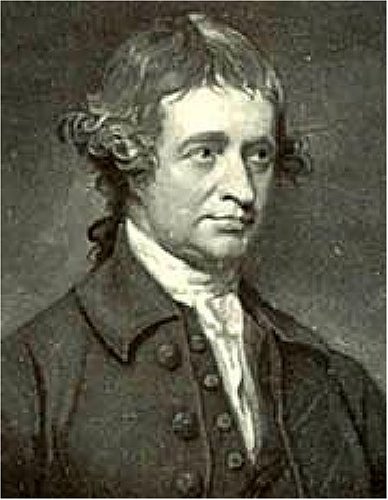 | Kindle Edition:
Pages
(2008-02-01)
list price: US$1.99 Asin: B0013FZ40M Canada | United Kingdom | Germany | France | Japan |
|
Editorial Review Product Description | |
| 1-20 of 98 | Next 20 |
 Broad but emasculated coverage
 This man is a hack!