e99 Online Shopping Mall

Geometry.Net - the online learning center Help  
Home  - Philosophers - Derrida Jacques (Books)

  Back | 21-40 of 100 | Next 20
A  B  C  D  E  F  G  H  I  J  K  L  M  N  O  P  Q  R  S  T  U  V  W  X  Y  Z  

click price to see details     click image to enlarge     click link to go to the store

$41.17
21. Between Deleuze and Derrida
$21.73
22. Futures: Of Jacques Derrida (Cultural
$20.00
23. The Animal That Therefore I Am
$17.94
24. Given Time: I.Counterfeit Money
$15.29
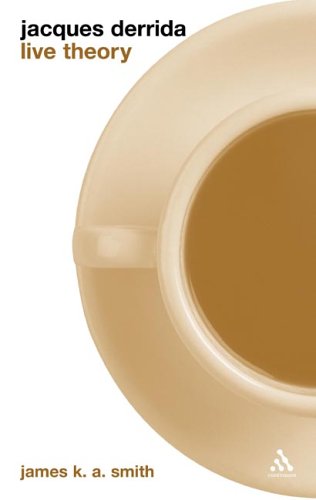
25. Jacques Derrida: Live Theory
$48.00
26. Veils (Cultural Memory in the
$24.95
27. Derrida and Negative Theology
$23.99
28. Archive Fever: A Freudian Impression
$10.00
29. Of Spirit: Heidegger and the Question
$15.98
30. Deconstruction in a Nutshell:
 
$83.22
31. Routledge Philosophy Guidebook
$7.51
32. Introducing Derrida, 3rd Edition
$9.15
33. The Politics of Friendship (Radical
$6.68
34. How to Read Derrida (How to Read)
$21.90
35. Edmund Husserl's "Origin of Geometry":
$27.71
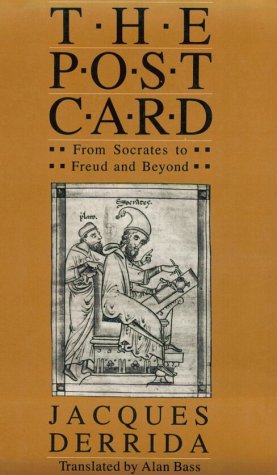
36. The Post Card: From Socrates to
$9.15
37. The Work of Mourning
$18.60
38. Spurs: Nietzsche's Styles/Eperons:
$18.00
39. Jacques Derrida and the Humanities:
 
$95.00
40. Jacques Derrida (Routledge Critical

21. Between Deleuze and Derrida
Paperback: 224 Pages (2003-05)
list price: US$49.05 -- used & new: US$41.17
(price subject to change: see help)
Asin: 0826459730
Average Customer Review: 4.0 out of 5 stars
Canada | United Kingdom | Germany | France | Japan
Editorial Review

Book Description
Gilles Deleuze and Jacques Derrida are the two leading philosophers of French post-structuralism. Both theorists have been widely studied but very little has been done to examine the relation between them. Between Deleuze and Derrida is the first book to explore and compares their work. This is done via a number of key themes, including the philosophy of difference, language, memory, time, event, and love, as well as relating these themes to their respective approaches to Philosophy, Literature, Politics and Mathematics.

Contributors:
Eric Alliez, Branka Arsic, Gregg Lambert, Leonard Lawlor,Alphonso Lingis, Tamsin Lorraine, Jeff Nealon, Paul Patton, Arkady Plotnitsky, John Protevi, Daniel W. Smith ... Read more

Customer Reviews (1)

4-0 out of 5 stars Derrida, Deleuze and their Difference
Paul Patton and John Protevi have provided us with a collection of studies which not only constitutes a promising starting point for comparing and contrasting the thought of Derrida and Deleuze, but also with fertile ground for further (re)search on the issues raised.

If Derrida and Deleuze appear to be strangers - despite having lived in Paris, it is because, as Agamben has claimed, they seem to be following two unlike intellectual trajectories, namely, that of "transcendence" with Derrida - and Levinas, and that of "immanence" with Deleuze - and Nietzsche, a tradition going back to Spinoza. Despite their differences, they both seem concerned with developing a non-Hegelian philosophy of difference, that is, a non-dialectical difference.

It is around such discussions that the collection is organized. In particular, Patton explores the ethico-political orientation with respect of the future with emphasis on the open construction of "future"; Lorraine further explores conceptualizations of "time" in Derrida and Deleuze. Smith follows Agamben's thesis and provides additional evidence, a claim that Lawlor skillfully counters. Alliez explores ways Plato has been understood by Derrida in 'Plato's Pharmacy' and Deleuze in 'Plato and the Simulacrum'. Plotnitsky identifies a common mathematical reference and inspiration although Derrida's approach is algebraic and Deleuze's is primarily geometric. With Lambert the concern is literature and re-presentation, a theme equally discussed by Arsic with reference to Melville. Nealon exposes the developments and inspirations found in cultural studies with an emphasis on the non-coincidence between language and that which it signifies, which Lingis sees as an opportunity to escape from interpretation. The closing paper by Protevi explores the notion "experience" in relation to "love": 'love as experience of aporia for Derrida' v. 'love as exercise in depersonalization for Deleuze' (p. 13).

Overall, a very important contribution to discussions surrounding Derrida and Deleuze, that is well edited and accessible. ... Read more


22. Futures: Of Jacques Derrida (Cultural Memory in the Present)
Paperback: 272 Pages (2002-03-01)
list price: US$21.95 -- used & new: US$21.73
(price subject to change: see help)
Asin: 0804739560
Canada | United Kingdom | Germany | France | Japan
Editorial Review

Book Description

Seven eminent authors, all known for their work in deconstruction, address the millennial issue of our “futures,” “promises,” “prophecies,” “projects,” and “possibilities”—including the possibility that there may be no “future” at all. Speculative in every sense, these essays are marked by a common concern for the act of reading as it is practiced in the work of Jacques Derrida. The contributors—Geoffrey Bennington, Paul Davies, Peter Fenves, Werner Hamacher, Jean-Michel Rabaté, Elisabeth Weber, and Jacques Derrida himself—study a range of authors, including Pascal, Kant, Hegel, Leibniz, Marx, Benjamin, Koyré, Arendt, and Lacan.

These readings are neither prescriptive, definitive, nor definitional. Each essay seeks out, in the work it studies, those moments that pronounce or propose futures that enable speculation, moments in which the speculator has to make promises. As Derrida says in his essay, “Between lying and acting, acting in politics, manifesting one’s own freedom through action, transforming facts, anticipating the future, there is something like an essential affinity. . . . The lie is the future.” Or, in the words of Werner Hamacher, “The futurity of language, its inherent promising capacity, is the ground—but a ground with no solidity whatever—for all present and past experiences, meanings, and figures which could communicate themselves in it.”

These essays, though arising from deconstruction, point out the ways in which deconstruction has yet to occur, and they do so by scanning the unattainable horizons marked off by thinkers at the forefront of our modern era.

... Read more

23. The Animal That Therefore I Am (Perspectives in Continental Philosophy)
by Jacques Derrida
Paperback: 192 Pages (2008-04-15)
list price: US$20.00 -- used & new: US$20.00
(price subject to change: see help)
Asin: 082322791X
Canada | United Kingdom | Germany | France | Japan
Editorial Review

Book Description
The Animal That Therefore I Am is the long-awaited translation of the complete text of Jacques Derrida’s ten-hour address to the 1997 Cérisy conference entitled “The Autobiographical Animal,” the third of four such colloquia on his work. The book was assembled posthumously on the basis of two published sections, one written and recorded session, and one informal recorded session.The book is at once an affectionate look back over the multiple roles played by animals in Derrida’s work and a profound philosophical investigation and critique of the relegation of animal life that takes place as a result of the distinction—dating from Descartes—between man as thinking animal and every other living species. That starts with the very fact of the line of separation drawn between the human and the millions of other species that are reduced to a single “the animal.” Derrida finds that distinction, or versions of it, surfacing in thinkers as far apart as Descartes, Kant, Heidegger, Lacan, and Levinas, and he dedicates extended analyses tothe question in the work of each of them.The book’s autobiographical theme intersects with its philosophical analysis through the figures of looking and nakedness, staged in terms of Derrida’s experience when his cat follows him into the bathroom in the morning. In a classic deconstructive reversal, Derrida asks what this animal sees and thinks when it sees this naked man. Yet the experiences of nakedness and shame also lead all the way back into the mythologies of “man’s dominion over the beasts” and trace a history of how man has systematically displaced onto the animal his own failings or bêtises. The Animal That Therefore I Am is at times a militant plea and indictment regarding, especially, the modern industrialized treatment of animals. However, Derrida cannot subscribe to a simplistic version of animal rights that fails to follow through, in all its implications, the questions and definitions of “life” to which he returned in much of his later work. ... Read more


24. Given Time: I.Counterfeit Money
by Jacques Derrida
Paperback: 182 Pages (1994-09-01)
list price: US$21.00 -- used & new: US$17.94
(price subject to change: see help)
Asin: 0226143147
Average Customer Review: 3.0 out of 5 stars
Canada | United Kingdom | Germany | France | Japan
Editorial Review

Book Description

Is giving possible? Is it possible to give without immediately entering into a circle of exchange that turns the gift into a debt to be returned? This question leads Jacques Derrida to make out an irresolvable paradox at what seems the most fundamental level of the gift's meaning: for the gift to be received as a gift, it must not appear as such, since its mere appearance as gift puts it in the cycle of repayment and debt.

Derrida reads the relation of time to gift through a number of texts: Heidegger's Time and Being, Mauss's The Gift, as well as essays by Benveniste and Levi-Strauss that assume Mauss's legacy. It is, however, a short tale by Baudelaire, "Counterfeit Money," that guides Derrida's analyses throughout. At stake in his reading of the tale, to which the second half of this book is devoted, are the conditions of gift and forgiveness as essentially bound up with the movement of dissemination, a concept that Derrida has been working out for many years.

For both readers of Baudelaire and students of literary theory, this work will prove indispensable.
... Read more

Customer Reviews (2)

5-0 out of 5 stars A matrix of Derrida's early programmatic texts and thought
If there could be such a thing as a text that 'exemplifies' Derrida's thought, one that meticulously and clearly explains the strategies of 'deconstruction,' while at the same time distilling not just its own theory, but also producing a critical reading of several other prominent thinkers and their texts (and one that of course demonstrates the practical ends of the exposé of his theory), then "Given Time" ("Donner le temps") would unequivocally be that book. It is that good. In fact, it is superb. For those who have read Derrida's texts of the late 60s and early 70s, and know where they stand regarding Derrida's ideas, this book acts like a kind of overview or survey of his thought, a matrix or map of his thought, an architectural plan, even a game plan.

The primary text is a story by Baudelaire, and Derrida uses this two-page story to explicate the relations he has with his own masters, the lessons learned and the major points that he has taken from them and transformed. Husserl on the notion of the gift and the necessity to zigzag (a "Zick-Zack" or "mouvement en vrille") between bound and free idealities; Heidegger on being and temporality and the impossibility of appropriation or presence; Bataille on excess. All through a refreshing reading of Baudelaire's story together with Mauss' seminal essay from 1923 "The Gift: The Form and Reason for Exchange in Archaic Societies" (often considered the most influential work of anthropology, focusing on the social customs of exchange and the obligation to reciprocate) which conceives of a total social fact of gifting that Bataille had himself begun to unhinge in his 1949 "The Accursed Share" by implicitly laying waste to Hegel's philosophical economy - a multivolume work that was itself greatly influenced by "The Gift."

From a map of thought to Derrida's Joycean world
"Given Time" is a brief treatise on the layered notions of the 'gift' in several important works (in Husserl, it means what is given to us in the world through the 'immediate experience' of our senses; in Husserl's phenomenological reduction or "epoche" what is intended is separated from what is given. Derrida, in his earliest critical works on Husserl, analyzes the conceptual foundations of the intuition/intention relationship, and while he critiques Husserl's formal limits of the two, he nevertheless maintains that the "epoche" remains "the principal of principals" for transcendental phenomenology, and as such is also indispensable for his own work. However, via Heidegger, Derrida will insist that in every act of being given there remains by necessity an aspect of the gift that holds itself back, is not given, and that gives nothing - the flipside of giving, as Deleuze noted, is theft. This temporizing aspect of the gift is reflected in Derrida's title "Given Time"). Derrida's thesis is that giving is only possible through a splintered 'time' of originary difference, which produces a doubling-effect of the notion of the 'origin,' and which means that the only possibility of authenticity will always be that of inauthenticity, which doubles and splits the difference. In other words, contamination occurs between the concepts of authenticity and inauthenticity: authenticity is impossible without the possibility of inauthenticity. Much like all 'counterfeit money' (which is also the title of Baudelaire's story) you can't tell whether the coin is or isn't truly money that you can buy a commodity with and truly possess something. Is it or isn't it fake? It's a split decision that Derrida patiently explores the 'logic' of. (By the way, art historian Georges Didi-Huberman has written a wonderful book, "Phasmes" (1990), partially translated as "The Phasmid," on deception and pretending; search for it on the net.) This important concept, which also runs throughout Deleuze's work, is a term he calls "the power of the false." But to give credit where it is due, it comes first of all in Heidegger's critique of his own project of a fundamental ontology (very arguably, to my mind) in Section 72 of "The Fundamental Concepts of Metaphysics," where he speaks of the assertive logos as "false," "deceptive," and "pretending," and discusses the as-structure that will be so crucial for all of Derrida's work - in fact his explication of the true/false pair in "Given Time" explains this operative concept of 'relation' without naming it. 'Relation' is one of the most important concepts in Derrida's thought, and he explicates it at length in "Given Time." Derrida shows how there is indeed a beyond to the binary couple of truth and falsity, authenticity and inauthenticity, by exploring a catachresis that simultaneously surpasses each of them (suggesting that they are impossibly pure concepts, as each implies the other as its limit) but that also makes their 'false' opposition possible (and that they must therefore mix or contaminate each other). Derrida has given many strategic names to this notion, such as originary difference or différance (which Leonard Lawlor has suggested is Derrida's reinscription of Husserl's notion of intention). This relation of possibility to impossibility is very clearly laid out in "Given Time" ("on one hand"..."on the other hand"), and gives the reader a penetrating insight into the importance that Derrida ascribes here and throughout his work - especially his more recent works "Aporias" (another very clear book of his, and highly recommended), "The Politics of Friendship" and "Cosmopolitanism and Forgiveness" - to the counter-intuitive and non-oppositional relationship between impossibility and possibility (which is an important redrawing of Kant's condition of possibility and the notion of 'limit' and critique).

Also, one can read the entire book as a long commentary on capitalism, one which places Marxian thinkers in an uncomfortable position and that tries to think through capitalism a little bit further from within 'deconstruction': Derrida's most overt attempts at this are 'From restrictive to general economy' of 1966 (a superb essay with a very pretentious title that plays on Einstein's 1905 and 1916 Nobel-prize earning work "Special [aka "Restricted"] and General Theory of Relativity" - although his 1921 Nobel was technically awarded for his "contribution to photoelectrics") and "Specters of Marx," from 1994, with a title that's cribbed from his mentor and colleague Louis Althusser's book "Specters of Hegel" as an homage. One also has to remember that this book was originally a lecture course from c. 1979. Derrida is of course using transcendental phenomenology as the guiding thread to discuss literature and sociology, and makes something really interesting occur in each, along with modifying our concept of capitalism. From anywhere you stand you can see Derrida's French qualities: literature, anthropology, the belief that philosophy has to engage with capitalism if it is to be considered at all relevant. All are relevant to deconstruction, and are considered game for being folded into it, so long as they take you somewhere else, produce different thoughts regarding the world we inhabit, and permit these thoughts to be formalized.

There is no other book written by Derrida that lays out the material and the method so clearly and patiently (although again, "Aporias" is highly recommended). It does assume familiarity with his earliest programmatic works. If one looks at pp. 71-75 of Derrida's brief and incisive "Introduction to Husserl's Origin of Geometry," for example, one glimpses the thematic affinity between that earlier, more programmatic work, and how Derrida's conclusions there are extended in multiple and different directions in "Given Time" (those pages discuss the troubled constitution of ideal objects and how they can always be false and inauthentic in their expression. If Derrida chooses a work of fiction by Baudelaire on counterfeit money, it is in part because all truth must pass through fiction, or to put it differently, the necessary possibility of inauthenticity).

In sum, this is one of Derrida's most elegant and accessible treatises on his own philosophy and how its relations extend to other modes of thought that on the one hand he himself is influenced by, and on the other hand he radicalizes as he engages them. It is a book that thoroughly transforms the interrelated concepts of the gift that exist in separate disciplines - not least of which is philosophy, which is often said to have 'begun' in wonder or amazement at the world and what is supposedly simply presented or given to us. Derrida takes a critical step back (à la Husserl's method of "rückfragen," that attempts to account for the structuring of tradition) to explore how this presencing comes about, and how the 'there is' (es gibt, in German) appears, and then goes a step further to explain how we relate in our everyday, societal lives via an uncanny and counter-intuitive 'structure' or 'logic' (as well as mediated 'experiences') of giving and receiving, and how these open onto the issues of responding responsibly (which is a theme that Derrida explicitly explores in his works on forgiveness and on hospitality).

As to the translation, which is polished and luminous, it is one of the best translations of Derrida's work into English.

1-0 out of 5 stars Typical Deconstructionist Wool-Gathering
Derrida here engages in his usual word-games and cute metaphores, and the result is pointless and nearly incomprehensible, as usual. How exactly is human knowledge furthered in a positive and valuable way by saying things like "The title of the text is the title (without title) of the text"? Nothing but meaningless verbiage... ... Read more


25. Jacques Derrida: Live Theory
by James K. A. Smith
Paperback: 176 Pages (2005-11-30)
list price: US$24.95 -- used & new: US$15.29
(price subject to change: see help)
Asin: 0826462812
Canada | United Kingdom | Germany | France | Japan
Editorial Review

Book Description
"James K.A. Smith has written a lively, sure-footed guide to key landmarks in the immense territory of Derrida's thought .... The task of reading Derrida has only just begun and Smith's book issues an open and congenial invitation to get on with it." Peggy Kamuf, Marion Frances Chevalier Professor of French and Comparative Literature, University of Southern California

Jacques Derrida: Live Theory is a new introduction to the work of this most influential of contemporary philosophers.It covers Derrida's corpus in its entirety - from his earliest work in phenomenology and the philosophy of language, to his most recent work in ethics, politics and religion.It investigates Derrida's contribution to, and impact upon such disciplines as philosophy, literary theory, cultural studies, aesthetics and theology. Throughout, the key concepts that underpin Derrida's thought are thoroughly examined; in particular, the notion of "the Other" or "alterity" is employed to indicate a fundamental continuity from Derrida's earliest to his latest work. The text emphasizes the importance of understanding Derrida's philosophical heritage as the key to understanding the interdisciplinary impact of his project.In the wake of Derrida's death, the book includes an "interview" that interrogates the very notion of "live" theory as a way into the core themes of deconstruction. ... Read more


26. Veils (Cultural Memory in the Present)
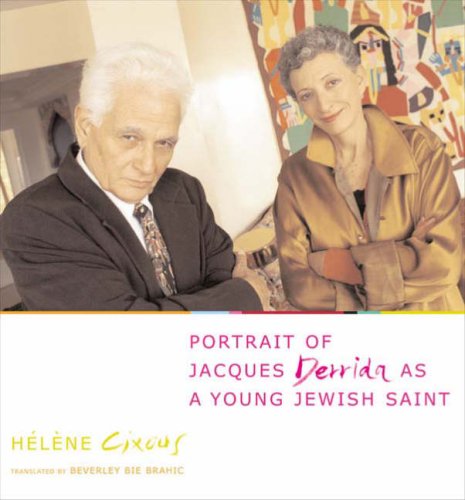
by Helene Cixous, Jacques Derrida
Hardcover: 120 Pages (2002-09-01)
list price: US$48.00 -- used & new: US$48.00
(price subject to change: see help)
Asin: 0804737940
Canada | United Kingdom | Germany | France | Japan
Editorial Review

Book Description

Something of a historical event, this book combines loosely “autobiographical” texts by two of the most influential French intellectuals of our time. “Savoir,” by Hélène Cixous, is a brief but densely layered account of her experience of recovered sight after a lifetime of severe myopia, an experience that ends with the unexpected turn of grieving for what is lost. Her literary inventiveness mines the coincidence in French between the two verbs savoir (to know) and voir (to see). Jacques Derrida’s “A Silkworm of One’s Own” complexly muses on a host of autobiographical, philosophical, and religious motifs—including his varied responses to “Savoir.” The two texts are accompanied by six beautiful and evocative drawings that play on the theme of drapery over portions of the body.

Veils suspends sexual difference between two homonyms: la voile (sail) and le voile (veil). A whole history of sexual difference is enveloped, sometimes dissimulated here—in the folds of sails and veils and in the turns, journeys, and returns of their metaphors and metonymies.

However foreign to each other they may appear, however autonomous they may be, the two texts participate in a common genre: autobiography, confession, memoirs. The future also enters in: by opening to each other, the two discourses confide what is about to happen, the imminence of an event lacking any common measure with them or with anything else, an operation that restores sight and plunges into mourning the knowledge of the previous night, a “verdict” whose threatening secret remains out of reach by our knowledge.

... Read more

27. Derrida and Negative Theology
Paperback: 352 Pages (1992-08-25)
list price: US$24.95 -- used & new: US$24.95
(price subject to change: see help)
Asin: 0791409643
Average Customer Review: 5.0 out of 5 stars
Canada | United Kingdom | Germany | France | Japan

Customer Reviews (1)

5-0 out of 5 stars Summery
Summary


This book explores the thought of Jacques Derrida as it relates to the tradition of apophatic thought--negative theology and philosophy--in both Western and Eastern traditions. Following the Introduction by Toby Foshay, two of Derrida's essays on negative theology, Of an Apocalyptic Tone Newly Adopted in Philosophy and How to Avoid Speaking: Denials, are reprinted here. These are followed by essays from a Western perspective by Mark C. Taylor and Michel Despland, and essays from an Eastern perspective by David Loy, a Buddhist, and Harold Coward, a Hindu. In the Conclusion, Jacques Derrida responds to these discussions.

"So we could say that, rather than measuring deconstruction as a negative theology, we are attempting to gauge the degree to which the modern in its negativity is prefigured by the classical tradition in its own characteristic search for autonomy, to better appreciate the genealogy and disjunction of our era." -- from the Introduction

Harold Coward is Director of the Calgary Institute for the Humanities at the University of Calgary. He is author of Derrida and Indian Philosophy and Jung and Eastern Thought; editor of Modern Indian Responses to Religious Pluralism; and co-author of Hindu Ethics: Purity, Abortion, and Euthanasia, all published by SUNY Press. Toby Foshay is Assistant Professor in the Department of English at the University of Victoria.


Table Of Contents

Acknowledgments

Contributors

1. Introduction: Denegation and Resentment
Toby Foshay

2. Of an Apocalyptic Tone Newly Adopted in Philosophy
Jacques Derrida

3. How to Avoid Speaking: Denials
Jacques Derrida

4. On Not Solving Riddles Alone
Michel Despland

5. nO nOt nO
Mark C. Taylor

6. A Hindu Response to Derrida's View of Negative Theology
Harold Coward

7. The Deconstruction of Buddhism
David Loy

8. Conclusion: Divine Reservations
Morny Joy

9. Post-Scriptum: Aporias, Ways and Voices
Jacques Derrida

Index


... Read more


28. Archive Fever: A Freudian Impression (Religion and Postmodernism Series)
by Jacques Derrida
Hardcover: 128 Pages (1997-01-01)
list price: US$24.00 -- used & new: US$23.99
(price subject to change: see help)
Asin: 0226143368
Average Customer Review: 4.0 out of 5 stars
Canada | United Kingdom | Germany | France | Japan
Editorial Review

Book Description

In Archive Fever, Jacques Derrida deftly guides us through an extended meditation on remembrance, religion, time, and technology—fruitfully occasioned by a deconstructive analysis of the notion of archiving. Intrigued by the evocative relationship between technologies of inscription and psychic processes, Derrida offers for the first time a major statement on the pervasive impact of electronic media, particularly e-mail, which threaten to transform the entire public and private space of humanity. Plying this rich material with characteristic virtuosity, Derrida constructs a synergistic reading of archives and archiving, both provocative and compelling.

"Judaic mythos, Freudian psychoanalysis, and e-mail all get fused into another staggeringly dense, brilliant slab of scholarship and suggestion."—The Guardian

"[Derrida] convincingly argues that, although the archive is a public entity, it nevertheless is the repository of the private and personal, including even intimate details."—Choice

"Beautifully written and clear."—Jeremy Barris, Philosophy in Review

"Translator Prenowitz has managed valiantly to bring into English a difficult but inspiring text that relies on Greek, German, and their translations into French."—Library Journal
... Read more

Customer Reviews (1)

4-0 out of 5 stars the fever that motivates this review...
Anyone who keeps a blog or produces any type of content will find value in understanding the archive. Where does this desire, this passionate fever for remembering arise and what sustains it? The archive has now become an accessible tool that changes the nature of the "event". That is to say that the archive is a door to the future which is waiting to be uncovered or rearranged to create a new logic. It is receptive and passive in the way that its original authors are now capable of answering to the future. The archive isn't an ultimate pronouncement as hidden archives offer archeological evidence for counter-arguments that answer lingering or unasked questions. As personal archivists in our own lives we become aware of the way meaning can be interpreted through our methods of archivation. If you are an archivist and like to record things in order to remember or make permanent the past, you may find Derrida's theories interesting. ... Read more


29. Of Spirit: Heidegger and the Question
by Jacques Derrida
Paperback: 148 Pages (1991-04-09)
list price: US$18.00 -- used & new: US$10.00
(price subject to change: see help)
Asin: 0226143198
Average Customer Review: 4.5 out of 5 stars
Canada | United Kingdom | Germany | France | Japan
Editorial Review

Book Description

"I shall speak of ghost, of flame, and of ashes." These are the first words of Jacques Derrida's lecture on Heidegger. It is again a question of Nazism—of what remains to be thought through of Nazism in general and of Heidegger's Nazism in particular. It is also "politics of spirit" which at the time people thought—they still want to today—to oppose to the inhuman.

"Derrida's ruminations should intrigue anyone interested in Post-Structuralism. . . . . This study of Heidegger is a fine example of how Derrida can make readers of philosophical texts notice difficult problems in almost imperceptible details of those texts."—David Hoy, London Review of Books

"Will a more important book on Heidegger appear in our time? No, not unless Derrida continues to think and write in his spirit. . . . Let there be no mistake: this is not merely a brilliant book on Heidegger, it is thinking in the grand style."—David Farrell Krell, Research in Phenomenology

"The analysis of Heidegger is brilliant, provocative, elusive."—Peter C. Hodgson, Religious Studies Review
... Read more

Customer Reviews (3)

4-0 out of 5 stars Lecture on Heidegger's Spirit
The question of Heidegger and politics has plagued (and will continue to plague) continental philosophy since Heidegger's induction into the Recktorship under the Nazi regime in the thirties.

Why did he? But, and perhaps more importantly, why does something like Nazism come up? What is it about the West that breeds this kind of pathological racism? And how could Heidegger, for all his time concerned with, and working on authenticity and inauthenticity get swept up in the most inauthentic political movement of the century?

For Derrida, this kind of fascistic-nationalistic racism is not a problem of facticity, it is a problem of Spirit (Geist). Heidegger avoids the question and problem of Spirit, and it is a failure of his fundamental ontology and onto-theology.

This is a fascinating lecture from the late Derrida, who investigates Heidegger in new and unfamiliar modes. He relates (what he and the majority of others perceives to be) Heidegger's avoiding (vermeiden), of the question of Spirit ( Hegelian Geist). Avoiding means the saying without saying, the writing without writing, using words, without using them.

"No one ever speaks of spirit in Heidegger" (pg.4), well now Derrida has provided us with the speaking.

"The question of spirit must be recognized in indifference" (pg. 19), and Derrida performs this with remarkable coolness, though not lucidity.

This lecture is about spirit, about politics, about Europe, and about language. All students of Heidegger should read it, as it is one of the best.

4-0 out of 5 stars Watch out for the whole world, not just for politics.
If you read this book, you might notice how one century tends to follow another, but certain problems could crop up, particularly in places which don't define the world quite like we do, philosophically or religiously.I expected to spend a full weekend trying to figure out what this book has to say, but it dropped right into my preconceptions.

Some questions are more unsettling than others, and the question of spirit in Heidegger is worse when Derrida makes it perfectly clear that Heidegger knew how to avoid the question in purely philosophical works, firstly in Sein und Zeit, but treated spirit like a bandwagen that "the leap" (p. 32) would land on for those "in the movement of an authentication or identification which wish themselves to be properly German" (p. 33) in his famous Rectorship Address six years later, in 1933.The key paragraph of that address pictures the Germans, for whom the "will to essence creates for our people its most intimate and extreme world of danger, in other words its true spiritual world."(p. 36)My confusion about this doesn't really start until page 41, where "Spirit is its double."The consideration moves to the Einfuhrung (1935) which "repeats the invocation of spirit launched in the Address.It even relaunches it, explains it, extends it, justifies it, specifies it, surrounds it with unprecedented precautions."(p. 41).What has become a concern for Heidegger is "The darkening of the world implies this destitution of spirit, its dissolution, consuming, its repression, and its misinterpretation.We are attempting at present to elucidate this destitution of spirit from just one perspective, and precisely that of the misinterpretation of spirit.We have said:Europe is caught in a vice between Russia and America, which metaphysically come down to the same thing in regard to their belonging to the world and their relation to spirit."(p. 59).The collapse of German idealism a century earlier was, to Heidegger, the problem of an age "which was not strong enough to remain equal to the grandeur, the breadth, and the original authenticity of this spiritual world, that is, to realize it truly."(p. 60).I dropped a lot of German words from the passages I quoted, and the bracketed "[to the character of their world, or rather to their character-of-world, Weltcharakter]", for the benefit of those who might have thought that he already said that.Plenty of attention is paid to language, but of all the foreign words which might mean spirit, I'm barely aware of how the Latin word spiritus might be sung in church with a different meaning than how German philosophers arrogate about geistliche or Geistigkeit.

Page 63 has a sentence on how the metaphysics of the latter word as well as the Christian value, "a word which will itself thus find itself doubled" form some "profound relationship with what is said twenty years earlier of the darkening of world and spirit."(p. 63).If you are following this, this might be the book for you, if you still want to know, "Heidegger names the demonic.Evidently not the Evil Genius of Descartes . . ."(p. 62).

5-0 out of 5 stars about of spirit, too
An open question in the (by now) standard readings of Heidegger is his relation to Geist - spirit. From prescribed avoidance to evangelical inclusion over twenty five years, what motivated this change in Heidegger's pronouncements on spirit?

By following the formations, transformations,presuppositions and destinations of this sea change, Derrida once moreopens the question of the question, that famous Heideggerian question orquestioning which originates human kind: "Human being is that beingwhich questions the being of its Being."

In reading any Derridaanalytique, one is made aware all over again of the many echos surroundingevery voice, every attempt to speak. This is particularly poignant withregard to Heidegger, and Derrida does not gloss over the German's naziismas much as trace the hubris of his fallen state.

Is there a conclusion?There is no conclusion. It's enough to keep talking...not to interrupt. ... Read more


30. Deconstruction in a Nutshell: A Conversation with Jacques Derrida (Perspectives in Continental Philosophy)
by John Caputo
Paperback: 215 Pages (1996-01-01)
list price: US$20.00 -- used & new: US$15.98
(price subject to change: see help)
Asin: 0823217558
Average Customer Review: 4.0 out of 5 stars
Canada | United Kingdom | Germany | France | Japan
Editorial Review

Book Description
Responding to questions put to him at a Roundtable held at Villanova University in 1994, Jacques Derrida leads the reader through an illuminating discussion of the central themes of deconstruction. Speaking in English and extemporaneously, Derrida takes up with unusual clarity and great eloquence such topics as the task of philosophy, the Greeks, justice, responsibility, the gift, the community, the distinction between the messianic and the concrete messianisms, and his interpretation of James Joyce. Derrida convincingly refutes the charges of relativism and nihilism that are often leveled at deconstruction by its critics and sets forth the profoundly affirmative and ethico-political thrust of his work. The “Roundtable” is marked by the unusual clarity of Derrida’s presentation and by the deep respect for the great works of the philosophical and literary tradition with which he characterizes his philosophical work. The Roundtable is annotated by John D. Caputo, the David R. Cook Professor of Philosophy at Villanova University, who has supplied cross references to Derrida’s writings where the reader may find further discussion on these topics. Professor Caputo has also supplied a commentary which elaborates the principal issues raised in the Roundtable. In all, this volume represents one of the most lucid, compact and reliable introductions to Derrida and deconstruction available in any language. An ideal volume for students approaching Derrida for the first time, Deconstruction in a Nutshell will prove instructive and illuminating as well for those already familiar with Derrida’s work. ... Read more

Customer Reviews (12)

4-0 out of 5 stars Good book
Caputo summarizes the destruction that Derrida puts forth so well, he makes it understandable, he makes a writer that is often misunderstood, and viewed as impossible to understand, and summarizes it well, he puts deconstruction in a nutshell, which Derrida probably hates.

1-0 out of 5 stars not terribly useful or interesting
Caputo's tone in the commentary, which constitutes all but the first 30 or so pages of this book, is infuriatingly cutesy and playful, and behind his cutness and attempts to paraphrase Derrida, there is very little interesting commentary. It is obvious that Caputo has a great deal of admiration and love for his subject, but beyond that, I foundan awful lot of defensive rhetoric and lots of wonderful aspects of Derrida's work completely left out of the discussion. It seems Caputo's greatest interest lies in Theology and Deconstruction, and I was interested by his brief comments about Derrida's relationship to Judaism, but he barely gets into the subject in this book, and instead recommmends that the reader read one of his several other books on Derrida. One can only hope that his other books contain more original ideas and less of his own titles in the ever-present footnotes!

Also: although this title will undoubtedly attract "beginners" to Deconstruction, I must say I am grateful that this text was not my first introduction to Derrida. While Derrida has a reputation for being difficult reading, the rewards one gets are certanly worth the effort! There is bound to be something that interests you among the titles that make up his prodigious output. Buy Dissemination, or Writing and Difference, take it in, and then check this book out of the library, read the "Roundtable", bask in the brilliance, and return it. Now you'll have more room on your bookshelf for books worth owning!

3-0 out of 5 stars Quite frustrating, occasionally rewarding
Much of this book is seems to alternate between giddy celebration of Derrida and a prickly defense of Deconstruction.The latter is probably unneeded in this book, the former makes me impatient.Caputo's "playful" style becomes quite annoying - unfortunate because the material is very interesting (I particularly liked the chapter on Community).

The first part of the book, the interview, is quite good.The questions are engaging and Derrida's responses are clear and relevant.The rest of the book is more spotty.On the whole, the book is worthwhile but it might be more profitable to go straight to Derrida's writing.

4-0 out of 5 stars A note of caution
I would suggest that anyone (a "beginner") purchasing this book to understand "Deconstruction" as a philosophy in the grand meta-narrative sense will be disappointed."Deconstruction" should be understood more precisely as a process of keeping a critical check on philosophical assumptions employed in philosophy in any historical time.It involves --as a process-- analysis of (un)warranted assumptions and conclusions in philosophy, and in that regard is extraordinarily helpful in assessing --to a certain extent-- philosophical arguments.One should be quick to add that "Deconstruction" is a tool, not a dogma or philosophical worldview per se, which the book attempts to address implicitly.I would take care not to recommend this and related works to those interested in analysis of pure philosophy, which does have value unto itself outside of socio-historical and linguistic criticism, which --to a large extent-- is the main thrust of "Deconstruction" as a "discipline."Overall, the book constitutes a good introduction to Derrida's thinking --thinking which has without doubt provided much of the furniture of the landscape of "Deconstructive" analysis.This book is a nice introduction to that landscape, not philosophical landscapes as conceived by philosophers.Though Derrida is an extraordinary philosopher, "Deconstruction" should probably not be thought of as a philosophical process.I am not sure if this book communicates this implicit distinction that is currently drawn among many respectable academicians.

5-0 out of 5 stars A very welcome nutshell indeed....
....for Derrida is not easy reading.This fine book takes some of his best concepts and explains them in a clear and witty style.Highly recommended starting point for the beginner to deconstructionist thought. ... Read more


31. Routledge Philosophy Guidebook To Derrida on Deconstruction (Routledge Philosophy Guidebooks)
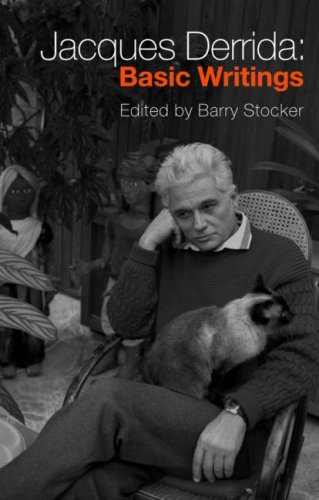
by Barry Stocker
 Hardcover: 212 Pages (2006-05-01)
list price: US$100.00 -- used & new: US$83.22
(price subject to change: see help)
Asin: 0415325013
Canada | United Kingdom | Germany | France | Japan
Editorial Review

Book Description
Jacques Derrida is one of the most influential and controversial philosophers of the last fifty years. Derrida on Deconstruction introduces and assesses:
* Derrida's life and the background to his philosophy
* the key themes of the critique of metaphysics, language and ethics that characterize his most widely read works
* the continuing importance of Derrida's work to philosophy.
This is a much-needed introduction for philosophy or humanities students undertaking courses on Derrida. ... Read more


32. Introducing Derrida, 3rd Edition (Introducing)
by Jeff Collins
Paperback: 176 Pages (2006-01-25)
list price: US$12.95 -- used & new: US$7.51
(price subject to change: see help)
Asin: 1840466669
Average Customer Review: 3.5 out of 5 stars
Canada | United Kingdom | Germany | France | Japan
Editorial Review

Book Description
Describes the key features of Derrida's writings, explains their controversial effects and shows how Derrida has put them to work in literature, art, architecture and politics. ... Read more

Customer Reviews (5)

5-0 out of 5 stars Undecidability
Derrida is quite an unsettling thinker. It would seem the easiest to characterize him as a philosopher, a literary criticist or, even perhaps an artist. He wants you to be unable to decide pretty much about all the certainties you have. Language is uncertain; art is uncertain.This is accomplished through a series of movements in thought, a serious disturbance of your premises. He manages to do this superbly.He has studied philosophers, painters and writers to further inquire about their premises and, by making them explicit, he has been able to break them.

He will ask you to identify two constant directives in his work:

1) He wants to render certainties and premises weak, no longer absolute.
2) He goes about this like a virus, in the sense that a virus is neither a proper living organism nor a completely dead one. He wants to be pervasive and fatal, and be able to cross boundaries constantly.

He proposed something called deconstruction which can be used as a noun, a verb, an adjective, a concept, a tool, a method, a mode of inquiry; but he would be the first to tell you that it is not exclusively one of those but, perhaps, all of them. It really depends. What do you accomplish with it? To nullify boundaries by making them explicit, to extend semantical domains by inhibiting its predefined -comfortable- ontologies.

I had to read it twice, because the first time I was uncertain if I had achieved full control and understanding of the notions. Read it carefully; it is a great starting point into his rather more complex works. The editors have made an excellent job in keeping consistency and congruence between the graphics in each page and the concepts therein mentioned; they were not gratuituous and they were not simplistic. In the specific case of Derrida, often times a helpful, concrete analogy is needed, even if only a graphic one.

As a previous reviewer mentioned, you will derive the greatest benefit from his ideas by getting acquainted first with Phenomenology and Structuralism and, to some extent, with schools of thought previous to these ones, as he constantly makes reference to them in his works.

Overall, an efficient and simple introduction to a fascinating topic.

5-0 out of 5 stars A good glimpse at Derrida
There seems to be two kinds of people who read these books: those who see the word "INTRODUCING" in the title, and those who don't.The latter group seems to think that the books in this series are titled "THE COMPLETE, UNABRIDGED WORKS OF (insert philosopher's name)".They miss the point that these books are meant to give average readers a brief glimpse of the subject matter.The reader can then go on to read the ACTUAL writings of the philosophers.I think these books (and DERRIDA in particular) are really great, because they are getting more people interested in philosophy.That said, I found that I got more out of this book after familiarizing myself with other philosophers, since Derrida is a post-modern philosopher, reffering to work done before him.So if you are considering this as your first book in the series, I would suggest familiarizing yourself with Western philosophy over the past 200 years (Kant, German Idealism, Existentialism, Structuralism) and you'll take much more away from Derrida's work.

1-0 out of 5 stars weak
This rather impoverished account spends insufficient
time with each topic to provide traction
for the reader.Apart from the first section the
whole thing was a big disappointment.

2-0 out of 5 stars humbug
The book naturally focuses on 'deconstruction' - a nebulous
collage that has been rejected even by philosophers - which
should clue the public in to how soft the subject really is.
Additionally there are production flaws (dark shading in the
illustrations obscuring the text) to vex the weary reader.

5-0 out of 5 stars Honk if you Hate Metaphysics!
I can't believe this book is not more popular! I loved it. It has pictures on every page which really helps keep your attention, at least for the first two-thirds of this 171-page illustrated book. This is difficult stuff, and the authors have done a very good job of introducing, simplifying, and illustrating Jacques Derrida's style and concepts. If you've had some exposure to either the Metaphysicians, Nietzsche, Heidigger or the Existentialists, it'll help. But this straight-forward format makes the new ideas extremely easy to understand. It gave me exactly what I wanted: Information about Derrida's roots, in Structuralism and Phenomenology, plus a springboard to allow me to read Derrida's books without any fear of misunderstanding or misinterpreting his ideas.

After a brief introduction to the core Viruses: Undecidability and Derailed Communication, the authors first use the concept of the Zombie in Hollywood movies to illustrate Derrida's concept of Undecidability, then Plato's Phaedrus to illustrate the concepts of Supplement and Difference which explain the magic, which metaphysics uses to disappear those nasty opposites! Phonocentrism and Logocentrism follow and whoopee! You're already starting to recognize a metaphysical concept coming from halfway down the block if you see one!

Seriously, the book is really THAT good if you like reading Philosophy and you've wanted to learn about Derrida's ideas. It pays attention to all of the important critical philosophers that preceded him, Hume, for example (p.45). After page 100, however, you realize you are reading about individual papers and speeches of his, which are a little bit like seeing advertisements and reading biography rather than seeing parts of the whole picture. You might want to skip through this section to whatever you're interested in. The problem is that Derrida happens to be a bit of a Rennaisance man, and the fact that he has an interest in architecture, or feminism, or people with disabilities is somewhat less interesting for me than what he is doing in Philosophy. ... Read more


33. The Politics of Friendship (Radical Thinkers) (Radical Thinkers)
by Jacques Derrida
Paperback: 320 Pages (2006-01-11)
list price: US$12.00 -- used & new: US$9.15
(price subject to change: see help)
Asin: 1844670546
Average Customer Review: 4.5 out of 5 stars
Canada | United Kingdom | Germany | France | Japan
Editorial Review

Book Description
The most influential of contemporary philosophers explores the idea of friendship and its political consequences, past and future. ... Read more

Customer Reviews (3)

5-0 out of 5 stars O Friends, There Are No Friends
This book has its origins in the seminar that Jacques Derrida gave during the academic year 1988-89, as part of his late attempt to grapple with issues of political philosophy that he also deals with in his Specters of Marx. The book itself is an extended replay of the first session of the seminar, in which the French philosopher (who died in 2004) gave an overview of the themes that he would cover at more length during the year, beginning with the apostrophe: "O my friends, there are no friends" that Montaigne attributes toAristotle.

I was fortunate enough to attend that lecture and some of those that followed. The desire to retrieve that experience from the past and to compare the understanding of the written text with the impression left by the oral intervention certainly drove me to read this volume, with the English language providing an additional distance that I somehow find necessary to break with the immediacy of my native French.

The stage was set twenty years ago at the salle Dussane of the Ecole Normale Superieure, before an audience composed of fellow academics, faithful followers and curious onlookers, drawn together by the intellectual aura of the French philosopher who was at the peak of his public career. The atmosphere was quite different from the scenes of mass hysteria that are said to have accompanied the seminar of Jacques Lacan in that very same conference room some twenty years before, with swooning ladies fainting over the words of the Maitre and fanatical psychoanalysts arguing furiously over Freud's legacy. The cosmopolitan nature of the audience, composed mainly of foreigners, bore witness to the international following that Derrida's brand of philosophy already attracted, as well as to the conservatism of French philosophy students, who tended to shun this lecture in favor of more academically correct seminars.

Reading Derrida or other French authors like Bataille, Foucault, Barthes or Bourdieu is sometimes considered as a kind of rite of passage into the world of rebellious intellect. Such motivation was not absent from my decision to attend that seminar, which had no connexion whatsoever with my university major in economics. But if I or others were in for the show, for a kind of post-modern happening, then the lecture was certainly a deception. As a philosopher molded in the classical tradition, deeply familiar with the canon of great authors that he quoted in their original language (be it Greek, Latin, German or English), Derrida expected the same kind of familiarity, and the same language skills, from his listeners.

I remember my sense of frustration and awe as I realized that my philosophical background, limited to a course in classical philosophy during high school and preparatory class as well as personal readings of contemporary French authors, hadn't prepared me at all to dealing with the many quotes, allusive references and close readings of topical excerpts that were thrown at us during that first session. I came home with a long reading list of quoted authors, some of whom I later skipped entirely like Aristotle, others which I discovered during that academic year and with whom I am still familiar, like Carl Schmitt.

Friendship has been celebrated by many classical authors, starting with Plato, Aristotle and Cicero, very often as an act of mourning over the disappearance of a beloved one or as a celebration of a great couple of friends, always men, who provide the model of ideal friendship:Orestes and Pylades, Theseus and Pirithous, Damon and Pythias, Laelius and Scipio, Montaigne and La Boetie, etc.

But the apostrophe attributed to Aristotle, articulating a performative contradiction, also opens friendship to its own deconstruction: if there are no friends, how can one address friends? And how to draw the line between the friend and the enemy, a basic opposition to which Carl Schmitt attributes a central role in the definition of politics? Even the origin of the quote is obscure, as its attribution to Aristotle by Diogenes Laertius and subsequent authors is purely based on hearsay and its aporetic nature contradicts the clarity of the Greek philosopher's prose. The destiny of this ambiguous quote provides a common thread to the book and indeed to a significant part of Western philosophy, as it runs through the work of authors as different as Montaigne, Florian, Kant, Nietzsche, Blanchot and Deguy. A large part of Derrida's book is devoted to the commentary of Nietzsche's even more paradoxical statement, in Human All Too Human, that subverts the quotation by reversing it:

'Friends, there are no friends!' thus said the dying sage;
'Foes, there are no foes!' say I, the living fool.

Here the friend is converted into the enemy, the sage passes himself off as a fool, and one is not sure whether to rejoice or to mourn the disappearance of the enemy which, if one follows Carl Schmitt, puts into question the very existence of the political.

The question of counting or enumerating people--how many friends are there, how many are listening to the apostrophe that there are no friends--is also one of the lecture's recurring theme, which ironically points toward the obligation made to the teacher to register the attendance and count the number of students in the classroom (an obligation that Derrida conspicuously avoided) as well as to the ideal number of citizens that a functioning democracy cannot exceed (which, according to Aristotle, was less than 10 000).As Derrida points out, there is no democracy without respect for irreducible singularity, which by definition one cannot count, but there is no democracy without the calculation of majorities and the addition of equal, identifiable citizens. This paradox suggests the possibility of a "community without community" which, according to Derrida, would characterize the "democracy to come".

The key to this insistence on number is only given at the end of the book, when Derrida shows that, according to the way the omega is accentuated in the original Greek quote, the paradoxical interjection: "O friends, no friends" can also be translated, more prosaically, as "Many friends, no friends", or "he who has many friends can have no true friends." This philological coup de theatre does not eliminate the fecundity of the original quote, which functions as a textualmachine producing its own discourse as if granted with a life of its own.

4-0 out of 5 stars Too true to be ignored.
Some things that I have previously written about fools were undoubtedly reinforced by my earlier attempt to gain something from this book.Now that I have returned to this book with all the seriousness that creative intellectual labor demands when it is not in a good mood, my concern is with a portion of Chapter 4, "The Phantom Friend Returning (in the name of `Democracy')" stated most concisely on pages 81-82, "with neither consciousness nor memory of its compulsive droning" being applied to "what has become the real structure of the political ~ . . . the marks and the discourse that give it form ~ to allow us to speak of them in such a way today, seriously and solemnly?"Whatever is being discussed here is leading to a German thinker on page 83:"This tradition takes on systematic form in the work of Carl Schmitt."The flip side of things is actually the case."As soon as war is possible, it is taking place, . . . in a society of combat, in a community presently at war, since it can present itself to itself, as such, only in reference to this possible war."(p. 86)"The concept of the enemy is . . . the very concept of the political."(p. 86)

Perhaps this is only serious in a sense in which psychosis might be considered serious, or a political professional might be considered engaged in something like the practice of law, or a majority of the Supreme Court might think that people shouldn't count... because their wishes and desires will prevent them from maintaining any hard and fast rules about how they are counting.This is about the same as the democratic principles for friendship which are the topic of this book.Comedians might have predicted that if a presidency were to go, either to a guy that they thought was too smart, or to the dumb guy, the law ought to prefer the dumb guy anyway, because the law is like comedy, playing to the same audience.It might not always be right, but the audience always gets the jokes about the dumb guy.Derrida is not providing an index or bibliography with this work, just notes at the end of the chapters, so it wasn't easy for me to find comic elements of this book to pursue.I think he is fond of more troubling aspects of reality, like TRAGIC WAYS OF KILLING A WOMAN by Nicole Loraux and the usual Greek philosophers.As far as my concerns about the war on drugs, he provides some reasons for thinking that with the powers of high altitude herbicide spraying available today, we are capable of destroying much more of Columbia for each opium user here at home than back when Nietzsche was taking opium.When Derrida wrote this book, he might not have been thinking that the United States would be doing that by now, but it must be true.

4-0 out of 5 stars What are friends for?
Derrida's latest book continues what has been pecieved as an 'ethical turn' in deconstruction, intiated with 1994's "Spectres of Marx," and the subesquent rich contribution of 'deconstructionists' to politicaland moral thinking. However, Derrida himself contends that his entireproject would have been unthinkable without some form of Marxism, and Ishare emphatically the view of Critchley, Laclau et al that questions ofethics and politics lie at the heart of the deconstructive enterprise. Itis such a reading that gives this latest text a crucial location in themost contempoarary of politics. And those who contend that Derrida's (andthe continental tradtion's legacy in general) has nothing 'practical,''useful' to say about the conduct of states and peoples in something calledthe 'real world,' need only refer to the Middle East situation, and theendlessly shifting notions of 'friends' and 'enemies' in that region tobegin to grasp the paradoxical importance of Aristotle's strange address,inverted by Nietzsche, "O my friends, there are no friends,"around which Derrida constructs his arguments. Where do the boundairiesof friendship lie - is not our closest friend also, as Nietzsche suggestedlong ago, also our greatest enemy? Throughout the years of the Cold War,such questions may have seemed irrelevant, facticious. For those of us inthe West, it was US and them, the USSR, the Warsaw Pact. Complicated thoughthe transactions may have been, it was between two concretely opposed andfinished blocs. Today the questions are rarley so simple - is the US afriend, to those in Britain? But which US - for it is surely now not anhomogenous entity if it ever was. And which Russia do we hold dear? Thecollsape of stable relasionships between states of the world precipates acollaspe of recognition and identification within these states, via whichwe exist as political beings. Derrida's book is not the truth of friends,but in myraid different ways explores the legacy in various philosophicaltraditions of the dicotomy friend / enemey, and opens new and vitalinterpretations of our contempoarary state. ... Read more


34. How to Read Derrida (How to Read)
by Penelope Deutscher
Paperback: 128 Pages (2006-04-24)
list price: US$11.95 -- used & new: US$6.68
(price subject to change: see help)
Asin: 0393328791
Average Customer Review: 4.0 out of 5 stars
Canada | United Kingdom | Germany | France | Japan
Editorial Review

Book Description
Approaching the writing of major intellectuals, artists, and philosophers need no longer be daunting. How to Read is a new sort of introduction—a personal master class in reading—that brings you face to face with the work of some of the most influential and challenging writers in history.

About the series: Intent upon letting the reader discover the central concepts of important thinkers, the How to Read series explains essential topics in lucid, accessible language and provides a context and an explanation that will facilitate and enrich your understanding of these texts vital to our world today. ... Read more

Customer Reviews (4)

4-0 out of 5 stars Very good introduction.
This book is a great introduction into Derrida's work.It combines his actual writings with easy to read explanations.I am sure to get more of the "How to Read" series.

4-0 out of 5 stars Good introduction to the pluralistic ideology of deconstruction
This is a very clearly written and confident exposition of Derrida's main ideas. Written by a true believer in deconstruction, so it does avoid tackling inconsistencies in Derrida's thought, and is sometimes gushing in its praise. I found his notion of the 'impossibility' of interpersonal acts such as gift-giving and forgiveness to be especially weak, since these concepts are assumed to imply some kind of Platonic 'purity' of meaning that is then self-cancelling. This exposes the dependence of deconstruction on the very metaphysical certainties it claims to counter. For example, in concepts such as 'democracy-to-come' the myth of some 'original' truth is simply replaced with a 'barely possible' utopian ideal which is then forever delayed.

5-0 out of 5 stars Good introduction to Derrida
Even though I've a good grasp of other difficult continental philosophers (important influences on Derrida) such as Hegel and Heidegger, I still felt a barrier to 'getting' deconstruction. This book helps to clarify the gist of textual deconstruction and Derrida's implicit political motives. I've come to the conclusion that much of the 'barrier' to understanding Derrida has to do with problems in his (anti-)philosophy, which come to light, for instance, by comparing his work with that of Deleuze who also develops a "philosophy of difference," yet without avoiding the question of substance which contemporary thought must address anew. I had read other 'introducing..' type books, but most of them simplify the material too much. For the dillegent, focused reader, this book yields a good middle way to comprehension between Derrida's daunting original texts and other introductory books.

4-0 out of 5 stars Useful
A reader is not entirely the same as an introduction or a beginner's guide.It selects key passages from an author, and "brings the reader face-to-face with the writing itself in the company of an expert guide".Thus Penelope Deutscher explains -- or perhaps one should say explicates -- key passages ofDerrida.This she does very well -- and while it is not easy reading, it is not inscrutable if one is prepared to concentrate.

In the main, Deutscher would seem to have chosen crucial extracts of Derrida.These are passages which should be read and understood.She takes little for granted, and explains all that needs to be explained to the reader -- lucidly and intelligently.In fact she effectively communicates the striking de(con)structive power of his work.She further draws comparisons between Derrida's early and late work, and highlights a few issues that were problematic to Derrida himself.

There were two things that I missed in this book.Firstly, I would have welcomed a more thorough comparison between Derrida's post-structuralism and the structuralism or (more broadly) modernism that went before.Secondly, Derrida's ideas were highly controversial, and there was little hint of this in Deutscher's commentary.However, for what it is worth, this is a book well written, and it does much to deepen one's insight into Derrida. ... Read more


35. Edmund Husserl's "Origin of Geometry": An Introduction
by Jacques Derrida
Paperback: 205 Pages (1989-05-01)
list price: US$22.00 -- used & new: US$21.90
(price subject to change: see help)
Asin: 0803265808
Canada | United Kingdom | Germany | France | Japan
Editorial Review

Book Description

Edmund Husserl's Origin of Geometry": An Introduction (1962) is Jacques Derrida's earliest published work. In this commentary-interpretation of the famous appendix to Husserl's The Crisis of European Sciences and Transcendental Phenomenology, Derrida relates writing to such key concepts as differing, consciousness, presence, and historicity. Starting from Husserl's method of historical investigation, Derrida gradually unravels a deconstructive critique of phenomenology itself, which forms the foundation for his later criticism of Western metaphysics as a metaphysics of presence. The complete text of Husserl's Origin of Geometry is included.
... Read more

36. The Post Card: From Socrates to Freud and Beyond
by Jacques Derrida
Paperback: 552 Pages (1987-06-15)
list price: US$29.00 -- used & new: US$27.71
(price subject to change: see help)
Asin: 0226143228
Average Customer Review: 4.0 out of 5 stars
Canada | United Kingdom | Germany | France | Japan
Editorial Review

Book Description

17 November 1979

You were reading a somewhat retro loveletter, the last in history. But you have not yet received it. Yes, its lack or excess of address prepares it to fall into all hands: a post card, an open letter in which the secret appears, but indecipherably.

What does a post card want to say to you? On what conditions is it possible? Its destination traverses you, you no longer know who you are. At the very instant when from its address it interpellates, you, uniquely you, instead of reaching you it divides you or sets you aside, occasionally overlooks you. And you love and you do not love, it makes of you what you wish, it takes you, it leaves you, it gives you.

On the other side of the card, look, a proposition is made to you, S and p, Socrates and plato. For once the former seems to write, and with his other hand he is even scratching. But what is Plato doing with his outstretched finger in his back? While you occupy yourself with turning it around in every direction, it is the picture that turns you around like a letter, in advance it deciphers you, it preoccupies space, it procures your words and gestures, all the bodies that you believe you invent in order to determine its outline. You find yourself, you, yourself, on its path.

The thick support of the card, a book heavy and light, is also the specter of this scene, the analysis between Socrates and Plato, on the program of several others. Like the soothsayer, a "fortune-telling book" watches over and speculates on that-which-must-happen, on what it indeed might mean to happen, to arrive, to have to happen or arrive, to let or to make happen or arrive, to destine, to address, to send, to legate, to inherit, etc., if it all still signifies, between here and there, the near and the far, da und fort, the one or the other.

You situate the subject of the book: between the posts and the analytic movement, the pleasure principle and the history of telecommunications, the post card and the purloined letter, in a word the transference from Socrates to Freud, and beyond. This satire of epistolary literature had to be farci, stuffed with addresses, postal codes, crypted missives, anonymous letters, all of it confided to so many modes, genres, and tones. In it I also abuse dates, signatures, titles or references, language itself.

J. D.

"With The Post Card, as with Glas, Derrida appears more as writer than as philosopher. Or we could say that here, in what is in part a mock epistolary novel (the long section is called "Envois," roughly, "dispatches" ), he stages his writing more overtly than in the scholarly works. . . . The Post Card also contains a series of self-reflective essays, largely focused on Freud, in which Derrida is beautifully lucid and direct."—Alexander Gelley, Library Journal
... Read more

Customer Reviews (8)

5-0 out of 5 stars Repetition is bequeathed; the legacy repeated...
Contrary to the reviews thus far reported in regards to this "work in the traditions of Finnegans Wake," i would reccomend reading this book to all who are interested in Derrida's philosophy of ethics. Herein we may find ephemerally expounded glimpses at Postmodernism's notions of continuity and of the legacy of ideas: a gift which we neccessarely both receive and reinscribe - "What is tragic is not the possibility but the neccessity of repetition" (Writing and Difference). Many Derrida readers have shied away from this text because of its disparate and fragmented stuttering...Don't if you have patience to listen read this treasure. It is a pastiche, a montage and a rebus. An exquisite rendition on tradition and inheritance, on presence and absence. A reminder to never stop giving and giving and giving because the most ethical one can be is through the dissemination of ideas, the transformation of the recurring within which each becomes a relative of all and none. Finnegans Wake approximates the same themes with Vico's philosophy of history as an addendum. By the way Vico was an avid reader of the Cabbala...Only Walter Benjamin can better inspire the re-visions that we need for a tragic becoming tragic. This book is extremely personal and one of Richard Rorty's favorites I might add...he was not very fond of the early Derrida...Rorty understands Derrida as only Caputo and Bennington have...This is our modern day Novalis, we may dream of dreaming our dreams!

5-0 out of 5 stars The first time is still best
It took me a long time to crack the Derrida nut. But when I did, I did it with this book. Thus it will always be my favorite philosophical novel by Derrida. When I finished this book I picked up Badiou's book on Deleuze and he said I got everything right, only he said it better than I would have.

So far, all the other readers seem to have missed the point. First, this book is not about anything so feminine and smacking of vulgar Christianity as love and cushy feelings. Derrida says it's a poison pen letter. It's about hate. It may be "between lovers," but it's published for the whole world to admire and appraise, a radically different context than the relationship of husband and wife. Which the careful Derrida-phile will note was handled very carefully, almost cynically, in the Derrida "documentary." (Has there ever been a greater and more hilarious take on oral sex?)

One wag commented that the book is only good for beach-reading. But that misses the serious side of Derrida, which is also the point. Rhetoric can be philosophy. Derrida is one hundred percent hilarious. But he's always pushing the philosophical envelope with his puns. To resort to a distinction that has a pragmatic value even though it utterly lacks any philosophical foundation, the use-mention distinction, when Derrida uses the word 'this,' he also means _that_. (Why does the use-mention distinction make no sense? Because when you say 'horse,' a _horse_ comes out of your mouth. As per Wittgenstein and the Stoics.) It's up to us lesser mortals to tease out the strands and levels until we can produce something as thoroughly competent. And simultaneously beautiful and ugly. Like orgasm.

Which brings us to Lacan. Some say he's a charlatan. And you have to be suspicious of anyone who declares that they're not interested in truth, but falsity. But when the postmodernists say this what they mean is that the truth, which can potentially be known, is in being aware that you actually don't know. The idea goes back to Plato and his early Socratic dialogues. Stated like that, it isn't too far from Kant, who also believed that we can't actually know much, other than that there are stars above and some sort of moral rules within. (Nobody has ever agreed with him on his rules, including his great heir John Rawls.) Derrida doesn't differ much from Lacan. He abandons Oedipus for the same reasons as Deleuze (it's a self-fulfilling prophecy and alienated from real life). But the argument on the postal system only looks different from Lacan's account because Derrida says it is. That he got Lacan to agree with him says something about Derrida's prestige, so there must be something there. (Though Lacan's submission looks suspiciously like he doesn't submit--republishing the Ecrits in an edited down version where the offensive passages have been actively forgotten.) But when Lacan says that a letter always gets to its destination he means that it always misses its destination, because the person it's intended for is going to sometime pass away. ("The living is a species of the dead." Nietzsche.) Which is also Derrida's point. I haven't read Derrida's latest writings on Lacan but apparently there's a whole lot of a rapprochement. In his interviews with Roudinescu, A Quoi Demain, he considers his style to be Lacanian and a lot of his conclusions to be similarly disposed.

Here's hoping the most consistently amusing of the post-Heideggerians remains a liberal individualist. Though it's probably going to be tough for him, given that the Straussists of the Whitehouse talk a similar talk and walk a similar walk. ("Jewgreek is Greekjew.") I believe the fact that Derrida is explicitly against the death penalty is the deciding difference. QED.

3-0 out of 5 stars Hungry Hungry Hippos
I like this book better than the game hungry hungry hippos. Catch all the marbles as fast as you can, beat your opponents with a slight of the hand!

4-0 out of 5 stars A book which can only be read among *other* books.
Derrida has stated that one of the main purposes of his decontructive readings, writing, and ruthless re-contextualization of various philosophical ideas is to minimize the "violence" of various philosophical practices- those ways of speaking, writing, which silently privilege various terms, and ideas and, perhaps unknowingly repress others. Given the other "esoteric" reviews here, its my duty to minimize the "violence" for those people who really want to know about the book, and not about namedropping, three lines of praise.

The Postcard is a "collection" of various love-letters, supposedly burned in a fire, which has left pieces of text missing. Derrida has also included a few essays which he believes continues the analysis begun in the loveletters [envois]. The content of the loveletters covers a broad range of philosophical and personal questions - from philosophy of language - to the relation b/w Socrates and Plato - to personal encounters in (I suppose) Derrida's life as a philosopher. But the over all effect of this - this "re-contextualization" or in other words, this casting of philosophical questions in a format not usually considered "serious" -> love letters... the profundity, the importance, the dissemination of the questions take on a wholly different feel and effect. The feel and effect, of course, is hard to describe, but it is a way of playing with "philosophical sensibilities" -- what is "real" philosophy? What is "serious" philosophy? And what is the meaning of such questions in the most private of all communications - love letters between two intimate lovers.

Of course, in typical Derridean style, he puns, and jokes his way, throwing punchlines out of every page. The envois are not an easy read. They can be tough, and confusing, especially with the 'missing text" which link ideas. The other essays included in The Postcard are equally a tough read, with a very interesting, but treacherous deconstruction of Lacan's analysis of Poe's "The Purloined Letter".

The Postcard can only be understood as continuation of previously examined (Of Grammatology), argued (Limited Inc.), and illustrated (Glas) philosophical strategies employed by Derrida. And yes, Richard Rorty (an american post-enlightenment philosopher) totally misses the boat on this one. While, i believe Derrida is attempting to "play" with various aspects of the philosophical tradition (Derrida is by far the funniest philosopher, since, Nietzsche), The Postcard is merely an new way of asserting those same ideas Derrida laid out in Limited Inc and other books, that conceptual meaning is not fixed but disseminated and deferred [differance] to all possible contextual usages and instantiations.

I know, this is merely one small aspect of Derrida's enterprise. But it is, I believe, the main purpose of The Postcard: to see how the meaning of philosophical questions regarding language, history, and the sequence of events, take on new meanings in the context of lost love lettes-- the same way a Post Card, which never reaches its destination-- takes on new meanings for the unintended third reader.

4-0 out of 5 stars A book which can only be read among *other* books.
Derrida has stated that one of the main purposes of his decontructive readings, writing, and ruthless re-contextualization of various philosophical ideas is to minimize the "violence" of various philosophical practices- those ways of speaking, writing, which silently privilege various terms, and ideas and, perhaps unknowingly repress others. Given the other "esoteric" reviews here, its my duty to minimize the "violence" for those people who really want to know about the book, and not about namedropping, three lines of praise.

The Postcard is a "collection" of various love-letters, supposedly burned in a fire, which has left pieces of text missing. Derrida has also included a few essays which he believes continues the analysis begun in the loveletters [envois]. The content of the loveletters covers a broad range of philosophical and personal questions - from philosophy of language - to the relation b/w Socrates and Plato - to personal encounters in (I suppose) Derrida's life as a philosopher. But the over all effect of this - this "re-contextualization" or in other words, this casting of philosophical questions in a format not usually considered "serious" -> love letters... the profundity, the importance, the dissemination of the questions take on a wholly different feel and effect. The feel and effect, of course, is hard to describe, but it is a way of playing with "philosophical sensibilities" -- what is "real" philosophy? What is "serious" philosophy? And what is the meaning of such questions in the most private of all communications - love letters between two intimate lovers.

Of course, in typical Derridean style, he puns, and jokes his way, throwing punchlines out of every page. The envois are not an easy read. They can be tough, and confusing, especially with the 'missing text" which link ideas. The other essays included in The Postcard are equally a tough read, with a very interesting, but treacherous deconstruction of Lacan's analysis of Poe's "The Purloined Letter".

The Postcard can only be understood as continuation of previously examined (Of Grammatology), argued (Limited Inc.), and illustrated (Glas) philosophical strategies employed by Derrida. And yes, Richard Rorty (an american post-enlightenment philosopher) totally miss