e99 Online Shopping Mall

Geometry.Net - the online learning center Help  
Home  - Philosophers - Dewey John (Books)

  1-20 of 100 | Next 20
A  B  C  D  E  F  G  H  I  J  K  L  M  N  O  P  Q  R  S  T  U  V  W  X  Y  Z  

click price to see details     click image to enlarge     click link to go to the store

 
$4.98
1. Experience And Education
$5.95
2. Art as Experience
$8.88
3. John Dewey & Decline Of American
$28.52
4. The Essential Dewey, Volume 1:
$12.85
5. How We Think
$11.38
6. Public & Its Problems
$27.83
7. Reconstruction In Philosophy
$7.29
8. Freedom and Culture (Great Books
$17.90
9. The Philosophy of John Dewey:
$6.69
10. Human Nature and Conduct
$9.99
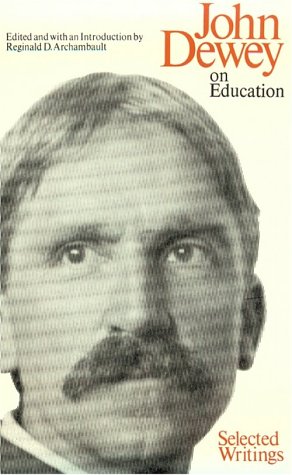
11. John Dewey, On Education: Selected
 
$35.00
12. The Middle Works of John Dewey,
$24.32
13. John Dewey and American Democracy
$36.90
14. The Education of John Dewey
$28.52
15. The Essential Dewey: Ethics, Logic,
$7.33
16. Liberalism and Social Action (Great
$9.56
17. Democracy and Education
$49.26
18. John Dewey in China: To Teach
$1.00
19. The School and Society: The Child
$7.75
20. A Common Faith (The Terry Lectures

1. Experience And Education
by John Dewey
 Paperback: 96 Pages (1997-07-01)
list price: US$10.95 -- used & new: US$4.98
(price subject to change: see help)
Asin: 0684838281
Average Customer Review: 4.5 out of 5 stars
Canada | United Kingdom | Germany | France | Japan
Editorial Review

Book Description
Experience and Education is the best concise statement on education ever published by John Dewey, the man acknowledged to be the pre-eminent educational theorist of the twentieth century. Written more than two decades after Democracy and Education (Dewey's most comprehensive statement of his position in educational philosophy), this book demonstrates how Dewey reformulated his ideas as a result of his intervening experience with the progressive schools and in the light of the criticisms his theories had received.

Analyzing both "traditional" and "progressive" education, Dr. Dewey here insists that neither the old nor the new education is adequate and that each is miseducative because neither of them applies the principles of a carefully developed philosophy of experience. Many pages of this volume illustrate Dr. Dewey's ideas for a philosophy of experience and its relation to education. He particularly urges that all teachers and educators looking for a new movement in education should think in terms of the deeped and larger issues of education rather than in terms of some divisive "ism" about education, even such an "ism" as "progressivism." His philosophy, here expressed in its most essential, most readable form, predicates an American educational system that respects all sources of experience, on that offers a true learning situation that is both historical and social, both orderly and dynamic. ... Read more

Customer Reviews (18)

5-0 out of 5 stars Perfect
The book was in great condition. I am sure I probably could have paid cheaper going to a store, but this was easier for me.

5-0 out of 5 stars Experience & Education by John Dewey
If you are think about reading Experience & Education by John Dewey, get ready for a "heady" read. This book is very dense and thoughtful. If you are an educator be prepared to read this book at a slow pace and take notes. Dewey, illustrates two thoughts in education: traditional vs. progressive.

According to Dewey, traditional education is focused on content rather than process. Progressive education, is more of a free approach with freedom of choices being most useful in education.Throughout the book, the reader must understand the nature of human experience. Dewey theorizes that the human experience has two principles: continuity and interaction.

Continuity is a concept that people will influence the future, for better or for worse.Interaction, according to Dewey, refers to situational influence on one's experience. Meaning the present experience is a function of the interaction between the past experience and the present situations. An applied example of this would be a teacher's experience of a lesson. The lesson will have much to do with the teacher's past interaction with the content. And this past interaction will them manifest out with how the teacher thinks, arranges and presents the content in the lesson.

This is a great book of cognition and metacognition.

Nancy Linden

5-0 out of 5 stars Timeless
John Dewey's Experience and Education is a timeless treasure on the educational process in the United States.Although the language maybe flowery and dated the ideas are fresh and meaningful. I have worn out the binding in this short 91 page gem of learning theory from reading and rereading passages that are as relevant today as they were almost 70 years ago.As I continue in my process as a graduate student in education this book will be a worthwhile reference and inspiration. I highly recommend this book to anyone interested in the value of education.

4-0 out of 5 stars Experiencing Experience and Education
John Dewey's Experience & Education was a quick read filled with many thought provoking ideas and concepts on education learning theory.For such a short book there were many educational motivators and interesting thoughts on education.

Dewey highlights that every learner learns by applying their past experience while creating new ones.In the book Dewey remarks, " . . .a child who learns to speak has a new facility and new desire.But he has also wideded the external conditions of subsequent learning. When he learns to read he similarly opens up a new environment." (p.37)

I believe after reading this book it will allow us to open up new environments for ourselves in our future discussions, thinking, learning and teaching.

4-0 out of 5 stars Experience is Not Enough
Finally somebody who gets it! Unfortunately, as I read John Dewey's Experience & Education I constantly needed to remind myself that Dewey understood what education should be back in the late 1930s, and the "new" education, contemporary or "progressive" as he often referred to it reflects a new-fangled educational system that by today's standards would seem old fashioned. Regardless the times, Dewey's précis is "the rise of what is called new education and progressive schools is in of itself a product of discontent with traditional education". Though he outlines both the wrongdoings and celebrations of both traditional and progressive philosophies of education, Dewey's prescription is for a "sound philosophy of experience...not a name or slogan". The question remains nearly seventy years later, have we yet filled a prescription which lends educators the ability to look beyond the `isms' of educational philosophies and reason in terms of the greater realm of experience?

In 2006 educators are still wading through a sea of ever-changing views of education. According to Dewey, we continue to consent to struggling with new philosophies due to our disgruntlement with policies of the past. The "old" school of education was flawed because teachers were enforcers; experts of education that pushed "autocratic and harsh" arrangements upon students, withholding the undeniable experiences students sought and deserved. Traditional schooling demanded teachers uniformly enforce a "military regime of pupils who were permitted to move only at certain signals" impeding a learner's ability to experience intellectually beyond the surroundings of the habitual desks, blackboard, and meager school yard. Old schools imposed an appalling hypocrisy of memorization of facts and figures, historical dates and such all in preparation of the unknown future, with little regard to the present. Generally in an attempt to keep order, teachers failed to seek the cooperation of students in preparing the purposes of education and learning.

Therefore, in what was likely the backlash of traditionally educated pupils sprouted a generation of new-age educators referred to by Dewey as the progressive-ists. Bearing mind that progressive education realistically commenced at the end of nineteenth century, the wrongdoings of the era I shall now reflect upon, are quite a century old. While progressive education focused on the freedom of the learner, the dismissal of traditional education aroused contemporary difficulties when educators recognized that new education was more difficult than the old. Progressive schools, founded in life-experiences, were rarely well organized as few teachers truly conceptualized the discrepancies in experiences. Moreover, because children were perhaps overly indulged in the participation of learning purposes, school was an amusing fun time in which "visitors (were)...shocked by the lack of manners in students they came across".

As with all educational philosophies that withstand the test of time, the celebrations of such generally outnumber the wrongdoings. Traditional, as well as progressive schools were no exception. Traditional educators were able to keep order in the learning environment in turn providing more teachable time to study the foundations of education, upon which all future learning would take place. In addition, traditionalists valued one of the most important lessons of life: that of "mutual accommodation and adaptation" of others. Surely an adult visitor to a traditional school would be impressed with the periods of "quiet reflection" offered, even for the youngest of pupils. Progressive education was not without its celebrations. Because progressive educators emphasized the freedom of the learner, genuine education came through experience and children were allowed their natural tendencies to socialize and participate in the purposeful planning of the curriculum. New schools even offered the opportunity to study life-skills experiences such as homemaking and mechanics. Yet despite the moving-forward approach of progressivism, "we are told that our schools, old and new, are failing in...the ability to (produce students that) reason".

Experiences are not enough. Dewey reminds us in Chapter 3: Criteria of Education that not all experiences are educative and some are even mis-educative. Everything depends on the quality of the experiences, and that if experience is within and of itself a philosophy of education it requires a plan of what and how such experiences will be implemented. This plan, which Dewey submits as a "Category of Continuity" is responsible for discriminating between the experiences that are meaningful and those that are not. Educational processes must be measurable in terms of good growth, for example providing opportunities for future growth in decent directions. In what is perhaps the finest vignette of Experience & Education Dewey tells of a burglar who gains experience robbing others and as his experiences grow "the burglar may grow into a highly expert burglar" hence not all experiences constitute positive growth. Still within the principle of continuity are the outside sources (i.e. demographics such as income, neighborhood, ethnicity, etc.) and social set-up of the surroundings (equipment, books, materials of learning) that make up the experimental situation. Lastly, teachers must take into account how such experiences are going to enhance his students in the future.

Dewey suggests that educational experiences are vital as some people with little schooling have been given the "precious gift of the ability to learn from the experiences they have (had)", and certainly not all educational experiences occurred in the schoolroom. According to Dewey, good experiences (and bad) are acted upon by a single impulse. I wonder what it might feel like if I put my hand in the fish tank, a student of mine might ponder. Their purpose for choosing to act upon the impulse, which creates the experience, will end with an observation. In this case the student observes the surrounding conditions of the sensation of warm, flowing water, a rapidly moving, exotic, tropical fish, and the final numbness of the fingers when the fish confuses the daring hand with that of his food. The observations my student has just experienced will undoubtedly aid him in future situations. The knowledge of this experience may be enough to prevent future finger-numbing encounters with the tropical chiliad, as their judgment in imminent situations will be the collectivity of previous knowledge and observations.

While we can be aware of consequences through previous experiences, the goal of the educator is in finding material for creating organized learning experiences. The search for high-quality learning experiences could be in of itself a paradox to Dewey's decree that we need to get back to an education that is "pure and simple"; an education that is a reality and "not a name or a slogan". After all, the "sound philosophy of experience" Dewey seeks is in actuality a name and a "slogan" called Experiential Education, which finds its way into the progressive era, in-between the common schools movement and the eras of school reform. Therefore, in answer to my earlier question: Have we yet filled a prescription which lends educators the ability to look beyond the `isms' of educational philosophies and reason in terms of the greater realm of experience? No; because it is the very nature of educators and humans in general to philosophize a new wave of education as a result of our discontent with the current. And these waves of change are good as it defines the very character of learners; those whose experiences constantly alter the way we perceive the world.
... Read more


2. Art as Experience
by John Dewey
Paperback: 384 Pages (2005-07-05)
list price: US$14.95 -- used & new: US$5.95
(price subject to change: see help)
Asin: 0399531971
Average Customer Review: 4.5 out of 5 stars
Canada | United Kingdom | Germany | France | Japan
Editorial Review

Book Description
Based on John Dewey's lectures on esthetics, delivered as the first William James Lecturer at Harvard in 1932, Art as Experience has grown to be considered internationally as the most distinguished work ever written by an American on the formal structure and characteristic effects of all the arts: architecture, sculpture, painting, music, and literature. ... Read more

Customer Reviews (4)

4-0 out of 5 stars Overly Detailed but Insightful
It's a little thick, but you have to consider it's based off of his lectures. From the point of view from a philosopher, he gives insight into things that we as artists might already know, but have never realized, and even other stuff that's impossible to see that only someone from the outside could see.

5-0 out of 5 stars Excellent Theorizing On Art
As a reviewer below stated, this is a very interesting book that treats art as a means of recapturing the experience of life and trasmitting that experience to the audience.He captures a number of concepts established earlier by Leo Tolstoy in his "What is Art?" and delves deeper into them, expounding on their more practical and less esoteric uses.

Dewey, however, certainly earns his title as a pragmatist.His wording is complicated and, at times, careful.It is difficult to pin specific sayings or doctrines to him.However, once the task is completed, he has a great deal of important things to say about art and artistic experience.

5-0 out of 5 stars this book is kickin!
if you are an artist this book will blow your mind.

it is prettytheoretical, but if you can get through the first 20 pages.. and get intohis vibe.. it's BEAUTIFUL.. (yum).

This is probably the most importantbook i've ever read. You trust katie, you! you buy! you buy!!

4-0 out of 5 stars One of the great books on art theory.
Although somewhat dated in that what Dewey novelly stated long ago, we now accept as obvious, this is a great book to gain an understanding of art both as a producer and as a spectator.

The central theme is that life is an experience, and that the goal of art is to recapture that experience.Hence, a painting of a flower is only valuable in the way that it capturesthe essence of a flower, or the experience of viewing a flower. The viewingof a painting must also provide some of the experience of making thatpainting ( its process ).

If you can manage to finish the book ( thestyle is a bit archaic ), the experience is worth the effort. ... Read more


3. John Dewey & Decline Of American Education: How Patron Saint Of Schools Has Corrupted Teaching & Learning
by Henry T. Edmondson III
Paperback: 200 Pages (2006-01-01)
list price: US$15.00 -- used & new: US$8.88
(price subject to change: see help)
Asin: 193223652X
Average Customer Review: 4.0 out of 5 stars
Canada | United Kingdom | Germany | France | Japan
Editorial Review

Book Description

The influence of John Dewey's undeniably pervasive ideas on the course of American education during the last half-century has been celebrated in some quarters and decried in others. But Dewey's writings themselves have not often been analyzed in a sustained way. In John Dewey and the Decline of American Education, Hank Edmondson takes up that task. He begins with an account of the startling authority with which Dewey's fundamental principles have been-and continue to be-received within the U.S. educational establishment. Edmondson then shows how revolutionary these principles are in light of the classical and Christian traditions. Finally, he persuasively demonstrates that Dewey has had an insidious effect on American democracy through the baneful impact his core ideas have had in our nation's classrooms. Few people are pleased with the performance of our public schools. Eschewing polemic in favor of understanding, Edmondson's study of the "patron saint" of those schools sheds much-needed light on both the ideas that bear much responsibility for their decline and the alternative principles that could spur their recovery.
... Read more

Customer Reviews (6)

1-0 out of 5 stars What on Earth?
You are welcome to do your own research on John Dewey, but he has hardly corrupted America's schools -- in fact, we've hardly adopted his theories at all.If we had, we would no longer have SATs, LSATs, MCATs, or GPAs for that matter.We certainly wouldn't have the No Child Left Behind Act. This book is about school prayer, not John Dewey.

From Wikipedia: "Dewey's ideas, while quite popular, were never broadly and deeply integrated into the practices of American public schools, though some of his values and terms were widespread. Progressive education (both as espoused by Dewey, and in the more popular and inept forms of which Dewey was critical) was essentially scrapped during the Cold War, when the dominant concern in education was creating and sustaining a scientific and technological elite for military purposes. In the post-Cold War period, however, progressive education has reemerged in many school reform and education theory circles as a thriving field of inquiry. Dewey is often cited as creating the foundations for outcomes-based education and Standards-based education reform, and standards such as the NCTM mathematics standards, all of which emphasize critical thinking over memorization of facts."

2-0 out of 5 stars A "fair and balanced" attack on Dewey?
To be in education is to be, at some level, a political activist.After all, education is the water that feeds the tree of a democratic republic, and those who would educate are preparing the youth for citizenship in said society.Edmondson decries the state and direction of our society and this book is his activist response.While the focus of his scapegoating is John Dewey, the book is much less about Dewey's legacy and his work (which is superficially represented in the book - and naturally so; after all, who could possibly summarize in less than 130 pages the oevre of a man who published over 35 books and scores of articles over the course of his career?) than it is about the tragedy of a judicial interpretation of one of the cornerstones of our founding Constitutional principals: separation of church and state.

The book is interestingly researched and is a unique and lively discussion of Dewey.About half way through the text, though, it becomes clear that the object is not to protest the influence of an educational philosophy but to use the cover of education scholarship to engage in the debate about school prayer.In his discussion of the function of education as an apparatus for moralizing he points towards Dewey and Dewey's ambivalence for religious indoctrination as the root cause for this deficiency in 21st century American classrooms.It seems Dewey, in other words, is directly responsible for having prayer taken out of schools - an extreme claim to be sure.

If partisan scholarship isn't problematic for you, the book ofers some interesting insights into the educational philosophies of our contry's early political leaders.The book offers an interesting spin on the effects of our eduational system - spin that fails to address issues of race and, especially, class in exchange for cliched urgings for a return to a nostalgic educational past.

5-0 out of 5 stars Most Succinctly
Most of my thirty four years of teaching the physical sciences and math were enjoyable despite being beclouded by the frustrating confusion of the pernicious decline of educational statistics.Our most earnest efforts in "inovative" programs, better book and innumerable caimpaigns for bigger budgets and better schools notwithstanding, the stats continued their depressing downslides. Why??? Professor Edmondson answers that critical one word question most succinctly in the 123 pages of "John Dewey and the Decline of American Education. It is a compelling read for everyone.
Steve Masone, veteran educator and author of Hammer of Chalk

5-0 out of 5 stars An Answer to a Puzzle.
Dr. Edmondsons' book on Dewey was a great read. It was an revealing expose' on the root cause of what is wrong with the present school system.As such, it answered many puzzling questions i. e.: Why do so many public school teachers send their children to private schools?Why do so many parents opt for homeschooling?Why do so manyparents desire school vouchers?Is it all an unconscious flight from the insidious influence of "Deweyism"?Dr. Edmondson adroitly answers these queries with insight and clarity.

5-0 out of 5 stars A Must Read
My wife is a retired public school teacher who went through the excrutiating stupidity of Deweyism in her career, personally witnessing the destructive effects of John Dewey's theoretical nonsense on our once-excellent system of public education.I am retired from the Defense Department where I was a teacher and a language program administrator for a number of years.Mr. Dewey's perverse theories and destructive postulations eventually found their way even into military education and training programs!This book is an absolute must read for those teachers who have not yet become addicted to the "progessive" educational system with its total failure, nonexistent discipline, and abdication of standards.It should also be read by parents who send their children into the political indoctrination centers known as public schools nowadays.Your property taxes are funding the destruction of what little remains of the public schools and you need to know where all this started and why the "professional educators" are basically modern day co-conspirators with John Dewey in the foisting of an un-American ideology on unsuspecting young people.This book is very well researched and Professor Edmondson fully documents all his claims with hard, incontrovertible evidence of the destruction Mr. Dewey and his followers have caused to our country and our way of life. ... Read more


4. The Essential Dewey, Volume 1: Pragmatism, Education, Democracy
by Thomas M. Alexander, John Dewey
Paperback: 417 Pages (1998-07)
list price: US$29.95 -- used & new: US$28.52
(price subject to change: see help)
Asin: 0253211840
Average Customer Review: 5.0 out of 5 stars
Canada | United Kingdom | Germany | France | Japan

Customer Reviews (1)

5-0 out of 5 stars Good introduction to Dewey
I believe that John Dewey was one of the most important philosophers in history, bar none.But he is not easy to read, in part because of the subtlety of his thinking, in part because of his prose style, which can be ponderous and convoluted.My first encounter with him was in "Pragmatism: A Reader" by Louis Menard (Pragmatism: A Reader), and I was not thrilled.For some reason, I decided to try Vol. 1 of this anthology, and my opinion was totally turned around.This book is an excellent introduction to Dewey's thinking. The articles are well-selected, presenting a lot of breadth, and substantial depth in such a way that you are led somewhat gently into difficult subject matter, and not bowled over by unfamiliar concepts.Of course, like most anthologies, at some point it leaves you wanting to go deeper.I bought both Vol. 1 and Vol. 2, but someplace early in Vol. 2 decided to switch to "Experience and Nature" (Experience and Nature), and am glad I did.I will probably go back to Vol. 2, though.The BREADTH of Dewey's thought was also phenomenal, and only a good anthology (or a lifetime of study) can give one a feel for that. ... Read more


5. How We Think
by John Dewey
Paperback: 236 Pages (2008-01-01)
list price: US$12.95 -- used & new: US$12.85
(price subject to change: see help)
Asin: 1605200999
Average Customer Review: 5.0 out of 5 stars
Canada | United Kingdom | Germany | France | Japan
Editorial Review

Book Description
First published in 1910, How We Think is one of John Dewey's many works on the philosophy of education. His aim in this volume, as he states simply, is to show that a child's natural method for perceiving the world is very similar to an adult's sophisticated application of the scientific method.Dewey brings his readers through an exploration of the concept of thought, reflective thought, fancy, and the fluid way in which the methods of thinking blend with one another. He further discusses the importance of training the mind to achieve better results when reflective thought is employed.Anyone with an interest in education and philosophy will find this an accessible and instructive manual. American educator and philosopher JOHN DEWEY (1859-1952) helped found the American Association of University Professors. He served as professor of philosophy at Columbia University from 1904 to 1930 and authored numerous books, including The School and Society (1899), Experience and Nature (1925), Experience and Education (1938), and Freedom and Culture (1939). ... Read more

Customer Reviews (5)

4-0 out of 5 stars How we think can be "influenced" this book suggests
John Dewey book "How We Think" concludes that we can be taught to "think well". Ways to do just that are discussed.He starts with beliefs and then considers the consequences they bring about. He suggests that knowledge is relative to its interaction with the world. He seems to conclude that real freedom is intellectual and then defines that as the ability to just turn things over in ones mind which he calls the power of thought. Thinking is according to much of what he says more important than what is being thought about.

Thinking is about cause and the effects that follow. A process is implied and likewise a connection is made to influences that have a negative influence on the process. Thoughtful conclusions are less likely when influences from unbalanced appetites, caprice or the circumstances of the moment.

The book concentrates on the influences to thought. In addition to beliefs it looks at logic, language, and simple observation.

This book is a good foundation for digging deeper into literary cannon and its interpretation.

An easy book to read. Well worth it.

5-0 out of 5 stars If you want to *learn* how to think better, read this book!
Dewey's "How We Think" is the first book of his I have read.What a joy!I am in the "thick" of my doctoral dissertation, and am struggling to present and unfold my research work in a way that is clear to my audience (in this case, the members of my dissertation committee).Dewey's analysis of thought has helped me to consider important elements of thinking (and writing) such as: (1) the iterative "ebb and flow" between inductive and deductive thinking; (2) what is necessary to train my own mind to think "better"; etc.

Following my reading of "How We Think," I am now reading Dewey's "The Quest for Certainty" and "Knowing and the Known."

Reading "How We Think" is not difficult; however, it does require one to pay attention to what Dewey is saying to his reader audience.Now that I've read through it once, I will likely read through it again (fairly soon), as I work to tighten up my Ph.D. dissertation.

In conclusion, whether you are a student, teacher, or just plain interested in analyzing the world around you, then reading this book is very worthwhile.

5-0 out of 5 stars Reviewing: How We Think
As a professional educator, it's always great to review and reread works by the great theorists such as Dewey. Great information for business and educators alike!

5-0 out of 5 stars Better the second time around.
I had never heard of John Dewey until I took a philosophy class.When I first received the book, I read through it relatively fast.Much of the material went over my head.However, on the second reading it was as ifthe pages were illuminated.In this book, Mr. Dewey gives his opinion onhow we humans learn.It takes every day simple actions, breakes them upinto their smallest unit and discusses why we did it that way.

What haveI gained from this book?Everytime I do something,I attempt to break itdown into its simples being, and determining how this breakdown fostersgreater intelligence within myself.

As a text book or a book one wants tolearn something from, I give it five stars.For just general reading itwill garner 1/2 of a star.

5-0 out of 5 stars Basic ideas to develop your thinking skills

It is very good to see this book appearing in new editions. This is a classic book about thinking. Dewey studies thought from the psychological and philosophical points of view and derives practical ideas for education.

Reading this book, I was surprised to see the applicability of its contents to my main activity field, which is business management. Today's main effort in business research is toward innovation and learning. Thus, thinking skill is probably the most important resource of any organization.

Dewey's view of thinking is surprisingly consistent and as fresh as any of the new management theories. Just to mention one aspect, he warns about the confusion of mental analysis (looking for the general aspects of an object) with physical analysis (dissection into parts), which leads to study living objects as if they were dead. This is the essence of systems thinking, which is so fashionable today!

The ideas Dewey presents about education are very useful for today's business environment. Business leaders, consultants and scholars should look carefully at his advices! His study of work and play is a great lesson of wisdom.

I would strongly recommend this book to anyone seriosly aiming at world class business performance. ... Read more


6. Public & Its Problems
by John Dewey
Paperback: 242 Pages (1954-06)
list price: US$13.95 -- used & new: US$11.38
(price subject to change: see help)
Asin: 0804002541
Average Customer Review: 4.0 out of 5 stars
Canada | United Kingdom | Germany | France | Japan
Editorial Review

Book Description
In The Public and Its Problems, a classic of social and political philosophy, John Dewey exhibits his strong faith in the potential of human intelligence to solve the public's problems. In his characteristic provocative style, Dewey clarifies the meaning and implications of such concepts as "the public," "the state," "government," and "political democracy." He distinguishes his a posterior reasoning from a priori reasoning, which, he argues permeates less meaningful discussion of basic concepts. Dewey repeatedly demonstrates the interrelationships between fact and theory. ... Read more

Customer Reviews (4)

4-0 out of 5 stars What happened to the voice of the public in politics and society?
Dewey, in response to Lippmann (phantom public), gives a diagnosis of what is wrong with today's fading public participation and incentive to act in politics. I do not rate this book five stars only because he gives a vague description of exactly how these conditions to upturn public voice can be met. Overall it is an excellent book for those interested in modern public issues.

5-0 out of 5 stars A Most Important Book
Derived from a series of lectures Dewey gave in 1927, The Public and Its Problems touches on virtually all the major political philosophy questions of our day. One marvels at its continued relevance into the 21st Century. Dewey, arguably the United States' greatest thinker, does an amazing job in sifting through the problems contemporary society faces when forming a polity.

The point Public and Its Problems brings up on more than one occasion is the need for political and social policy to incorporate the scientific method of testing and retesting to generate better results. Dewey refers to this as an experimental social method and surely felt corporate capitalism had used up its testing time and that a new socio-economic system should be tried. Public and Its Problems talks about how policies and theories need to be constantly in flux and not rigidly adhered. The social sciences would then work to investigate and interpret the results of the testing process.

One portion of the book gives a fascinating look at a puzzling quandary Dewey proffers: that being the contradiction of the French and American revolutions having a philosophy of individualism while being massive collective efforts. This section makes for some complicated reading but it's enthralling nonetheless because it touches on a fundamental political and philosophical question. It's in this chapter of the book where he goes on to pose one of the more audacious and profound points of political thought: the essential fallacy of the democratic creed being that it assumes free human beings can rule themselves. (He obviously does say democracy is a good thing given that it threw off a restrictive cloak.) Dewey goes on to elaborate on the point indicating that what's critically necessary is an improvement to the methods and conditions of debate and discussion. Public and Its Problems goes on to ostensibly say it's the corporate capitalist press that controls policy conduct by controlling public opinion. A most astute observation. Of course this opinion is of a public that hasn't found itself, Dewey asserts. He writes "the modern economic regime control present politics much as dynastic interests controlled those of two centuries ago. They effect thinking and desire." Here he touches on false consciousness and monopolistic control over our culture and institutions and the insidious way they thwart the public from finding itself and rallying for its concerns.

Most importantly, Public and Its Problems contends that the majority populace can indeed make wise decisions regarding our present day technocratic culture; the key is that they must have access to unbiased sources without a vested interest (commercial profit) in the issue. Only with a relatively independent conduit of information can the masses make informed decisions on complex subjects. Clearly Dewey would be quite dismayed to see the state of the mass media today, being wholly owned and controlled by big corporate conglomerates. He would no doubt find it nearly impossible for a public to make intelligent decisions when pseudo-fascists like Michael Savage, Joe Scarborough, Rush Limbaugh, Sean Hannity, Bill O'Reilly, Pat Robertson, Laura Ingram, Rusty Humphries, Michael Reagan, G. Gordon Liddy, Ann Coulter (the proud daughter of a union buster), Mike Gallagher, Bob Grant and William Kristol; along with myriad centrist status quo apologists, set the agenda. In one paragraph of the book Dewey showed incredible foresight by remarking that society "seems to be approaching a state of government by hired promoters of opinion called publicity agents." With current political discourse being dictated by PR firms it's obvious he was right on the mark eighty years ago when he made the prediction.

Dewey comes back to an important question routinely throughout, that being what are the conditions that make the transformation possible for the "Great Society" to change into the "Great Community"? The Public and Its Problems does much to stimulate thought on this vital issue that still plagues contemporary society, especially in the United States when the state was able to wage a war on Iraq when virtually ninety percent of the world was against it!

Dewey's book serves as a tremendous introduction to history's greatest pragmatic philosopher.

3-0 out of 5 stars Ambiguous
It was a good treatise yet after reading this, I wonder what it was that i just read. The book will be remembered for its isolated ingenius points rather than a book as a whole. I read this for a class.

3-0 out of 5 stars Ambiguous
It was a good treatise yet after reading this, I wonder what it was that i just read. The book will be remembered for its isolated ingenius points rather than a book as a whole. I read this for a class. ... Read more


7. Reconstruction In Philosophy
by John Dewey
Hardcover: 236 Pages (2007-07-25)
list price: US$41.95 -- used & new: US$27.83
(price subject to change: see help)
Asin: 0548107114
Average Customer Review: 5.0 out of 5 stars
Canada | United Kingdom | Germany | France | Japan
Editorial Review

Amazon.com
For those of us trying to make sense of the world and the institutions we devise to cope with it, John Dewey's Reconstruction in Philosophy offers tremendous insight. Writing a few years after World War I, the highly regarded American philosopher chose to embrace the modern sense of scientific optimism and apply it to the search for truth. He argued forcefully that our philosophical constructions are not based in reason, but only use higher thinking to justify themselves, and that we might find better ways of living if we examine our deepest beliefs and feelings with an eye toward their ultimate effects on us and others. This experimental philosophy, pragmatism, took several steps beyond the previous century's utilitarianism and was both hailed and reviled as a subsumption of philosophy and ethics into science.

Written as lectures, Reconstruction in Philosophy is marginally less dry than other philosophical tracts, but for readers new to the jargon, some sections can be slow-going. The pleasure of Dewey's works, though, comes from the intellectual stimulation of following a brilliant mind into then-uncharted epistemological territory. The last chapter, "Reconstruction As Affecting Social Philosophy," foreshadows so much 20th-century political thinking--from across the spectrum--that it ought to be required reading in high school civics classes. Did pragmatism change our lives for the better? The very fact that we can ask such a question is Dewey's legacy; the answer must remain an open question. --Rob Lightner ... Read more

Customer Reviews (9)

5-0 out of 5 stars More Editorial Reviews
"A modern classic. Dewey's lectures have lost none of their vigor...The historical approach, which underlay the central argument, is beautifully exemplified in his treatments of the origin of philosophy."--Philosophy and Phenomenological Research

"It was with this book that Dewey fully launched his campaign for experimental philosophy."--The New Republic

5-0 out of 5 stars Refreshing encounter with a great mind
Dewey's philosophy is hard for some people to get into, or take seriously, because his whole body of concerns and ideas are present behind every sentence-- so, even though his language is plain-spoken, it is "saturated with meaning," to use one of his phrases.So it takes real work, and he doesn't always succeed in keeping the foreground clear, while remembering the background.It's DOING philosophy, rather than merely writing ABOUT it.This book is a great example -- what does philosophy do for us, how does it contribute when it is woven into the other enterprises of life, and what ideas in philosophy stand it the way of its making a living contribution.The book is full of dramatic, and even radical thinking, but in quiet, reflective language that requires relaxed, persistent attention.

3-0 out of 5 stars John Dewey's program for philosophy's reconstruction
Written soon after the First World War, Reconstruction in Philosophy by James Dewey attempts to lay out a program for making philosophy adapt to the needs of a new time and age. As man's experience has changed in the modern era, so must philosophy change; philosophy must evolve in order to explicitly address those issues from which it originally arose - those dealing with the everyday concerns of man. It is contemporary philosophy's (in 1919) detachment from man's real life and goals that Dewey wishes to diagnose and address. Philosophy must break the bonds of tradition and become entirely secular; the scientific method which revolutionized man's life must be embraced by philosophy - the facts and experience oriented spirit of science must pervade the reconstruction of philosophy.

It is the rise of science as the great shaper of human life and culture that constitutes the greatest change in human experience. Pre-historic man's life - which, according to Dewey, consisted of brief periods of food gathering and the rest of long periods of reverie - gave rise to conceptions of the nature of man and the world. As men's culture advanced, so did men's accounts of the nature of man and the world; these developments culminated in the works of the classic ancient thinkers, notably Plato and Aristotle. These were philosophies that denigrated ugly matter and imperfect change, and idealized perfect, eternal forms. These philosophies, and those in modern times which carry their influence, place ultimate value and ultimate reality in otherworldly or extra-sensory things - in the Forms, Celestial Spheres, the Categories, etc.

The Pragmatic method proposed by Dewey seeks to dispense with the old dichotomies and idealizations and transform knowledge and philosophy from the "contemplative to the operative." Science broke the old dogmas about the physical universe and philosophy should similarly make experience the test of our principles; abstractions, principles, generalizations, etc. should service concrete action, not the other way around. "The true is the verified," writes Dewey. This is the method by which logic, epistemology, morals, politics, etc. should base its reconstruction.

Dewey's program, it may be argued, only serves to relocate rather than resolve some of the main issues of philosophy. How exactly the methods of science are to be absorbed by philosophy, and whether philosophy does in fact differ from the sciences only in its degree of generality are unanswered questions. While deriding "fixed and final" end in ethics, Dewey posits "growth itself as the only moral end." And by defining society as "the process of associating in such ways that experiences, ideas, emotions, and values are transmitted and made common," he makes both the individual and the state subordinate to this process. Have we not traded one thing to subordinate ourselves to for another? This is not to say that Dewey doesn't offer a framework that perhaps allows us to offer more satisfying answers to philosophy's issues (which is just what Dewey argues for); its just that he is proposing a new methodology for answering those issues, not (in this work at least) offering specific answers, or defending in a satisfying way the assertion that his program is in the first place tenable. These comments aren't mean to trivialize Dewey's program offhand, but to point out the sort of questions he raises which should be answered.

For a much more fruitful and rigorous defense of a pragmatic-type approach to some of philosophy's central issues, see Susan Haack's Evidence and Inquiry: Towards Reconstruction in Epistemology (for the title of which she borrowed from Dewey). This work by Dewey, however, is required reading for those who wish to study the American Pragmatist school.

5-0 out of 5 stars An introduction to the philosophy of pragmatic humanism

Written shortly after World War I, John Dewey's classic RECONSTRUCTION IN PHILOSOPHY offered an introduction to the philosophy of pragmatic humanism, arguing against traditional philosophy by suggesting their fountains in self-justification were flawed and proposing an examination of core values based on other criteria. Published in 1948, this Dover reprint of the enlarged edition is an important guide to any college-level philosophy collection.

5-0 out of 5 stars Essential to understanding pragmatism and instrumentalism.
John Dewey, as I've heard, was never comfortable with labels. Throughout his career he shifted from and to many rubrics: pragmatism, interactionism, instrumentalism, transactionism, experimentalism. Truth be told, all of these are present in "Reconstruction in Philosophy" and partly because of that, this is probably the best intro to Dewey available.

Dewy has a bone to pick with traditional philosophy. Not only has it lost track with real, as opposed to academic, problems (anyone walking down the street can tell us this) but it never really was that good at depicting real questions and descriptions anyway. Take comcepts like Plato's ideal forms and Kant's a priori. Neither of these are teneble in any realm of experience; rather, they were a misguided quest to explain the permanance and stability of the world.

Dewey's book is an attempt to pull the carpet out from under their feet; science and inquiry using its methods shows us that the world changes and if anything, stability is something that is felt by us - not inherent in the world. Thus a prioris, ideal forms, seperation of the noumenal and phenouminal amongst other current 'problems' in philosophy - all based on the idea of permanant/transitory dichotomy - are not only wearing thin, but are fast showing to be irrelevant. From this, he builds the groundwork of a philosophy in between rationalism and empiricism. Taking from rationalism an admiration and recognition of reason's power to direct action and combining it with empiricims fascination with experience, Dewey creates a philosophy that puts the spotlight not on one or the other, but on both as leading to and taking from eachother.

The first chapter are a philosophical survey of how philosophy went wrong; particularly in Ancient Greek and early Christian philosophy (both having a love affair with absolutes outside of experience). The second chapter focuses on the mistakes when philosophers, like Francis Bacon, widened the chasm between the real and experiential and the ideal and rational.

From here, Dewey proceeds piece by piece to show what was wrong and how to fix it by making clear tht scienctific inquiry (the equal interaction between subject and object) leaves no room for absolutes, forms or a prioris (or at least, not in any pragmatically useful sense). By extension, things like formal rules of logic above experience, non-experimentalism in moral or political theory and psychology that includes the individual without an equal part of the social; all of these become little more than unfounded but continually persisting glorifications.

For the reader interested in Dewey, naturalism, instrumentalism or the implications of pragmatism, this is a great introduction. From here, I suggest Dewey's "The Quest for Certainty" followed by "Experience and Nature", topped off with "Human Nature and Conduct". ... Read more


8. Freedom and Culture (Great Books in Philosophy)
by John Dewey
Paperback: 134 Pages (1989-12)
list price: US$13.00 -- used & new: US$7.29
(price subject to change: see help)
Asin: 0879755601
Average Customer Review: 4.5 out of 5 stars
Canada | United Kingdom | Germany | France | Japan

Customer Reviews (3)

5-0 out of 5 stars Freedom in Democracy Rejects Absolutism & Ulitmate Ends
John Dewey was an American who supported democracy. In this he leaned towards being a Democrat, rejecting the absolutism found in Republican conservatives. This book was written in 1939 when the scare of totalitarian governments were growing around the world. The idea that many of these people willingly gave up their democratic values and freedom in support of a dictatorial control was the shocker that needed to be addressed which included internally, here at home in the States, the need to address this issue. This book is not outdated, for democracy is a continual day by day experiment not an means to an end as in some ultimate answer as in Marxism and totalitarian states.

And now John Dewey will speak for himself:

The extreme danger of giving any body of persons power for whose exercise they are not accountable is a commonplace in a democracy. Arbitrary irresponsibility varies in direct ratio to the claim for absoluteness on the part of the principle in behalf of which power is exercised. To sustain the principle against heresy, or counterrevolutionary action, it finally becomes necessary to clothe the human officials that are supposed to represent the principle with the finality of the professed end. Divinity once hedged about kings. p.91

The serious threat to our democracy is not the existence of foreign totalitarian states. It is the existence within our own personal attitudes and within our own institutions of conditions which have given a victory to external authority, discipline, uniformity and dependence upon The Leader in foreign countries. The battlefield is also accordingly here - within ourselves and our institutions." p.49

Harm comes from the fact when a theory is framed in absolute terms, as one which applies to all places and times, instead of under the contemporary conditions and having definite limits. p. 75

While the possessing class is relatively more secure, yet its members are also profoundly unsettled by recurring cyclic depression . . . . . When disorders appear on any considerable scale, the adherence of the middle class to the side of "law and order" is won. Ironically enough, the desire for security which proceeds from the two groups of very different economic status combines to increase readiness to surrender democratic forms of action. pp. 60-61

The moral is not unintelligent glorification of empirical, pluralistic, and pragmatic method. On the contrary, the lesson to be learned is the importance of ideas and of a plurality of ideas employed in experimental activity as working hypotheses. thoughtless empiricism provides opportunity for secret manipulation behind the visible scene. When we assume that we are following common sense policies, in the most honorable sense of commons sense, we may in fact, unless we direct observation of conditions by means of general ideas, be in process of being led around by the nose by agencies purporting to be democratic, but whose activities are subversive of freedom: a generalized warning which, when translated into concrete words, should make us wary toward those who talk glibly about the "American way of life," after they have identified Americanism with a partisan policy in behalf of concealed economic aims." pp. 95-96

History shows that more than once social unity has been promoted by the presence, real or alleged, of some hostile group. It has long been a part of the technique of politicians who wish to maintain themselves in power to foster the idea that the alternative is the danger of being conquered by an enemy. pp. 37-38

As Huey Long is reported to have said, Fascists would come in this country under the name of protecting democracy from it's enemies. p. 68

Scientific method in operating with working hypotheses instead of with fixed and final Truth is not forced to have an Inner Council to declare just what is the Truth not to develop a system of exegesis which rivals the ancient theological way of explaining away apparent inconsistencies. it welcomes a clash of "incompatible opinions" as along as they can produce observed facts in their support. pp. 97-98

Any monolithic theory of social action and social causation tends to have a ready-made answer for problems that present themselves. the wholesale character of the answer prevents critical examination and discrimination of the particular facets involved in the actual problems. In consequence, it dictates a kind of al-or-none practical activity, which in the end introduces new difficulties. p. 100

When democracy openly recognizes the existence of problems and the need for probing them as problems as its glory, it will relegate political groups that pride themselves upon refusing to admit incompatible opinions to the obscurity which already is the fate of similar groups in science p. 102

It is no easy matter to find adequate authority for action in the demand, characteristic of democracy, that conditions be such as will enable the potentialities of human nature to reach fruition. Because it is not easy the democratic road is the hard one to take. It is the road which places the greatest burden of responsibility upon the greatest number of human beings. Backsets and deviations occur and will continue to occur. But that which is its weakness at particular times is its strength in the long course of human history. just because the cause of democratic freedom is the cause of the fullest possible realization of human potentialities, the latter when they are suppressed and oppressed will in time rebel and demand an opportunity for manifestation

With the founders of American democracy, the claims of democracy were inherently one with the demands of a just equal morality. We cannot now well use their vocabulary (They has the freedom to use words like ass and other non-conservative "obscene" words). Changes in knowledge have outlawed the significations of the words they commonly used. But in spite of the unsuitability of much of their language for present use, what they asserted was that self-governing institutions are the means by which human nature can secure its fullest realization in the greatest number of persons. The question of what is involved in self-governing methods is now much more complex. But for this very reason, the task of those who retain belief in democracy is to revive and maintain in full vigor the original conviction of the intrinsic moral nature of democracy, now stated in ways congruous with present conditions of culture. We have advanced fare enough to say that democracy is a way of life. We have yet to realized that it is a way of personal life and one which provides a moral standard for personal conduct pp. 129-130

War under existing conditions compels nations, even those professedly the most democratic, to turn authoritarian and totalitarian . . . the necessity of transforming physical interdependence into moral-into-human-interdependence is part of the democratic problem: and yet war is said even now to be the path of salvation for democratic countries p. 166

Any doctrine that eliminates or even obscures the function of choice of values and enlistment of desires and emotions in behalf of those chosen weakens personal responsibility of judgment and for action. It thus helps create the attitudes that welcome and support the totalitarian state p. 172

The conflict as it concerns the democracy to which our history commits us is within our own institutions and attitudes. It can be won only by extending the application of democratic methods, methods of consultation, persuasion, negotiation, communication, co-operative intelligence, in the task of making our own politics, industry, education, our culture generally, a servant and an evolving manifestation of democratic ideas. Resort to military force is a first sure sign that we are giving up the struggle for the democratic way of life, and that the Old World has conquered morally as well as geographically - succeeding in imposing upon us its ideals and methods.

If there is one conclusion to which human experience unmistakably points it is that democratic ends demand democratic methods for their realization. Authoritarian methods now offer themselves to us in new guises. They come to us claiming to serve the ultimate ends of freedom and equity in a classless society. Or they recommend adoption of a totalitarian regime in order to fight totalitarianism. In whatever form they offer themselves, they owe their seductive power to their claim to serve ideal ends. Our first defense is to realize that democracy can be served only by the slow day by day adoption and contagious diffusion in every phase of our common life of methods that are identical with the ends to be reached and that recourse to monistic, wholesale, absolutist procedures is a betrayal of human freedom no matter in what guise it presents itself. An American democracy can serve the world only as it demonstrates in the conduct of its own life the efficacy of plural, partial, and experimental methods in securing and maintaining an ever-increasing release of the powers of human nature, in service of a freedom which is co-operative and a co-operation which is voluntary. pp. 175-176

5-0 out of 5 stars A very helpful work.
FREEDOM AND CULTURE is particularly helpful in understanding the different views of freedom and liberty found within the Anglo-American school of thought as compared to the Continental school of thought.Dewey is always an informative read and he explains things very well, though that doesn't mean he would grab the attention of the uninterested.I greatly enjoyed this book, along with Dewey's other works.

3-0 out of 5 stars Good but Remarkably Short Scope.
Like so many other of Dewey's books, this could've been- indeed should've been- longer. It was also a bit more muddled than other Dewey-penned titles I've read. The ideas are many, but if one underlying theme had to be given, it would be the shattering of the nature/nurture dualilsm (as relating to political debate.) I've long since agreed with Dewey here. It is absurd to postulate as to what man's nature is apart from an environment for her to act on. This does not mean that Dewey is denying biological traits- nor is he saying that we are simply products of environment. He breaks through the dualism by suggesting that just as our environments exist the way they do because of our action upon them, we exist the way we do because of how our environemt acts on us. Any line drawing between inside and outside is dangerous and leads to bad theory.

From here, he takes the above theory to a few problems in political debate. Do capitialism and democracy HAVE to be exlusive and is there any good reason they can't function seperately? Does Marxism undermine itself by acknowledging environmental factors to the elimination of human autonomy? If, as Marxism holds, that environment is ALL there is, how can someone be class-conscious- isn't that an autonomous actiion? Dewey's point in asking these questions is to tell us that the answers (if there are any) are not as easy as poltical science might have us believe. For every decision (capitalism, totalitarianism, welfare state etc.) there are trade offs. Here's where Dewey brings in science.
As we know, the pragmatists are ga-ga over science and rightfully so. Science as Dewey knows it is a process, not a concrete method. Science is debate and discovery through experiment and dialogue. While the natural sciences have been quick in their advances, the social sciences barely creep along. Dewey suggests a few reasons. So as not to give away the book (which you should buy after this review!) the one I'll relay is that of commercialism. He who has the money can decide what research to do and why. Dewey is not a Feyerabendian flake who thinks that this makes science a mere myth, but
he does see the problem when only a few hands hold the ability to do science. To his credit, he sees totalitarian states as even more harmful to scientific progrss.
My only problem with the book is that at 133 pages, the readers appetite will be wet by every chapter but she will have to look elsewhere for detailed explanations and more thorough discussion. My reccomendation is to read Dewey's "The Quest For Certainty" before, after or during this book. ... Read more


9. The Philosophy of John Dewey: Volume 1. The Structure of Experience.Volume 2: The Lived Experience
by John Dewey
Paperback: 766 Pages (1981-04-15)
list price: US$30.00 -- used & new: US$17.90
(price subject to change: see help)
Asin: 0226144011
Average Customer Review: 5.0 out of 5 stars
Canada | United Kingdom | Germany | France | Japan
Editorial Review

Book Description

John J. McDermott's anthology, The Philosophy of John Dewey, provides the best general selection available of the writings of America's most distinguished philosopher and social critic. This comprehensive collection, ideal for use in the classroom and indispensable for anyone interested in the wide scope of Dewey's thought and works, affords great insight into his role in the history of ideas and the basic integrity of his philosophy.

This edition combines in one book the two volumes previously published separately. Volume 1, "The Structure of Experience," contains essays on metaphysics, the logic of inquiry, the problem of knowledge, and value theory. In volume 2, "The Lived Experience," Dewey's writings on pedagogy, ethics, the aesthetics of the "live creature," politics, and the philosophy of culture are presented. McDermott has prefaced each essay with a helpful explanatory note and has written an excellent general introduction to the anthology.
... Read more

Customer Reviews (1)

5-0 out of 5 stars I loved this book
I was a student teacher who taught the IMP curriculum and I wasn't really impressed with the whole experience.

After reading this book, my whole conception of learning changed and I realized that any curriculum based environment is not really Dewey since it seperates the learning from the real world.

I liked this book so much that I had to buy copies for interested friends.

It's wonderful, to me, when you start seeing things for what they are... ... Read more


10. Human Nature and Conduct
by John Dewey
Paperback: 336 Pages (2002-06-19)
list price: US$10.95 -- used & new: US$6.69
(price subject to change: see help)
Asin: 0486420973
Average Customer Review: 5.0 out of 5 stars
Canada | United Kingdom | Germany | France | Japan
Editorial Review

Book Description

Influential work by the great educator/philosopher maintains that the key to social psychology lies in an understanding of the many varieties of habit; individual mental activity is guided by subordinate factors of impulse and intelligence. His investigation focuses on three main areas of conduct: habit, impulse, and intelligence, with each factor receiving an incisive treatment.
... Read more

Customer Reviews (1)

5-0 out of 5 stars This is the most revolutionary book about morals.
John Dewey's HUMAN NATURE AND CONDUCT is a bookthat has the potential to change the world for better.This book establishes the guidelines for social psychology and helps people solve their problems and get rid of their hangups. It is a must read for anyone and everyone who needs to find meaning in life. ... Read more


11. John Dewey, On Education: Selected Writings
by John Dewey
Paperback: 470 Pages (1974-12-15)
list price: US$35.00 -- used & new: US$9.99
(price subject to change: see help)
Asin: 0226143902
Canada | United Kingdom | Germany | France | Japan
Editorial Review

Book Description

In this collection, Reginald D. Archambault has assembled John Dewey's major writings on education. He has also included basic statements of Dewey's philosophic position that are relevant to understanding his educational views. These selections are useful not only for understanding Dewey's pedagogical principles, but for illustrating the important relation between his educational theory and the principles of his general philosophy.
... Read more

12. The Middle Works of John Dewey, Volume 13, 1899 - 1924: 1921-1922, Essays on Philosophy, Education, and the Orient (Collected Works of John Dewey)
by John Dewey
 Paperback: 556 Pages (1988-01-11)
list price: US$35.00 -- used & new: US$35.00
(price subject to change: see help)
Asin: 0809314363
Average Customer Review: 3.5 out of 5 stars
Canada | United Kingdom | Germany | France | Japan
Editorial Review

Book Description

Volume 13 in The Middle Works of John Dewey, 1899–1924, series brings together Dewey’s writings for 1921 and 1922, with the exception of Human Nature and Conduct. A Modern Language Association Committee on Scholarly Editions textual edition.

Ralph Ross notes in his Introduction that the 53 items constituting this volume “defend Dewey’s beliefs at 63 and look forward to what he was yet to write.” The essays to which Dewey responded, as well as abstracts of articles that have been published only in Japanese, appear as appendixes.

The article “Valuation and Experimental Knowledge” treats a favorite Dewey theme: “Most of the important crises of life are cases where tastes are the only things worth dis­cussing, and where, if the life of reason is to exist and prevail, judgment must be per­formed with regard for its logical implica­tions.” The philosophical articles stress Dewey’s view that, as Ross remarks, “philosophies are not timeless and universal, but speak to times, places and conditions.”
... Read more

Customer Reviews (3)

5-0 out of 5 stars Dewey's social & moral philosophy
John Dewey's writing style will never set the world of letters ablaze, though there are a few of us who actually like his ordinary, Yankee prose. But you've got to be prepared for this if you're going to attempt to penetrate his thought.

With that said, this is not a bad place to start for someone looking to get into Dewey's thought. Although counted as part of his "middle" period, it nevertheless represents his mature thought on the connection between moral thought, educational policy, the democratic ideal, and the theory of inquiry. As such, there is a great deal going on and the patient reader is rewarded with an extraordinary range of relational connections which Dewey's prose -- since it is as lacking in style and extravagant rhetoric as possible -- might easily disguise by its superficial ordinariness.

Democracy, for Dewey, is nothing so simplistic as just the franchise, and education is nothing so brutal as schooling. The ideal of democracy is that of the maximization of opportunities for human growth, opportunities which can only manifest themselves in a community that shares in the ideals of personal and social growth. Education, on the other hand, is more or less the same thing as human growth. It is intrinsically moral, and is only possible in a context of free, intelligent inquiry. Hence, education is the foundation of democracy, and democracy is the manifestation of a durable educational ideal. (Schooling, on the other hand, is often enough the place where the entrenched powers of society strangle inquiry, and obliterate education for the sake of conformity and regimented training.)

It is worth mentioning that this volume, as part of the Collected Works, includes important critical essays and editorial matter from top Dewey scholars. Consequently, even if you have, or can get, an older edition of this book, it is well worth your trouble to choose this edition instead.

5-0 out of 5 stars Brilliant, engrossing, if only we applied this!
I find most philosophical writings to be boring, impenetrable, and/or too theoretical and abstract, but this book was fascinating. Dewey's philosophy is a living, breathing analysis of human life in an ever-changing world, in a capitalist democracy, in a specific culture and family.This work is inspiring and useful for educators, policy-makers and anyone who wishes to live in a more engaged and meaningful manner.

1-0 out of 5 stars A cure for Insomnia
If this book doesn't put you to sleep, nothing will.Full of vague and windy generalities, and incredible repetition, you won't find out much of anything.But you will be bored. ... Read more


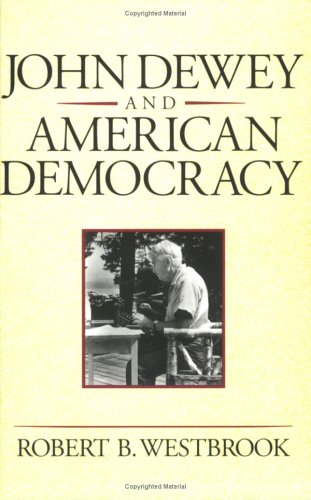
13. John Dewey and American Democracy (Cornell Paperbacks)
by Robert B. Westbrook
Paperback: 570 Pages (1993-02)
list price: US$24.95 -- used & new: US$24.32
(price subject to change: see help)
Asin: 0801481112
Average Customer Review: 5.0 out of 5 stars
Canada | United Kingdom | Germany | France | Japan

Customer Reviews (2)

5-0 out of 5 stars Great Book
I don't think there is a better introduction to John Dewey available. This great booktraces the intellectual development of every major aspect of Dewey's thought in thoughtful detail - his metaphysics, his psychology, his thought on education and democracy, his aesthetic theory. It gives a reader a full overview of Dewey's thought in their historical and intellectual context and leaves him with a sense of the greatness (and present relevance) of Dewey as a thinker. Ive gone on to read several of Dewey's works since because of the interest stirred by this book. I would get a copy soon before it goes out of print

5-0 out of 5 stars Much more than a biography
Robert Westbrook's intellectual biography is one of the very best studies on Dewey's life and work. In my view, it's more balanced and carefully researched than Alan Ryan's "John Dewey and the High Tide of American Liberalism", the most obvious competing book. What Westbrook achieves is a happy combination of historical research and insightful theoretical analysis. And that's what any intellectual biography is all about, right? In a nutshell: this book is definitely worth buying if you are interested in expanding your knowledge on Dewey. ... Read more


14. The Education of John Dewey
by Jay Martin
Hardcover: 592 Pages (2003-02-15)
list price: US$43.00 -- used & new: US$36.90
(price subject to change: see help)
Asin: 0231116764
Average Customer Review: 3.0 out of 5 stars
Canada | United Kingdom | Germany | France | Japan
Editorial Review

Book Description

During John Dewey's lifetime (1859-1952), one public opinion poll after another revealed that he was esteemed to be one of the ten most important thinkers in American history. His body of thought, conventionally identified by the shorthand word "Pragmatism," has been the distinctive American philosophy of the last fifty years. His work on education is famous worldwide and is still influential today, anticipating as it did the ascendance in contemporary American pedagogy of multiculturalism and independent thinking. His University of Chicago Laboratory School (founded in 1896) thrives still and is a model for schools worldwide, especially in emerging democracies. But how was this lifetime of thought enmeshed in Dewey's emotional experience, in his joys and sorrows as son and brother, husband and father, and in his political activism and spirituality? Acclaimed biographer Jay Martin recaptures the unity of Dewey's life and work, tracing important themes through the philosopher's childhood years, family history, religious experience, and influential friendships.

Based on original sources, notably the vast collection of unpublished papers in the Center for Dewey Studies, this book tells the full story, for the first time, of the life and times of the eminent American philosopher, pragmatist, education reformer, and man of letters. In particular,The Education of John Dewey highlights the importance of the women in Dewey's life, especially his mother, wife, and daughters, but also others, including the reformer Jane Addams and the novelist Anzia Yezierska. A fitting tribute to a master thinker, Martin has rendered a tour de force portrait of a philosopher and social activist in full, seamlessly reintegrating Dewey's thought into both his personal life and the broader historical themes of his time.

... Read more

Customer Reviews (4)

4-0 out of 5 stars Dewey and the Light of Experience
Martin's book has an interesting premise, that the life experience of John Dewey was his education.That makes logical sense.Martin was privy to documents from the Dewey Center that were just made available to the public.The book is full ofthought provaking information. I especially enjoyed the parts about his high school and college teaching styles. However, the author raises several unanswered questons?Why did Dewey teach high school and college classes different? What was his espistemology? Overall, the work is a good read and helped the reader gain insights into a complex philosopher.The book so inspired me that I traveled to Oil City,Pennsylvania to see if they had anything on Dewey. All they had was an historical marker where the school was, which is now a firehouse, and a file at the library. One question lingers, what happened to Dewey's dissertation on Kant? No one knows? The mystery of History.

3-0 out of 5 stars 2 1/2 Stars, Actually
It is heartening to see that this book is NOT subject to the "star inflation" that plagues much of this website![I mean, do you really think a majority of books should receive 4 or 5 stars!]."The Education of John Dewey" is a solid biography of an interesting man who played an important role in American intellectual history.However, the book just didn't grab me.Not like "Lincoln's Virtues:an Ethical Biography" for example.One note about Dewey's philosophy.I don't see what was so new about pragmatism/naturalism/progressivism or whatever you want to call it.Wasn't Dewey's emphasis on the importance of the continuing pursuit of truth just a modern version of the Socratic method????????

2-0 out of 5 stars A pleasant read, but a substantive disappointment
Martin endeavors to write a psychological portrait of John Dewey, but falls short. Ironically, the least developed aspect of Dewey's life in this volume is that of Dewey, the psychologist. Dewey was an early member (& president) of the American Psychological Assn. His observation of the reflex arc is still a staple of introductory psychology and the social psychological concepts and models he developed with George Herbert Mead and others prefigured much of the contemporary work in social cognition. Important figures in academic clinical psychology such as George Kelly and Seymour Sarason drew heavily on Dewey's work and Sarason has remained an important champion. No mention is made that Dewey's great friend, James McKeen Catell (a recurring, but little described figure in the book), was diametrically opposed to Dewey on many important issues in psychology including the roles of inheritance and environment in the development of intelligence and the conception of intelligence, itself. Dewey's ability to remain close to people whose ideas he vigorously opposed was but one of the inspiring aspects of Dewey's character. The shortcomings of this book made me more aware than ever that a full scale biography of Dewey, the psychologist, is needed rather than another biography of Dewey the philosopher, especially a tepid, uneven one like this.

Martin, a humanities professor and a practicing psychonanalyst with an eclectic background occasionally deals with psychiatric disorder in Dewey's life (and the lives of his family members) and trots out some watered down neo-Freudian interpretations of his family life. Yet much of the time, Dewey, the man, remains elusive. Martin makes a number of preposterous claims about Dewey: he tells us that Dewey was "impoverished" for most of his professional life, although his salary was far in excess of that of an ordinary wage earner of his time and his home had servants. We also are told that Dewey was unique among 20th century leftists in his rejection of Marxism and Communism. In fact, Dewey was one of many American leftists who were opposed to Marx and Communism. American socialism probably owes more to the social gospel and non-Marxist political economists like Veblen than to Marx, Lenin, or Stalin. Martin also ignores the vigorous and polemical support Dewey gave to World War I and the strains it caused between Dewey and friends like Jane Addams. Instead, we are told that Dewey was a consistent pacifist driven by a concern that war would undermine democratic values. Remarks like these demonstrate Martin's ignorance of Dewey's life, as well as an ignorance of the social and political environment in which Dewey lived. Much of the discussion of Dewey, the philosopher, is laden with academic philosophy that is insufficiently explained for the educated layperson. Many well-educated people are not familiar with Hegel or the Vienna Circle or only dimly recall these from an introductory course. Many are drawn to Dewey because of his educational ideas or his importance in 20th century demoratic socialism, hence, it is probably not reasonable to expect that readers will automatically be drawn to the various debates within academic philosophy.

This book is an easier read than the dense, often turgid works of Robert Westbrook or Steven Rockefeller. On the other hand, the book lacks the breezy, often humorous, tone of Alan Ryan's biography. Ryan's book is a much better introduction to Dewey---witty and scholarly, yet extremely readable. Although Ryan also focuses on Dewey the philosopher, he is more knowledgable about many aspects of Dewey's life and environment than Martin. He recognizes, for example, the importance and the the deeply flawed character of G. Stanley Hall, who provided Dewey with an introduction to operationism and to developmental psychology. Ryan also points out the limitations of Dewey's sometimes wooly writing. One of the problems with reading Dewey is that Dewey, the philosopher, often requires an understanding of Dewey, the psychologist, or Dewey, the political activist, to understand many of the basic concepts that guided Dewey decades into his effort to develop a coherent worldview of pragmatism. The same problem occurs when one looks at him as psychologist, as a pedagogue or, as a political commentator/activist. He was all of these things in all his professional identities, to some extent. Despite the recent run of Dewey biographies and the renewed interest in pragmatism, there's still more to learn about Dewey. Unfortunately, only well-read afficionados will get much from Martin's book and many may be distracted by it's shortcomings.

4-0 out of 5 stars The Education of John Dewey
Jay Martin has accomplished a monumental task in his efforts to uncover the true natures of John Dewey and his colorful life.My interest is in educational psychology and pedagogy.I admit a bit of disappointment in that Dewey's theories - - philosophical, psychological, and pedagogical - - were not explored as much as I had hoped.Nonetheless, I feel that Martin's book is a good primer for anyone who is interested in not only Dewey but, also, names such as Parker, and Tyler.The biography's deep historical basis allows readers of this and closely related materials to have a better contextual grasp how U.S. philosophical, psychological, and pedagogical theories were formulated in the late 18th and early 20th Centuries. ... Read more


15. The Essential Dewey: Ethics, Logic, Psychology
by John Dewey, Larry Hickman, Thomas M. Alexander
Paperback: 488 Pages (1998-07)
list price: US$29.95 -- used & new: US$28.52
(price subject to change: see help)
Asin: 0253211859
Canada | United Kingdom | Germany | France | Japan

16. Liberalism and Social Action (Great Books in Philosophy)
by John Dewey
Paperback: 93 Pages (1999-11)
list price: US$13.00 -- used & new: US$7.33
(price subject to change: see help)
Asin: 1573927538
Canada | United Kingdom | Germany | France | Japan
<