e99 Online Shopping Mall

Geometry.Net - the online learning center Help  
Home  - Philosophers - Epicurus (Books)

  1-20 of 100 | Next 20
A  B  C  D  E  F  G  H  I  J  K  L  M  N  O  P  Q  R  S  T  U  V  W  X  Y  Z  

click price to see details     click image to enlarge     click link to go to the store

$5.34
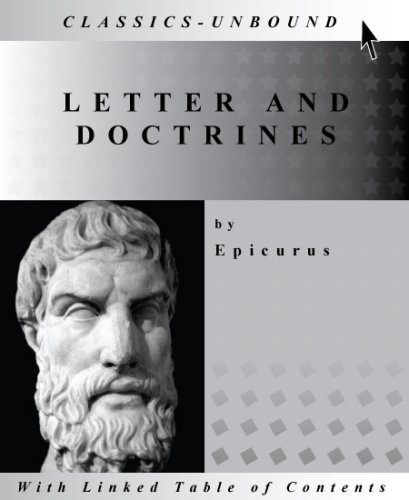
1. The Essential Epicurus: Letters,
$6.99
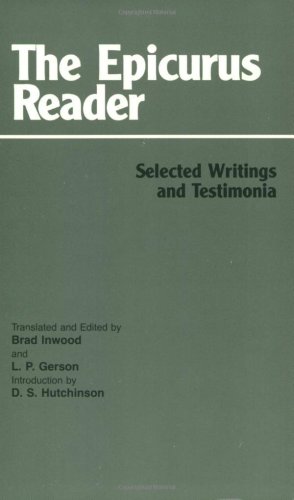
2. The Epicurus Reader: Selected
$32.90
3. Facing Death: Epicurus and His
$37.63
4. From Epicurus to Epictetus: Studies
$10.32
5. Epicurus: The Sage
 
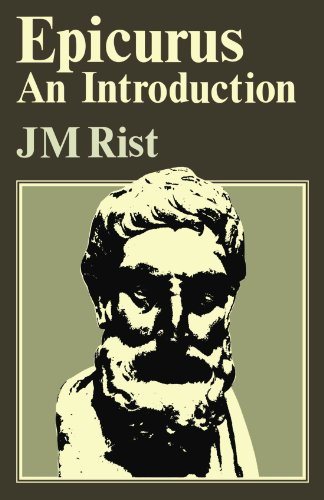
6. Epicurus: An Introduction
 
7. Epicurus and His Philosophy.
$22.78
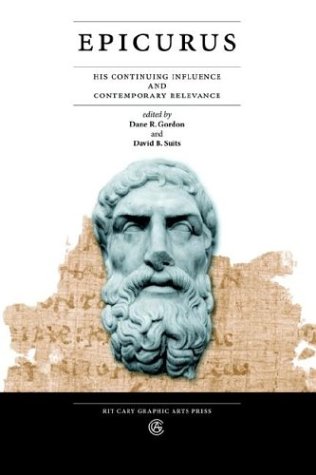
8. Epicurus: His Continuing Influence
9. Letters and Sayings of Epicurus
$17.66
10. The Garden Of Epicurus
 
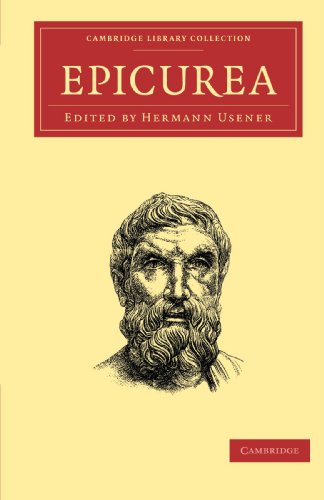
11. Epicurus, the Extant Remains
$62.40
12. Epicurus on Freedom
 
13. Epicurus and His Philosophy
14. Epicurus: The Extant Remains of
 
$5.99
15. Epicurus the Sage: The Many Loves
$35.91
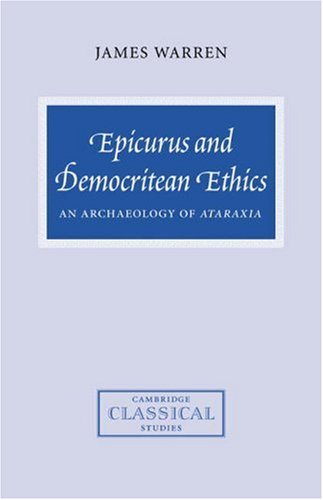
16. Epicurus and Democritean Ethics:
$24.50
17. The Five Great Philosophies of
$24.90
18. Epicurus On the Swerve and Voluntary
 
19. Epicurus : The Extant Remains
 
$5.95
20. When death comes knockin' who

1. The Essential Epicurus: Letters, Principal Doctrines, Vatican Sayings, and Fragments (Great Books in Philosophy)
by Epicurus
Paperback: 101 Pages (1993-05)
list price: US$10.00 -- used & new: US$5.34
(price subject to change: see help)
Asin: 0879758104
Average Customer Review: 4.5 out of 5 stars
Canada | United Kingdom | Germany | France | Japan

Customer Reviews (10)

3-0 out of 5 stars Epicurus, not so great...
A disappointment. At first, I really liked his 'No pain' theorem, but after reading this book (which wasn't so greatly organized or collaborated), I discovered that, yes, perhaps he was looked down on by other Europeans because he elaborated on rather communist ideals. Personally, I like a few of his segments, but NOT his oeuvre en total. This book, either.

5-0 out of 5 stars The Greek Buddha
Epicurus lived in the Athens of Plato.He attracted a host of followers to his preferred teaching place, a garden.There he taught them the ultimately anti-Platonic truths: this life is the only one, it is good, and the best way to live it is by maximizing stable pleasures.

Few philosophers have been more maligned and underappreciated.The Platonists and their ilk (the later Christians) found Epicurus' teachings too much focused on this world and not enough on the other.They thought he taught unalloyed hedonism and accused the Epicureans of wild orgies.Today, an Epicurean is thought of as an effete, wine-sipping decadent.All of these conceptions are completely wrong.

Starting with the truth that everything is made from the material of atoms (after Democritus), Epicurus determined that our consciousness must necessarily die with the death of our bodies.Since this is the only life it should be the sole focus of our efforts.In this mortal life we must maximize our pleasure and minimize our pain.Pleasure is defined as the avoidance of pain and the stabilization of comfort.The most reliable comforts are certainly not sex, drugs, rock and roll-all such things are unstable pleasures that lead to greater appetites.The best pleasures are those that can be controlled without much effort such as good friendship, good cheer, and an appreciation for the simple things.By avoiding epicurean dishes (our misreading) and satisfying our appetites with the most basic, most easily attainable foods, we sate our hunger.The full belly wants neither caviar nor black bread.Taking this principle to all other pleasures, Epicurus finds them easily satisfied.

Much of our turmoil is due to immaterial concerns, the attainment of more power, money, love, and the evasion of death.Epicurus shows, point-by-point, how these concerns can be wrestled into submission.Once the basic pleasures are met and one's anxieties are minimized life becomes simple and good.Before Christianity put non-Chrisitians under the sword, Epicureanism had become immensely popular and was constantly growing.It is time it resumed its natural course.

O'Connor's translations personify the philosopher himself-they are clear and elegant.This is an insightful, exciting, and pleasant read.

5-0 out of 5 stars To Epicurus
The first to bring grain to uneasy mortals
in times past was the famous city of Athens
which made life anew and instituted laws:
And first brought delicious consolation to life
when she gave birth to the man of genius so extraordinary
that everything came from a mouth devoted to truth
so that, even though now he is dead, his divine discoveries
spread abroad, carrying his glory to the sky.

For when he saw that whatever men's needs demanded,
so far as may be, to keep their lives in safety,
was there at hand already for their use,
that men had all they could want in the way of wealth
and honor and praise, and pride in successful children;
Yet, at home each was perpetually disquieted
and the mind was enslaved by all its bitter complaints;
He understood that the trouble was in the container
and because of some flaw in it, everything would go bad
whatever excellent things were put into it:
Partly because there were holes and things flowed through them
and there was no possibility of filling it up;
And partly because what did get in was spoiled,
so to speak, by the nauseous taste there was inside.

The truth was what he used to purify hearts with
and he set a limit to fear as to desire;
He explained what it is that all of us really want
and showed us the way along a little path
which makes it possible for us to go straight there;
He showed what evils there are in human affairs
and how they were brought about by the force of nature,
popping up by change or because nature worked that way;
And he showed how best to face each of these difficulties
and proved that the human race was generally vain
in the way it ruminated in its gloomy thoughts.
For just as children are afraid of the dark
their elders are as often as not afraid in the light
of things which there is as little cause to fear
as those which children imagine to frighten themselves.
These grown-up terrors are also no more than shadows
and yet they are nothing that the sunlight can dissipate:
What is needed is the rational study of nature.

Who is skillful enough to produce an adequate poem
about the magnificent world and these discoveries about it?
Does anyone so use language that he can praise appropriately
the man who made these discoveries and left them for us?

Compare what he did with what the other gods did.

I follow you, nothing better has come out of Greece,
and now, where the print of your foot fell, I place my own,
not in jealous competition but out of love
which constrains me to imitate you. For does the swallow
set herself against swans? Or the wobbling kid
think that she should go as fast as a racehorse?
You discovered nature, father: you gave us instruction
and left the whole matter set out in your writings
where, just as bees help themselves in the meadows,
we can replenish ourselves with your golden sayings;
Golden, in that they are of permanent value.

As soon as your theory, the product of an intellect
something more than human, began to make some noise,
the fears that haunt minds disappeared, the walls of the world
gave way, and I saw through all space how everything happens...

By Lucretius
Written 50 B.C.E

5-0 out of 5 stars The antidote to human stupidity and greed.
This book does not rely on a god or a saviour to lead a smart and fulfilling life.It relies soley on reason and what an effective use of it by epicurus!Most of epicurus works are either lost or destroyed, but this book contains his essential teachings.Epicurus did not deny the existance of the gods.This would make sense.If the universe is infinite as he says, then all possible things already exist in one way or another.According to epicurus one should live out his natural life, this would be prudent.This life is the only one you get.He writes that by being prudent ie; looking at both sides of an issue to find truth and getting only what you need, you can live a smart and happy life. After life is over one goes to eternal oblivion, free of all suffering forever.The ironic thing about epicurus is that he admits there are gods.If one reads what he writes carefully, one finds that one doesnt need to go to heaven or even to exist. Since it is not needed, one loses nothing.The same thing can be said for the wild goose chase, most people are engaged in for happiness.They want bigger houses, more expensive cars, more cash, etc. and instead of gaining happiness gain more misery.Why?Because the truth is you gain happiness by getting only what you need.Epicurus writes that those who are not satisfied with a little, will never be satisfied even with a lot or even infinity.The more you have above need, the more worry, headache and problems.This in no way is conducive to happiness.These writings are some of the most brilliant in the entire realm of philosophy.This book gets two thumbs up!

4-0 out of 5 stars Enjoyed reading Epicurus, but the book can be improved
Most of the other reviers have given this book five stars, and I would too, if I thought this book was perfect! The book does encompass all of Epicurus' first hand writing in English. I did enjoy reading the book and wished we had more of his writinga especially on friendship which in my opinion surpasses Platonic and Aristotilian philosophy. However, I think a copy of the greek text with an apparatus would be highly helpful, especially in writing a good philosophy paper on Epicurus because many different English translations are rendered from the greek fragment, and one word translated obscurely may mean all the difference in philosophical thought. ... Read more


2. The Epicurus Reader: Selected Writings and Testimonia (HPC Classics)
by Epicurus, Brad Inwood
Paperback: 111 Pages (1994-03)
list price: US$7.95 -- used & new: US$6.99
(price subject to change: see help)
Asin: 0872202410
Average Customer Review: 5.0 out of 5 stars
Canada | United Kingdom | Germany | France | Japan

Customer Reviews (2)

5-0 out of 5 stars An Eye Opener about Living with Eyes Open
Let me say at the outset that Epicurus is hard to understand because we have only fragments of his work.

Epicurus is important to people living in the third millenium because he realized, asmost of us do, that traditional religion is not very believable.

In his time the Hellenistic and Romanworld was about to fall into a morass of Eastern religions, spiritualism,and superstition familiar tothird millenium peopleliving amid Tibetan and Zen Buddhism, Wicca, and New Age.

Epicurus has two huge virtues that make him worth reading even now.

He is ferociously smart for one. Some of his insightsabout physical phenomena millenia before the invention of real scientificinstrumentsare astonishing.

The other is that he is unrelentingly honest and rigorous. His premise isthat we only know what we can find out from our senses and our reason. This is immensely liberating from all the causistry,tradition, authority, and sentiment of both culture and counter-culture.

To the ultimate rationalization for religion,"Well, it is a comfort for the simple." he responds, "Truthand honesty are better than comfort."Hedismissed death as nothing, and proved his point by showing legendarycourage in facing his own.

5-0 out of 5 stars An Eye Opener about living with Eyes Open
Let me say at the outset that Epicurus is hard to understand because we have only fragments of his work.

Epicurus is important to people living in the third millenium because he realized, as most of us do, thattraditional religion is not very believable.

In his time the Hellenisticand Roman world was about to fall into a morass of Eastern religions,spiritualism, and superstition familiar to third millenium people livingamid Tibetan and Zen Buddhism, Wicca, and New Age.

Epicurus has two hugevirtues that make him worth reading even now.

He is ferociously smart forone. Some of his insights about physical phenomena millenia before theinvention of real scientific instruments are astonishing.

The other isthat he is unrelentingly honest and rigorous. His premise is that we onlyknow what we can find out from our senses and our reason. This is immenselyliberating from all the causistry, tradition, authority, and sentiment ofboth culture and counter-culture.

To the ultimate rationalization forreligion, "Well, it is a comfort for the simple." he responds,"Truth and honesty are better than comfort."He dismissed deathas nothing, and proved his point by showing legendary courage in facing hisown. ... Read more


3. Facing Death: Epicurus and His Critics
by James Warren
Paperback: 256 Pages (2006-07-20)
list price: US$46.00 -- used & new: US$32.90
(price subject to change: see help)
Asin: 019929769X
Average Customer Review: 4.5 out of 5 stars
Canada | United Kingdom | Germany | France | Japan
Editorial Review

Book Description
The ancient philosophical school of Epicureanism tried to argue that death is 'nothing to us'. Were they right? James Warren provides a comprehensive study and articulation of the interlocking arguments against the fear of death found not only in the writings of Epicurus himself, but also in Lucretius' poem De rerum natura and in Philodemus' work De morte. These arguments are central to the Epicurean project of providing ataraxia (freedom from anxiety) and therefore central to an understanding of Epicureanism as a whole. They also offer significant resources for modern discussions of the value of death - one which stands at the intersection of metaphysics and ethics. If death is the end of the subject, and the subject can not be benefited nor harmed after death, is it reasonable nevertheless to fear the ceasing-to-be? If the Epicureans are not right to claim that the dead can neither be benefited nor harmed, what alternative models might be offered for understanding the harm done by death and do these alternatives suffer from any further difficulties? The discussion involves consideration of both ethical and metaphysical topics since it requires analysis not only of the nature of a good life but also the nature of personal identity and time. A number of modern philosophers have offered criticisms or defences of the Epicureans' views. Warren explores and evaluates these in the light of a systematic and detailed study of the precise form and intention of the Epicureans' original arguments.Warren argues that the Epicureans also were interested in showing that mortality is not to be regretted and that premature death is not to be feared. Their arguments for these conclusions are to be found in their positive conception of the nature of a good and complete life, which divorce the completeness of a life as far as possible from considerations of its duration. Later chapters investigate the nature of a life lived without the fear of death and pose serious problems for the Epicureans being able to allow any concern for the post mortem future and being able to offer a positive reason for prolonging a life which is already complete in their terms. ... Read more

Customer Reviews (2)

5-0 out of 5 stars Facing My Brother's Death
My brother, Scott Swaner, was a Professor at the Univ. of Washington, Seattle when he was diagnosed
with terminal Pancreatic Cancer.He was only 38 years old and other than teaching, he devoured philsophy,
wrote poetry, translated Korean literature and poetry and was waiting for his first novel to be published.
He was living a determined and purposeful life.
The shock of the diagnosis, left him befuddled, but he continued to study and write as he always had.
This book-- Facing Death by James Warren, is one of only three books that Scott read, and recommended
for anyone facing their own mortality.
Scott encouraged each and all of his family members and friends to get a copy and read along with him
as he continued to try and make sense of the senseless.
It helped us.
It helped Scott. I will forever be indebted to Mr. Warren for his words and thoughts.
The Book: Facing Death-- helped save my brothers life, even as he was dying.
Scott died December 20, 2006.Only nine months after his diagnosis and three weeks shy of his 39th
birthday.
We completely recommend this book, for anyone faced with the same situation--
and for anyone who wants to broaden and expand their mind.
Sheri Swaner

4-0 out of 5 stars Great investigation of Epicurianism, but a bit boring
Maybe you stumbled on a description of Epicurus' philosophy and were attracted to it, like I was.A review in Skeptic magazine included a quote:

"God should not concern us.
Death is not to be feared.
What is good is easy to obtain.
What is bad is easily avoided."

A nice perspective to have, as the modern world becomes more and more hedonistic, and God seems more and more out of the picture.

I read Warren's book a couple months ago, so please forgive my fuzziness.The first section is very engaging--a wonderful philosopher's breakdown of the conflicts and claims Epicureanism.In particular, it enumerates the many fears one can have regarding death.My purpose, as yours may be, in reading this book was to see how Epicurus claims to deal with these.This first section promised an investigation into these fears (and true enough, the book delivered).

The second section is on the symmetry argument (not existing before birth doesn't bother us, neither should absence after death).This is an interesting argument, but is not convincing (he agrees, and reserves some criticisms for later).However, it is definitely much too long--I almost wish I'd skipped it.

The rest of the book analyzes some other objections to Epicurianism, from the fear of mortality to the unsustainability of their perfect life (nutshell: at every moment you are satisfied with having lived your life.How can you justify preserving it?).

In fact my only objection to his arguments is in the Epicurean Will section (why write a will if you have no care what happens after your death?).It seems obvious to me that you might write a will to appease and comfort those around you (your grandson might be less nice to you in life if you didn't promise to give him your house when you died; thus you'd be more unhappy.)

In the later parts of the book, he digs deeper into the primary texts of the early practicers, trying to get a handle on what Epicurus taught.I was a little disappointed (slightly uplifted later, at the conclusion) that less time was spent analyzing the viability of these teachings--at this point it became too historical for my taste.

The book is obsessively footnoted, so many of the issues he raises (not only with historical interpretations, but also in viability) can be further explored in literature (some online, some not).Many point to dry topics, but undoubtedly some address my objections.

To tell the truth, in the end I was uninterested in a lot of the conclusions.I'd realized that at least one of my particular major objections were not going to be addressed.Still, I think that alot of the issues, examples, and counterpoints he makes are very illuminating.I have benefitted from reading this book, and as soon as I can get around to it, plan to look up some more argumentative modern defenses of Epicurianism. ... Read more


4. From Epicurus to Epictetus: Studies in Hellenistic and Roman Philosophy
by A. A. Long
Paperback: 456 Pages (2006-11-23)
list price: US$55.00 -- used & new: US$37.63
(price subject to change: see help)
Asin: 0199279128
Canada | United Kingdom | Germany | France | Japan
Editorial Review

Book Description
A.A. Long, one of the world's leading writers on ancient philosophy, presents eighteen essays on the philosophers and schools of the Hellenistic and Roman periods---Epicureans, Stoics, and Sceptics. The discussion ranges over four centuries of innovative and challenging thought in ethics and politics, psychology, epistemology, and cosmology.In iFrom Epicurus to Epictetus/i, Long's focus is on the distinctive contributions and methodologies of individual thinkers, notably Epicurus, Zeno, Pyrrho, Arcesilaus, Lucretius, Cicero, Seneca, and Epictetus.Placing their philosophy in its cultural context, and considering it in relation to the earlier ideas of Socrates, Plato and Aristotle, he invites his readers to imagine themselves choosing between Stoicism and Epicureanism as philosophies of life.All but one of these pieces has been previously published in periodicals or conference volumes, but the author has revised and updated everything, and has also added postscripts to many of the essays. This is a book not only for scholars and experts but also, thanks to the author's accessible style, for everyone interested in understanding the legacy and continuing relevance of ancient thought. ... Read more


5. Epicurus: The Sage
by William Messner-Loebs, Sam Keith
Paperback: 160 Pages (2003-09-01)
list price: US$19.95 -- used & new: US$10.32
(price subject to change: see help)
Asin: 1401200281
Average Customer Review: 4.5 out of 5 stars
Canada | United Kingdom | Germany | France | Japan

Customer Reviews (5)

5-0 out of 5 stars If you like Keith or humorous stuff, you'll LOVE this
If you learned history of Greek phylosophy or live somewhere in south Europe, there is great possibility that you will love this one. It is a farce of historical and myth based stories. All of you who read Alan Ford, this is like His Highness Number One stories which he tells to bother others...

5-0 out of 5 stars excellence .
I found this story to be smart, funny and somewhat insightful.However, I will say that a little knowledge of the philosophers and their philosophy will augment the hilarity tenfold. For instance, Plato constantly is making references to "a cave."If you are not familiar at all with Plato, there is no way to understand that humor.There are many other funny references and critiques of the philosopher's philosophy and I would have found it rather dull if not for my academic background in ancient philosophy. Yet, if you like Sam Keith's charecture sytle of art, then this book is a must.

4-0 out of 5 stars Epicuriouser and curiouser
OK, it's not a likely source of comedy. Epicurus, the philsopher, meets Plato. They suffer the withering gaze of Socrates, the ignominy of discovering that Persephone had actually run away with "Hades-poo," the libido of Zeus and the lividity of Hera in response, and lots more. It's a merry (and somewhat skewed) romp through the golden age of Greek philosophy and through the gilded cage in which the classical gods toy with us mere mortals. With them comes Alexander not-yet-the-Great, a hyperactive eight year old with an attitude and a sword.

This compiles a few of the original comics (and these truly are comical), from the long-ish "Visiting Hades," through "Riding the Sun," to "Helen's Boy." The artistic style develops visibly through the progression, from humorous to frankly bizarre exaggerations - watch for Hera speaking in a quasi-human cow, and brace yourself for a laughable but yuk-creepy caricature of a human female form. The stories wander agreeably through the old tales, back and forth through myth, truth, and pure silliness.

It's a good set, despite a visual style that I thought went downhill through the series. Knowing the original history and mythology will make the stories better for you - but reading these stories will also make you want to look up the originals. The renderings here include a few crude moments. Face it, though, Zeus's carrying-on with all those ill-starred lovelies isn't really what you're likely to use as a goodnight story for your tyke, not when you really think about the details. If you can put up with a little authentic indelicacy, it's good, literate fun.

//wiredweird

4-0 out of 5 stars Intelligent Comedy
I respectfully disagree with the previous reviewer's statement that no previous knowledge of Greek history is needed. I am by no means an expert in Greek history, but I know a few things from high school, watching documentaries, visiting museums and historical stories and movies. The first two stories in this volume are based on pretty well known Greek myths but the second two are more obscure, so I couldn't get into them very much. The plot does take a while to get going but I think that is necessary because of the story's philosophical theme. Of course, its not acurate according to history, its a satire, but I don't think most of it can be proven wrong either. Its very funny and very daring because this type of thing can lose readers pretty quickly. Even though there was a lot I didn't understand, this book is still a good purchase. I'll put it on the shelf for a couple of years and come back to it by which time I'll probably have learned more about Greek history so that I can understand the subtlties (and there are a lot of them).


5-0 out of 5 stars Epicurus is an absolute pleasure
Epicurus the Sage is a biting satire about the philosophical and historical climate of classical Athens.Although not at all historically accurate, it takes each character, including good old Socrates himself, tothe extreme.No knowledge of philosophy or the mythology is required toget the most out of this book, although it certainly helps.It seems totake a while for the plot to kick and it winds up very quickly, which is alittle disappointing.Still, it had my whole household rolling on thefloor with laughter.In the tradition of Asterix, this is a great comic. ... Read more


6. Epicurus: An Introduction
by John M. Rist
 Paperback: 199 Pages (1977-04-21)
list price: US$8.95
Isbn: 052129200X
Canada | United Kingdom | Germany | France | Japan

7. Epicurus and His Philosophy.
by Norman Wentworth. De Witt
 Hardcover: Pages (1954)

Asin: B000WVRQRC
Canada | United Kingdom | Germany | France | Japan

8. Epicurus: His Continuing Influence And Contemporary Relevance
Paperback: 223 Pages (2003-11)
list price: US$24.99 -- used & new: US$22.78
(price subject to change: see help)
Asin: 0971345961
Average Customer Review: 4.5 out of 5 stars
Canada | United Kingdom | Germany | France | Japan

Customer Reviews (3)

4-0 out of 5 stars Print on demand
First - this is print on demand and I didn't know this when ordering. For $25 and only 223 pages I would have wanted decent printing and binding.
I'm not against the technology, but I want to know that a book is poorly printed before I buy it, because I really care about books.
Don't know why they charge so much for it, if you're not going to invest in a big print run, you can at least take a smaller cut of the profits. POD is more expensive per book, but you're not laying out thousands of dollars either.
The ink reflects light and the printing is poor, the lines of letters aren't crisp, it's like they're printed from a raster image. frustrating to read. Obviously the few illustrations are terrible, worse than my 6 year old laser printer.

Second, the title of the book is also the title of a 2002 conference on Epicurus held at Rochester Institute of Technology, when many of the ideas here were first presented. This is not a bad thing, just information not given on the Amazon page.

The publisher's website contains the following:
"Since the Cary Collection's inception in 1969, occasional publications have appeared, inspired by its holdings. Strong scholarship and editorial direction, elegant design, and fine printing have characterized these publications, which are usually historical in context. With the formal establishment of the Cary Graphic Arts Press, we hope to carry on these high standards with increasing regularity.
Though we will continue to produce high-quality letterpress and offset publications, one aspect of our expanded mission is to explore digital technologies and to branch into electronically generated content. In this way, the latest information delivery system will be infused with the best historic ideals--a combination that fosters an optimal educational experience."

Yes, they are an arts press that publishes books about bookbinding, lettering, etc. etc. And this book, however nicely the type may be set - it looks like crap when printed by whatever service they use.

5-0 out of 5 stars Relevant, All-Too-Relevant
Rarely do I recommend secondary sources over primary ones; this book in an exception. The reason is obvious: Epicurus, the most popular and prolific philosopher of antiquity, writing over 37 volumes, is largely lost to us. What the Church did to eliminate these texts one can only guess. But if any philosophy is set diametrically against Judeo-Christian-Islam, Epicurus's is. Since only fragments and reports from others in antiquity survive, Epicurus requires scholarship to pull it all together from so many disparate sources.

Epicurus, the Founder of Epicureanism, continues to be reviled for his materialism, hedonism, atheism, disproof of an afterlife, his tranquility of mind (ataraxia) toward anxiety, his praise of both emotions and reason, for his cultivation of friendship, his praise of love, etc. Let's start with the most "controversial" of his theories: Hedonism. The self-evident principle is to maximize pleasure, minimize pain. Pleasure, for Epicurus, requires a "disciplined" approach, not wild licentious abandon. For example, over-indulgence of any appetite, say deep-fried calamari (my favorite food), for each meal and snack every day of every week loses its pleasure. Calamari all the time makes calamari banal, if not detested. Thus, one must approach each appetite that brings pleasure with a modicum of discipline, balance, and moderation (a very Greek concept). Mutatis mutandis, every other appetite, including sexual.

Epicurus and his disciple Lucretius anticipated Darwin and a materialistic based universe, which, of course, is opposed by Platonism, Christianity, and other metaphysical schemes. His physics remains primitive by today's standards, but his claim that all are atoms or a void "fits" modern physics like a glove.

Like Plato and Aristotle before him, the Charioteer and Two Steeds (Psyche at the reins of emotion and reason) are intended to "govern" or "direct" human emotions to their moderate end through the use of reason. Typical of Greek ethics and values, excess and deficiency are vices, moderation is a virtue. Justice, for example, is taking anger over a violation and moderating the lawful and equal to its proper harbor, without an excess of anger leading to murder and mayhem, and without a deficiency of anger leading to indifference and abuse. Compare this view with Jesus's, who extols turning the cheek to be abused again. To the Greeks that would be unjust. Self-defense is moderate and a virtue, heated tempers an excess of anger, and turning the other cheek a case of masochistic abuse.

Several Church Fathers embraced Stoicism's apathea (apathy, indifference) rather than Epicurus's ataraxia (tranquility, imperturbability), regardingemotions as "brutish, animistic, and sub-human." Not Epicurus. Some emotions cannot be discharged through the moderating influence of reason (for any number of reasons), and those cases require a tranquil resignation of forces larger than ourselves. But where we can effect virtue, can alter an injustice into justice, our sense of justice requires it. Otherwise, in Nietzsche's famed statement, we submit to Slave Morality. Guess who figures prominently an Nietzsche's call to return to Greek values?

The ancient Skeptics disavowed both reason and the senses. Not Epicurus. Our sensory experience is always veridical. And, while reason is never infallible, it alone steers human sensory experience and emotions to the harbors of tranquility, and to the Final End of Human Flourishing. Anxiety, which the Stoics would simply choose to be indifferent to, is a force to reconcile, and if beyond the realm of resolution, simply to be resigned to. Sage Epicureanism: "if you do not reconcile your behavior with the goal of nature, then there will be a conflict between theory and practice."

The Angst of Modernity, the Death of God, the Pendulum of Extremes, the Rise of Irrationality are all predictable reactions when the "opiates of the masses" are removed, whether religious, Marxist, Freudian, or Cults like Heaven's Gate, Jim Jones, and the "Jesus Camp" folk. Without the certainty that Authority brings, whether the Church, the Bible, the Empire, Nationalism, Therapeutics, etc., it might serve our modern anxieties to become reacquainted with Greek thought, especially Epicurus. Commonsense, nature, and tranquility do not need "deities" or "opiates," just a sense of purpose, a sense of living well, and a commonsense that is simply obvious.

Gordon's synthesis from various sources produces an excellent alternative to the Reactions-to-Reactions. No philosopher of Antiquity remains more relevant, more stigmatized, more marginalized, and more despised, all of which are reasons to make Epicurus's acquaintance.

5-0 out of 5 stars you will not get seven virgins after your death ...
It is the shabby trade of the denominations and religion bureaucracies, that they (with infiltrated awe for God and the beyond) again and again try to stir up and bedevil naiv humans: Epicurus (341 - 270 BC) wanted to cut those puppet works. In the today's fundamentalist meets ("in the sky", the Taliban suicide assassins are instructed (swindled), "you will get seven virgins for reward") religious stir-up-neighborhoods and other morasses know how to produce foolish terrorists. The scholars barely can be waiting to enter the promised life after death. "The Clash Of The Civilizations" (Samuel P. Huntington) since September 11 made a worse climax, 2300 years after Epicurus - and this completely uninfluenced by any realizations of Greek philosophy. One could generally doubt, if philosophy is able at all, to clear up brains. Fortunately in parts of Western cultures and counter-cultures however fragments of Epicureanism, Skepticism and Stoicism are still living on. Epicurus (with honorable persistence) tried to weaken the fear of Gods and their punishment-actions and the awe concerning the certain coming death (all animals fate) - and on the other hand he recommended to keep a distance to the political scene (which too often is involved into corruption or riot, filled with hollow slogans or hate-sermons). He prefered not to work on public places but only in his lovely garden, talking to a handful of well-known friends. This conception requires to proof not only the habits of a sensible life-style but more deeper the patterns of personal identity and the consciousness of using time. "A free live is not able to acquire much money , because this is not easy to get without being serviceable to the rich or the mediocre people ..." Epicurus wrote - and he is not frightened at the opulence deficit. "The voice of our bodies: do not be hungry, thirsty, cold!" Indeed, some non-European, i.e. African nations are demonstrating persistently to the rest of the world, how to overcome with low costs - without loosing dignity. Today, an Epicurean is thought of as a exhausted wine-sipping decadent, practicing unalloyed hedonism and wild orgies, sex and drugs and rock and roll. This is completely wrong. Pleasure is defined by Epicurus as the avoidance of pain and passion, of mania and addiction, is defined as a stabilization of emotions. Epicurus preached as a goal of our mortal life to minimize our excitements and anxieties, dependencies and crazes. Not an everlasting carnival was intended, but calmness as a lifestyle. Of course not a cramped indigence and having of no wants combined with self-punishment and nunful, self-indebted hate-the-own-body-attitude. Few philosophers have been more maligned and underappreciated. Epicurus still delivers important annotations. A last one: "You must comprehend the fact, that a long and a short statement are able to reach the same aim." I hope so. ... Read more


9. Letters and Sayings of Epicurus Library of Essential Reading Series
by Epicurus
Mass Market Paperback: Pages (1990)

Isbn: 0760763283
Canada | United Kingdom | Germany | France | Japan

10. The Garden Of Epicurus
by Anatole France
Paperback: 244 Pages (2007-03-01)
list price: US$26.95 -- used & new: US$17.66
(price subject to change: see help)
Asin: 1432584472
Canada | United Kingdom | Germany | France | Japan

11. Epicurus, the Extant Remains
by Trans.) Epicurus (Cyril Bailey
 Hardcover: Pages (1947)

Asin: B000X7170C
Canada | United Kingdom | Germany | France | Japan

12. Epicurus on Freedom
by Tim O'Keefe
Hardcover: 186 Pages (2005-09-19)
list price: US$75.00 -- used & new: US$62.40
(price subject to change: see help)
Asin: 052184696X
Canada | United Kingdom | Germany | France | Japan
Editorial Review

Book Description
The ancient Greek philosopher Epicurus (341-271/0 BCE) has attracted much contemporary interest. Tim O'Keefe argues that the sort of freedom which Epicurus wanted to preserve is significantly different from the 'free will' which philosophers debate today, and that in its emphasis on rational action, has much closer affinities with Aristotle's thought than with current preoccupations. His original and provocative book will be of interest to a wide range of readers in Hellenistic philosophy.Download Description
In this book, Tim O'Keefe reconstructs the theory of freedom of the ancient Greek philosopher Epicurus (341-271/0 BCE). Epicurus' theory has attracted much interest, but our attempts to understand it have been hampered by reading it anachronistically as the discovery of the modern problem of free will and determinism. O'Keefe argues that the sort of freedom which Epicurus wanted to preserve is significantly different from the 'free will' which philosophers debate today, and that in its emphasis on rational action it has much closer affinities with Aristotle's thought than with current preoccupations. His original and provocative book will be of interest to a wide range of readers in Hellenistic philosophy. ... Read more


13. Epicurus and His Philosophy
by Norman Wentworth Dewitt
 Paperback: Pages (1967)

Asin: B000NXMJKI
Canada | United Kingdom | Germany | France | Japan

14. Epicurus: The Extant Remains of the Greek Text.
by EPICURUS.
Unknown Binding: 195 Pages (1947)

Asin: B0000CP4GE
Canada | United Kingdom | Germany | France | Japan

15. Epicurus the Sage: The Many Loves of Zeus (Epicurus)
by William Messner-Loebs
 Paperback: 48 Pages (1991-01)
list price: US$9.95 -- used & new: US$5.99
(price subject to change: see help)
Asin: 0930289919
Average Customer Review: 4.0 out of 5 stars
Canada | United Kingdom | Germany | France | Japan

Customer Reviews (1)

4-0 out of 5 stars Good art, great story.
For those of you unsure who William Messner-Loebs is, he's the guy who wrote all that swell dialogue for the first few years of Kieth's inexplicably non-award-winning series THE MAXX (no, I did not misspell "Kieth").I originally hunted down and bought EPICURUS for Sam's art, but the writing threatened to overshadow the art at times... which is not to say that the art is sub-par, but rather that the story, although a tad uneven, is almost funny and engaging enough to make one forget how good the art is.Political satire tends to age quickly, but EPICURUS THE SAGE is one of those works that manages to remain timeless by not getting overly topical. ... Read more


16. Epicurus and Democritean Ethics: An Archaeology of Ataraxia (Cambridge Classical Studies)
by James Warren
Paperback: 256 Pages (2006-12-14)
list price: US$45.00 -- used & new: US$35.91
(price subject to change: see help)
Asin: 0521034450
Average Customer Review: 4.0 out of 5 stars
Canada | United Kingdom | Germany | France | Japan
Editorial Review

Book Description
The Epicurean philosophical system has enjoyed much recent scrutiny, but the question of its philosophical ancestry remains largely neglected. This book traces its origins in the fifth-century BC atomist Democritus, in his fourth-century followers such as Anaxarchus and Pyrrho, and in Epicurus' disagreements with his own Democritean teacher Nausiphanes. The result is not only a fascinating reconstruction of a lost tradition, but also an important contribution to the philosophical interpretation of Epicureanism, bearing especially on its ideal of tranquillity and on the relation of ethics to physics. ... Read more

Customer Reviews (4)

5-0 out of 5 stars Simply stunning.
An excellent account of the subject matter. Superb presentation and very rigorous indeed.

5-0 out of 5 stars A Response to Mr. Chappels
In my opinion Warren's book - contrary to the above - is an intriguing and expansive treatment of Epicurus' moral theory. To dismiss Warren's conclusion so out of hand suggests to my mind misunderstanding more than anything else. Democritus seen as a model for Epicurus is in fact a hypothesis which is well substantiated, lucid and an exciting new angle on this topic.
I recommend this book unreservedly.

1-0 out of 5 stars I did not know this Democritus
I understand that the students did NOT read this book! The author explains a Democritus that did not exist. May be he was not the Democritus of Abdera, the atomist we knew. To say that the moral of Epicurus is COPIED from that of Democritus is completely CRAZY! The author ignores the CLINAMEN and the FREE WILL of Epicurus' morals. It is better to forget this book and to leave it to the students that do NOT read it.

5-0 out of 5 stars rigorous yet compelling
As students of Dr. James "jimmy" Warren we would like to promulgate that - in spite of not having read this work - it is probably one of the finest intellectual achievements of the last century. ... Read more


17. The Five Great Philosophies of Life: From Epicurus to Christ
by William De Witt Hyde
Paperback: 312 Pages (2003-04)
list price: US$24.50 -- used & new: US$24.50
(price subject to change: see help)
Asin: 1410205517
Canada | United Kingdom | Germany | France | Japan
Editorial Review

Book Description
Contents:
The Epicurean Pursuit of Pleasure
Stoic Self-Control by Law
The Platonic Subordination of Lower to Higher
The Aristotelian Sense of Proportion
The Christian Spirit of Love

William De Witt Hyde, the seventh president of Bowdoin College (1885-1917), was born in Winchendon, Massachusetts, on September 23, 1858. After earning his bachelor's degree from Harvard in 1879, he continued his theological studies at Union Theological Seminary (1879-1880) and Andover Theological Seminary (1882). Hyde served as a minister in Patterson, New Jersey (1883-1885), prior to accepting his post as president of Bowdoin and professor of mental and moral philosophy.

Hyde transformed Bowdoin from a failing country college into an example of a style of higher education. He enlarged the faculty, revolutionized the curriculum, eased entrance requirements, and gave new status to the sciences and the languages.

Hyde was a prolific author, which gave Bowdoin nationwide exposure and cemented Hyde's reputation as a theorist of higher education. Hyde was also a trustee of Phillips Academy in Exeter, New Hampshire (1898-1917), and he received honorary degrees from Bowdoin (1886, 1917), Harvard (1886), Syracuse (1897), and Dartmouth (1909). ... Read more


18. Epicurus On the Swerve and Voluntary Action (American Philological Association American Classical Studies)
by Walter G. Englert
Paperback: 232 Pages (1987-05-01)
list price: US$38.00 -- used & new: US$24.90
(price subject to change: see help)
Asin: 1555401244
Average Customer Review: 5.0 out of 5 stars
Canada | United Kingdom | Germany | France | Japan

Customer Reviews (4)

5-0 out of 5 stars Get it.You won't be sorry!
Unlike too many other books on the subject, Englert's book is readable, hitting the right balance between assuming the reader's background knowledge and explaining the roots of the school of thought.

5-0 out of 5 stars Impressive!
Knew the author as a lad swinging through the "Little Everglades" at Stinson Beach and am not surprised he has come up with such a scholarly work.

5-0 out of 5 stars Wally Englert is a great guy
While I have not actually read THIS book by Wally, I have read his Bryn Mawr commentary on Cicero's "Pro Caelio" and his version of "The Republic --" oh, I mean C.D.C. Reeve's version (wink, wink). Wally is my adviser at lovely Reed College in Portland, OR, and he hashelped me a lot in my development as a human being and a student.

Again,I haven't read this book exactly, but his writing style is very fluid andeasy to follow; his sense of humor shows through in his writing.So buythis book.You won't regret it

5-0 out of 5 stars Wally Englert is God (or Jupiter)
Wally Englert is the greatest writer of all time.He has personally seen to it that the first line of "The Iliad" was recited by over 300 people.This may seem like a small task to you, but did you know "TheIliad" is recited in Ancient Greek?This is an impressive task.BigWally Englert is also the nicest man I know.He is a friend to bicyclistseverywhere, and always wears his bicycle helmet.He pretty much wrote theEnglish version of "The Republic."Classicists everywhere arelining up to copy off of him -- imitation is the greatest form of flattery. Come on, read this book!It'll make you feel good! ... Read more


19. Epicurus : The Extant Remains of the Greek Text
by Introduction By Irwin Edman.Book Design By Bruce Rogers Epicurus.Translated By Cyril Bailey
 Hardcover: Pages (1947)

Asin: B000QXRKPE
Canada | United Kingdom | Germany | France | Japan

20. When death comes knockin' who ya gonna call?(Facing Death: Epicurus and His Critics )(Book Review): An article from: Skeptic (Altadena, CA)
by David Voron
 Digital: 5 Pages (2005-03-22)
list price: US$5.95 -- used & new: US$5.95
(price subject to change: see help)
Asin: B000CQN4JQ
Canada | United Kingdom | Germany | France | Japan
Editorial Review

Book Description
This digital document is an article from Skeptic (Altadena, CA), published by Thomson Gale on March 22, 2005. The length of the article is 1376 words. The page length shown above is based on a typical 300-word page. The article is delivered in HTML format and is available in your Amazon.com Digital Locker immediately after purchase. You can view it with any web browser.

Citation Details
Title: When death comes knockin' who ya gonna call?(Facing Death: Epicurus and His Critics )(Book Review)
Author: David Voron
Publication: Skeptic (Altadena, CA) (Magazine/Journal)
Date: March 22, 2005
Publisher: Thomson Gale
Volume: 11Issue: 4Page: 83(3)

Article Type: Book Review

Distributed by Thomson Gale ... Read more


  1-20 of 100 | Next 20
A  B  C  D  E  F  G  H  I  J  K  L  M  N  O  P  Q  R  S  T  U  V  W  X  Y  Z  

Prices listed on this site are subject to change without notice.
Questions on ordering or shipping? click here for help.

site stats