
|
Help |
| Home - Philosophers - Feyerabend Paul K (Books) | |
e99 Online Shopping Mall
|
|
Help |
| Home - Philosophers - Feyerabend Paul K (Books) | |
| 1-20 of 49 | Next 20 |
click price to see details click image to enlarge click link to go to the store
| 1. Three Dialogues on Knowledge by Paul K. Feyerabend | |
 | Paperback: 167
Pages
(1991-09-02)
list price: US$26.95 -- used & new: US$18.88 (price subject to change: see help) Asin: 0631179186 Canada | United Kingdom | Germany | France | Japan |
|
Editorial Review Product Description | |
| 2. Against Method: Outline of an Anarchistic Theory of Knowledge by Paul K. Feyerabend | |
| Paperback: 304
Pages
(1989-01-12)
list price: US$16.95 Isbn: 086091934X Average Customer Review: 
Canada | United Kingdom | Germany | France | Japan | |
|
Editorial Review Product Description Customer Reviews (20)
| |
| 3. Wissenschaft als Kunst (Edition Suhrkamp) (German Edition) by Paul K Feyerabend | |
 | Perfect Paperback: 168
Pages
(1984)
-- used & new: US$31.98 (price subject to change: see help) Asin: 3518112317 Canada | United Kingdom | Germany | France | Japan |
| 4. Paul Feyerabend-Hans Albert Briefwechsel: Herausgegeben von Wilhelm Baum (Philosophie Fischer) (German Edition) by Paul K Feyerabend | |
 | Perfect Paperback: 255
Pages
(1997)
Isbn: 359613434X Canada | United Kingdom | Germany | France | Japan |
| 5. Probleme des Empirismus 1. by Paul K. Feyerabend | |
 | Paperback: 261
Pages
(2002-02-01)
-- used & new: US$57.80 (price subject to change: see help) Asin: 3150181399 Canada | United Kingdom | Germany | France | Japan |
| 6. Mind, Matter, and Method: Essays in Philosophy and Science in Honor of Herbert Feigl (Minnesota Archive Editions) | |
 | Paperback: 532
Pages
(1966-05-10)
list price: US$60.00 -- used & new: US$56.89 (price subject to change: see help) Asin: 0816657645 Canada | United Kingdom | Germany | France | Japan |
|
Editorial Review Product Description Mind, Matter, and Method was first published in 1966. Minnesota Archive Editions uses digital technology to make long-unavailable books once again accessible, and are published unaltered from the original University of Minnesota Press editions. This volume of twenty-six essays by as many contributors is published in honor of Herbert Feigl, professor of philosophy at the University of Minnesota and director of the Minnesota Center for the Philosophy of Science. Though the majority of the contributors are philosophers, there are also -- as benefits Mr. Feigl's varied intellectual interests -- representatives of psychology, psychoanalysis, and physics. The first group of ten essays deals with the philosophy of mind, particularly with the mind-body problem, to which Mr. Feigl has devoted much attention. The eleven essays in the second part are concerned with problems of philosophical method, especially with induction and confirmation. The third part is comprised of five essays on the philosophy of the physical sciences. A biographical sketch of Mr. Feigl and a bibliography of his writings are also provided. | |
| 7. Briefe an einen Freund (Edition Suhrkamp) (German Edition) by Paul K Feyerabend | |
 | Perfect Paperback: 290
Pages
(1995)
-- used & new: US$66.42 (price subject to change: see help) Asin: 351811946X Canada | United Kingdom | Germany | France | Japan |
| 8. Widerstreit und Harmonie: Trentiner Vorlesungen (Passagen Philosophie) (German Edition) by Paul K Feyerabend | |
 | Perfect Paperback: 171
Pages
(1998)
-- used & new: US$23.83 (price subject to change: see help) Asin: 385165305X Canada | United Kingdom | Germany | France | Japan |
| 9. Contra El Metodo (Spanish Edition) by Paul K. Feyerabend | |
| Paperback:
Pages
(2003-12)
list price: US$22.95 -- used & new: US$29.99 (price subject to change: see help) Asin: 8441318603 Canada | United Kingdom | Germany | France | Japan | |
| 10. Erkenntnis fur freie Menschen (Edition Suhrkamp) (German Edition) by Paul K Feyerabend | |
 | Perfect Paperback: 299
Pages
(1980)
-- used & new: US$13.09 (price subject to change: see help) Asin: 351811011X Canada | United Kingdom | Germany | France | Japan |
| 11. Paradigmenwechsel und "Anything goes". Die Wissenschaftsauffassung Thomas S. Kuhns in der Kritik Paul K. Feyerabends (German Edition) by Christian Schwießelmann | |
 | Paperback: 40
Pages
(2007-09-12)
list price: US$17.90 -- used & new: US$15.96 (price subject to change: see help) Asin: 3638757757 Canada | United Kingdom | Germany | France | Japan |
|
Editorial Review Product Description | |
| 12. Galileo En El Infierno: Un Dialogo Con Paul K. Feyerabend (Spanish Edition) by Jose Luis Gonzalez Recio | |
| Hardcover: 90
Pages
(2007-01)
list price: US$0.19 -- used & new: US$15.27 (price subject to change: see help) Asin: 8481649171 Canada | United Kingdom | Germany | France | Japan | |
| 13. Farewell to Reason by Paul K. Feyerabend | |
| Hardcover: 362
Pages
(1987-11-01)
Isbn: 0860911845 Average Customer Review: 
Canada | United Kingdom | Germany | France | Japan | |
|
Editorial Review Product Description Customer Reviews (3)
First, this book focuses more on culture than scientific belifs. Feyerabend makes clear from the get-go that he is a believer in 'democratic relativism" - literally, that what works for one culture may not work for another. This is really not a radical view untill you take Feyerabends conclusion that because of this, there can be no objective truths, standards, or even critierion for deciphering either. Here's how he undercuts himself though. For Feyerabend, this relativism demands that we recognize our ability to learn from other cultures, engage in dialogue and even argue from time to time. The problem is that if reason is just as good (no better) than any other way of proceeding, it is difficult to imagine how dialogue can proceed, outside of a reasoned structure. At the end of the first essay, Feyerabend stretches further still. If quarks and gods are both theoretical (that is, not empirical) then isn't it strange to regard quarks as more 'real' than gods. Well, Paul, not if you consider that quarks are a) open to falsification, b) accountable to scientific prediction that CAN falsify them and c) have so far enabled us to make accurate predictions without being falsified, then I guess the answer is "no". Many readers will also read this book as a diatribe against Karl Popper. I would urge these readers, if they've not read Popper, to first read either "Conjectures and Refutations" or "Objective Knowledge". Many of Feyerabends characterizations are wrong. Feyerabend constantly underestimates Popper's recongintion of theory and ideology in conjectures and observations. Feyerabend also miscarachterizes Popper's falsification as a view that as soon as an individual sees her theory falsified, she should abandon it as quick as possible. Nope! She should defend it while keeping in mind that she could be wrong. Third, Feyerabend misconstrues Popper as an elitist of science who claims that Western scientific conclusions are the most valid. Popper would be the first to admit that good ideas can come from anywhere. Popper's only suggestion is that matriculation of those ideas into our lives involves making up our minds, which involves reason and that empirical methods are good insofar as they HAVE TO BE the common denominator of intersubjective discussion.Overall, Feyerabends conclusions are all-in-all self defeating, his arguments are largely misunderstandings and his book is verging on being a waste of time.
As usual his groundwork is thorough, although not as detailed as that in "Against Method", and full of interesting asides which both support the argument and fascinate the reader. His energy is infectious although some of his comments are quite abrasive especially those concerning Popper. It compares well to the first book and is far better than his last "Conquest of Abundance" which seemed tired by comparison and lacking the zest of the earlier works such as this one and the first. To me, the two outstanding chapters are the ones on Mach and Aristotle which alone make the book worth buying. Feyerabend is a rare breed of philosopher in that he does not construct systematic theories but rather deconstructs existing ones and criticises them consistently at the same time giving credence to his ideas of relativism which are quite at odds with the usual interpretation of this idea. Feyerabend does not constrain himself overly in the sense of a solid theoretical basis prefering to remain loose and free to move. There are many advantages to this process although it does not introduce new ideas or concepts which by themselves could lead to further insights, this is possible without stagnation or a crystallisation of views which often occurs. He is also aware of his own propensity to intellectualise, something which he tries to supplement with a kind of living discourse which partly compensates. | |
| 14. Problems of Empiricism: Volume 2: Philosophical Papers (Feyerabend, Paul, K., Philosophical Papers, V. 2.) by Paul K. Feyerabend | |
| Hardcover: 268
Pages
(1981-10-30)
list price: US$80.00 Isbn: 0521239648 Canada | United Kingdom | Germany | France | Japan | |
|
Editorial Review Product Description | |
| 15. Knowledge, Science and Relativism (Philosophical Papers/Paul K. Feyerabend, Vol 3) by P. K. Feyerabend | |
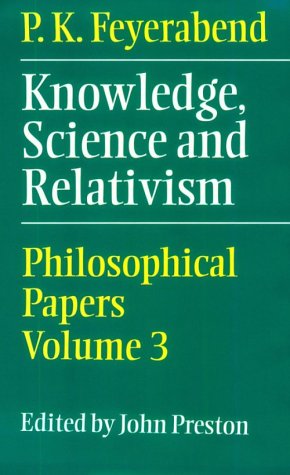 | Hardcover: 268
Pages
(1999-05-28)
list price: US$99.00 -- used & new: US$94.64 (price subject to change: see help) Asin: 0521641292 Canada | United Kingdom | Germany | France | Japan |
|
Editorial Review Product Description | |
| 16. Der wissenschaftstheoretische Realismus und die Autoritat der Wissenschaften (His Ausgewahlte Schriften) (German Edition) by Paul K Feyerabend | |
| Perfect Paperback: 367
Pages
(1978)
Isbn: 3528084111 Canada | United Kingdom | Germany | France | Japan | |
| 17. Ambiguedad Y Armonia (Spanish Edition) by Paul K. Feyerabend | |
 | Paperback: 162
Pages
(1998-12-29)
list price: US$22.95 -- used & new: US$21.22 (price subject to change: see help) Asin: 8449305373 Canada | United Kingdom | Germany | France | Japan |
| 18. Matando El Tiempo (Spanish Edition) by Paul K. Feyerabend | |
| Paperback:
Pages
(1998-07)
list price: US$18.90 -- used & new: US$56.70 (price subject to change: see help) Asin: 8474448913 Canada | United Kingdom | Germany | France | Japan | |
| 19. Limites De La Ciencia (Spanish Edition) by Paul K. Feyerabend | |
| Paperback: 160
Pages
(1989-08-28)
list price: US$22.95 -- used & new: US$18.28 (price subject to change: see help) Asin: 8475095364 Canada | United Kingdom | Germany | France | Japan | |
| 20. Erkenntnis Fur Freie Menschen by Paul K. And Maxwell, Grover Feyerabend | |
| Paperback:
Pages
(1980)
Asin: B0028H3NC0 Canada | United Kingdom | Germany | France | Japan | |
| 1-20 of 49 | Next 20 |
 Mr
Mr So what does Feyerabend believe?
 An energetic read.