
|
Help |
| Home - Philosophers - Foucault Michel (Books) | |
e99 Online Shopping Mall
|
|
Help |
| Home - Philosophers - Foucault Michel (Books) | |
| 1-20 of 100 | Next 20 |
click price to see details click image to enlarge click link to go to the store
| 1. The History of Sexuality, Vol. 1: An Introduction by Michel Foucault | |
 | Paperback: 168
Pages
(1990-04-14)
list price: US$14.00 -- used & new: US$7.00 (price subject to change: see help) Asin: 0679724699 Average Customer Review: 
Canada | United Kingdom | Germany | France | Japan |
|
Editorial Review Product Description Customer Reviews (31)
| |
| 2. Abnormal: Lectures at the Collège de France, 1974-1975 (Lectures at the College de France) by Michel Foucault | |
 | Paperback: 400
Pages
(2004-09-01)
list price: US$18.00 -- used & new: US$10.08 (price subject to change: see help) Asin: 0312424051 Average Customer Review: 
Canada | United Kingdom | Germany | France | Japan |
|
Editorial Review Product Description Customer Reviews (2)
| |
| 3. Madness and Civilization: A History of Insanity in the Age of Reason by Michel Foucault | |
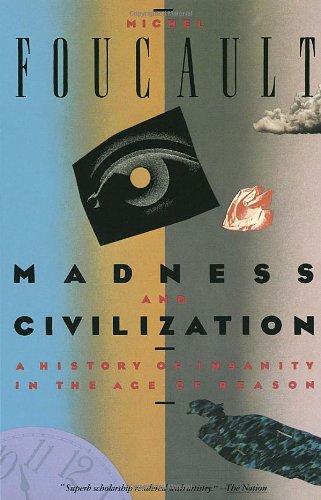 | Paperback: 320
Pages
(1988-11-28)
list price: US$15.00 -- used & new: US$8.09 (price subject to change: see help) Asin: 067972110X Average Customer Review:
Canada | United Kingdom | Germany | France | Japan |
|
Editorial Review Product Description Customer Reviews (22)
| |
| 4. Power/Knowledge: Selected Interviews and Other Writings, 1972-1977 by Michel Foucault | |
 | Paperback: 288
Pages
(1980-11-12)
list price: US$16.00 -- used & new: US$8.80 (price subject to change: see help) Asin: 039473954X Average Customer Review: 
Canada | United Kingdom | Germany | France | Japan |
|
Editorial Review Product Description Now, in this superb set of essays and interviews, Foucault has provided a much-needed guide to Foucault. These pieces, ranging over the entire spectrum of his concerns, enabled Foucault, in his most intimate and accessible voice, to interpret the conclusions of his research in each area and to demonstrate the contribution of each to the magnificent -- and terrifying -- portrait of society that he was patiently compiling. For, as Foucault shows, what he was always describing was the nature of power in society; not the conventional treatment of power that concentrates on powerful individuals and repressive institutions, but the much more pervasive and insidious mechanisms by which power "reaches into the very grain of individuals, touches their bodies and inserts itself into their actions and attitudes, their discourses, learning processes and everyday lives" Foucault's investigations of prisons, schools, barracks, hospitals, factories, cities, lodgings, families, and other organized forms of social life are each a segment of one of the most astonishing intellectual enterprises of all time -- and, as this book proves, one which possesses profound implications for understanding the social control of our bodies and our minds. Customer Reviews (8)
His work is incredibly hard to understand, more tedious to read then Dickens and Dostoevsky combined, and very incoherent.None the less, I'm afraid to give it poor marks out of fear that the intellectuals will brand me a mental midget.On the same line, I'm afraid to engage anyone in conversation about Foucault out of fear that my shallow-comic-book-level understanding of his text will be exposed. Ultimately, I think this really takes away from his work.He has a lot of insightful things to write.But if you can't communicate them what is the purpose?Read the text and get the comic books.Study your signs and make sure you obey traffic laws.
The problem with this book is in the presentation. I don't agree with other reviewers who state that this is a good summary or compendium of Foucault's works, because of its very fragmentary nature. Each of the chapters here can be considered distillations of Foucault's thoughts on key subjects. Most of the chapters are structured as interviews or dialogues but with no surrounding context. We have no explanation of who the interviewers are or from which angle they have approached Foucault's works. The chapters begin abruptly, often with the feel of an interview in progress, with no introductory explanations of the context for that portion of Foucault's efforts. Similarly, the chapters end abruptly with no wrapping up or conclusive explanations of the matter at hand. One chapter consists of two "lectures" given at different times, with zero explanation of the purpose of Foucault's visit to wherever the lecture was delivered, who the audience was, or the environment in which Foucault's presence was utilized. Therefore this book is not a good summary because it only leaves you with fragmentary details of far more vast philosophical masterpieces, with no surrounding context or supplementary information. You can get a passable introduction to Foucault's general ideas here, but for true knowledge you will have to tackle his proper dissertations. The best examples with relevance for contemporary thought are "Madness and Civilisation," "Archeology of Knowledge," and others. [~doomsdayer520~] ... Read more | |
| 5. The Government of Self and Others: Lectures at the College de France, 1982-1983 by Michel Foucault | |
 | Hardcover: 432
Pages
(2010-06-08)
list price: US$30.00 -- used & new: US$19.68 (price subject to change: see help) Asin: 1403986665 Canada | United Kingdom | Germany | France | Japan |
|
Editorial Review Product Description This lecture, given by Michel Foucault at the Collège de France, launches an inquiry into the notion of parresia and continues his rereading of ancient philosophy. Through the study of this notion of truth-telling, of speaking out freely, Foucault re-examines Greek citizenship, showing how the courage of the truth forms the forgotten ethical basis of Athenian democracy. The figure of the philosopher king, the condemnation of writing, and Socrates’ rejection of political involvement are some of the many topics of ancient philosophy revisited here. | |
| 6. Discipline & Punish: The Birth of the Prison by Michel Foucault | |
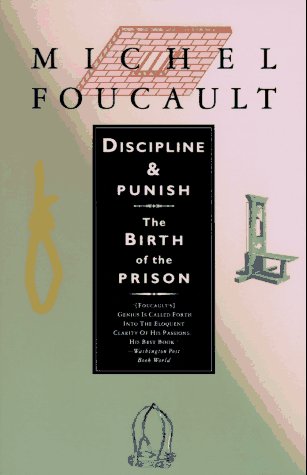 | Paperback: 352
Pages
(1995-04-25)
list price: US$15.95 -- used & new: US$9.09 (price subject to change: see help) Asin: 0679752552 Average Customer Review:
Canada | United Kingdom | Germany | France | Japan |
|
Editorial Review Product Description Customer Reviews (47)
| |
| 7. The Foucault Reader by Michel Foucault | |
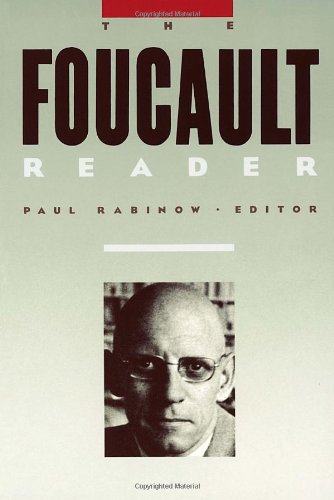 | Paperback: 400
Pages
(1984-11-12)
list price: US$18.00 -- used & new: US$10.92 (price subject to change: see help) Asin: 0394713400 Average Customer Review:
Canada | United Kingdom | Germany | France | Japan |
|
Editorial Review Product Description The Reader contains selections from each area of Foucault's work as well as a wealth of previously unpublished writings, including important material written especially for this volume, the preface to the long-awaited second volume of The History of Sexuality, and interviews with Foucault himself, in the course of which he discussed his philosophy at first hand and with unprecedented candor. This philosophy comprises an astonishing intellectual enterprise: a minute and ongoing investigation of the nature of power in society. Foucault's analyses of this power as it manifests itself in society, schools, hospitals, factories, homes, families, and other forms of organized society are brought together in The Foucault Reader to create an overview of this theme and of the broad social and political vision that underlies it. Customer Reviews (8)
| |
| 8. Order of Things: An Archaeology of the Human Sciences (Routledge Classics) by Michel Foucault | |
 | Hardcover: 448
Pages
(2001-12-21)
list price: US$130.00 -- used & new: US$113.38 (price subject to change: see help) Asin: 0415267366 Average Customer Review:
Canada | United Kingdom | Germany | France | Japan |
|
Editorial Review Product Description Customer Reviews (14)
| |
| 9. Power (The Essential Works of Foucault, 1954-1984, Vol. 3) by Michel Foucault, Robert Hurley, James D. Faubion, Paul Rabinow | |
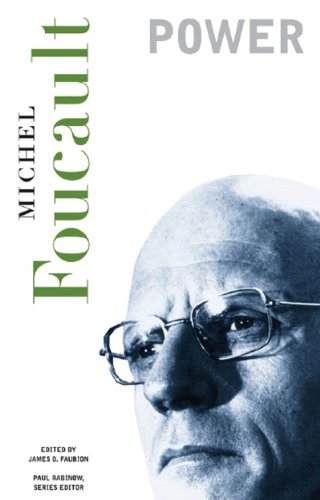 | Paperback: 528
Pages
(2001-10)
list price: US$19.95 -- used & new: US$12.83 (price subject to change: see help) Asin: 1565847091 Average Customer Review:
Canada | United Kingdom | Germany | France | Japan |
|
Editorial Review Product Description Customer Reviews (1)
| |
| 10. The History of Sexuality, Vol. 2: The Use of Pleasure by Michel Foucault | |
 | Paperback: 304
Pages
(1990-04-14)
list price: US$15.00 -- used & new: US$8.55 (price subject to change: see help) Asin: 0394751221 Average Customer Review:
Canada | United Kingdom | Germany | France | Japan |
|
Editorial Review Product Description Throughout The Uses of Pleasure Foucault analyzes an irresistible array of ancient Greek texts on eroticism as he tries to answer basic questions: How in the West did sexual experience become a moral issue? And why were other appetites of the body, such as hunger, and collective concerns, such as civic duty, not subjected to the numberless rules and regulations and judgments that have defined, if not confined, sexual behavior? Customer Reviews (4)
Foucault delves deep into therecesses of our occidental world by attempting to answer the question,"Why is it that sexuality has become morally problematic?"Whyand when did we attribute a negativity to certain sexualities?And whatdoes this imply about sexuality itself? Foucault works with irresistiblesources (e.g. Plato's Republic; Hippocrates' Ancient Medicine) in an effortto reconstruct the Hellenic approach to sexuality.The result: a clear andfascinating delineation of the similarities and differences between modernsexual consciousness and "pagan license". ... Read more | |
| 11. History of Madness by Michel Foucault | |
 | Paperback: 776
Pages
(2009-04-02)
list price: US$24.95 -- used & new: US$15.65 (price subject to change: see help) Asin: 0415477263 Average Customer Review:
Canada | United Kingdom | Germany | France | Japan |
|
Editorial Review Product Description When it was first published in France in 1961 as Folie et Déraison: Histoire de la Folie à l'âge Classique, few had heard of a thirty-four year old philosopher by the name of Michel Foucault. By the time an abridged English edition was published in 1967 as Madness and Civilization, Michel Foucault had shaken the intellectual world. This translation is the first English edition of the complete French texts of the first and second edition, including all prefaces and appendices, some of them unavailable in the existing French edition. History of Madness begins in the Middle Ages with vivid descriptions of the exclusion and confinement of lepers. Why, Foucault asks, when the leper houses were emptied at the end of the Middle Ages, were they turned into places of confinement for the mad? Why, within the space of several months in 1656, was one out of every hundred people in Paris confined? Shifting brilliantly from Descartes and early Enlightenment thought to the founding of the Hôpital Général in Paris and the work of early psychiatrists Philippe Pinel and Samuel Tuke, Foucault focuses throughout, not only on scientific and medical analyses of madness, but also on the philosophical and cultural values attached to the mad. He also urges us to recognize the creative and liberating forces that madness represents, brilliantly drawing on examples from Goya, Nietzsche, Van Gogh and Artaud. The History of Madness is an inspiring and classic work that challenges us to understand madness, reason and power and the forces that shape them. Customer Reviews (8)
| |
| 12. The Birth of the Clinic: An Archaeology of Medical Perception by Michel Foucault | |
 | Paperback: 240
Pages
(1994-03-29)
list price: US$15.00 -- used & new: US$7.43 (price subject to change: see help) Asin: 0679753346 Average Customer Review: 
Canada | United Kingdom | Germany | France | Japan |
|
Editorial Review Product Description Customer Reviews (7)
Reviewer: A reader from California May 17, 1998 "Again, Foucault shatters our illusions.This book examines our cultural tendency to elevate the authority of the physician..." This reviwer's summary of the book is incorrect because the work is not astudy of power or "authority" (themes which would be important inFoucault's later works). In "The Birth of the Clinic" we see howFoucault MIGHT HAVE made a crticism of clinical medicine as anauthoritarian institution, but in fact this is NOT the focus of the book.This book is not the attempt to dispel a "myth", it is adescription of the reality of the development of the clinical gaze as adiscursive formation distinct from its historical predecessors. Reviewer:spandex9@aol.com from Barbaraville, Manitoba (Canada)July 21, 1998."Structures of Perception and Positivism Questioned". This reviewis much closer to the mark than the first one. In particular, in the secondparagraph the reviewer touches on the implications of the development ofanatomo-clinical medicine for "the human experience itself". Inthe conclusion to the book Foucault himself stated that "theexperience of individuality in modern culture is linked to the experienceof death" and that is one reason why we should be interested in thiswork. Reviewer: Dr. W Y Wan from Hong Kong "A book with specialinsight-- one that you cannot miss. I agree that this book can be ofvalue to physicians who are genuinely interested in human welfare, and it'sunfortunate that most physicians never study the humanities during theireducations.
| |
| 13. The Archaeology of Knowledge & The Discourse on Language by Michel Foucault | |
 | Paperback: 256
Pages
(1982-09-12)
list price: US$15.00 -- used & new: US$8.56 (price subject to change: see help) Asin: 0394711068 Average Customer Review:
Canada | United Kingdom | Germany | France | Japan |
|
Editorial Review Product Description Customer Reviews (8)
| |
| 14. The Birth of Biopolitics: Lectures at the Collège de France, 1978--1979 (Lectures at the College de France) by Michel Foucault | |
 | Paperback: 368
Pages
(2010-03-02)
list price: US$19.00 -- used & new: US$11.43 (price subject to change: see help) Asin: 0312203411 Average Customer Review:
Canada | United Kingdom | Germany | France | Japan |
|
Editorial Review Product Description Customer Reviews (7)
| |
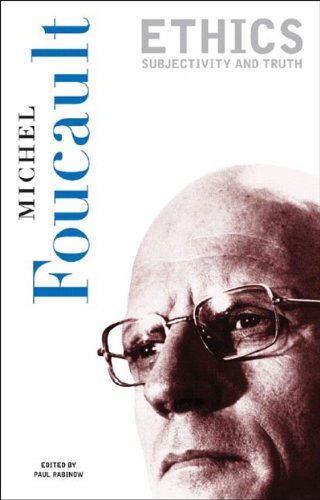
| 15. Ethics: Subjectivity and Truth (Essential Works of Foucault, 1954-1984, Vol. 1) by Michel Foucault | |
 | Paperback: 384
Pages
(2006-04-28)
list price: US$19.95 -- used & new: US$12.15 (price subject to change: see help) Asin: 1565844343 Average Customer Review:
Canada | United Kingdom | Germany | France | Japan |
|
Editorial Review Product Description Customer Reviews (3)
This volume is divided into two sections: the first is the completecollection of Foucault's resumes from the courses he conducted at theCollege de France; and the second part consists of numerous interviews andessays that have been gathered around the theme of ethics.The resumes arethe official submissions by Foucault to the College, meaning that theyweren't meant for publication but rather for administrative reasons.Assummaries of a year's worth of teachings, covering 1970 to 1984, they onlyprovide crude chunks of what may have proceeded in these courses and publiclectures.Thus, they are rather innocuous, and useless for most scholars. The second part is equally erratic as the theme of ethics just doesn't holdup: for example, what does the piece "The Masked Philosopher"have to do with Foucault's study of Greek and Christian ethics? The 2ndvolume of this series, on aesthetics, methhod and epistemology, is a farsuperior collection of Foucault goodies. The best selections from thisvolume is a good summary of Foucault's last two projects: on Greek andRoman sexual practices.Even the introduction by Paul Rabinow is a minordisappointment. And I gotta say this: the cover layout is atrocious. And why couldn't they just find another photo of Foucault for the backcover, instead of merely reversing the image?Which makes me wonder: whichis the original? ... Read more | |
| 16. Michel Foucault: Beyond Structuralism and Hermeneutics by Hubert L. Dreyfus, Paul Rabinow | |
 | Paperback: 271
Pages
(1983-12-15)
list price: US$23.00 -- used & new: US$17.22 (price subject to change: see help) Asin: 0226163121 Average Customer Review:
Canada | United Kingdom | Germany | France | Japan |
|
Editorial Review Product Description Customer Reviews (8)
| |
| 17. The Hermeneutics of the Subject: Lectures at the Collège de France 1981--1982 by Michel Foucault | |
 | Paperback: 608
Pages
(2005-12-27)
list price: US$18.00 -- used & new: US$11.13 (price subject to change: see help) Asin: 0312425708 Average Customer Review:
Canada | United Kingdom | Germany | France | Japan |
|
Editorial Review Product Description Customer Reviews (2)
| |
| 18. The History of Sexuality, Vol. 3: The Care of the Self by Michel Foucault | |
 | Paperback: 288
Pages
(1988-11-28)
list price: US$15.00 -- used & new: US$7.50 (price subject to change: see help) Asin: 0394741552 Average Customer Review:
Canada | United Kingdom | Germany | France | Japan |
|
Editorial Review Product Description Customer Reviews (3)
So what is the nature of the changes presented in this volume? First is the newfound and pivotal concern for the self nearly absent in the writing examined in the preceding volume. The Greeks seemed concerned for the self only insomuch as an untamed, desirous self would have no right to rule over others within the domestic or political sphere (Use 70-72). These political conceptions of the good, moderate citizen, in conjunction with any special birthrights, were to dominate the life of the individual men (I use this word literally) who would make up a Greek city (Use 72). But within the first two centuries of our own era, there was a new concern for the self and a general disconnection of its relation to the political sphere (Care 67-68). It was through the care of the self that one would discover how to relate to the political realm, and this would be regardless of class strata or other "external" difference (Care 87-94). In many ways, the development of more personal practices of the self would more definitely shape the greater moral code--this code would be more relativized, more individualized. But this would certainly not mean that men could absolutely develop their own ethical code without regard to the discursive features of the period. It was not absolutely relative to the individual in question. The second theme, thus, was a shift in emphasis in practices related to the body, boys and marriage. In all of these realms, there was an increasing idea of the frailty of the fiber--morally and physically--of the self. For instance, the Greek's valorization of sexual moderation shifted nearly to idealization of sexual abstinence in Roman writings (122). What was once an anxiety over the effects of too much sexual activity became an anxiety over sexual pleasure generally--due very visibly to the new emphasis on the care of the self for the self's own sake (123). Within this thematic of shifting values the question of marriage and of relations with young men was re-cast. Marriage became a much more personal institution; the idea of love, mutual care and fidelity began to dominate discourse on marriage. Where before the husband was not expected to have sexual relations exclusively with his wife (Use 180), it was now a weakness if he did not (Care 175). Marriage was idealized as the most perfect, most complete formulation for sexual relation. Therefore, Foucault writes, when the love of young men was posed, it would often be contrasted with this more "perfect" marital relation and held against a valorization of intentional virginity--ideally meant until the more excellent marital union might be realized (228-32). The love of young men became a weakness of the self in this ideational restructuring. This is perhaps where I would call into question Foucault's hermeneutical method. While he makes it very clear that he is only analyzing an elite medico-philosophical discourse from the period (235), he does not mention exactly what this means: what he is leaving out. Martial's Epigrams, for instance, was a contemporaneous personal exposition into as many sexual acts and practices as one might imagine. Further, Garland's poetry from the same period speaks of a love for a boy held above any other love one might find in the earthly realm. Foucault can only (albeit convincingly) speculate that the early Roman discourse he is uncovering matriculated into the formation of the Christian Roman Empire (235), and that it was not, for instance, an inconsequential reaction to the varied "decadences" one might find in these other literary works. There is simply not a lot of methodological certainty about why or how this elite and small conversation between philosophers and medics diffused itself so completely into the later empire. Nonetheless, I still think that this is the most exciting volume of Foucault's history. Its presentation is more complex and subtle then the almost schematically frigid The Use of Pleasure, and its articulation is more intentional and deliberate than the broad strokes of the Introduction. Moreover, this volume, I believe, shows us the very first seeds of the discourse that would eventually insist on an essential sexuality revelatory of the truth of the self: the idea of sexuality we all live with today. ... Read more | |
| 19. Manet and the Object of Painting by Michel Foucault | |
 | Hardcover: 96
Pages
(2010-03-01)
list price: US$21.95 -- used & new: US$12.98 (price subject to change: see help) Asin: 1854378457 Average Customer Review:
Canada | United Kingdom | Germany | France | Japan |
|
Editorial Review Product Description Customer Reviews (1)
| |
| 20. Feminist Interpretations of Michel Foucault (A E Reading the Canon) by Susan Hekman | |
 | Paperback: 336
Pages
(1996-11-01)
list price: US$26.00 -- used & new: US$26.00 (price subject to change: see help) Asin: 0271032715 Canada | United Kingdom | Germany | France | Japan |
|
Editorial Review Product Description | |
| 1-20 of 100 | Next 20 |
 The History of Sexuality an Introduction by Michael Foucault
 Foucault's Pendulum of Human Sexuality
 Important Warning: Bad Research