e99 Online Shopping Mall
|
|
Help |
| Home - Philosophers - Foucault Michel (Books) | |
|   | Back | 21-40 of 100 | Next 20 |
click price to see details click image to enlarge click link to go to the store
| 21. Foucault: A Critical Reader (Blackwell Critical Reader) | |
![]() | Paperback: 246
Pages
(1991-01-15)
list price: US$27.95 -- used & new: US$26.95 (price subject to change: see help) Asin: 0631140433 Average Customer Review: Canada | United Kingdom | Germany | France | Japan |
Customer Reviews (1)
| |
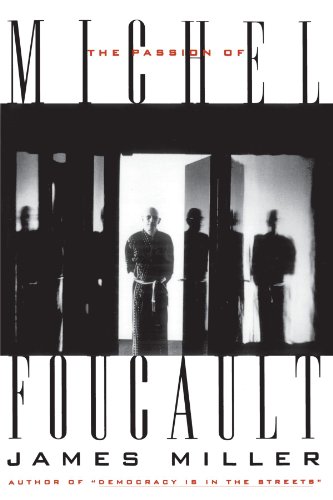
| 22. The Passion of Michel Foucault by James Miller | |
![]() | Paperback: 492
Pages
(2000-04-07)
list price: US$24.95 -- used & new: US$24.95 (price subject to change: see help) Asin: 0674001575 Average Customer Review: Canada | United Kingdom | Germany | France | Japan |
|
Editorial Review Book Description Customer Reviews (9)
Foucault said, "...there is not a book I have written that does not grow, at least in part, out of a direct, personal experience."Each chapter of Miller's book gradually unfolds the truth of this statement, beginning with Foucault's earliest writings on madness and mental illness, through his works on knowledge and criminality, to his final opus on the nature of human sexuality.Foucault's unorthodox approach to history is made clear, revealing a revolutionary philosophy based not on structured logic and reason, but growing instead from the realm of experience, in keeping with the "great Nietzschean quest [to] become what one is." I personally found this book quite disturbing, still accepting as I do many principles of existential humanism, especially those of free will and personal responsibility.But humanism as a whole is a philosphy Foucault and his contemporaries emphatically reject as "a diminution of man," made up of "everything in Western civilization that restricts the desire for power" and "every attitude that considers the aim of politics to be the production of happiness."In reality, says Foucault, happiness does not exist---and the happiness of man exists still less." "The individual," he is reported to have said, "is contingent, formed by the weight of moral tradition, not really autonomous."And we "can and must make of man a negative experience, lived in the form of hate and aggression." Somewhat stunned, I've nevertheless gained from Miller's book a new understanding of the world I live in, and of myself as part of that world."Under the impact of civilization," he summarizes, "the will to power (Freud's 'death instinct') has been driven inward and turned against itself---creating within the human being a new inclination: to destroy himself."So, if Foucault is right, the basic truth that society tries to make humans homogenously "tame" is itself the very root of the violence and decadence of our times.If we are to point to the cause of these problems, we can only point at ourselves and at our structured ways of thinking.The problem is not what we have allowed to be, but rather what we have tried to deny and eliminate."I am referring," says Foucault, "to all those experiences that have been rejected by our civilization, or which it accepts only within literature."This view throws the current move toward increased artistic censorship into new and unexpected relief. For Foucault, then, the issue is the same, whatever the subject at hand: the concept of madness, our systems of language and knowledge, law and the punishment of crime, or the idea and expression of our individual sexuality.Regardless of our lifestyle, history has told us the limits of what we can be, and as individuals and as a culture we are paying a great price for believeing it.According to Foucault, the solution can only be to "free ourselves from...cultural conservatism, as well as from political conservatism.We must see our rituals for what they are: completely arbitrary things."We must find the "limits" of our thinking and learn to transcend them.Says Foucault, "...the unity of society [is] precisely that which should...be destroyed." Miller's book is HIGHLY RECOMMENDED!!
I am not convinced either that Foucault's es muss sein can be essentialized as a Nietzschean project per se. Foucault is the great synthesizer. Rather than build on his academic successes, Miller pokes around looking for dirt on Foucault using the same technique that proved successful for Foucault - the archives. Read all three biographies to get an idea of his work but make sure to read his TEXT to get an idea of his thought. Miguel Llora
| |
| 23. The History of Sexuality: The Use of Pleasure (Vintage) Vol. 2 by Michel Foucault | |
![]() | Paperback: 304
Pages
(1990-04-14)
list price: US$14.00 -- used & new: US$7.50 (price subject to change: see help) Asin: 0394751221 Average Customer Review: Canada | United Kingdom | Germany | France | Japan |
|
Editorial Review Book Description Customer Reviews (3)
Miguel Llora
Foucault delves deep into therecesses of our occidental world by attempting to answer the question,"Why is it that sexuality has become morally problematic?"Whyand when did we attribute a negativity to certain sexualities?And whatdoes this imply about sexuality itself? Foucault works with irresistiblesources (e.g. Plato's Republic; Hippocrates' Ancient Medicine) in an effortto reconstruct the Hellenic approach to sexuality.The result: a clear andfascinating delineation of the similarities and differences between modernsexual consciousness and "pagan license". ... Read more | |
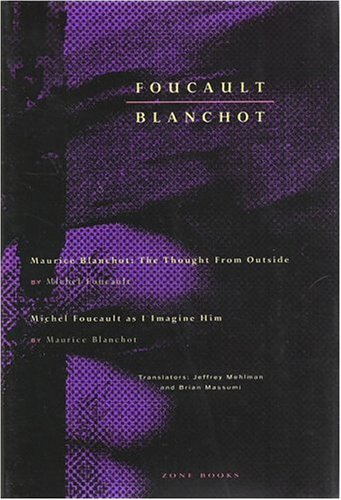
| 24. Foucault / Blanchot: Maurice Blanchot: The Thought from Outside and Michel Foucault as I Imagine Him by Michel Foucault, Maurice Blanchot | |
![]() | Paperback: 109
Pages
(1989-10-19)
list price: US$16.95 -- used & new: US$10.47 (price subject to change: see help) Asin: 0942299035 Average Customer Review: Canada | United Kingdom | Germany | France | Japan |
|
Editorial Review Book Description Customer Reviews (1)
| |
| 25. The Order of Things: An Archaeology of Human Sciences by Michel Foucault | |
![]() | Paperback: 416
Pages
(1994-03-29)
list price: US$15.00 -- used & new: US$8.43 (price subject to change: see help) Asin: 0679753354 Average Customer Review: Canada | United Kingdom | Germany | France | Japan |
Customer Reviews (12)
The style of the book is what you're likely to notice most immediately.The Structuralists are famous for subordinating lucidity and logical rigor for what is sometimes called "vast erudition."Vast erudition is that set of decidedly French stylistic elements that include such frequently beautiful techniques as intentional obscurity of meaning; undisciplined, looping, rambling metaphors which go on for pages and pages; flowery, arcane rhetoric; and more neologisms than the French Academy could possibly record.In short, Foucault uses 100 words to say what he could have said in 10, but it is great fun to read despite its difficulty.Trust me, if you didn't get it, probably he didn't intend for you to.And what critics like to hail as erudition is sometimes nothing more than purposeful obscurity and literary name dropping.Daniel Boorstin is as erudite as any French Structuralist, but he is infinitely more lucid. Now, there's the substance.Foucault's essential thesis is that science is a front for an unconscious network of order relating ALL branches of human knowledge.The thesis is, if anything, an epistemological statement.Typical of modern French scholarship in general, this book cuts a wide interdisciplinary swath through arts and sciences to show how seemingly unrelated fields of human knowledge--biology, economics and language, for example--are really empirical manifestations of the same human process.At the heart of the matter is the notion that all of human knowledge is socially constructed, ignorant of the submerged "order of things" that joins it under the surface.Hence, we must discover this order by means of digging, by means of "archaeology." So, don't worry about deciphering every sentence.Once you get the essential ideas (they're in the Preface), sit back and enjoy Foucault's collage of words and thoughts. ... Read more | |
| 26. Fearless Speech by Michel Foucault | |
![]() | Paperback: 128
Pages
(2001-02-19)
list price: US$11.95 -- used & new: US$7.90 (price subject to change: see help) Asin: 1584350113 Average Customer Review: Canada | United Kingdom | Germany | France | Japan |
|
Editorial Review Book Description Customer Reviews (1)
Parrhesia is a type of speech that is neither rhetoric nor dialectic, though it has historically occupied an important space among both - forming perhaps a trialectic.Parrhesia is a species of truth that mandates its own telling, in a quasi-spiritual fashion if need be: the parrhesiastes, or truth-teller, is one who puts him- or herself at considerable risk, including the risk of death, with his or her words.It can easily be seen that parrhesia is an essential antecedent to criticism and critical theory, but it is also ubiquitous in many forms of discourse.The Jeremiads of prophetic speech, the jokes of court jesters, Che's formative travelogues around South America, Taussig's defacing messages to the academy, and the best-selling literature of Rushdie that was in the 1990s so ill-received by the Muslim community - all of these are examples of this powerful discourse-form at work and play. I first ran across the term in Arpad Szakolczai's excellent volume on Weber and Foucault, "Parallel Life-Works."After reading FS, I was frankly amazed that the idea is not more widely discussed in university rhetoric classes.The concept is extremely fruitful, first of all, for anyone interested in rhetoric, dialectic, philosophy, and law.Moreover, for anyone studying Foucault's life or epistemic universe (orders of discourse, manifestation, dispositifs, and so on), parrhesia needs to be on the list of terms.For those interested in neo-Enlightenment thinkiers like Habermas and the communicative ethics thinkers like Benhabib and Miller, Rorty and the pragmatists, or the large and diverse group of scholars studying ideology (such as Teun van Dijk) within Critical Discouse Analysis, it's also a very worthwhile read. Most of all, though, the book shows everyone - and not just the intellectual - that parrhesia needs to be incorporated within our everyday modes of thinking and speaking.To what extent are "we" speaking, and to what extent is ideology speaking through us?What power does our speech reproduce, and what might it transform?Is our speech emancipatory?Does it contribute to the complexity of thought?Does it leave more questions open than closed?Do we break new ground, or just re-hash the useless play of words?This is a book that will fuel the mind and inspire questions like these like few others I've recently read.If you're tired of reading about the "end of history" and post-post-everything thought, try this slim volume.Highly recommended. ... Read more | |
| 27. The Hermeneutics of the Subject: Lectures at the College de France 1981--1982 (Lectures at the College de France) by Michel Foucault | |
![]() | Paperback: 608
Pages
(2005-12-27)
list price: US$16.00 -- used & new: US$8.93 (price subject to change: see help) Asin: 0312425708 Average Customer Review: Canada | United Kingdom | Germany | France | Japan |
|
Editorial Review Book Description Customer Reviews (2)
| |
| 28. Power: Essential Works of Foucault, 1954-1984, Volume III by Michel Foucault, Robert Hurley, James D. Faubion, Paul Rabinow | |
![]() | Paperback: 528
Pages
(2001-10)
list price: US$19.95 -- used & new: US$12.77 (price subject to change: see help) Asin: 1565847091 Average Customer Review: Canada | United Kingdom | Germany | France | Japan |
|
Editorial Review Book Description Customer Reviews (1)
| |
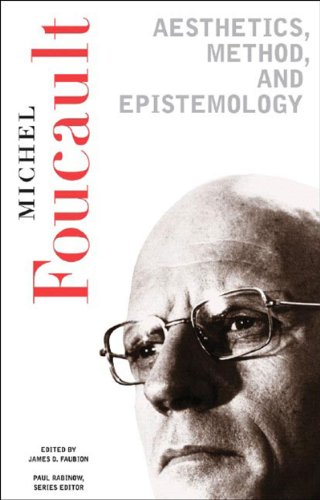
| 29. Aesthetics, Method, and Epistemology: Essential Works of Foucault, 1954-1984, Volume II by Michel Foucault, Paul Rabinow, Robert Hurley | |
![]() | Paperback: 528
Pages
(1999-09-01)
list price: US$21.95 -- used & new: US$14.88 (price subject to change: see help) Asin: 1565845587 Average Customer Review: Canada | United Kingdom | Germany | France | Japan |
|
Editorial Review Book Description Customer Reviews (2)
Thus,Foucault's occasional essays, covering academic journals, popular press,lectures, introductions, and so on, serve to clue us, the readers, as towhere Foucault is coming from, and, furthermore, in which direction histhought is heading. This edition, covering Foucault's superb writingson literature, his mentors, music, as well as other philosophicalmovements, situates a thinker within an intellectual context from his veryown words.In "The Archaeology of Knowledge" Foucault begins bysaying "do not ask me who I am..."To be sure, with this volume,we can begin to better understand Foucault without the interface ofcommentators and scholars.Directness of discourse is an important elementin Foucault's thought... Although much of the pieces that appear herehave been previously translated and released in a variety of formats, Ipredict that any scholar or occasional reader would be pleased to acceptthis redundancy for the very convenience that this collectionpresents. Some most interesting pieces include, the previously hard tofind Foucault's response to Derrida's reading of "Madness andCivilization"; Foucault's responses to the Epistemology circle; and anilluminating interview in which Foucault situates his thought in 20thCentury French intellectual life.In addition, this collection includespopular 'staple' such as "Theatrum Philosophicum,""Nietzsche, Freud, Marx," and "Nietzsche, Genealogy,History," all of which provide endless insight into Foucault evendespite numerous re-readings. While serious followers of Foucault'sworks would benefit greatly from this collection, this would also serve asa good introduction to Foucault--maybe second only to the cartoon books onFoucault! And to close: if Nietzsche was the greatest philosophicalstylist, this collection demonstrates conclusively that Foucault was aclose second...
| |
| 30. The archaeology of knowledge by Michel Foucault | |
| Unknown Binding: 245
Pages
(1982)
Isbn: 3944711068 Average Customer Review: Canada | United Kingdom | Germany | France | Japan | |
Customer Reviews (7)
Understanding the implication of Foucault's thought process from a first read requires a refflective reader and in many ways requires a far-reaching mind from the start.This work is composed of a terminal plethora of architectures and teleological plethoras of exemplifications from science and history. Economics, stats, documents, records, and items from all discourses are examined and presented as artifacts of discursive knowledge.The Archeaology itself is the thematic for the Archive, and the archive is the preservatory of knowledge, that such discursive knowledge is preserved is archaeology.Foucault's task then is to undermine the archives of knowledge and present that knowledge back upon the structural framework of rational discourse.With observational power and radical ability, Foucault goes beyond the framework and invisibly subordinates it's needs to be observed and it's intention to be ritcheous (ritcheous in all that it accounts for, and ritcheous of the observer.)From the most primordial archean, to the revival of the primal archaic state, to the archaology of all knowledge, Foucault shows that in a way discourses built upon historical facts are like artifacts themselves.Here in the conclusion we see that the problematic of language (langue) as the derivational principal of discourses, cannot be made paletable (literaly!) And so the audition fails because language or the "langue" is not sufficiently constructed for what it represents in discursive practice.At the zenith of the teleological project,when temporal conceptualization extinguishes itself from being quantified into being qualified, at the last quarter of the era,perhaps this work will be gleamed from the resevoire and conrgessively discussed.
| |
| 31. Michel Foucault (Core Cultural Theorists series) by Clare O'Farrell | |
| Hardcover: 200
Pages
(2005-10-10)
list price: US$118.00 -- used & new: US$107.33 (price subject to change: see help) Asin: 0761961631 Canada | United Kingdom | Germany | France | Japan | |
|
Editorial Review Book Description "Dr. Clare O'Farrell has written a marvelous introduction to this Foucault for that ever growing number of readers who are working in what has come to be designated as cultural studies. This volume captures the penetrating interdisciplinary concerns that have made Foucault a guide to so many beyond the frontiers of philosophy and history, beyond the borders of the academic community itself. O'Farrell is an excellent guide to Foucault's exploration of culture, highlighting, as she does, the characteristic insights of his learning: the instability of cultural forms of order, the subversive potential of historical analyses, the variety of true discourses within history, and his commitment to social justice. O'Farrell reveals Foucault as he is: the engaged moralist who survived the twentieth century's systems of total explanation. This is an excellent introduction for the general reader to a passionate mind that continues to spread its influence'"- James Bernauer, Boston College Michel Foucault's work is one of the most influential sources of ideas in the humanities and social sciences today. Clare O'Farrell offers a comprehensive and accessible introduction to Foucault's enormous, diverse and challenging output. Her book provides a range of practical tools and a reference work for readers who wish to understand and apply his ideas at both introductory and advanced levels. This volume includes: - a discussion of Foucault's situation in the contemporary context exploring his role as an iconic thinker, with clear explanations as to why his work is so difficult to come to grips with, and also importantly, why it is of interest to so many people. - the location of Foucault's work within its own historical, social and political setting. - brief summaries in chronological order of all of Foucault's major works, including the more recently published volumes of lectures. - the organization of Foucault's work around five distinct but interrelated series of assumptions which underpin his world view: namely order, history, truth, power and ethics. Ideas for which he is well-known, such as archaeology, genealogy, discourse, discipline, governmentality, the subject and others are defined and discussed within the framework of these five assumptions. - a chronology of Foucault's life, work and times. - a very extensive list of key concepts in Foucault's work with detailed references pointing to where the relevant material can be found in his writings. - a wide-ranging list of resources and a bibliography of Foucault's work for easy consultation. | |
| 32. Michel Foucault and Theology: The Politics of Religious Experience | |
![]() | Paperback: 240
Pages
(2004-04)
list price: US$29.95 -- used & new: US$25.74 (price subject to change: see help) Asin: 0754633543 Average Customer Review: Canada | United Kingdom | Germany | France | Japan |
Customer Reviews (1)
| |
| 33. The Lives of Michel Foucault by David Macey | |
![]() | Paperback: 624
Pages
(1995-04-25)
list price: US$25.00 -- used & new: US$17.58 (price subject to change: see help) Asin: 0679757929 Average Customer Review: Canada | United Kingdom | Germany | France | Japan |
|
Editorial Review Book Description Customer Reviews (5)
Foucault was shaping an enterprise in anti-humanist, anti-essentialist "discourse." In sync with many other strains in the thought of his continentalcontemporaries - with Kant, Nietzsche and Heidegger were acknowledged as his primary influences while Althusser, Canguilhem and Barthes were included in the mix - Foucault's ideas about the essential constitution of civil society drew on a ardently anti-liberal attack on the Enlightenment. Far from being the light of reason to shed light and resolve problems surrounding the human condition, the Enlightenment according to Foucault replaced the ancien regime model of social marginalization and class demarcations with a better mousetrap of domination, which was simply a modernized technology of social control. It would no longer be possible to look to the obvious figures of sovereignty and privilege - embodied in king and counts - for the telling signs of "power." Power was beginning to make its way into the ordinary institutions of social life.The reigning king of the humanist project was still Sartre, who became the locus ofFoucault's efforts. Sartre, according to Foucault stood for a tired philosophy of "Marxist humanism." Sartre did not see, in Foucault's view that humanism was inevitably the soiled result of the new technology of domination that sprang up with the Enlightenment. Sartre, according to Foucault, was the poster boy of the Enlightenment. Macey spells out how according to Foucault, Humanism was just the happy facade put on the medical and scientific lessening of the human being into an itemized, categorized and catalogued object of a detached "gaze" - recognition of this phenomenon according to Foucault should put to rest any ebullience for the communitarian didactic discourse of the Sartrean "politics of commitment." More openly then does Miller (or Eribon for that matter), Macey recognizes Foucault's ongoing struggle against Sartre's "gaze," against any other interpretative or evaluative power. What was really happening, Foucault posits was the construction of a "networks" of power - though one was not supposed to ask "`whose' power?" Power, this new social fixation with discipline and surveillance, became its own rationale according to Foucault. As I mentioned above, power was not to be found in leaders or social organizations or parties or in any given social structure, but was rather a kind of "discourse, " a set of terms or symbolic representations that connect, in an abstract way, the given instances of discipline and surveillance at work in social life. For Foucault, to fight a diffuse "power" was to be able to pick any point of attack in any institutional setting and do the work of social revolution. Foucault is not keen to lay out a recipe for such transgression but his strength is in critique. Macey's strength is making this often baroque author accessible - the Macey that I appreciate. Miguel Llora
nonetheless, there are important criticisms to be made. there's a certain elegiac tone throughout much of the book which is not totally appropriate to foucault's thought and perhaps even to foucault himself. this tone complicates the problem of writing a biography of a thinker without treating him through his own lens of comprehending "the subject," "the author," "the self" etc. in other words, the account is stylistically rather conservative, something that might lead readers to doubt the level of depth at which foucault is approached. and indeed, though the depth is considerable, the approach is too conservative to catch some of the more radical tones in foucault especially as regards his "post-modern" tendencies (foucault was suspicious of that term). still, this is a very good biography and a good reading of MF, that mixes well his life and his thought.worth reading, even (especially) if you've read other accounts. it complements them well and improves on them considerably.
Trueman Myaka Tel:0927 31 303 6466 Fax: 0927 31 303 4493
Trueman Myaka Tel:0927 31 303 6466 Fax: 0927 31 303 4493 ... Read more | |
| 34. Introduction to Kant's Anthropology from a Pragmatic Point of View (Semiotext(e) / Foreign Agents) by Michel Foucault | |
![]() | Paperback: 128
Pages
(2008-04-30)
list price: US$14.95 -- used & new: US$10.17 (price subject to change: see help) Asin: 1584350547 Canada | United Kingdom | Germany | France | Japan |
|
Editorial Review Book Description | |
| 35. Feminism and Foucault: Reflections on Resistance | |
![]() | Paperback: 246
Pages
(1988-06-23)
list price: US$24.95 -- used & new: US$7.30 (price subject to change: see help) Asin: 1555530338 Canada | United Kingdom | Germany | France | Japan |
| 36. Michel Foucault (Routledge Critical Thinkers) by Sara Mills | |
![]() | Hardcover: 176
Pages
(2003-06-24)
list price: US$95.00 -- used & new: US$92.06 (price subject to change: see help) Asin: 0415245680 Average Customer Review: Canada | United Kingdom | Germany | France | Japan |
|
Editorial Review Book Description Customer Reviews (1)
Mills' text, following the pattern of the others, includes background information on Foucault and his significance, the key ideas and sources, and Foucault's continuing impact on other thinkers. As the series preface indicates, no critical thinker arises in a vacuum, so the context, influences and broader cultural environment are all important as a part of the study, something with which Foucault would agree. Why is Foucault included in this series? Foucault is probably second only to Jacques Derrida in influence on thinkers in the field of critical theory and cultural studies, and his impact has gone far beyond narrow intellectual confines to influence psychology, politics, literature, sociology, philosophy, linguistics, history and anthropology.Mills indicates that Foucault's primary focus is on issues of power, knowledge and discourse, with influence in the development of a lot of `posts' - post-modernism, post-colonialism, post-Marxism, post-structualism, etc. Foucault often concentrated on the ignored, the forgotten or the overlooked in his studies.In looking at the written confession of a murderer from generations ago, or looking at prisoners in present society, Foucault looks not only at the way power operates in practical settings, but what underpins the kind of power relationships.Heavily influenced by the events of 1968, with various forms of war and open rebellion going on across the globe (including Foucault's native French society), he had an inherent distrust for the kinds of power and society relationships considered standard.His work with prisoners and those classified as mentally ill challenged prevailing notions of the intentions of incarceration and even classification - perhaps we can see even more clearly in today's mass-media-saturated society the inconsistencies, not only of application, but of intention in the development of considering who is a criminal (and what their punishment and rehabilitation is likely to be) and who is considered mentally ill - the shift care to confinement and isolation (effective removal) from society gains new meaning from Foucault's analysis. Foucault looks at power from a very basic position, not that of macroscopic geopolitical entities, but rather interpersonal relationships on a more local level, even exploring the way society uses body and sexuality as a root resource in formulating power relationships.It is worth noting that this issue is over the idea of the `body', and not the `individual', which for Foucault are not strictly synonymous.Looking at the history of sexuality (the freer periods of sexual frankness vis-Ã -vis the more strict and reserved periods such as the Victorian age) leads to another set of power relations often internalised and often overlooked. The concluding chapter, After Foucault, highlights some key areas of development in relation to other thinkers, as well as points of possible exploration for the reader. Foucault's thought vis-Ã -vis feminist thought is dramatic and interesting, given Foucault's generally androcentric (and often misogynistic) stance in writing - still the issues of power relations and society are crucial to feminist critique.His post-colonialist ideas, again springing from the reformulation of power relationships in society after a dominant, foreign power is displaced, influenced further thinkers such as Edward Said.Foucault has (perhaps unintentionally) become useful for the anti-psychiatric lobby, as Foucault sees much defined as madness to be social construct rather than actual ailment (Foucault saw talk-therapy as a kind of modernised `confessional'). There was only one point at which I had a serious disagreement with Mills in her analysis of Foucault.At one point in discussing his tendency toward not developing fully thought-out theories, she speculates that his kind of approach could possibly be used `to justify fascism or to deny the existence of the Holocaust'.I would disagree with this assessment, given that this would not in fact discredit systems of power, but merely replace one with another.If fascism or Holocaust-deniers were not a power-in-potential, that might be true.But then, this is a point upon which much discussion could continue! As do the other volumes in this series, Mills concludes with an annotated bibliography of works by Foucault (primarily those available in authoritative English translation), works on Foucault, and even internet references. While this series focuses intentionally upon critical literary theory and cultural studies, in fact this is only the starting point. For Foucault (as for others in this series) the expanse is far too broad to be drawn into such narrow guidelines, and the important and impact of the ideas extends out into the whole range of intellectual development. As intellectual endeavours of every sort depend upon language, understanding, and interpretation, the thorough comprehension of how and why we know what we know is crucial. ... Read more | |
| 37. Michel Foucault: The Will to Truth by Alan Sheridan | |
![]() | Paperback: 243
Pages
(1990-12-31)
list price: US$53.95 -- used & new: US$45.40 (price subject to change: see help) Asin: 0415051177 Average Customer Review: Canada | United Kingdom | Germany | France | Japan |
Customer Reviews (1)
| |
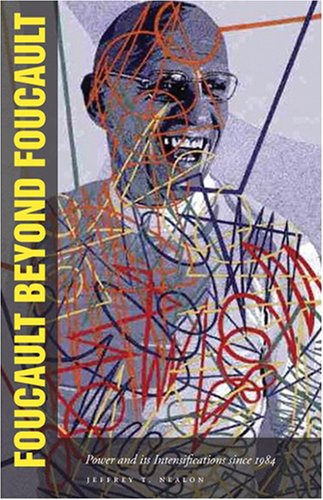
| 38. Foucault Beyond Foucault: Power and Its Intensifications Since 1984 by Jeffrey Nealon | |
![]() | Paperback: 152
Pages
(2007-11-12)
list price: US$21.95 -- used & new: US$21.95 (price subject to change: see help) Asin: 080475702X Canada | United Kingdom | Germany | France | Japan |
|
Editorial Review Book Description | |