e99 Online Shopping Mall

Geometry.Net - the online learning center Help  
Home  - Philosophers - Frege Gottlob (Books)

  1-20 of 100 | Next 20
A  B  C  D  E  F  G  H  I  J  K  L  M  N  O  P  Q  R  S  T  U  V  W  X  Y  Z  

click price to see details     click image to enlarge     click link to go to the store

$11.70
1. Frege Explained (Ideas Explained)
$22.90
2. Gottlob Frege: una introduccion
 
$209.00
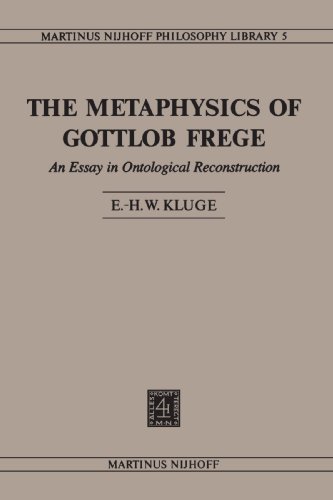
3. The Metaphysics of Gottlob Frege:
$5.55
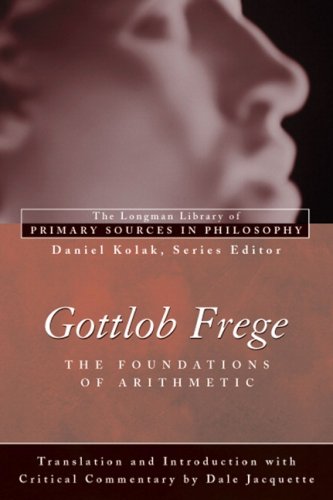
4. Gottlob Frege: Foundations of
$19.57
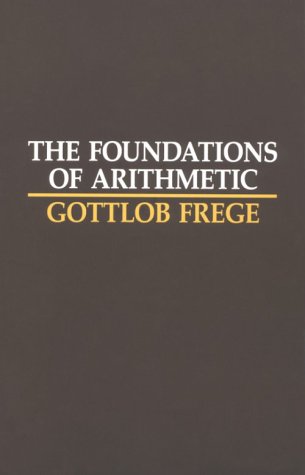
5. The Foundations of Arithmetic:
$30.01
6. Frege: An Introduction to the
$46.50
7. Frege's Logic
 
$266.00
8. Frege Synthesized: Essays on the
 
$124.95
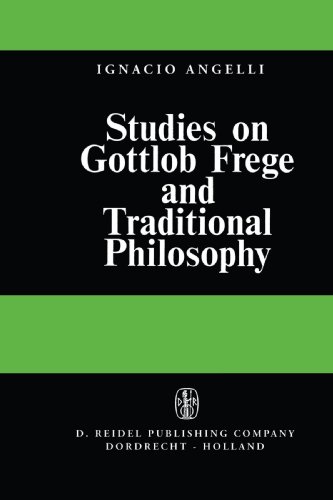
9. Studies on Gottlob Frege and Traditional
$29.95
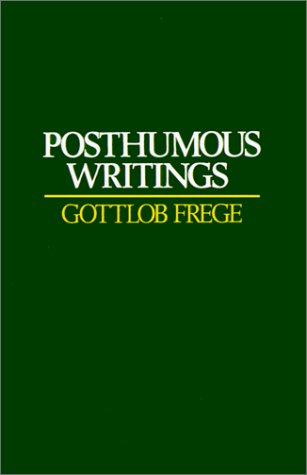
10. Posthumous Writings
$42.50
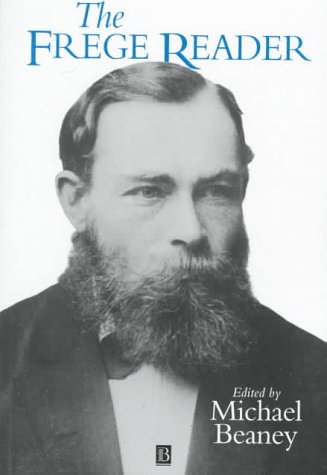
11. The Frege Reader (Blackwell Readers)
$99.95
12. A Critical Introduction to the
 
$1,300.00
13. Gottlob Frege: Critical Assessments
$66.10
14. The Sense of Reference: Intentionality
$37.95
15. Frege on Definitions: A Case Study
 
16. Translations from the Philosophical
 
17. Translations from Philosophical
$35.15
18. Fixing Frege (Princeton Monographs
$66.59
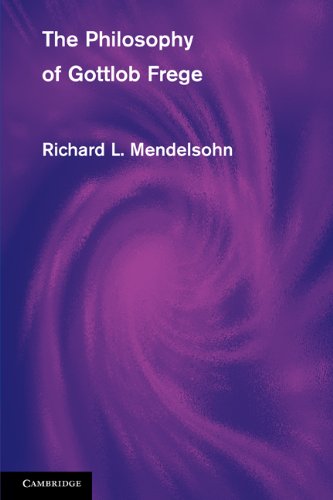
19. The Philosophy of Gottlob Frege
$135.37
20. Frege: Sense and Reference One

1. Frege Explained (Ideas Explained)
by Joan Weiner
Paperback: 176 Pages (2004-12-29)
list price: US$18.95 -- used & new: US$11.70
(price subject to change: see help)
Asin: 0812694600
Average Customer Review: 5.0 out of 5 stars
Canada | United Kingdom | Germany | France | Japan
Editorial Review

Book Description

What is the number one?Does 2 plus 2 always equal 4? These seemingly simple questions have perplexed philosophers for eons, but the ideas of German philosopher Gottlob Frege (1848–1925) transformed the discussion. Frege believed that the truths of arithmetic and of all mathematics are derived from self-evident logical truths. His new way of looking at logic and mathematics was influential and his convictions revolutionized logic and laid the foundation for modern analytic philosophy. Joan Weiner presents an accurate, accessible explanation of Frege's ideas, tracing the development of his thought and making the essential concepts understandable.
... Read more

Customer Reviews (1)

5-0 out of 5 stars An in-depth examination of Frege's career and legacy
Written by a Professor of Philosophy at Indiana University, Frege Explained: From Arithmetic to Analytic Philosophy is an in-depth examination of Frege's career and legacy. Frege's work was marked by his determination to show that arithmetic is really a part of logic; while that effort ended in failure, in the process Frege revolutionized philosophic understanding of logic and set the foundation for analytic philosophy. Chapters survey Frege's life and character, his "new logic" and definitions of numbers, his logical investigations and speculations upon the foundations of geometry, his impact upon recent and modern philosophy, and much more. Especially for philosophy students and scholars, Frege Explained presents complex concepts in as straightforward a manner as practically possible, and is especially recommended for college library philosophy shelves.
... Read more


2. Gottlob Frege: una introduccion (Cuardernos De Logica, Epistemologia Y Lenguaje)
by M Stepanians
Paperback: 164 Pages (2007-09-10)
list price: US$23.00 -- used & new: US$22.90
(price subject to change: see help)
Asin: 1904987583
Canada | United Kingdom | Germany | France | Japan
Editorial Review

Book Description
Este libro pone al alcance del lector no especializado la obra cardinal de GottlobFrege, padre de la filosofia analitica. De facillectura y compresion, la pluma de Stepanians nos conduce vivamente por el entramado primordial del significados y sentidos vislumbrados por una de las mentes mas brillantes de la historia del pensamiento y que aun sigue siendo uno de los pensadores menos leidos en lengua castellana. ... Read more


3. The Metaphysics of Gottlob Frege: An Essay in Ontological Reconstruction (Martinus Nijhoff Philosophy Library)
by E.H.W Kluge
 Hardcover: 308 Pages (1980-09-30)
list price: US$209.00 -- used & new: US$209.00
(price subject to change: see help)
Asin: 9024724228
Canada | United Kingdom | Germany | France | Japan

4. Gottlob Frege: Foundations of Arithmetic (Longman Library of Primary Sources in Philosophy) (Longman Library of Primary Sources)
by Gottlob Frege, Dale Jacquette, Daniel Kolak
Paperback: 144 Pages (2007-01-14)
list price: US$9.60 -- used & new: US$5.55
(price subject to change: see help)
Asin: 0321241894
Canada | United Kingdom | Germany | France | Japan
Editorial Review

Book Description

Part of the Longman Library of Primary Sources in Philosophy,” this edition ofFrege's Foundations of Arithmetic is framed by a pedagogical structure designed to make this important work of philosophy more accessible and meaningful for readers. A General Introduction includes the work's historical context, a discussion of historical influences, and biographical information on Gottlob Frege.The conclusion discusses how the work has influenced other philosophers and why it is important today. Annotations and notes from the editor clarify difficult passages for greater understanding, and a bibliography gives the reader additional resources for further study.

... Read more

5. The Foundations of Arithmetic: A Logico-Mathematical Enquiry into the Concept of Number
by Gottlob Frege
Paperback: 144 Pages (1980-12-01)
list price: US$22.00 -- used & new: US$19.57
(price subject to change: see help)
Asin: 0810106051
Average Customer Review: 4.5 out of 5 stars
Canada | United Kingdom | Germany | France | Japan
Editorial Review

Book Description
This volume represents the first philosophically sound discussion of the concept of number in Western civilization. (Mathematics) ... Read more

Customer Reviews (5)

5-0 out of 5 stars The first escape from the Elencus...
You know how _frustrating_ it is, reading a platonic dialog? Some question like "What is virtue?" or "What is justice" is asked, and Socretes goes on for pages showing that the so-called "experts" don't have a clue about what it really is?

But what's _really_ frustrating is that you're all expecting, at the end of the dialog, after following a hard line of argument, that you'll be rewarded with THE definitivie definition of 'virtue' or 'justice' or whatever--only to be disapointed.All you get in the end is a new appreciation of your own hopeless ignorance...

...well, imagine a platonic dialog which started the same as any other platonic dialog, but with the question "What is a number?"Only this time, at the end of the dialog, you actually get an answer to the question?

In retrospect, its pretty amazing that Plato didn't write a Socratic dialog concerned with the question "What is number?'After all, Plato considered numbers more real than physical objects, and people like the Pythagorians were going around claiming that everything _was_ made out of numbers.But what the heck _is_ a number, anyways?

Perhaps the reason was that everybody thought they already understood what numbers were.But Frege, like Socretes before him, realized that this so-called knowledge was really just a collective ignorance.So Frege starts out this book with a thorough, merciless review of what his coleages and predicessors were saying about what numbers were, showing that they ranged from cocksure to confused, from pompously-wrongheaded to just plain silly.

But then Frege does something really amazing--for the first time in history, he goes on give a real answer to the question "what are numbers?"Building on the work of Hume, he gives a sustained argument now known as "Frege's theorem" which shows how numbers can be grounded on an understanding of one-to-one correspondence.

Unfortunately, this work had to wait almost a century for the rest of us to really catch up to its significance.Russell found a contradiction in the arguments presented here, and for the next 80 years attention shifted elsewhere.But first Charles Parsons, in 1964, and then Crispen Wright and others in the 80's and 90's begain to realize that Frege's theorem could be reconstructed without the paradox.This sparked a whole flurry of neo-Fregean studies which is one of the most active branches of analytic philosophy today.

This revival means that Frege's importance, and the importance of reading and comming to grips with the arguments presented by Frege in this book, are going to continue to grow.Although tragically Frege didn't live to see the day, we now realize that the line of reasoning he followed in this book was one of those signature moments in human history, every bit as profound as the invention of the wheel or the discovery of the pythagorian theorem--it was the moment where, for the first time ever, the question "what the heck _are_ numbers, anyways?" got a real answer.

4-0 out of 5 stars Frege, You're Not Supposed To Have...
*The Foundations of Arithmetic*, one of the most durable works of philosophy of mathematics ever produced, is something of a curiosity as presented by J.L. Austin (who translated the work for the use of an Oxford undergraduate course); and perhaps Frege's platonism got the best of Austin, and this work is really just as , well, Kantian as it appears, "a good sight" more Kantian than "standard" Frege is typically allowed to be.Frege's definition of number in terms of equipollence (one-one correspondence of sets) is legendary: that is to say, it is traditionally understood to do a great deal more work than the "thin" version allowed by mathematical logic as reconstructed to avoid Russell's paradox.

But here Frege's work-up of the concept for a general readership is so "genteel" as to suggest that this may not in fact be the case, and that Frege actually partook more heavily of Neo-Kantian bromides than his *theory of arithmetic* suggests; to wit, that this theory was always intended to be situated within a general philosophy of mathematics obeying the strictures of reasoning involving Kantian "intuition" (as is typically said of Frege's last efforts in the field).As such, it would be unfortunate that we cannot effectively read this book (formerly available *en face*, and unfortunately much the worse for the original's omission) in conjunction with its contemporary geometrical counterpart: long out of print, rarely making its way into the philosophical Frege literature, and perhaps in all parts an *anticipatory* if "crochety" rebuke to Hilbertian formalism.

Perhaps Frege was to a certain extent wholly other than the mathematics of his time; perhaps we are not well-served by a Frege "out of time"; we certainly have one of the great prose stylists of English on hand here, and perhaps it would actually do to consider his aptitude for "gold" extraction here as a clue to puzzling out the rest of Frege -- a figure supremely unconcerned with sameness of meaning, and already owing a certain debt to those para-philosophical figures all his work is at cross-purposes with (the German '70s having been quite a time indeed).A great help to understanding number theory, a marvelous thing for a library to have.

4-0 out of 5 stars Excellent work
His conclusion (p.99e) is that the laws of arithmetic are analytic judgements and consequently a priori.

Note that he is very consistently hard on Mill.

Some interesting quotes: p. 115e #106. "...number is neither a collection of things nor a property of such, yet at the same time is not a subjective product of mental processes either, we concluded that a statement of number asserts something objective of a concept.

... (p. 116e) We next laid down the fundamental principle that we must never try to define the meaning of a word in isolation, but only as it is used in the context of a proposition: only by adhering to this can we, as I believe, avoid a physical view of it.

#107. (p.117e) "A recognition statement must always have a sense."

5-0 out of 5 stars greatwork
possibly one of the greatest works in history of philosophy and the founding book of 20th century analytic philosophy... I read it only once and a better appraisal will be coming shortly..I can say right away this is not simply a 'technical' work in philosophy of mathematics but a broad although short philosophical investigation in notions of truth, meaning and identity - although it expressly deals with defining numbers in purely logical terms. continental philosophers who read this work might change some of their negative ideas about where analytic philosophy is coming from.

5-0 out of 5 stars A Must for Any Philosopher of Mathematics
This book written by Gottlob Frege is one of the most influential books of the 20th century philosophy of mathematics.In here Frege establishes the nature of arithmetics as founded in logic, which is his logicist proposal.For that, he refutes the assertion that logic as such is founded on psychology.

Sometimes he distorts a little bit what others say about logic, so he argues against those thinkers more effectively.In here he establishes the anti-psycology difference between concept and object; though he has not made a difference yet between sense and reference.He also refers to a principle called the contextual principle, in which the word makes reference to something depending on the context.Afterwards after he wrote the book, he would reject this principle, because of his doctrine of sense and reference:the sense of the words determine the sense of the sentence; and the reference of the words determine the reference of the sentence.

This is a great philosophical work, and I would suggest it to anyone who is starting to study Analytic philosophy (philosophy of mathematics, logic and language), and also those who want to consider the platonist proposal. ... Read more


6. Frege: An Introduction to the Founder of Modern Analytic Philosophy
by Anthony Kenny
Paperback: 240 Pages (2000-10-10)
list price: US$38.95 -- used & new: US$30.01
(price subject to change: see help)
Asin: 0631222316
Average Customer Review: 4.5 out of 5 stars
Canada | United Kingdom | Germany | France | Japan
Editorial Review

Book Description
Written by Anthony Kenny, a leading figure in contemporary philosophy, this volume guides the reader through a concise and accessible explanation and assessment of Frege's radical and lasting contributions to our understanding of language, meaning, and the foundations of arithmetic. ... Read more

Customer Reviews (3)

4-0 out of 5 stars Narrative approach to learning symbolic logic
Apart from a couple of typos that will make some of the explanations of Frege's system difficult for those not already familiar with symbolic systems, this is another excellent effort by Anthony Kenny. Unlike his book on Wittgenstein that was much more of a biography, this book really concentrates on the symbolic system. This will be a good read for students studying advanced symbolic or mathematical logic.

5-0 out of 5 stars A Classic
This book is the best introduction to the development of Frege's thought that I've read.Kenny covers each major work of Frege in detail with clear explanations of the argument and purpose of each work. There is a brief biographical sketch in the beginning and the book finishes with a summary of Frege's achievements.

4-0 out of 5 stars Good, non-scholarly introduction
This is a good introduction to Frege's philosophy for the general reader and undergraduates.It is fairly accurate, though very uncritical, and doesn't go into too much detail or use too much philosophical jargon (at least not without explaining it).This is a good feature for those unfamiliar with Frege, but if you are already familiar with Frege or analytic philosophy and/or have a good basic knowledge of formal logic, this book will probably not be worth you time. But, let me emphasize once again, if you are just getting started, this is a very good book to start with. ... Read more


7. Frege's Logic
by Danielle Macbeth
Hardcover: 218 Pages (2005-05-31)
list price: US$46.50 -- used & new: US$46.50
(price subject to change: see help)
Asin: 0674017072
Average Customer Review: 3.5 out of 5 stars
Canada | United Kingdom | Germany | France | Japan
Editorial Review

Book Description

For many philosophers, modern philosophy begins in 1879 with the publication of Gottlob Frege's Begriffsschrift, in which Frege presents the first truly modern logic in his symbolic language, Begriffsschrift, or concept-script. Danielle Macbeth's book, the first full-length study of this language, offers a highly original new reading of Frege's logic based directly on Frege's own two-dimensional notation and his various writings about logic.

Setting out to explain the nature of Frege's logical notation, Macbeth brings clarity not only to Frege's symbolism and its motivation, but also to many other topics central to his philosophy. She develops a uniquely compelling account of Frege's Sinn/Bedeutung distinction, a distinction central to an adequate logical language; and she articulates a novel understanding of concepts, both of what they are and of how their contents are expressed in properly logical language. In her reading, Frege's Begriffsschrift emerges as a powerful and deeply illuminating alternative to the quantificational logic it would later inspire.

The most enlightening examination to date of the developments of Frege's thinking about his logic, this book introduces a new kind of logical language, one that promises surprising insight into a range of issues in metaphysics and epistemology, as well as in the philosophy of logic.

... Read more

Customer Reviews (3)

3-0 out of 5 stars Not a beginning logic student's book
Of course I didn't see the author's preface: "Although this is a book about Frege's logic, it is not a work of logic in any standard sense....My aim is rather to develop a novel reading of Frege's logical language...."With this in mind the title of her book should have been "Frege's logic: an examination of his notation."I'm a third of the way in and all I get is information on Frege's bizarre logic notation.I'm no scholar of logic.I want to understand Frege's logic as it relates to his contribution to the development of symbolic logic over the years.I wanted to know a bit about his influence on Godel and such.One book I have says that although Russell found a problem in Frege's work, which Frege found totally demoralizing, there are various "fixes" for what they call the Russell Antimony.Okay, what are these "fixes"?I won't find out in this book, I'm sure.

5-0 out of 5 stars a Technically Sound and Accessible History
Danielle Macbeth's book tells a thorough and accessible history of the development of Frege's logic which builds up a novel interpretation of that logic.The work is the result of her years as a professor of analytic philosophy at Haverford College.

Traditional interpretations of Frege's work typically dismiss his logic as a failed attempt to do what Russell later did properly (even though neither Frege nor Russell appear to have believed such a thing). Frege's notation has several oddities, most prominently its 2-dimensional notation (rather than the 1-dimension of text). The traditional claim that Frege was trying to achieve the same ends as Russell do not account for these features of his logic. Such accounts also fail to explain many of the claims Frege made in letters he exchanged with Russell (and others) during the logic's development.Many of these claims are quite surprising and make no sense if you try to force Frege into the mould of Russell's logic.

Macbeth provides an alternative interpretation of Frege's logic, which accounts for its notation, Frege's claims about it, and the history of its development. She gives an integrated account of the development of the logic, and how it coincided with other developments in mathematics and logic. Frege's logic is actually quite interesting, and assigns subtly different meanings to logical implication and to the existential quantifier as compared to Russell's logic.

Her work is presented as a historical story, not a logic textbook, and should be read from the beginning rather than in fragments.She does not presume a knowledge of relevant history, philosophy, or logic -- she does an excellent job of explaining precisely those pieces that you need to to know in order to understand her explanation.Concequently, the book may omit your favorite piece of logical history, although I found it quite a relief to read a focused account rather than one which attempted to cover everything.As a result, it is accessible to readers without extensive background in the area, while still accurate and scholarly.It has depth rather than breadth.

2-0 out of 5 stars Insufficient historical perspective
Two important books have been published in the last fifteen years, both of which have implications for any discussion of Frege: A. Garciadiego, BERTRAND RUSSELL AND THE ORIGINS OF THE SET-THEORETIC PARADOXES (1992), and I. Grattan-Guinness, THE SEARCH FOR MATHEMATICAL ROOTS (2000).

Macbeth's book refers to neither of these works.The result is that she marginalizes her own book.Most glaringly, she grants some logical content to Russell's paradox, and so messes up a discussion of the famous interaction of Russell and Frege.This is one historical episode you don't want to get wrong, but she does.She hasn't read Garciadiego, so she doesn't realize that Russell's "paradox" is a meaningless formulation, devoid of logical content.

Because her work is not grounded in math history at all, she also fails to put Frege's ideas in context.Whatever the different ideas of Dedekind, Russell, Frege or Cantor, they all come out of a very ancient mathematical school of "natural" mathematics.This approach--which never manages to form a logical part of any mathematical argument--seeks to "avoid" or "solve" paradoxes.Macbeth has missed the bus, in that she isn't aware that the most important work going on now in philosophy and mathematics is the reexamination of these paradoxes.Garciadiego famously began this work, drawing up a "list" in his book of nonexistent paradoxes, Russell's, Richard's, Burali-Forti's, Cantor's.Among other things, it has destroyed Godel's theorem, which relies--for its distinction between truth and provability--on Richard's paradox having at least some logical content.Richard's paradox has no logical content whatsoever.

This movement has proved so disturbing that it has brought substantive work to a halt, in both philosophy and mathematics, while we see where we are (if we're anywhere!).

And math and philosophy are not the only disciplines which have been brought to a halt."Natural" mathematics lies at the heart of Sraffa, Kimura, chemistry (in ways which are just beginning to be revealed) and even Einstein, who bought into the "natural" math polemics of a book for which he had high regard, Poincare's SCIENCE AND HYPOTHESIS.Where is it in the relativity of simultaneity?Here:

Up to now our considerations have been referred to a particular body of reference, which we have styled a 'railway embankment.' We suppose a very long train travelling along the rails with the constant velocity v and in the direction indicated....People travelling in this train will with advantage use the train as a rigid reference-body (co-ordinate system); they regard all events in reference to the train. Then every event which takes place along the line also takes place at a particular point of the train. Also the definition of simultaneity can be given relative to the train in exactly the same way as with respect to the embankment. As a natural consequence, however, the following question arises: Are two events (e.g. the two strokes of lightning A and B) which are simultaneous with reference to the railway embankment also simultaneous relatively to the train? We shall show directly that the answer must be in the negative. When we say that the lightning strokes A and B are simultaneous with respect to the embankment, we mean: the rays of light emitted at the places A and B, where the lightning occurs, meet each other at the mid-point M of the length A -> B of the embankment. But the events A and B also correspond to positions A and B on the train. Let M' be the mid-point of the distance A -> B on the travelling train. Just when the flashes (as judged from the embankment) of lightning occur, this point M' naturally coincides with the point M, but it moves towards the right in the diagram with the velocity v of the train.

This translation is accurate (the French and Italian are not). Einstein really does say "fallt zwar...zusammen." That is, he says that one point "naturally" coincides with another. The "naturally" reveals the intuitionist expression of the concept, for it reflects the belief that the formulations of geometry do not express facts.

Obviously, the logical problem with it is that, regardless of what Einstein may "feel" about mathematical expressions, nowhere in Einstein's writings--either in the 1905 papers or after--is any meaning assigned to 'naturally.' The failure to do so, destroys the idea, and it is easy to see why. If we retain the concept without meaning there is no logical basis on which to proceed beyond it. If we eliminate it, we wind up with a contradiction: the two assumed coordinate systems collapse into one. What is more, when we place this train experiment next to the various other thought experiments, we see that they are simply translations of the same problem into other terms, just as the false 'paradoxes' turn out to be subject to the same problem Richard indicated (reference to an infinite domain which destroys the meaning). In special relativity, natural coincidence can only be defined by infinitely many words. So the distinction collapses.

Macbeth knows none of this.Typical scholar so deeply into her subject that she loses track of her object. ... Read more


8. Frege Synthesized: Essays on the Philosophical and Foundational Work of Gottlob Frege (Synthese Library)
 Hardcover: 408 Pages (1986-04-30)
list price: US$266.00 -- used & new: US$266.00
(price subject to change: see help)
Asin: 9027721262
Canada | United Kingdom | Germany | France | Japan

9. Studies on Gottlob Frege and Traditional Philosophy
by I. Angelelli
 Hardcover: 312 Pages (1967-07-31)
list price: US$235.00 -- used & new: US$124.95
(price subject to change: see help)
Asin: 9027700672
Canada | United Kingdom | Germany | France | Japan

10. Posthumous Writings
by Gottlob Frege
Paperback: 304 Pages (1991-01-15)
list price: US$29.95 -- used & new: US$29.95
(price subject to change: see help)
Asin: 0631128352
Canada | United Kingdom | Germany | France | Japan
Editorial Review

Book Description
This volume contains all of Frege's extant unpublished writings on philosophy and logic other than his correspondence, written at various stages of his career. (Philosophy) ... Read more


11. The Frege Reader (Blackwell Readers)
by Gottlob Frege
Paperback: 432 Pages (1997-07-14)
list price: US$49.95 -- used & new: US$42.50
(price subject to change: see help)
Asin: 0631194452
Average Customer Review: 5.0 out of 5 stars
Canada | United Kingdom | Germany | France | Japan
Editorial Review

Book Description
This is the first single-volume edition and translation of Frege's philosophical writings to include all of his seminal papers and substantial selections from all three of his major works. ... Read more

Customer Reviews (3)

5-0 out of 5 stars Comment on The Frege Reader:
What a great book this is! The Frege Reader is not for everybody, that's for sure. But when/if you get into the "right space" - then please read this book.

I can't remember when I first heard the name "Frege". But I do know how my reading and study began that eventually brought me to stumble across this mathematician, logician, and philosopher. You see I'm a software developer, more specifically a database guy. I have read much of Chris Date and Hugh Darwen's work. They say that programming languages and databases are considered to be "formal systems", that is to say, a formal system of logic. Date and Darwin go on to say that what we are really doing when we call the database to create an answer set is "instantiating the predicate". So, I started on a path to learn what a "predicate" is. It did not take long before the names: Russell, Whitehead, Wittgenstein, and finally, Frege came up.

There are many fine authors who have written about Frege's logic and philosophy. But, until you read his words (and his words are really, really good!) you really don't get a sense for what this man was really trying to say. This book is not just talking about numbers. This book is about everything we can talk about. Using Frege's "perfect language" we learn to distinguish between "objects", and what we say about those "objects".

So, I learned from this book that when I "instantiate my predicate" I am (in Frege's words) finding the content of the concept, saturating the concept, finding its meaning, its "Bedeudung", returning thoughts to my user.

In his book, LOGIC, LOGIC, and LOGIC, George Boolos quotes one of his professors. The professor said that the way to seduce good students to philosophy is to teach them Russell's and Frege's concept of number. Programmers and DBAs can also be "seduced" by reading Frege. So, if you want to be "seduced" to philosophy, then read The Frege Reader.

Stephen A. Wilson
sawilson3@att.com

5-0 out of 5 stars Nice collection of an important philosopher
This is a nice selection of excerpts and full essays written by Frege.The book is a pleasure to read, however, not only becaues of the selections and the fine introductory section, but because Frege is such a clear writer and thinker himself. I particularly enjoyed Frege's Begriffshrift - you can see modern quantificational logic being born.

5-0 out of 5 stars All you need and more
The Frege Reader is an excellent collection of Frege's works. The texts are edited carefully and the editor has supplied extremely helpful footnotes throughout. The introduction and appendices are clear resourcesthat the reader will consult often as she works through the text.

Theexcerpts from many of Frege's letters are a great addition as these shedlight on the development of his project. This work will remain for yearsthe standard first place to turn for Frege. ... Read more


12. A Critical Introduction to the Philosophy of Gottlob Frege
by Guillermo E. Rosado Haddock
Hardcover: 157 Pages (2006-09)
list price: US$99.95 -- used & new: US$99.95
(price subject to change: see help)
Asin: 0754654710
Canada | United Kingdom | Germany | France | Japan

13. Gottlob Frege: Critical Assessments of Leading Philosophers, 4 Volume Set (Critical Assessments of Leading Philosphers) (Critical Assessments of Leading Philosophers)
 Hardcover: 1600 Pages (2006-01-13)
list price: US$1,300.00 -- used & new: US$1,300.00
(price subject to change: see help)
Asin: 0415306019
Canada | United Kingdom | Germany | France | Japan
Editorial Review

Book Description
This collection brings together recent scholarship on Frege, including new translations of German material, made available to Anglophone scholars for the first time.

Gottlob Frege (1848-1925) has come to be recognized as someone who, in demonstrating the affinity of logic with mathematics, laid the foundations for modern philosophy of language and modern logic. Frege regarded logic as the foundation for philosophy. In so doing he instigated a radical change in the stance of the majority of Western philosophers whose main pre-occupation had been with the nature of logic rather than logic. His influence can be seen in the work of the logical positivists of the early twentieth century and in much of Ludwig Wittgenstein's philosophy. ... Read more


14. The Sense of Reference: Intentionality in Frege (Perspectives in Analytical Philosophy, Bd. 10.)
by Gilead Bar-Elli
Hardcover: 251 Pages (1996-12)
list price: US$66.10 -- used & new: US$66.10
(price subject to change: see help)
Asin: 311015059X
Canada | United Kingdom | Germany | France | Japan

15. Frege on Definitions: A Case Study of Semantic Content
by John Horty
Hardcover: 176 Pages (2007-11-16)
list price: US$55.00 -- used & new: US$37.95
(price subject to change: see help)
Asin: 0195314417
Canada | United Kingdom | Germany | France | Japan
Editorial Review

Book Description
In this short monograph, John Horty explores the difficulties presented for Gottlob Frege's semantic theory, as well as its modern descendents, by the treatment of defined expressions. The book begins by focusing on the psychological constraints governing Frege's notion of sense, or meaning, and argues that, given these constraints, even the treatment of simple stipulative definitions led Frege to important difficulties. Horty is able to suggest ways out of these difficulties that are both philosophically and logically plausible and Fregean in spirit.This discussion is then connected to a number of more familiar topics, such as indexicality and the discussion of concepts in recent theories of mind and language. In the latter part of the book, after introducing a simple semantic model of senses as procedures, Horty considers the problems that definitions present for Frege's idea that the sense of an expression should mirror its grammatical structure. The requirement can be satisfied, he argues, only if defined expressions--and incomplete expressions as well--are assigned senses of their own, rather than treated contextually. He then explores one way in which these senses might be reified within the procedural model, drawing on ideas from work in the semantics of computer programming languages. With its combination of technical semantics and history of philosophy, Horty's book tackles some of the hardest questions in the philosophy of language. It should interest philosophers, logicians, and linguists. ... Read more


16. Translations from the Philosophical Writings of Gottlob Frege
by Peter (ed.) Geach
 Hardcover: Pages (1960)

Asin: B000X9YEIW
Canada | United Kingdom | Germany | France | Japan

17. Translations from Philosophical Writings of Gottlob Frege
by Gottlob Frege, Peter Geach
 Paperback: Pages (1980-06)
list price: US$26.95
Isbn: 084766287X
Canada | United Kingdom | Germany | France | Japan

18. Fixing Frege (Princeton Monographs in Philosophy)
by John P. Burgess
Hardcover: 272 Pages (2005-07-05)
list price: US$42.00 -- used & new: US$35.15
(price subject to change: see help)
Asin: 0691122318
Canada | United Kingdom | Germany | France | Japan
Editorial Review

Book Description

The great logician Gottlob Frege attempted to provide a purely logical foundation for mathematics. His system collapsed when Bertrand Russell discovered a contradiction in it. Thereafter, mathematicians and logicians, beginning with Russell himself, turned in other directions to look for a framework for modern abstract mathematics. Over the past couple of decades, however, logicians and philosophers have discovered that much more is salvageable from the rubble of Frege's system than had previously been assumed. A variety of repaired systems have been proposed, each a consistent theory permitting the development of a significant portion of mathematics.

This book surveys the assortment of methods put forth for fixing Frege's system, in an attempt to determine just how much of mathematics can be reconstructed in each. John Burgess considers every proposed fix, each with its distinctive philosophical advantages and drawbacks. These systems range from those barely able to reconstruct the rudiments of arithmetic to those that go well beyond the generally accepted axioms of set theory into the speculative realm of large cardinals. For the most part, Burgess finds that attempts to fix Frege do less than advertised to revive his system. This book will be the benchmark against which future analyses of the revival of Frege will be measured.

... Read more

19. The Philosophy of Gottlob Frege
by Richard L. Mendelsohn
Hardcover: 246 Pages (2005-01-10)
list price: US$80.00 -- used & new: US$66.59
(price subject to change: see help)
Asin: 0521836697
Canada | United Kingdom | Germany | France | Japan
Editorial Review

Book Description
This analysis of Frege's views on language metaphysics raised in On Sense Reference, (arguably one of the most important philosophical essays of the past hundred years) provides a thorough introduction to the function/argument analysis. It applies Frege's technique to the central notions of predication, identity, existence and truth, and Bertrand Russell's views throughout serve as a foil to Frege.Download Description
This analysis of Frege's views on language and metaphysics in 'On Sense and Reference', arguably one of the most important philosophical essays of the past hundred years, provides a thorough introduction to the function/argument analysis and applies Frege's technique to the central notions of predication, identity, existence and truth. Of particular interest is the analysis of the Paradox of Identity and a discussion of three solutions: the little-known Begriffsschrift solution, the sense/reference solution, and Russell's 'On Denoting' solution. Russell's views wend their way through the work, serving as a foil to Frege. Appendices give the proofs of the first 68 propositions of Begriffsschrift in modern notation. This book will be of interest to students and professionals in philosophy and linguistics. ... Read more


20. Frege: Sense and Reference One Hundred Years Later (Philosophical Studies Series)
Hardcover: 224 Pages (1995-11-30)
list price: US$209.00 -- used & new: US$135.37
(price subject to change: see help)
Asin: 0792337956
Canada | United Kingdom | Germany | France | Japan
Editorial Review

Book Description
Gottlob Frege's Über Sinn und Bedeutung (`OnSense and Reference'), has come to be seen, in the century since itspublication in 1892, as one of the seminal texts of analyticphilosophy. It, along with the rest of Frege's writings on logic andmathematics, came to mark out a whole new domain of inquiry. Thisvolume bears witness to the continuing importance and influence ofthat agenda. It contains original papers written by leading Fregescholars for the conference held in 1992 in Karlovy Vary to celebratethe publication of Frege's essay. The fourteen essays show how thequestions Frege discusses in that essay connect intimately with issuesmuch debated in current philosophy of language and philosophy of mind. ... Read more


  1-20 of 100 | Next 20
A  B  C  D  E  F  G  H  I  J  K  L  M  N  O  P  Q  R  S  T  U  V  W  X  Y  Z  

Prices listed on this site are subject to change without notice.
Questions on ordering or shipping? click here for help.

site stats