
|
Help |
| Home - Philosophers - Habermas Jurgen (Books) | |
e99 Online Shopping Mall
|
|
Help |
| Home - Philosophers - Habermas Jurgen (Books) | |
| 1-20 of 100 | Next 20 |
click price to see details click image to enlarge click link to go to the store
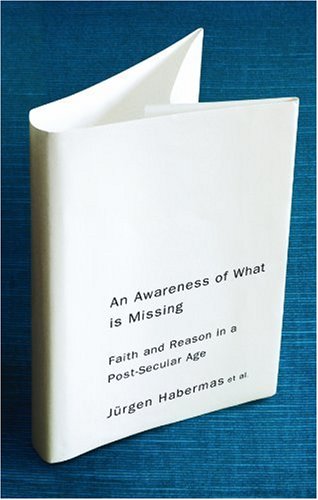
| 1. An Awareness of What is Missing: Faith and Reason in a Post-secular Age by Jurgen Habermas | |
 | Hardcover: 96
Pages
(2010-04-05)
list price: US$49.95 -- used & new: US$39.96 (price subject to change: see help) Asin: 0745647200 Average Customer Review: 
Canada | United Kingdom | Germany | France | Japan |
|
Editorial Review Product Description Habermas argues that in order to engage in this dialogue, two conditions must be met: religion must accept the authority of secular reason as the fallible results of the sciences and the universalistic egalitarianism in law and morality; and conversely, secular reason must not set itself up as the judge concerning truths of faith. This argument was developed in part as a reaction to the conception of the relation between faith and reason formulated by Pope Benedict XVI in his 2006 Regensburg address. In 2007 Habermas conducted a debate, under the title ‘An Awareness of What Is Missing', with philosophers from the Jesuit School for Philosophy in Munich. This volume includes Habermas's essay, the contributions of his interlocutors and Habermas's reply to them. It will be indispensable reading for anyone who wishes to understand one of the most urgent and intractable issues of our time. Customer Reviews (1)
| |
| 2. Habermas: A Very Short Introduction (Very Short Introductions) by Gordon Finlayson | |
 | Paperback: 184
Pages
(2005-08-25)
list price: US$11.95 -- used & new: US$6.67 (price subject to change: see help) Asin: 0192840959 Average Customer Review:
Canada | United Kingdom | Germany | France | Japan |
|
Editorial Review Product Description Customer Reviews (3)
| |
| 3. Jurgen Habermas on Society and Politics: A Reader by Jurgen Habermas | |
 | Paperback: 336
Pages
(1989-11-01)
list price: US$30.00 -- used & new: US$18.00 (price subject to change: see help) Asin: 080702001X Average Customer Review: 
Canada | United Kingdom | Germany | France | Japan |
|
Editorial Review Product Description Customer Reviews (1)
| |
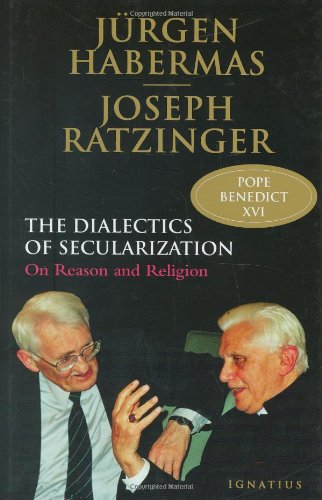
| 4. The Dialectics of Secularization: On Reason and Religion by Joseph Ratzinger, Jürgen Habermas | |
 | Hardcover: 85
Pages
(2007-01-10)
list price: US$14.95 -- used & new: US$8.77 (price subject to change: see help) Asin: 1586171666 Average Customer Review: 
Canada | United Kingdom | Germany | France | Japan |
|
Editorial Review Product Description Jurgen Habermas has surprised many observers with his call for "the secular society to acquire a new understanding of religious convictions", as Florian Schuller, director of the Catholic Academy of Bavaria, describes it his foreword. Habermas discusses whether secular reason provides sufficient grounds for a democratic constitutional state. Joseph Ratzinger/Benedict XVI argues for the necessity of certain moral principles for maintaining a free state, and for the importance of genuine reason and authentic religion, rather than what he calls "pathologies of reason and religion", in order to uphold the states moral foundations. Both men insist that proponents of secular reason and religious conviction should learn from each other, even as they differ over the particular ways that mutual learning should occur. Customer Reviews (7)
| |
| 5. Between Naturalism and Religion: Philosophical Essays by Jürgen Habermas | |
 | Paperback: 344
Pages
(2008-06-10)
list price: US$26.95 -- used & new: US$18.90 (price subject to change: see help) Asin: 0745638252 Average Customer Review:
Canada | United Kingdom | Germany | France | Japan |
|
Editorial Review Product Description Customer Reviews (2)
| |
| 6. Theory and Practice by Jurgen Habermas | |
 | Paperback: 320
Pages
(1988-03-09)
list price: US$30.00 -- used & new: US$21.00 (price subject to change: see help) Asin: 080701527X Canada | United Kingdom | Germany | France | Japan |
| 7. The Philosophy of Jürgen Habermas: A Critical Introduction by Uwe Steinhoff | |
 | Hardcover: 304
Pages
(2009-08-31)
list price: US$99.00 -- used & new: US$78.38 (price subject to change: see help) Asin: 0199547807 Canada | United Kingdom | Germany | France | Japan |
|
Editorial Review Product Description | |
| 8. Philosophy in a Time of Terror: Dialogues with Jurgen Habermas and Jacques Derrida by Giovanna Borradori | |
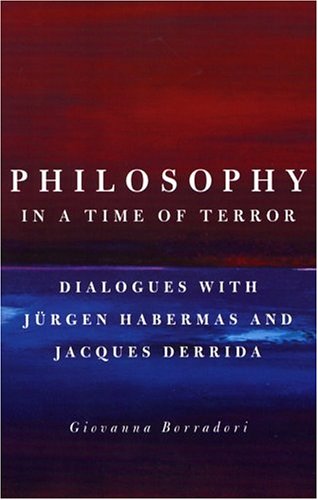 | Paperback: 224
Pages
(2004-09-01)
list price: US$17.00 -- used & new: US$12.80 (price subject to change: see help) Asin: 0226066665 Average Customer Review: 
Canada | United Kingdom | Germany | France | Japan |
|
Editorial Review Product Description Customer Reviews (15)
This book is a reminder to us all of the role played by philosophy in shaping our present and a call for a return to philosophical reflection in order to forge a sustainable future for everybody. It's a start, and credit is due to Habermas, Derrida and of course Borradori for their collaboration. The world may well be awash with pragmatism (much of it needed admittedly) but there has to be a degree of reflexivity if we are going to avoid a groundhog day scenario. I mean, we're all idealists at heart, aren't we?
| |
| 9. The Structural Transformation of the Public Sphere: An Inquiry into a Category of Bourgeois Society (Studies in Contemporary German Social Thought) by Jürgen Habermas | |
 | Paperback: 301
Pages
(1991-08-28)
list price: US$30.00 -- used & new: US$20.63 (price subject to change: see help) Asin: 0262581086 Average Customer Review:
Canada | United Kingdom | Germany | France | Japan |
|
Editorial Review Product Description Customer Reviews (7)
| |
| 10. Lifeworld and System: A Critique of Functionalist Reason (The Theory of Communicative Action, Vol. 2) by Jürgen Habermas | |
 | Paperback: 457
Pages
(1985-03-01)
list price: US$35.00 -- used & new: US$20.18 (price subject to change: see help) Asin: 080701401X Average Customer Review:
Canada | United Kingdom | Germany | France | Japan |
|
Editorial Review Product Description Customer Reviews (2)
| |
| 11. Between Facts and Norms: Contributions to a Discourse Theory of Law and Democracy (Studies in Contemporary German Social Thought) by Jurgen Habermas | |
 | Paperback: 675
Pages
(1998-01-09)
list price: US$44.00 -- used & new: US$27.00 (price subject to change: see help) Asin: 0262581620 Average Customer Review:
Canada | United Kingdom | Germany | France | Japan |
|
Editorial Review Product Description In Between Facts and Norms Jürgen Habermas works out thelegal and political implications of his Theory of CommunicativeAction (1981), bringing to fruition the project announced with hispublication of The Structural Transformation of the Public Spherein 1962. This new work is a major contribution to recent debates on the rule oflaw and the possibilities of democracy in postindustrial societies. Itoffers a sweeping, sociologically informed conceptualization of law andbasic rights, a normative account of the rule of law and theconstitutional state, an attempt to bridge normative and empiricalapproaches to democracy, and an account of the social context requiredfor democracy. The work concludes with a bold proposal for a newparadigm of law that goes beyond the dichotomies that have afflictedmodern political theory from its inception and that still underliecurrent controversies between so-called liberals and civic republicans. Customer Reviews (7)
Habermas in this book is very German. The book isstraightforward: it deals with the dual nature of laws.... i.e. that theideals we establish in laws are conditioned by a sociological process andthen interpreted through the same process. It's not a book that one wouldread for pleasure... it's not a book that one would want to have around toplease girls. It's dry at times, but CAN BE very rewarding. Please, dearGod, do not let this be an introduction to philosophy. But-- as the reviewsabove hint at-- it is an important work by an important author if taken inthe right light and for the right reasons. I do not intend here to writea review of Habermas: that's way beyond what needs to be done in thissituation. He's not a whole lot of fun though.... ;)... but a brilliantman, nonetheless.... ... Read more | |
| 12. Communication and the Evolution of Society by Jurgen Habermas | |
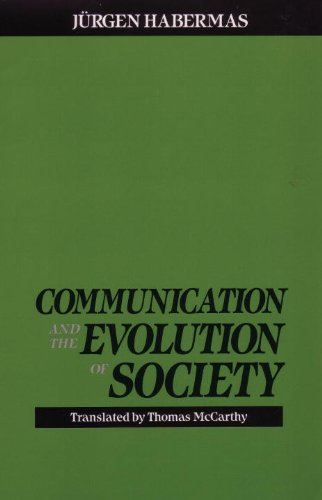 | Paperback: 264
Pages
(1979-03-08)
list price: US$22.00 -- used & new: US$18.99 (price subject to change: see help) Asin: 080701513X Canada | United Kingdom | Germany | France | Japan |
|
Editorial Review Product Description | |
| 13. The Cambridge Companion to Habermas (Cambridge Companions to Philosophy) | |
 | Paperback: 368
Pages
(1995-04-28)
list price: US$39.99 -- used & new: US$21.25 (price subject to change: see help) Asin: 052144666X Average Customer Review: 
Canada | United Kingdom | Germany | France | Japan |
|
Editorial Review Product Description Customer Reviews (2)
I've read a lot of philosophy, but even I had a hard time getting through this book, and I didn't learn much about Habermas. I do not accept the justification that complex philosophical matters require bad writing. Prose loaded with twenty-cent words and pompous jargon is not only a poor start for the struggling student, but an unwitting comment on the writer's capacity for the kind of pompous intellectualizing that drives students and seekers OUT of philosophy. With the exception of essayists Nancy Love and Simone Chambers, most of the contributors to this troublesome tome need to go back to Strunk and White, William Zinsser, and basic English composition to learn how NOT to write sentences like this one: "The insight of the metacritique of pure reason is that the comprehensiveness of a system of reason cannot be predicated on comprehensiveness itself, and that a certain amount of incomprehensibility is necessary to make 'systematic' or 'complete comprehension' possible." Setting aside the question of how many times can we work "compre-" into an incomprehensible phrasing, in plain English it means--I think--that a thought system's clarity doesn't guarantee the scope of its applicability. Why the hell not say so, and in a way that doesn't unconsciously make an irony of itself? One expects this sort of thing in a journal, but for beginners it's useless and discouraging. ... Read more | |
| 14. Jurgen Habermas: Democracy and the Public Sphere (Modern European Thinkers) by Luke Goode | |
 | Paperback: 176
Pages
(2005-10-20)
list price: US$35.00 -- used & new: US$28.63 (price subject to change: see help) Asin: 0745320880 Average Customer Review:
Canada | United Kingdom | Germany | France | Japan |
|
Editorial Review Product Description Customer Reviews (1)
| |
| 15. The Derrida-Habermas Reader | |
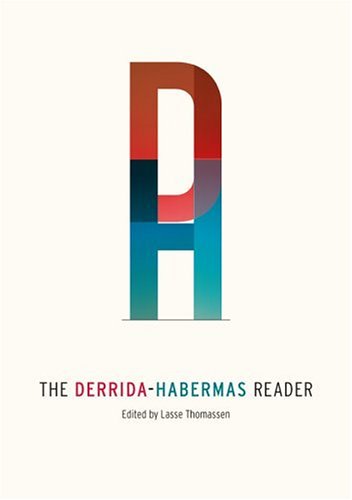 | Paperback: 330
Pages
(2006-07-01)
list price: US$30.00 -- used & new: US$20.30 (price subject to change: see help) Asin: 0226796841 Average Customer Review: 
Canada | United Kingdom | Germany | France | Japan |
|
Editorial Review Product Description Jacques Derrida and Jürgen Habermas have long represented opposite camps in contemporary thought. Derrida, who pioneered the intellectual style of inquiry known as deconstruction, ushered in the postmodern age with his dramatic critique of reason; Habermas, on the other hand, has consistently argued in defense of reason, modernity, and the legacy of the Enlightenment. Their many differences led to a long-standing, if scattered, dialogue, evidence of which has been available in only bits and pieces. But now, for the first time, The Derrida-Habermas Reader brings these pieces together, along with a collection of essays documenting the intellectual relationship between two of the twentieth century’s preeminent thinkers. Customer Reviews (1)
| |
| 16. Reason and the Rationalization of Society (The Theory of Communicative Action, Vol. 1) by Jürgen Habermas | |
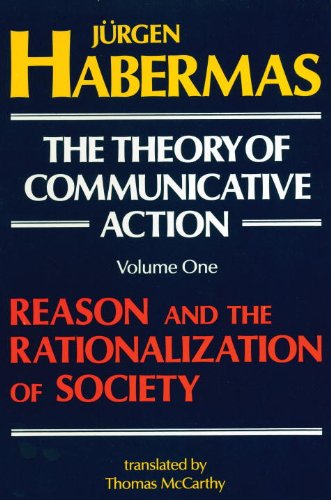 | Paperback: 465
Pages
(1985-03-01)
list price: US$35.00 -- used & new: US$34.57 (price subject to change: see help) Asin: 0807015075 Average Customer Review:
Canada | United Kingdom | Germany | France | Japan |
|
Editorial Review Product Description Customer Reviews (6)
| |
| 17. Europe: The Faltering Project by Jurgen Habermas | |
 | Paperback: 192
Pages
(2009-08-17)
list price: US$19.95 -- used & new: US$19.06 (price subject to change: see help) Asin: 0745646492 Canada | United Kingdom | Germany | France | Japan |
|
Editorial Review Product Description In this new book, one of Europe's leading intellectuals examines the political alternatives facing This book includes Habermas's portraits of three long-time philosophical companions, Richard Rorty, Jacques Derrida and Ronald Dworkin. It also includes several important new texts by Habermas on the impact of the media on the public sphere, on the enduring importance religion in "post-secular" societies, and on the design of a democratic constitutional order for the emergent world society. | |
| 18. Habermas and Rawls: Disputing the Political (Routledge Studies in Contemporary Philosophy) | |
| Hardcover: 256
Pages
(2010-11-15)
list price: US$105.00 -- used & new: US$84.00 (price subject to change: see help) Asin: 0415876869 Canada | United Kingdom | Germany | France | Japan | |
|
Editorial Review Product Description Habermas and Rawls are two heavyweights of social and political philosophy, and they are undoubtedly the two most written about (and widely read) authors in this field. However, there has not been much informed and interesting work on the points of intersection between their projects, partly because their work comes from different traditions—roughly the European tradition of social and political theory and the Anglo-American analytic tradition of political philosophy. In this volume, contributors re-examine the Habermas-Rawls dispute with an eye toward the ways in which the dispute can cast light on current controversies about political philosophy more broadly. Moreover, the volume will cover a number of other salient issues on which Habermas and Rawls have interesting and divergent views, such as the political role of religion and international justice. | |
| 19. Habermas: A Guide for the Perplexed (Continuum Guides for the Perplexed) by Lasse Thomassen | |
| Hardcover: 192
Pages
(2010-04-18)
list price: US$80.00 -- used & new: US$60.13 (price subject to change: see help) Asin: 0826487653 Canada | United Kingdom | Germany | France | Japan | |
|
Editorial Review Product Description | |
| 20. La Etica del Discurso y la Cuestion de la Verdad (Paidos Studio) (Spanish Edition) by Jurgen Habermas | |
 | Paperback: 91
Pages
(2004-02)
list price: US$15.60 -- used & new: US$29.17 (price subject to change: see help) Asin: 9501267598 Canada | United Kingdom | Germany | France | Japan |
| 1-20 of 100 | Next 20 |
 same review as volume I; it's really one book.
 turgid