e99 Online Shopping Mall

Geometry.Net - the online learning center Help  
Home  - Philosophers - Hegel Georg Wilhelm Friedrich (Books)

  Back | 21-40 of 100 | Next 20
A  B  C  D  E  F  G  H  I  J  K  L  M  N  O  P  Q  R  S  T  U  V  W  X  Y  Z  

click price to see details     click image to enlarge     click link to go to the store

$22.52
21. Hegel's Dialectic of Desire and
 
22. Preface and Introduction to the
 
$25.00
23. Hegel's Phenomenology of Self-Consciousness:
 
24. Hegel: The Letters
 
25. Hegel's Aesthetics: Lectures on
 
$10.00
26. The Philosophy of Right, The Philosopy
$39.95
27. Lectures on Logic (Studies in
 
$15.95
28. On the Episode of the Mahabharata
$14.00
29. Georg Wilhelm Friedrich Hegel:
 
30. Hegel's Lectures on the Philosophy
 
31. Hegel;: Highlights, an annotated
 
32. Hegel's Introduction to Aesthetics:
$14.48
33. Ästhetik III.
$3.15
34. Philosophy of Right (Great Books
$24.80
35. Phaenomenologie des Geistes
 
$9.86
36. The Philosophy of Hegel
 
37. Hegel: The Difference Between
 
$440.00
38. The Philosophy of Fine Art (Hegel's
 
39. Grundlinien der Philosophie des
 
40. Hegel on the Arts: Selections

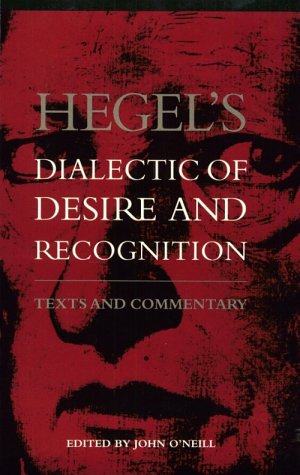
21. Hegel's Dialectic of Desire and Recognition: Texts and Commentary (Suny Series in the Philosophy of the Social Sciences)
Paperback: 331 Pages (1996-01)
list price: US$29.95 -- used & new: US$22.52
(price subject to change: see help)
Asin: 0791427145
Canada | United Kingdom | Germany | France | Japan

22. Preface and Introduction to the Phenomenology of Mind (Library of Liberal Arts)
by Georg Wilhelm Friedrich Hegel
 Paperback: 138 Pages (1990-01)
list price: US$11.55
Isbn: 0024171158
Canada | United Kingdom | Germany | France | Japan

23. Hegel's Phenomenology of Self-Consciousness: Text and Commentary (Suny Series in Hegelian Studies)
by Leo Rauch, Georg Wilhelm Friedrich Hegel
 Hardcover: 236 Pages (1999-06)
list price: US$30.50 -- used & new: US$25.00
(price subject to change: see help)
Asin: 0791441571
Canada | United Kingdom | Germany | France | Japan
Editorial Review

Book Description
Offering a new translation of the famous chapter IV ("Self-Consciousness") of Phenomenology of Spirit, this book reflects the far-reaching insights of contemporary Hegelian scholarship. Included is extensive commentary as well as a review of its reception by such important twentieth-century thinkers as Kojeve, Heidegger, Sartre, Gadamer, Bataille, Deleuze, Lacan, and Habermas.

Interest in Hegel has historically centered around the Phenomenology of Spirit. In particular chapter IV, including Hegel's celebrated "master-slave dialectic," has influenced philosophers, political theorists, social psychologists, cultural anthropologists, and literary theorists alike. Hegel began this chapter with an influential discussion of the nature of human "desire," and then described a hypothetical encounter between two pre-social human beings who engage in a life-and-death struggle for recognition. Out of this struggle that gave rise to self-identity, emerged such forms of consciousness as master and slave, stoicism, skepticism, and what Hegel referred to as "the unhappy consciousness," which he took to be paradigmatic of early Christianity. These forms of consciousness, in turn, are transcended by other, more comprehensive, forms of consciousness that ultimately come to reflect the highest elaborations of societal life. The impetus for these dynamic changes comes from the dialectical contradictions that inhere within our most basic conceptions of personhood. ... Read more


24. Hegel: The Letters
by Georg Wilhelm Friedrich Hegel
 Hardcover: 740 Pages (1984-11)
list price: US$59.95
Isbn: 0253327156
Canada | United Kingdom | Germany | France | Japan

25. Hegel's Aesthetics: Lectures on Fine Art
by Georg Wilhelm Friedrich Hegel
 Hardcover: 1324 Pages (1975-06)
list price: US$205.00
Isbn: 0198243715
Canada | United Kingdom | Germany | France | Japan

26. The Philosophy of Right, The Philosopy of History By Georg Wilhelm Friedrich Hegel. Great Books of the Western World 46
by Robert M., Hegel Hutchins
 Hardcover: Pages (1952)
-- used & new: US$10.00
(price subject to change: see help)
Asin: B000N8RHM8
Canada | United Kingdom | Germany | France | Japan

27. Lectures on Logic (Studies in Continental Thought)
Hardcover: 256 Pages (2008-07)
list price: US$39.95 -- used & new: US$39.95
(price subject to change: see help)
Asin: 0253351677
Canada | United Kingdom | Germany | France | Japan

28. On the Episode of the Mahabharata Known by the Name Bhagavad-Gita
by Georg Wilhelm Friedrich Hegel
 Hardcover: 151 Pages (1995-10-01)
list price: US$17.50 -- used & new: US$15.95
(price subject to change: see help)
Asin: 8185636192
Canada | United Kingdom | Germany | France | Japan
Editorial Review

Book Description
PRESENTS G.W.F. HEGEL'S REVIEW OF WILHELM VON HUMBOLDT'S LECTURES ON THE BHAGAVAD-GITA. ... Read more


29. Georg Wilhelm Friedrich Hegel: Knowledge Products (Giants of Philosophy) (Library Edition)
by John E. Smith
Audio CD: Pages (2006-04-01)
list price: US$18.00 -- used & new: US$14.00
(price subject to change: see help)
Asin: 0786169362
Average Customer Review: 4.0 out of 5 stars
Canada | United Kingdom | Germany | France | Japan
Editorial Review

Product Description
Friedrich Hegel developed a profound and influential synthesis of all prior knowledge. He aimed to make philosophy an all-comprehensive science that would restate, in rational language, the truth of Christianity. In Hegel’s vast speculative and idealistic philosophy, truth is found not in the part but in the whole. Nature is an organic whole shot through with rationality akin to the reason in ourselves.

Hegel viewed history as the growth of human consciousness, which is also the emergence of freedom. He thought that progress takes the form of the “dialectic,” a historical process that moves us, through struggle and contradiction, to a higher stage of development. These ideas had a great impact on virtually all subsequent philosophy, particularly that of Marx, Kierkegaard, Sartre, and Dewey. ... Read more

Customer Reviews (5)

5-0 out of 5 stars A great alternative to Strathern
If you are looking for a thoughtful and honest summary of the more important aspects of Aquinas' contribution to the history of philosophy, this is the best audio book I have yet found.Unlike the glib and grossly naive attempts at dealing with Aquinas such as Strathern's cheesy "Aquinas in 90 Minutes", this is actually written by a scholar devoted to understanding Aquinas.The treatment of his "five proofs for the existence of God" is precise and accurate. In fact, if you listen closely to them it will save you from thinking that the flaccid objections of people like Bertrand Russel had anything to do with what Aquinas was communicating in these proofs. Of course, if you are looking for Aquinas' theology, it is not here addressed.But then again, the title of the series is not "Giants of Theology."Overall, this is the best bang for your buck in Aquinas on audio.

4-0 out of 5 stars what better way is there to learn and drive
The way I look at these tapes as the best way of reading philosophy while you are driving. Please keep your eyes on the road while you are driving. These series are great. I believe they are not intended to be comprehensive and they could not be in two hours but they give you %60 biography %40 philosophy. Some of them even have accent as they though they were immigrants from original contries to US, Kant speakes with German/English accent. It is fun, entertaining, illuminating. Much better than talk shows. Please this is not a substitute for a real book so judge accordingly.

5-0 out of 5 stars Great introduction to Hume
This brief introduction to Hume is exceptional.I went from this tape to Hume's "An Enquiry Concerning Human Understanding" and "An Enquiry Concerning the Principles of Morals".I don't think it would have been such an easy transition without learning how Hume fits into Western philosophical history and what problems concerned him.It startled me to discover that Hume's major point is that inductive thinking (thinking about "matters of fact" ) is irrational:forming general laws about the world has its basis in custom and experience and not by the sort of reasoning used in math and logic ("relations of ideas" in Hume's lexicon).

Hume's political, historical, and ethical ideas are also interesting and I was surprised to learn how much Hume's ideas on the separation of powers in government had influenced James Madison.

1-0 out of 5 stars Pretty bad summary of Augustine.
The material is mostly biographical. It is also boring. Remember the kid in the school play who tries to do an accent and can't? The person doing the voice of Augustine is like that. Heston, as usual, is stiff as aspanker's paddle.

I note the other review is about Kant not Augustine.

5-0 out of 5 stars Great Audio Cassettes
This is a very good overview of Kant's thought that can be listened to while driving. Does not cover epistomology well. ... Read more


30. Hegel's Lectures on the Philosophy of Religion 3 Vols
by Georg Wilhelm Friedrich (trans by E B Speirs & J Burdon Sanderson) Hegel
 Hardcover: Pages (1962)

Asin: B000ZCYXJ2
Canada | United Kingdom | Germany | France | Japan

31. Hegel;: Highlights, an annotated selection
by Georg Wilhelm Friedrich Hegel
 Unknown Binding: 361 Pages (1960)

Asin: B0007DQRPW
Canada | United Kingdom | Germany | France | Japan

32. Hegel's Introduction to Aesthetics: Being the Introduction to The Berlin Aesthetics Lectures of the 1820s
by Georg Wilhelm Friedrich Hegel, T. M. Knox, Charles Karelis
 Hardcover: 170 Pages (1979-12-27)
list price: US$22.00
Isbn: 0198243774
Canada | United Kingdom | Germany | France | Japan

33. Ästhetik III.
by Georg Wilhelm Friedrich Hegel
Paperback: Pages (1971-01-01)
-- used & new: US$14.48
(price subject to change: see help)
Asin: 3150079853
Canada | United Kingdom | Germany | France | Japan

34. Philosophy of Right (Great Books in Philosophy)
by Georg Wilhelm Friedrich Hegel
Paperback: 365 Pages (1996-11)
list price: US$13.00 -- used & new: US$3.15
(price subject to change: see help)
Asin: 157392105X
Average Customer Review: 3.5 out of 5 stars
Canada | United Kingdom | Germany | France | Japan
Editorial Review

Book Description
A translation of 'Naturrecht und Staatswissenschaft im Grundisse' and 'Grundlinien der Philosophie des Rechts.' ... Read more

Customer Reviews (7)

1-0 out of 5 stars buy a different edition!
This was a miserable translation, even when it was first published, and for far too many years it was the only one avaiable in English.Now, however, there are far better choices.The Wood-Nisbet version published by Cambridge is far superior, but I believe that mine (HEGEL'S PHILOSOPHY OF RIGHT, Focus Press) is the best of the lot.For some reasons, see either my review of the Wood-Nisbet edition, or Peter Kalkavage's review of mine, on its Amazon page.

5-0 out of 5 stars From Stanford University Encyclopedia of Philosophy
Along with J. G. Fichte and F. W. J. von Schelling, Hegel (1770-1831) belongs to the period of "German idealism" in the decades following Kant. The most systematic of the post-Kantian idealists, Hegel attempted, throughout his published writings as well as in his lectures, to elaborate a comprehensive and systematic ontology from a "logical" starting point. He is perhaps most well-known for his teleological account of history, an account which was later taken over by Marx and "inverted" into a materialist theory of an historical development culminating in communism. For most of the twentieth century, the "logical" side of Hegel's thought had been largely forgotten, but his political and social philosophy continued to find interest and support. However, since the 1970s, a degree of more general philosophical interest in Hegel's systematic thought has also been revived.

Like the Science of Logic, the Encyclopaedia of the Philosophical Sciences is itself divided into three parts: a Logic; a Philosophy of Nature; and a Philosophy of Spirit. The same triadic pattern in the Philosophy of Spirit results in the philosophies of subjective spirit, objective spirit, and absolute spirit. The first of these constitutes Hegel's philosophy of mind, the last, his philosophy of art, religion, and philosophy itself. The philosophy of objective spirit concerns the objective patterns of social interaction and the cultural institutions within which "spirit" is objectified. The book entitled Elements of the Philosophy of Right which Hegel published as a textbook for his lectures at Berlin essentially corresponds to a more developed version of the section on "Objective Spirit" in the Philosophy of Spirit.

The Philosophy of Right (as it is more commonly called) can, and has been, read as a political philosophy which stands independently of the system, but it is clear that Hegel intended it to be read against the background of the developing conceptual determinations of the Logic. The text proper starts from the conception of a singular willing subject (grasped from its own first-person point of view) as the bearer of "abstract right." While this conception of the individual willing subject with some kind of fundamental right is in fact the starting point of many modern political philosophies (such as that of Locke, for example) the fact that Hegel commences here does not testify to any ontological assumption that the consciously willing and right-bearing individual is the basic atom from which all society can be understood as constructed -- an idea at the heart of standard "social contract" theories. Rather, this is merely the most "immediate" starting point of Hegel's presentation and corresponds to analogous starting places of the Logic. Just as the categories of the Logic develop in a way meant to demonstrate that what had at the start been conceived as simple is in fact only made determinate in virtue of its being part of some larger structure or process, here too it is meant to be shown that any simple willing and right-bearing subject only gains its determinacy in virtue of a place it finds for itself in a larger social, and ultimately historical, structure or process. Thus even a contractual exchange (the minimal social interaction for contract theorists) is not to be thought simply as an occurrence consequent upon the existence of two beings with natural wants and some natural calculative rationality; rather, the system of interaction within which individual exchanges take place (the economy) will be treated holistically as a culturally-shaped form of social life within which the actual wants of individuals as well as their reasoning powers are given determinate forms.

Here too it becomes apparent in Hegel's treatment of property and the exchange contract that the notion of recognition plays a crucial role in his general conception of the relation of individuals to each other and to society as a whole. A contractual exchange of commodities between two individuals itself involves an implicit act of recognition in as much as each, in giving something to the other in exchange for what they want, are thereby recognizing them as a proprietor of that thing, or, more properly, of the inalienable value attaching to it. By contrast, such proprietorship would be denied rather than recognised in fraud or theft -- forms of "wrong" (Unrecht) in which right is negated rather than acknowledged or posited. Thus what differentiates property from mere possession is that it is grounded in a relation of reciprocal recognition between two willing subjects. Moreover, it is in the exchange relation that we can see what it means for Hegel for individual subjects to share a "common will" -- an idea which will have important implications with respect to the difference of Hegel's conception of the state from that of Rousseau. Such an interactive constitution of the common will means that for Hegel such an identity of will is achieved because of not in spite of a co-existing difference between the particular wills of the subjects involved: while contracting individuals both "will" the same exchange, at a more concrete level, they do with different ends in mind. Each wants something different from the exchange.

Hegel passes from the abstract individualism of "Abstract Right" to the social determinacies of "Sittlichkeit" or "Ethical Life" via considerations first of "wrong" (the negation of right) and its punishment (the negation of wrong, and hence the "negation of the negation" of the original right), and then of "morality," conceived more or less as an internalisation of the external legal relations. Consideration of Hegel's version of the retributivist approach to punishment affords a good example of his use of the logic of "negation." In punishing the criminal the state makes it clear to its members that it is the acknowledgment of right per se that is essential to developed social life: the significance of "acknowledging another's right" in the contractual exchange cannot be, as it at first might have appeared to the participants, simply that of being a way of each getting what he or she wants from the other. Hegel's treatment of punishment also brings out the continuity of his way of conceiving of the structure and dynamics of the social world with that of Kant, as Kant too, in his Metaphysics of Morals had employed the idea of the state's punitive action as a negating of the original criminal act. Kant's idea, conceived on the model of the physical principle of action and reaction, was structured by the category of "community" or reciprocal interaction, and was conceived as involving what he called "real opposition." Such an idea of opposed dynamic forces seems to form something of a model for Hegel's idea of contradiction and the starting point for his conception of reciprocal recognition. Nevertheless, clearly Hegel articulates the structures of recognition in more complex ways than those derivable from Kant's category of community.

First of all, in Hegel's analysis of Sittlichkeit the type of sociality found in the market-based "civil society" is to be understood as dependent upon and in contrastive opposition with the more immediate form found in the institution of the family -- a form of sociality mediated by a quasi-natural inter-subjective recognition rooted in sentiment and feeling: love. In the family the particularity of each individual tends to be absorbed into the social unit, giving this manifestation of Sittlichkeit a one-sidedness that is the inverse of that found in market relations in which participants grasp themselves in the first instance as separate individuals who then enter into relationships that are external to them.

These two opposite but interlocking principles of social existence provide the basic structures in terms of which the component parts of the modern state are articulated and understood. As both contribute particular characteristics to the subjects involved in them, part of the problem for the rational state will be to ensure that each of these two principles mediate the other, each thereby mitigating the one-sidedness of the other. Thus, individuals who encounter each other in the "external" relations of the market place and who have their subjectivity shaped by such relations also belong to families where they are subject to opposed influences. Moreover, even within the ensemble of production and exchange mechanisms of civil society individuals will belong to particular "estates" (the agricultural estate, that of trade and industry, and the "universal estate" of civil servants), whose internal forms of sociality will show family-like features.

Although the actual details of Hegel's "mapping" of the categorical structures of the Logic onto the Philosophy of Right are far from clear, the general motivation is apparent. As has been mentioned above, Hegel's logical categories can be read as an attempt to provide a schematic account of the material (rather than formal) conditions required for developed self-consciousness. Thus we might regard the various "syllogisms" of Hegel's Subjective Logic as attempts to chart the skeletal structures of those different types of recognitive inter-subjectivity necessary to sustain various aspects of rational cognitive and conative functioning ("self-consciousness"). From this perspective, we might see his "logical" schematisation of the modern "rational" state as a way of displaying just those sorts of institutions that a state must provide if it is to answer Rousseau's question of the form of association needed for the formation and expression of the "general will."

Concretely, for Hegel it is representation of the estates within the legislative bodies that is to achieve this. As the estates of civil society group their members according to their common interests, and as the deputies elected from the estates to the legislative bodies give voice to those interests within the deliberative processes of legislation, we might see how the outcome of this process might be considered to give expression to the general interest. But Hegel's "republicanism" is here cut short by his invocation of the familial principle: such representative bodies can only provide the content of the legislation to a constitutional monarch who must add to it the form of the royal decree -- an individual "I will ...." To declare that for Hegel the monarch plays only a "symbolic" role here is to miss the fundamentally idealist complexion of his political philosophy. The expression of the general will in legislation cannot be thought of as an outcome of some quasi-mechanical process: it must be "willed." If legislation is to express the general will, citizens must recognize it as expressing their wills; and this means, recognising it as willed. The monarch's explicit "I will" is thus needed to close this recognitive circle, lest legislation look like a mechanical compromise resulting from a clash of interests, and so as actively willed by nobody. Thus while Hegel is critical of standard "social contract" theories, his own conception of the state is still clearly a complicated transformation of those of Rousseau and Kant.

Perhaps one of the most influential parts of Hegel's Philosophy of Right concerns his analysis of the contradictions of the unfettered capitalist economy. On the one hand, Hegel agreed with Adam Smith that the interlinking of productive activities allowed by the modern market meant that "subjective selfishness" turned into a "contribution towards the satisfaction of the needs of everyone else." But this did not mean that he accepted Smith's idea that this "general plenty" produced thereby diffused (or "trickled down" ) though the rest of society. From within the type of consciousness generated within civil society, in which individuals are grasped as "bearers of rights" abstracted from the particular concrete relationships to which they belong, Smithean optimism may seem justified. But this simply attests to the one-sidedness of this type of abstract thought, and the need for it to be mediated by the type of consciousness based in the family in which individuals are grasped in terms of the way they belong to the social body. In fact, the unfettered operations of the market produces a class caught in a spiral of poverty. Starting from this analysis, Marx later used it as evidence of the need to abolish the individual proprietorial rights at the heart of Hegel's "civil society" and socialise the means of production. Hegel, however, did not draw this conclusion. His conception of the exchange contract as a form of recognition that played an essential role within the state's capacity to provide the conditions for the existence of rational and free-willing subjects would certainly prevent such a move. Rather, the economy was to be contained within an over-arching institutional framework of the state, and its social effects offset by welfarist state intervention.

3-0 out of 5 stars get the wood and nisbet edition
Okay this edition's servicable, but it's a long sight from being good.The Wood and Nisbet edition in the "Cambridge Texts in the History of Social Though" is noticeably superior to the Knox edition.The Cambridge edition is a somewhat more accurate and readable translation, is much better organized, and has an excellent introduction by Wood; all the Knox edition has going for it is a nicer cover.

4-0 out of 5 stars Hegel's Encyclopaedia of Social Life
The book is a fascinating encyclopaedia of human life in all its social dimensions starting from our relation to a thing (property) and going on to relation between states in world history. Hegel's categorisation of social institutions contains some contraversial statements. But they all add tothe fascination of reading the book.

Unfortunatelly Knox's translationdoes make it very difficult to comprehend some crucial passages, especiallywhere Hegel's deals with the concept of Right in refined speculative terms.It also contains some basic mistakes which make a comparative reading ofthe English and the German text an anoying experience.

1-0 out of 5 stars Date of translation
This readable translation was originally published in 1896 (not 1967) and there are two very fine and more recent translations of this book by T.M. Knox and H.B. Nisbet (with slightly different titles). ... Read more


35. Phaenomenologie des Geistes
by Georg Wilhelm Friedrich Hegel
Paperback: 356 Pages (2006-09-19)
list price: US$24.90 -- used & new: US$24.80
(price subject to change: see help)
Asin: 1406807044
Canada | United Kingdom | Germany | France | Japan

36. The Philosophy of Hegel
by Georg Wilhelm Friedrich Hegel
 Paperback: 552 Pages (1965-02-01)
list price: US$10.00 -- used & new: US$9.86
(price subject to change: see help)
Asin: 0075536552
Canada | United Kingdom | Germany | France | Japan
Editorial Review

Book Description
Edited, with an Introduction, by Carl J. Friedrich ... Read more


37. Hegel: The Difference Between the Fichtean and Schellingian Systems of Philosophy
by Georg Wilhelm Friedrich Hegel
 Paperback: 109 Pages (1978-06-01)
list price: US$15.00
Isbn: 0917930126
Canada | United Kingdom | Germany | France | Japan

38. The Philosophy of Fine Art (Hegel's Lectures on Absolute Spirit)
by Georg Wilhelm Friedrich Hegel
 Hardcover: 1610 Pages (1999-08-01)
list price: US$440.00 -- used & new: US$440.00
(price subject to change: see help)
Asin: 1855068079
Canada | United Kingdom | Germany | France | Japan
Editorial Review

Book Description

The first complete translation into English of the three volumes devoted to aesthetics in Hegel's Works. Based on lectures Hegel gave between 1820 and 1829, The Philosophy of Fine Art has been described as the most fully articulated idealistic system of aesthetics and is one of the key works in the history of the philosophy of art.


... Read more

39. Grundlinien der Philosophie des Rechts, mit Hegels eigenhandigen Randbemerkungen in seinem Handexemplar der Rechtsphilosophie
by Georg Wilhelm Friedrich Hegel
 Hardcover: Pages (1962)

Asin: B000Z3UGYW
Canada | United Kingdom | Germany | France | Japan

40. Hegel on the Arts: Selections from G.W F. Hegel's Aesthetics, or the Philosophy of Fine Art (Milestones of Thought in the History of Ideas)
by Georg Wilhelm Friedrich Hegel
 Paperback: 200 Pages (1979-04)
list price: US$9.95
Isbn: 0804462623
Canada | United Kingdom | Germany | France | Japan

  Back | 21-40 of 100 | Next 20
A  B  C  D  E  F  G  H  I  J  K  L  M  N  O  P  Q  R  S  T  U  V  W  X  Y  Z  

Prices listed on this site are subject to change without notice.
Questions on ordering or shipping? click here for help.

site stats