
|
Help |
| Home - Philosophers - Heidegger Martin (Books) | |
e99 Online Shopping Mall
|
|
Help |
| Home - Philosophers - Heidegger Martin (Books) | |
| Back | 41-60 of 98 | Next 20 |
click price to see details click image to enlarge click link to go to the store
| 41. Martin Heidegger: Key Concepts | |
 | Paperback: 288
Pages
(2010-01-19)
list price: US$24.95 -- used & new: US$18.77 (price subject to change: see help) Asin: 1844651991 Canada | United Kingdom | Germany | France | Japan |
|
Editorial Review Product Description | |
| 42. Nietzsche: Vols. 3 and 4 (Vol. 3: The Will to Power as Knowledge and as Metaphysics; Vol. 4: Nihilism) by Martin Heidegger, David Farrell Krell | |
 | Paperback: 608
Pages
(1991-03-01)
list price: US$24.00 -- used & new: US$11.04 (price subject to change: see help) Asin: 0060637943 Average Customer Review: 
Canada | United Kingdom | Germany | France | Japan |
|
Editorial Review Product Description Customer Reviews (4)
| |
| 43. Martin Heidegger and the Holocaust | |
 | Paperback: 285
Pages
(1997-07)
list price: US$32.98 -- used & new: US$20.02 (price subject to change: see help) Asin: 1573926205 Canada | United Kingdom | Germany | France | Japan |
|
Editorial Review Product Description "Milchman and Rosenberg have edited a collection of essays that focus on the German philosopher and Nazi party member-in-good-standing Martin Heidegger and his alleged 'silence' about the Holocaust in the years after its perpetration.Many of the contributors make clear that Heidegger's approach to his Nazi past is not unlike that of a whole generation of Germans who falsified or suppressed their shameful complicity in support of Hitler's Third Reich." -- Choice "This title contains a good deal of interesting commentary on, and sharp criticism of, Germany's most puzzling and infamous twentieth-century thinker." -- Bridges | |
| 44. Mindfulness (Athlone Contemporary European Thinkers) by Martin Heidegger, Thomas Kalary, Parvis Emad | |
 | Paperback: 432
Pages
(2006-06-22)
list price: US$39.95 -- used & new: US$28.53 (price subject to change: see help) Asin: 0826480829 Canada | United Kingdom | Germany | France | Japan |
|
Editorial Review Product Description This brand new translation of Martin Heidgger's Mindfulness (Besinnung) makes available in English for the first time Heidegger's second major being-historical treatise. Here Heidegger returns to and elaborates in detail many of the individual dimensions of the historically self-showing and transforming allotments of be-ing. In addition to the main text, this volume also includes two further important texts, A Retrospective Look at the Pathway (1937/8) and 'The Wish and the Will (On Preserving What is Attempted)' (1937/8), in which Heidegger surveys his unpublished works, gives instructions for their eventual publication, talks about his relationship to Catholic and Protestant Christianity, and reflects on his life's path. This is a major new translation of a key text from one of the most important thinkers of the twentieth century. | |
| 45. Aristotle's Metaphysics T 1--3: On the Essence and Actuality of Force (Studies in Continental Thought) by Martin Heidegger | |
 | Hardcover: 224
Pages
(1995-10-01)
list price: US$35.00 -- used & new: US$24.00 (price subject to change: see help) Asin: 0253329108 Canada | United Kingdom | Germany | France | Japan |
|
Editorial Review Product Description "Highly recommended." -- Choice Martin Heidegger's reading of Aristotle was one of the pivotal influences in the development of his philosophy. This 1931 lecture course shows the close correlation between Heidegger's phenomenological interpretation of the Greeks (especially of Aristotle) and his critique of metaphysics. | |
| 46. Logic: The Question of Truth (Studies in Continental Thought) by Martin Heidegger | |
 | Hardcover: 376
Pages
(2010-03-01)
list price: US$44.95 -- used & new: US$31.95 (price subject to change: see help) Asin: 0253354668 Canada | United Kingdom | Germany | France | Japan |
|
Editorial Review Product Description Martin Heidegger's 1925--26 lectures on truth and time provided much of the basis for his momentous work, Being and Time. Not published until 1976 as volume 21 of the Complete Works, three months before Heidegger's death, this work is central to Heidegger's overall project of reinterpreting Western thought in terms of time and truth. The text shows the degree to which Aristotle underlies Heidegger's hermeneutical theory of meaning. It also contains Heidegger's first published critique of Husserl and takes major steps toward establishing the temporal bases of logic and truth. Thomas Sheehan's elegant and insightful translation offers English-speaking readers access to this fundamental text for the first time. | |
| 47. Plato's Sophist (Studies in Continental Thought) by Martin Heidegger | |
 | Paperback: 512
Pages
(2003-06-18)
list price: US$29.95 -- used & new: US$21.85 (price subject to change: see help) Asin: 025321629X Average Customer Review: 
Canada | United Kingdom | Germany | France | Japan |
|
Editorial Review Product Description "Students and scholars alike can now see for themselves why Heidegger's lectures on the Greeks in the 1920s caused such a stir, and they can judge just what it means to read a Greek text with Heidegger." -- John Ellis, University of Memphis "... thematic and methodological parallels render this volume a fine source for those interested in the archaeology of Being and Time.... The text shows us a young Martin Heidegger at ease and passionate about his subject...." -- International Philosophical Quarterly This volume reconstructs Martin Heidegger's lecture course at the University of Marburg in the winter semester of 1924-25, which was devoted to an interpretation of Plato and Aristotle. Published for the first time in German in 1992 as volume 19 of Heidegger's Collected Works, it is a major text not only because of its intrinsic importance as an interpretation of the Greek thinkers, but also because of its close, complementary relationship to Being and Time, composed in the same period. In Plato's Sophist, Heidegger approaches Plato through Aristotle, devoting the first part of the lectures to an extended commentary on Book VI of the Nichomachean Ethics. In a line-by-line interpretation of Plato's later dialogue, the Sophist, Heidegger then takes up the relation of Being and non-being, the ontological problematic that forms the essential link between Greek philosophy and Heidegger's thought. Customer Reviews (2)
| |
| 48. Arte y poesia (Breviarios) (Spanish Edition) by Heidegger Martin | |
 | Paperback: 124
Pages
(1958-12-31)
list price: US$6.99 -- used & new: US$6.98 (price subject to change: see help) Asin: 9681600401 Canada | United Kingdom | Germany | France | Japan |
|
Editorial Review Product Description | |
| 49. Protestant Metaphysics After Karl Barth and Martin Heidegger by Timothy Stanley | |
 | Paperback: 275
Pages
(2010-08)
list price: US$33.00 -- used & new: US$33.00 (price subject to change: see help) Asin: 1608996913 Average Customer Review: 
Canada | United Kingdom | Germany | France | Japan |
|
Editorial Review Product Description Customer Reviews (1)
| |
| 50. Being, man, & death: A key to Heidegger by James M Demske | |
| Hardcover: 233
Pages
(1970)
Isbn: 0813111943 Average Customer Review:
Canada | United Kingdom | Germany | France | Japan | |
Customer Reviews (2)
| |
| 51. Basic Concepts of Ancient Philosophy (Studies in Continental Thought) by Martin Heidegger, Richard Rojcewicz | |
 | Hardcover: 272
Pages
(2007-10-22)
list price: US$39.95 -- used & new: US$30.04 (price subject to change: see help) Asin: 0253349656 Average Customer Review:
Canada | United Kingdom | Germany | France | Japan |
|
Editorial Review Product Description Customer Reviews (1)
| |
| 52. Heraclitus Seminar (SPEP) by Martin Heidegger, Eugen Fink | |
 | Paperback: 171
Pages
(1993-01-21)
list price: US$24.95 -- used & new: US$21.33 (price subject to change: see help) Asin: 0810110679 Average Customer Review:
Canada | United Kingdom | Germany | France | Japan |
Customer Reviews (5)
I ordered "The Heraclitus Seminar", perhaps naively, in order to gain a better understanding of Heraclitus and his Metaphysics--I came away from the ordeal completely dumbfounded. This is partially my own fault--I knew going in that Heidegger makes for difficult reading, and that his precipitous works are, almost without exception, extremely abstruse. As such, his books require great dedication and patience. This, I was prepared for. However, I came to an impasse with the book almost immediately. This resulted from the multitude of passages that were written, within the body of the text, in Attic Greek--with *no* translations. (no kidding) This one is better left for the later grad students and/or their profs--that is, unless you happen to be an extremely patient novice, who can read Greek without a lexicon, and who has a penchant for Heideggarian analysis of the pre-Socratics.
| |
| 53. On the Way to Language by Martin Heidegger | |
 | Paperback: 208
Pages
(1982-02-24)
list price: US$16.00 -- used & new: US$6.44 (price subject to change: see help) Asin: 0060638591 Canada | United Kingdom | Germany | France | Japan |
|
Editorial Review Product Description The "Dialogue on Language," between Heidegger and a Japanese friend, together with the four lectures that follow, present Heidegger's central ideas on the origin, nature, and significance of language. These essays reveal how one of the most profound philosophers of our century relates language to his earlier and continuing preoccupation with the nature of Being and himan being. One the Way to Language enable readers to understand how central language became to Heidegger's analysis of the nature of Being. On the Way to Language demonstrates that an interest in the meaning of language is one of the strongest bonds between analytic philosophy and Heidegger. It is an ideal source for studying his sustained interest in the problems and possibilities of human language and brilliantly underscores the originality and range of his thinking. | |
| 54. Heidegger: A Very Short Introduction (Very Short Introductions) by Michael Inwood | |
 | Paperback: 160
Pages
(2002-07-11)
list price: US$11.95 -- used & new: US$6.28 (price subject to change: see help) Asin: 0192854100 Average Customer Review:
Canada | United Kingdom | Germany | France | Japan |
|
Editorial Review Product Description Customer Reviews (5)
Anyone new to Heidegger who is looking for a good Introductory survey of the man and his thought would do much better to take a look at George Steiner's 'Martin Heidegger.' In contrast to Inwood, Steiner writes with real passion and leaves one with a desire to know more about this amazing thinker. In fact, Steiner's book is so good that you'll probably want to read it again. I was left wishing it had been two or three times longer.
Anyone new to Heidegger who is looking for a good Introductory survey of the man and his thought would do much better to take a look at George Steiner's 'Martin Heidegger.'In contrast to Inwood, Steiner writes with real passion and leaves one with a desire to know more about this amazing thinker.In fact, Steiner's book isso good that you'll probably want to read it again.I was left wishing it had been two or three times longer. ... Read more | |
| 55. Inhabiting the Earth: Heidegger, Environmental Ethics, and the Metaphysics of Nature by Bruce V. Foltz | |
 | Paperback: 202
Pages
(1995-09)
list price: US$28.98 -- used & new: US$22.02 (price subject to change: see help) Asin: 1573926094 Canada | United Kingdom | Germany | France | Japan |
|
Editorial Review Product Description Dr. Foltz finds that to ecofeminism and social ecology, whose prescriptions are based on historically oriented etiologies of domination and oppression, Heidegger's work offers what is arguably the first comprehensive and nonreductive philosophy of history since Hegel that can embrace both nature and humanity in one narrative, and the first since Augustine that can do this while granting to nature a measure of self-standing. But it is probably for the environmental philosophies of deep ecology, bioregionalism, and ecological holism that Heidegger's work has the most immediate and extensive implications, because it is to them that it has the most affinity. Finally, as a corrective challenge to deep ecology, which has tended to valorize the scientific approach to nature, Heidegger's work provides a sophisticated basis for showing the primacy of the poetic in the task of learning to inhabit the earth rightly. "Thinkers concerned with environmental philosophy will find this book a profound clarification of our concept of nature." by Professor Alphonso Lingis, Pennsylvania State University. | |
| 56. Martin Heidegger: Between Good and Evil by Rüdiger Safranski | |
 | Paperback: 496
Pages
(1999-11-01)
list price: US$25.00 -- used & new: US$17.00 (price subject to change: see help) Asin: 0674387104 Average Customer Review:
Canada | United Kingdom | Germany | France | Japan |
|
Editorial Review Product Description Customer Reviews (14)
| |
| 57. The Heidegger-Jaspers Correspondence (1920-1963) (Contemporary Studies in Philosophy and the Human Sciences.) by Martin Heidegger, Karl Jaspers, Walter Biemel, Hans Saner | |
 | Hardcover: 295
Pages
(2003-07)
list price: US$69.98 -- used & new: US$47.23 (price subject to change: see help) Asin: 1591020603 Average Customer Review:
Canada | United Kingdom | Germany | France | Japan |
|
Editorial Review Product Description While the first thirteen years of their acquaintance were marked by a collegial exchange of views on philosophical issues of mutual interest, their relationship changed significantly in 1933, when Heidegger publicly supported the National Socialist revolution, and, as a party member, implemented the National Socialist agenda as rector of Freiburg University.By contrast, Jaspers, whose wife was Jewish, was forced into retirement.After the war, during the Freiburg de-Nazification process, Jaspers sharply criticized Heidegger's conduct but nonetheless stressed the lasting value of his philosophical contributions.Despite this conflict, the two men continued to find common ground and correspnded until 1963. The letters touch on many points of philosophical interest to both men, yet only hint at the political turmoil that swirled around them.They discuss how they came to see themselves as personally connected but publicly misidentified as "existentialists."There are also many illuminating exchanges concerning Hannah Arendt, Karl Lowith, Max Weber, Edmund Husserl, and others.Editors Walter Biemel and Hans Saner provide a wealth of references and annotations that make these personal letters accessible to contemporary readers. This first English translation of the correspondence between two giants of twentieth-century German philosophy will be of great interest to philosophers, historians, and anyone intrigued by the Heidegger controversy. Customer Reviews (1)
The emphasis on Heidegger in recent years has expanded into an investigation of his personal life, intertwined as it was with the Nazi regime during the '30s. We have access to the Arendt-Jaspers correspondence, but only get to know Heidegger second-hand. That is why the release of the Heidegger-Jaspers correspondence is a tresure for every student of philosophy. Not only do we gain valuable insights into the workings of each author's conception of existentialism, but we also get to soak in the atmosphere of German university life, and its view of scholarship, so different from our own universities today, which now serve as little else than extensions of high school. The letters also give us the opportunity to see how the Heidegger-Japsers friendship fared over the years. (The letters are from 1920 to 1963.) During the '20s, the two are very close and share critiques of each others philosphy. During the '30s, with the rise of the Nazis, we see a cooling off due to the fact Heidegger sides with the Nazis and Jaspers, whose wife was Jewish,was appalled by what was happening to Germany. Very few letters are exchanged during the period from 1936 to 1948, when Heidegger, by now defanged by the Allied occupation, once again ventures into the public eye. The letters of this perios lack the warmth of the letters from the '20s, with Heidegger wishing to forget what happened in the '30s and Jaspers wanting an explanation. This is an unforgettable foray into the livers anf thought of two giants of twentieth century philosophy, and, as such, is a must for every philosophical library. ... Read more | |
| 58. Hölderlin's Hymn "The Ister" (Studies in Continental Thought) by Martin Heidegger | |
| Hardcover: 200
Pages
(1996-09-01)
list price: US$35.00 -- used & new: US$29.08 (price subject to change: see help) Asin: 0253330645 Average Customer Review:
Canada | United Kingdom | Germany | France | Japan | |
|
Editorial Review Product Description "... Heidegger's reading of The Ister is thoughtful and rich. It provides his readers with the tools to build on his interpretation and to correct any missteps without doing violence to the whole." -- Review of Metaphysics Martin Heidegger's 1942 lecture course interprets Friedrich Hölderlin's hymn "The Ister" within the context of Hölderlin's poetic and philosophical work, with particular emphasis on Hölderlin's dialogue with Greek tragedy. Revealing of Heidegger's thought of the period are his discussions of the meaning of "the political" and "the national," in which he emphasizes the difficulty and the necessity of finding "one's own" in and through a dialogue with "the foreign." Customer Reviews (2)
| |
| 59. Heidegger's Way of Thought: Critical and Interpretive Signposts by Theodore Kisiel, Marion Heinz, Alfred Denker | |
 | Paperback: 280
Pages
(2002-06-01)
list price: US$60.00 -- used & new: US$31.32 (price subject to change: see help) Asin: 0826457363 Canada | United Kingdom | Germany | France | Japan |
|
Editorial Review Product Description | |
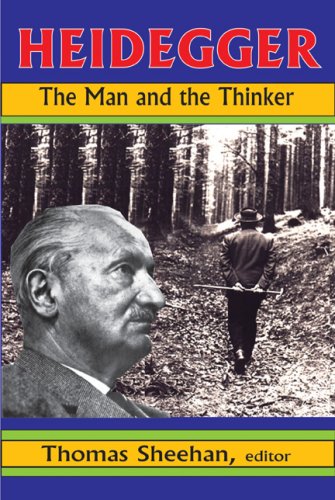
| 60. Heidegger | |
 | Paperback: 367
Pages
(2009-09-30)
list price: US$34.95 -- used & new: US$29.14 (price subject to change: see help) Asin: 1412810841 Canada | United Kingdom | Germany | France | Japan |
|
Editorial Review Product Description Many people consider Martin Heidegger the most important German philosopher of the twentieth century. He is indisputably controversial and influential. Athough much has been written about Heidegger, this may be the best single volume covering his life, career, and thought. For all its breadth and complexity, Heidegger's perspective is quite simple: he is concerned with the meaning of Being as disclosure. Heidegger's life was almost as simple. He was a German professor, except for a brief but significant period in which he supported the Nai regime. While that departure from philosophy continues to haunt his name and work, one must question whether his thought from 1912 to 1976 should be measured by the yardstick of his politics from May, 1933, through February, 1934. Th is anthology addresses his complex but simple thought and his simple but complex life. In a real sense, Sheehan claims, there is no content to Heidegger's topic and legacy, only a method. But method must not be taken to mean a technique or procedure for philosophical thinking. Rather, the topic of Heidegger's thought and his pursuit of that topic, the "what" and the "how," are one and the same thing. Heidegger writes, "Alles ist Weg," "Everything is way," and man's Being is to be on-the-way in essential movement. Heidegger, argues in our essence we humans are the topic and the point is not to be led there so much as to come to know what we already know and to become what we already are. This brilliant collection confirms this truism, and is an excellent introduction to the work of this seminal thinker. Thomas Sheehan is professor emeritus of philosophy at Loyola University Chicago and professor of religious studies at Stanford University. He is the author of The First Coming: How the Kingdom of God Became Christianity, Karl Rahner: The Philosophical Foundations and co-editor and translator of Edmund Husserl’s, Psychological and Transcendental Phenomenology, and The Confrontation with Heidegger. | |
| Back | 41-60 of 98 | Next 20 |
 Heidegger's Plato's Sophist
 I disagree