
|
Help |
| Home - Philosophers - Kierkegaard Soren (Books) | |
e99 Online Shopping Mall
|
|
Help |
| Home - Philosophers - Kierkegaard Soren (Books) | |
| Back | 21-40 of 99 | Next 20 |
click price to see details click image to enlarge click link to go to the store
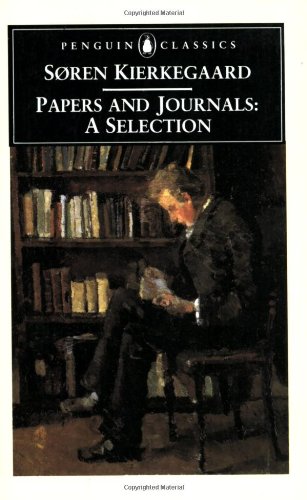
| 21. Papers and Journals: A Selection by Soren Kierkegaard | |
 | Paperback: 704
Pages
(1996-11-01)
list price: US$18.00 -- used & new: US$10.40 (price subject to change: see help) Asin: 0140445897 Average Customer Review: 
Canada | United Kingdom | Germany | France | Japan |
|
Editorial Review Product Description Customer Reviews (4)
There are many reasons for someone to read in Kierkegaard's journals.He used his journals for dry runs for many ideas that later cropped up in his various books and discourses.He often presents these ideas in a more straightforward manner than he would in his books.But he also often writes things that he did not intend to be seen by the public in his lifetime.Make no mistake about it:Kierkegaard definitely wrote these journals with the assumption that they would later be read by others in published form.But the knowledge that this would only come after his death freed him from any form of constraint, not that even here he is terribly forthcoming. Reading the journals is also essential because it is the only way to get a truly balanced picture of his literary career and life.For instance, the caricature of Kierkegaard is of a soul who unhappily engaged in a Quixotic battle with the Danish Lutheran church in the final years of his life.The image is of an unhappy, isolated, tormented soul who never finds his rest.In fact, from the journals we find a person who has achieved a great deal of personal peace and a quiet contentment.This cannot be drawn from the books he published in his lifetime, but only from the journals.For all these reasons, anyone interested in Kierkegaard will profit enormously from these pages. My lone complaint is that Alastair Hannay is not the most gifted prose stylist in the world.I have read just about all his words in English (all dealing with Kierkegaard or translations of Kierkegaard), and while I have no doubt about his accuracy as a translator, I have no confidence in his literary abilities.As a result, the volume--like the other volumes he has translated for Penguin--is highly serviceable, but not something that will thrill and inspire. I should mention that Amazon shows a Princeton University Press edition of the JOURNALS scheduled to appear in the fall of 2004.I do not know very much about this edition.I am assuming that it is a single volume edition, but I have no idea how extensive of an edition this will be.Princeton's publications of Kierkegaard's works tend to be somewhat schizophrenic.While their edition of Kierkegaard's works are likely to be the standard edition for a very long time to come, they also produce some odd collections that seem to be targeted at a more popular audience.Perhaps their edition will be scholarly (my hope).Either way, this excellent volume by Penguin will either serve if the Princeton is unhelpful, or a useful alternative if it is successful. ... Read more | |
| 22. Søren Kierkegaard's Journals and Papers [7 Volumes Complete] by Søren Kierkegaard | |
| Hardcover:
Pages
(1967)
Isbn: 0253182395 Canada | United Kingdom | Germany | France | Japan | |
| 23. The Diary Of Soren Kierkegaard by Soren Kierkegaard | |
 | Paperback: 256
Pages
(2000-12-01)
list price: US$12.95 -- used & new: US$7.87 (price subject to change: see help) Asin: 0806502517 Average Customer Review:
Canada | United Kingdom | Germany | France | Japan |
|
Editorial Review Product Description The Diary covers the important elements in Kierkegaard's life, including his childhood, his relations with his father, the influence of other writers on him, his broken engagement (which had a far-reaching effect on the rest of his life), and his celebrated quarrel with the Church. Kierkegaard's writings are important because he is almost the first European writer to take a modern, analytical, psychological approach to religion. Proust, Joyce, and Aldous Huxley were only a few of the modern writers influenced by the Dane; and Jean-Paul Sartre's philosophy of existentialism is based on his thinking. Customer Reviews (2)
| |
| 24. Kierkegaard's Writings, XV: Upbuilding Discourses in Various Spirits by Soren Kierkegaard | |
 | Paperback: 464
Pages
(2009-07-06)
list price: US$35.00 -- used & new: US$29.97 (price subject to change: see help) Asin: 0691140774 Average Customer Review: 
Canada | United Kingdom | Germany | France | Japan |
|
Editorial Review Product Description Customer Reviews (1)
| |
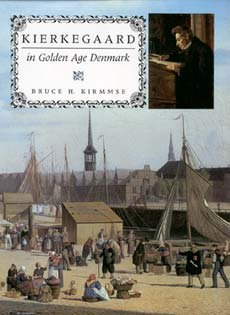
| 25. Kierkegaard in Golden Age Denmark (Indiana Series in the Philosophy of Religion) by Bruce H. Kirmmse | |
 | Hardcover: 576
Pages
(1990-08-01)
list price: US$41.95 -- used & new: US$37.75 (price subject to change: see help) Asin: 0253330440 Average Customer Review: 
Canada | United Kingdom | Germany | France | Japan |
|
Editorial Review Product Description "... the most important contribution to Kierkegaard studies to be published in English in recent years.... Not only is it a fascinating, surprising, and perceptive study of Kierkegaard within his time and world, Kirmmse has produced a research resource, a reference work, that is simply without parallel or equal." -- Michael Plekon "It is a rare work of philosophy that not only clarifies its subject but also places it within an intellectual and historical context. In his study of 19th-century Danish philosopher Kierkegaard, Kirmmse accomplishes both, setting a standard... " -- Library Journal "... an outstanding contribution to Kierkegaard research... The book is intellectual history of the highest calibre." -- So[slash]ren Kierkegaard Newsletter "This excellent book is recommended for all collections on Kierkegaard... For all readers." -- Choice "This richly researched and readable book supplies an important contribution to the widespread reappropriation of Kierkegaard's thought currently taking place." -- Theology Today "This book is a tour de force in intellectual history." -- Review of Metaphysics "Kirmmse's book is a major work of scholarship that confers on Kierkegaard's social and intellectual universe a depth and a richness of detail that will permanently alter the familiar stereotypes about Kierkegaard's isolation from his fellow Danes and his supposedly fanatical campaign against philistine Denmark and its corrupt state church." -- American Historical Review Against the background of Denmark's evolution from a mercantile economy to a broad-based agricultural economy, Kirmmse reinterprets Kierkegaard's thought as a reaction to the tensions within his society. Customer Reviews (1)
| |
| 26. The Sickness Unto Death: A Christian Psychological Exposition For Upbuilding And Awakening (Kierkegaard's Writings, Vol 19) (v. 19) by Soren Kierkegaard | |
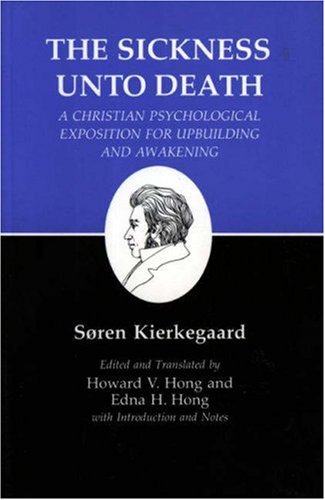 | Paperback: 201
Pages
(1983-11-01)
list price: US$19.95 -- used & new: US$11.94 (price subject to change: see help) Asin: 0691020280 Average Customer Review:
Canada | United Kingdom | Germany | France | Japan |
Customer Reviews (18)
| |
| 27. The Crowd Is Untruth by Soren Kierkegaard | |
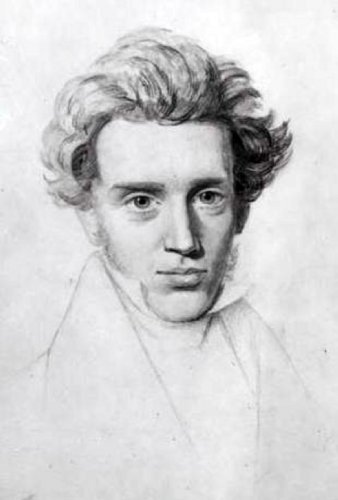 | Kindle Edition:
Pages
(2009-12-08)
list price: US$0.99 Asin: B0030BF0YM Canada | United Kingdom | Germany | France | Japan |
|
Editorial Review Product Description | |
| 28. A Literary Review (Penguin Classics) by Soren Kierkegaard | |
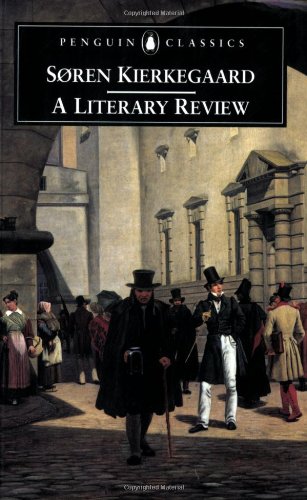 | Paperback: 160
Pages
(2002-03-26)
list price: US$15.00 -- used & new: US$7.99 (price subject to change: see help) Asin: 0140448012 Average Customer Review:
Canada | United Kingdom | Germany | France | Japan |
|
Editorial Review Product Description Customer Reviews (2)
| |
| 29. The Present Age by Soren Kierkegaard | |
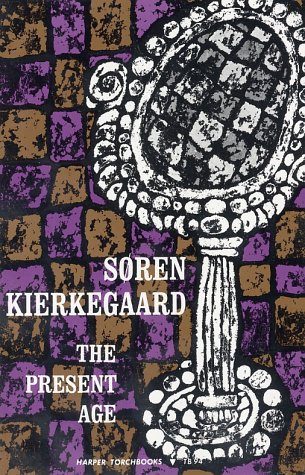 | Paperback: 112
Pages
(1962-10-12)
list price: US$12.00 -- used & new: US$4.31 (price subject to change: see help) Asin: 0061300942 Average Customer Review:
Canada | United Kingdom | Germany | France | Japan |
|
Editorial Review Product Description "Nor does he merely challenge our existence; he also questions some ideas that had become well entrenched in his time and that are even more characteristic of the present age. Kierkegaard insists, for example, that Christianity was from the start essentially authoritarian--not just that the Catholic Church was, or that Calvin was, or Luther, or, regrettably, most of the Christian churches, but that Christ was--and is. Indeed, though Kierkegaard was, and wished to be, an individual, and even said that on his tombstone he would like no other epitaph than 'That Individual,' his protest against his age was centered in his lament over the loss of authority." --Walter Kaufman, in the Introduction Customer Reviews (4) On Nihilism and relativism, Kierkegaard writes: "A passionate tumultuous age will overthrow everything, pull everything down; but a revolutionary age, that is at the same time reflective and passionless, transforms that expression of strength into a feat of dialectics; it leaves everything standing but cunningly empties it of significance. Instead of culminating in a rebellion it reduces the inward reality of all relationships to a reflective tension which leaves everything standing but makes the whole of life ambiguous; so that everything continues to exist factually whilst by a dialectical deceit, privatissime, it supplies a secret interpretation - that it does not exist: p. 42 On individualism and public opinion, Kierkegaard writes: "The abstract principle of leveling . . has no personal relation to any individual but has only an abstract relationship which is the same for every one. There, no hero suffers for others, or helps them; the taskmaster of all alike is the leveling and himself becomes greatest does not become an outstanding man or a hero - that would only impede the leveling process, which is rigidly consistent to the end - he himself prevents that from happening because he has understood the meaning of leveling; he becomes a man and nothing else, in the complete equalitarian sense. That is the idea of religion. But, under those conditions, the equalitarian order is sever and the profit is seemingly very small; seemingly, for unless the individual learns in the reality of religion and before God to be content with himself, and learns, instead of dominating others, to dominate himself, content as priest to be his own audience, and as author his own reader, if he will not learn to be satisfied with that as the highest, because it is the expression of the equality of all men before God and of our likeness to others, then he will not escape from reflection. " p.57 "The public is a concept which could not have occurred in antiquity because the people en masse, in corpore, took part in any situation which arose, and were responsible for the actions of the individual, and, moreover, the individual was personally present and had to submit at once to applause or disapproval for his decision. Only when the sense of association in society is no longer strong enough to give life to concrete realties is the Press able to create that abstraction 'the public', consisting of unreal individuals who never are and never can be united in an actual situation or organization - and yet are held together as a whole." p. 60 "The man who has no opinion of an event at the actual moment accepts the opinion of the majority, or, if he is quarrelsome, of the minority. But it must be remembered that the majority and minority are real people, and that is why the individual is assisted by adhering to them. A public, on the contrary, is an abstraction. To adopt the opinion of this or that man means that one knows that they will be subjected to the same dangers as oneself, that they will be led astray with one if the opinion leads astray. But to adopt the same opinion as the public is a deceptive consolation because the public is only there in abstracto. p.61
This book provides a good, short intro to Kierkegaard, and the humor keeps this moving without masking the personal challenges.
| |
| 30. Practice in Christianity : Kierkegaard's Writings, Vol 20 by Soren Kierkegaard | |
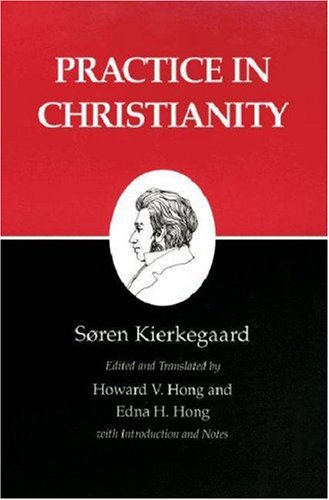 | Paperback: 452
Pages
(1991-10-23)
list price: US$29.95 -- used & new: US$16.96 (price subject to change: see help) Asin: 0691020639 Average Customer Review:
Canada | United Kingdom | Germany | France | Japan |
|
Editorial Review Product Description Customer Reviews (5)
If these concepts sound interesting to you, I highly recommend this volume.Die hard atheists will probably view this book as a fruitless discussion over a moot point.But people who consider themselvesChristian, and want to set themselves apart from other lackadaisical, so-called Christians, could benefit greatly by reading this book.This is not a book for people who show up to church just to show up and then fall asleep in the pew - it is for people who want to reach a higher standard of rigorous practice in religion.
| |
| 31. For Self-Examination/Judge for Yourselves : Kierkegaard's Writings, Vol 21 by Soren Kierkegaard | |
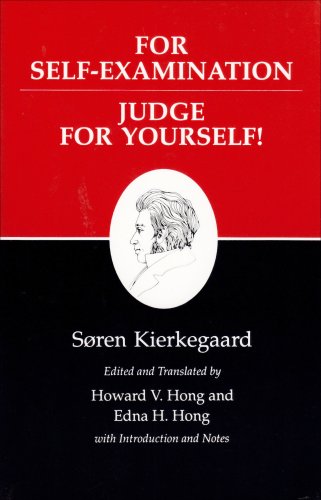 | Paperback: 320
Pages
(1991-05-06)
list price: US$28.95 -- used & new: US$18.13 (price subject to change: see help) Asin: 0691020663 Average Customer Review:
Canada | United Kingdom | Germany | France | Japan |
|
Editorial Review Product Description For Self-Examination and its companion piece Judge for Yourself! are the culmination of Søren Kierkegaard's "second authorship," which followed his Concluding Unscientific Postscript. Among the simplest and most readily comprehended of Kierkegaard's books, the two works are part of the signed direct communications, as distinguished from his earlier pseudonymous writings. The lucidity and pithiness, and the earnestness and power, of For Self-Examination and Judge for Yourself! are enhanced when, as Kierkegaard requested, they are read aloud. They contain the well-known passages on Socrates' defense speech, how to read, the lover's letter, the royal coachman and the carriage team, and the painter's relation to his painting. The aim of awakening and inward deepening is signaled by the opening section on Socrates in For Self-Examination and is pursued in the context of the relations of Christian ideality, grace, and response. The secondary aim, a critique of the established order, links the works to the final polemical writings that appear later after a four-year period of silence. Customer Reviews (2)
| |
| 32. On Soren Kierkegaard (Transcending Boundaries in Philosophy and Theology) by Edward F. Mooney | |
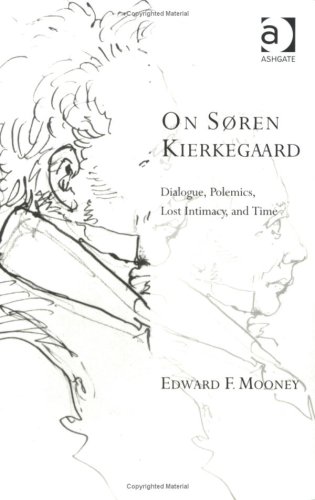 | Paperback: 276
Pages
(2007-07-31)
list price: US$29.95 -- used & new: US$22.96 (price subject to change: see help) Asin: 0754658228 Canada | United Kingdom | Germany | France | Japan |
|
Editorial Review Product Description | |
| 33. Kierkegaard's Writings, X: Three Discourses on Imagined Occasions by Soren Kierkegaard | |
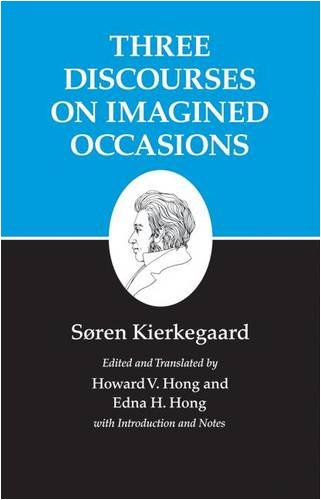 | Paperback: 198
Pages
(2009-10-05)
list price: US$24.95 -- used & new: US$17.50 (price subject to change: see help) Asin: 069114074X Average Customer Review:
Canada | United Kingdom | Germany | France | Japan |
|
Editorial Review Product Description Customer Reviews (1)
| |
| 34. Kierkegaard's Writings, XVIII: Without Authority by Soren Kierkegaard | |
 | Paperback: 340
Pages
(2009-10-05)
list price: US$35.00 -- used & new: US$23.50 (price subject to change: see help) Asin: 0691140790 Canada | United Kingdom | Germany | France | Japan |
|
Editorial Review Product Description | |
| 35. Parables of Kierkegaard (Kierkegaard's Writings) by Soren Kierkegaard | |
 | Paperback: 216
Pages
(1989-09-01)
list price: US$18.95 -- used & new: US$2.98 (price subject to change: see help) Asin: 0691020531 Average Customer Review:
Canada | United Kingdom | Germany | France | Japan |
Customer Reviews (10)
I liked this book and still do.:) Very accessible, and interesting even The other parable mentioned in another review "A Possibility" is widely regarded The introduction well describes the purpose and intent Many short parable presented that are witty or amusing. A few longer ones such as "A Possibility." Not definitive as a representative of his thought or writing Enjoyable light(er) reading than trying to delve Soren Kierkegaard's authorship has always In some ways his authorship could be summed up His sharp and keenly critising mind was often His ideas are anathema, heretical, undermining He (Kierkegaard) basically tells us that That most want to be in that category and be taken Christianity is demanding and harsh, people go to It was more important to put on that face then. He was saying there are very few real and true Christains. Something people do not want to hear. Kierkegaard by and large is not for everyone, Lawrence Connor
If you are familiar with Kierkegaard, you know what a brilliant reference tome this will be. If you are not, this is a great way to begin your examination of a man who was justifiably the Danish Dalai Lhama. His spirituality is immersed in being present in the moment, and would lay the foundation for all existentialist (i.e., Buddhist thinkers in Western trappings) thought in the 20th Century from Husserl and Sartre to Heidegger and Neil Young.
| |
| 36. Philosophical Fragments/Johannes Climacus : Kierkegaard's Writings, Vol 7 by Soren Kierkegaard | |
 | Paperback: 400
Pages
(1985-11-01)
list price: US$29.95 -- used & new: US$20.00 (price subject to change: see help) Asin: 0691020361 Average Customer Review:
Canada | United Kingdom | Germany | France | Japan |
Customer Reviews (5)
The title is badly translated in all English editions, being a Biblical reference, to the story of the rich man Dives and Lazarus.Just as the poor man Lazarus had to be content with the crumbs from the rich man's table, so Johannes Climacus, who passionately denies that he has any contributions whatsoever to make to the grand Hegelian System, claims to be content with mere philosophical crumbs.For some reason, no publisher or translator has been willing to employ the more accurate if less palatable PHILOSOPHICAL CRUMBS. Johannes Climacus presents the heart of the conflict between Hegel and Christianity in the first chapter.In Hegelian thought, Jesus in essence is viewed as the non-unique Son of God, and sees him as important for his teachings and the example for others for a transition to all people potentially becoming children of God.The emphasis is on the teachings, and the "truth" of Jesus can be construed as that which he taught.Kierkegaard thinks this is profoundly mistaken, and tries to get at the problem by a thought project that opens the book.Kierkegaard contrasts two kinds of teacher.One is the kind of teacher found in Socrates, where he is able to assist others in learning things because they already had the capacity to learn them.In the case of the Socratic teacher, the individual instructor is not essential to learning the truth.But Kierkegaard asks us to consider a second kind of teacher, one who not merely teaches us the truth, but provides the conditions for making such learning possible.This second kind of teacher is essential to someone learning the Truth, and it is this kind of teacher that Kierkegaard sees as representing Christ.The problem, as Kierkegaard understands it, is that we are separated from God by sin, and therefore we are in a position of needing to be restored to a relationship with God before coming to know God.Jesus is therefore not an accidental teacher of truths of a divine nature, but himself the essential foundation for anyone wanting to come to know God.In other words, for Kierkegaard, Christianity is an event and not a set of teachings: the incarnation of God in Christ as opposed to the things he wanted to teach us. The remainder of the book explicates this essential distinction between the Christ of Christianity and the Jesus of Hegel.In particular, he deals with the question of the "disciple at second hand" versus the "contemporary disciple."This is essential to consider because while Hegel is thought to take history seriously, his Jesus becomes nonhistorical, while Kierkegaard is intent on emphasizing his historicity. This is essential Kierkegaard, and along with the CONCLUDING UNSCIENTIFIC POSTSCRIPT and THE SICKNESS UNTO DEATH, my own favorites among his writings.One cannot understand Kierkegaard's thought without reading this book, and along with its sequel represents the heart of what he was trying to achieve in what he called his "Authorship."
| |
| 37. The Concept of Irony/Schelling Lecture Notes : Kierkegaard's Writings, Vol. 2 by Soren Kierkegaard | |
 | Paperback: 664
Pages
(1992-01-27)
list price: US$42.50 -- used & new: US$35.82 (price subject to change: see help) Asin: 0691020728 Average Customer Review:
Canada | United Kingdom | Germany | France | Japan |
|
Editorial Review Product Description The Concept of Irony and the Notes of Schelling's Berlin Lectures belong to the momentous year 1841, which included not only the completion of Kierkegaard's university work and his sojourn in Berlin, but also the end of his engagement to Regine Olsen and the initial writing of Either/Or. Customer Reviews (3)
2. On whether or not Irony is a mature work: the first part is not.The first part begins and ends with Hegel, with occasional allusions to what points he will hit in the second part.Want to skip the first part because it's long and doesn't seem to get to the point, or you don't know enough about Socrates?Forget the second part then, which won't make any sense at all without the working definition it takes until the discussion of Aristophanes to get to.And don't worry about not having a background on the Greeks.All you have to do is have a little working knowledge of the Apology of Plato, and know that Xenophon is a bit of a dimwit.Everything you wouldn't know and Kierkegaard doesn't tell you is said in the commentary, which is both repititious to those who know, and vexatious to those who don't, but is really helpful nonetheless. 3. The second part, especially in the discussion of Lucinde is a microcosm of the rest of Kierkegaard's philosophy.It just takes a little bit of a skewed lens (an ironic lens, if you will).Irony as infinite negativity? (which is probably an infuriating way of putting it since it really doesn't say anything about irony unless you understand the context provided by the discussion on Socrates in the first part... see why you can't just skip ahead?) alludes to concious despair, or at least if you're an ironist, and you see the emptiness of your position LEADS you to concious despair.The Ironic itself becomes sublimated somewhere between the aesthetic and the humorous, something unsustainable in it of itself, because after all, it is infinite negativity (once again,i refer you to the first part.It has something to do with Socrate's position that he was the wisest man in Athens because he knew nothing, and about the soul after death.See why Socrates is so necessary an ingredient now?). 4. The discussion on Lucinde in the second part is his descisive turn away from the Aesthetic and from Regine, not the Seducer's Diary as presented in EITHER/OR.In fact, EITHER/OR is his more direct explanation of his position that he first touched upon in Irony.Do you see the irony in that?He had to write a pseudonymonous work of an editor who finds a pile of papers in a desk in order to be more direct about a subject he indirectly touched upon in his dissertaition. 5. This is seminal Kierkegaard.This is the book that makes clear the infinite bottomless pit that Kierkegaard points you to in his later work is in fact, an infinite bottemless pit--WAAAUUGHHHH! 6. I hereby disclaim all my references to Kierkegaard.Especially this one.
1) It isKierkegaard's doctoral thesis and he bears a great load of hostilityagainst his professors. He works this out passive-aggressively, by writingin a near impenetrable style. They are testing him by making him defend athesis and he, in his turn, is testing them to see whether they can figureout exactly what thesis he is defending. He claims that Irony, the concepthe is explicating, is "infinite absolute negativity." Certainly his thesisis. The thesis is not just about Irony, it enacts Irony. The thesis showshim the master of Irony. 2) The thesis seems hostile to Socrates who,throughout his authorship he always speaks of with approval. This isbecause among the contemporary witnesses he chooses to credit Aristophanesabove Xenophon and Plato. Aristophanes' portrayal is indeed negative.Aristophanes is clearly hostile to Socrates. Socrates even blamesAristophanes at his trial for poisoning the peoples' minds against him. 3) He later repudiated the idea that Irony is "infinite absolutenegativity," claiming that at the time he was an "Hegelian fool."Kierkegaard claims he did not, in his thesis, appreciate certain positiveaspects of Socratic Irony, qualities that made Socrates a great ethicist.Certainly, he would never have believed Aristophanes except that heconfirms Hegel's view of Socrates. 4) This book does not belong with theother books of his authorship (starting with Either/Or). While it isbrilliantly shrewd, it does not carry out Kierkegaard's program. While itillustrates a mastery of technique, it is not a mature work in the sensethat it lacks the his characteristic questions and concerns. This is thesource of a negativity absent from his later works. If you want to reada classic on the subject, read this book. An acquaintance with Xenophon,Plato and Aristophanes is vital. Moreover, patience with Kierkegaard'sinfuriating style is also a must. ... Read more | |
| 38. Concluding Unscientific Postscript 1 : Kierkegaard's Writings, Vol 12.1 by Soren Kierkegaard | |
 | Paperback: 650
Pages
(1992-04-15)
list price: US$35.00 -- used & new: US$21.50 (price subject to change: see help) Asin: 0691020817 Average Customer Review:
Canada | United Kingdom | Germany | France | Japan |
|
Editorial Review Product Description Customer Reviews (7)
After Hegel's reduction of the individual to a cog in the grumbling historical machine, it is refreshing to read of the individual and the individuals concerns. As mentioned, Climacus ridicules objectivity and focuses the reader in on subjective truth, encouraging us to be authentic and take responsiblity for life. Christian or non-Christian alike, this book will challange the reader in many ways. It was a major influence on existentialist and Continental thought for a good reason. Unconditionally recommended. ... Read more | |
| 39. Kierkegaard's Writings, XXII: The Point of View by Soren Kierkegaard | |
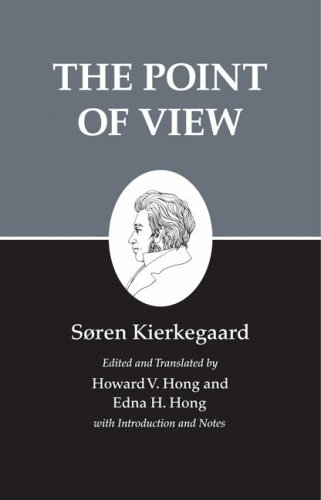 | Paperback: 382
Pages
(2009-07-06)
list price: US$35.00 -- used & new: US$27.29 (price subject to change: see help) Asin: 0691140804 Canada | United Kingdom | Germany | France | Japan |
|
Editorial Review Product Description | |
| 40. Either/Or, Part II (Kierkegaard's Writings, Vol. 4) by Soren Kierkegaard | |
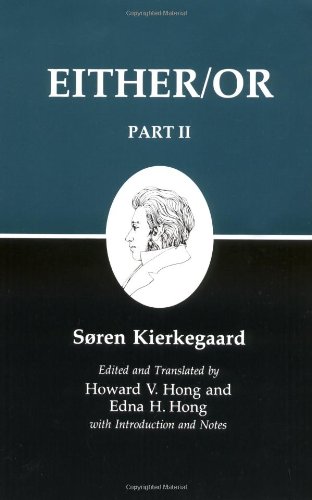 | Paperback: 529
Pages
(1988-01-01)
list price: US$29.95 -- used & new: US$14.56 (price subject to change: see help) Asin: 0691020426 Average Customer Review:
Canada | United Kingdom | Germany | France | Japan |
Customer Reviews (2)
| |
| Back | 21-40 of 99 | Next 20 |
 EXCERPTS FROM KIERKEGAARD'S JOURNALS AND PAPERS
 Slow
Slow