e99 Online Shopping Mall

Geometry.Net - the online learning center Help  
Home  - Philosophers - Kristeva Julia (Books)

  1-20 of 100 | Next 20
A  B  C  D  E  F  G  H  I  J  K  L  M  N  O  P  Q  R  S  T  U  V  W  X  Y  Z  

click price to see details     click image to enlarge     click link to go to the store

$22.36
1. Julia Kristeva: Speaking The Unspeakable
$20.00
2. Desire in Language: A Semiotic
$25.85
3. Powers of Horror: An Essay on
4. A Kristeva Reader
$25.94
5. Julia Kristeva: Psychoanalysis
$20.93
6. Black Sun
$57.75
7. Por Que Recordar?
$9.30
8. El Porvenir De LA Revuelta (Seccion
$23.77
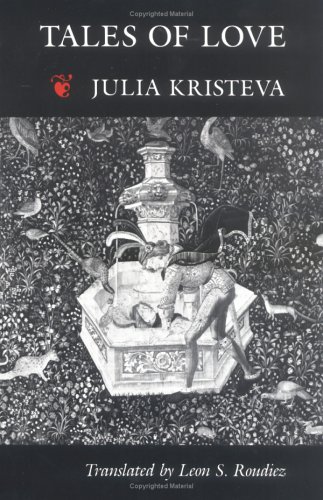
9. Tales of Love (European Perspectives)
$27.48
10. Julia Kristeva and Literary Theory
$30.50
11. Nations Without Nationalism
$22.95
12. Time and Sense
$18.28
13. Julia Kristeva (Routledge Critical
$18.54
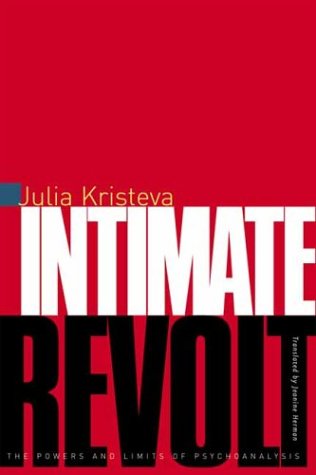
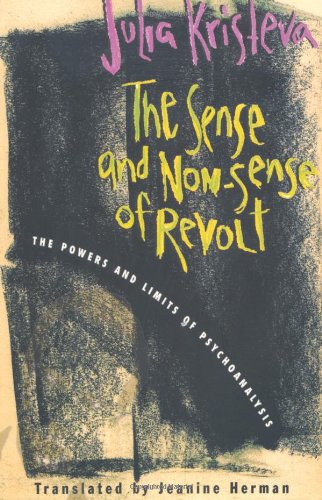
14. Intimate Revolt: The Powers and
$17.00
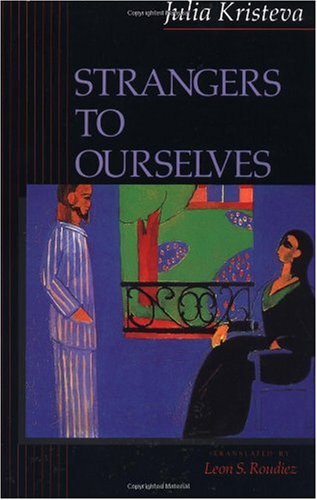
15. Strangers to Ourselves
$6.65
16. Hannah Arendt
$14.95
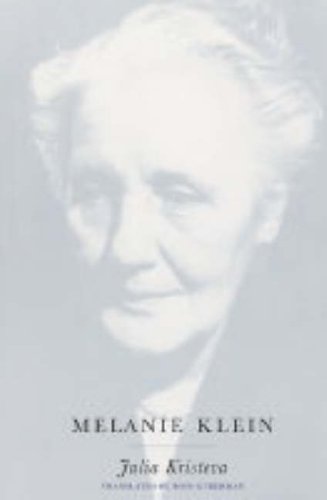
17. Melanie Klein (European Perspectives:
 
$11.95
18. New Maladies of the Soul
$13.25
19. Colette (European Perspectives:
$19.99
20. The Portable Kristeva

1. Julia Kristeva: Speaking The Unspeakable (Modern European Thinkers)
by Anne-Marie Smith
Paperback: 120 Pages (1998-08-01)
list price: US$22.95 -- used & new: US$22.36
(price subject to change: see help)
Asin: 0745310575
Canada | United Kingdom | Germany | France | Japan

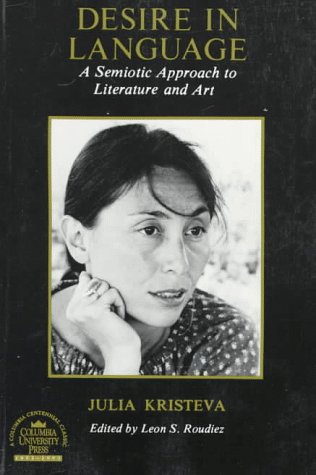
2. Desire in Language: A Semiotic Approach to Literature and Art
by Julia Kristeva
Paperback: 305 Pages (1980-04-15)
list price: US$29.50 -- used & new: US$20.00
(price subject to change: see help)
Asin: 0231048076
Average Customer Review: 4.0 out of 5 stars
Canada | United Kingdom | Germany | France | Japan
Editorial Review

Book Description

--Contemporary Literature


Desire in Language traces the path of an investigation, extending over a period of ten years, into the semiotics of literature and the arts. But the essays of Julia Kristeva in this volume, though they often deal with literature and art, do not amount to either "literary criticism" or "art criticism." Their concern, writes Kristeva, "remains intratheoretical: they are based on art and literature in order to subvert the very theoretical, philosophical, or semiological apparatus."

Probing beyond the discoveries of Sigmund Freud, Jacques Lacan, Roman Jakobson and others, Julia Kristeva proposes and tests theories centered on the nature and development of the novel, and on what she has defined as a signifying practice in poetic language and pictural works.Desire in Language fully shows what Roman Jakobson has called Kristeva's "genuine gift of questioning generally adopted 'axioms,' and her contrary gift of releasing various 'damned questions' from their traditional question marks."

... Read more

Customer Reviews (1)

4-0 out of 5 stars Beyond Lacan and Freud: Language and Psychoanalysis
In this book Kristeva takes on the issues of language and psychoanalysis, expanding upon Lacan's views on desire and language. (Lacan said: All speech is demand, the demand for love). Kristeva is considered a genius in her field, and highly respected in France (where all this work goes on nowadays). Here she is presented in translation so that the English-reading world can enjoy her work.

The interest in such theories of language, semiotics, post-structuralism and psychoanalysis is slim in the English speaking world, and this is unfortunate. Not enough scholars of language look to Lacan and Kristeva, but they should. The text is difficult, and even more so in translation, but it is worth struggling through. However, for the reader with little background in the subject matter, penetrating Kristeva's work may be almost impossible without guidance.

This book is subtitled 'a semiotic approach to literature and art'. What Kristeva does is apply her theories to the area of aesthetics, especially her specialty area of the novel. Unfortunately, her studies are naturally based on the French novel (19th century), so readers unfamiliar with novellists such as Mallarme might have a problem following this aspect of her work. ... Read more


3. Powers of Horror: An Essay on Abjection (European Perspectives Series)
by Julia Kristeva
Paperback: 219 Pages (1982-04-15)
list price: US$30.00 -- used & new: US$25.85
(price subject to change: see help)
Asin: 0231053479
Average Customer Review: 5.0 out of 5 stars
Canada | United Kingdom | Germany | France | Japan
Editorial Review

Book Description

-- Paul de Man

... Read more

Customer Reviews (3)

5-0 out of 5 stars Are You Subject to Abjection?
Excellent resource for the Lacanian scholar, if you are looking specifically at abjection.If you are looking at Subjectivity theory overall, however, this is too specific.Luckily, my focus is abjection, and this book really did wonders for the article I'm working on!

5-0 out of 5 stars Difficult but worthwhile, ohmy!
Don't be abjected even further than you already are, read this book and allow Kristeva's language to take you on a hallucinatory journey to the limits of symbolization. The act of reading this book can be, at times, an excersize in facing/coping with abjection. If you're patient, go slow, and finally understand thirty percent of this book, you'll be leagues ahead of most intellectuals out there.

5-0 out of 5 stars Uncanny...astonishing...
Kristeva rules... To everyone who has some interest in the ABJECT matter, here's the Bible! Uncanny... ... Read more


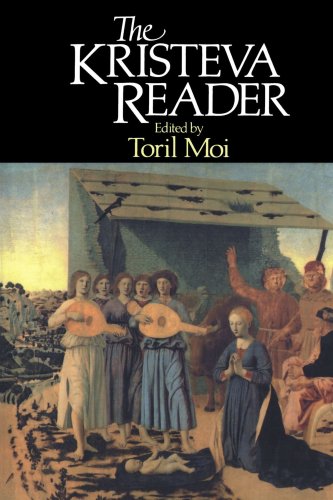
4. A Kristeva Reader
by Julia Kristeva
Hardcover: 327 Pages (1986-11)
list price: US$94.00
Isbn: 0231063245
Average Customer Review: 4.5 out of 5 stars
Canada | United Kingdom | Germany | France | Japan
Editorial Review

Book Description

-- Elaine Showalter

... Read more

Customer Reviews (3)

5-0 out of 5 stars Changed my life
This is one of my most cherished volumes of critical theory. Any self-respecting lit student should own this tome, and read it carefully. Many useful pieces for different scenarios.

5-0 out of 5 stars A deep look into language, religion and...
...abjection (If you also read 'Powers of Horror' by Kristeva) Quitecomprehensive altough it would be hard to make a choice in the work ofKristeva. Kristeva's work focuses heavily on semiotics and women's role inpolitics and religion. Many of the theories will stir the soul, especially'Stabat Mater' if you grew up forced into any european or western dogma.'Women's Time' is a good possible evaluation of women and politics. Freudgets thrown into this in a very different manner than one expects, whichleaves us to wonder, is Kristeva supporting the old 'Dr.' or not?

4-0 out of 5 stars Celebrating Language and Thought
The Kristeva Reader is a good, even great, introduction to the work of Julia Kristeva.Some of Kristeva's most important works are brilliantly exerpted in readable prose by Toril Moi.Lovers of linguistics, rhetoric,literary theory, and psychology will find Kristeva's work compelling.Oneinteresting aspect of the text is that it offers the reader a glimpse intothe creative process.In an early essay, "Word, Dialogue, andNovel," Kristeva responds to the theory of Mikhail Bakhtin.Her lateressay, "Revolution in Poetic Language," shows the evolution ofKristeva's language theory.Unfortunately, in order to make Kristevaaccessible, Moi had to make some difficult choices in her editing.Aserious scholar will undoubtedly find herself looking for the completeessays in another text. ... Read more


5. Julia Kristeva: Psychoanalysis and Modernity (Suny Series in Gender Theory)
by Sara Beardsworth
Paperback: 309 Pages (2004-09-09)
list price: US$29.95 -- used & new: US$25.94
(price subject to change: see help)
Asin: 0791461904
Canada | United Kingdom | Germany | France | Japan

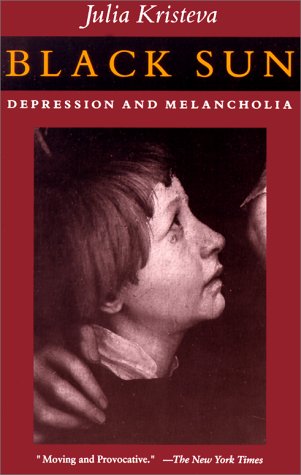
6. Black Sun
by Julia Kristeva
Paperback: 300 Pages (1992-10-15)
list price: US$27.00 -- used & new: US$20.93
(price subject to change: see help)
Asin: 0231067070
Average Customer Review: 4.5 out of 5 stars
Canada | United Kingdom | Germany | France | Japan
Editorial Review

Book Description

InBlack Sun, Julia Kristeva addresses the subject of melancholia, examining this phenomenon in the context of art, literature, philosophy, the history of religion and culture, as well as psychoanalysis. She describes the depressive as one who perceives the sense of self as a crucial pursuit and a nearly unattainable goal and explains how the love of a lost identity of attachment lies at the very core of depression's dark heart.

In her discussion she analyzes Holbein's controversial 1522 painting "The Body of the Dead Christ in the Tomb," and has revealing comments on the works of Marguerite Duras, Dostoyevsky and Nerval.Black Sun takes the view that depression is a discourse with a language to be learned, rather than strictly a pathology to be treated.

... Read more

Customer Reviews (3)

4-0 out of 5 stars Billy Us
Kristeva's is definitely worth a read. While staking a claim for the salubrious effects of psychoanalysis, the author freshly details art's engagement with melancholy and depression. The first chapter or two will make rough going for the reader who is not amused by the lexicon of psychoanalysis. But even readers with a literary intolerance of that sort will find the third chapter on feminine depression sensitively written and thoughtfully invested with human presence. The chapters on art and artists with melancholia make generally excellent reading. The most brief of the chapters, "Beauty: The Depressive Other's Realm," provides a soaring inauguration of the author's poetic and psychoanalytic approaches to the madness and melancholia among Durer, Nerval, Dostoevsky, and Duras. The chapter on Duras might not bear a discussion of an author familiar to American readers but it is worth reading because it alone of the chapters explicity raises questions concerning politics, expectations, madness and depression. The author investigates the sites she has chosen with great sensitivity and radiant intellect. Scattered clouds will be apparent to those who find psychoanalysis an unsatisfying or capricious methodology of investigation.

5-0 out of 5 stars A different approach to depression. A "must read."
This is a different approach to depression.Too often, our focus has been on the DSM-IV approach, or to the treatment of depression using selective seratonin reuptake inhibitors such as Prozac and Paxil.Very rarely does somebody, let alone a respected psychoanalyst, attempt to explain what it actually *feels* like to experience major depression.This is a writing that gives meaning to depression, and I feel that it helps people and their families understand the experience of depression.

The process of all modalities of psychotherapy involves communication, a dialogue between the therapist and the client. This process draws the client out and is an essential factor in the care of the client. Kristeva emphasizes the "antidepressant qualities of psychoanalysis."While acknowledging the utility of antidepressants in psychotherapy, the function of the linguistic component seeks to emphasize the meaning of the "inconsolable loss" experienced by the depressed patient.To symbolically illustrate the sensation of depression, Kristeva uses great sensativity in drawing on the poetry of Gerard de Nerval, the novels of Doestoyevsky, and Hans Holbein's picture "Dead Christ."

"Dark Sun" had meaning to me because of its emphasis on the *individual* and how he or she feels. We must always emphasize the dignity of the individual in dealing with the depressed.

5-0 out of 5 stars An energetic and exhaustive study of the blues.
In much the same way that Philippe Aries took the subject of childhood and illuminated it for all time in "Centuries of Childhood," fellow French writer (although Bulgarian-born) and Lacanian psychoanalyst Julia Kristeva examines depression and melancholia. She comes at it from various angles and filters: fine arts, literature, history, philosophy, religion, and of course psychology. She posits psychoanalysis as a (really THE) 'counterdepressant' -- convincingly. This is great highbrow stuff: chapters with titles like"Beauty, the Depressive's Other Realm," and "Life and Death of Speech." Death, suicide, the inevitable gloom resulting from loss of maternal, later erotic,love; all are insightfully discussed -- even rather tenderly. If you're depressed BLACK SUN won't make you more so -- and if you're feeling okay to begin with, it's a terrific scholarly study. ... Read more


7. Por Que Recordar?
by Julia Kristeva, Paul Ricoeur, Elie Wiesel
Paperback: Pages (2003-10)
list price: US$30.05 -- used & new: US$57.75
(price subject to change: see help)
Asin: 8475779093
Canada | United Kingdom | Germany | France | Japan

8. El Porvenir De LA Revuelta (Seccion Obras de Filosofia)
by Julia Kristeva, Martin Dupaus
Paperback: 108 Pages (1999-01)
list price: US$13.00 -- used & new: US$9.30
(price subject to change: see help)
Asin: 9505573332
Canada | United Kingdom | Germany | France | Japan

9. Tales of Love (European Perspectives)
by Julia Kristeva
Paperback: 414 Pages (1987-04-15)
list price: US$31.00 -- used & new: US$23.77
(price subject to change: see help)
Asin: 0231060254
Average Customer Review: 4.5 out of 5 stars
Canada | United Kingdom | Germany | France | Japan
Editorial Review

Book Description

--Choice

... Read more

Customer Reviews (2)

4-0 out of 5 stars very sweet
I read this book from start to finish and just couldn't get enough of it. A friend of mine in college gave it to me even though i'm not really an avid reader like she is. It kept me up many a night. So check it out. Also check out this other book she gave me called "Tales of love, ugliness and stars under the sea." Also very awesome. It's more poetic stuff, but i found it equally moving.

5-0 out of 5 stars An Interesting Love Theory
This book picks up Western love as main theme and analyzes its both diachronic and synchronic aspects. In the first part, Kristeva shows her theory of love as the theory of psychoanalysis. It is very interesting herethat her attention is concentrated on transference in psychoanalysis. Then,with this theory of love, we can read histories of Western love from Plato,the Bible, Narcissus, to St. Thomas and heroes and heroines in love storiessuch as Don Juan, Romeo and Juliet, and Mary. These histories and storiesare in harmony with the next part in which Kristeva analyzes discourses oflove in texts of Troubadour, Jeanne Guyon, Baudelaire, Stendhale, andBataille. Reading here, we can learn what Western love has ever been, whichenables us to think about modern love. Finally, Kristeva mentions to thecrisis of love, which emerges now because of the abolition of psychic spaceand discusses psychoanalytic role, especially, transferencefs one. Kristeva shows various aspects of Western love as a mosaicof histories, stories, and texts, which are connected logically each otherby psychoanalysis and the theory of love. Therefore, this book has a veryclear composition. This is why I like this book. Another reason is that Iam interested in Kristevafs idea which differentiates Western love fromJapanese one. I think that she also shows how to approach Japanese lovewhich has been thought to be changed dynamically these years, not onlyWestern one. ... Read more


10. Julia Kristeva and Literary Theory (Transitions)
by Megan Becker-Leckrone
Paperback: 224 Pages (2005-03-02)
list price: US$29.95 -- used & new: US$27.48
(price subject to change: see help)
Asin: 0333781945
Average Customer Review: 5.0 out of 5 stars
Canada | United Kingdom | Germany | France | Japan
Editorial Review

Book Description
Julia Kristeva has sparked considerable debate among feminist, political and psychoanalytic thinkers, securing her status as one of the most formidable figures in twentieth-century critical theory. However, her precise relevance to the study of literature can be hard for new readers to fathom. This volume explores Kristeva's definitions of literature, her methods for analyzing it, and the theoretical ground on which those endeavors are based. ... Read more

Customer Reviews (2)

5-0 out of 5 stars Wow!
Who would have thought that the girl from high school that used to fall asleep in Social Studies (Mr. Ahrens class) and sneezes 10 times in five seconds is now this big English Professor? Cool!Enjoy this thoughtful look at literature and society.

5-0 out of 5 stars excellent reading of a difficult thinker
This book is a superb introduction: it is clear, fair, informed, and judicious. Becker-Leckrone neither panders nor evades, and such equanimity is rare in literary theory, especially when dealing with and digesting a figure as complicated and, yes, outright obscure as Kristeva. BL's analyses are thoughtful and diligent. A triumph of delicate taste and careful reading. Anyone remotely interested in contemporary theory MUST buy this book. ... Read more


11. Nations Without Nationalism
by Julia Kristeva
Hardcover: 108 Pages (1993-04-15)
list price: US$30.50 -- used & new: US$30.50
(price subject to change: see help)
Asin: 0231081049
Canada | United Kingdom | Germany | France | Japan
Editorial Review

Book Description

--Times Literary Supplement

... Read more

12. Time and Sense
by Julia Kristeva
Paperback: 432 Pages (1998-10-15)
list price: US$27.50 -- used & new: US$22.95
(price subject to change: see help)
Asin: 0231102518
Canada | United Kingdom | Germany | France | Japan
Editorial Review

Book Description

Not only a meditation on Proust, this is a commentary on how the experience of literature is manifested in time and sensation. Kristeva uses Proust as a starting point to reflect upon broader notions of character, time, sensation, metaphor, and history.

... Read more

13. Julia Kristeva (Routledge Critical Thinkers)
by Noelle Mcafee
Paperback: 200 Pages (2003-12-09)
list price: US$21.95 -- used & new: US$18.28
(price subject to change: see help)
Asin: 0415250099
Average Customer Review: 5.0 out of 5 stars
Canada | United Kingdom | Germany | France | Japan
Editorial Review

Book Description
One of the most original thinkers of the twentieth century, Julia Kristeva has been driving forward the fields of literary and cultural studies since the 1960s. This volume is an accessible, introductory guide to the main themes of Kristeva's work, including her ideas on:
*semiotics and symbolism
*abjection
*melancholia
*feminism
*revolt.
McAfee provides clear explanations of the more difficult aspects of Kristeva's theories, helpfully placing her ideas in the relevant theoretical context, be it literary theory, psychoanalysis, linguistics, gender studies or philosophy, and demonstrates the impact of her critical interventions in these areas.
Julia Kristeva is the essential guide for readers who are approaching the work of this challenging thinker for the first time, and provides the ideal opportunity for those with more knowledge to re-familiarize themselves with Kristeva's key terms. ... Read more

Customer Reviews (1)

5-0 out of 5 stars Extremely Helpful
The book gives an overview of Kristeva's theory. It surely has helped me to understand better the language used by Kristeva. It also includes other references given by other theorists such as Lacan. This guide does not subsistitute reading the original material published by Kristeva but it traces a guide-line for those who are not acquainted with Kristeva's theories. After reading this guide, some points that were still blurry for me on Kristeva's theory are now a lot clearer. I recommend it! ... Read more


14. Intimate Revolt: The Powers and Limits of Psychoanalysis (European Perspectives: A Series in Social Thought and Cultural Criticism)
by Julia Kristeva
Paperback: 92 Pages (2003-08-06)
list price: US$23.00 -- used & new: US$18.54
(price subject to change: see help)
Asin: 023111415X
Average Customer Review: 4.0 out of 5 stars
Canada | United Kingdom | Germany | France | Japan
Editorial Review

Book Description

Julia Kristeva, herself a product of the famous May '68 Paris student uprising, has long been fascinated by the concept of rebellion and revolution. Psychoanalysts believe that rebellion guarantees our independence and creative capacities, but is revolution still possible? Confronted with the culture of entertainment, can we build and nurture a culture of revolt, in the etymological and Proustian sense of the word: an unveiling, a return, a displacement, a reconstruction of the past, of memory, of meaning? In the first part of the book, Kristeva examines the manner in which three of the most unsettling modern writers -- Aragon, Sartre, and Barthes -- affirm their personal rebellion.

In the second part of the book, Kristeva ponders the future of rebellion. She maintains that the "new world order" is not favorable to revolt. "What can we revolt against if power is vacant and values corrupt?" she asks. Not only is political revolt mired in compromise among parties whose differences are less and less obvious, but an essential component of European culture -- a culture of doubt and criticism -- is losing its moral and aesthetic impact.

... Read more

Customer Reviews (1)

4-0 out of 5 stars Intellectual exile therapy: reading
I have read several books by Julia Kristeva, but I have difficulty recalling the points that each signifies, so it was a relief to me, when I started this book, that it stated an outlook on modern society which I share wholeheartedly.For people who are growing older, reading seems to be an activity that offers fewer rewards than ever, and it becomes difficult to find any indication that authors have been gaining anything by being aware of philosophy, to pick a topic that has reached modernity with as little certainty as the physics of subatomic particles.The multiplicity of approaches and observations diminishes the opportunity for any point to be important in a system which only understands certain kinds of schemes:

" . . . European culture--a culture fashioned by doubt and critique--is losing its moral and aesthetic impact.This moral and aesthetic dimension finds itself marginalized and exists only as a decorative alibi tolerated by the society of the spectacle, when it is not simply submerged, made impossible by entertainment culture, performance culture, and show culture."(p. 4).

My review of Kristeva's book on Hannah Arendt attempted to demonstrate, by counting the footnotes in that book, how much it was merely providing a reading of the volumes of THE LIFE OF THE MIND on THINKING and WILLING.The notes for INTIMATE REVOLT show much wider interests, but this book is Volume 2 of THE POWERS AND LIMITS OF PSYCHOANALYSIS and continues reading as in the previous volume."I will explore new texts among the works of the three major authors examined in volume 1, Aragon, Sartre, and Barthes, each an integral part of the revolt of the twentieth century, and emphasize the paradoxical logic by which this experience of revolt is accomplished."(p. 3).

For those who are not concerned so much with reading, there is a chance to skip ahead to Part II, The Future of Revolt, which has its own Preface, Chapter 13, Psychoanalysis and Freedom; Chapter 14, The Love of Another Language; and Chapter 15, Europhilia-Europhobia.I had always pictured Julia Kristeva as an exclusively French feminist psychoanalyst, but Chapter 14 reveals that she is an exile whose native tongue was Bulgarian.If she could only adopt "the tradition of offhandedness--when not nationalism--toward any remedy for our century," she might actually seem French."I have so shifted into this other language, which I have spoken for fifty years, that I am almost ready to believe the Americans who see me as a French intellectual and writer."(p. 246).

So INTIMATE REVOLT turns into a book which is ultimately about issues of self, and Julia Kristeva becomes an example of someone who is trying to fit in as an intellectual because none of the other ultra modern cultures appeals to her sense of self.Revolt is a theme which ties philosophy to literature in a quest for new values that seeks to go further."The nihilist is not a man in revolt in the sense that I investigated in volume I.The pseudorebellious nihilist is in fact a man reconciled with the stability of new values.And this stability, which is illusory, is revealed to be deadly, totalitarian.I can never sufficiently emphasize the fact that totalitarianism is the result of a certain fixation of revolt in what is precisely its betrayal, namely, the suspension of retrospective return, which amounts to a suspension of thought.Hannah Arendt has brilliantly developed this elsewhere."(p. 6).

In addition to the authors previously mentioned, this book frequently delves into Christianity, Freud, and Heidegger.The intellectual method owes a lot to the subject matter:"In making a narrative out of free association in transference, the subject at once confronts what is . . ." in a way that "constitutes himself in himself for the other and in this sense reveals himself--in the strongest sense of the word, liberates himself."(p. 236).Analytical discourse approaches "the endless refraction that constitutes psychical splitting."(p. 236).

Kristeva has also written a novel, POSSESSIONS, a detective story, which she considers a low form of revolt that keeps the possibility of questioning alive.Combining "a police investigation is still possible" (p. 4) with her concern that "the arrival of women at the forefront of the social and ethical scene has had the result of revalorizing the sensory experience, the antidote to technical hair-splitting" (p. 5) she attempts to question the past in a way that produces freedom for us, as "In his reading of Kant, Heidegger reconnected with another version of freedom, anchored in pre-Socratic thought before the establishment of logical categories or values."(p. 236). ... Read more


15. Strangers to Ourselves
by Julia Kristeva
Paperback: 230 Pages (1994-08-15)
list price: US$26.00 -- used & new: US$17.00
(price subject to change: see help)
Asin: 0231071574
Average Customer Review: 3.0 out of 5 stars
Canada | United Kingdom | Germany | France | Japan
Editorial Review

Book Description

This book is concerned with the notion of the "stranger" -the foreigner, outsider, or alien in a country and society not their own- as well as the notion of strangeness within the self -a person's deep sense of being, as distinct from outside appearance and their conscious idea of self.

Kristeva begins with the personal and moves outward by examining world literature and philosophy. She discusses the foreigner in Greek tragedy, in the Bible, and in the literature of the Middle Ages, Renaissance, Enlightenment, and the twentieth century. She discusses the legal status of foreigners throughout history, gaining perspective on our own civilization. Her insights into the problems of nationality, particularly in France are more timely and relevant in an increasingly integrated and fractious world.

... Read more

Customer Reviews (1)

3-0 out of 5 stars A difficult read
The most interesting sections of this work are the earliest chapters; Kristeva seems to run out of steam and stop abruptly once she begins to discuss foreignness and strangeness in contemporary culture. The writing is also very abstract (perhaps more so because it is a translation); this particular book is probably only interesting to a student of literature who is critically concerned with the figure of the Stranger in fiction and legends.I don't recommend picking this book up simply out of curiousity. ... Read more


16. Hannah Arendt
by Julia Kristeva
Paperback: 320 Pages (2003-07-15)
list price: US$23.00 -- used & new: US$6.65
(price subject to change: see help)
Asin: 0231121032
Average Customer Review: 4.0 out of 5 stars
Canada | United Kingdom | Germany | France | Japan
Editorial Review

Amazon.com
Julia Kristeva's Hannah Arendt brings together two of the best minds in 20th-century philosophy; two who are especially noteworthy because they are visionary women in a field long dominated by men. Appropriately, the book is, in part, a tribute to Arendt, one of a series of looks at female genius. Kristeva brings her considerable scholarly arsenal, which includes linguistics, literary criticism, philosophy, feminism, aesthetics, cultural studies, and psychoanalysis. In particular, her psychoanalytic bent makes for an incisive look at Arendt because she was "gripped from the start by that unique passion in which life and thought are one.... [She] consistently put life--both life itself and life as a concept to be analyzed--at the center of her work."

Arendt is certainly one of the 20th century's brightest intellectual luminaries. Penning The Human Condition and Eichmann in Jerusalem, she wove her accounts of philosophy with a unique penchant for narrative and personal reflection, vivified by her extraordinary life. Throughout this biography, Kristeva plies Arendt's trade, using Arendt's life to illuminate her thought. By turns she examines Arendt's use of narrative, her ratiocinations on Jewish-ness and anti-Semitism, and her political philosophy. Kristeva's insightfulness in this volume will help ensure her a place in the canon alongside Arendt. --Eric de Place Book Description

Twenty-five years after her death, we are still coming to terms with the controversial figure of Hannah Arendt. Interlacing the life and work of this seminal twentieth-century philosopher, Julia Kristeva provides us with an elegant, sophisticated biography brimming with historical and philosophical insight.

Centering on the theme of female genius,Hannah Arendt emphasizes three features of the philosopher's work. First, by exploring Arendt's critique of Saint Augustine and her biographical essay on Rahel Varnhagen, Kristeva accentuates Arendt's commitment to recounting lives and narration. Second, Kristeva reflects on Arendt's perspective on

Judaism, anti-Semitism, and the "banality of evil." Finally, the biography assesses Arendt's intellectual journey, placing her enthusiasm for observing both social phenomena and political events in the context of her personal life.

Drawing on fragments of Arendt's most intimate correspondence with her longtime lover Martin Heidegger and her husband Heinrich Blucher, excerpts from her mother's "Unser Kind" (a diary tracking Hannah's formative years), and passages from Arendt's philosophical writings, Kristeva presents a luminous story. With a thorough thematic index and bibliographical references,Hannah Arendt is a major breakthrough in the understanding of an essential thinker.

... Read more

Customer Reviews (1)

4-0 out of 5 stars The intellectual overview of a political science genius
It has been a long time since I went to a baseball game, but trying to keep track of the intellectual action in the biography of Hannah Arendt by Julia Kristeva reminded me of the game.Eventually, I even thought of a song, "Catfish" by Bob Dylan (Words by Bob Dylan and Jacques Levy) recorded on July 28, 1975, an outtake from the album "Desire" that was finally released in a three-CD package called "The Bootleg Series Volumes 1-3 [rare and unreleased] 1961-1991."There was once a pitcher called Catfish Hunter, million dollar man, and Dylan's chorus said, "Nobody can throw the ball Like Catfish can."I have had the words since "The Songs of Bob Dylan" was released in 1976, but I didn't hear the song until 1991.Having an English translation from 2001 of a feminist biography of a political scientist of the mid-twentieth century captures the intellection activity that interests me about as well as "Catfish" captures the action of a baseball game.

Lazy stadium night, Catfish on the mound,
"Strike three" the umpire said,
Batter have to go back and sit down.

There are three chapters in HANNAH ARENDT, and the third has 219 notes.Basic statistics on how much Julia Kristeva is merely educating herself in public by providing a reading from Arendt's books might be obtained by counting the Ibid.s.Counting backwards, I found 133 Ibid.s in the notes for Chapter 3, including my favorite note:

"99."Letter to the Romans 7:21, drafted between 54 and 58 a.d., cited in ibid., p. 64."(p. 268).

A lot of the books I read lately keep trying to tell me when the Bible was written, but I never noticed it in a note before.Usually my favorite notes are about Nietzsche, like:

"123.Ibid., p. 165, citing Nietzsche, THE GAY SCIENCE, no. 310"

"126.Concerning the `forgetting' that Nietzsche revives see p. 237; and Paul Ricoeur, paper presented at the Hannah Arendt Conference at the Grande Bibliotheque de France, December 6, 1997."

"128.Ibid., pp. 169-70, citing Nietzsche, THE WILL TO POWER, no. 585 A, pp. 316-19."

`131.LM, "Willing," p. 172, citing Nietzsche, THUS SPOKE ZARATHUSTRA, pt. 3, "Before Sunrise." '

`187.Ibid., citing Nietzsche, "The Use and Abuse of History," pp. 6, 7.'

"189.Ibid., citing Nietzsche, THE GENEALOGY OF MORALS, p. 61"

`192.Ibid., pp. 63, 72-73 ("even in old Kant:the categorical imperative reeks of cruelty").'

Nietzsche wrote such things about Kant, and it is a bit difficult to imagine that Kristeva and Arendt would associate such ideas with the great weight of the past if Nietzsche hadn't made this connection first.Understanding philosophy is a process that can be compared to intellectually building a rehash of old, familiar plays, as if it is about something like a baseball game, which has an umpire who gets to decide when an easy pop fly is an infield fly rule call that makes the batter out, but the umpire does not have time to say anything until after it is all over when a triple play picks off the runners before they have a chance to tag up if the pitcher ducks under a line drive that gets caught right on second base before anyone has time to react, but a quick shortstop snagged the ball out of the air and flipped it to first in the only instant in which that could happen.Kristeva is capable of interpreting political science as an activity best understood in terms of the philosophy of Nietzsche:

"To the `identical will' that forges the solidarity of a group, Arendt contrasts the way men who are connected to one another through a mutual promise `act in concert.'These men dispose of the future as though it were the present, and they live together in the miraculous enlargement of what Nietzsche called the `memory of the Will,' which is what distinguishes human life from animal life.As Arendt evokes Nietzsche's concept, she hears only the joyful touches of the superman and denotes not a trace of Nietzsche's disdainful tone."(p. 236).

Still counting backward, I find 102 Ibid.s in the notes for Chapter 2 and only 52 Ibid.s in the notes for Chapter 1.The Introduction only had two notes, on a wide variety of topics, but both related to the nature of "genius."When political opinion surveys offer a few sample views to encompass the political orientation of the great mass of the population, only a genius could be expected to have a ready answer to questions like "Will mothers become our only safeguard against the wholesale automation of human beings?"(p. xiii).The Introduction actually seems more suited for a triple biography, as "The three women who are the subject of this work" on page xv includes two women who are hardly mentioned in the three main chapters of HANNAH ARENDT.It does not add much to understanding this book to also learn "that Melanie Klein devoted herself to studying decompensation."(p. xvii).But in considering who else has been brilliant, it pays to have some comic relief.Among the French, who must understand comedy as well as any people anywhere, it might even be popular to declare:

"Colette's only real rival would prove to be Proust, whose narrative search has a social and metaphysical complexity that goes well beyond the adventures of Claudine and her counterparts.And yet Colette far surpasses Proust in the art of capturing pleasures that have never been lost."(pp. xviii-xix). ... Read more


17. Melanie Klein (European Perspectives: A Series in Social Thought and Cultural Criticism)
by Julia Kristeva
Paperback: 304 Pages (2004-09-29)
list price: US$23.00 -- used & new: US$14.95
(price subject to change: see help)
Asin: 0231122853
Canada | United Kingdom | Germany | France | Japan
Editorial Review

Book Description

To the renowned psychoanalyst, philosopher, and linguist Julia Kristeva, Melanie Klein (1882--1960) was the most original innovator, male or female, in the psychoanalytic arena. Klein pioneered psychoanalytic practice with children and made major contributions to our understanding of both psychosis and autism. Along the way, she successfully introduced a new approach to the theory of the unconscious without abandoning the principles set forth by Freud. In her first biography of a fellow psychoanalyst, the prolific Kristeva considers Klein's life and intellectual development, weaving a narrative that covers the history of psychoanalysis and illuminates Kristeva's own life and work.

Kristeva tells the remarkable story of Klein's life: an unhappy wife and mother who underwent analysis, and -- without a medical or other advanced degree -- became an analyst herself at the age of 40. In examining her work, Kristeva proposes that Klein's "break" with Freud was really an attempt to complete his theory of the unconscious. Kristeva addresses Klein's numerous critics, and, in doing so, bridges the wide gulf between the clinical and theoretical worlds of psychoanalysis.

Klein is celebrated here as the first person to see the mother as the source of not only creativity, but of thought itself, and the first to consider the place of matricide in psychic development. As such, Klein is a seminal figure in the evolution of the provocative ideas about motherhood and the psyche for which Kristeva is most famous. Klein is thus, in a sense, a mother to Kristeva, making this book an account of the development of Kristeva's own thought as well as Klein's.

... Read more

18. New Maladies of the Soul
by Julia Kristeva
 Paperback: 242 Pages (1997-04-15)
list price: US$27.50 -- used & new: US$11.95
(price subject to change: see help)
Asin: 0231099835
Average Customer Review: 5.0 out of 5 stars
Canada | United Kingdom | Germany | France | Japan
Editorial Review

Book Description

--International Journal of Psycho-Analysis


These days, who still has a soul? asks Julia Kristeva in her psychoanalytic exploration,New Maladies of the Soul. Hailed by Peter Brooks in theNew York Times as "a critic of great psychoanalytic insight," Kristeva reveals to readers a new kind of patient, symptomatic of an age of political upheaval, mass-mediated culture, and the dramatic overhaul of familial and sexual mores. The book poses a troubling question about the human subject in the West today: Is the psychic space that we have traditionally known disappearing?

... Read more

Customer Reviews (1)

5-0 out of 5 stars Julia Kristeva's best work on Psychoanalysis
One of the most renowned researchers in the field of Social Studies, Kristeva has gone deeply in the facts of the soul in our modern world, exercising her acute views on the disturbs that affect the human soul. The two halves of the book: The clinic and History lead us through a path full of novelties regarding the presence of man/woman in this world and how this very world causes so many new diseases...not only in the body, but mainly in the soul of them. Lacan and Freud would be surprised to see how their works were so consitently revisited ... Read more


19. Colette (European Perspectives: A Series in Social Thought and Cultural Criticism)
by Julia Kristeva
Paperback: 448 Pages (2005-11-16)
list price: US$20.00 -- used & new: US$13.25
(price subject to change: see help)
Asin: 0231128975
Canada | United Kingdom | Germany | France | Japan
Editorial Review

Book Description

Published on the fiftieth anniversary of her death, this intellectual biography of Colette -- the final volume of Julia Kristeva's trilogy "Female Genius" -- will be considered a major breakthrough in understanding one of the great creative minds of the twentieth century.

Colette (1873-1954) was a prolific novelist who celebrated sexual pleasure and invented a language for it at a time when women writers were inhibited about dealing with the topic. Female sexuality in a male-dominated world and the joys and pains of love served as her main themes, and her novels --Cheri, La Chatte, andGigi, among them -- blurred the boundaries between fact and fiction long before autobiographical novels became commonplace. She married three times, had male and female lovers, and for a time supported herself as a mime, dancing semi-nude in music halls throughout France. When she died, she received the first state funeral the French Republic had ever given a woman.

Colette's writing was inspired by entertainers, courtesans, an aristocratic Parisian lesbian subculture, andfin de siècle gay aesthetes. She admired those who lived on the sexual edge and was accused of moral corruption in intellectual matters -- she published in pro-Vichy, anti-Semitic journals during the Occupation, even as she fought to keep her Jewish third husband from deportation. Kristeva deftly examines Colette's controversial life and work and considers two of her most important influences, Honoré de Balzac and Marcel Proust. In a multifaceted approach, Kristeva considers Colette's use of metaphor, the characters in her novels, and the development of her writing within the context of her life. Paying particular attention to the language the French writer used to "say the unsayable and name the unnameable," Kristeva offers an elegant and sophisticated critique of Colette's psychological conflicts, particularly her sexual relationships and how these conflicts are both recorded in and resolved through the act of writing.

Appealing to Freudian and Lacanian concepts such as the Oedipus complex, perversion, the symbolic, and melancholy, Kristeva opens Colette's oeuvre to psychoanalytic interpretation. The impression that remains is of a woman intent on experiencing the world's pleasures -- itsjouissance -- in a melding with the world's flesh.

... Read more

20. The Portable Kristeva
by Julia Kristeva
Paperback: 464 Pages (1997-04-15)
list price: US$24.50 -- used & new: US$19.99
(price subject to change: see help)
Asin: 0231105053
Canada | United Kingdom | Germany | France | Japan
Editorial Review

Book Description
The first fully representative selection of Kristeva's most important writings of the last two decades. ... Read more


  1-20 of 100 | Next 20
A  B  C  D  E  F  G  H  I  J  K  L  M  N  O  P  Q  R  S  T  U  V  W  X  Y  Z  

Prices listed on this site are subject to change without notice.
Questions on ordering or shipping? click here for help.

site stats