e99 Online Shopping Mall

Geometry.Net - the online learning center Help  
Home  - Philosophers - Levinas Emmanuel (Books)

  Back | 21-40 of 100 | Next 20
A  B  C  D  E  F  G  H  I  J  K  L  M  N  O  P  Q  R  S  T  U  V  W  X  Y  Z  

click price to see details     click image to enlarge     click link to go to the store

$13.99
21. Nine Talmudic Readings
$31.95
22. Ethics as First Philosophy: The
$17.35
23. Emmanuel Levinas: The Problem
$81.66
24. Emmanuel Levinas: Ethics, Justice,
 
$71.01
25. An-Archy and Justice: An Introduction
$27.00
26. Feminist Interpretations of Emmanuel
 
$67.00
27. Re-Reading Levinas (Studies in
$12.77
28. Beyond the Verse: Talmudic Readings
$126.00
29. Facing the Other: The Ethics of
$16.05
30. Levinas, Judaism, and the Feminine:
$21.00
31. The Intrigue of Ethics: A Reading
$56.90
32. Levinas and Buber: Dialogue and
 
$21.95
33. Emmanuel Levinas (Routledge Critical
 
$1,193.99
34. Emmanuel Levinas: Critical Assessments
$71.10
35. Twilight of Jewish Philosophy:
 
36. Totality and infinity;: An essay
$11.76
37. Eros y Nacimiento Fuera de La
 
$5.95
38. Emmanuel Levinas: The Genealogy
$23.71
39. Time, Death, and the Feminine:
$26.95
40. Toward The Outside: Concepts And

21. Nine Talmudic Readings
by Emmanuel Levinas
Paperback: 240 Pages (1994-02)
list price: US$16.95 -- used & new: US$13.99
(price subject to change: see help)
Asin: 0253208769
Average Customer Review: 4.5 out of 5 stars
Canada | United Kingdom | Germany | France | Japan

Customer Reviews (3)

5-0 out of 5 stars Brings a fresh approach to both Talmud study and Philosophy
This is the book that's noted for the famous quote about how we might be able to forgive some Nazis but never Heidigger. And while that's a great line, it's even more profound in the context of a story about a rabbi that didn't begin teaching again for the last late student - a seemingly inocuous action that had great consequences. While the traditional interpretation (rabbis have greater learning and leadership roles and therefore greater responsibilities) is in line with Levinas' argument, his invocation of Heidigger at once makes the Talmud contemporary and profound.

Every one of his readings of the Talmudic passages (and note that these are aggadic passages. Levinas is humble enough to understand that many better and more learned philosophers have mined the halacha) illuminates the Talmud and the contemporary society, showing how the Talmud is still a revolutionary text despite its long history. Of course, the methodology that he uses and his conclusions are great for those that have no Jewish learning.

I read this book when I was first contemplating a conversion to Judaism and while it spoiled me for some methods of learning, it definitely gave me enough learning to see that I was on the right track. Anyhow, I could gush forever on the importance of this book, but suffice it to say that you should buy it.

4-0 out of 5 stars When philosophy meets Talmud
Emmanuel Levinas' ethical philosophy is also becoming more known in North America lately - he is very popular in Europe and Israel. He received a "good Jewish education" as a child but was no yeshiva boy. After he moved to France and studied with Edmund Husserl and Martin Heidegger he developed after WWII his ethical philosophy. At the same time he started to learn Talmud with the mysterious Mr. Chouchani. The combination of his original philosophical thought with his knowledge of Talmud became popular topic of a number of lectures that finally became part of this book. For someone who has never encountered the Talmud it might be difficult to follow his reading and understand some of his original interpretations. It is a very fine example of how to give an ethical reading of an ancient text and make it meaningful for our time.
In the Indian University Press edition of 1994 some of the "page" quotes referring to the Talmudic passages are incorrect which is irritating.

4-0 out of 5 stars A Philosopher Reads The Talmud
Emmanual Levinas (1906-95) was a contintental philosopher, credited with introducing the thinking of Husserl and Heidegger to France.He was raised in the Lithuanian Jewish community, however, and that heritage became increasingly important to him in the 1930s, culminating in his study of the Talmud following WWII.The nine lectures collected in this volume were originally delivered by Levinas between 1963 and 1975.In the guise of commentaries on specific passages of Talmud, these lectures represent Levinas' attempt to "translate" the values and the concerns of the Talmud into the terms of 20th Century phenomenological discourse.

Levinas' main concern is with the ethical aspect of Judaism, and the universal role it (in its specificity) plays.Each lecture begins with a passage from the Talmud, which Levinas interprets line-by-line.Although the interpretation often strays far afield from the plain meaning (and even, sometimes, beyond the symbolic or didactic meaning) of the passage under consideration, I do not think that the rabbis would disagree with Levinas' conclusions.Most of the lectures ultimately turn to one's radical responsibility to and for the other.It is not enough to be good oneself:"the righteous are responsible for evil before anyone else is.They are responsible because they have not been righteous enough to make their justice spread and abolish injustice."(186)Levinas' interpretation of the story of the Gibeonites is particularly thought-provoking in these times:the Gibeonites demanded talion (a life for a life) for the wrongs done to them by Saul; in doing so, by failing to show mercy toward the other, they excluded themselves from Israel.

Although I found much to think about in these lectures and may reread them, they are *not* easy to follow and are often written in the almost impenatrable prose of 20th Century continental philosophy.The translator, Annette Aronowicz, provides a very useful introduction to Levinas, his thought in general, and what he is attempting to do in these lectures, but even with the introduction, I would not recommend this to someone who has no familiarity with philosophical discussion.Familiarity with the Talmud is not required. ... Read more


22. Ethics as First Philosophy: The Significance of Emmanuel Levinas for Philosophy, Literature and Religion
by Adriaan Theodoor Peperzak
Paperback: 288 Pages (1995-10-13)
list price: US$31.95 -- used & new: US$31.95
(price subject to change: see help)
Asin: 0415911435
Canada | United Kingdom | Germany | France | Japan
Editorial Review

Book Description
Ethics as First Philosophy brings together original essays by an outstanding group of international scholars that discuss the work of Emmanuel Levinas. The book explores the significance of Levinas' work for philsophy, psychology and religion. Ethics as First Philosophy comprises an excellent collection of work on this major contemporary thinker.

The book presents Levinas philosophy from a wide and well-balanced variety of perspectives. The contributions range from thematic discussions of Levinas central concepts to explorations of his affinities and differences with other key writers such as Kant, Kierkegaard, Rosenzweig, Benjamin, Blanchot and Derrida. Some of the authors focus on the religious and philosophical issues presented by Levinas while others analyze the role of Levinas within phenomenology in or within recent French philosophy. ... Read more


23. Emmanuel Levinas: The Problem of Ethical Metaphysics (Perspectives in Continental Philosophy, 8)
by Edith Wyschogrod
Paperback: 260 Pages (2000-01-01)
list price: US$20.00 -- used & new: US$17.35
(price subject to change: see help)
Asin: 082321950X
Canada | United Kingdom | Germany | France | Japan
Editorial Review

Book Description
Edith Wyschogrod presents the first full-length study in English of the important contemporary French philosopher Emmanuel Levinas. It is a revision of the author’s earlier study and includes discussions of his recent writings as well as current scholarship. Dr. Wyschogrod’s extensive discussion of Levinas's relation to Judaism, especially his use of literature from the Torah and other religious writings, will be of interest to religious scholars. The author compares Levinas’s thought with that of his contemporaries, most notably Jacques Derrida and Husserl. ... Read more


24. Emmanuel Levinas: Ethics, Justice, and the Human Beyond Being (Studies in Philosophy)
by Elisabeth L. Thomas
Hardcover: 216 Pages (2004-08-04)
list price: US$85.00 -- used & new: US$81.66
(price subject to change: see help)
Asin: 0415971241
Average Customer Review: 5.0 out of 5 stars
Canada | United Kingdom | Germany | France | Japan
Editorial Review

Book Description
This book explores Levinas's rethinking of the meaning of ethics, justice and the human from a position that affirms but goes beyond the anti-humanist philosophy of the twentieth century ... Read more

Customer Reviews (1)

5-0 out of 5 stars Carefully Written and Insightful
Elisabeth L. Thomas' book traces the connection between ethics, justice and being throughout the development of Levinas' thought.In the preface, Thomas announces that for Levinas "it is not a matter of leaving being, but rather of how being remains susceptible to the ethical saying" (p. 9).Her book, in other words, examines the place of ontology within Levinas' ethics.

The thing I like most about this book is how Thomas takes pains to show Levinas' early works from the 1930s and 1940s remain relevant for his later thought.That is, Thomas does not dismiss Levinas' early reflections on the ontological difference and the "there is" as simply "early works", but argues that these themes have an important role to play in Levinas' ethics even during the time of Otherwise Than Being in 1967.Many commentators have also insisted on the importance of Levinas' early works, but from what I can see Thomas is the first one to carefully work out these details, and for this reason this book should be on the shelf of anyone with a serious interest in Levinas' thought.

... Read more


25. An-Archy and Justice: An Introduction to Emmanuel Levinas's Political Thought
by William Paul Simmons
 Hardcover: 156 Pages (2003-10-28)
list price: US$75.00 -- used & new: US$71.01
(price subject to change: see help)
Asin: 0739107038
Canada | United Kingdom | Germany | France | Japan
Editorial Review

Book Description
An-Archy and Justice reveals how Emmanuel Levinas' thought moves from an an-archichal ethics based on the face of the Other to an embrace of the modern liberal state. Author William Paul Simmons argues that by grounding the liberal state in this an-archical ethic, Levinas' philosophy provides a new foundation and new possibilities for key concepts of political thought such as natural rights, freedom, humanism, and international relations. ... Read more


26. Feminist Interpretations of Emmanuel Levinas (Re-Reading the Canon)
Paperback: 272 Pages (2001-08)
list price: US$27.00 -- used & new: US$27.00
(price subject to change: see help)
Asin: 0271021144
Canada | United Kingdom | Germany | France | Japan
Editorial Review

Book Description
This volume of essays, all but one previously unpublished, investigates the question of Levinas'srelationship to feminist thought.Levinas has become known as the philosopher of the Other, famously portrayed by Simone de Beauvoir as a patriarchal thinker who denigrated women by viewing them as the paradigm Other.Reconsideration of the validity of this interpretation of Levinas and exploration of what more positively can be derived from his thought for feminism are two of this volume's primary aims.

Levinas breaks with Heidegger's phenomenology by understanding the ethical relation to the Other, the face-to-face, as exceeding the language of ontology. The ethical orientation of Levinas's philosophy assumes a subject who lives in a world of enjoyment, a world that is made accessible through the dwelling. The feminine presence presides over this dwelling, and the feminine face represents the first welcome. How is this feminine face to be understood? Does it provide a model for the infinite obligation to the Other, or is it a proto-ethical relation? The essays in this volume investigate this dilemma. ... Read more


27. Re-Reading Levinas (Studies in Continental Thought)
by Robert Bernasconi
 Hardcover: 252 Pages (1991-06)
list price: US$39.95 -- used & new: US$67.00
(price subject to change: see help)
Asin: 0253311799
Canada | United Kingdom | Germany | France | Japan

28. Beyond the Verse: Talmudic Readings and Lectures (Continuum Impacts)
by Emmanuel Levinas
Paperback: 214 Pages (2007-11-15)
list price: US$19.95 -- used & new: US$12.77
(price subject to change: see help)
Asin: 0826499031
Canada | United Kingdom | Germany | France | Japan
Editorial Review

Book Description
This book brings together an important collection of essays by Emmanuel Levinas, a leading philosopher of the 20th century, dating from between 1969 and 1980. The book considers specific Jewish problems: exegetic methodology, points of Jewish doctrine, Jewish religious philosophy, and contemporary political and cultural issues. It also includes five Talmudic readings. The book will be of interest to readers throughout the wider philosophical and religious communities. ... Read more


29. Facing the Other: The Ethics of Emmanuel Levinas (Curzon Jewish Philosophy Series)
by Sean Hand
Hardcover: 195 Pages (1996-04-11)
list price: US$170.00 -- used & new: US$126.00
(price subject to change: see help)
Asin: 0700704159
Canada | United Kingdom | Germany | France | Japan

30. Levinas, Judaism, and the Feminine: The Silent Footsteps of Rebecca (Indiana Series in the Philosophy of Religion)
by Claire Elise Katz
Paperback: 192 Pages (2003-10)
list price: US$22.95 -- used & new: US$16.05
(price subject to change: see help)
Asin: 0253216249
Canada | United Kingdom | Germany | France | Japan

31. The Intrigue of Ethics: A Reading of the Idea of Discourse in the Thought of Emmanuel Levinas (Perspectives in Continental Philosophy, No. 18)
by Jeffrey Dudiak
Paperback: 438 Pages (2001-01-01)
list price: US$25.00 -- used & new: US$21.00
(price subject to change: see help)
Asin: 0823220931
Average Customer Review: 4.5 out of 5 stars
Canada | United Kingdom | Germany | France | Japan
Editorial Review

Book Description
This work explains how human beings can live more peacefully with one another by understanding the conditions of possibility for dialogue. Philosophically, this challenge is articulated as the problem of: how dialogue as dia-logos is possible when the shared logos is precisely that which is in question. Emmanuel Levinas, in demonstrating that the shared logos is a function of interhuman relationship, helps us to make some progress in understanding the possibilities for dialogue in this situation. If the terms of the argument to this point are taken largely from Levinas's 1961 Totality and Infinity, Dudiak further proposes that Levinas's 1974 Otherwise than Being can be read as a deepening of these earlier analyses, delineating, both the conditions of possibility and impossibility for discourse itself. Throughout these analyses Dudiak discovers that in Levinas's view dialogue is ultimately possible, only for a gracious subjectivity already graced by God by way of the other, but where the word God is inseparable from my subjectivity as graciousness to the other. Finally, for Levinas, the facilitation of dialogue, the facilitation of peace, comes down to the subject's capacity and willingness to be who he or she is, to take the beautiful risk of a peaceful gesture offered to the other, and that peace, in this gesture itself. As Levinas himself puts it: "Peace then is under my responsibility. I am a hostage, for I am alone to wage it, running a fine risk, dangerously." Levinas's philosophical discourse is precisely itself to be read as such a gesture. ... Read more

Customer Reviews (2)

4-0 out of 5 stars A Solid Introduction to Levinas' Thought
Dudiak's book is by far one of the best introductions to Levinas available. It does a great job explaining Levinas' philosophy without getting caught up in technical language, and it makes a great effort to situate Levinas' thought within the context of Western philosophy.My only complaint about this book, however, is that it makes little mention of Levinas' Jewish sources.This is important since Levinas himself characterized his thought as addressing the relation between the "Jew" and the "Greek".A book on Levinas' conception of dialogue should also contain more references to Buber, Rosenzweig, and Buber, who each informed Levinas' ideas on discourse and dialogue.

5-0 out of 5 stars Recommended for ethics studies reading lists.
A recommended picks at the college level. Jeffrey Dudiak's Intrigue Of Ethics is especially recommended for schools with strong philosophy department: it focuses on the thought of Emmanuel Levinas, exploring prospects for peaceful dialogue. Very specific to his theories, this holds broader applications for ethical discussions in general. ... Read more


32. Levinas and Buber: Dialogue and Difference
Hardcover: 325 Pages (2004-11-30)
list price: US$60.00 -- used & new: US$56.90
(price subject to change: see help)
Asin: 0820703494
Average Customer Review: 5.0 out of 5 stars
Canada | United Kingdom | Germany | France | Japan

Customer Reviews (1)

5-0 out of 5 stars Long Overdue
A volume such as this is long overdue and welcome to those of us who feel near to Buber and Levinas. In the introduction, the editors announce the intent of the volume as "not to assimilate their respective views to each other, but to point out their differences - differences that both Levinas and Buber agreed were required to begin." (2) While the question of rapprochement is always in the not too distant background, this work eminently achieves its intentions, even in those essays that modestly gesture toward rapprochement.

As I read, I was struck by the pathos, the energy produced in drawing Levinas and Buber into proximity. In each essay, one feels the preference of each contributor, a nearness beyond intellectual specificity, a proximity that resembles filial obligation. Levinas and Buber inspire commitment in us. The import of their excurses reach through yet beyond formal questions to the vitality of flesh and breath. In reading I found myself drawn into this drama. Thus, my own filiality might be manifest in this review.

The book is organized into four parts. Part one, "Dialogue," presents a short essay by Buber entitled, "Samuel and Agag," and an essay by Levinas, "On Buber," responding to it. These selections are well made in that the "little disagreement" they illustrate is enceinte, in all the multivalence of the term, signaling the divergent trajectories each take in their respective accounts of inter-subjectivity.
Part two, "Ethics," queries the differences and similarities in Levinas's and Buber's ethical thinking. Stephan Strasser's "Buber and Levinas: Philosophical Reflections on an Opposition" delicately traces the philosophical tensions that emerge in their proximity. As he critically presents both thinkers, he allows the oppositions to meet without, admirably, seeking to resolve them. Robert Bernasconi, in "`Failure of Communication' as Surplus: Dialogue and Lack of Dialogue between Buber and Levinas," brings Levinas and Buber into a contact that allows their respective insights to operate without utterly assimilating one to the other. I recognized, however, that this contact has a quintessentially Levinasian flavor. In my view, Bernasconi models the most viable strategy for a rapprochement between them. Andrew Tallon's essay, "Affection and the Transcendental Dialogical Personalism of Buber and Levinas," seeks to invite Levinas into Tallon's own Buberesque project. This essay is especially intriguing to those of us interested in pre-deconstructive phenomenological analysis and the situatedness of these thinkers with respect to tradition. Neve Gordon in "Ethics and the Place of the Other," and Maurice Friedman in "Martin Buber and Emmanuel Levinas: An Ethical Query," are refreshing in their forthright criticisms of Levinas. Gordon convincingly suggests that Levinas's ethical inter-subjectivity cannot be teased out of, or integrated within, the I-Thou without damaging Buber's central theses.
Part three, "Religion," discusses Buber's and Levinas's embeddness in the Jewish tradition and their different locations within this locale. These essays are especially interesting. The authors seem more comfortable with the tensions produced in the dialogue. They imply, it seems to me, that the tautness between communion and concern for justice, evolution and tradition, consolation and responsibility, reciprocity and height, may be necessary for religion to authentically operate. The tension is none other than that space familiar to us, that space where the pastoral and prophetic meet (or perhaps we might say the dialogical and the ethical). Ephraim Meir, in "Buber's and Levinas's Attitudes toward Judaism" masterfully presents these differences, such that I was touched by the vitality. He is valiantly even-handed though he hints at a Levinasian leaning. Michael Fagenblat and Nathan Wolski, in "Revelation Here and Beyond: Buber and Levinas on the Bible," tackle the problematic of revelation in Levinas and Buber. Robert Gibbs's "Reading Torah: The Discontinuity of Tradition," presents Buber's and Levinas's respective approaches to the reading of the Torah with special attention to the (non) mediation of tradition. Tamra Wright, in "Beyond The `Eclipse of God': The Shoah in the Jewish though of Buber and Levinas," compares their different trajectories in the wake of the Holocaust. The one exception to the aforementioned comfort is Andrew Kelley's essay, "Reciprocity and the Height of God: A Defense of Buber against Levinas." Kelly's "defense" is unconvincing as I will show below.
In Part four, "Heidegger, Humanism, and the Other Animal," the culminating essays draw Levinas and Buber into current debates on these issues. Richard Cohen's important essay, "Buber and Levinas - and Heidegger," traces Buber's and Levinas's respective relation to Heideggerian ontology. Cohen successfully discloses how this relation structures their own meeting. Matthew Calarco, in "The Retrieval of Humanism in Buber and Levinas," convincingly argues that Levinas, passing through yet beyond Buber, provides a pregnant site from which to address the contemporary problematic of humanism. Peter Atterton's essay, "Face-to-Face with the Other Animal," is an interesting attempt to extend Levinas's thought beyond its explicit specifications, integrating Buber's concern for a non-human I-Thou relation. Passionately argued in the best sense, Atterton highlights an ambiguity in the application of Levinas's thought. Though he raises some complex questions, unfortunately, he may only be convincing to those who share his sentiments. Atterton confronts Levinas's (alleged) anthropocentrism with his own, implicit, anthropocentrism (or more precisely, anthropomorphisms).

The Promethean thread strung throughout this volume suggests that the questions of reciprocity and formalism posed to Buber by Levinas are the decisive points of contention. The essays that most decidedly side with Buber suggest that these criticisms are not well founded when giving Buber a close reading. Gordon, Friedman, and Kelley aim at answering Levinas's challenge on these grounds while critiquing his positions. Gordon (elsewhere) writes, "I believe that it is more becoming to begin reading Buber's ideas without assimilating him to Levinas" (119). While this may be so, it may be equally "becoming" to read Levinas in the same vein.For example, Friedman writes: "Levinas's...most insistent critiques of Buber's philosophy are tied up with his own assertion that the relation to the Other must be asymmetrical, and correspondingly, I must place the Other at a height above me..." (119). Kelley makes similar moves when he writes: "For Levinas, there is something about the other - the person opposite - that I cannot grasp" (227). These simple statements, meant to convey Levinas's position in relation to Buber, betray an ignorance of Levinas's point and the implications of his challenge. While it is true that the question of asymmetry and alterity are decisive, Friedman and Kelley seem to miss why they are decisive. In other words, the other is not placed at a height by the I, but is always already a height, and as such, the other person is never initially "the person opposite." I want to dwell on the why of these criticisms because I do not believe the above are mere `slips of the pen,' but expressions of a deep fissure irrupting between Buber and Levinas.
Cohen's essay explicitly draws out the why behind Levinas's criticisms of Buber, a why not adequately addressed by Gordon, Friedman or Kelley: what has priority, ontology or ethics? Cohen writes, "Buber's critique of Heidegger is not based on a critique of ontology as such, but rather on a different version of ontology" (241). This is Levinas's qualm with Buber and the reason he raises questions of reciprocity and height. As such, no amount of amendments or qualifications to Buber's ideas can ameliorate the tension; it resembles analytic opposition. The question is not: can ontology (in this case Buber's) have an ethics? The Levinasian question is more basic: is Being adequate to Goodness? For Levinas, the answer is no and if one answers in the affirmative one must philosophically and ethically account for the horrors of human history, one must become an apologist for Being. As our contemporary milieu demonstrates, nihilism and fanaticism seem preferable to such an apology, or perhaps, proceed from it.

Numerous statements throughout specific essays, as the examples above hint, miss this basic point. Tallon's essay attempts to extend Buber's insights while "...comparing and contrasting...by circling several times..." the challenge of Levinas (49). Tallon constructs epistemological categories in seeking to make Buber's ontology more rigorous. While he is successful at integrating some of Levinas's broad concerns in his dialogical perspective, his recourse to "co-constitution," "broadened intentionality," "intimate co-presence," and the construction of a "dialogical transcendental," would draw ethics back into ontology, rendering it derivative. Kelley writes elucidating the I-Thou: "I allow the other person to be who he or she is. It is in this way that speaking...does not destroy the height of the other" (230). And: "The word `Thou' merely indicates the initiative on the part of an I of turning toward and addressing that which confronts the I" (232). It is hard to see how the relation is not determined by the I's own comportment, that is, the I determines the relation in "allowing," in its "turning toward," the other to "be who he or she is." Being is still the underlining term. It seems to require sheer heroism to keep the "-" from subsuming the "I" and "Thou." The issue is not that we should not efface the other's height, but that we absolutely and utterly can not. The height of the other is inviolable, and this is precisely what traces the rupture of Being by ethics. Kelley, and Friedman quoted above, already presuppose reciprocity. Such a position already reduces the "ungraspable alterity" to a derivative status, (i.e. the other is different from me) setting the relation into an economy, the play of polarities, and so on. For Levinas, the other's height marks a (pre) originary alterity, an alterity before all presence and reciprocity. Before any question of economy or reciprocity can be raised, the command-the height of the other-elects the subject to an infinite responsibility. In ethics, the I is elected to an orientation before any choice of how and whether I comport myself in such and such a manner.
I do not wish to be uncharitable in these criticisms. Yet in order "not to assimilate their respective views to each other, but to point out their differences - differences that both Levinas and Buber agreed were required to begin," (2) the question of the priority of ethics to being must be addressed. If it were a question of assimilation, it seems to me that Levinas would fare far worse in that he essentially evaporates in Buber, as ethics always does when subordinate to an ontological relation. Buber fares better than Levinas, in that Levinas ruptures the process of assimilation as such. Buber's deep insights can operate in Levinas's orbit without being obliterated. It would be interesting and important to elaborate what Buberian intimacy would look like while taking Levinas's criticisms seriously, that is, while maintaining the primacy of ethics over ontology. For instance, what would "communion" mean when it no longer means diffusement in a totality? I'm not sure that Levinas's descriptions in his phenomenology of eros are exhaustive, or even, perhaps, adequate. For instance, what happens in an intimate and personal friendship taking the priority of ethics seriously?

As I intimated earlier, Gordon convincingly suggests that Levinas's ethical inter-subjectivity can not be teased out of, or integrated within, the I-Thou without damaging Buber's central theses. In that these theses assume an ontological basis he is absolutely correct. It must be stressed that the issue is not Buber's "nominal" use of the language of Being, but rather, that the very structure of inter-subjectivity he elaborates requires Being, and in such a way that can allow the I its hegemony. Bernasconi successfully argues that it is not the case that Levinas "fails" to give Buber a close reading. Given the basic opposition in their founding orientation, Levinas is as charitable as he can be in his evaluation of Buber. At the close of his fine essay, Bernasconi writes: "For our model of dialogue should also recognize the alterity of the other which shows itself in `the restlessness of the same disturbed by the other'...and in the failure to communicate" (97). To modify my opening comments, this exhilarating volume repeats previous communicative failures, in that the dialogue is yet to adequately address the question of priority between ethics and ontology. As things stand, the dialogue can not help but fail, unless Buber's concerns are elaborated on an ethical rather than ontological basis. So the failure of this book is precisely its success, in that the challenge is now more explicitly and directly presented. With Bernasconi and Cohen, we must admit Buber's ontological rather than ethical bias, that is, the very structure of Buber's intersubjectivity is at issue and no amount of qualifications really address Levinas's basic challenge. The task, it seems, is to set ourselves to articulate what the intimacy of the I-Thou would look like on an ethical rather than ontological basis.

A quick note on form: though the cover art leaves something to be desired, the publisher is to be commended for the attractive and reader friendly layout and font selection. The substantive index will be welcome to students and researchers. Taking into account the few critical exceptions noted, this volume is, I think, an eminent success. As I intimated earlier, reading Levinas and Buber in close proximity generates pathos. The essays in this book are sure to inform and inspire, even those that offer perspectives one rejects. This volume will no doubt set off some intense dialogue as we continue to engage these questions.
... Read more


33. Emmanuel Levinas (Routledge Critical Thinkers)
by Sean Hand
 Paperback: 128 Pages (2008-06-20)
list price: US$21.95 -- used & new: US$21.95
(price subject to change: see help)
Asin: 0415402751
Canada | United Kingdom | Germany | France | Japan
Editorial Review

Book Description

In this clear, accessible guide, Sean Hand sets Levinass work in its intellectual and social contexts and examines:

  • the influence of phenomenology and Judaism on Levinass thought
  • key Levinasian concepts such as the face, the other, ethical consciousness and responsibility
  • Levinass work on aesthetics
  • the relationship of philosophy and religion in Levinass writings
  • the interaction of Levinass work with historical discussions.

Concluding with an assessment of Levinass continuing influence in contemporary theory and a thorough guide to further reading, this volume is an invaluable first step for those new to his wide-ranging and sometimes difficult work.

... Read more

34. Emmanuel Levinas: Critical Assessments of Leading Philosophers (Routledge Critical Assessments of Leading Philosophers.)
by Claire Katz
 Hardcover: 1652 Pages (2004-12-23)
list price: US$1,300.00 -- used & new: US$1,193.99
(price subject to change: see help)
Asin: 0415310490
Canada | United Kingdom | Germany | France | Japan
Editorial Review

Book Description
Emmanuel Levinas (1905-1995) was one of the foremost thinkers of the twentieth century. His work influencing a wide range of intellectuals such as Maurice Blanchot, Jacques Derrida, Luce Irigaray and Jean-Luc Marion. ... Read more


35. Twilight of Jewish Philosophy: Emmanuel Levinas' Ethical Hermeneutics
by WRIGHT
Hardcover: 180 Pages (1999-04-01)
list price: US$80.00 -- used & new: US$71.10
(price subject to change: see help)
Asin: 9057023504
Canada | United Kingdom | Germany | France | Japan
Editorial Review

Book Description
Emmanuel Levinas (1906-1995) is widely acknowledged as one of the great Jewish thinkers of the 20th century, yet during his lifetime he refused the label 'Jewish philosopher', insisting that he was a philosopher tout court. The Twilight of Jewish Philosophy explores the relationship between Levinas' ethical philosophy and his understanding of Judaism.
The first chapter focuses on the 'face-to-face' or 'ethical relation', as it is presented in Totality and Infinity. Subsequent chapters are concerned with showing how this quasi- phenomenological account of the ethical relation provides the orientation for Levinas' approach to interpreting the texts of both Judaism and western thought, his 'ethical hermeneutics'. Through close readings of his major texts, the significance of key terms in Levinas' discourse - particularly 'humanism', 'God' and 'Judaism' - is clarified. Finally, the author examines the writings that constitute Levinas' most distinctive contribution to Jewish thoug ... Read more


36. Totality and infinity;: An essay on exteriority (Duquesne studies. Philosophical series)
by Emmanuel Levinas
 Unknown Binding: 307 Pages (1969)

Asin: B0006BYX3S
Average Customer Review: 4.0 out of 5 stars
Canada | United Kingdom | Germany | France | Japan

Customer Reviews (9)

5-0 out of 5 stars For Levinas-lovers
Totality and Infinity is Levinas's first magnum opus, one of two. It is truly an amazing and magnificient piece of work. I had read later Levinas first and began reading this one initially as a sort of self-imposed mandatory prerequisite to read his second magnum opus Otherwise Than Being. Being used to later Levinas, it was an adjustment to read this earlier text. The language of both eras is highly dense and complex (and original), but the earlier language is more pedagogic and the structure more methodic.
At times, I didn't think I would finish the book. I knew I loved Levinas, but in this book the phenomological analyses are so thorough and extensive, that I wondered if it was the same author at times or when I'd find the definitive Levinasian mark of ethics, of the face. However, I am very happy that I did finish this book. Virtually the first half of the book is about Separation - an ambivalence in which a being masters and enjoys but is also dependent on the resources of the world. Interiority does not commence as a cogito or reason, but as enjoyment (of the world). Every being, in their enjoyment of this life, is separated from a totality that would fully account for all of them. The vertigo of existence, of the "il y a" ("there is"), is subsided in the prolongation of labor and in the dwelling. However, the interior economy is still not in a "face to face."
Only separated beings can enter into a face to face and share their resources with an Other.
Finally, the last sections (beginning from section 3) of the book begin to look a lot like later Levinas, and he goes into extensive and radical analyses of the ultimate, irreducible relation of the face to face and its highly ethical situation. He ruminates on goodness, justice, language, plurality, and peace. He speaks of the end of philosophy, of its inadequacy to do justice to the uniqueness of a face. He deliberately and deservingly after many rigorous pages of working out an original and unforeseen thought invokes how this is a departure from and in opposition to most of Western philosophy.
No one who reads and truly understands this book will remain unchanged. To read the first magnum opus of such an original mind, to join Levinas in his thought process by way of the apex of the first part of his career, is truly an unparalleled and beautiful experience, and one you will never forget nor cease to take with you.

5-0 out of 5 stars Deeply rewarding
There's no doubt, this is a difficult read (though much easier than Deleuze's Difference and Repetition). I would recommend to anyone tackling this great book that they skip the Introduction, saving it until the end. Levinas writes in a style that is best described as majestic, but not self-inflated. Elsewhere I have read others state that this is a book about morality. In fact, it is much more; it is a phenomenological description of the inner life in all its essential aspects. Morality is a consequence (or an outcome) of the inner life as it is portrayed.

Certain passages are simply breath-taking, poetic, and unforgettable. And best of all, it is not an atheistic humanism as we get in Deleuze. Even so, God is occasionally mentioned but only as an distant and remote observer. For example, the concept of Justice implies some kind of Roycean Synoptic Insight which observes all the thoughts of men from an insurmountable distance and renders a final verdict so that the outward historicism of mankind never has the final word. The shadow of Martin Heidegger is present throughout, but Levinas attempts to discredit him for the most part, or it might be more accurate to say that Levinas' argument is that Heidegger is only partially correct in his observations.

I totally loved this book. It has had a huge impact on my way of seeing the world. The most difficult part of the book, and the part which has clearly generated the most controversy, is a section toward the end where Levinas speaks of fecundity and the father-son relation. If you take his words literally it is patently sexist language, which many critics have put down to the patriarchal tendencies of Levinas' Jewish faith. But Levinas does state quite clearly that the biological father/son relation is only to be understood as an instance of the prototype. The father/son prototype relation can also be instantiated by the mentor-student. This whole topic of fecundity is definitely a speed-bump in navigating this thought-provoking book, but the book does not rise or fall dependent on this one difficult topic.

In summary, this is a richly rewarding book that is not impossible to read or understand. Skip the Introduction, and go straight to Chapter One. The book is beautifully written and carefully translated. I loved the time I spent with this book. It was spiritually rewarding, an unforgettable experience. I am planning to read it again one of these days.

4-0 out of 5 stars Totality and Infinity--extremely hard, but also fulfilling
I only read parts of Totality and Infinity, but I found Levinas extremely hard and rewarding.His insights in the book are helpful to everyday life, and they've changed my world view altogether.read it, but preferably with someone else who is reading it, too, or have someone else who has read it help you.

5-0 out of 5 stars One of the Great Books
To previous reviewers:

~ Levinas is trying to uncover the source of the idea of infinity ~

No, infinity by definition is boundless and cannot be encompassed or reduced. Levinas is not asking the Cartesian question nor concerned with securing the `existence' of the external world. The concept of infinity is unique in that its content always exceeds or overflows its concept. Ethical relation operates in just this manner: the relation to the other is not negative (ala Idealism) but rather a relation to an excess. This excess is no Hinterwelt, but rather goodness.

~ Then he proceeds to "show" that the face to face relation with the Other is the source for our capacity to have theoretical and practical knowledge. ~

Indeed. Though the term `source' is very problematic. Levinas shows theoretical and practical `knowledge' - science and law/politics - are fundamentally social. In this way, the ethical relation opens and conditions this `knowledge,' while always exceeding it. What if science claimed to discover that women were `inferior' to men? We would no doubt question the `truth' of this discovery. Why? Because such a claim seems to exceed the bounds of what scientific activity can produce. This example shows how ethics exceeds theoretical knowledge. The same goes for the `practical.' Why do we think that segregation is wrong or unjust? Why is excluding the `other' from basic political participation, and the responsibility and rights it entails, a problem? Political theory and practice, which in its way is a kind of `scientific ethics,' can also lead to problematic situations. How are we able to judge or discern or resist claims that seek to justify unethical attitudes and practices? The face-to-face is Levinas's attempt to grapple with this perennial problem.

~ Oh yeah, the Other is a man, because the feminine other is not Other enough for Levinas, and romantic love is bad. ~

The problem of the feminine in Levinas is a real issue. Yet only a reductive and amateurish reading would pose the problem in these blunt terms. "The Other is man" and not women, is false according to any close reading of Levinas's texts. It is true that Levinas implicitly treats gender with a patriarchal slant, yet it is also true that he complicates and problematizes the way gendered is valued. There is a running debate on this within feminist camps. The more thoughtful and rigorous feminists realize the complexity and nuanced structural problems within Levinas's thinking of the feminine. Even if we admit that there is an undeniable patriarchal aspect in Levinas's work, we must also admit that he subverts that same patriarchy from within his own work. Here we may possibly oppose Levinas to Levinas. (Check out Tine Chanter's essay in `Addressing Levinas'). Oh ya, `romantic love is bad'?? Go read `Phenomenology of Eros' more carefully.

~Essentially, what he does is fuse Husserl and Heidegger's theories, to an extent, and replaces the transcendental ego of Husserl with the face to face relation with the Other.~

This sounds like a bad regurgitation of certain of Levinas's critics. The more precise way to put it is this: Levinas plays Heidegger's anti-scientism against Husserl, and Husserl's anti-historicism and relativism against Heidegger. There is a certain sense where the other displaces Husserl's T-Ego, in terms of its structural function. Yet Levinas is not after absolute knowledge, and `replacing' the ego with alterity precisely disturbs and relativizes - in fact renders impossible - constitution.

~ Levinas is just intentionally writing obscurely, perhaps because he realizes how silly his whole enterprise is and how much modernism is contained within it (still trying to find the condition for experience itself, did someone say German Idealism?).~

This comment shows the extent of our reviewer's ignorance. 1st: Levinas's entire project is one the most rigorous and non-reductive challenges to the Idealist tradition from Fichte to Husserl. Levinas's project is precisely a critique of the modernist project to secure absolute foundations. He ever retained an allergy to G-Idealism and saw within its totalizing logic the seeds of Auschwitz. 2nd: The claim that Levinas intentionally wrote obscurely betrays intellectual laziness and a certain chauvinism. A simple survey of Levinas's contemporaries, French philosophy of the mid-20th century, shows that Levinas is writing within a specific intellectual culture and style. Continental philosophy in general tends to be more difficult for us Anglophones in that we are socialized into an instrumental and minimalist stylistic culture. One need only read Hegel, Kierkegaard, Husserl, Heidegger, Merleau-Ponty, or Derrida to the see the extent in which Levinas is operating within a certain tradition and style of philosophy.

Finally, the following suggestion by the above reviewer can help us understand Levinas's basic point:

~ you would be better served by spending 3 hours contemplating and reasoning to your own working definition of the following words: --- "totality" --- "infinity" --- "other"
Then spend 3 hours contemplating and reasoning to your own understanding of how the three are interrelated.~

As you sit `contemplating' your definitions, imagine you are right on the cusp of a new idea that will refute Levinas and bring you philosophic immortality. All of a sudden, a frantic bang on your door jars you. You open the door and there stands your neighbor with blood running down his face. He explains that while he was sitting watching water flow over rocks (while contemplating Aristotle); a tree branch fell on his head. You immediately begin to help your neighbor: bandages, ice, call the ambulance, and so forth. By the time the ordeal is over, you have forgotten the specifics of you idea and must start all over.

The supplicating demand of the other interrupts all self activity, rendering our clarity and certainty and sedentary contemplation secondary and relative. No matter how grand and all encompassing our ideas become, there always remains an exterior: an other who bangs on the door needing help; whom we feel obliged to help even if the don't agree with our ideas, even if they are stupid, confused, and so forth. This knock on the door is not another `meaning,' idea, world, or theory, not another term to be defined or explained. The knock on the door is the face of the other that needs and demands whether or not our theory or definition justifies it.

Totality and Infinity is, no doubt, one of the Great Books.

1-0 out of 5 stars Your Time
I have to confess I didn't get very far with this one. If you have to read this for a course, I'm very sorry.

I'm not an academic, but I do I read a lot of philosophy. I'll put a lot of energy into a complex text, but I prefer to invest it with works that will enlighten, not confuse.

On the clarity-precision scale, I would push Levinas right past "dense" or "challenging" and put it somewhere between "turgid" and "impenetrable." (His apologists decry the inability of human language to convey Levinas' sophisticated thoughts. Maybe so, but perhaps the apology says more about his thoughts than it does about human language.)

In any case, it will take you a long time to genuinely read this book. If you're looking for truth (as opposed to a passing grade in a required course), you would be better served by spending 3 hours contemplating and reasoning to your own working definition of the following words:

--- "totality"
--- "infinity"
--- "other"

Then spend 3 hours contemplating and reasoning to your own understanding of how the three are interrelated.

Then get a decent translation of Aristotle's Metaphysics. (I like the McKeon translation, but there are certainly newer, hipper ones.) Then read Aristotle instead of Levinas. If you find the idea of reading a Dead White Guy repugnant, spend the time watching water move over rocks. Either choice will provide you more wisdom than you could get from a lifetime studying An Essay on Exteriority. ... Read more


37. Eros y Nacimiento Fuera de La Ontologia Griega: Emmanuel Levinas y Michel Henry
by Mario Lipsitz
Paperback: Pages (2004-06)
list price: US$23.25 -- used & new: US$11.76
(price subject to change: see help)
Asin: 950921762X
Canada | United Kingdom | Germany | France | Japan

38. Emmanuel Levinas: The Genealogy of Ethics.: An article from: The Review of Metaphysics
by David Justin Hodge
 Digital: 4 Pages (1998-06-01)
list price: US$5.95 -- used & new: US$5.95
(price subject to change: see help)
Asin: B00098CTMU
Canada | United Kingdom | Germany | France | Japan
Editorial Review

Book Description
This digital document is an article from The Review of Metaphysics, published by Philosophy Education Society, Inc. on June 1, 1998. The length of the article is 1041 words. The page length shown above is based on a typical 300-word page. The article is delivered in HTML format and is available in your Amazon.com Digital Locker immediately after purchase. You can view it with any web browser.

Citation Details
Title: Emmanuel Levinas: The Genealogy of Ethics.
Author: David Justin Hodge
Publication: The Review of Metaphysics (Refereed)
Date: June 1, 1998
Publisher: Philosophy Education Society, Inc.
Volume: v51Issue: n4Page: p943(3)

Article Type: Book Review

Distributed by Thomson Gale ... Read more


39. Time, Death, and the Feminine: Levinas with Heidegger
by Tina Chanter
Paperback: 320 Pages (2002-06-01)
list price: US$23.95 -- used & new: US$23.71
(price subject to change: see help)
Asin: 0804743118
Canada | United Kingdom | Germany | France | Japan
Editorial Review

Book Description

Examining Levinas’s critique of the Heideggerian conception of temporality, this book shows how the notion of the feminine both enables and prohibits the most fertile territory of Levinas’s thought.

According to Heidegger, the traditional notion of time, which stretches from Aristotle to Bergson, is incoherent because it rests on an inability to think together two assumptions: that the present is the most real aspect of time, and that the scientific model of time is infinite, continuous, and constituted by a series of more or less identical now-points. For Heidegger, this contradiction, which privileges the present and thinks of time as ongoing, derives from a confusion about Being. He suggests that it is not the present but the future that is the primordial ecstasis of temporality. For Heidegger, death provides an orientation for our authentic temporal understanding.

Levinas agrees with Heidegger that mortality is much more significant than previous philosophers of time have acknowledged, but for Levinas, it is not my death, but the death of the other that determines our understanding of time. He is critical of Heidegger’s tendency to collapse the ecstases (past, present, and future) of temporality into one another, and seeks to move away from what he sees as a totalizing view of time. Levinas wants to rehabilitate the unique character of the instant, or present, without sacrificing its internal dynamic to the onward progression of the future, and without neglecting the burdens of the past that history visits upon us.

The author suggests that though Levinas’s conception of subjectivity corrects some of the problems Heidegger’s philosophy introduces, such as his failure to deal adequately with ethics, Levinas creates new stumbling blocks, notably the confining role he accords to the feminine. For Levinas, the feminine functions as that which facilitates but is excluded from the ethical relation that he sees as the pinnacle of philosophy. Showing that the feminine is a strategic part of Levinas’s philosophy, but one that was not thought through by him, the author suggests that his failure to solidly place the feminine in his thinking is structurally consonant with his conceptual separation of politics from ethics.

... Read more

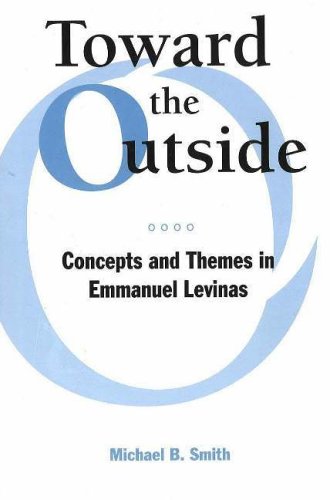
40. Toward The Outside: Concepts And Themes In Emmanuel Levinas
by Michael B. Smith
Paperback: 282 Pages (2005-07-30)
list price: US$26.95 -- used & new: US$26.95
(price subject to change: see help)
Asin: 0820703699
Average Customer Review: 5.0 out of 5 stars
Canada | United Kingdom | Germany | France | Japan

Customer Reviews (1)

5-0 out of 5 stars A solid introduction
Michael B. Smith's book is among the best introductions to Levinas' thought available.This book does an extraordinary job explaining the central concepts of Levinas' philosophy in clear language.The book has an easy to follow structure, and can function as a book and also as a reference for those wanting a quick and dirty definition of Levinas' key terms.The most impressive feature of this book is its breadth, for it takes into account Levinas' phenomenological and Jewish influences, and also shows an excellent understanding of the development of Levinas' thought.

Those who find this book helpful should also look at Jeffrey Dudiak's _The Intrigue of Ethics_ and Adriaan Peperzak's _Toward the Other_. ... Read more


  Back | 21-40 of 100 | Next 20
A  B  C  D  E  F  G  H  I  J  K  L  M  N  O  P  Q  R  S  T  U  V  W  X  Y  Z  

Prices listed on this site are subject to change without notice.
Questions on ordering or shipping? click here for help.

site stats