e99 Online Shopping Mall

Geometry.Net - the online learning center Help  
Home  - Philosophers - Marx Karl (Books)

  Back | 41-60 of 100 | Next 20
A  B  C  D  E  F  G  H  I  J  K  L  M  N  O  P  Q  R  S  T  U  V  W  X  Y  Z  

click price to see details     click image to enlarge     click link to go to the store

 
$3.80
41. Critique of the Gotha Program
 
$12.55
42. How To Read Karl Marx
 
$34.95
43. Karl Marx, Frederick Engles: Collected
$8.33
44. Early Writings (Penguin Classics)
$7.73
45. The German Ideology, including
$29.30
46. Karl Marx's Theory of History
$4.22
47. Economic and Philosophic Manuscripts
$3.76
48. The Communist Manifesto
$6.95
49. The Poverty of Philosophy (Great
 
50. Karl Marx Capital Unabridged (3
 
$24.85
51. Collected Works of Karl Marx and
 
$24.95
52. Collected Works of Karl Marx and
$17.82
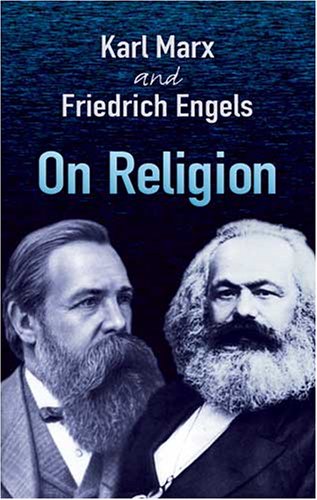
53. Marx on Religion
$29.90
54. A Contribution To The Critique
 
$34.99
55. Karl Marx (COLECCION ENSAYO)
 
$24.95
56. Karl Marx, Frederick Engels: Marx
 
$24.94
57. Karl Marx, Frederick Engels: Marx
 
$24.95
58. Karl Marx, Frederick Engels: Marx
 
59. Collected Works of Karl Marx and
 
$24.95
60. Karl Marx, Frederick Engels: Marx

41. Critique of the Gotha Program
by Karl Marx
 Paperback: 116 Pages (1938-06)
list price: US$4.95 -- used & new: US$3.80
(price subject to change: see help)
Asin: 0717800431
Canada | United Kingdom | Germany | France | Japan

42. How To Read Karl Marx
by Ernst Fischer, Franz Marek
 Paperback: 224 Pages (1996-01-01)
list price: US$15.00 -- used & new: US$12.55
(price subject to change: see help)
Asin: 0853459746
Canada | United Kingdom | Germany | France | Japan
Editorial Review

Book Description
A brief, clear, and faithful exposition of Marx's major premises, with particular attention to historical context.

... Read more


43. Karl Marx, Frederick Engles: Collected Works (Karl Marx, Frederick Engels: Collected Works)
by Karl Marx, Friedrich Engels
 Hardcover: 671 Pages (2001-06)
list price: US$34.95 -- used & new: US$34.95
(price subject to change: see help)
Asin: 0717805484
Canada | United Kingdom | Germany | France | Japan

44. Early Writings (Penguin Classics)
by Karl Marx
Paperback: 464 Pages (1992-07-01)
list price: US$15.95 -- used & new: US$8.33
(price subject to change: see help)
Asin: 0140445749
Average Customer Review: 3.5 out of 5 stars
Canada | United Kingdom | Germany | France | Japan

Customer Reviews (2)

3-0 out of 5 stars Not for beginners
As someone who thought he had a relatively good grasp of what Marxist philsophy is comprised of, it came as something of a surprise that this text was so incomprehensible. This was the first actual Marx I have ever set out to read. I believed that _Early Writings_ might a good place to start (you know: start at the beginning, as they say). At any rate, I would encourage someone who is a novice at this sort of thing to start with another book. From the very start I had a difficult time determing exactly what Marx was getting at. The first 200 pages are a refutation to a Hegelian concept of the state. If you are not familiar with the writings and ideas of Hegel, you will not want to read that particular work. The second half of the book is more approachable, but not what I would term "accessible" by any means. I would recommend this only to people that already have extensive knowledge of Marx's terminology and belief systems. Without this prerequisite, you might as well be reading Latin.

4-0 out of 5 stars To Learn More About A Legend
This book gives the reading a kind of "before they were stars" approach.It provides a good spring board to seeing how Marx metamorphasized from Das Capitol into the Communist Manifesto.I recommend this book for anyone who is looking to get to the base of and learn more about this influential write and philosopher. ... Read more


45. The German Ideology, including Theses on Feuerbach (Great Books in Philosophy)
by Karl Marx, Friedrich Engels
Paperback: 571 Pages (1998-11)
list price: US$13.00 -- used & new: US$7.73
(price subject to change: see help)
Asin: 1573922587
Average Customer Review: 4.0 out of 5 stars
Canada | United Kingdom | Germany | France | Japan

Customer Reviews (7)

4-0 out of 5 stars Earlier = Better
More concise and hardcore in the critique of capital than later works. Should be in every Marxist/non-Marxist library.

2-0 out of 5 stars Great work, poor edition
I highly recommend The German Ideology, but wish to warn buyers of this edition (Prometheus).The quality of the print in this edition is very low, the font is difficult to read, and the spacing is very tight.Perhaps most frustrating, however, is that the text is marked with numbers for footnotes that have no actual corresponding footnotes.I have written to the publisher three times about this issue and have received no response or explanation.The name of the translator is also suspiciously absent, and there is no introduction to the work--something that in this case would be very helpful.On the positive side, I think this edition provides the complete German Ideology, but Book One is really all that is necessary or ever referenced, and this can be found in other editions.

5-0 out of 5 stars A grand masterpiece
this book is basically an in depth communist manifesto, it backs up his claims of the communist society and goes into much detail. Also included is the critique on fueurbach, and the intro to the critique of the political economy. Very good book, any marxist needs it

4-0 out of 5 stars A philosophical romp with the "young Marx"
The fashionable revisions and reifications of Hegel (the "official" political theory of Germany) common to Marx's era filled him with such disgust that he and Engels penned an entire rhetoric-laced diatribe against them, "The German Ideology."This book served, for Marx and his sidekick, not only as a materialist attack on Hegelian idealism and its conceptions of history, but also served, in their words, as a "self-clarification" of their own stances on a number of issues.Foremost among these issues is the actual role of the political philosopher in society and in history.Indeed, Marx is directly referring to the legacy of his Hegelian contemporaries when he says that "philosophers have only interpreted the world . . . the point, however, is to change it."

Marx departs from Hegel and his latter-day followers (whether revolutionary or conservative) in both method and in goals.As far as methodology is concerned, Marx is an empiricist of a certain normatively world-changing brand, which obviously leaves him open to critiques from "pure" empiricism as being either an outright determinist (an obviously abhorrent concept to the entire Humean tradition) or else being merely a moral philosopher in scientist's clothing.

As for goals, while some of Hegel's followers might share a certain revolutionary telos with Marx, they cannot truly be his comrades because for Marx the revolutionary method (historical materialism) is inseparable from the revolutionary goal (communism); that is, communism cannot by nature be an "ideal" . . . "to which reality will have to adjust itself"(as it is for the Hegelians).Instead, the ideal of communism must adjust itself to reality (thus becoming no longer an ideal), and that is precisely Marx's project as expressed in the 11th Thesis on Feuerbach:through his writings, to "adjust" the real world to his view of the way it's going to be (by writing about the world the way that it has been, and the way that it is now).

4-0 out of 5 stars A vital early work, but not a complete picture of Marx.
First of all, the correct title would refer to the THESES on Feuerbach, of which there are eleven.These are terse exhortations, which Marx apparently wrote out for himself as a reminder of principles, not intended for publication.They remain brilliant and challenging to readers.The rest of the volume is taken up by *excerpts* from the vast manuscript on the German Ideology, which is an uneven early work of Marx and Engels.There are brilliant passages, crucial to Marxist thought, but there's also a lot of directionless vitriol directed at now relatively unimportant thinkers.

I disagree with the previous reviewer -- this is not an ideal intro to Marxism.Read the Communist Manifesto, then move on to the Eighteenth Brumaire, or this, or Capital, or the early works.

And by the way, get the International Publishers edition if you can find it. ... Read more


46. Karl Marx's Theory of History
by Gerald Allen Cohen, G. A. Cohen
Paperback: 430 Pages (2000-12-15)
list price: US$34.95 -- used & new: US$29.30
(price subject to change: see help)
Asin: 0691070687
Average Customer Review: 3.5 out of 5 stars
Canada | United Kingdom | Germany | France | Japan
Editorial Review

Book Description

First published in 1978, this book rapidly established itself as a classic of modern Marxism. Cohen's masterful application of advanced philosophical techniques in an uncompromising defense of historical materialism commanded widespread admiration. In the ensuing twenty years, the book has served as a flagship of a powerful intellectual movement--analytical Marxism. In this expanded edition, Cohen offers his own account of the history, and the further promise, of analytical Marxism. He also expresses reservations about traditional historical materialism, in the light of which he reconstructs the theory, and he studies the implications for historical materialism of the demise of the Soviet Union.

... Read more

Customer Reviews (3)

4-0 out of 5 stars Classic defense of the economic determinist interpretation
Cohen's classic book is a defense of the Second International thesis that the productive forces (roughly technology and labor power) are the "motive forces" of history.In the first version of the book this idea, widely disputed among Marxists, was intended to show that socialism was the necessary culmination of a history of increasing development of the productive forces.This is a difficult thesis to maintain today, and indeed in more recent work, some of which is embodied in the second edition of the book, Cohen retracts it, suggesting only that the development of the productive forces makes socialism possible. (Subsequently he seems to have backpedaled even on this.) The implications of the weakening of historical materialism (along with a sharp critique of Cohen's original view, one that he now largely accepts) were offered by Wright, Levine, and Sober in their Reconstructing Marxism, an essential companion piece to Cohen's book. They essentially involve taking apart the optimistic claims that Marxism offers an integrated scientifically based program of social change that inspires optimism about progress towards socialism.Cohen's main thesis, as an interpretation of Marx and as a _defense_ of Marx, seems much less plausible than, for example, the alternative "class struggle" interpretations of historical materialism urged, for example, by Robert Brenner or (formerly) Richard Miller in his Analyzing Marx.

Nonetheless, Cohen's book remains a model of clarity, depth, and ruthlessly honest exposition that shows up the places where it runs into problems. It contains must that is salvageable, not least an interpretation of what it is for the economic to be "primary" in terms of a theory of functional explanation, on which the ideological superstructure and the state are explained in part in terms of their functionality for the economic base, and revolutionary social change due to "fettering" of the productive forces understood in terms of dysfunctionality. People who like their Marx fuzzy and obscure enough to avoid intelligible criticism (Althusserians, for example) have never liked this book, but if Marxism _as a theory_ has a future in the wake of collapse of the Marxism _as a movement_, Cohen here set the standard for what that theory should look like in procedure and rigor if not necessarily in its substanative claims. Serious study of Marx's theory of history starts here.

1-0 out of 5 stars The starting point for all critics of Marx
This book has some virtues, in terms of clarity of exposition, but as a reading of Marx it leaves a lot to be desired.Like Jon Elster's attempts of making (non)sense of Marx that followed it, this text reads into Marx a set of assumptions taken for granted within neoclassical economics but entirely foreign to Marx's work.If you want to see how Marx and Marxism measure up to the unquestionable and seemingly unthinkable criteria of bourgeois thought, read this.But if you want to understand Marx, read Althusser.'For Marx' is a good place to start, but be sure to read the essays collected in 'The Humanist Controversy' and 'Philosophy and the Spontaneous Philosophy of the Scientists' too, not to mention 'Reading Capital' and 'Machiavelli and Us' ... Cohen may be easier to read, but only because Cohen doesn't challenge any of the ideology of capitalism that is as invisible to most people as water is to the fish that swim in it.

5-0 out of 5 stars A Strong Defense
In the Base-Superstructure debate that has been raging for a while, and still is, within modern Marxism, GA Cohen's Defense of Karl Marx's Theory of History is one of the more powerful blows struck and deserves to be read.

Cohen is a supporter of "the primary of productive forces" (the word primacy here being used to avoid the label of being a determinist or vulgar marxist) and argues to uphold the base-superstructure metaphor which Marx set forth in the 1859 preface to the Contribution to Political Economy. In a nutshell, the metaphor basically said that the base of all society is the economic structure, where everything else (legal and political institutions, for example) rise as a superstructure on this base. The implication is that the most influential thing in society is indeed our economic system. The further implication here, and surely what Marx was trying to say, is that capitalism is the defining aspect of everything and essentially the primarily determining entity in society.

GA Cohen upholds this metaphor by first scouring the 1859 preface, then other Marx works and finally arguing for the legitimacy of the "primary of productive forces" himself. His arguments are concise and powerful. If you are a serious student of Marxism, the read is basically mandatory and helps break the illusion that there is really one theory of Marxism and thats it. Cohen's interpertation of Marx tends to be the one that most people identify Marx with themselves and also tends to paint Marxism as cold and determinist (despite his attempts to keep away from the dreaded title).

However, if you are going to read this, be sure to read Althusser, Williams and Lukacs. These are the other three major points on the debate and reading them will give you a rounded perspective on the entire thing. I tend not to agree with Cohen (though that doesn't show in my rating) and think that if you read a lot of Marx, you can see he himself differing from Cohen. The famous 11th statement in his Thesis of Feurbach sums it all up:

"The philosophers have only interperted the world, in various ways; the point, however, is to change it."

Cohen's views on the economic base's primacy doesn't leave much room for this statement to be anything other than a hollow statement. ... Read more


47. Economic and Philosophic Manuscripts of 1844 (Dover Books on Western Philosophy)
by Karl Marx
Paperback: 208 Pages (2007-04-19)
list price: US$6.95 -- used & new: US$4.22
(price subject to change: see help)
Asin: 0486455610
Canada | United Kingdom | Germany | France | Japan
Editorial Review

Book Description

This predecessor to the Communist Manifesto offers a historical analysis of the human condition. It forms the foundation of the author's denunciation of capitalism, combining elements of psychology, sociology, and anthropology in a philosophy of economics. Accessible and influential, this concise treatise is essential to an understanding of Marxist theory.
... Read more

48. The Communist Manifesto
by Karl Marx, Frederick Engels
Paperback: 54 Pages (2007-11-07)
list price: US$3.99 -- used & new: US$3.76
(price subject to change: see help)
Asin: 1599867524
Canada | United Kingdom | Germany | France | Japan
Editorial Review

Book Description
The Communist Manifesto is the classic work by Karl Marx and Frederick Engels that founded the idea of a communist type government. This publication has been used widely in political science courses and by individuals studying comparative government and various forms of political movements. The Communist Manifesto is highly recommended for those interested in learning about communism and those who are fans of the writings of Karl Marx and Frederick Engels. ... Read more


49. The Poverty of Philosophy (Great Books in Philosophy)
by Karl Marx, Karl Mark
Paperback: 227 Pages (1995-06)
list price: US$12.00 -- used & new: US$6.95
(price subject to change: see help)
Asin: 0879759771
Average Customer Review: 4.5 out of 5 stars
Canada | United Kingdom | Germany | France | Japan

Customer Reviews (2)

4-0 out of 5 stars Most people are sure to disagree.
This book is of historical interest.Karl Marxobtained his doctorate in philosophy in 1841, based on a thesis on post-Aristotelian Greek philosophy.He became a newspaper editor in 1842, until the government closed the publication.Marx moved to Paris, and wrote THE POVERTY OF PHILOSOPHY in 1847.(p. 5).Most Americans believe that the American revolution was fought to establish principles of equality.As equals of anyone, we certainly don't think of ourselves as having fought the American revolution against our own government.Marx and Engels created the COMMUNIST MANIFESTO in 1847, a mere 14 years before the American Civil War, when it seemed like Americans on both sides were being blamed for fighting against a Union or the rights of states, and the Americans who were on the same side as General Sherman had the clearest picture of their military policy (war is hell).

THE POVERTY OF PHILOSOPHY was written just before Marx might have been considered the founder of a settled doctrine, but it is full of signs that Marx saw how necessary it was that those who would rule should think like a government, or like a burning bush, and more honest than the law could ever be.Most of the observations in this book are based upon economic considerations.In pure economics, the almighty dollar would be the standard for determining matters of exchange, but this book is in search of a basis for political economics.In opposition to the political economics of Proudhon, which was based on the idea of equality, Marx wrote:

Hypotheses are only made in view of some end.The end proposed to itself in the first place by the social genius which speaks by the mouth of M. Proudhon, was the elimination of that which was evil in each economic category, in order to have only the good.For him good, the supreme good, the true practical end, is equality.And why does the social genius propose equality rather than inequality, fraternity, Catholicism, or any other principle?Because "humanity has realized successively so many particular hypotheses only in view of a superior hypothesis," which is precisely equality.In other words:because equality is the ideal of M. Proudhon.He imagines that the division of labor, credit, the workshop, that all the economic relations have been invented only for the benefit of equality, and nevertheless they have always finished by turning against her.From the fact that the history and the fiction of M. Proudhon contradict each other at every step, he concludes that there is a contradiction.If there is a contradiction it exists only between his fixed idea and the real movement.

Henceforth the good side of an economic relation is that which affirms equality, the bad side is that which denies it and affirms inequality.Every new category is a hypothesis of the social genius to eliminate the inequality engendered by the preceding hypothesis.To sum up, equality is the primitive intention, the mystic tendency, the providential end, that the social genius has before its eyes in turning round and round in the circle of economic contradictions.Providence is also the locomotive which conveys all the economic baggage of M. Proudhon better than his pure and heedless reason.(p. 129)

In the time of Marx, the struggle between the bourgeoisie and proletariat classes was political, but the almighty dollar has managed to produce a politics which is fundamentally only for those of standing, who have "conflicting, antagonistic interests, inasmuch as they find themselves opposed by each other.This opposition of interests flows from the economic conditions of their bourgeois life."(pp. 133-4).According to Marx, any attempt by a humanitarian school of economics was doomed to have a theory which was actually based "upon interminable distinctions between theory and practice, between principles and results, between the idea and the application, between the content and the form, between the essence and the reality, between right and fact, between the good and evil side."(p. 135)Marx proposes an ability to see beyond this, imagining the power of "the revolutionary subversive side which will overturn the old society."(p. 137).Even without communism, the papers are full of the efforts of the doomed to try this stunt, and of the government to stop them.General Sherman was as American as any economist.

5-0 out of 5 stars marx is mind expanding
Marxs book here shows you how the distribution of wealth yes why some now 060601, have 145,000,000 in net worth at top of company and a worker in company has 43,000 dollars, is a human political construction.Nothing that exists is law of physics unalterable reality.He shows how this distribution is stupid, and how a more equal distribution and democratic economy can do much betterthan now.He says this in angery word webs.It is a fun book that get sone thinking.You will have intellectual, fun, a rare form of fun these days. ... Read more


50. Karl Marx Capital Unabridged (3 volumes)
 Paperback: 2301 Pages (1967)

Asin: B000OC0AAO
Canada | United Kingdom | Germany | France | Japan

51. Collected Works of Karl Marx and Friedrich Engels, 1848, Vol. 7: Demands of the Communist Party in Germany, Articles, Speeches
by Karl Marx, Friedrich Engels
 Hardcover: 750 Pages (1978-06)
list price: US$24.95 -- used & new: US$24.85
(price subject to change: see help)
Asin: 0717805077
Average Customer Review: 5.0 out of 5 stars
Canada | United Kingdom | Germany | France | Japan

Customer Reviews (1)

5-0 out of 5 stars Brian Wayne Wells, Esquire, reviews Collected Works Vol. 7
Volume 7 of the massive 50 volume set of the English translations of all the writings of Karl Marx and Frederick Engels is a very significant book.Having developed and refined their theory of dialectical historical materialism known as scientific socialism, Marx and Engels set about applying their theory to explain the significance of events occuring in their own day.

Because Volume contains the writings of Marx nd Engels from the year 1848, the events which fill the pages of this book are the various revolutionary upsurges that were occurring all around Europe that year.In Paris, Berlin, Frankfurt, Vienna, and Hungary along with many other places in Europe, the revolt of the people required monarchs everywhere to come to terms with the demands of the people for representive assemblies and constitutions which would restrict the absolute authority and "devine right" of royalty.All by itself, Volume 7 is exciting reading of one of the most significant times in human history. ... Read more


52. Collected Works of Karl Marx and Friedrich Engels, 1845-47, Vol. 5: Theses on Feuerbach, The German Ideology and Related Manuscripts
by Karl Marx, Friedrich Engels
 Hardcover: 687 Pages (1976-06)
list price: US$24.95 -- used & new: US$24.95
(price subject to change: see help)
Asin: 0717805050
Average Customer Review: 5.0 out of 5 stars
Canada | United Kingdom | Germany | France | Japan

Customer Reviews (1)

5-0 out of 5 stars Brian Wayne Wells, Esquire, reviews, Collected Works Vol. 5
This is Volume 5, of the 50 volume set of the entire collection of all the writings of Karl Marx and Frederick Engels.Marx and Engels were the founders of scientific socialism which drew elements from three main sources--English economics of Adam Smith and David Ricardo, utopian French socialism of Charles Fourier and Claude Henri Saint-Simon and from the German philosophy of Georg Wilhem Frederich Hegel.

Reading the entire 50 volume set of the Collected Works can be a daunting task, but it is an effort that will offer the reader the best chance to get inside the minds of the two nintgeenth century philosphers and follow all their steps as they sztruggled to develop a coherent concept of the economic system of the world.

Short of reading the entire set, each volume is a self contained book which offers real insight into the Marxian theory.Volume 5, covering the years 1845 thru 1847, contains "German Ideology" where Marx and Engels do philosophical battle with the Young Hegelians. ... Read more


53. Marx on Religion
Paperback: 242 Pages (2002-04)
list price: US$20.95 -- used & new: US$17.82
(price subject to change: see help)
Asin: 1566399408
Canada | United Kingdom | Germany | France | Japan
Editorial Review

Book Description
"Religious suffering is at one and the same time the expression of real suffering and a protest against real suffering. Religion is the sigh of the oppressed creature, the heart of a heartless world and the soul of soulless conditions."

Few people would ever expect that Karl Marx is the writer of the above statement. He not only wrote it, but he did so in the same breath of his more famous dictum that "religion is the opiate of the masses." How can one reconcile such different perspectives on the power and ubiquity of religion?

In this compact reader of Marx's essential thought on religion, John Raines offers the full range of Marx's thoughts on religion and its relationship to the world of social relations. Through a careful selection of essays, articles, pamphlets, and letters, Raines shows that Marx had a far more complex understanding of religious belief. Equally important is how Marx's ideas on religion were intimately tied to his inquiries into political economy, revolution, social change, and the philosophical questions of the self.

Raines offers an introduction that shows the continuing importance of the Marxist perspective on religion and its implications for the way religion continues to act in and respond to the momentous changes going on in our social and environmental worlds. Marx on Religion also includes a study guide to help professors and students—as well as the general reader—continue to understand the significance of this often under-examined component of Marx. ... Read more


54. A Contribution To The Critique Of Political Economy
by Karl Marx
Hardcover: 316 Pages (2007-07-25)
list price: US$45.95 -- used & new: US$29.90
(price subject to change: see help)
Asin: 0548222193
Canada | United Kingdom | Germany | France | Japan

55. Karl Marx (COLECCION ENSAYO)
by Isalah Berlin
 Paperback: 240 Pages (2007-01-01)
list price: US$34.99 -- used & new: US$34.99
(price subject to change: see help)
Asin: 8420667587
Average Customer Review: 4.5 out of 5 stars
Canada | United Kingdom | Germany | France | Japan
Editorial Review

Book Description
First published over fifty years ago, Isaiah Berlin's compelling portrait of the father of socialism has long been considered a classic of modern scholarship and the best short account written of Marx's life and thought. It provides a penetrating, lucid, and comprehensive introduction to Marx as theorist of the socialist revolution, illuminating his personality and ideas, and concentrating on those which have historically formed the central core of Marxism as a theory and practice. Berlin goes on to present an account of Marx's life as one of the most influential and incendiary social philosophers of the twentieth century and depicts the social and political atmosphere in which Marx wrote. This edition includes a new introduction by Alan Ryan which traces the place of Berlin's Marx from its pre-World War II publication to the present, and elucidates why Berlin's portrait, in the midst of voluminous writings about Marx, remains the classic account of the personal and political side of this monumental figure. ... Read more

Customer Reviews (10)

4-0 out of 5 stars Interesting philosophy, but little biographical details
Because of the way my brain is wired, I take a lot more interest in the historical than I do in the philosophical. Even though Marx spent a good chunk of his life sequestered away in the reading room of the London Library, I still find the narrative details of his life fascinating: his banishment from one country to another, his participation in the 1848 revolutions, the numerous petty squabbles he had with other 19th century revolutionaries, his involvement in the politics of the International, and his last great fight against Bakunin.

It's always a struggle to find a good biography that focuses on the historical instead of on the philosophical. And after reading Isaiah Berlin's take on Marx's life, I am beginning to appreciate how good the biography by Francis Wheen was that I read this past summer.

Isaiah Berlin does a good job of summarizing Marx's life in under 300 pages, but most of the book lingers on Marx's philosophical development, with whole long chapters devoted to topics such as "The Young Hegelians" and "Historical Materialism." I would have preferred more emphasis on the narrative sections, but when reading a biography of a philosopher, I suppose it is hard to get away from the philosophy.

One thing Berlin does which I thought was very interesting was that he emphasized the paradoxes in Marx's legend. For example Marx lived during the age of romantic revolutions in which popular revolutionary figures like Herzen, Mazzini, Blanqui, and Lassalle commanded almost religious like followings. Marx spent most of his life in obscurity in the London library, and yet today his name is still known by almost everyone on the planet. Marx's central thesis, that historical material conditions and not ideas influence history, has been undercut by its very success.

Or how the German and Austrian communists, who followed Marx's advice about organizing from the bottom up, were eventually overwhelmed by the fascists, where as the Bolsheviks, who committed the most un-Marxist act of a revolutionary coup, was the first (and for a time the only) successful Marxist revolution.

Bakunin, as seems to be the case with any biography vaguely sympathetic towards Marx, comes off a bit badly here. I suppose that's to be expected. (When I was in my big anarchist phase at College, I used to read biography's about Bakunin in which Marx came off badly.)

There is no denying that Bakunin had his flaws. Anyone who has read any piece of analysis by Bakunin knows he didn't have the brilliance of Marx's pinky. He was a romantic without a clear ideology, and he didn't share Marx's horror for Revolutions that went off half-cocked with no chance of succeeding. And, as every biography of Marx makes clear, he was an anti-Semite.

And yet, he was right (well, not about the anti-Semite part). But history has shown all of Bakunin's criticisms of Marx to be true. And, to his credit, Isaiah Berlin does include some of Bakunin's extended quotations:
"We believe power corrupts those who wield it as much as those who are forced to obey it. Under its influence, some become greedy and ambitious tyrants, exploiting society in their own interest, or in that of their class, while others are turned into abject slaves. Intellectuals, positivists, doctrinaires, all those who put science before life...defend the idea of the state and its authority as being the only possible salvation of society-quite logically, since from their false premises that thought comes before life, that only abstract theory can form the starting-point of social practice...they draw the inevitable conclusion that since such theoretical knowledge is at present possessed by very few, these few must be put in control of social life, not only to inspire, but to direct all popular movements, and that no sooner is the revolution over than a new social organization must be at once be set up; not a free association of popular bodies...working in accordance with the needs and instincts of the people but a centralized dictatorial power concentrated in the hands of this academic minority, as if they really expressed the popular will....The difference between such revolutionary dictatorship and the modern State is only one of external trappings. In substance both are a tyranny of the minority over the majority in the name of the people-in the name of the stupidity of the many and the superior wisdom of the few-and so they are equally reactionary, devising to secure political and economic privilege to the ruling minority, and the...enslavement of the masses, to destroy the present order only to erect their own rigid dictatorship on its ruins."

Berlin gives a surprisingly hostile account of the Paris Commune, which he appears to have based completely off the Bourgesious press. And he also advances the interesting idea that Marx actually opposed the Paris Commune because it was more along the lines of Bakunin's revolutionary ideology, but once it was clear the Commune was going to fall, Marx embraced it for the cynical reasons of the desire to link his name with the most infamous revolution in Europe at the time. Berlin is the first writer I have come across who claims this, and well it certainly is not an impossible conclusion, it would be nice if he gave some more evidence for it.

5-0 out of 5 stars Not quite best autobiography but worth reading
David McLellan's Karl Marx: A Biography is a better standard biography. McLellan had access to much more material about Marx's life than did Berlin and he brings it all together in a satisifying package.

Berlin's book, however, provides a superb discussion of the philosophical background to Marx's work. Because of that Berlin's book is extremely valuable.

Readers of Berlin's book must be aware that his interpretation of Marx's social theory is colored by Berlin's anti-communist beliefs. Although many today reject that a close tie existed between Marx's social theory and the USSR, Berlin assumed that such a link existed when he looked at things in the late 1930s. As a result, a tone of worry and concern suffuses Berlin's discussion of many of Marx's ideas and Berlin tends to paint Marx as more of a potential authoritarian than did later biographers.

Despite that, Berlin's book is well worth a read.

5-0 out of 5 stars A classic account of Marx
Rereading the fourth edition of this classic short intellectual biography of Marx, one finds it as interesting as on the first occasion, and the result is a crisp portrait of one of the most misunderstood figures of philosphical history. Marx lived in what was not only a rapidly changing social environment,but one in which the social ideologies of modernity where themselves undergoing shifts of paradigm. From the electric world of the now almost unimaginable period of the Hegelian tide, via Feuerbach and the Left Hegelians, we pass to the age of post-Comptean positivism, and the post-Darwinian world view. This divide is reflected in Marx's philosophic development itself, one of the reasons he is almost never properly understood. Berlin's deft account proceeds through this obscurities with a sure touch.

5-0 out of 5 stars IT'S THE THOUGHT THAT COUNTS
Isaiah Berlin's biography of Karl Marx is as erudite as it is compelling. Taking one of the more controversial and laborious men of the twentieth century as his subject matter, Berlin weaves the intricate and sometimes confounding thoughts of his subject into a patterned and complex whole.

Karl Marx is treated fairly in this book--neither with sycophantic adulation nor with profound cynicism typical of other treatments of Marx and his philosophy. Perhaps because of the political consequences of Marx's ideas, the negative overview's of his life have emphasized his tempermental side, the irony of being funded by an aristocratic Engels, or the silliness of his labour theory of value premise (shared by David Ricardo). Meanwhile, on the other side, there are writings on the life of Marx that stick to his genius, his profound impact on the world, and further entrench his cult status.

It is this latter part that I found most interesting in Berlin's work--the exploration of Marx's temper tantrums with anyone who should deviate from Marx's conception of how things must be. Proudhon, for instance, is castigated by Marx. So, too, is Feuerbach and the Young Hegelians (Berlin muses about whether or not this has to do with the mighty influence these have had on Marx's own thought and Marx's desire to be seen as a wholly original thinker). Bakunin does not escape public ridicule when they differ on the value of the State as a mechanism to be used by the proletariat. Bakunin, of course, did not believe in hierarchical orderings of any kind--whether in capitalist industry, or in the socialist state--and issued proclamations and gave speeches to that effect, explicitly cautioning people about the possibility of the government violating the freedom it was supposed to secure. Marx was not impressed, and consequently mocked him openly. Engels was perhaps the only man to escape the eventual polemical wrath of Marx, saving himself from such a fate possibly because he simply agreed with whatever Marx said, and indulged him in most everything else.

Still, what comes across most forcefully is the life of a man steeped in ideas, and interested in the fundamental, radical underpinnings of society as a whole. Marx is often enough considered a genius of the highest calibre, with impeccable literary credentials to back it up. It is this attention to minute detail, and his incredible analysis of society (or rather, the historical 'movement', if you will, of human relationships which reciprocally interact with the concrete, material conditions of their existence) that makes this praise seem a bit understated.

This singular fact--Marx as a man of ideas, and the fact of the practical consequences of his ideas--is touched upon in a self-conscious bit of irony by Berlin. For Marx explained that it isn't ideas that do anything, really, but are, instead, the consequences of material conditions, these conditions being fundamental. And yet it was the writings of Marx that sparked several revolutions and formed the primary cause of the one in Russia which stuck around for a while (no one is here implying a monistic view of history... the lessons Marx tried to teach are not entirely lost on me).

What we're left with is an incredibly vivid picture of Marx, the man (not the myth, or the legend; although a little bit of both is tossed in for spice). Berlin does a masterful job, so anyone picking this book up should find it entirely enjoyable.

4-0 out of 5 stars PURE AND PROPER INTELLECTUAL HISTORY
Let me say that if you are looking for a biography of Marx's life you had better look elsewhere. There are no long chapters about his school days, his relations with his Sisters, Mother or Father. You will not find detailed references to every argument Marx had or every aspect of his squallid and, at times, extremely personally irresponsible lifestyle. You must look elsewhere for those details.

This book is about ideas and the struggle between ideas. It is about Marx emersed in the ideas of his time and how those ideas shaped his thinking, whether changing his ideas, borrowing or regjecting them outright Berlin has a wonderful, at times unique grasp of the issues and the ideas of the times that Marx lived.

Starting with a broad description of the Rational-Empiricist debate and the Hegelian reaction to empiricism, Berlin describes Marx as a unique German Hybrid of British Empiricism married to a searching German Hegelian spirit, dissatisified with the traditional historical interpertations offered by Hegel and his German offshoots, the Young Hegelians.

Along the way Marx comes across a uniques set of millenarian and social theorists of his time; Proudhom, Bakunin, Engels, Lasalle, Feuerbach and others, whom all, even though perhaps disliking Marx personally, respected his argument style, his learning, and his deep insight into the problems of the time.

I would not classify this as a beginning book on Marx. There is a lot of ground covered here and if one does not have at least a thumbnail sketch understanding of the times, the social and political issues, then there will be a chance that the author will loose some of his readership. Berlin's prose has been described variously as dense and hard to understand. It may be for some readers. But Berlin is not excessively wordy (it is a slender volume), but he does have the ability to cover a lot of ideas and currents in a single sentence. It is this juggling and keeping in mind of a lot of ideas and concepts in a single sentence that may necessitate one to reread certain sentences, or at least know the concepts to which he is referring.

If you do have general outline of the ideas of the age then you will love this book. I sat down thinking that this was my "serious reading." I fully expected it to be a labourious process to get through this book. Instead I was profoundly surprised by the breath and depth Berlin covers in his lucid prose.

I found it hard to put the book down.

There is no analysis of whether Marx was right or wrong. Of how his ideas become to become the bible of the oppressed on the earth or how it eventually was transmogrified in some cases to justify the mass killing of those who stood in the way of historical materialism. This is a book of ideas, and as such the ideas discussed of Marx, his contemporaries, and his intellectual primogeniteurs are a ripping good read. ... Read more


56. Karl Marx, Frederick Engels: Marx and Engels Collected Works 1867-70 (Karl Marx, Frederick Engels: Collected Works)
by Karl Marx, Friedrich Engels
 Hardcover: 645 Pages (1986-09)
list price: US$24.95 -- used & new: US$24.95
(price subject to change: see help)
Asin: 0717805212
Canada | United Kingdom | Germany | France | Japan

57. Karl Marx, Frederick Engels: Marx and Engels Collected Works 1861-64 (Karl Marx, Frederick Engels: Collected Works)
by Karl Marx, Friedrich Engels
 Hardcover: 484 Pages (1984-10)
list price: US$24.95 -- used & new: US$24.94
(price subject to change: see help)
Asin: 0717805190
Canada | United Kingdom | Germany | France | Japan

58. Karl Marx, Frederick Engels: Marx and Engels Collected Works 1856-58 (Karl Marx, Frederick Engels: Collected Works)
by Karl Marx, Friedrich Engels
 Hardcover: 808 Pages (1986-08)
list price: US$24.95 -- used & new: US$24.95
(price subject to change: see help)
Asin: 0717805158
Canada | United Kingdom | Germany | France | Japan

59. Collected Works of Karl Marx and Friedrich Engels, 1851-53, Vol. 11: Revolution and Counter-Revolution in Germany, the 18th Brumaire, Etc.
by Karl Marx, Friedrich Engels
 Hardcover: 796 Pages (1980-11)
list price: US$24.95
Isbn: 0717805115
Canada | United Kingdom | Germany | France | Japan

60. Karl Marx, Frederick Engels: Marx and Engels Collected Works 1864-68 (Karl Marx, Frederick Engels: Collected Works)
by Karl Marx, Friedrich Engels
 Hardcover: 614 Pages (1986-05)
list price: US$24.95 -- used & new: US$24.95
(price subject to change: see help)
Asin: 0717805204
Canada | United Kingdom | Germany | France | Japan

  Back | 41-60 of 100 | Next 20
A  B  C  D  E  F  G  H  I  J  K  L  M  N  O  P  Q  R  S  T  U  V  W  X  Y  Z  

Prices listed on this site are subject to change without notice.
Questions on ordering or shipping? click here for help.

site stats