e99 Online Shopping Mall

Geometry.Net - the online learning center Help  
Home  - Philosophers - Mill John Stuart (Books)

  1-20 of 100 | Next 20
A  B  C  D  E  F  G  H  I  J  K  L  M  N  O  P  Q  R  S  T  U  V  W  X  Y  Z  

click price to see details     click image to enlarge     click link to go to the store

$5.54
1. The Basic Writings of John Stuart
$6.60
2. John Stuart Mill: On Liberty (Longman
$11.89
3. Autobiography
$24.00
4. SYSTEM OF LOGIC, RATIOCINATIVE
$12.85
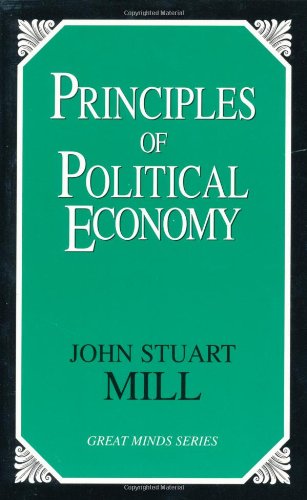
5. Principles of Political Economy
$3.89
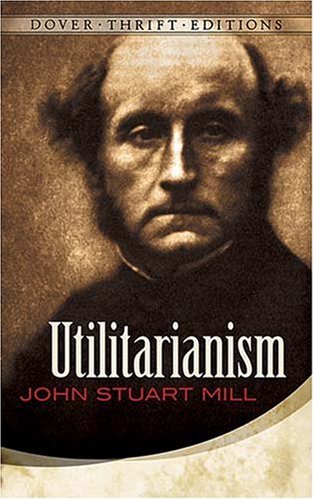
6. Utilitarianism
 
$56.80
7. Collected Works of John Stuart
 
8. Autobiography of John Stuart Mill
 
9. ESSENTIAL WORKS OF JOHN STUART
$5.48
10. On Liberty and The Subjection
$53.97
11. Utilitarianism
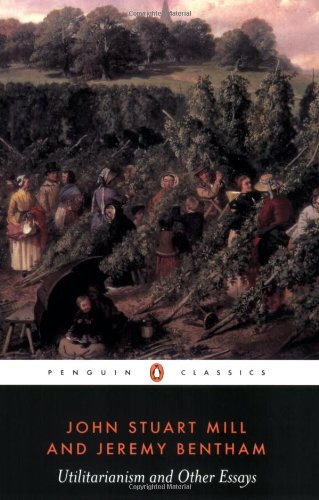
12. On Liberty and Other Essays (Oxford
 
13. John Stuart Mill and Representative
 
14. John Stuart Mill on Liberty
$13.39
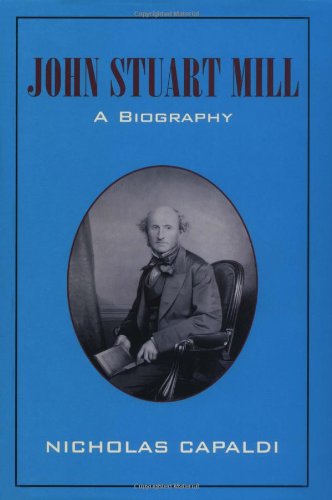
15. John Stuart Mill: A Biography
$4.49
16. On Liberty
$1.40
17. J. S. Mill: 'On Liberty' and Other
 
$26.40
18. John Stuart Mill
 
$3.96
19. ON LIBERTY by John Stuart Mill
 
$89.50
20. The Economics of John Stuart Mill

1. The Basic Writings of John Stuart Mill: On Liberty, the Subjection of Women and Utilitarianism (Modern Library Classics)
by John Stuart Mill
Paperback: 400 Pages (2002-05-14)
list price: US$9.95 -- used & new: US$5.54
(price subject to change: see help)
Asin: 0375759182
Average Customer Review: 5.0 out of 5 stars
Canada | United Kingdom | Germany | France | Japan
Editorial Review

Book Description
The writings of John Stuart Mill have become the cornerstone of political liberalism. Collected for the first time in this volume are Mill’s three seminal and most widely read works: On Liberty, The Subjection of Women, and Utilitarianism. A brilliant defense of individual rights versus the power of the state, On Liberty is essential reading for anyone interested in political thought and theory. As Bertrand Russell reflected, “On Liberty remains a classic . . . the present world would be better than it is, if [Mill’s] principles were more respected.”

This Modern Library Paperback Classics edition includes newly commissioned endnotes and commentary by Dale E. Miller, and an index. ... Read more

Customer Reviews (5)

5-0 out of 5 stars good way to get all three works
this isn't the highest quality paper, but it's an economical way to get three works.there is not much in the way of editorial content, but depending on your interests that may be fine.

5-0 out of 5 stars The great defender of individual liberty
I read this book for a graduate class in Philosophy.Dr. Dale Miller who was the editor for this book was my professor.He is excellent and an expert on J. S. Mill.Recommended reading for anyone interested in philosophy, political science, and history.

John Stuart Mill, 1806-73, worked for the East India Co. helped run Colonial India from England.Minister of Parliament 1865-68 he served one term.Maiden speech was a disaster his second was great success.He was first MP to propose that women should be given the vote on equal footing with the men who could vote.He got 1/3 support, England gives franchise to women after U.S.He was a great Feminist, his essay "Subjection of Women" is written with great passion and prose.It was a brave position for him to take he was ridiculed for it.He favored democracy, and letting more men from lower classes the right to vote, but believed that people that are more educated should have more votes then less educated because they would make better decisions about what government should do.He would have wanted to extend education to the masses, so that all may have gotten 2-3 votes and so on.He didn't think it should be extended to where a small elite could carry the day on votes.The idea was that if the working class, and middle class, where divided on an issue, the people with more intelligence would have the power to tip the balance.Mill thought that people with more education would probably not only be better able to make political decisions, especially in terms of intellectually being able to see what would be best for the government to do, but that they would also be more concerned about the common good publicly then people in general.He was intensely educated by his father James.John could read Greek, and Latin at 6 yrs.; his Dad tutored him at home.Dad thought environment was everything.He was treated like an adult, never played games with kids; he had a very cerebral upbringing.He had a period of depression in his twenties, it changed his philosophy, and he recognized the importance of developing feelings along with the intellect, this is something that he stressed in his work.He read poetry to get out of depression; he became devoted to poetry and became a romantic.He fell in love with a married woman Harriet Taylor, was a platonic relationship, after her husband's death they married 3 years later and probably never consummated the marriage maybe due to Harriet having syphilis.His dedication to "On Liberty" is to her, very devoted to each other.Both buried together in Avignon France where they used to vacation.

Mill as a moral theorist subscribed to a theory we call Utilitarianism.It means---In some way morality is about the maximization of happiness.Whether actions are right or wrong depends on how happiness can be most effectively maximized.I say in some way, because there are allot of different kinds of Utilitarians.Allot of different ways of saying exactly how it is the maximization of happiness comes into morality.Therefore, happiness is clearly an important idea for Utilitarians.Mill has a hedonistic view of happiness, he thinks that happiness can be defined in terms of "pleasure in the absence of pain."What is distinctive about Mill in this area is that he believes that some kinds of pleasure are better than others are, and add more to a person's happiness than other kinds of pleasures.He believes in what he calls, "higher quality pleasures."These are pleasures, he says, that we get from the exercise of faculties that only human beings happen to have.So the intellect, imagination, the moral feelings, these are the sources of higher quality pleasures people use.His view seems to be that a certain quantity of intellectual pleasure just adds more to your happiness, and a given quantity of some lower pleasure like a kind we would share with the animals such as sensation, taste, sexual pleasure, etc.His "higher quality pleasures" in a way echo Aristotle's ethics.The idea of those things that make us distinctly human that are the real key to our happiness, that is in Mill also.It is not as limited to reason and intellect as Aristotle thinks.Mill recognizes the importance of the appreciation of beauty, aesthetic pleasure, and moral pleasure.He frankly owes a debt to Aristotle that he never properly acknowledges, never gives him proper credit.

"On Liberty" is Mill's is his most widely read and enduring work.It is an indispensable essay on political thought, which strenuously argues for individual liberty.He is defending what he calls the "liberty principle."It is a principle that guarantees individuals quite a bit of personal freedom."That the only purpose for which power can be rightfully exercised over any member of a civilized community, against his will, is to prevent harm to others.His own good, either physical or moral, is not a sufficient warrant."These quoted sentences in John Stuart Mill's book, "On Liberty," embody the crux of his argument; that the power of the state must intrude as little as possible on the liberty of its citizenry.In essence, Mill was against using the power of the state through its lawmaking apparatus to compel citizens to conduct themselves in ways that society deems moral or appropriate.Mill thought that people had not only a right, but also a duty to develop their intellectual faculties, which is indispensable to maximize their happiness.He believed that society improved for all its citizens when they where left unfettered to the maximum extent possible, allowing them to use their imagination and intellect to improve themselves.Mill postulates a theory that societies usually institute laws based primarily on "personal preference" of its citizenry instead of established principles.This lack of clarity of opinion often leads to the government frequently interfering in the lives of its citizens unnecessarily.For Mill, there are very few times when the state can infringe on the personal liberty of others.Firstly, the state has the right to promulgate laws that prevent a person's actions from harming others.Secondly, the state must protect those citizens who are not mature enough to protect themselves, such as children.Thirdly, he exempts, "... backward states of society in which the race itself may be considered as in its nonage."In Mill's view, immature societies need a benevolent leader to rule them until they have developed to a point where they, "... have attained the capacity of being guided to their own improvement by conviction or persuasion ..."Mill said this third exemption did not apply to any of the countries in Europe.Mill believed that forced morality by the state on its citizen's liberties was destructive to their inward development, and could even lead to a violent reaction by them against the government.


There are different parts of his defense of this, different arguments that he gives.He has a long chapter on freedom of speech and press.He has some very specific reasons why he thinks those freedoms are important.Always in the background for Mill is the idea of development, and making it possible for more people to enjoy these higher quality pleasures.How do we help people develop their distinctly human faculties, in ways that will help them enjoy their higher quality pleasures?Because for him that is the way, we maximize the total amount of happiness that is enjoyed in the world, and that is the object of morality as far as he is concerned.Utilitarianists believe that maximizing happiness is ultimately, what morality is all about.That does not mean maximizing your own happiness that means maximizing the total amount of happiness that is enjoyed, not only by yourself but also by everybody else as well.

Roger Kimball, in his book "Experiments Against Reality" wrote, "On Liberty" was published in 1859, coincidentally the same year as "On the Origin of Species."Darwin's book has been credited--and blamed--for all manner of moral and religious mischief.But in the long run "On Liberty" may have effected an even greater revolution in sentiment.

5-0 out of 5 stars A bit dry, but worth the effort!
I am interested in Mill's contributions to utilitarian philosophy. Utilitarianism holds that morals should be based upon those acts which promote the greatest good to the greatest number of people. Human actions which foster happiness are held to be right, while those which yield the converse are wrong. Mill defines happiness as intended pleasure with the absence of pain. Also, he maintains that intended pleasure and freedom from pain are the only things desirable as personal ends. Pleasure which employs one's higher faculties tends to give more satisfaction than baser pleasures, or mere sensations. Few humans would exchange their limited, fleeting pleasures for the fullest ration of the pleasures of the "lower" animals. Since a noble character is made happier by its nobleness, utilitarianism can only attain its end towards the multiplication of happiness through a general elevation of the nobleness of the character of the larger population.

Mill states that pleasures and pains have different values to the actor. Only the judgment honed by experience can assist us in assessing appropriate trade-offs in acquiring a particular pleasure at the cost of gaining a specific pain as well. This type of cost/benefit analysis advocated by utilitarians gives rise to the criticism that utilitarianism results in coldness and lack of sympathy towards others. However, Mill claims that the proof of the worth of utilitarianism, or any other moral system, lies in its ability to produce good results.

Although it is sometimes difficult to wade through the dryness of Mill's rhetoric, it is truly worth it for the philosophical insights contained. This book is a good survey of Mill's thoughts on utilitarian ethics and many other subjects of value.

5-0 out of 5 stars A must read for anyone interested in political ideology...
One of the main writers on liberty, J.S. Mill is often overlooked in introductory courses in Political Theory courses. I bought this books as a supplement in my class and it was a wonderful read that gave me an advantage. This book contains some of Mill's best work and the notes added by Schneewind give them an extra dimention and a few explanations that I am glad I had.

4-0 out of 5 stars Liberty: The Basics
Not that Mill was ever obscure or inaccessible, but while Prof Schneewind's Introduction adds little value, the notes and annotations by Dale E Miller certainly renders this compendium transparent, even to folks like me who have been dumbed down by years of television debates as primary intellectual nourishment.He enlightens each of Mill's chapters with a short and easily assimilated introductory overview. Complementing this with text annotations, collected at the back of the book. The annotations appear to be very well selected, as they are never too numerous to make flipping to the back of the book tedious, yet they manage to illuminate every aspect or item I might have found even remotely confusing, ambiguous or otherwise incomprehensible in the modern idiom.

This text is an excellent starting point for reading JS Mill, and is very well suited to the armchair philosopher who wishes to get into the material with ease and without encumbrance. However, there may be too little in the annotations in terms of external references, or cross references to Mill's other writings, or background information to satisfy the more academically inclined.

Of course anyone with even a nominal interest in what liberty is... NEEDS to read JS Mill. But then, you wouldn't be here if you didn't know that, right? ... Read more


2. John Stuart Mill: On Liberty (Longman Library of Primary Sources in Philosophy) (Longman Library of Primary Sources)
by John Stuart Mill, Michael B. Mathias, Daniel Kolak
Paperback: 192 Pages (2006-12-30)
list price: US$8.80 -- used & new: US$6.60
(price subject to change: see help)
Asin: 0321276140
Average Customer Review: 5.0 out of 5 stars
Canada | United Kingdom | Germany | France | Japan
Editorial Review

Book Description
Part of the Longman “Library of Primary Sources in Philosophy,” this edition of Mill's On Liberty is framed by a pedagogical structure designed to make this important work of philosophy more accessible and meaningful for readers. A General Introduction includes biographical information on Mill, the work's historical context, and a discussion of historical influences. Annotations and notes from the editor clarify difficult passages for greater understanding. A bibliography gives the reader additional resources for further study. ... Read more

Customer Reviews (1)

5-0 out of 5 stars Buy it now!
Excellent novel. You gotta buy it! ... Read more


3. Autobiography
by John Stuart Mill
Paperback: 188 Pages (2007-03-23)
list price: US$11.99 -- used & new: US$11.89
(price subject to change: see help)
Asin: 1426440707
Average Customer Review: 4.0 out of 5 stars
Canada | United Kingdom | Germany | France | Japan
Editorial Review

Product Description
It seems proper that I should prefix to the following biographical sketch some mention of the reasons which have made me think it desirable that I should leave behind me such a memorial of so uneventful a life as mine.Download Description
For some years after this I wrote very little, and nothing regularly, for publication: and great were the advantages which I derived from the intermission. It was of no common importance to me, at this period, to be able to digest and mature my thoughts for my own mind only, without any immediate call for giving them out in print. Had I gone on writing, it would have much disturbed the important transformation in my opinions and character, which took place during those years. ... Read more

Customer Reviews (9)

5-0 out of 5 stars Mill telling it like it is
I read this book for a graduate Mill seminar in Philosophy.Recommended reading for anyone interested in philosophy, political science, and history.

John Stuart Mill, 1806-73, worked for the East India Co. helped run Colonial India from England.Minister of Parliament 1865-68 he served one term.

I have to say that I found Mill's Autobiography left me wanting to read a good biography of him in order to learn more about his personal life and interaction with family and friends.He certainly did not reveal himself in the way Jean Jacques Rousseau did in his much-ballyhooed autobiography The Confessions.I do understand that his wife Harriett edited the autobiography to the extent that there is no mention of Mill's mother in it.Other than his education and his reference to taking walks with his father to talk about books he had read, he says little about their relationship.In addition, there is only a passing reference to having to serve as schoolmaster to his siblings while he was an adolescent and he does not mention them again.Mill spent most of his adulthood working for the East India Company; however, he says little about that experience in his autobiography.It seems he had few friends as an adult, if you go by his autobiography.There is a brief reference about his friendship with George Grote, the eminent historian of Greek history.Thus, the impression that I got of Mill the man was one of an emotionally cold person socially except to his wife Harriett, who I believe was the only person in his life he truly loved.Most of his autobiography is dedicated to his education; such as, books he had read or written and philosophers he was influenced by, and this is a part of his life that I found most interesting.

In Mill's autobiography, he tells readers how he benefited and suffered from having one of the most unique educational experiences known to humankind.His father was personally involved in both his education and that of his other siblingsHe was a brilliant student who read Greek by the age of three and Latin at eight years old.By the time he matured to adulthood, he was extremely well read.Thus, he received an academically rigorous education at home, and I find that his education really defined and shaped his character.Providing and improving education for all humans was a cornerstone of his philosophical belief in Utilitarianism.Education meant that people could develop their higher pleasures; a concept that Mill thought was of paramount importance to increase one's happiness.He invented this concept and differed with Jeremy Bentham, the progenitor of Utilitarianism, on this point.Bentham did not believe there was a qualitative property to happiness--Mill did.Thus, it is no mystery that in adulthood he developed very strong views on the advantages that universal education would have on improving people's characters.Mill believed universal education would lead to fostering social change for the betterment of all mankind.He stayed consistent on this belief throughout his life.He gave what I think was one of the great speeches on education and character formation in 1867 after accepting the position as Rector of the University of St. Andrews.In his Inaugural Address Delivered to the University of St. Andrews, one of the points that he made in his speech was the responsibility that universities had in building their students' characters.He also wrote about the importance of character formation had on the ability for people to enjoy freedom in society in his book On Liberty.However, he personally found that his education had come at a great price to his emotional well-being.

During the winter of 1826 and into 1827 while in his early twenties, Mill recognized that he was suffering from a bout with depression.This is the only portion of his autobiography where Mill exposes his inner emotions to his readers.He believed his depression stemmed from an inadequacy in his education.He came to realize that although his father provided him a superior education on many intellectual levels, it was negligent in social contact with children of his own age, and did not prepare him emotionally for interaction with other members of society.His parents and visitors treated him as an adult from early childhood.Mill realized that his upbringing led up to his inability to feel a normal range of human emotions; thus, he felt detached from humanity.Mill found that reading poetry by Wordsworth in 1828 ultimately broke his depression.In poetry, Mill found that he could feel sorrow, and sympathize with others.

I found this part of his autobiography of importance for three reasons.First, it is the only painful human emotional event in his life that he divulges to his readers.Secondly, it is an indication of the importance that the concept of sympathy played in his life and formed his philosophical views as well.Mill understood the need for humans to be sympathetic to one another.Sympathy is required for social interaction and is a useful character trait that we use in order to keep us from harming each other.Thirdly, without his awakening of this emotion in his life, I seriously doubt that he would have found the capacity to love his wife Harriett in the manner that he did.One does get the sense from his description of her that she was his true soul mate and only real long lasting friend in his life.

Mill's friendship with Harriett while she was married to another man, caused them both to endure scandalous gossip, even though they both denied there relationship had any sexual component to it.When they eventually married each other about two years after she became a widow, Mill stayed true to his life long conviction in believing in equal rights for women.During Mill's time, married women's property automatically devolved to their husband and he correctly saw this as one more inequity against women placed on them by society.Therefore, on the day when he married Harriett Taylor in 1851, a financially secure widow, he wrote a formal renunciation to all of her property in protest against the current law.He was a life long feminist who wrote in his essay The Subjection of Women, about the scathing inequalities that women endured since the history of mankind had been chronicled.I have no doubt that his essay paved the way in changing marriage and divorce laws and fostered the improvement of relations between the sexes.He was also the first Member of Parliament to introduce a bill in the Commons to enfranchise women.He worked tirelessly at the end of his life, supporting women's rights with his pen and his purse.His stepdaughter Helen carried on his feminist work by becoming a leader in the suffragist movement in her own right.

In total, I would say that although the Autobiography provides scant information into Mill's daily life, when he does reveal himself, it appears he consistently lived up to his philosophical teachings and beliefs.

5-0 out of 5 stars A classic worthy of being called a classic
This book is so wonderful on so many different levels that to give it a review at all would be a disservice.My recommendation is not on whether or not to read it but instead on how to read it.I suggest a quiet room, comfortable chair or couch, cup of coffee and a few hours of uninterrupted reading time.After completing the book, rest and repeat as desired.

4-0 out of 5 stars "The Econony of Melancholy"
Mill's remarkable childhood education prepared him to be one of the leading intellectuals of his day (far surpassing his father, James Mill, who was no slouch, but not in his son's league) but while I admire his erudition and achievements, one has to wonder if the deep depression he fell into in his mid-20s had something to do with that.

Mill's contributions are better remembered than many of the other famous British intellectuals of the period--such as Herbert Spencer--whose particularly invidious version of the theory of Social Darwinism is best left languishing in obscurity. Who today remembers the prolific Spencer, whose collected works run to over 20 large volumes?

Mill is frank about his depression and how debilitating it was, and what a struggle it was to pull through it. But with the help of his best friend, he pulled out of it and went on to write many important works in philosophy, logic, political science, and economics.

Mill's I.Q. was certainly very high (estimated by psychologist Katherine Cox using a modified ratio I.Q. method to be at least 200), but very likely his father's misguided efforts to produce a prodigy and homegrown, British Wunderkind (to compete with the legendary "Infant of Lubeck," no doubt :-)) were the cause of his long, serious depression.

Mill's text on econonics, which was called Political Economy back in those days (also the title of his book, if I remember right), was the longest running and most successful college text of all time, being used for the next 50 years until the 1920s when the "New Economics" of the day, championed by the field of microeconomics and the theory of the firm, made a more modern, updated text necessary.

For me the most interesting part of the book was Mill's theory of history, with positive periods of creative cultural development being followed by periods of negation and dissolution. Mill summarizes it as follows (I think I'm remembering the quote more or less accurately): "During the positive periods mankind adopts with conviction some positive creed, claiming jurisdiction for all their actions proceeding from it, and possessing more or less of the truth and adaptation to the needs of humanity; when a period follows of negation and dissolution, during which mankind loses its old beliefs, of a general and authoritative character, except the belief that the old are false." Mills theory has parallels to the earlier Hegel's historical dialectic and later to Oswald Spengler's theory, and to later 20th century historian Arnold Toynbee's idea of "challenge and response."

For another more literary (and probably more interesting) take on depression by another British intellectual, you might try Richard Burton's The Anatomy of Melancholy (not to be confused with the African explorer by the same name). After all, anyone who says that "Giraffes live for love," not to mention palm trees, can't be all bad. :-)

2-0 out of 5 stars Bah, humbug! Caramba! Mein Gott! Baka da na! Sacre bleu!
Ever wonder for which bipolar monomaniac the Sorcerer's Apprentice worked? Now you know. Drier than Dryden, boot-licking admirer of the thief of his childhood, humorless bookworm of a dusty aristocrat, protonerd ex machina in extremis. When Continent-lazing navel-gazers concern themselves with improving society, oil your firearms. I'd rather a deep belly laugh than Mill's musings, any day.

5-0 out of 5 stars Mind is not enough
John Stuart Mill was raised by his father to be his intellectual heir, and a great genius. There is something moving about the care taken by the father to teach his wunderkind son all that he knew. The father was with Jeremy Bentham the guiding spirit of the philosophical movementUtilitarianism. Utilitarianism was a mechanical kind of philosophy which thought it possible to measure the goodness of action by measuring the amount of pleasure against the amount of pain. Mill followed the path his father set out from him, adopted his father's values and social conscience and was already by the tender age of twenty a distinguished intellectual figure. But then he asked himself the question if the realization of all his social schemes and all the grand social ideals would bring him happiness. And he understood that it would not. He understood in other words that all this focus on outward good and action, on mechanical measures for human life was missing some vital component in life and in himself. Mill went into a great depression. What brought him out was the reading of the poetry of Wordsworth and the understanding that there is a dimension of feeling, a dimension of the inner life which is somehow more important than all the social thought. This did not mean that Mill abandoned the path of social reform but rather that he changed its direction. Part of this change had to do with his meeting his relationship with Harriet Taylor, his embracing in a certain sense of liberal ideas on the role of women in society. Mill found himself and continued on his intellectual path, a path which would lead him to produce one of the masterpieces of modern political thought, "On Liberty ". ... Read more


4. SYSTEM OF LOGIC, RATIOCINATIVE
by JOHN STUART MILL
Paperback: 1379 Pages (2006-08-30)
list price: US$24.00 -- used & new: US$24.00
(price subject to change: see help)
Asin: 0865976929
Canada | United Kingdom | Germany | France | Japan

5. Principles of Political Economy (Great Mind)
by John Stuart Mill
Paperback: 892 Pages (2004-04)
list price: US$21.00 -- used & new: US$12.85
(price subject to change: see help)
Asin: 1591021510
Average Customer Review: 5.0 out of 5 stars
Canada | United Kingdom | Germany | France | Japan
Editorial Review

Book Description
The standard economics textbook for more than a generation, PRINCIPLES OF POLITICAL ECONOMY, written by John Stuart Mill (1806-1873) in 1848, is as much a synthesis of his predecessors' ideas as an original treatise on economics. Heavily influenced by the work of David Ricardo, and taking ideas from Adam Smith and Thomas Malthus, Mill demonstrates how important economic concept can be applied to realworld situations.

Reflecting his utilitarian social philosophy, Mill suggests that social improvements are always possible. He thus proposes modifying a purely laissez-faire system, advocating trade protectionism and regulation of employees' work hours for the benefit of domestic industries and workers' well-being. In such features he displays a leaning toward socialism.

For anyone with an interest in the history of economics or the history of ideas, Mill's landmark work still makes for stimulating reading. ... Read more

Customer Reviews (1)

5-0 out of 5 stars The Hobo Philosopher
This is a very good and very pertinent book. If the people of the time had paid more attention to Mill as opposed to Ricardo and then Marks our world would definitely have been a safer and more peaceful place. Mill has some very sound economic ideas. His ideas are not only reasonable and rational they are possible, compassionate and much more sensible that what we have today; ideas that should be revived and reviewed today. He has a number of interesting answer to basic economic problems. If economics is your passion don't miss this one. This man is no dummy. ... Read more


6. Utilitarianism
by John Stuart Mill
Paperback: 94 Pages (2007-11-07)
list price: US$3.99 -- used & new: US$3.89
(price subject to change: see help)
Asin: 1599867648
Canada | United Kingdom | Germany | France | Japan
Editorial Review

Book Description
Utilitarianism, by British philosopher John Stuart Mill, is one of his most influential works and is a philosophical defense of utilitarian ethical theory. This publication remained a relevant publication since its original publication in the mid 19th century, as is still relevant in the application of utility in regard to social policy. This is an important work for those studying the concept of utilitarianism, or those who are interested in the writings of John Stuart Mill. ... Read more


7. Collected Works of John Stuart Mill 8 Vol. Set (including vols: 1,2,3,4,5,7,8,and 10)
by JOHN STUART MILL
 Paperback: 5110 Pages (2006-08-30)
list price: US$76.80 -- used & new: US$56.80
(price subject to change: see help)
Asin: 0865976589
Canada | United Kingdom | Germany | France | Japan

8. Autobiography of John Stuart Mill
by John Stuart (John Jacob Coss, Preface) Mill
 Hardcover: Pages (1924)

Asin: B000IN97A8
Canada | United Kingdom | Germany | France | Japan

9. ESSENTIAL WORKS OF JOHN STUART MILL.
by Max Lerner
 Paperback: Pages (1965)

Asin: B000GSBI2K
Canada | United Kingdom | Germany | France | Japan

10. On Liberty and The Subjection of Women (Penguin Classics)
by John Stuart Mill
Paperback: 304 Pages (2007-04-24)
list price: US$10.00 -- used & new: US$5.48
(price subject to change: see help)
Asin: 014144147X
Average Customer Review: 5.0 out of 5 stars
Canada | United Kingdom | Germany | France | Japan
Editorial Review

Book Description
Two cornerstones of liberalism from the great social radical of English philosophy

John Stuart Mill was a prodigious thinker who sharply challenged the beliefs of his age. In On Liberty—one of the sacred texts of liberalism—he argues that any democracy risks becoming a “tyranny of opinion” in which minority views are suppressed if they do not conform to those of the majority. The Subjection of Women, written shortly after the death of Mill’s wife, Harriet, stresses the importance of sexual equality. Together they provide eloquent testimony to the hopes and anxieties of Victorian England, and offer a trenchant consideration of what it really means to be free. ... Read more

Customer Reviews (1)

5-0 out of 5 stars The great defender of individual liberty
John Stuart Mill, 1806-73, worked for the East India Co. helped run Colonial India from England.Minister of Parliament 1865-68 he served one term.Maiden speech was a disaster his second was great success.He was first MP to propose that women should be given the vote on equal footing with the men who could vote.He got 1/3 support, England gives franchise to women after U.S.He was a great Feminist, his essay "Subjection of Women" is written with great passion and prose.It was a brave position for him to take he was ridiculed for it.He favored democracy, and letting more men from lower classes the right to vote, but believed that people that are more educated should have more votes then less educated because they would make better decisions about what government should do.He would have wanted to extend education to the masses, so that all may have gotten 2-3 votes and so on.He didn't think it should be extended to where a small elite could carry the day on votes.The idea was that if the working class, and middle class, where divided on an issue, the people with more intelligence would have the power to tip the balance.Mill thought that people with more education would probably not only be better able to make political decisions, especially in terms of intellectually being able to see what would be best for the government to do, but that they would also be more concerned about the common good publicly then people in general.He was intensely educated by his father James.John could read Greek, and Latin at 6 yrs.; his Dad tutored him at home.Dad thought environment was everything.He was treated like an adult, never played games with kids; he had a very cerebral upbringing.He had a period of depression in his twenties, it changed his philosophy, and he recognized the importance of developing feelings along with the intellect, this is something that he stressed in his work.He read poetry to get out of depression; he became devoted to poetry and became a romantic.He fell in love with a married woman Harriet Taylor, was a platonic relationship, after her husband's death they married 3 years later and probably never consummated the marriage maybe due to his having syphilis.His dedication to "On Liberty" is to her, very devoted to each other.Both buried together in Avignon France where they used to vacation.

Mill as a moral theorist subscribed to a theory we call Utilitarianism.It means---In some way morality is about the maximization of happiness.Whether actions are right or wrong depends on how happiness can be most effectively maximized.I say in some way, because there are allot of different kinds of Utilitarians.Allot of different ways of saying exactly how it is the maximization of happiness comes into morality.Therefore, happiness is clearly an important idea for Utilitarians.Mill has a hedonistic view of happiness, he thinks that happiness can be defined in terms of "pleasure in the absence of pain."What is distinctive about Mill in this area is that he believes that some kinds of pleasure are better than others are, and add more to a person's happiness than other kinds of pleasures.He believes in what he calls, "higher quality pleasures."These are pleasures, he says, that we get from the exercise of faculties that only human beings happen to have.So the intellect, imagination, the moral feelings, these are the sources of higher quality pleasures people use.His view seems to be that a certain quantity of intellectual pleasure just adds more to your happiness, and a given quantity of some lower pleasure like a kind we would share with the animals such as sensation, taste, sexual pleasure, etc.His "higher quality pleasures" in a way echo Aristotle's ethics.The idea of those things that make us distinctly human that are the real key to our happiness, that is in Mill also.It is not as limited to reason and intellect as Aristotle thinks.Mill recognizes the importance of the appreciation of beauty, aesthetic pleasure, and moral pleasure.He frankly owes a debt to Aristotle that he never properly acknowledges, never gives him proper credit.

"On Liberty" is Mill's is his most widely read and enduring work.It is an indispensable essay on political thought, which strenuously argues for individual liberty.He is defending what he calls the "liberty principle."It is a principle that guarantees individuals quite a bit of personal freedom."That the only purpose for which power can be rightfully exercised over any member of a civilized community, against his will, is to prevent harm to others.His own good, either physical or moral, is not a sufficient warrant."These quoted sentences in John Stuart Mill's book, "On Liberty," embody the crux of his argument; that the power of the state must intrude as little as possible on the liberty of its citizenry.In essence, Mill was against using the power of the state through its lawmaking apparatus to compel citizens to conduct themselves in ways that society deems moral or appropriate.Mill thought that people had not only a right, but also a duty to develop their intellectual faculties, which is indispensable to maximize their happiness.He believed that society improved for all its citizens when they where left unfettered to the maximum extent possible, allowing them to use their imagination and intellect to improve themselves.Mill postulates a theory that societies usually institute laws based primarily on "personal preference" of its citizenry instead of established principles.This lack of clarity of opinion often leads to the government frequently interfering in the lives of its citizens unnecessarily.For Mill, there are very few times when the state can infringe on the personal liberty of others.Firstly, the state has the right to promulgate laws that prevent a person's actions from harming others.Secondly, the state must protect those citizens who are not mature enough to protect themselves, such as children.Thirdly, he exempts, "... backward states of society in which the race itself may be considered as in its nonage."In Mill's view, immature societies need a benevolent leader to rule them until they have developed to a point where they, "... have attained the capacity of being guided to their own improvement by conviction or persuasion ..."Mill said this third exemption did not apply to any of the countries in Europe.Mill believed that forced morality by the state on its citizen's liberties was destructive to their inward development, and could even lead to a violent reaction by them against the government.


There are different parts of his defense of this, different arguments that he gives.He has a long chapter on freedom of speech and press.He has some very specific reasons why he thinks those freedoms are important.Always in the background for Mill is the idea of development, and making it possible for more people to enjoy these higher quality pleasures.How do we help people develop their distinctly human faculties, in ways that will help them enjoy their higher quality pleasures?Because for him that is the way, we maximize the total amount of happiness that is enjoyed in the world, and that is the object of morality as far as he is concerned.Utilitarianists believe that maximizing happiness is ultimately, what morality is all about.That does not mean maximizing your own happiness that means maximizing the total amount of happiness that is enjoyed, not only by yourself but also by everybody else as well.

Roger Kimball, in his book "Experiments Against Reality" wrote, "On Liberty" was published in 1859, coincidentally the same year as "On the Origin of Species."Darwin's book has been credited--and blamed--for all manner of moral and religious mischief.But in the long run "On Liberty" may have effected an even greater revolution in sentiment.

I read this book for a graduate class in Philosophy.Recommended reading for anyone interested in philosophy, political science, and history.
... Read more


11. Utilitarianism
by John, Stuart Mill
Paperback: 112 Pages (2005-11-09)
list price: US$70.99 -- used & new: US$53.97
(price subject to change: see help)
Asin: 1421928760
Average Customer Review: 4.5 out of 5 stars
Canada | United Kingdom | Germany | France | Japan
Editorial Review

Book Description
John Stuart Mill's Utilitarianism is one of the most important, controversial, and suggestive works of moral philosophy ever written. Mill defends the view that all human action should produce the greatest happiness overall, and that happiness itself is to be understood as consisting in "higher" and "lower" pleasures. This volume uses the 1871 edition of the text, the last to be published in Mill's lifetime. The text is preceded by a comprehensive introduction assessing Mill's philosophy and the alternatives to utilitarianism, and discussing some of the specific issues Mill raises in Utilitarianism.Download Description
We are continually informed that Utility is an uncertain standard, which every different person interprets differently, and that there is no safety but in the immutable, ineffaceable, and unmistakable dictates of justice, which carry their evidence in themselves, and are independent of the fluctuations of opinion. One would suppose from this that on questions of justice there could be no controversy; that if we take that for our rule, its application to any given case could leave us in as little doubt as a mathematical demonstration. ... Read more

Customer Reviews (10)

4-0 out of 5 stars Short and important
The foundation of consequentialist ethical theory, John Stuart Mill's Utilitarianism is a must read for anybody who wants to understand ethical theory.While we may debate what makes action right or wrong, Mill's take is one that must be acknowledged.

5-0 out of 5 stars Happiness is..."The Public Good."
One of the Classical School economists explains and defends a system of ethics that counted among its adherents Ludwig von Mises, one of the great Austrian School economists and philosophers.
Utilitarianism, in John Stuart Mill's day and our own, periodically comes under attack from the spokesmen of organized religion. But Mill holds that his philosophy is completely compatible with religious morals. Mill even writes that the founder of Christianity was a utilitarian. Makes sense when we realize that one of the main features of the early Christians was jettisoning Judaism commandments that seem to have no obvious utility (usefulness). That attitude lead them to eventually discard the entire Torah.
Mill imbibed Utilitarianism from his father -- British East India Co. executive and writer James Mill -- and their friend Jeremy Bentham. The two tablets of Utilitarianism are pleasure (acquisition of) and pain (avoidance of). Reduced to one it is the "greatest happiness principle." Mill argues persuasively that these things are more hard-wired into humans than almost everything else. The pursuit of virtue, which some in organized religion see as being at odds with Utilitarianism, is actually a form of the pursuit of happiness for the virtue-seeker, those around him/her, and/or future generations. This adds to the "public good," which is at the peak of Mill's values pyramid.
Utilitarian concepts are all over America's founding documents, especially the Constitution. Interestingly, and ironically, Mill's essay was published at the time of the Constitution's greatest crisis -- the Civil War (1863). Mill makes no mention of the crisis or America's earlier successful marriage of Utilitarianism and federalism/limited government.
Mill's "public good" and the U.S. Constitution's "general welfare" clauses helped open the gates to big government, Ayn Rand and other individual rights advocates point out. Sad but true. Although his ideas contain seeds for the modern welfare state, Mill meant his public good to be best achieved by free-acting individuals getting little or no prompting from government.
How does the individualized commandment of "love thy neighbor as thyself" get turned into the collectivist Social Security Administration? Perhaps the psychiatric profession can explain it. I can't.

5-0 out of 5 stars Utilitarian philosophy explained
I read this book for a graduate Mill seminar in Philosophy.Recommended reading for anyone interested in philosophy, political science, and history.

John Stuart Mill, 1806-73, worked for the East India Co. helped run Colonial India from England.Minister of Parliament 1865-68 he served one term.

Mill develops a theory of morality in Utilitarianism.He argues against the group of people who think that morality is intuitive.Intuitionists think that God put morality in us, thus, morality is a priori.Moral rules or principles were programmed in us, we can see these rules, they are binding, however they do acknowledge that on a case by case basis we still need to use them to reason out the ultimate answer for a particular case.

Mill also believes that there are a set of moral principles that we ought to be thinking about.Intuitionists today think that case by case we can reason out what is right or wrong.However, they would be suspicious that of believing there were general moral principles.Intuitionists say it is not up to us to investigate what is right or wrong.Mill would disagree.Mill doesn't like Intuitionists theory because they can't prove their view; and they can't explain why "lying is wrong" as an example.In addition, they do not provide a list of these innate morals we are suppose to have, and they do not have a hierarchy for them to resolve the conflict between two morals when they arise.

Background on essay, written in 1861 came out in 3 magazine articles, pretty scanty which sometimes drives one crazy trying to deduce what Mill is saying.A lot of interpretation is necessary.

Chapter 2: The second paragraph is official statement of the theory.

"The creed which accepts as the foundation of morals, Utility, or the Greatest Happiness Principle, holds that actions are right in proportion as they tend to promote happiness, wrong as they tend to produce the reverse of happiness."

Happiness=pleasure and freedom from pain.This makes him a Hedonist philosophically.


Higher Pleasures Doctrine- Jeremy Bentham says how valuable pleasure was based on 2 dimensions that we evaluate our experience of pleasure by, intensity and duration.Bentham says this determines quantity in pleasure.Bentham said this determined how much a given experience adds to a person's happiness.

Mill adds a third value to evaluate pleasure by and that's its quality, how good it is.Many don't understand Mill's idea that pleasure has value and quality.Most people think that Mill is really talking about quantity, or they don't believe one can be a hedonist, that pleasure is the only thing that has value, and yet think that there is something more to judging how valuable an experience is than the intensity and the duration of the pleasure it contains.So, they say that one of two things must be going on here.Of course, some people are sure it is one thing, and some are sure it is another.Either what Mill is talking about when you get right down to it is quantity in pleasure and different experiences, or all the different things he says about quality can be somehow resolved into quantity.So that really what is going on is that when Mill talks about a pleasure being of a higher quality that just means that there is a lot more pleasure there that the quantity is much greater.Or, Mill is giving up on hedonism at this point and he is admitting that some things are valuable aside from pleasure.So, when he says an experience like reading a good book or something like that is more valuable than an experience of some kind of animalistic pleasure, that really what he is saying is this experience is more valuable for reasons that go beyond the amount of pleasure involved.In addition to how much pleasure is involved there is also that maybe the experience is more beautiful or more noble or something like that and this gives it additional value.So something other than the amount of pleasure involved gives it additional value.Mill can be a consistent hedonist and he can consistently say that pleasure is the only thing that can have value and yet it is still the case that some pleasures are just more valuable than other pleasures.


4-0 out of 5 stars Confirm Edition
Many of the posted reviews refer to a different version of the text (i.e. Crisp vice Sher)

Sher's version is an inexpensive and accessible (good font size and binding) edition of this classic.It contains the 3 essays (unabridged) use to construct Utilitarianism as well as a speech given by Mill while serving as a British MP in 1868 on capital punishment.Readers should note that aside from a short introduction by George Sher, this edition does not contain any additional analysis.Readers looking for a more detailed discussion will need to look elsewhere. Judging from some of the other reviews it sounds as if Crisp's version may be worthwhile.

5-0 out of 5 stars Definitive Statement of one of Ethics' cfassic positions
'Utilitarianism' by 19th Century English social philosopher, John Stuart Mill is the classic statement of a theory of ethics which is bases its argument primarily on the question of 'What is Good' instead of questions of obligation on which many other classic theories are based.

Today, Mill's theory and Utilitarianism in general fall under the shadow of an equally famous work by English philosopher, G. E. Moore, the great analytical work 'Principia Ethica'.

Utilitarianism is based on determining what is good by what provides the greatest pleasure for the greatest number of people. All by itself, this theory leaves itself open to all sorts of difficult questions about whether great good for a large number of people is worth the suffering of a single individual and all sorts of variations on this theme.

Moore's argument is simply that these problems simply point up the fact that what is moral cannot be reduced to statements of fact, such as the amount of pleasure received by a number of people.

Oddly enough, Moore did not kill Utilitarianism. That is why Mill's work is still studied today. Unlike scientific theories, philosophical theories, being different ways of looking at the world, never entirely loose their insights, even some of the most absurd sounding notions such as Bishop Berkeley's solipsism.

Like Kant's short 'Groundwork for the Metaphysics of Morals', the greatest virtue of this book is that it is a classic statement of an important position by it's most famous proponent in a relatively short work.

It is not easy reading, but it's length means one can read and analyze it within the course of a week, which is why professors still assign it.

A very important work.
... Read more


12. On Liberty and Other Essays (Oxford World's Classics)
by John Stuart Mill
Paperback: 640 Pages (2008-04-17)

Isbn: 0199535736
Average Customer Review: 4.5 out of 5 stars
Canada | United Kingdom | Germany | France | Japan
Editorial Review

Book Description
Collected here in a single volume for the first time, On Liberty, Utilitarianism, Considerations on Representative Government, and The Subjection of Women show John Stuart Mill applying his liberal utilitarian philosophy to a range of issues that remain vital today--the nature of ethics, the
scope and limits of individual liberty, the merits of and costs of democratic government, and the place of women in society. In his Introduction John Gray describes these essays as applications of Mill's doctrine of the Art of Life, as set out in A System of Logic. Using the resources of recent
scholarship, he shows Mill's work to be far richer and subtler than traditional interpretations allow. ... Read more

Customer Reviews (9)

5-0 out of 5 stars The great defender of individual liberty
John Stuart Mill, 1806-73, worked for the East India Co. helped run Colonial India from England.Minister of Parliament 1865-68 he served one term.Maiden speech was a disaster his second was great success.He was first MP to propose that women should be given the vote on equal footing with the men who could vote.He got 1/3 support, England gives franchise to women after U.S.He was a great Feminist, his essay "Subjection of Women" is written with great passion and prose.It was a brave position for him to take he was ridiculed for it.He favored democracy, and letting more men from lower classes the right to vote, but believed that people that are more educated should have more votes then less educated because they would make better decisions about what government should do.He would have wanted to extend education to the masses, so that all may have gotten 2-3 votes and so on.He didn't think it should be extended to where a small elite could carry the day on votes.The idea was that if the working class, and middle class, where divided on an issue, the people with more intelligence would have the power to tip the balance.Mill thought that people with more education would probably not only be better able to make political decisions, especially in terms of intellectually being able to see what would be best for the government to do, but that they would also be more concerned about the common good publicly then people in general.He was intensely educated by his father James.John could read Greek, and Latin at 6 yrs.; his Dad tutored him at home.Dad thought environment was everything.He was treated like an adult, never played games with kids; he had a very cerebral upbringing.He had a period of depression in his twenties, it changed his philosophy, and he recognized the importance of developing feelings along with the intellect, this is something that he stressed in his work.He read poetry to get out of depression; he became devoted to poetry and became a romantic.He fell in love with a married woman Harriet Taylor, was a platonic relationship, after her husband's death they married 3 years later and probably never consummated the marriage maybe due to his having syphilis.His dedication to "On Liberty" is to her, very devoted to each other.Both buried together in Avignon France where they used to vacation.

Mill as a moral theorist subscribed to a theory we call Utilitarianism.It means---In some way morality is about the maximization of happiness.Whether actions are right or wrong depends on how happiness can be most effectively maximized.I say in some way, because there are allot of different kinds of Utilitarians.Allot of different ways of saying exactly how it is the maximization of happiness comes into morality.Therefore, happiness is clearly an important idea for Utilitarians.Mill has a hedonistic view of happiness, he thinks that happiness can be defined in terms of "pleasure in the absence of pain."What is distinctive about Mill in this area is that he believes that some kinds of pleasure are better than others are, and add more to a person's happiness than other kinds of pleasures.He believes in what he calls, "higher quality pleasures."These are pleasures, he says, that we get from the exercise of faculties that only human beings happen to have.So the intellect, imagination, the moral feelings, these are the sources of higher quality pleasures people use.His view seems to be that a certain quantity of intellectual pleasure just adds more to your happiness, and a given quantity of some lower pleasure like a kind we would share with the animals such as sensation, taste, sexual pleasure, etc.His "higher quality pleasures" in a way echo Aristotle's ethics.The idea of those things that make us distinctly human that are the real key to our happiness, that is in Mill also.It is not as limited to reason and intellect as Aristotle thinks.Mill recognizes the importance of the appreciation of beauty, aesthetic pleasure, and moral pleasure.He frankly owes a debt to Aristotle that he never properly acknowledges, never gives him proper credit.

"On Liberty" is Mill's is his most widely read and enduring work.It is an indispensable essay on political thought, which strenuously argues for individual liberty.He is defending what he calls the "liberty principle."It is a principle that guarantees individuals quite a bit of personal freedom."That the only purpose for which power can be rightfully exercised over any member of a civilized community, against his will, is to prevent harm to others.His own good, either physical or moral, is not a sufficient warrant."These quoted sentences in John Stuart Mill's book, "On Liberty," embody the crux of his argument; that the power of the state must intrude as little as possible on the liberty of its citizenry.In essence, Mill was against using the power of the state through its lawmaking apparatus to compel citizens to conduct themselves in ways that society deems moral or appropriate.Mill thought that people had not only a right, but also a duty to develop their intellectual faculties, which is indispensable to maximize their happiness.He believed that society improved for all its citizens when they where left unfettered to the maximum extent possible, allowing them to use their imagination and intellect to improve themselves.Mill postulates a theory that societies usually institute laws based primarily on "personal preference" of its citizenry instead of established principles.This lack of clarity of opinion often leads to the government frequently interfering in the lives of its citizens unnecessarily.For Mill, there are very few times when the state can infringe on the personal liberty of others.Firstly, the state has the right to promulgate laws that prevent a person's actions from harming others.Secondly, the state must protect those citizens who are not mature enough to protect themselves, such as children.Thirdly, he exempts, "... backward states of society in which the race itself may be considered as in its nonage."In Mill's view, immature societies need a benevolent leader to rule them until they have developed to a point where they, "... have attained the capacity of being guided to their own improvement by conviction or persuasion ..."Mill said this third exemption did not apply to any of the countries in Europe.Mill believed that forced morality by the state on its citizen's liberties was destructive to their inward development, and could even lead to a violent reaction by them against the government.


There are different parts of his defense of this, different arguments that he gives.He has a long chapter on freedom of speech and press.He has some very specific reasons why he thinks those freedoms are important.Always in the background for Mill is the idea of development, and making it possible for more people to enjoy these higher quality pleasures.How do we help people develop their distinctly human faculties, in ways that will help them enjoy their higher quality pleasures?Because for him that is the way, we maximize the total amount of happiness that is enjoyed in the world, and that is the object of morality as far as he is concerned.Utilitarianists believe that maximizing happiness is ultimately, what morality is all about.That does not mean maximizing your own happiness that means maximizing the total amount of happiness that is enjoyed, not only by yourself but also by everybody else as well.

Roger Kimball, in his book "Experiments Against Reality" wrote, "On Liberty" was published in 1859, coincidentally the same year as "On the Origin of Species."Darwin's book has been credited--and blamed--for all manner of moral and religious mischief.But in the long run "On Liberty" may have effected an even greater revolution in sentiment.

I read this book for a graduate class in Philosophy.Recommended reading for anyone interested in philosophy, political science, and history.

5-0 out of 5 stars Liberty for all
It is surprising to me how many people assume that 'On Liberty' was written before or during the American Revolution - Mill was certainly influenced by the spirit of American liberty, which was variously romanticised and adapted in Britain and Europe during the nineteenth century. Published in 1859, 'On Liberty' is one of the primary political texts of the nineteenth century; perhaps only the writings of Marx had a similar impact, and of the two, in today's world, Mill's philosophy seems (please note that I only said 'seems') the one that is triumphant.

One of the interesting ideas behind 'On Liberty' is that this may in fact be more the inspiration of Harriet Taylor (later Mrs. J.S. Mill) than of Mill himself; Taylor wrote an essay on Toleration, most likely in 1832, but it remained unpublished until after her death. F.A. Hayek (free-market economist and philosopher) noticed this connection. Whether this was the direct inspiration or not, the principles are similar, and the Mills were rather united in their views about liberty.

'On Liberty' is more of an extended essay than a book - it isn't very long. It relates as a political piece to his general Utilitarianism and political reform ideology. A laissez faire capitalist in political economy, his writing has been described as 'improved Adam Smith' and 'popularised Ricardo'. Perhaps it is in part the brevity of 'On Liberty' that gives it an enduring quality.

There are five primary sections to the text. The introduction sets the stage philosophically and historically. He equates the histories of classical civilisations (Greece and Rome) with his contemporary England, stating that the struggle between liberty and authority is ever present and a primary feature of society. He does not hold with unbridled or unfettered democracy, either (contrary to some popular readings of his text) - he warns that the tyranny of the majority can be just as dangerous and damaging toward a society as any individual or oligarchic despotism. Mill looks for a liberty that permits individualism; thus, while democracy is an important feature for Mill, there must be a system of checks and balances that ensures individual liberties over and against this kind of system. All of these elements receive further development in subsequent sections.

The second section of the text is 'Of the Liberty of Thought and Discussion'. Freedom of speech and expression is an important aspect here. Mill presents a somewhat radical proposition that even should the government and the people be in complete agreement with regard to coercive action, it would still be an illegitimate power. This is an important consideration in today's world, as governments and people contemplate the curtailment of civil liberties in favour of increased security needs. The possibility of fallibility, according to Mill, makes the power illegitimate, and (again according to Mill) it doesn't matter if it affects many or only a few, people today or posterity. It is still wrong. Mill develops this argument largely by using the history of religious ideas and religious institutions, in addition to the political (since the two were so often inter-related).

The third section is perhaps the best known and most quoted, 'Of Individuality, as One of the Elements of Well-Being'. It is perhaps a natural consequence of Enlightenment thinking that individuality over communal and corporate identity would dominate. Our world today goes back and forth between individual and communal identities (nationality, regionality, employment, church affiliation, school affiliation, sports teams, etc.). Mill's ideas of individual are very modern, quite at home with the ideas of modern political and civil individuality, with all of the responsibilities.

Mill states, 'No one pretends that actions should be as free as opinions.' He recognises the increased limitations on individual liberty given that we do live in communal settings, but this does not hinder the idea of individuality and individual liberty, particularly as it pertains to thoughts and speech. Mill explores various ideas of personal identity and action (medieval, Calvinist, etc.) to come up with an idea of individuality that is rather modern; of course, this is political personhood that pre-dates the advent of psychology/psychoanalytic theory that will give rise to a lot more confusion for the role of identity and personhood in society.

The fourth primary section looks theoretically at the individual in community, 'Of the Limits to the Authority of Society Over the Individual'; the final section looks at specific applications. Mill discounts the idea of social contract while maintain that there is a mutual responsibility between individuals and community. Mill looks at the Temperance movements and laws as an example of bad laws (not only from the aspect of curtailment of liberty, but also for impractical aspects of enforcement); in similar examples, Mill looks at the role of society in regulating the life of the individual, calling on good government to always err on the side of the individual.

Mill puts it very directly -- Individuals are accountable only to themselves, unless their actions concern the interests of society at large. Few in the Western world would argue with this today; however, we still live in a world where 'thought police' are feared, and 'political correctness' is debated as appropriate or not with regard to individual liberties.

Mill wrote extensively beyond this text, in areas of philosophy (logic, religion, ethics). The particular text here includes other essays of interest: 'Utilitarianism', 'Considerations on Representative Government', and 'The Subjection of Women', and also has a useful bibliography and index. The essay on Utilitarianism is one of the more contentious works of Mill; the later two contain ideas well ahead of their time, and many parts can be seen at work in modern democracies.

This should probably be required reading in civics classes, if not in the pre-university years for students, then certainly in the early university years.

4-0 out of 5 stars Triumph of the individual
This Oxford collection of four definitive essays by John Stuart Mill, arguably the most famous Victorian writer who could be called a philosopher, gives an excellent profile of a rigorous social reformer and political thinker.The subjects of these essays--liberty, utilitarianism, government, and women's rights--are interrelated to the extent that they reveal a man with a sharp sense of history and its impact on the methods and mores of contemporary society.Mill, after all, was of Charles Dickens's generation and therefore witnessed an era in which the British crown was inclined to manifest its power through tyranny in its efforts to maintain a costly worldwide empire.

Mill's basic concern is liberty, both social and civil.He identifies a difference between freedom and liberty--freedom is the state of being free, while liberty is the freedom that a government or governing body grants its people.Briefly a member of Parliament (the workings of which are described in great detail in "Representative Government") and heavily informed and influenced by Alexis de Tocqueville's "Democracy in America," Mill recognized that the most important (and perhaps the only proper) function of a government is to protect the liberties of its citizens.However, people generally get the form of government they deserve; if laws they allow to go unchecked become the tools of despotic powers, they have only their own ignorance or indolence to blame.

An enumeration of Mill's finer points may suffice as a summary of his ideas:

1. Freedom of the press and freedom of expression are essential rights of man.You don't have to accept as true what other people say, but let them say it because there's always the chance that they're right and you're wrong.Mill points out that even the Roman Catholic Church, most intolerant of religions (his words, not mine), allows a "devil's advocate" to offer repudiative evidence before it canonizes a new saint.He notes instances in which religious intolerance still rears its ugly head in the British Empire of his day.

2. Christianity does not have a monopoly on moral authority; literary history gives evidence of this.

3. Individuality should be fostered so that new ideas may flourish, but society, specifically the middle class, establishes the normative values that unfortunately tend to stifle individuality.You have an unlimited right to your opinion, but you are free to act only so far as you do not harm or molest others.Long before Orwell, Mill had the insight that institutional deprivation of liberty is effectively suppression of thought, for how can someone train himself to think independently when doing so could lead to persecution for heresy or treason?

4. State-sponsored education should restrict itself to teaching scientifically provable or reliably documented facts rather than push religious or political agenda.When or if polemical issues are raised, arguments for and against are to be presented as opinions so that students may draw their own conclusions.

5. The utilitarian principle states that actions that promote happiness (in its most obvious form, pleasure) are "right" and those that reduce happiness are "wrong"--in other words, utilitarianism is the opposite of puritanism.Consider how much better it is to be a dissatisfied human being than a satisfied pig, because the human has the potential for so much more happiness than the pig, whose breadth of experience is contained entirely between the trough and the slaughterhouse, could ever know.

6. Women deserve the same rights as men because the social and mental limitations attributed to women are for the most part a male-conceived artifice.Chivalry is a fallacy.

And so on.I'm not sure if it's correct to call Mill a libertarian in modern terms, but he was certainly concerned with the issues with which modern libertarians are concerned.Much of his discourse is relevant to today's world, even though he often draws upon the past for contrast in order to make his conclusions, the implication being that improvement comes with increased knowledge and experience.Anyone who is interested in nineteenth-century thought on democracy and individualism will find much to ponder in Mill's eloquence.


3-0 out of 5 stars On "On Liberty..."
Don't get me wrong. This book is quaint and it certainly has its merits. However, I was disappointed that the character on the cover isn't featured anywhere within. Who is the man with outsretched arms? Is he pleading for alms? Is he offering to pull someone out of a river? In fact, if you look closely he appears to be standing in a body of water which could support the latter theory. Who is he pulling from the river? Or is this a metaphor... do these essays figuratively pull one out of the river - the river of intellectual darkness? Perhaps not, which brings me back to my original point. Who is this man? Like all great philosophical questions... we may never know.

5-0 out of 5 stars Liberal, Utilitarian and First Feminist. Essential reading.
JS Mill is rightfully so one of the most studied political theorists and philosophers. His radical ideas on women started a womens revolution during the Victorian era. His ideas about good government and freedom are applicable today, and obviously not being listened to in this neofascist age. His 'harm principle' for freedom remains one of the most enlightened theories out there, and it is with an open heart that I recommend his readings to anyone with an open mind, who is not afraid of change. ... Read more


13. John Stuart Mill and Representative Government.
by Bryant Thompson
 Paperback: 256 Pages (1979-05)
list price: US$14.95
Isbn: 0691021872
Canada | United Kingdom | Germany | France | Japan

14. John Stuart Mill on Liberty
by John Stuart Mill
 Paperback: Pages (1956)

Asin: B000O5WXC4
Canada | United Kingdom | Germany | France | Japan

15. John Stuart Mill: A Biography
by Nicholas Capaldi
Hardcover: 456 Pages (2004-01-12)
list price: US$45.00 -- used & new: US$13.39
(price subject to change: see help)
Asin: 0521620244
Average Customer Review: 4.5 out of 5 stars
Canada | United Kingdom | Germany | France | Japan
Editorial Review

Book Description
Nicholas Capaldi's biography of John Stuart Mill traces the ways in which Mill's many endeavors are related and explores the significance of his contributions to metaphysics, epistemology, ethics, social and political philosophy, the philosophy of religion, and the philosophy of education. Capaldi shows how Mill was groomed for his life by both his father James Mill and Jeremy Bentham, the two most prominent philosophical radicals of the early 19th century. Mill, however, revolted against this education and developed friendships with both Thomas Carlyle and Samuel Taylor Coleridge who introduced him to Romanticism and political conservatism.A special feature of this biography is the attention devoted to Mill's relationship with Harriet Taylor. No one exerted a greater influence than the woman he was eventually to marry. Capaldi reveals just how deep her impact was on Mill's thinking about the emancipation of women. Nicholas Capaldi was until recently the McFarlin Endowed Professor of Philosophy and Research Professor of Law at the University of Tulsa. He is the founder and former Director of Legal Studies. His principal research and teaching interest is in public policy and its intersection with political science, philosophy, law, religion, and economics.He is the author of six books, including The Art of Description (Prometheus, 1987) and How to Win Every Argument (MJF Books, 1999), over fifty articles, and editor of six anthologies. He is a recent recipient of the Templeton Foundation Freedom Project Award. ... Read more

Customer Reviews (2)

5-0 out of 5 stars Easily the Best Book on Mill
Contemporary analytic philosophers tend to present a rather skewed view of Mill, ignoring the larger textual and personal context of his work.Capaldi's book goes a long way to correcting these errors.

For instance, Capaldi provides strong reasons to think that Utilitarianism should be read in light of On Liberty, not vice versa, as contemporary textbooks tend to present Mill.In addition, Capaldi provides an in-depth examination of Mill's intellectual growth. He starts with Mill's early education and exposure to the philosophical radicalism of his father and Jeremy Bentham, and describes how Mill spent a large part of his life struggling to keep what he believed was good about their hedonistic utilitarianism while rejecting its inadequacies.Capaldi shows us how the style of education Mill received permanently influences Mill's manner of thinking.Capaldi demonstrates how Mill is essentially a dialectical thinker attempting to synthesize Romantic deontology with its emphasis on autonomous self-development, with empiricist ethical methodology with its emphasis on pleasure and associationist human psychology.At the same time, Capaldi illuminates the precise ways that figures like Carlyle, Hegel, Comte, Coleridge, and of course Harriot Taylor influenced Mill.Capaldi helps us learn how to read Mill, based on who Mill's audience was and the purpose of his various texts.One's view of Utilitarianism, for instance, will be radically changed in light of Capaldi's biography.This text, taken as the definitive statement of Mill's theory by most contemporary philosophers, emerges as a rather restrained attempt to defend a general class of philosophies, will Mill's own beliefs quite hidden under the surface.

The picture of Mill that emerges is that of a powerful mind with continually evolving ideas.For the typical philosopher who has read at most a few of Mill's works, this book is very valuable indeed.

As an aside, by way of illustrating what the reputation of Capaldi's intellectual biography is, let me relate the following.I recently had a paper defending a thesis of Mill's accepted for publication in a major philosophy journal.The reviewer asked me to make some revisions in light of this work.This book is quickly becoming the authoritative source on John Stuart Mill.In comparing Capaldi's work with that of others who have written on Mill, one gets the feeling that Capaldi is the only one taking Mill--and intellectual history--seriously.

As such, I highly recommend that any philosopher interested in ethics or the history of philosophy read this.

4-0 out of 5 stars Capaldi on Mill
From the view of philosophy departments, Mill is frequently read as as figure in the line of traditional empiricists stretching from Locke to Russell. In that context, some of his teachings, such as the quality of pleasure and the primacy of social good seem like, well, mistakes. In fact, that's how it was presented to me in school and I'm afraid I may have passed that view on. I always wondered how a guy so smart could be so dumb. By bringing in the French connection (and Mill's intellectual environment in general), Capaldi presents the complete thinker. That's a service. Of course, given their format, no title in this series from Cambridge can be either a full scale biography or a full scale commentary. ... Read more


16. On Liberty
by John Stuart Mill
Kindle Edition: 80 Pages (2004-07-01)
list price: US$5.99 -- used & new: US$4.49
(price subject to change: see help)
Asin: B000FC20VA
Average Customer Review: 4.5 out of 5 stars
Canada | United Kingdom | Germany | France | Japan
Editorial Review

Book Description
Mill, John Stuart. On Liberty. London: John W. Parker and Son, 1859. Reprinted 2002 by The Lawbook Exchange, Ltd. LCCN 2001053980. ISBN 1-58477-221-2. Cloth. $65.Influenced by the Utilitarian philosopher Jeremy Bentham, Mill [1806-1873] adopted a modified laissez-faire position, believing in the efficiency of free enterprise, but aware of the frequent failure of the market to maximize utility. Later refining this stance, he argued that the promotion of happiness is a moral duty (though he made a clear distinction between desirable and undesirable forms of pleasure). These ideas had a decisive influence on Mill's classic 1859 essay, perhaps the most celebrated defense of individual freedom and "self-protection" to appear in English based on utilitarian values rather than natural right. Cannon, Oxford Companion to British History 643. Printing and the Mind of Man 345. Dictionary of National Biography XIII 390-399.Download Description
THE time, it is to be hoped, is gone by when any defence would be necessary of the "liberty of the press" as one of the securities against corrupt or tyrannical government. No argument, we may suppose, can now be needed, against permitting a legislature or an executive, not identified in interest with the people, to prescribe opinions to them, and determine what doctrines or what arguments they shall be allowed to hear. ... Read more

Customer Reviews (28)

4-0 out of 5 stars A Keen Analysis of Liberal Thought
In many ways, one is tempted to think that there is no such thing as liberalism alive in America today.It would do many well to read the work of the Englishman Mill in order to understand much of what is called both "liberalism" as well as "individual liberty." In addition, one of the growing issues of the contemporary political landscape in America is a polarization which is wholly unnecessary when analysis is applied the current plane of consideration.The reason for this conspicuous lack of reason for polarization is made obviously clear when one reads a work on liberal thought like that of Mill's.For Mill, individual liberty is a question both of social and political proportions, demanding a lack of interference by both government and social pressures.Additionally, he is keen in his analysis of the need for humility when it comes to humanity's apprehension of the Truth, thus necessitating free speech as a vehicle for the continual realization of those parts of the Truth which man so often forgets because of personal bias.

However, the analysis is weak insofar as it also denies the need for structures to educate humanity in a fallen world.His criteria for legal and social sanctions does overlook the necessity to draw on tradition to properly shape those in the world (while maintaining individual dignity).While he acknowledges that it would be preposterous to deny the necessity of interrelationships and sharing of experience, Mill remains somewhat weak on the necessity of tradition and community as related to individual liberty.However, on the whole, the work presents a decent overview of the need to acknowledge individual dignity through the liberty of the individual.Indeed, all communal criticisms aside, On Liberty does indeed serve as a corrective against crass traditionalism which propagates itself without true individual consent and embrace. Therefore, even in its weakness, it remains strong as a key text on the primacy of the human individual as the recipient and follower of the Truth.In a day when liberty is shouted by groups who have no interest in talking to each other, such a small text would do well to make all groups realize that our American (and indeed Western) goals aren't that different, that we are united in trying to express human dignity through the individuals.

5-0 out of 5 stars A classic of current relevance
A work every 21st Century conservative should read and understand.

5-0 out of 5 stars Amazing
I don't really like the fact that Mill wasn't religious- I don't believe you can have a just person who doesn't believe in a higher power, but the economics in On Liberty and the politics are amazing.It comes down to this: No one should be prevented from thinking or doing anything except that which harms others.In other words: government needs to get out of our bidness!

5-0 out of 5 stars The great defender of individual liberty
John Stuart Mill, 1806-73, worked for the East India Co. helped run Colonial India from England.Minister of Parliament 1865-68 he served one term.Maiden speech was a disaster his second was great success.He was first MP to propose that women should be given the vote on equal footing with the men who could vote.He got 1/3 support, England gives franchise to women after U.S.He was a great Feminist, his essay "Subjection of Women" is written with great passion and prose.It was a brave position for him to take he was ridiculed for it.He favored democracy, and letting more men from lower classes the right to vote, but believed that people that are more educated should have more votes then less educated because they would make better decisions about what government should do.He would have wanted to extend education to the masses, so that all may have gotten 2-3 votes and so on.He didn't think it should be extended to where a small elite could carry the day on votes.The idea was that if the working class, and middle class, where divided on an issue, the people with more intelligence would have the power to tip the balance.Mill thought that people with more education would probably not only be better able to make political decisions, especially in terms of intellectually being able to see what would be best for the government to do, but that they would also be more concerned about the common good publicly then people in general.He was intensely educated by his father James.John could read Greek, and Latin at 6 yrs.; his Dad tutored him at home.Dad thought environment was everything.He was treated like an adult, never played games with kids; he had a very cerebral upbringing.He had a period of depression in his twenties, it changed his philosophy, and he recognized the importance of developing feelings along with the intellect, this is something that he stressed in his work.He read poetry to get out of depression; he became devoted to poetry and became a romantic.He fell in love with a married woman Harriet Taylor, was a platonic relationship, after her husband's death they married 3 years later and probably never consummated the marriage maybe due to his having syphilis.His dedication to "On Liberty" is to her, very devoted to each other.Both buried together in Avignon France where they used to vacation.

Mill as a moral theorist subscribed to a theory