
|
Help |
| Home - Philosophers - Plato (Books) | |
e99 Online Shopping Mall
|
|
Help |
| Home - Philosophers - Plato (Books) | |
| Back | 21-40 of 98 | Next 20 |
click price to see details click image to enlarge click link to go to the store
| 21. Great Dialogues of Plato by Plato | |
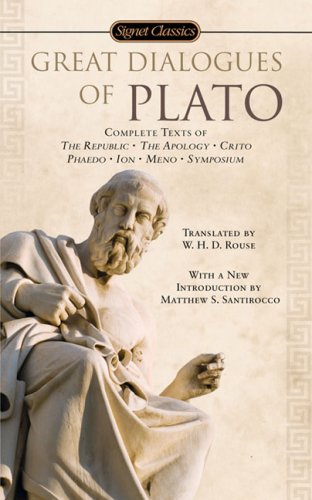 | Paperback: 656
Pages
(2008-03-04)
list price: US$6.95 -- used & new: US$3.52 (price subject to change: see help) Asin: 0451530853 Average Customer Review: 
Canada | United Kingdom | Germany | France | Japan |
|
Editorial Review Product Description Customer Reviews (15)
| |
| 22. Critias by Plato | |
 | Paperback: 48
Pages
(2010-01-29)
list price: US$11.95 -- used & new: US$11.94 (price subject to change: see help) Asin: 1407614886 Canada | United Kingdom | Germany | France | Japan |
|
Editorial Review Product Description | |
| 23. Symposium by Plato | |
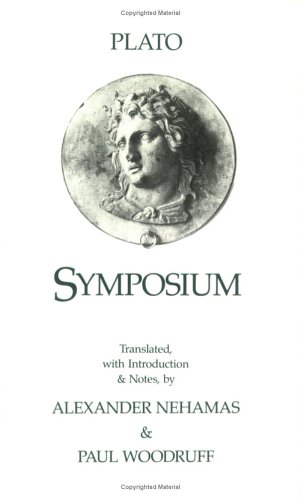 | Paperback: 107
Pages
(1989-05)
list price: US$8.95 -- used & new: US$4.95 (price subject to change: see help) Asin: 0872200760 Average Customer Review: 
Canada | United Kingdom | Germany | France | Japan |
|
Editorial Review Product Description Customer Reviews (10)
| |
| 24. Republic (Oxford World's Classics) by Plato | |
 | Paperback: 560
Pages
(2008-05-15)
list price: US$9.95 -- used & new: US$6.15 (price subject to change: see help) Asin: 0199535760 Average Customer Review: 
Canada | United Kingdom | Germany | France | Japan |
|
Editorial Review Product Description Customer Reviews (4)
| |
| 25. The Symposium (Penguin Classics) by Plato | |
 | Paperback: 144
Pages
(2003-04-29)
list price: US$9.00 -- used & new: US$3.90 (price subject to change: see help) Asin: 0140449272 Average Customer Review:
Canada | United Kingdom | Germany | France | Japan |
|
Editorial Review Product Description Customer Reviews (8)
| |
| 26. The Collected Dialogues of Plato: Including the Letters (Bollingen Series LXXI) by Plato | |
 | Hardcover: 1776
Pages
(2005-09-15)
list price: US$49.50 -- used & new: US$37.85 (price subject to change: see help) Asin: 0691097186 Average Customer Review: 
Canada | United Kingdom | Germany | France | Japan |
|
Editorial Review Product Description Customer Reviews (12)
| |
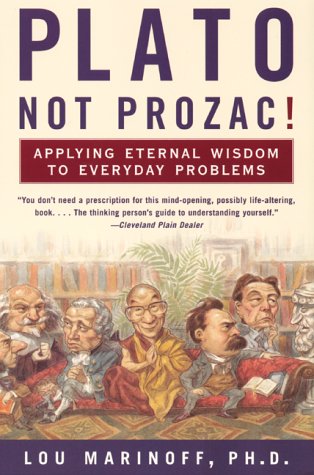
| 27. Plato, Not Prozac!: Applying Eternal Wisdom to Everyday Problems by Lou Marinoff | |
 | Paperback: 320
Pages
(2000-08-01)
list price: US$13.00 -- used & new: US$1.95 (price subject to change: see help) Asin: 0060931361 Average Customer Review:
Canada | United Kingdom | Germany | France | Japan |
|
Editorial Review Product Description If you're facing a dilemma -- whether it's handling a relationship, living ethically, dealing with a career change, or finding meaning in life -- the world's most important thinkers from centuries past will help guide you toward a solution compatible with your individual beliefs. From Kirkegaard's thoughts on coping with death to the I Ching's guidelines on adapting to change, Plato, Not Prozac! makes philosophy accessible and shows you how to use it to solve your everyday problems. Gone is the need for expensive therapists, medication, and lengthy analysis. Clearly organized by common problems to help you tailor Dr. Lou Marinoff's advice to your own needs, this is an intelligent, effective, and persuasive prescription for self-healing therapy that is giving psychotherapy a run for its money. Customer Reviews (33)
| |
| 28. The Last Days of Socrates by Plato | |
 | Paperback: 168
Pages
(2010-05-06)
list price: US$12.00 -- used & new: US$10.80 (price subject to change: see help) Asin: 1452847096 Average Customer Review:
Canada | United Kingdom | Germany | France | Japan |
|
Editorial Review Product Description Customer Reviews (12)
| |
| 29. Republic by Plato, C. D. C. Reeve | |
 | Paperback: 392
Pages
(2004-09-30)
list price: US$10.95 -- used & new: US$4.00 (price subject to change: see help) Asin: 0872207366 Average Customer Review:
Canada | United Kingdom | Germany | France | Japan |
|
Editorial Review Product Description Customer Reviews (10)
| |
| 30. Symposium (Oxford World's Classics) by Plato | |
 | Paperback: 160
Pages
(2009-01-15)
list price: US$8.95 -- used & new: US$4.63 (price subject to change: see help) Asin: 0199540195 Canada | United Kingdom | Germany | France | Japan |
|
Editorial Review Product Description | |
| 31. Plato: Timaeus, Critias, Cleitophon, Menexenus, Epistles (Loeb Classical Library No. 234) (v. 9) by Plato | |
 | Hardcover: 656
Pages
(1929-01-01)
list price: US$24.00 -- used & new: US$19.20 (price subject to change: see help) Asin: 0674992571 Average Customer Review:
Canada | United Kingdom | Germany | France | Japan |
|
Editorial Review Product Description Plato, the great philosopher of Athens, was born in 427 BCE. In early manhood an admirer of Socrates, he later founded the famous school of philosophy in the grove Academus. Much else recorded of his life is uncertain; that he left Athens for a time after Socrates' execution is probable; that later he went to Cyrene, Egypt, and Sicily is possible; that he was wealthy is likely; that he was critical of 'advanced' democracy is obvious. He lived to be 80 years old. Linguistic tests including those of computer science still try to establish the order of his extant philosophical dialogues, written in splendid prose and revealing Socrates' mind fused with Plato's thought. In Laches, Charmides, and Lysis, Socrates and others discuss separate ethical conceptions. Protagoras, Ion, and Meno discuss whether righteousness can be taught. In Gorgias, Socrates is estranged from his city's thought, and his fate is impending. The Apology (not a dialogue), Crito, Euthyphro, and the unforgettable Phaedo relate the trial and death of Socrates and propound the immortality of the soul. In the famous Symposium and Phaedrus, written when Socrates was still alive, we find the origin and meaning of love. Cratylus discusses the nature of language. The great masterpiece in ten books, the Republic, concerns righteousness (and involves education, equality of the sexes, the structure of society, and abolition of slavery). Of the six so-called dialectical dialogues Euthydemus deals with philosophy; metaphysical Parmenides is about general concepts and absolute being; Theaetetus reasons about the theory of knowledge. Of its sequels, Sophist deals with not-being; Politicus with good and bad statesmanship and governments; Philebus with what is good. The Timaeus seeks the origin of the visible universe out of abstract geometrical elements. The unfinished Critias treats of lost Atlantis. Unfinished also is Plato's last work of the twelve books of Laws (Socrates is absent from it), a critical discussion of principles of law which Plato thought the Greeks might accept. The Loeb Classical Library edition of Plato is in twelve volumes. Customer Reviews (3)
| |
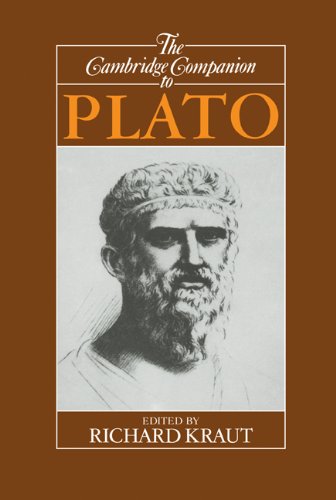
| 32. The Cambridge Companion to Plato (Cambridge Companions to Philosophy) | |
 | Paperback: 576
Pages
(1992-10-30)
list price: US$41.99 -- used & new: US$30.00 (price subject to change: see help) Asin: 0521436109 Average Customer Review:
Canada | United Kingdom | Germany | France | Japan |
|
Editorial Review Product Description Customer Reviews (6)
Given this, it may surprise those unfamiliar with Plato to learn that the interpretation of him has always been the subject of hot dispute - perhaps only Nietzsche among philosophers has inspired more controversy. Why is this? Why is Plato so easy to read and yet so difficult? Five problems are worth calling out: (1) Dramatic presentation: All of Plato's published works are presented as dialogues between characters - Plato himself is never a character. Thus, any interpretation must have some mapping (implicit or explicit) between the characters' views and Plato's views, as well as how the dramatic structure (setting, characters, story) as a whole presents Plato's views. (2) Irony: The main speaker in most of Plato's dialogues is Socrates, a character who often speaks ironically. Other characters can be read as sometimes being ironical as well (such as The Athenian in the dialogue "Laws"). Any interpretation must determine when a character is speaking ironically and when seriously. (3) Stories/Myths: Characters in Plato's dialogues often tell stories whose subject matter is mythological - they concern Gods and Goddesses, the afterlife,and other subject matter beyond ordinary human experience. Any interpretation that deals with them must determine how they are to be read. (4) The Platonic Lie: In "The Republic", Plato endorses (or seems to endorse) lying as a means of instilling beneficial beliefs in audiences that are unable to acquire philosophical knowledge. A beneficial belief is one that is not true in its substance, but which, if believed, will tend to the same end as would the corresponding knowledge. If we accept that this is Plato's view, then interpretations must consider whether views expressed in the dialogues are themselves Platonic Lies, and not real representations of Plato's thought. (5) Historical Background: Plato lived in a time and place different from our own, whose language, customs, intellectual background, and attitudes are not ours. This is a much bigger problem than just unfamiliar names - it is the unconscious attitudes we absorb from our culture (and he from his) of which we are not necessarily even consciously aware. Different interpreters do not read these influences the same way (there is no book we can all go to called "How We Thought About Things", authored by "The Ancient Greeks"). With regard to these issues, the dominant view in "A Cambridge Companion to Plato" is something I would call Platonic Fundamentalism: "Socrates says what Plato means, and he means what he says" (this is after the Christian Fundamentalist credo: "The Bible says what it means and it means what it says"). A difficulty with this view is that it leaves Plato contradicting himself an awful lot. The general solution presented here is the evolving-Plato theory - that the dialogues were written over a long period of time and that the contradictions represent real changes in Plato's views. The collection thus abounds in references to Plato's "early dialogues" or "middle dialogues" or "late dialogues". Now, there are certainly Plato scholars, past and present, who do not accept this particular interpretive framework, but their views, if raised at all,are raised only so that they may be dismissed (sometimes in the same sentence). Those looking for substantial engagement on the problems of Platonic interpretation must look elsewhere. So, given that the book does not aim to present the scholarly debate on interpreting Plato, it is fair to ask: what does it aim to do? This is an excellent question, but I could not find the answer to it in the book itself. If it were for the beginning reader, I would think it would focus on the order of reading, and on prepping the reader with background info for each dialogue so as to make reading it more rewarding. But it doesn't do anything like that. If it were for the intermediate reader, I would think it would focus on illuminating doubtful passages or drawing connecting webs across disparate ones. But it doesn't do that either. If it were for the advanced reader, I would think it would focus on the debates in the secondary literature, and that it would be used by peers to address peers on controversies. But it doesn't do that either. So, when it comes to the ultimate question of whether I should recommend the book or not, I just can't think of anyone to whom I would recommend it. Finally, to take another tack at how worthwhile a book is: the basic challenge any work of secondary literature must face is whether it is more profitable to read it, or to give the primary literature another reading instead. The only work in the collection that I would say clearly passes that test is Constance Meinwald's essay on "Parmenides" (for those who don't know, "Parmenides" is by far the most formidable work in the Platonic corpus - the first half works to demolish the theory of Forms that we might otherwise hold to be Plato's view, and the second half defies the ability of most readers to make any sense of at all). Even here, however, if you want to read Meinwald's theories on "Parmenides" (and they are worth reading), you would do better to get her book "Plato's Parmenides" than to read the essay excerpted from that book included here.
Like all books in the Cambridge series, the Companion to Plato consists of a number of essays written by preminent scholars. These essays explain and evaluate various aspects of Plato's philosophy, from "the defense of justice in Plato's Republic" to "mathematical method and philosophical truth." Like any philosophy textbook, The Cambridge Companion to Plato can, at times, be dense. I won't recommend it for everbody; a hearty interest in learning philosophy is definately required. However, I've found it to be one of the finest introductions to Plato in his philosophy. It provides a good foundation for actual reading of Plato's texts, which is the next logical step beyond this book. It is also perfect for those who wish to gain a working understanding of Plato's view of the world but, like me, simply do not have the patience to garner it from Plato's own work.
| |
| 33. Plato: Apology (Greek Edition) by Plato | |
 | Paperback: 127
Pages
(1997-03-01)
list price: US$27.00 -- used & new: US$21.00 (price subject to change: see help) Asin: 0865163480 Average Customer Review:
Canada | United Kingdom | Germany | France | Japan |
|
Editorial Review Product Description Also available: Meleager: The Poems - ISBN 0865162549 For over 30 years Bolchazy-Carducci Publishers has produced the highest quality Latin and ancient Greek books. From Dr. Seuss books in Latin to Plato's Apology, Bolchazy-Carducci's titles help readers learn about ancient Rome and Greece; the Latin and ancient Greek languages are alive and well with titles like Cicero's De Amicitia and Kaegi's Greek Grammar. We also feature a line of contemporary eastern European and WWII books. Some of the areas we publish in include: Selections From The Aeneid Customer Reviews (4)
| |
| 34. Plato's Political Philosophy by Mark Blitz | |
 | Paperback: 336
Pages
(2010-09-28)
list price: US$24.95 -- used & new: US$17.96 (price subject to change: see help) Asin: 0801897653 Canada | United Kingdom | Germany | France | Japan |
|
Editorial Review Product Description This comprehensive, yet compact, introduction examines Plato's understanding of law, justice, virtue, and the connection between politics and philosophy. Focusing on three of Plato's dialogues -- The Laws, The Republic, and The Statesman -- Mark Blitz lays out the philosopher's principal interests in government and the strength and limit of the law, the connection between law and piety, the importance of founding, and the status and limits of political knowledge. He examines all of Plato's discussions of politics and virtues, comments on specific dialogues, and discusses the philosopher's explorations of beauty, pleasure, good, and the relations between politics and reason. Throughout, Blitz reinforces Plato's emphasis on clear and rigorous reasoning in ethics and political life and explains in straightforward language the valuable lessons one can draw from examining Plato's writings. The only introduction to Plato that both gathers his separate discussions of politically relevant topics and pays close attention to the context and structure of his dialogues, this volume directly contrasts the modern view of politics with that of the ancient master. It is an excellent companion to Plato's Dialogues. | |
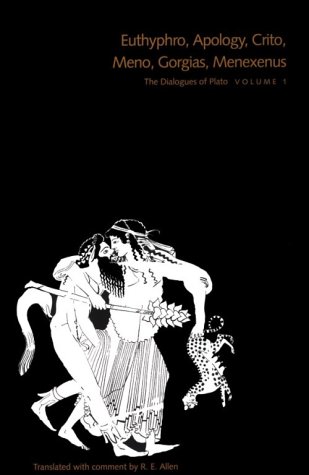
| 35. The Dialogues of Plato, Volume 1: Euthyphro, Apology, Crito, Meno, Gorgias, Menexenus (v. 1) by Plato | |
 | Paperback: 352
Pages
(1989-09-10)
list price: US$26.00 -- used & new: US$12.00 (price subject to change: see help) Asin: 0300044887 Average Customer Review:
Canada | United Kingdom | Germany | France | Japan |
Customer Reviews (3)
| |
| 36. Phaedrus (Penguin Classics) by Plato | |
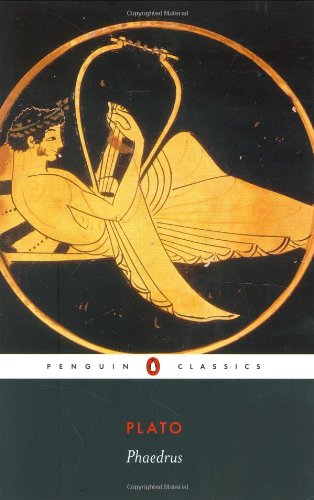 | Paperback: 176
Pages
(2005-12-27)
list price: US$11.00 -- used & new: US$5.45 (price subject to change: see help) Asin: 0140449744 Average Customer Review:
Canada | United Kingdom | Germany | France | Japan |
|
Editorial Review Product Description Customer Reviews (2)
| |
| 37. Plato on Love: Lysis, Symposium, Phaedrus, Alcibiades, with Selections from Republic and Laws by Plato | |
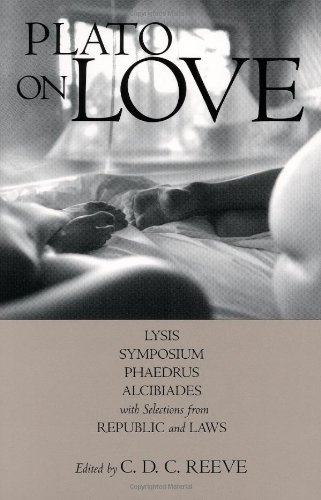 | Paperback: 272
Pages
(2006-03-30)
list price: US$13.95 -- used & new: US$10.39 (price subject to change: see help) Asin: 0872207889 Average Customer Review:
Canada | United Kingdom | Germany | France | Japan |
|
Editorial Review Product Description Reeve's Introduction provides a wealth of historical information about Plato and Socrates, and the sexual norms of classical Athens. His introductory essay looks closely at the dialogues themselves and includes the following sections: Socrates and the Art of Love; Socrates and Athenian Paiderastia; Loving Socrates; Love and the Ascent to the Beautiful; The Art and Psychology of Love Explained; and Writing about Love. Customer Reviews (2)
| |
| 38. Gorgias by Plato Plato, Gonzalez Lodge | |
 | Paperback: 328
Pages
(2010-08-23)
list price: US$31.75 -- used & new: US$22.92 (price subject to change: see help) Asin: 1177633884 Average Customer Review:
Canada | United Kingdom | Germany | France | Japan |
|
Editorial Review Product Description Customer Reviews (8)
| |
| 39. Plato's Republic (complete) by Plato | |
 | Paperback: 356
Pages
(2009-10-18)
list price: US$19.95 -- used & new: US$18.04 (price subject to change: see help) Asin: 144955105X Average Customer Review:
Canada | United Kingdom | Germany | France | Japan |
|
Editorial Review Product Description Customer Reviews (6)
| |
| 40. Plato's Symposium: A Translation by Seth Benardete with Commentaries by Allan Bloom and Seth Benardete by Plato | |
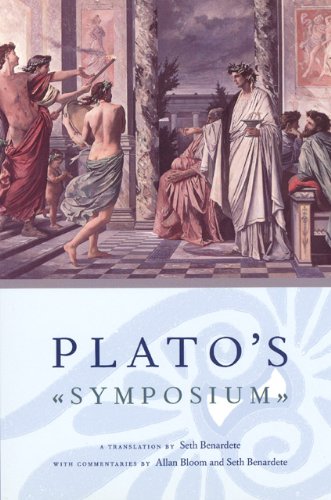 | Paperback: 199
Pages
(2001-02-01)
list price: US$18.00 -- used & new: US$12.96 (price subject to change: see help) Asin: 0226042758 Average Customer Review:
Canada | United Kingdom | Germany | France | Japan |
|
Editorial Review Product Description Customer Reviews (7)
| |
| Back | 21-40 of 98 | Next 20 |
 Plato is great, but this translation is not
 NEVER RECEIVED THE BOOK!!
 Your time and money are better spent elsewhere