e99 Online Shopping Mall

Geometry.Net - the online learning center Help  
Home  - Philosophers - Popper Karl (Books)

  1-20 of 100 | Next 20
A  B  C  D  E  F  G  H  I  J  K  L  M  N  O  P  Q  R  S  T  U  V  W  X  Y  Z  

click price to see details     click image to enlarge     click link to go to the store

$13.24
1. The Logic of Scientific Discovery
$22.31
2. Popper Selections
$9.50
3. Conjectures and Refutations: The
$23.30
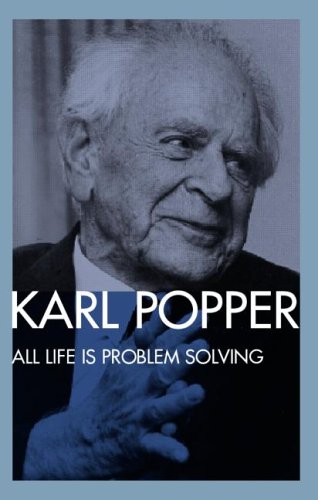
4. All Life is Problem Solving
$27.90
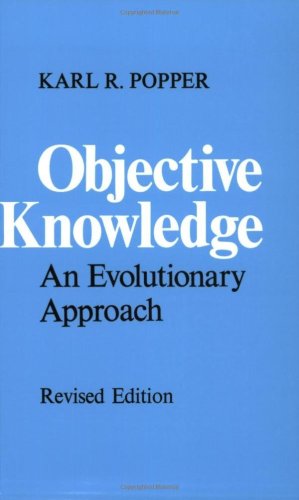
5. Objective Knowledge: An Evolutionary
$98.90
6. The Open Society and Its Enemies
$88.55
7. Unended Quest (Routledge Classics)
$12.00
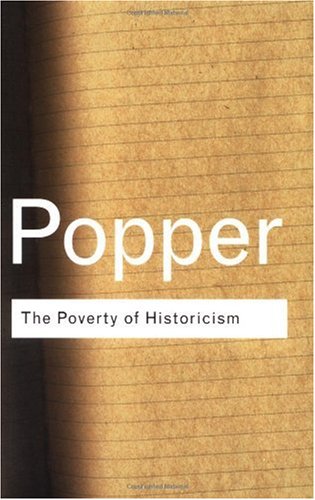
8. The Poverty of Historicism (Routledge
$15.55
9. Philosophy and the Real World:
 
10. Philosophy of Karl Popper (The
$33.17
11. Myth of the Framework: In Defence
 
$46.21
12. La Sociedad Abierta Y Sus Enemigos/
$99.95
13. Karl Popper, a Centenary Assessment
$99.95
14. Karl Popper: a Centenary Assessment
$99.95
15. Karl Popper, a Centenary Assessment
 
16. In Pursuit of Truth: Essays on
$43.99
17. The Open Universe: From the Postscript
$29.13
18. Popper's Open Society After Fifty
 
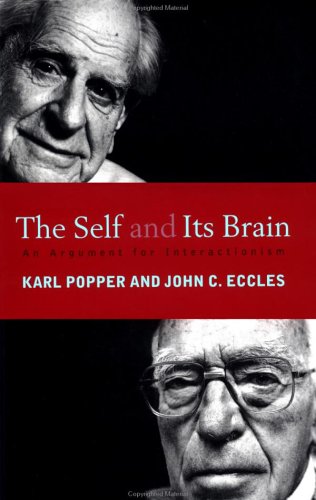
19. The Self and Its Brain
$31.45
20. Quantum Theory and the Schism

1. The Logic of Scientific Discovery (Routledge Classics)
by Karl Popper
Paperback: 544 Pages (2002-03-29)
list price: US$20.95 -- used & new: US$13.24
(price subject to change: see help)
Asin: 0415278449
Average Customer Review: 4.5 out of 5 stars
Canada | United Kingdom | Germany | France | Japan
Editorial Review

Book Description
When first published in 1959, this book revolutionized contemporary thinking about science and knowledge. It remains the one of the most widely read books about science to come out of the twentieth century. ... Read more

Customer Reviews (15)

5-0 out of 5 stars A philosphical classic
Not exactly light reading, but a great reference work, and a clear expostion of Popper's Falsificationism. This methodology is widely regarded as the leading tool for demarcating between science and non-science or pseudo-science.

5-0 out of 5 stars Very interesting
I have to ask myself, "What is the basis for my scientific knowledge?"On a daily basis, as I am a chemist.I have often been struck by arguments for "induction" as lacking credibility, because how can one argue of probabilities with an unknown sample size?Popper argues that a proposing scientific hypothesis is an inductive act, but it is a creative act not a logical one, but that scientific knowledge is dedective.

I agree with him.The nature of science is such that one must put for statements about how the world works and test them.A scientist should always try to find a way of proving himself or herself wrong.If the predictions of the test are shown to be false, then the hypothesis must be false.That is the basis of scientific knowledge.The rest, the best theories we have are just "working models" and we can never justify why they work.They're simply our best working models now.


I don't find Popper's argument disheartening.Popper points out that we don't have to justify our search for explanations of the world, because they may do us benefit (if we happened to live in a world with stable physical laws, for instance).

I think many scientists would fundamentally agree that the laws of nature can never really be proven.They can't, but they speak volumes about what is relevant to us as a species (which is why Popper's argument that "induction" is creative is so interesting).All Popper asks of a scientific hypothesis is that it can, in principle, be demonstrated false by experience.

This is by far one of the most interesting and (I feel) important books I've ever read.

5-0 out of 5 stars Popper's magnum opus
The Logic of Scientific Discovery is in my view Karl Popper's finest work.When I studied science I was amazed at the insight Popper had into the scientific method of inquiry, and I admired his refusal to accept intellectual garbage.

While Popper has come under strong attack from both scientists and philosophers for several shortcomings in his work, in my view Popper has framed one of the most important studies of scientific knowledge and how it is gained, and the difference between science and non-science.

I agree with Popper's argument that the key feature of scientific theories is that they are 'falsifiable.'By this Popper simply meant that a scientific theory, even if beautiful, can be shown wrong by empirical observation.While this account is no doubt oversimplified and leaves out the key social and historical dimensions to science (which thinkers such as Kuhn addressed later on), this principle remains central to science; as Feynman said, 'If it disagrees with experiment, it is wrong.'The fallibility of science in Popper's view was the key to its strength, in contrast to pseudo-sciences such as Marxism and Freudian psychology, which while containing elements of truth, set themselves up as infallible truths and glossed over things which contradicted the belief system.

Popper also wrote many other philosophical works, including an important study of the difference between democratic political societies and ones ruled by totalitarian ideaology.However, he rightly deserves fame as one of the most important 20th century philosophers of science.

2-0 out of 5 stars A philosopher's view of science
In this book Popper presents two contradictory theses: (a) science can be based on deductive logic only, and there is no need for induction; (b) science cannot have a logical basis.

Because deduction yields sure knowledge if it is based on sure knowledge and induction always produces only hypothetical knowledge, as Bertrand Russell clearly stated, Popper begins by trying to show that the use of deduction instead of induction can provide a solid logical basis for science. He talks about replacing "inductivism" by "deductivism." In reality, he explains the use of deduction in the testing of a theory: consequences are deduced from the theory and are compared with known facts, which is something known by many. Induction, on the other hand, is used in creating hypotheses in both experimental and theoretical investigations and is again used in generalizing the results of tests (a) to all other possible tests in experimental investigation, and (b) also to some phenomena that cannot be used to test the theory created using the hypothesis, or hypotheses, that are produced inductively. When Popper claims that inductivism can be replaced by deductivism, he is unaware of the fact that induction is used at the beginning of both experimental and theoretical investigations to create hypotheses and again at the end of the investigation to generalize the test results.

But in the rest of the book, Popper concentrates on the generalization of test results, which is done through induction and is what he overlooked to begin with, as explained above. Consequently, Popper proves rightly that scientific knowledge cannot be produced using deductive logic, which is the opposite of what he tried to prove earlier.

The truth is that new knowledge is not a product of logic but is learned from the world about singular phenomena and is generalized through induction. Induction does not yield logically sure knowledge, but evolution created the human brain/mind so that it knows that it has to trust induction. Thus, everyone avoids hitting his or her head against hard objects by learning from past experience through induction. Someone who does not trust such inductive knowledge is punished severely. Similarly, when a scientist or an engineer does not use an accepted theory anywhere in his or her work, he or she is likely to be punished by failure and its consequences of many kinds.

Popper's views should serve to waken up those who seek the comfort of producing all knowledge through deduction only, but in fact, they shed doubt mostly on theories, because a theory is not deduced from anywhere, unlike empirical knowledge is, about some singular phenomena. A theory is constructed and tested by using induction or deduction, as necessary, at various stages of the total process on the basis of empirical knowledge. Popper's views are those of a philosopher who is not familiar with the mission and methods of science and thinks that science is about discovering something that can be called the absolute truth. Read also my evaluation of Kuhn's views.

Another erroneous idea of Popper is that theories can be falsified but cannot be verified. It is true that if a new theory is falsified by a few or even a single test, there is usually no more wish to keep testing it. But when an accepted theory is falsified by one phenomenon, it is not discarded as invalid. Its use continues where it gives good results. It is also true that a theory cannot be verified in an absolute sense, but this is true also about empirical knowledge. The generality of any knowledge is a consequence of induction which is forced upon the mind by the results of evolution, as mentioned. The verification of a theory, or any knowledge, means that it can be used where it gives useful results. Unfortunately, the impossibility of the logical or experimental validation of knowledge in a general way is seen as a weakness of only theories by those who ignore what a theory is and how it is constructed, tested, and used.

5-0 out of 5 stars The basis of empiricism
This is a seminal work in the philosophy of empiricism. A must-read for anyone who considers themselves educated in science. Beware comments from nutcase pseudoscience shills such as "Archimedes_tritium" below ("...the foundation and original source it flows from is now identified and recognized to be fouled..."). Time and again it has been shown that science never "proves" anything; it can only show things to be false. Anyone who disputes that is whistling in the dark because he is afraid to think that we might not actually be masters of our own universe. ... Read more


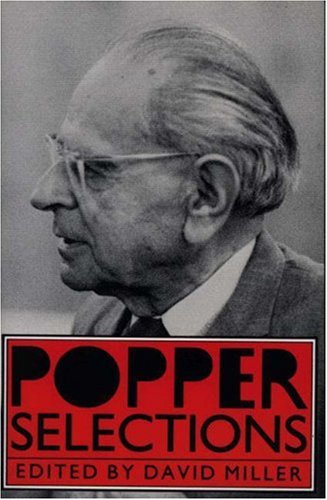
2. Popper Selections
by Karl Raimund Popper
Paperback: 480 Pages (1985-02-01)
list price: US$35.00 -- used & new: US$22.31
(price subject to change: see help)
Asin: 0691020310
Average Customer Review: 5.0 out of 5 stars
Canada | United Kingdom | Germany | France | Japan

Customer Reviews (7)

5-0 out of 5 stars An excellent collection of Popper's work, especially for the laymen
This book presents a great selection of Popper's writings, a real a crash course on the thinking of one of the greatest philosophers of science of the 20th century. The book also presents his work regarding social and political philosophy. As almost any text dealing with philosophy, a calm and slow reading is absolutely required to fully grasp Popper's ideas, especially if you are a layman like me.I mean, this is not the kind of page-turner you can read entirely during a flight. This collection allows you to learn about Popper's legacy without the burden of reading his whole work, which I guess is almost reserved for scholars and students of philosophy.

I particularly enjoyed his ideas regarding the philosophy of science and scientific progress, specifically his critical rationalism and the concept of falsifiability (meaning that a hypothesis must be falsifiable and that a proposition or theory cannot be called scientific if it does not admit the possibility of being shown false). I highly recommend this book for those with a serious interest in the evolution of science and the scientific method. A worthy follow up to Sir Karl's views on science would be Thomas S. Kuhn's "The Structure of Scientific Revolutions" (1962). Tough many ideas between these two philosophers of science are similar, Kuhn, in his book "The Essential Tension: Selected Studies in Scientific Tradition and Change" (1977), presents an interesting discussion in Chapter 11 (Logic of Discovery or Psychology of Research) about the disagreements between his views and Popper's regarding scientific development.

By the way, Popper's ideas come very handy and this book is a must-read for those with a genuine interest in the trustworthiness of science behind the current "Consensus Theory" explaining the causes of Global Warming. You can bet that in a few years the way most climate scientists are handling simulation modeling, making predictions with an immature science, with selective interpretation of weather data will become a textbook case of politicized science, together with complete disregard for the most basic principles of the scientific method, including the fact that no criticism is allowed. As Popper said:

"If we are uncritical we shall always find what we want: we shall look for, and find, confirmations, and we shall look away from, and not see, whatever might be dangerous to our pet theories. In this way it is only too easy to obtain what appears to be overwhelming evidence in favor of a theory which, if approached critically, would have been refuted". The Poverty of Historicism (1957).

5-0 out of 5 stars Science's and Society's Philosopher
Warning: I am highly biased, as Karl Popper is one of my most influential "mentors." As time passes, his wisdom increases, and his value as an original thinker becomes more, not less, vivid -- even if many of his "controversial" ideas in the Thirties are now considered normative.

Popper's collected essays, derived from class lectures, offers a broad introduction to the work of this seminal philosophy. These essays cover scientism, the scientific method, the scientific attitude, nominalism, historicism, democracy, falsification principle, evolutionary thought and applications, rationality, epistemology, and more.

While heralded as the scientists' philosopher of science, Popper's thought is not so provincial. His brevity and clarity of analysis are brought to bear on many subjects, practical and theoretical. His perspicacity and directness leave no room for ambiguity. The one philosophical topic not addressed in this representative volume is ethics.

Popper's central theme, of course, is science and how the scientific attitude and method fundamentally change our modern perceptions. While no longer controversial, indeed his thought has become commonsense, he, alone of the Vienna Circle, survived intact decades later. Because of the clarity, incisiveness, and rectitude of his claims, I purposefully return to him every five or so years to get "grounded" again.

One doesn't experience "eurkea" with Popper, one simply becomes reacquainted with basic knowledge and a few first principles. Perhaps a few "tweaks" occur, but Popper is more of an anchor than a revolutionary. Even his "defense" of science comes with numerous caveats. Given the topsy-turvy intellegensia stirring up the pot with new "-isms," it's useful to have a "home" to come back to. Because his commonsense prevails, his controversial stances several decades ago, while not quite platitudes now, are "defaults" that have withstood the strongest assaults. I cannot think of another major thinker who has withstood time and challenges better.

A couple of examples of Popper's gems: Democracy is not the best form of government; rather, it is the best form for excising bad government (this novel insight, a Popper first, is repeated by many subsequent political theorists, e.g., Ian Shapiro, Michael Walzer, John Rawls, etc.). An "open society" is more important, but this preeminent value requires the "background" of democracy. Central planning by governments should be confined to the margins, tinkering with changes that can be reversed before bad policy and unintended consequences become ensconced. If useful, then begin the reach. His skepticism does not permit purchase of any ideology. All historicisms are fortune-telling religious dogma, erroneously believing the past predicts the future, or that "inevitability" resides with the forces of History. Humans exist in an "open" environment, while science's predictability requires a "closed" environment; ergo, all "human sciences" are at best informed or educated guesses. Their ability to predict is next to nil.

Again, these Popperean gems may no longer be earth-shaking insights, but they once were, and the repitition of these claims is welcome against the ever-advancing onslaught of new "-isms." Popper's innately skeptical stances are a constant reminder that our fantasies can become our nightmares. This is most evident with science, where Popper insists that all knowledge, even scientific knowledge, is "tentative" at best. It's not just its verification, but ultimately its falsification, that requires this tentative stance. And, just because "science can," does not mean "science should:" Technology must "be harnassed."

An encounter with Popper leaves one speechless. Contentious by nature, I try to find loopholes in his claims; Popper does not leave many, if any. I'm still puzzled by his appeal to nominalism, but I cannot fault his logic. His thought experiment with tripartite worlds (not "universes") of the empirical, the conscious, and their overlap, is one of the best examples of Occam's Razor. But above all, Popper is as accessible as he is grounded. His clarity, brevity, and incisiveness are not common to philosophers, and thus, all the more welcome. He may not change your life, but he will provide a needed grounding for further venture!

4-0 out of 5 stars Book in great condition!
This book came to me quickly and efficiently.Its contents were in terrific condition and I feel that Amazon.com did a great job at satisfying my expectations.

5-0 out of 5 stars The Tradition of Critical Discussion + more..
Brilliant, clearly written, and wonderfully brief essays that span the life works of Karl Popper, organized into four parts: Theory of Knowledge, Philosophy of Science, Metaphysics, and Social Philosophy.

Perhaps best known for his 'Open Society and Its Enemies' (written during WWII while in New Zealand), Popper is clearly an advocate of open and free debate in all academic disciplines.Against solving irrelevant 'puzzles of language' - a habit of philosophers and Ludwig Wittgenstein in particular (Read book on this: 'Wittgenstein's Poker') - Popper is most concerned with solving real world 'problems' that impact human life.'Our ignorance is sobering and boundless' he suggests but, together, through open-ness we can move toward finding ever-adjusting solutions for a better world.

Like other survivors of WWII (e.g. Isaiah Berlin), Popper is especially concerned with those who advocate 100% solutions to society's woes.One of our clearest advocates of the lessons of the Ancient Greeks, Popper tells us: The 'tradition of critical discussion' was the secret of the ancients.This tradition leads us to the realization that our attempts to find 'truth' are never final; and that criticism and critical discussion are our only means of getting nearer to the truth.

For those interested in: 1) Clear-headed discussions on science and philosophy, and 2) Hearing from a strong advocate of freedom and the 'western tradition' read this book.And bring a pencil.

5-0 out of 5 stars Critical Rationalism
Popper's favorite philosophers are the pre-Socratics. He celebrates them for their willingness to entertain/invite/encourage alternative points of view.The pre-Socratics sought to explain the universe ( a goal modern philososphy/science has lost sight of) but no one theory was viewed as absolute, rather each theory was viewed as a proposition that could then be honed/improved/altered by further argument/inquiry. This spirit of inquiry begins to vanish around the time of Plato and Aristotle for their teachings begin to be passed down not as theories that can be improved upon (modified or dismissed) but as knowledge. For Popper reverence for "great men" and "great ideas" only stands in the way of pluralism and progress.

Poppers method is to identify the mistakes made by the "great men"and therefore clear the way for further inquiry.Of all the western philosphers Plato receives the most attention.Popper finds much to admire in Plato but also much that needs amending. In an essay on "subjective" and "objective" knowledge Popper evolves his idea of a third "world" of knowledge. This autonomous third world of knowledge isreminiscent of Plato's theory of ideal forms with one essential difference.For Popper all knowledge is man made and so his third world of knowledge contains not ideals(in Popper's world ideals do not exist) but "problem situations" -- the state of a discussion or the state of a critical argument at the present time and these "states" make up the "objective contents of thought".

In the world according to Popper thought ( in the philosophic and scientific realms) evolves because a variety of thinkers make a variety of creative propositions that are then examined and found to be true or false. Popper calls this method "critical rationalism".

In each of these essays Popper addresses a key philosophic issue and discusses it with his signature grace, eloquence and humor.His contribution to social theory seems especially significant and on this topic he is especially eloquent.Being no great believer in the great man theory of history and knowing full well that all of mans ideas as well as social theories are riddled with mistakes Popper thinks the best way to advance socially is in a piecemeal fashion. This limits the harm any one man or theory or institution can do. For Popper society like philosophy and knowledge is the result of an ever renewed inquiry.

This is clearsighted and jargon free writing and these are model essays! ... Read more


3. Conjectures and Refutations: The Growth of Scientific Knowledge (Routledge Classics)
by Karl R. Popper
Paperback: 688 Pages (2002-08-09)
list price: US$19.95 -- used & new: US$9.50
(price subject to change: see help)
Asin: 0415285941
Average Customer Review: 4.5 out of 5 stars
Canada | United Kingdom | Germany | France | Japan
Editorial Review

Book Description
This classic remains one of Karl Popper's most wide-ranging and popular works, notable not only for its acute insight into the way scientific knowledge grows, but also for applying those insights to politics and to history. ... Read more

Customer Reviews (9)

5-0 out of 5 stars My conjecture on this book
Written with atypically clear prose and full of wit and insight.Sir Popper is truly one of the 20th century's greatest minds.

5-0 out of 5 stars Conjectures and Refutations
This is Popper at his mature full authoritive best. This work connects his early classic on Open Society with the works of contemporary philosiphers as well as with the Greeks. Popper makes the connection with modern science and it's foundations from the ancients. Anyone how has failed to avail themselves of Poppers insights into knowing and learning is the poorer for it.

5-0 out of 5 stars How do we know what we know? We don't, we only guess...
We guess. We make up a story that explains the phenomena we observe. Why is there night and day? Because the sun rises from the east and sets itself down in the west. Aha! Let's check that. Let's go east. After a while we realize that we're living on a sphere and so we know our story is wrong. The sun does not rise up and set. So what does it do? We're on a ball and the sun is above and it moves around us! Great! Problem solved. But wait! Let's check that. The stars also move. Let's plot their course, and then... and so on and so forth.

For Popper, this is how we've built up our picture of the world. We make bold conjectures to explain what we see see and then we check, or rather we establish a failure test. If the test is true, then our guess is false. But if we only test to see if a guess is false, rather than to try and prove that it's true, then how do we know our guess is true? Popper answers that we do not and cannot ever know that. Knowledge lies beyond our grasp, we can only seek knowledge without ever hoping to attain it.

This is the central theme of Conjectures and Refutations, which itself is a comprehensive overview of Popper's epistemological thought. The book is divided in two parts titled, you guessed it, I-Conjectures and II-Refutations.

Part I, Conjectures, comprises the first ten chapters. Popper begins with an overview of his thesis, then explores the nature of the problems that face people who think about the world and who act in it (chapter 2), he presents three other views of what we mean by knowledge (ch. 3), he describes tradition and the history of thought (chapters 4 to 6) and then turns to a critique of Kant, and of the effect that Newton's astonishingly successful theory of gravity, unrefuted for over 200 years, had on the development of western science (chapter 7). Popper then closes part I with discussions on what the difference is between science and metaphysics, on why mathematics works so well in describing the world, and finally on the nature of scientific knowledge, i.e. what do we mean by "knowledge".

In part II, Refutations, Popper does not present anything, he destroys existing theories which he feels are wrong. He returns to metaphysics and because it deals in existential statements that are irrefutable (e.g. you can't prove the Devil's existence or non-existence) he seeks to separate its pursuits from that of science. Science deals only in refutable statements.

Then Popper attacks other theories and problems. He gives a succinct summary of his attack on historicism, his name for the belief that History follows laws (e.g. Marxism) and that historians should be able to predict the future course of mankind.

In short, Conjectures and Refutations is a complete introduction to Popper's thinking. It sketches out all his thoughts on the social sciences and describes in fair detail his thinking on the development of science. He ends on a positive note. It may seem depressing that we can never obtain true knowledge, but we can certainly find sufficiently rich rewards in the pursuit of it.

5-0 out of 5 stars Conjectures and Refutations
This book is divided into two sections - "Conjectures" and "Refutations".Roughly, or not so roughly, these titles refer to the basic aim of the essays divided under them.Moreover, the process of conjecture and refutation is itself the primary theory threading these various essays together. The first division consists of Popper's own conjectures about the nature of scientific method, human knowledge, the nature of metaphysics, a theory of tradition, etc.The latter section: refutations of commonly held theories on the mind-body problem, the demarcation between science and metaphysics, language, and social philosophy.In this Routledge Classics edition there is a third section of addenda pertaining to just a few of the individual essays in the text.
For those who are unfamiliar Popper Conjectures and Refutations is probably one of the best ways to get to know him. Being a collection of essays originally published elsewhere, they are on varied themes.These themes are often inspired by a conference or publication, but despite the occasional aspect of these writings they all generally further the the falsifiability thesis of scientific theories.For Popper, this means that all theories, though they can not be "proved" by "experience" or "observation", that is empirically, they can be falsified by empirical means.This is the truly empirical nature of scientific thought and the scientific method.This empirical-ness of theories (or statements) is what makes them scientific. Unlike the early positivists argued, the empirical nature of the scientific method is not its ability to establish universal laws by the appeal to experience and the use of inductive reasoning.The appeal to observation and experience work to corroborate theoretical claims, but can never "prove" a theory once and for all.
Along the same lines, Popper's demarcation between science and metaphysics figures heavily in these essays. While science consists of testable theories/statements to be corroborated or falsified by experience, metaphysics is constituted by un-testable, non-falsifiable theories/statements.The un-testable, un-observable nature of metaphysical statements does not make them meaningless as Wittgenstein, Ayer, and others have argued - a universal claim about the nature of gravity is no way more meaningful - it simply makes them untestable, unfalsifiable, and unscientific.
The philosophy of science and scientific method are not all that is important to Popper. They do not even exhaust the topics discussed in this book. I could write (and have written elsewhere) pages and pages on Popper's polical philosophy, his critiques of historicism and scienticism, and his epistemology. If you want a proper introduction buy Conjectures and Refutations.You might want to consider his Poverty of Historicism as well.

4-0 out of 5 stars an enjoyable book
The book is a collection of articles by Popper. It is easier to understand than his classic Logik der Forshung, and is much richer in content, for Popper embarks in some of these lectures on the history of philosophy and the history of science. There is also a delicious paper on self-reference and meaning in ordinary language.

I especially recommend the paper on "Scientific problems and their roots in metaphysics". Popper's conception of scientific dinamics as a sequence of big problems and answers to them makes him see continuity where experts on some particular philospher usually don't. Thus Popper sees a direct relation between Pythagoras, Plato and Euclid based on some fundamental cosmological problems. Euclid's Elements, Popper claims, were conceived by its author not as an excercise in pure geometry but as an organon of a theory of the world, designed to solve the problems of Plato's cosmology. Plato realized that Pythagoras' "arithmetical" theory of the world was in ruins after the discovery of irrational numbers, and that a new method was needed to understand the world. That is why he initiated the "gemoetrical" programme, which found its culmination in platonic Euclid's work. This way of seeing things is a bit unrealistic, a kind of free "rational reconstruction", but I think it is nevertheless a valuable view.

The fundamental lecture on philosophy of science in this collection is chapter 10, "Truth, rationality & the growth of scientific knowledge", where Popper presents his philosophy of science quite clearly and in detail. There has been a lot of water under the bridge since this paper was first published. His theory of "verisimilitude", for instance, was shown to be unmistakably wrong in the 1970s.

His approach to Tarski's theory of truth in that chapter is rather awkward: he pretends that Tarski's work showed what is meant by correspondence with the facts. To prove this, he appeals to instances of convention (T) and replacement of "is true" by "corresponds to the facts". Thus "snow is white" corresponds to the facts if and only if snow is white. But this might explain what it is for "snow is white" to correspond to the facts, but not what "correspondence with the facts" is. We cannot ascertain what that single property consists of, and surely Tarski's definiens for "truth" (i.e. "satisfaction by every infinite sequence") won't do the job.

Also, Popper's answer to the challenge that Duhem's problem posed on his philosophy is disappointing, the answer being something like "there exists a logical method of proving independence from axioms, so we might hopefully see from which axiomS the falied prediction depended; and even so, I admit that this method is usually difficult to apply; therefore holism is an untenable dogma."

The thesis of the book, says Popper, can be put like this: we can learn from our mistakes. This is held together with this other thesis: there is no ground for believeing any empirical statement to be true. The reader might wonder how Popper managed to believe in these two thesis at one and the same time. In Popper's view, science is this: conjecturing a theory to be true; subjecting this theory to criticism (empirical testing); this testing is done after experiment, but experiments are not reliable, we have no warrant that our perceptual apparatus is not deceiving us; if the theory fails the test, we reject it; but "it" is a whole system of related theories, even observational theories (even logic and mathematics, says Quine); and then we have to guess which of these we have to reject. The risk of taking a true theory to be false is certainly very high, as high as that of taking a false theory to be true. So I don't see how Popper can be so confident that we can learn from mistakes. Perhaps if we purged Popper's methodology of things like truth (not to mention verisimilitude), we could get a methodology of science conceived as a canon of critical procedure, with no claims as to what we are achieving when we abide by it.

The article on hegelian Dialectics is amusing. It tries the impossible task of explaining dialectics in a simple language, and then to refute it. The dialectician's typical reply to this kind of criticism is: you used clear language, so that is NOT Hegel's diatectics.

As I said, this is a highly stimulating and clearly written book, which deserves to be read even if many things in it must to be corrected or complemented. ... Read more


4. All Life is Problem Solving
by Karl Popper
Paperback: 192 Pages (2001-02-28)
list price: US$34.95 -- used & new: US$23.30
(price subject to change: see help)
Asin: 0415249929
Average Customer Review: 3.5 out of 5 stars
Canada | United Kingdom | Germany | France | Japan
Editorial Review

Book Description
All Life is Problem Solving is a stimulating and provocative selection of Popper's writings on some of the main preoccupations during the last twenty-five years of his life.The collection illuminates Popper's process of working out key formulations in his theory of science, and indicates his view of the state of the world at the end of the Cold War and after the collapse of communism. ... Read more

Customer Reviews (2)

3-0 out of 5 stars Fun read, but there are many better.
I am a long-time Karl Popper fan. I've read all but, I believe, 4 books of his. To my knowledge, this is his shortest at 161 pages - all consisting of essays. This is also the book of his that is the least original. If you're a long-time fan, you've read these ideas before. If you are a newcomer, there are better books to start with.

For all that, the first essay, "The Logic and Evolution of Scientific Theory" is the best short summary of Popper's views on science that I've read. The second essay is also a good summary of Popper's theories of body/mind interactionism, an odd position for a modern theoriest to hold.

The second half, although quite unoriginal (I've started to realize that Popper's views on freedom, democracy, open society, etc. were better expressed by James Madison)is still quite interesting. Also, this book, I'm quite sure for the first time, gives us Popper's views towards international policy. 'Waging Wars for Peace', an excerpt from a radio interview, is pretty timely in 2003 and reminds us that there can be no thing as an absolute pacifist. Not destroying someone certain to kill only postpones. The title essay, at 6 pages, is another timely celebration of technology; timely because many on the right and left (for different reasons about different techonologies) are preaching against technologies while failing to see the many good sides.

All in all, a quick and fairly worthwhile read. The experienced reader of Popper, again, will find nothing new here. [...]

4-0 out of 5 stars A Taste of Popper
This book is a collection of 15 lectures/speeches/interviews that Popper gave at various points throughout his career (earliest 1958, latest 1994).They are organized into two sections (1) those related to natural science and (2) those related to history and politics.The first section relates to theory of science and knowledge in an evolutionary context with the process of problem solving at the core.In the second section Popper addresses problem solving more generally ("all life is problem solving") and shares his thoughts on subjects such as war, peace, communism, and interpretation of history.

This book has the weaknesses and strengths that you would expect from a work not originally intended to be published in written form.The benefits are that the chapters are fairly brief and easy to read. Also, Popper's style is nearly anti-academic as he tries almost too hard to simplify the material in order to make it understandable to all.The primary drawbacks are that the book can't be well organized and there are significant repetition and overlap in ideas.Additionally, the book doesn't provide the level of detail that one normally expects in a book by a major thinker.

This is the first book of Popper's that I've read.I became interested in his work by being briefly introduced to some of his thinking from other authors.This book did not provide enough detail to satisfy my interest in Popper, but it served to confirm to me that he is a first rate thinker and that his other works should be near the top of my reading list.I especially enjoyed the surprise of reading Popper's thoughts on Saddam Hussein and the threat of nuclear weapons - highly relevant to our situation today (early 2003).There is no doubt where Popper would stand on the current debate about Iraq.

So this is a good book to get a taste of Popper or maybe for a quick review of some of his thinking if you are already familiar with him.However, this isn't the best book for studying Popper's ideas in detail. ... Read more


5. Objective Knowledge: An Evolutionary Approach
by Karl R. Popper
Paperback: 390 Pages (1972-11-09)
list price: US$37.95 -- used & new: US$27.90
(price subject to change: see help)
Asin: 0198750242
Average Customer Review: 4.0 out of 5 stars
Canada | United Kingdom | Germany | France | Japan
Editorial Review

Book Description
The essays in this volume represent an approach to human knowledge that has had a profound influence on many recent thinkers.Popper breaks with a traditional commonsense theory of knowledge that can be traced back to Aristotle. A realist and fallibilist, he argues closely and in simple language that scientific knowledge, once stated in human language, is no longer part of ourselves but a separate entity that grows through critical selection. ... Read more

Customer Reviews (8)

5-0 out of 5 stars Paradigm Shift in Major Key -- Not for Beginners
Popper's principal theories are summarized in this excellent compendium, save his political and pseudo-scientific discourses. Popper is eminently accessible, one of the most lucid and articulate philosophers since Aristotle, superseding even Hume and Russell. But for all his accessibility, he is still a major challenge, not because he's difficult to read, but because he's turned Marx, Freud, historicism, psychologism, sociology, etc., and the pseudo-sciences on their heads.

Yet, for his radical insights, he still remains controversial -- largely because he accepts "Hume's Problem of Induction" for what it truly is: A major problem for those disciplines dependent on it. Not unlike Darwin, whom Popper fully embraces and models many of his insights, seeing the world through Popper's lens is both liberating -- and difficult for many individuals who are steeped in essentialism and mythology. Popper is unopposed to those individuals, he simply operates on a much more rigorous plane of intelligibility.

This work would NOT be the work to start Popper with, although it is clear and concise in every respect. I recommend David Miller's "Popper Selections" for several reasons. First, the "chunks" in Miller's edition are much smaller and easier to digest than these compendious writings. Second, Miller's edition is broader is scope and function and gives the reader a broader sense of how revolutionary and yet radical Popper is. Third, Miller's work introduces these same subjects in smaller portions so that the dazzling mind of Popper is fully on display.

Once that task is accomplished, this book refines, elaborates, and develops more concretely the epistemological concerns which are the bedrock of all Popper's works, and why he represents such critical risks to the metaphysicians practicing their voodoo.

4-0 out of 5 stars Pretty good
Many reviewers have already put down a lot of information and advice on this book which I agree with and endorse. Karl Popper = brilliant philosopher of science, and his epistemology is pretty provocative. This book is about that epistemology.

I just wanted to point out, though, that Popper did not originate the idea of "Three Worlds" as most of the reviewers here seem to assert. He picked it up from Frege and ran with it. If you want the astounding arguments and proofs for the existence of said "Three Worlds," read "On Sense and Reference" and "Thought" by Frege--you can probably find both articles for free, online. If not, pick up virtually any anthology of analytic philosophy--they should be in there.

1-0 out of 5 stars not good
This is a useless book, as I learnt after various re-readings of it and other philosohy of science books. The main points of the first chapter (on the problem of induction) have been long ago refuted by "the scourge of popperian deductivism", the great American philosopher Adolf Grünbaum. Popper's purported "solution" to the problem of induction is not taken seriously by professional philosophers (not to mention inductive logicians like Gaifman et. al.). The impression that one gets in the first (and last) reading of this chapter is the same as Schrödinger's, who said after reading Popper's Logik der Forschung (as reported by Feyeraband): "He says he does something about Hume's problem - but he doesn't, he just talks, and talks, and talks, and Hume's problem is still unsolved".

One of the notions which pervade the whole book, "verisimilitude", had been defined by Popper in a seemingly unobjectionable way in the 1960s, and verisimilitude was thought by Popperians (including Popper) to be an accessible and legitimate aim of science, given that truth was seen as an important but very elusive target. Popper even tells us here (chapter 8) that with his novel definition he has rehabilitated the notion of "verisimilitude" just as Tarski had rehabilitated the notion of truth. This turned out to be a vain hope. Popper's definition of verisimilitude was shown to be completely wrong - in that two FALSE theories could not be compared with respect to their verisimilitude in Popper's sense -, and moreover, since the 1970s all the work which has been done on this topic seems to support the conclusion that verisimilitude is neither a clear nor a useful a notion. Yet Popper had maintained that "we cannot do without this idea". The consequences of this failure for Popper's account of scientific knowledge, and for this book in particular, should therefore be evident for everyone. Moreover, the negative results concerning verisimilitude were discovered after the first edition of this book had been published. The make-shift amendments in the second edition are hardly enough to improve matters.

The conception of knowledge as a Darwinian process is a nice idea, but it is rather vague and also too emphatic and one sided: knowledge also has its "Lamarckian" aspects. The story about the amoeba and Einstein (Einstein is not ESSENTIALLY more intelligent than the ameba) is funny. The production of correct answers cannot, it seems, be reduced to the sheer overproduction of hypotheses and the elimination of incorrect ones. The process of HOW some hypotheses are designed from initial data is also important - a logic of discovery, that is. Popper is not interested in this, despite the title of his classic book on scientific method - the reason being...that any process of discovery is not DEDUCTIVELY VALID!

Another curious feature of the "objective knowledge" which Popper describes is that it resides in a platonic heaven of "statements in themselves": it is a knowledge "without a knowing subject" (sic), although, curiously enough, it is somehow dependent (if I understood this platonic myth correctly) on what we humans do.

The chapter on "The aim of Science" contains a point which was made by Popper in 1949. Newton's theory does not entail Kepler's third law nor Galileo's law of falling bodies: it is actually incompatible with them. The incompatibility with Galileo's law was perhaps more well known before Popper wrote this essay than the incompatibility with Kepler's law. But the lesson which Popper derives from this, namely, that inductivism is refuted, is certainly spurious.

The chapter on clouds (inderterministic systems) and clocks (deterministic systems) is suggestive in the poetic wording and the stories, but does not add much to the debate of determinism-indeterminism. Popper believes that all systems are clouds, although some more clocklike than others. Here is an argument: the determinist thesis implies that a deaf physicist would have been be able to write Mozart's compositions just by knowing Mozart's physical state at a certain time and predicting what he would write in the pentagram; but this is absurd. Therefore determinism is wrong.

The chapter on Evolution and the tree of knowledge is all wrong. Popper's views on the (un)scientific character of evolutionary theory were shown to be wrong by scientists and philosophers alike. This time, Popper says that the only thing Darwin did was to show that evolutionary explanations "can exist", that is, "are not logically impossible" (!), and that no Darwinist has ever provided evolutionary explanations of anything at all. Later Popper admitted that his views on Darwinism were sheer mistakes, but even so the later reformulations of his views were found to be also terribly misleading and confused. What is even more curious, Popper objects to the usual definition of fitness in terms of reproduction rates on the grounds that it does not take into account that such rates might be due not to fitness but to fecundity; but his amended statistical definition of comparative fitness (A is more fit than B if its survival rate is greater and its fecundity rate is less or equal) has all the vices of every attempt to DEFINE fitness in terms of survival rates: it renders evolutionary explanations circular (A survived because fit, and A is fit because it survived).

The "Logic" part of Popper's "A realist view of Logic, Physics and History" (ch. 8) is extremely odd. He defends classical logic on sheer PRAGMATIC grounds (its utility as a canon of critical procedure), but he does not answer the question of whether there is any CORRECT logic amongst the many logics, which is the WHOLE question of "realism" about logic.

The chapter on Tarski (ch.9) is also mainly incorrect. His discussion of the problem of truth bearers in note 1 is completely muddled and rash. For instance, he says that he employs "sentence" as a synonym of "interpreted sentence OR PROPOSITION" (!). The interpretation of Tarski's theory as a theory of correspondence with FACTS is entirely arbitrary. Tarski nowhere talks about facts, but Popper speaks EVERYWHERE about them, even of "supposed" facts, of "real" facts, of "the world of facts" and what not. He also says that "Tarski's theory" allows us to define REALITY as "that with which true sentences correspond". Reality would in turn be "the set of real facts". It is needless to say that these grotesque fancies are not to be found nor suggested in Tarski's careful and precise work on truth.

There is almost nothing to be learnt from this book, and much to become confused about.

3-0 out of 5 stars Good overview of 20th century philosophy of science
In a recent article on the relation between natural philosophy and quantum chromodynamics (the physical theory of the strong nuclear interaction), Frank Wilcek, a well-recognized researcher in elementary particle physics, included the following entertaining passage:

A man walks into a bar, takes a seat on the next-to-last stool, and spends the evening chatting up the empty stool next to him, being charming and flirtatious, as if there were a beautiful women in that empty seat. The next night, same story. And the next night, same story again. Finally the bartender can't take it any more. She asks, "Why do you keep talking to that empty stool as if there were a beautiful woman in it?".

The man answers, "I am a philosopher. Hume taught us that it's logically possible that a beautiful woman will suddenly materialize on that stool, and no one has ever refuted him. If one does appear, then obviously I'll seem very clever indeed, and I'll have the inside track with her."

"That's ridiculous", says the bartender, who happens to be a physicist. "Plenty of very attractive women come to this bar all the time. You're reasonably presentable, and extremely articulate; if you applied your charm on one of them, you might succeed".

"I thought about trying that," he replies, "but I couldn't prove it would work."

I included this passage in this review not to ridicule the work of David Hume but to emphasize that his philosophy of science is in no way troubling. The author of this book though spent most of his professional life attempting to refute the views of Hume and then justify the practice of science "objectively". In the first few paragraphs of this book, the author sounds bitter about the lack of recognition for his work on "the problem of induction", which he felt Hume had shown to have devastating consequences on the "truth" of science. The search for an objective, rational "foundation" of science has occupied the time of this author and many others, who hold to the idea that scientific knowledge needs such a foundation and the Humean challenge must be answered. To those readers who agree with the author in this regard, this book would be of interest. To those who do not, this book could possibly be read as an exercise in mental gymnastics. There are some places in the book where issues are raised that are important in fields such as artificial intelligence, but as a whole the book is typical of 20th century philosophy of science: it holds as axiomatic that scientific knowledge needs an underlying foundation.

Since I personally do not believe the David Hume has to be answered at all, a review of the author's arguments against Hume would be misplaced. Having read Hume's works in detail, and having walked away from them puzzled as to why they are considered so "formidable" or "devastating", my interest in this book was purely subjective: that of gaining insight as to why many philosophers of science are so deeply troubled by Hume's philosophy and other science skeptics. Finishing the book still left my questions unanswered in this regard, and judging by a perusal of the literature on the philosophy of science, Humean skepticism is still considered the "thing to answer". Scientific truth is still held in doubt to a large degree, and debates on it in the social and political realm usually take place in the context of religion or why creationism should be taught in the public schools.

But science needs no foundation. The game of philosophy should now be what consequences science has for philosophy. What theories of truth, of ethics, of knowledge, are possible for philosophy because of science? If this book were rewritten to reflect this attitude, its content would be very different, possibly more elaborate in its views. The avenues that science opens up in ethics, epistemology, and ontology are rich in information theory, mathematics, logic, and many other areas. Scientific and technological advances are exploding at an unprecedented rate, and no Humean challenge or backlash can stop it.....thankfully.

5-0 out of 5 stars A Splendid intro to common-sense epistemology!
To those who've not read Popper before, I highly reccomend that you statrt now- and with this book. To those who have experienced these pages first-hand, you understand why Popper and the theories herein are so important.

As short-windedly as possible, I'd like to say how I came to read him. I had forayed into philosophy through Ayn Rand who managed to convince me- as she does so many readerss- that philosophy is a chasm between soft relativism and hard objectivism. Either one believes in absolute truth and reasons 100% ability to grasp it, she wrote, or that truth is a chimera and as such, reality is mutable. I believed her. Later though, I grew restless. Truth is out there, I supposed, but how can we guarantee that our beliefs are and will always be correct? Grudgingly, I read Popper and it all made sense.

Most are familiar with Poppers theories on demarcation and epistemology but this book goes into great detail on both in clear, enjoyable language. Truth, Popper tells us, is absolute. It is certainty that creates the dilemma. Since experience has shown us that objective reality exists, science works but does not take us the full way. Theories are superceded and what once seemed true may not tomorrow. So the ultimmate test of a theory should not be whether it can be VERIFIED- if we look for supporting evidence of a pretty good yet minorly false theory, we'll probably find it- but whehter the theory can be FALSIFIED- if we look for evidence against a pretty good yet minorly false theory, it's easier, quicker and beter to find IT. What does this mean? Reality exists, otherwise why do science- it's just our CERTAINTY of any belief that will prove elusive. This book, in its small yet powerful essays, explains, examines and defends this theory of an evolutionary approach to knowledge (i.e., science.) Popper is not Foucoult; his intention is not to destroy science but to enhance it.

If you're like me, in awe of Popper's theories, perplexed as to why more people aren't and would like to read others who give similar views, one can do no better than C.S. Pierce and John Dewey. Especially Dewey's "Quest for Certainty" which underlines the experimental process of knowledge and breaks down the false dualism of knowledge and action. Also, Michael Polanyi and Thomas Kuhn (don't believe what Kuhn's critics, even Popper himself, says about him) have similar approaches. for a contemporaary Popperian style, read Susan Haack's "Manifesto of a Passionate Moderate." Not to dissuade you from reading this first as this is the starting points, the other books are enhancements. Fall in love with science! ... Read more


6. The Open Society and Its Enemies (Routledge Classics)
by Karl Popper
Hardcover: 480 Pages (2006-01-26)
list price: US$120.00 -- used & new: US$98.90
(price subject to change: see help)
Asin: 0415290635
Average Customer Review: 4.5 out of 5 stars
Canada | United Kingdom | Germany | France | Japan

Customer Reviews (48)

4-0 out of 5 stars Worth it for the discussion of Marxism
Popper's criticism of Marxist thought is the real payoff of the two volumes of this work.He writes with a passion that is at times overwrought - especially when teeing off against Plato and Hegel.Whether his criticism of their views is on the mark is incidental to the attack on Marx, and I leave it to the scholars of each to debate the merits of his critique.What Popper brings to the table is a clear exposition of his ideas.He makes a solid case for "social engineering" (an accurate but unfortunate term) as both a description of the past century and a prescription for addressing the problems with economic and social systems.This is a valuable and challenging book which will reward the reader willing to think through Popper's analysis.

5-0 out of 5 stars Philosophy of History: Prove untruth, not truth
To Popper, science is a process of "conjectures and refutations"-- advancing bold conjectures about the state of the world and then trying to refute them. "Even in the study of history, objectivity should be sought in the institutions and traditions of a discipline. It is only through the give and take of open criticism and the ongoing interplay of many different kinds of biases that anything approaching objectivity will emerge." Thus, "truth" is seen as a hypothesis--you can't prove truth, you can only prove untruth. This is because one cannot know everything, therefore, nothing can be proved to be true.
Open societies, in Popper's definition, with their ideals of freedom and reason, of men who may create their own future, are opposed to the regimes of authoritarianism and totalitarianism.Hegel and Marx are the main focus of the book. Aristotle built his theory on Plato; Hegel on Aristotle; Marx on Hegel. Popper is concerned with their philosophies of history. A philosophy of history is an attempt to interpret systematically the historical process by a principle that unifies the results of research and points to an "ultimate meaning" behind the process. It involves systematic reflection on scientifically derived data about the past. All the parts are unified to form a whole with "ultimate meaning."
It was thus not Marx's historicist method which led him to success, but instead the "methods of institutional analysis." In many democratic, capitalist countries production has been so great that theworkers have a higher standard of living than Marx ever envisaged. He also had an unrealistic view of human nature--that because man is born good, changing his environment will bring happiness. But this view ignores the universality of human imperfection, and the sacredness of personality that is lost in the communist state.

Yet, Popper claims that Marx has done Christianity a great service by pointing out the humanitarian demands of Christ. Popper made many generalizations about Christianity without describing the basic tenets that have made Christianity "the strongest opponent of Communism." Popper does not view Christianity as being a "substitute from dreams and wish--fulfillment; it should resemble neither the holding of a ticket in a lottery, nor the holding of a policy in an insurance company." Popper opposes a "leap in the dark" of faith, whether by Marxists probing the beginning of evolution, or by those experiencing a personal relationship with God. Faith is necessary, but it is to be based on a rational understanding of the difference between belief and fact, and the appropriate place for both.

5-0 out of 5 stars Portrait of the Philosopher-King as an Artist
When confronted with the rise of totalitarianism and the destruction of all that he held dear, Poper felt a single, overwhelming urge: to return to the Greeks, to the dawn of our civilization, so as to understand the root of the evil and to offer a practical way out of bestiality. His search was motivated by the insight that "this civilization has not yet fully recovered from the shock of its birth--the transition from the tribal or 'closed society', with its submission to magical forces, to the 'open society', which sets free the critical powers of man."

Heraclitus set the stage with his claim that "the cosmos, at best, is like a rubbish heap scattered at random." If "everything is in flux" and "you cannot step twice into the same river", then at least we can try to discover the historical or evolutionary laws which will enable us to prophesy the destiny of man.

Plato's claim to greatness is to have discovered such a law: that "all social change is corruption or decay or degeneration," and that the only way to break this cycle of decay is to arrest development and return to the Golden Age, where no change occurs. His belief in perfect and unchanging things, the Platonic Ideas from which all things originate, finds its expression in all fields of inquiry: be it social justice, nature and convention, wisdom and truth, or goodness and beauty.

Behind these lofty ideals, Popper uncovers a discomforting truth: Plato envisioned the ideal Greek polity as a totalitarian nightmare, where the 'race of the guardians' had to be kept pure from any miscegenation and where the role of the rulers was to breed the human cattle according to some esoteric formula (the 'Platonic Number', a number determining the True Period of the human race). Along his apology of Sparta came his endorsement of infanticide and his recommendation that children of both sexes be "brought within the sight of actual war and made to taste blood."

Popper demonstrates that these crazy ideas were not the vague mumblings of an otherwise sound philosopher: they were central tenets in Plato's philosophy, a system which has been characterized by another author as "the most savage and most profound attack upon liberal ideas which history can show."

Popper connects this extreme radicalism of the Platonic approach with its aestheticism, i.e. with "the desire to build a world which is not only a little better and more rational than ours, but which is free from all its ugliness." Plato, the Philosopher-King, can be best characterized as an artist: a man attracted to a world of pure beauty, a craftsman who tries to visualize an ideal model of his work and to copy it faithfully, and for whom "the part has to be executed for the sake of the whole, and not the whole for the sake of the part." His desire to "start from a clean canvas" or his claim to prefer "the original to the copy" find disturbing echoes in contemporary political debates. Contrary to Plato's belief, however, the canvas can never be made clean, and the copy often improves upon the original.

Let's give Popper the last word: "But there I must protest. I do not believe that human lives may be made the means for satisfying an artist's desire for self-expression. We must demand, rather, that every man should be given, if he wishes, the right to model his life himself, as far as this does not interfere too much with others. Much as I sympathize with the aesthetic impulse, I suggest that the artist might seek expression in another material."

5-0 out of 5 stars Read the free excerpt - pg 7 Plato vs Pericles
Click on the book and keep clicking to page 7 - two quotes from Plato vs Pericles, which could have been written yesterday.
I may be moving and I'm busy, so no I have not read the book, but every now and then I reread that page 7 - how INSPIRING !

5-0 out of 5 stars A DIFFERENT VIEW OF PLATO
I wish Popper were still alive because there are so FEW philosophers who can write so clearly.

Volume 1 of the Open Society is a critique of historicism and an analysis of how Plato's later thought supports totalitarianism, not democracy.

Popper presents a convincing argument about the danger of deifying philosophers of the past. He shows how some of the ideas of Plato are imbedded in our culture in ways that do not always support an Open Society, by which he means not only democracy but a society that is OPEN to learning from its mistakes and adapting to change.

If you are interested in political philosophy or the interaction of philosopy and society, this book is worth your time. ... Read more


7. Unended Quest (Routledge Classics)
by Karl R. Popper
Hardcover: 320 Pages (2002-08-09)
list price: US$99.95 -- used & new: US$88.55
(price subject to change: see help)
Asin: 0415285895
Average Customer Review: 5.0 out of 5 stars
Canada | United Kingdom | Germany | France | Japan
Editorial Review

Book Description
A brilliant account of the life of one of the most influential thinkers of the twentieth century, Popper explains the central ideas in his work, making this ideal reading for anyone coming to his life and work for the first time. ... Read more

Customer Reviews (1)

5-0 out of 5 stars ...and What a Quest it Was!!
Routledge Classics has done us all - fans of clear thinking, clear writing and great literature - a real service by re-releasing Karl Popper's intellectual biography "An Unended Quest". In additiion to offering informative accounts of how he came about his greatest theories, he gives us entertaining life stories as well.

As we would expect from Popper, this book is set up similar to his problem solving methodology: (P1)- (TT)-(EE)-(P2). For those unfamiliar, this stands for problem 1, tentative theory, error elimination, problem 2 - and this is how Popper, at least, according to his biography, led his life. A problem would arise, he'd think about it enough to offer a best conjecture, go about watching its results (recieving criticism from others as well as himself, setting aside a refuted theory if necessary) and this would invariably lead to new and more challenging problems. It is party because of this ongoing method that Popper descrbes himself as "the happiest philosopher I ever met."

The first half of the book is especially thrilling. Popper shifts from a chapter relating personal events and development with "digression" chapters relating how these personal events led to theories, ideas and problems to be solved. Of note to me, with a B.A. in music, were the chapters exploring Poppers love for 'classical' music. Especially of suprise here was that he has many of the same tastes and reasons for them as I and he discusses many of those ideas in what could be the most exciting 'digression' in the book.

The second half of the book concentrates more on ideas and lesson events. This was the period where Popper, although still looked at as unconventional, was a bit more accepted. This period saw him write "The Open Society and It's Enemies", "Poverty of Historicism", and "Conjectures and Refutations". As most of this is about explaining his ideas, not the events therefrom, those familiar with Popper's writings may get a bit bored here. Still, with prose as crystal-clear and exciting as Popper's, nobody - from the novice to the professional philosopher - will want to miss a paragraph! ... Read more


8. The Poverty of Historicism (Routledge Classics)
by Karl Popper
Paperback: 160 Pages (2002-03-29)
list price: US$19.95 -- used & new: US$12.00
(price subject to change: see help)
Asin: 0415278465
Average Customer Review: 5.0 out of 5 stars
Canada | United Kingdom | Germany | France | Japan
Editorial Review

Book Description
Hailed on publication in 1957 as "probably the only book published this year that will outlive the century," this is a brilliant of the idea that there are fixed laws in history and that human beings are able to predict them. ... Read more

Customer Reviews (7)

5-0 out of 5 stars He sees a fundamental truth of the human situation
Popper's argument hereand his general view are somewhat surprisingly in synch with that of American Pragmatic philosophy. Elements of surprise, of creative newness are what for Pragmatists make the human future, history itself as a whole fundamentally unpredictable. Popper argues in this work that total theories such as Marxism which claim to contain within themselves the true course and outcome of history, are by their very nature, mistaken. A total predictability of history is impossible in part because the prediction itself effects the actors, but also because of unseen, and unforeseeable elements which come with our always imperfect knowledge. The position taken here by Popper is in consonance with his own defense of the Open Society, and human freedom- other major elements of his thought.
Popper sees here a fundamental truth of the human situation.

5-0 out of 5 stars Amazon reader
Do you have a deep down, hard to enunciate, disquiet with the level of debate in the broad area of social theory and "social engineering"? Do you feel that many of the claims and pronouncements made by social theorists (of any political disposition) are unjustified, but do not really know why you feel that way? If so, this book is a useful starting point for an examination of the problem.

In it, Popper develops the argument that "Historicism" (the term has more than one meaning in different contexts) as he defines it is a flawed approach, and that it is not a justifiable base for the sweeping claims of the historicist. To Popper, historicism is the concept that, by examination of history, we are able to define the rules that govern social change and hence are able to predict those changes. His initial impetus to look into this area was a critical evaluation of Marx - see his essay "How I became a philosopher without really trying" published in "All life is problem solving".

In its simplest form, Popper's argument is the observation that observation of the past does not allow one to accurately predict the future. This may seem to be a fairly obvious statement, but it is worth keeping in mind as he develops the various arguments that make up the case for and against historicism.

Popper's philosophy is often overlooked, perhaps because he attempts to limit himself to goals that he can reasonably achieve. He is a very prominent figure in the philosophy of science, and much of his epistemology relates to the methodology of the empirical sciences, and hence to direct observation, and the relationship of observation to development and testing of theories. Perhaps because he is not too ambitious, his philosophy is less "sexy". It is, however, eminently reasonable, and avoids many of the great stumbling blocks of traditional Western philosophy - for example, the problem of induction and infinite regress.

This book is non-technical, and is accessible to those with little formal philosophical training. It addresses the dominant paradigm in social engineering, and suggests why we may be unhappy with that paradigm.

5-0 out of 5 stars The fallacy of Utopian Engineering
Sir Popper is considered one of the most important thinkers in the area of philosophy of science."The Poverty of Historicism" despite its complexity, carries a fundamental simple message:prediction over the course of history (its social and economic implications) is nothing more than a fantasy, an illusion.And this assertion is based on the principle that the events/persons responsible for changes are themselves affected by these same changes.It is Heisenberg's principle of uncertainty applied to social sciences!
Historicism is the theory that history develops itself according to pre-determined, inexorable laws with a fixed objective or end.Fascism and communism were laid upon these presuppositions, and the course fo history has proven the fallacy (therefore poverty) of such assumptions.The attempt to have a holistic approach by eliminating individual differences through "brain washing" is incompatible with critical thought, and although it will bring about a concentration of power it will also cause an erosion of knowledge.The Poverty of Historicism becomes a poverty of imagination, of the ability of critical judgement and analysis.Historicism, according to Karl Popper preposterously assumes the postion of having discovered the problem of "change," but revolutions are not unique to our modern era and the metaphysical speculation of what constitutes "change" has been addressed since the time of Heraclitus.
The goal of applying scientific methods with the same accuracy and predictability as those in theoretical physics is bound to end in failure when it concerns the course of history.The influence of the prediction upon the predicted events is here being termed as the "Oedipus effect."Physics can arrive at universally valid uniformities, whereas sociology must be contented with the intuitive understanding of unique events, and of the role they play in particular situations, occuring within particular struggles of interests, tendencies and destinies.If sociological laws determine the degree of anything, they will do so only in very vague terms, and will permit, at the best, a very rough scaling.
Karl Popper who was a fierce advocate of democrary and social critiscim, dedicated this book to all of those who have been victims to the fascist and communist belief in the inexorable laws of historical destiny.

5-0 out of 5 stars The Poverty of Anti-Historicism?
This classic little work is a must read for any theorist of history and evolution, which is not to say that one agrees altogether with Popper's formulation. Reflecting Popper's experience both with issues of scientific methodology and the ideologies of scientism, the work ends in a paradoxical mode with respect to the idea of a science of history and/or evolution.The invisible influence of the antinomies of Kantian critical thought buttress the basic argument, as it transforms the term 'historicism' itself from its nineteenth century usage into something different, in a confusion of terminology that does not invalidate the basic thrust.Popper's insight remains fundamental even if the implied usage directed at more rigid forms of Marxism narrows its scope.We live in an age that has reinvented the fallacy of (Popperian)historicism in the search for causal social theories of all types, and the results are always in the same difficulty that Popper points to. If a deterministic theory bent on predicting the future fails for the reasons Popper gives,the implication that there can be no genuine 'universal history' fails as a necessary consequence. For such a history might embrace rather than be contradicted by Popper's argument, leaving us to wonder if there is not also a certain poverty to 'anti-historicism' in the sense of throwing out the baby with the bath, i.e. finding history to be without meaning! In any case, a classic little work. The section on the "Oedipus Effect" invokes the tragic theme, with Popper as a sort of theoretical Tiresias, grizzled and omimous. Read.

5-0 out of 5 stars A slim volume with a powerful punch
I read this book, and several of Karl Popper's other books then available in English, while still a graduate student in anthropology at an American university.While neither my dissertation committee members nor even myfellow graduate students were much interested in my attempts to bringPopper's arguments to their attention, I found his work to be exhilaratingfor its clarity, courage, and fairmindedness.Thirty-plus years later, Istill do. ... Read more


9. Philosophy and the Real World: An Introduction to Karl Popper
by Bryan Magee
Paperback: 132 Pages (1985-07)
list price: US$16.95 -- used & new: US$15.55
(price subject to change: see help)
Asin: 0875484360
Average Customer Review: 5.0 out of 5 stars
Canada | United Kingdom | Germany | France | Japan

Customer Reviews (4)

5-0 out of 5 stars Clear Introduction to Popper
This book provides a very short introduction to the ideas of Karl Popper; it was endorsed by Popper as an accurate reflection of his views. I became interested in this introduction after reading Magee's Confessions of a Philosopher: A Personal Journey Through Western Philosophy from Plato to Popper. The details in that book that interested me most related to Popper's philosophy of science along with his defense of a free society; these ideas are discussed in slightly more depth in this book.

The discussion regarding the proper role of scientific method as envisioned by Popper and contrasted with the traditional role is one that I found to be of particular interest and would recommend to any others who are involved or interested in scientific pursuits. Popper believed that scientific laws can never be proven (verified), but that they can be refuted (falsified) such that the best scientific theories are those that are highly falsifiable (hence, highly testable). From this standpoint, growth in scientific knowledge comes through finding instances where our existing theories are not applicable; therefore, in some sense, it is more admirable for a scientist to prove a theory wrong than it is to show that it holds for a certain condition. Popper claimed, "The wrong view of science betrays itself in craving to be right." Magee comments that such an outlook is liberating even outside the sciences since it promotes the idea that "...shortcomings are to be actively sought out, not concealed or passed over...critical comment from others, far from being resented, is an invaluable aid to be insisted on and welcomed."

As far as the political ideas of Popper are concerned, he thought that free and open societies were the ideal for purely practical reasons--quite apart from moral considerations. Popper argued that societies which encouraged the free exchange of ideas and criticisms were more efficient at improving themselves than were those societies that restricted the flow of information and ideas. As Magee summarizes, "...not only do authorities which forbid critical examination of their policies condemn themselves to making many of the mistakes in a more expensive form...[they] condemn themselves to pressing on with mistakes for some time after these have begun to produce injurious consequences. The whole approach, characteristic of highly authoritarian structures, is anti-rational."Popper saw the guiding principles for these open societies as being to "minimize avoidable suffering" and "maximize the freedom of individuals to live as they wish."

I found this book to be very enjoyable and easy to read. Magee is an excellent writer and illustrates concepts very clearly for the layperson. This book has increased my interest in Popper and I look forward to reading some of him first-hand. I would recommend this book for those interested in Popper, philosophy of science or political philosophy.

4-0 out of 5 stars Fine Overview
This is a lucid and concise overview of the philosophy of Karl Popper.Magee covers Popper's philosophy of science, philosophy of history, epistemology, and political philosophy in a series of well written chapters that also provide a reasonable amount of background information.The themes are Popper's emphasis on the provisional nature of knowledge, the important of vigorous criticism and falsification, constant questioning, and the importance of intellectual diversity.Magee is particularly concerned with demonstrating the underlying unity of Popper's thought and does a good job of connecting Popper's epistemology with his political philosophy.Magee's enthusiasm for Popper is obvious, perhaps to the extent of being a little uncritical.There are certainly precedents for Popper's fallibalist epistemology which Magee doesn't mention.Based on Magee's account, I don't think that Popper has really overcome the induction problem or that his evolutionism really rebuts empiricism.

5-0 out of 5 stars Magisterial introduction.
Bryan Magee summarizes in this small book superbly the work of Karl Popper: the elimination of the induction problem, the falsification criterion as a demarcation between science and non-science, the characterization of marxism as well as the Enlightment (the perfectibility of man) as historicisms, the responsibility of the individual.
The best possible introduction to the work of one of the most important philosophers of all times.

5-0 out of 5 stars unended tribute.
Karl Popper was the celebrated author of a good number of philosophy of science books. Reading this book by B Magee on Pooper one can follow very complex and far reching concepts of the man with ease. The clearity inwhich Mr Magee explores the key ideas on history, science andmethapisicsof him decerves praise. The books could have beena tiresome account ofPopper theories and abstract conceps butinsted is an engaging narrativeof ideas and their crucial inportance in the history of scientificdiscovery and the relation to history it self. Karl Pooper decerves to beread more and Brian Magee has given us to oportunity to know why. Mageeknew Popper well (Confessions of a philosopher), and not only he loved him,but respect him most for his thoughts and inteligence. After reading thisintroduction ofPopper ideas one can not help doing the same for both ofthem. ... Read more


10. Philosophy of Karl Popper (The Library of living philosophers)
 Hardcover: 1323 Pages (1977-04)
list price: US$30.00
Isbn: 0875481418
Canada | United Kingdom | Germany | France | Japan

11. Myth of the Framework: In Defence of Science and Rationality
by Karl Popper
Paperback: 248 Pages (1996-01-25)
list price: US$43.95 -- used & new: US$33.17
(price subject to change: see help)
Asin: 0415135559
Average Customer Review: 4.5 out of 5 stars
Canada | United Kingdom | Germany | France | Japan
Editorial Review

Book Description
'...[Popper's] championship of rational thought and his effective exposure of confusion and fanaticism in this region, and their often terrible consequences are a genuine asset of Western culture.' -- Sir Isaiah Berlin Sir Karl Popper has made some of the most important contributions to the twentieth-century discussion of science and rationality. The Myth of the Framework is acollection of some of Popper's most important materials on this subject. He offers his own critical rationalism, which he regards both as a theory of knowledge and as an attitude towards human life, human morals and democracy. ... Read more

Customer Reviews (3)

4-0 out of 5 stars Science Terminable and Interminable
One of the things I marvel at from time to time is the nearly complete lack of interest in the status of science in the world. I am, of course, referring to the vast majority of my fellow citizens. I doubt that the politicians share this agnosticism as to science's place, purpose, nature, technique and subject matter, the uses of science are too well known for that; but the subject does not seem to cause much wonder amongst the people. The modern world, after all, is a technological construct, and one would have thought that a consideration of, for instance, the epistemological underpinnings of science or the status of its' theories, would be de rigueur in a world whose very existence is based on the importance of science for the technological creation, maintenance and perpetuation of that world. No? Turn off the world's fuel and electricity supply for a month and see how many survive.

Indeed, in speaking with people one finds an unlikely, perhaps I should say alarming, tendency to consider science (and its' theories) with a quasi religious respect that simply is not due the subject. A tendency to speak as if science were in the business of discovering Platonic Truths, perhaps even revealing Nature Herself, which, of course, would obviously leave no room for criticism. One educated person once told me criticism was for politics and art; science, however, is objective. - That while literary criticism is endless (and often pointless), science discovers natural laws. But he speaks as if the great strides in science haven't been made by overthrowing earlier scientific theories. Think of the twentieth centuries replacement of Newton by Einstein, of classical mechanics by Quantum Mechanics.

This process of the replacement of one scientific 'truth' by another is ongoing and possibly endless. For all we know, at any point in history, we may be in the process of overturning yet another scientific theory. Allow me an anecdotal case in point. A few years back some observations, impossible from earth based telescopes, were made by the Hubble space telescope which showed a distant galaxy going in exactly the opposite direction that we would have expected it to go. That prediction was made on the basis of an interpretation of the the Big Bang Theory and the observable matter large enough to gravitationally effect the galaxy in question. (The Big Bang Theory basically predicts that all galaxies will be moving away from all other galaxies unless some locally large structures, nebulae or galaxies, have enough gravitational attraction to pull it in another direction). When pressed for an explanation of the discrepancy between the theoretically based prediction and the recent observation, the poor scientist that was interpreting this observation said that their must be a completely unknown type of unobservable matter attracting this galaxy in this unanticipated direction. In other words, save the theory at any cost, even if it requires a miracle!

As we can see, a combination of observation and theory led to the prediction, but observation alone isn't enough to overturn it. What this scientist, and some of my fellow citizens, have forgotten is that a theory is neither a fact nor a truth, it is only a working hypothesis. They treat theories as facts, and observable facts as details that either confirm present theory, or anomalies that sooner or later will be explained, or perhaps I should say, explained away. The philosopher that best explains, in my opinion, how we should treat theory is Karl Popper.His great insight is the importance of falsification to the theoretical process, and the counter-intuitive insight of the relative unimportance of 'true' theories.

Let me explain. Or, even better, let him explain. He says, in The Myth of The Framework, "All scientific knowledge is hypothetical or conjectural." Note this: It is not a Platonic Truth, a fact of nature, or a revelation of God.Therefore we can doubt a scientific theory without falling into grievous sin. He goes on to say, "The growth of knowledge, and especially scientific knowledge, consists in learning from our mistakes." If theories weren't falsifiable we would still believe the world flat. He tells us, "This fact should encourage you to try to refute your own [and others theories]." Of course, I should add that he doesn't mean that any objection to a scientific theory is good. He is defending objections and refutations that are scientific - flat-worlders and luddites will not find an ally here.

What of the vaunted scientific objectivity we have heard so much of? Again, Popper: "It is not the objectivity or the detachment of the individual scientist but of science itself [...] which makes for objectivity." What Popper is telling us is that it is the scientific method, not individual scientists or currently accepted theories, in which sciences great claims to objectivity reside. And he means that methodic objectivity is not mere experimentation, it is testing to falsify, that is to fail, theories.

The only way to discover the unknown is by seeking to overturn the known. That is why Popper says, "Authoritarianism in science [is] linked with [...] proving or verifying theories. [While] the critical approach is [...] trying to refute, or to falsify its conjectures." In other words, science is a critical, and therefore interminable project; it is an endless task. It is how we interact with our changing world. There is no piety, utterly no piety at all, in Popper's view of science; and this is the scientific attitude that I think we all should strive to emulate.

5-0 out of 5 stars modernizing Postmodernism ...
This is the last book by the great philosopher Karl R. Popper (1902-1944) ,it saw light after a short time of his death ,and it is still printed till this very day.
this book represents the image Popper embraced as a cultural message and his fertile ,ever-innovating philosophy which had many aspects touching our life as intellectuals.
Under the title (Myth of the framework) Karl explores any possibility of a discussion between civilisations ,and he explains that the union or even clash between them is vital and necessary for history's wheel.

Its is very true ,alas this essential interaction can be tragical if it was led by the hands of those of blind faiths and prejudistic beliefs .... if it was presented withing sealed ( frameworks) ... and the critical spirit is there no more ...

Popper - with trowels of critique - bashes every embodiment of bigoted frameworks ,even if it was disguised under the veil of postmodernism , and he dedicates this last breath of his to one final battle in determining factors of development in science ,knowledge ,and humanity.

5-0 out of 5 stars Popper is essential reading
Excellent, stimulating essays with some surprising and appealing ideas. Also some repetition and some dull essays. A very good book indeed.Popper was a maverick; his ideas will enrich your thinking even if you don't agree with them altogether. ... Read more


12. La Sociedad Abierta Y Sus Enemigos/ the Open Society and It's Enemies (Paidos Basica / Basic Paidos)
by Karl Raimund Popper