e99 Online Shopping Mall

Geometry.Net - the online learning center Help  
Home  - Philosophers - Rand Ayn (Books)

  Back | 21-40 of 100 | Next 20
A  B  C  D  E  F  G  H  I  J  K  L  M  N  O  P  Q  R  S  T  U  V  W  X  Y  Z  

click price to see details     click image to enlarge     click link to go to the store

$9.95
21. The Passion of Ayn Rand
$1.98
22. Ayn Rand
 
$5.20
23. Introduction to Objectivist Epistemology:
$22.00
24. Ayn Rand's Atlas Shrugged
$14.94
25. Ayn Rand: A Sense of Life : The
$21.78
26. My Years with Ayn Rand
$19.11
27. Atheism, Ayn Rand, and Other Heresies
$3.15
28. The Ideas of Ayn Rand
$6.94
29. The World of Atlas Shrugged: The
$10.98
30. Anthem
$6.35
31. Anthem
$21.12
32. Atlas Shrugged (Centennial Ed.
$20.07
33. It Usually Begins With Ayn Rand
$7.50
34. The Philosophic Thought of Ayn
$24.00
35. Feminist Interpretations of Ayn
$11.00
36. The Ayn Rand Cult
$7.95
37. Anthem
$3.50
38. Philosophy: Who Needs It
$7.00
39. Anthem (Centennial Edition)
 
40. We The Living

21. The Passion of Ayn Rand
by Barbara Branden
Paperback: 442 Pages (1987-09-18)
list price: US$17.95 -- used & new: US$9.95
(price subject to change: see help)
Asin: 038524388X
Average Customer Review: 3.5 out of 5 stars
Canada | United Kingdom | Germany | France | Japan
Editorial Review

Book Description
This bestselling biography of one of the 20th century's most remarkable and controversial writers is now available in paperback.  Author Barbara Branden, who knew Rand for nineteen years, provides a matchless portrait of this fiercely private and complex woman. ... Read more

Customer Reviews (47)

4-0 out of 5 stars An inside look at a great woman, amazing novelist and a profound philosoper
I am currently a law student who has an undergraduate degree in philosophy.I have spent much of my adult life studying Objectivism and integrating many of its principles into my life.I am not an "Objectivist," but I do consider myself a student of the philosophy.

This book is not a fanatical denouncement of Rand, as some of the reviewers giving it a 1 star have claimed.Those that have read this book and have calmly reflected upon it, have absolutely no valid justification in giving it a 1.The author points out her own experiences with Ms. Rand, and gives her own interpretation as to Ms. Rand's psychology.The overall feeling of the book towards Ms. Rand is one of honest admiration, sincere fondness, and regretful sorrow.The theme throughout the book is that Ms. Rand struggled, achieved profound success, and experienced deep tragedy.

Persons giving this book a 5 star rating, then going on to attack Ms. Rand's philosophy are despicably dishonest.The author's treatment of Objectivism is very positive.The only objections she has towards the philosophy are some of its applications to psychology (regarding free will and the origin of emotions).The author only really denounces the minority of individuals in the Objectivist movement that lack independence.If you want to understand Objectivism, read and think for yourself.But do not understand it through this biography, or the weak context-dropping reviews on this site.I suggest starting with some of the fiction if you aren't familiar with philosophy or the non-fiction if you are (either way, read the fiction eventually!)Then judge for yourself whether this philosophy is a great, complex, and powerful achievement, with positive practical application to all realms of man's life, or whether it is the 'over simplification' which the pseudo-intellectuals ramble on about in their reviews.

I give this book a 4 because it doesn't adequately discuss Objectivism, which is central to understanding Ayn Rand.The author does make clear that any claimed problems in Ms. Rand's psychology were not a result of Objectivism, or vice versa.Ms. Rand was a great woman that gave to this world amazing works of fiction, and a philosophy which has already significantly impacted our culture.I do not know if everything said is correctly interpreted, or if every relevant context was given, but I do not believe that the author was being dishonest.If you want to get an inside look at Ms. Rand, read this book, and make sure to read some other sources too.Do not judge her philosophy based on your conclusion on this book, and do not judge her completely based just on what you have read in this book.

5-0 out of 5 stars Closure
If you wish to continue hero worship or hatred of Ayn Rand, don't read this book.If you want a balanced view of this great Philosopher and Writer, it is a must read.I made an important decision after reading this book.I took my copies of "Atlas Shrugged" and "The Fountainhead" and donated them to a local library.It gave me closure.It is a happy ending to the story that psychologist Nathaniel Branden was to go on professionally and evolve beyond Objectivism.He puts out an excellent tape called "The Benefits and Hazards of the Philosophy of Ayn Rand."All praise to Barbara Branden for this book.Highly recommend reading Nathaniel Branden's "The Six Pillars of Self-Esteem," his opus.Enjoy hearing the good parts of Objectivism combined with an understanding of human emotion in that book.

3-0 out of 5 stars Bizarro biography; trust sparingly
A biography of Rand written by the wife of the man she shared with Rand!Another chapter in the bizarre history of Ayn (rhymes with "mine") Rand.Not bad, but likely not too reliable as biography given that the early part of Rand's bio is based solely on her notoriously unreliable recall of past events, and that the latter part of it is based heavily on Branden's personal experience and memory, likely not to be objective (ha!) given her emotional closeness to the subject.

However, it certainly appears more reliable than the weirdly awful Walker book reviewed elsewhere.

Just read Atlas Shrugged, and if you really have to learn more about Ayn Rand, read this book with a jaundiced eye toward specific events and focus as much as you can on the good and bad of Rand.

4-0 out of 5 stars Insiders View of Ayn Rand
Barbara Branden (and Nathaniel Branden) were two of Ayn Rand's closest associates from the time after publishing The Fountainhead through Atlas Shrugged and "the Collective" years.In the late 1960s there was a split between the Branden's and Ayn Rand following what Branden alleges was a 14 year affair between Rand and Nathaniel.

In this book, Barbara Branden formulates a biography of Ayn Rand, from her childhood in Soviet Russia to her early years in Hollywood to her death in the early 1980s.She portrays Rand as a powerful mind who had the ability to captivate people that met her and as a woman of great genius.She also portrays Rand as having an array of psychological problems, particularly during the writing of Atlas Shrugged and the years that followed.She argues that Rand often repressed many of her psychological desires and wants in favor of her rational faculties, often at the expense of others.She details Rand's alleged affair with Nathaniel Branden and the events that lead to their ultimate split in 1968.

I haven't read James Valliant's response to this book yet, however I am familiar with the standard Objectivist response to *anything* by a Branden.I don't think that Branden was as unfair to Rand.While she does point out Rand's failures, she also demonstrates Rand's powerful philosophy, intense motivation, hard work, and her genius.Frankly, I could care less for the drama between the Brandens and Objectivism.However,I do care about the work of Rand and the story of her life. I highly recommend this book to both Objectivists and non-Objectivists interested in Rand and her philosophy.

1-0 out of 5 stars Excuses, Excuses.
I have read both this Rand biography and the one by Barbara Branden's ex-husband, Nathaniel.I've also read the more recent book written by prosecuting attorney, James Valliant.

After reading Valliant's book, "The Passion of Ayn Rand's Critics" -which includes Ayn Rand's own journal entries written during the last two years of her relationship with the Brandens plus Valliant's analyses of both Brandens' books about Rand- I found it impossible to conclude anything but that Barbara Branden's Rand biography is a shameless, rear-end-saving, web of deceit.

Valliant's book gives the reader something neither "The Passion of Ayn Rand" nor Nathaniel Branden's"Judgement Day" could (or would) have given you: Ayn Rand's own words regarding the affair and the Brandens, while she still considered them friends. These were journals written during the time when the Branden's were doing their worst manipulating of and lying to Rand.Valliant's book offers crucial evidence on Rand's character and those of her close personal "biographers",the Brandens, which both of the Brandens' books leave out.

So if you're going to read Barbara Branden's book, I'd recommend an immediate follow-up with Valliant's "Passion of Ayn Rand's Critics" for a well-rounded view of the truth.If you can stomach reading both books in close proximity to each other. ... Read more


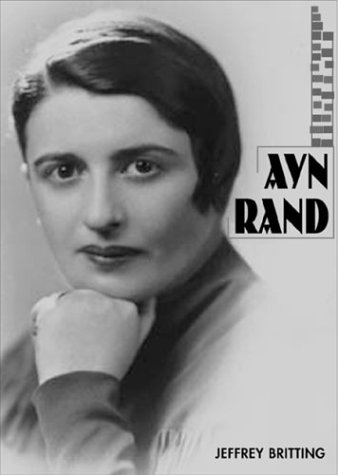
22. Ayn Rand
by Jeffrey Britting, Jeffery Britting, The Overlook Press
Hardcover: 144 Pages (2004-07)
list price: US$19.95 -- used & new: US$1.98
(price subject to change: see help)
Asin: 1585674060
Average Customer Review: 4.0 out of 5 stars
Canada | United Kingdom | Germany | France | Japan
Editorial Review

Book Description
Ayn Rand made a profound impact as both a philosopher who founded a school of social thought, Objectivism, and as a novelist of penetrating insight and vision. Her works are founded on heroic ideals, demonstrating the maxim that, “man’s ego is the fountainhead of human progress.”

The photos and illustrations in this volume have been hand-selected from the Ayn Rand Archives, and most have never been published. They include personal mementos of a Petersburg childhood, her family and their home on Nevsky Prospect; photos from her early years in America; personal papers, including her list of the twelve publishers who passed on The Fountainhead; original newspaper articles, film posters, notes, drawings, and much more.

In a recent poll conducted by the Library of Congress and the Book-of-the-Month Club, Rand’s Atlas Shrugged was voted the novel most influential to American readers. This latest volume of the acclaimed Overlook Illustrated Lives series gives her legions of fans an unprecedented chance to better understand the author they adore. ... Read more

Customer Reviews (7)

5-0 out of 5 stars Well-written, succinct, accurate
I approached this book with a bit of trepidation but was pleasantly surprised. Britting has written a succinct, accurate, and appropriately inspiring precis of Ayn Rand's life. His formula is pretty simple: he sticks scrupulously to the facts, and puts them in their proper perspective. You couldn't ask for more in 134 pages. In addition, the book contains some gorgeous photographs (of St. Petersburg; The Fountainhead dust jacket portrait of Rand; of "Galt's Gulch" in Colorado), and is chock full of intriguing trivia that I hadn't encountered (or dreamed of) in two decades' study of Objectivism: who knew that E.L. Doctorow wrote the ad copy for "For the New Intellectual"; that Rand's favorite painting was Dali's "Corpus Hypercubus"; and that she opposed Japanese internment during WW II?

I also think that Britting's treatment of Rand's HUAC testimony and her association and eventual break with the Brandens is a model of lucidity and fairness. He presents the facts in a way that is favorable to Rand, but the facts he presents are undeniably true and relevant to any judgment one might make about Rand on those issues. I don't see how one can call this "hagiography" unless, of course, one begins with an a priori animosity against Rand (and in favor of Lillian Hellman, the CPUSA, Josef Stalin, the KGB, and/or the Brandens) and wants to see that animosity expressed in print.

As I lack the relevant animosity, I don't see hagiography here; I just see a book well worth reading, and at a bargain price.


4-0 out of 5 stars Filling in the details
Rand was rather circumspect about her life, preferring to let her philosophy be demonstrated through her characters. What biographies there are come from the dubious sources of Nathaniel and Barbara Branden, who are responsible for both the hagiographic Who is Ayn Rand? and the highly critical Judgement Day and The Passion of Ayn Rand. But a reliable biography is a good source: less subject to manipulation, it is a more honest, realistic depiction of a philosophy than a character whose circumstances can be rigged to cast them in the best possible light.

Jeff Britting was an associate producer of the documentary Ayn Rand: A Sense of Life and took the accompanying photographs from the Leonard Peikoff-controlled Ayn Rand Archive, so he has a potential bias as well, though it doesn't particularly show.

But enough talk of biases. This book starts from the very beginning and fills in much detail about Rand's early life, back when she was still Alisa Rosenbaum and living in St. Petersburg. After the scant coverage in the above-mentioned biographies, it's hard to believe that such details are even available, discussing her relationship with her parents and sisters and providing photographs of her birth certificate, the building her family lived in when she was born, and numerous family photos. Fans probably know that her first fictional hero was a character named Cyrus from a boy's magazine of adventure serials. Britting fills in details about how she came upon Cyrus and even includes a drawing.

Such details and illustrations continue throughout: Rand at university, complete with her application photo, a picture of Lev Bekkerman, her first romantic interest, Rand in her museum guide uniform, and her desperation with her ideals conflicting so painfully with the Soviet police state. Even her parents realize that she can't survive for long unless she can get away.

The opportunity opens up in 1924, with an invitation from a cousin of her mother's in Chicago, and the scheming begins: her mother and sisters take politically correct jobs and endeavor to lead exemplary communist lives, all so that Rand can get a passport and leave the country. In early 1926, she manages to do so, shouting to her parents as the train leaves Leningrad, "By the time I come back, I'll be famous!"

The rest of the story is more familiar from the other biographies: moving to Los Angeles, meeting Cecil B. deMille and Frank O'Connor, and beginning her writing career. But the marvelous images continue: Rand's own sketch of Frank, deMille's handwritten access pass for Ayn, and her green card.

I could go on and on about little revelations here and there, but I'll flip quickly to the end, where toward the end of her life Rand begins writing her own screenplay of Atlas Shrugged. One depicted sheet shows thoughts she had on the casting, including such names as Martin Sheen (as Eddie), Tom Skerritt (Francisco), Ned Beatty (Taggart), Kate Jackson, and Julie Christie (no parts suggested for the women).

Some bits are certainly glossed over, such as Rand's affair with Nathaniel Branden (mentioned but only very lightly and that it was with the consent of all concerned), and the mistreatment of her husband that the Brandens allege. However, those have been covered in gory detail elsewhere, and this is a brief biography.

But, brief though it may be, it manages to cover a great deal of ground in a mere 118 copiously illustrated pages. This is a must-have for any Rand fan.

1-0 out of 5 stars Poorly written hagiography
This is an excellent example of the cutlish, doltish approach many "objectivists" take to Rand.For the true believers, it is "good" because it reinforces their beliefs.For thinking people on any side of the Rand debate, it is just another simpering example of group-think.

5-0 out of 5 stars A Hymn to a Woman Who Loved Life
This book is simply beautiful -- and it should be. Ayn Rand possessed a benevolent spirit, a tremendous intellect, and an unstoppable dedication to her work. She was both kind and powerful, joyful and driven, witty and serious. In short, Ayn Rand was one of the most intriguing human beings that this world has ever seen. If you don't know about her already, buy Atlas Shrugged. If you do know about her and you simply want to get to know her better, buy this gorgeous and informative little book.

4-0 out of 5 stars A great brief biography
This is a terrific short and graphic biography of philosopher/author Ayn Rand.The photos and images of memorabilia add to the joy of reading this book.This is really a biography and *not* a summary of her philosophy in any way.Of course her life shares some aspects of her heroes- she suffered some setbacks but was ultimately successful.As such this book still makes for an inspirational story.
... Read more


23. Introduction to Objectivist Epistemology: Expanded Second Edition
by Ayn Rand
 Paperback: 320 Pages (1990-04-26)
list price: US$20.00 -- used & new: US$5.20
(price subject to change: see help)
Asin: 0452010306
Average Customer Review: 3.5 out of 5 stars
Canada | United Kingdom | Germany | France | Japan

Customer Reviews (46)

5-0 out of 5 stars Best book on epistemology
This is the clearest exposition of the most important problem in epistemology: the problem of universals.Most philosophers have believed that the meaning of concepts are not derived from sense perception.The Platonists and religious philosophers such as Augustine believe that concepts come from pre-existing forms, which are revelations from the highest form God.The Sophists, nominalists, and other secular philosophers such as Kant believe concepts are inventions of the mind and do not correspond to reality. Rand argues persuasively that a concept (or universal) is not synonymous with its definition, but an organization of an entire class of existents, our defintion of it changing as we learn more about the similarities of this class.For instance, the concept of "atom" has changed a lot from the Ancient Greeks through Dalton to the present day; but this change in defintion was not arbitrary.The scientists were responding to their observations, and the more they learned about atoms, the more they were obliged to change the definition of atom in accordance with their new understanding.Rand recognizes her debt to Aristotle in epistemology, but also points out flaws in Aristotle's theory of universals, and how these flaws were relentlessly exposed by philosophers eager to attack reason and promote faith, brute feeling, and other forms of irrationality.Most philosophy in the modern period is very abstruse, obscure, and incoherent;this book, by contrast, presents the issue very clearly.

4-0 out of 5 stars Quine and knowledge
A reviewer wrote:

For example, Peikoff's piece on the analytic-synthetic distinction shows that he is completely unaware of contemporary philosophy: he begins by saying that the analytic-synthetic distinction "is accepted, in some form, by virtually every influential contemporary philosopher". But this is clearly false. The most cited paper in 20th century philosophy is Quine's "Two Dogmas of Empiricism" (1953, available in From A Logical Point of View) which famously (and, I think, quite effectively-much more effectively than Peikoff) attacks the distinction. Though there have been many criticisms of the paper and defenses of the distinction, many agree with Quine and he is one of the most famous philosophers of the 20th century, especially within Anglo-American philosophy.


Really, I am just curious as to the evidence behind the claim that Quine's article is the 'most cited' paper in 20th century philosophy. Furthermore, I have no clue into the amount of comprehension that reivewer has of Quine's argument in the paper at hand. As far as the outcome of the debate he has raised -- it is far from over. In fact, it is very much alive. A J Ayer, for example, has written several intersting essays discussing the nature of not only Quine's objections, but Alonzo Church as well.

5-0 out of 5 stars Read these reviews carefully
So many of these reviews complain that 'Ms. Rand claims that she has solved the problem of universals, but universals are a problem
of metaphysics, not epistimology'

Imagine a group of doctors standing around a patient, trying to figure out what is wrong with the patients nose, because he has complained that he has a problem breathing.They've examined his nose, looked up inside it, probed it, tested it, but none of them can solve the problem.

Then some competent young doctor happens by the scene, observes the activity, and declares, 'This man has a problem with his lungs, which can be treated by a particular operation I know.'

The doctor performs the operation, and the patient says, 'Thank You!! I can breathe properly now!', to which the group of doctors replies, 'He didn't really solve anything.It was a problem of the nose.'

5-0 out of 5 stars Excellent and Incredible
At last the the seemingly un-tractable problem of the Universals was solved by Ayn Rand.Here in this book it was brilliantly elucidated how the concepts can be based on the observed facts or how the observed facts can be explained through concepts without any ambiguity.Concepts can be formed realistically i.e., with reference to ACTUAL referents and without any recourse to either mystical realm or the 'unknowble' trash .Ayn Rand with her monumental Philosophy of Objectivism performed a much needed and an expert psycho-therapy to Philosophy, in general, which is otherwise went out of contact with reality by basing its foundationsin 'Unknowables','Subjectivism','Mysticism'. Ayn Rand forever will be accredited with making philosophy relevant to the life of a Man that is ONLY possible ' here on this earth'.Truly Objectivism is a philosophy for living on earth.Objectivism is aGreat ,Brilliant,Incredible and Lasting breakthrough in the sphere of Philosophy.

2-0 out of 5 stars David Hume's Treatise on Human Nature an Antedote
I'll not cover the topics others have speculated in great detail. And that's the point; Rand is an armchair speculative, grounding the support of her arguments from an Aristotlean, a priori-type logic that can "prove" just about anything. The greatest Aristotlean of them all, Thomas Aquinas, could prove or disprove just about anything and everything from the same logical method, and come up with all sorts of differing conclusions. Aquinas wrote his "Summa Theologica" using nothing but deductive logic, and upon close scrutiny, one ultimately has to ask: Is this really a reasonable (cf, rational) enterprise after all?

Using deductive logic, which Rand extols, can be helpful, but rarely leads to any "facts." It's merely speculation, and after a while, one has to ask if this whole methodology has any merit to it at all. Those committed to "strong reasons" will always speculate why their dogmas are superior to another's. But after a while, one begins to see that such a priori speculations are just that: An over-reliance on deductive logic to create a preference for one myth over another. The problem is that they are all myths, or false dogmas, or irrational conclusions based on spurious premises (even though the conclusions may be "valid," they aren't "sound").

For those tired of reading endless rational speculations based on nothing more than armchair a priori deductions, and becoming confused rather than enlightened about human affairs, a good antedote to all these mythologizers is reading 18th-century empiricist philosopher David Hume's "Treatise on Human Nature." First, he proves that there are no a apriori foundations for genuine knowledge (opinion or belief).All knowledge is a posteriori, that is inferred inductively from sense experience and the imagination's inferential patterns of resemblance, contiguity, and causality. Second, he shows that sensations and emotions are empirical, not a priori, and that they contribute just as much to our "knowledge" as does verification and non-falsibility. Lastly, he demonstrates that morals and the knowledge of them are based not on some pie-in-the-sky theory, but on the basic human inclination (shall we dare say "instinct") to maximize pleasure and avoid pain. For those who are tired of endless speculative metaphysical and highly rational (in the sense of overly a priori premises and conclusions) dogmas and myths, Hume is a great antedote.

Since Rand is no different from her progenitors Aristotle and Aquinas, whether you "choose" to buy into her armchair epistemology will depend on whether or not you've had enough of overly-deductive reason, outdated metaphysics, and irrational dogmas and myths. If you think she has the "answers," try out Hume's antedote to see that she might be just another in a long list of mythologizers. ... Read more


24. Ayn Rand's Atlas Shrugged
Paperback: 432 Pages (2007-11-01)
list price: US$24.95 -- used & new: US$22.00
(price subject to change: see help)
Asin: 0754655490
Average Customer Review: 5.0 out of 5 stars
Canada | United Kingdom | Germany | France | Japan

Customer Reviews (1)

5-0 out of 5 stars A true must-have
Very few novels have stood the test of time.This year marks a venerable exception to this axiom, with the fiftieth aniversary of the first publication of Ayn Rand's groundbreaking novel Atlas Shrugged, which has never been out of print since its inititial publication.Hugely popular among literature and philosophy buffs alike, it has meant many different things to many people over the years.To some, it is just an entertaining story with fascinating characters and plot twists, while to others it is the cornerstone of their business, political, economic, and life's philosophy.

One such man, Dr. Edward Younkins of Wheeling Jesuit University, has long argued the merits and deeper meaning of Ayn Rand's ideas and Objectivist philosophy, which was laid out so completely in her culminating work, Atlas Shrugged.While Dr. Younkins has authored other works on related ideas, he may well consider this his crowning achievement.Few have understood this complex and artistic work with the depth and breadth of Dr. Younkins, and he has worked with many of the worlds leading scholars, authors, philosophers, businessmen, and educators to compile thirty six different essays on various aspects of Atlas Shrugged.Each contributor has laid out in easily understood form a different aspect of Atlas Shrugged and its significance to the human condition.

Dr. Younkins has then organized each of these separate works into a comprehensive companion, designed to help anyone understand the deeper truths Ayn Rand worked so hard to articulate to those who are willing to look.After reading Dr. Younkins' companion compilation, it is clear to anyone why the works of Ayn Rand have had such staying power and influence over the best and brightest minds of our age, from such minds as Alan Greenspan all the way down to the causal reader just looking for a good story.Anyone wanting to expand their knowledge and understanding of this classic work need look no further. ... Read more


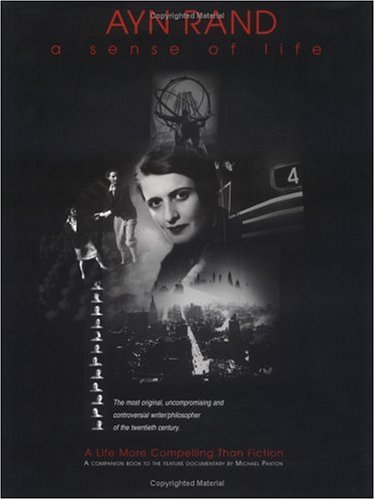
25. Ayn Rand: A Sense of Life : The Companion Book
by Michael Paxton
Hardcover: 191 Pages (1998-05)
list price: US$34.95 -- used & new: US$14.94
(price subject to change: see help)
Asin: 0879058455
Average Customer Review: 3.5 out of 5 stars
Canada | United Kingdom | Germany | France | Japan

Customer Reviews (16)

5-0 out of 5 stars New Discovery
I had never heard of Ayn Rand till I spotted the DVD "A Sense of Life" in the local library the other day!!! I am a fan of documentary bios.,so wanted to take a look...film opened a new world to me...I had seen "The Fountainhead" with Cooper in the past..kind of a "soaper"...but this DVD brought a whole new perspective to me about a very interesting woman!!! I produce an access TV show where I live....I'm into film productions...found this a delight!!!

5-0 out of 5 stars An inspiring look at a philosophic genius.
This book is a fascinating portrait of Ayn Rand.It shows in engrossing detail the depth of her thinking and brilliance of her philosophy, Objectivism.

As a companion to the Oscar-nominated movie this book is agreat coffee table reminder of one of the greatest accomplishments of the20th century; Ayn Rand's creation of a fully integrated, non-contradictorycode of morality.

1-0 out of 5 stars <shrug>
The story of a woman who said she would stop the motor of the world - and didn't.

1-0 out of 5 stars Glossy but dumb
A Child's Golden Book of Ayn Rand... Why in the world would someone take the time and trouble to publish a book without acquainting himself with the facts of his subject's life?This book is a superficial, riddled witherrors and worthwhile only for the photos.

5-0 out of 5 stars A Celebration
Many in this review section argue about whether this book is biased as it doesn't show Rand's flaws, about whether objectivism is a cult, etc.

All of this misses the point.Whether or not she was a perfect person (ofcourse she wasn't), whether or not this book is biased (it probably is),Ayn Rand was right.Her basic philosophy was pretty much the only moral,consistent, and life affirming one ever produced (whether or not sheherself applied it perfectly).This book celebrates the only person everto figure it out, and express it eloquently.Whatever her flaws or thebooks flaws, the world certainly needs (not deserves!) this book more thanthe countless other pieces of garbage out there. ... Read more


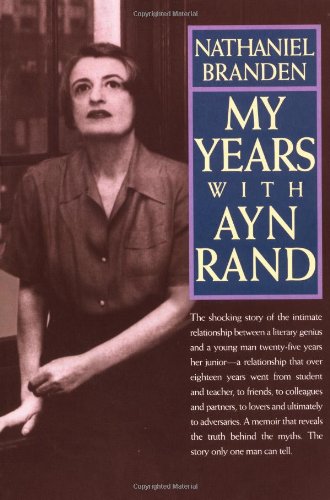
26. My Years with Ayn Rand
by Nathaniel Branden
Paperback: 432 Pages (1999-02-26)
list price: US$30.00 -- used & new: US$21.78
(price subject to change: see help)
Asin: 0787945137
Average Customer Review: 4.0 out of 5 stars
Canada | United Kingdom | Germany | France | Japan
Editorial Review

Book Description
Previous Praise for Nathaniel Branden"Relentlessly revealing. . . the myth of Ayn Rand gives way to a full-sized portrait in contrasting colors, appealing and appalling, potent and paradoxical. . . . it takes a special kind of nerve to write such a book."--Norman Cousins, author of Head First and The Healing Heart

Ayn Rand's Atlas Shrugged is one of the most influential books of the twentieth century-its popular impact ranked second only to the Bible in a major poll. Millions know Rand as one of this century's great thinkers, writers, and philosophers, yet much about the private Ayn Rand remains shrouded in mystery.

Who was Ayn Rand?

My Years with Ayn Rand charts the course of the clandestine, tempestuous relationship between the enigmatic author of Atlas Shrugged and The Fountainhead and Nathaniel Branden-her young disciple and future pioneer of the self-esteem movement. In this book, discover the real Ayn Rand through the eyes of the man who became her soul mate and shared her passions and philosophical ideals.

Their tragic and tumultuous love story began with a letter written by Branden as an admiring teenage fan and Anded, more than twenty years later, with accusations of betrayal and bitter recriminations. My Years with Ayn Rand paints an unforgettable portrait of Ayn Rand-whose ideas, even today, can generate a maelstrom of controversy. ... Read more

Customer Reviews (38)

4-0 out of 5 stars A memoir Ayn Rand's followers need to read.
I read Fountainhead when I was 18 and soon followed it with Atlas Shrugged. I liked Fountainhead for its individualist philosophy. Roark became my hero. I read Atlas Shrugged and was appalled at Rand's extremist views. Anyone who differs from her ideas is evil according to her. She spews venom and hopes to convert readers to her ideas with the force of her contempt.

I decided to read Branden's memoir in an appempt to gain more insight into what made this lady so bitter and angry. Its clear she lived only in amake believe world of ideas. She did not see reality as it was. She believed she was the personification of all her ideal values. Yet her need for adulation , her childish need to seek total acquiescence from her followers show she was far removed from her idea of a Hero.
Branden does a good job of humanising this self styled demi goddess. You just need to read this and you never need to be tempted again to read the churlish, self righteous sermonising of Rand.

2-0 out of 5 stars read it and bathe
This book was lying around the house, undoubtedly the result of the peregrinations of someone in the family through the remainder bins. I think I should clarify that the book I am reviewing, Judgment Day, is actually an earlier version of "My Years with Ayn Rand." I guess Branden got tired of being judged, or maybe needed to display Rand's name more prominently on the cover--or realized the Christian implication of his title.

I also should state that I couldn't care less about Branden, Rand, Objectivism, the Self-Esteem Movement, Libertarianism, or any other person or idea associated with the people involved in the book--a point I mention because many reviewers seem to feel strongly about some or all of the above. I did read the Fountainhead, many years ago, when I was 14, which seems to be a favorable age for finding prose like "Howard Roark laughed" not laughable. For a year or so I thought the book was great; then I lost interest. Personally, I think I developed greater literary sensitivity and a more adult appreciation of human psychology, but I don't want to patronize the many adults in the world who think everything Ayn is fine. Therefore, to anyone who needs to know--as Rand-people need to know--whether I'm "for" them, the answer is "no," which I guess means I'm against them.

I gave this book any stars at all because I believe it would speed the clear-eyed adolescent admirer of Objectivism to a better realization of the implications of all that hero-worship and examining premises stuff. I cannot imagine anyone finishing this book without having shuddered in disgust at least once. Was it possible Branden actually wrote a cautionary tale in the form of an apologia? Is he that clever?

I think not. I think Branden was trying to rehabilitate himself. Yet he remains so thickly encased in his own sense of self-importance that he cannot place himself in the position of any other human being. Therefore, when he describes a cousin who fails to understand him as "a eunuch," or lists his first wife as not the victim but the perpetrator of her own pain, I think he does not realize that a lot of readers will read the subtext rather than the text, and think, "What an unsympathetic creep." And, I should add, an unsympathetic creep who has made his living for the past 25 years as a psychologist in Southern California (which helps explain, now that this East Coast writer thinks about it, the mental disequilibrium of Los Angeles).

Here is an analogy I bet no one has made: The person Branden most reminded me of was our past beloved president, Bill Clinton. There is the same broad intellectual ability, charisma, and extroversion, wrecked by a sense of personal infallibility, an adolescent ego that sees his own life writ large across the cosmos, and, most damaging, an inability to take personal responsibility for bad decisions and suffer the negative consequences thereof. This guy (for those who don't know what I'm talking about) for over 20 years couldn't manage to extricate himself from a wacky mother-son romance (while married to a woman his own age) with Ayn Rand, that for at least half that time he didn't want. Couldn't help himself; didn't want to hurt her; didn't want to hurt the movement; didn't know which way was up; surrounded by moralists and enemies; help, get me outta here! His house of cards fell down around him when Woman Number 3 entered the picture and the bed just got too crowded. Studliness hath its price: Branden's not the first middle-aged guy who lost it all toa young bimbo, but true to type, he acted, and writes, like he was and is. I suppose in the days of the Patriarchs love meant never having to say you're sorry, but, as Rand and Branden spent most of their lives lamenting in a very Gloria Swanson-way, life has gotten smaller since then.

I took off 3 stars because the writing is boring and repetitive, there is almost no character development in spite of pages and pages of self-analysis and breast-beating (or chest-thumping), and most of the characters are very unpleasant. I will say that Wife #1, Barbara, seems like a real piece of work who I'd be interested in knowing better--that Nathaniel got away with this book without having her sue his tail off is testimony in that single fact to more strength of character on her part than her ex-husband displayed all the times of his life, added up.

1-0 out of 5 stars Smear and exploitation of Ayn Rand (read The Passion of Ayn Rand's Critics for the whole story)
This book is a smear job against Ayn Rand so that Nathaniel Branden can clean up his own tarnished reputation while cashing in on Ayn Rand's fame.

James S. Valliant, in his book The Passion of Ayn Rand's Critics: The Case Against the Brandens, thoroughly dissects the claims made by the Brandens against Ayn Rand. He then references Ayn Rand's own personal journals to systematically demonstrate how Barbara and Nathaniel Branden deceived and exploited Ayn Rand for years for their own illegitimate aims. Even after Ayn Rand's death, the Brandens continue to cash in on Ayn Rand's self-made fame and her original philosophy of Objectivism.

5-0 out of 5 stars Intimate portraits of Rand, her inner circle, and her philosophy
The memoirs/biographies of Barbara and Nathaniel Branden are musts for anyone seriously interested in Ayn Rand and her work. This is my "two-fer" review of both books, which should be read together.

The young Brandens' encounter with Rand was the most important experience of their lives. Her force of personality and formidable intellectual powers pulled them into a strange menage-a-quatre with Rand and her husband, Frank O'Connor, even as the Brandens launched the Objectivist movement. Both of them came away simultaneously transformed by Objectivism and personally disillusioned with Rand. The Branden-Rand break caused Rand great pain (disguised as moral indignation) and led to the almost-total isolation of her final years. The picture that emerges from both books is that of a woman caught in a self-created storybook world, eager for the companionship of equals, obsessed with control, unwilling to meet the world except on nearly impossible terms, trying to break out of her emotional-sexual prison -- then rejected by the smart and ambitious man twenty-five years her junior who had made her the center of an explosive and influential movement but who also discovered his need to lead his own life and make his own mark.

Barbara Branden's book is mostly biography and marked the first step towards an objective judgment of Rand. The Passion of Ayn Rand is detached and wistful, while Judgment Day is an aggressive, sometimes painfully honest, memoir. Nathaniel Branden was still wrestling with himself when he wrote it. He recounts with pride how he emerged, wounded but intact, from his break with Rand and how his experience as both guru and victim of a cult-like movement affected his later work in psychology. On the other hand, The Passion of Ayn Rand projects no sense of struggle. Barbara Branden deftly and quietly identifies aspects of Rand's psychology that started at a young age and became more pronounced after she finished Atlas Shrugged: her extreme positive and negative idealizations of other people, her habits of "editing" reality and rewriting history, her emotional repression and consequent angry outbursts. Nathaniel Branden traces how these tendencies spun themselves out in Rand's novels, her philosophy, and the movement he created. Rand's lack of self-knowledge extracted a steep price. Of such stuff are cults made, he concludes.

Fortunately, most people come to Rand by reading her books, not through the official Objectivist movement that she authorized, her attempt at complete control of her reputation, even beyond the grave. But it won't do, as many followers think, to accept her novels and philosophy while eschewing the official Ayn Rand cult. The complete Rand, both person and work, needs independent examination. The sledgehammer moralizing and Platonizing tendencies of her fiction are inescapable flaws of not just her personality, but her novels and philosophy. The extremes of emotional repression to which she subjected herself would have done in a person of lesser willpower, but she expected those who came to her to similarly contort themselves and to subordinate their own judgment to hers. A powerful, independent mind like Nathaniel Branden's could do this only for so long. The isolation and decline of her last decade were a result of the same determined willpower that made her novels possible. It also kept Rand and her followers from seeing her philosophical views as a flawed starting outline of a philosophy, hardly a complete system, and sprinkled with unproven assertions ("benevolent universe," "all problems solvable by reason," "existence = identity," etc., permeated by conceptual sleights of hand and her confusion of consistency with completeness and necessity).

These tendencies have had bad consequences for the Rand-inspired libertarian and Objectivist movements. They drove an unnecessary wedge between herself and conservatives. Her obsession with control and self-isolation prevented her from seeing the right arguments for a free society (no one can plan or control society or history or should pretend to) and led to her isolation from potential secular allies like Hayek, Popper, and Friedman. Emotional repression leads to disowning the self that in turn creates alienation from others. Are these not the very tendencies that libertarians suffer from and which seriously impair their ability to influence politics? Conservatives have gotten much further, not because of religion, but because they do not practice emotional repression or repudiate human nature. Rand's followers continue to hobble themselves with her faulty "psychoepistemology" that reduces thinking to conceptual abstraction and people to ideas. It's what made her think that John Galt and Dagny Taggart could be real people and not the allegories they so obviously are. Rand's impossible ideal was humans as self-creating gods, with their minds and lives fully subject to volitional control. For this reason, she rejected religion. But she nearly rejected evolution as well, because it implies that we are all subject to super-individual and unconscious forces, albeit wholly natural ones. Nothing was to interfere with Rand's fantasy of control -- that was her passion and her tragedy.

POSTSCRIPT: The 1990s saw new, important critical work on Rand and her writings. They constitute an excellent start for interested readers, once they've digested the Brandens' memoirs. Start with the official exposition in Leonard Peikoff's Objectivism: The Philosophy of Ayn Rand. Then move on to the best of the sympathetic criticism:

- The Ideas of Ayn Rand, Ronald Merrill
- The Philosophic Thought of Ayn Rand, eds. Douglas Den Uyl & Douglas Rasmussen
- The Ayn Rand Companion (2nd ed., The New Ayn Rand Companion), Mimi Gladstein
- Ayn Rand: The Russian Radical, Chris Matthew Sciabarra (a wealth of historical and biographical information giving Rand's ideas their full context - flawed thesis, but the most thorough scholarly treatment so far)

Even a major book like Sciabarra's only scratches the surface. Rand's allegorizing tendencies are linked to her rejection of her Russian childhood, but also to a thread in Russian literature (traceable, through Christianity, back to Plato) that views persons as embodiments of ideas (e.g., Dostoevsky). The style of her fiction can be viewed as "individualist realism," in opposition to the much cruder "socialist realism" popular in the 1930s and enforced in Soviet Russia. Rand's knee-jerk hostility to religion needs a fresh perspective in light of the mysticism of Orthodox Russia. Comparing Rand to other Russian refugees (like her contemporary and fellow Petersbergians Nabokov and Berberova) would be fascinating. (Russia's exit from the never-never land of Marxism has allowed rediscovery of its real history.) Someone should fully identify the influence of Nietzsche she supposedly outgrew with The Fountainhead. The Nietzschean "lone wolf" mentality clung to her and her work to the very end. Neither Rand nor her followers have ever produced a coherent theory of society. Neither did Nietzsche, but he knew himself well enough to reject movements, politics, and systematizing. Rand did not, and an intellectually sterile cult was the result.

Rand constructed her philosophical beliefs to force the conclusions she wanted - this is obvious in her esthetic views, but it also holds in the rest. Attempts to repair and complete her philosophy lead back to the standard Enlightenment mix of natural rights, utilitarianism, and historical analogy, with Aristotle as one intellectual ancestor among others. These theories remain the backbone of existing conservative and classical liberal thought, at least in the English-speaking world. Could such an exercise lead to anything else?

The hostile reviews on Amazon of the Brandens' books only provide more evidence of the mind-warping effects of cultism on nominally intelligent people. A pathetic recent attack on the Brandens falls into the same category. I could tell you not to read them -- but you should, so you can see what cults are like.

5-0 out of 5 stars I paid 13.30 for this in 2002. Now they want 28???
Either we have experienced some massive inflation or something is very wrong. ... Read more


27. Atheism, Ayn Rand, and Other Heresies
by George H. Smith
Hardcover: 324 Pages (1991-04)
list price: US$36.00 -- used & new: US$19.11
(price subject to change: see help)
Asin: 0879755776
Average Customer Review: 4.0 out of 5 stars
Canada | United Kingdom | Germany | France | Japan

Customer Reviews (8)

3-0 out of 5 stars The Precuror of God's Delusions by Atheists Today.
God is not a delusion, but he can and should be a personal God. Today, you find churches set up in storefronts or out in the country in hovels by untrained "preachers" instead of the denominations of days gone by. There were the Baptists, Methodists, Episcopalians, Lutherans, Presbyterians, Church of God, Church of Christ, etc. Now, it is non-denominational, which means "anything goes." Thus, this scientist has decided that the world would be better off without religious intervention. The churches do help their members in crisis, but otherwise they are in the business of money.

With the advent of telelevangists, we saw their public downfalls usually because of sex, though others were making a killing by using the money for personal luxuries. When Jeff went to Chicago to attend the U of C, he encountered his first atheist. Coming from a small Tennessee town, growing up Methodist, it was a bad discovery to find that his Physics and Astronomy professors did not believe in God. Everyone knows that the University of Chicago is a radical school. The Big Bang theory was that we were put here randomly and there are other aliens out there somewhere more intelligent than we. No intervention, no creation by God, no Jesus, (apparently he was a false prophet); my long-ago favorite prophet, Jeremiah (the prophet of doom) would have fit in as their advisor as he saw only the bad happening in his surroundings and was not inspired by the premonitions of Isiah and the Old Testament leaders who prophysized the coming of the Son of God. Atheists believe in the devil, so the rest of us can find comfort in God in his many varieties. The Catholics believe in communicating by calling on the Virgin Mary. I'm not an atheist, but no virgin could have a child, even a miracle child. Old women can, but not young virgins, so I believe that the Catholics have false beliefs for some reason all their own.

John Wesley taught us that Protestants of all persuasions can find life easier and we can get along with our neighbors if we have some kind of faith in a higher being. E. T. where are you?

In Pittsburg, PA, there is a large statue of Mary (mother of Jesus) looking down as she hold the babe. I saw a similar statue at a Methodist church in Nashville of Christ; when you kneel and look up (as I did) you look right into his eyes. It was eerie and moving all at the same time. At Sewanee, we had Church Women United sessions with the marvelous peacocks honking at you, but no Jesus statue in existence. That is near Bell Buckle where the original Webb School is located.

Atheists are not simply deluded, but are instruments of the devil.Today I see those young men and women all dressed in black with tatoos and black eye makeup, which are the modern version of cult members who have run amok.They could lose control at any moment, as it is clear that they are on drugs and the bad influence of something or someone not of this earth.They are definitely a danger to today's society.

4-0 out of 5 stars Lucid, thoughtful, sometimes way off.
Most anthologies of essays are like a loose pile of sand, but thematically, I thought this one hung together fairly well. The style varied from popular to almost bibliographical.

The Ayn Rand essays were informative, though I thought Smith bent over backwards a bit too far to shield Rand herself from the charge of fanaticism.(As is so often done with Marx.) The essays I liked the best were "My Path to Atheism," "Atheism and the Virtue of Reasonableness," (good advice for theists as well), and "Frantz Fanon and John Locke at Stanford," which I read as a stirring defense of free thought against the PC mind control so prevalent in our academic establishments.If everyone (including Smith himself)would follow his rules for debate in that second essay, we might be in for a lot of good, healthy debate!

As a Christian, I was perturbed, but not surprised (having seen it so often), to find someone as apparently well-informed as Smith badly misunderstand what orthodox Christians mean by faith.He repeated the old canard that "Faith conflicts with reason," and a great deal of his discussion was saddled with this profound and oft-repudiated error.Faith, he argued,
"cannot give you knowledge."It is "intellectually
dishonest, and should be rejected by every person of integrity."He backed up his mangled argument with the writings of some obscure theologian.But when understood as orthodox Christians understand it (as I argue in my book Jesus and the Religions of Man), it is truer to say that nothing besides faith can give knowledge."Never, never doubt the efficacy of your mind," Smith advised.Yes, and that is (in the Christian sense) an act of faith.Beyond a reasonable and tested faith in reason, memory, the fives senses, and other people, faith in God is the highest form not of blind faith (an un-Christian concept), but of the clear-headed act of reason by which rational beings perceive what is real in their environment.If you think faith is a wild and uneccessary leap in the dark, you misunderstand the Christian religion, and the nature of knowledge in general.

Suffering from this misunderstanding, Smith blames Augustine for the Dark Ages; which I think is radically unfair.(Especially considering that Augustine, one of the greatest thinkers in world history, died in a city under siege of the invaders who really did usher in the Dark Ages.)

Smith also tries halfheartedly to argue that Jesus fit the "profile" of an abusive cult leader.This is nonsense.In fact, compare the more detailed list of traits common to cult leaders compiled by such skeptical psychologists as Marcia Fabin and Anthony Storr with the Gospels, and it appears that Jesus was at the opposite end of the spectrum from that sort of person.I have been studying world religion, gurus, Messiahs, and "Living Buddhas" for many years, and I have not found any who resembled Jesus.

Despite these criticisms, I enjoyed this book and found a lot of value in it.Smith is extremely well-read, and writes with a style that is usually clear andreasonable.I look forward to reading his general defense of atheism.

4-0 out of 5 stars Interesting collection of essays
Heresy, Smith defines in his preface, is the rejection of the orthodox, and heresies are considered a threat to the established social order once the dogma of the institution (be it religious or otherwise) has become aligned with the power of the state or political force. The state, holding the reins of power, uses force, instead of persuasion, to enforce the orthodoxy.The Founding Fathers, most practicing Deists, itself a form of heretical thought, understood this and insisted on the separation of church and state, thus preventing the establishment of an official religion, preventing, they hoped, official heresies as well.Orthodoxy itself is not dangerous, only its alliance with political power.The central theme of Smith's book is the "crucial difference between the voluntary orthodoxy of organizations and the politicized orthodoxy of governments. "A free society, complete with orthodoxies and prejudices, is the best of all worlds for the heretic.Liberty permits the heretic to pit his beliefs against those of the orthodox majority."The paradox for the heretic is whether if and when his view becomes the dominant - to politicize the new orthodoxy or to permit liberty, which enabled the heretic to conquer ideologically, to possibly undermine the new orthodoxy?

Smith is unapologetically atheist; belief in God for Smith is simply unreasonable and irrational. Asked to prove the nonexistence of God, Smith's answer is simply that one cannot prove a negative and that the person who asserts the existence of something bears the burden of proof. He asserts that to believe in faith or to rely on faith is to "defy and abandon the judgment of one's mind. Faith conflicts with reason.It cannot give you knowledge; it can only delude you into believing that you know more than you really do.Faith is intellectually dishonest, and it should be rejected by every person of integrity.

The book is a loosely connected series of essays that discuss a variety of Christian and social heresies. He begins with his own philosophic journey to atheism.He is certainly a libertarian, and the essays on public education and the War on Drugs reflect that philosophy. But the reason I began this book was to discover his writing about Ayn Rand. He devotes two substantial chapters to her and the Objectivist philosophy.

Rand evokes fierce passions, both pro and con."Accounts of Objectivism written by Rand's admirers are frequently eulogistic and uncritical, whereas accounts written by her antagonists are often hostile and what is worse, embarrassingly inaccurate." The situation has been made worse by her appointed heir to the throne, Leonard Peikoff, who has declared Objectivism to be a "closed" philosophy, i.e., no critical analysis will be tolerated;one must accept it as he says it is and that's that. Whether Objectivism will survive such narrow-mindedness remains to be seen.It's a classic case of the true believer "unwilling to criticize the deity.Thinking for oneself is hard work so true believers recite catechisms and denounce heretics instead."Typically, this was contrary to Rand's philosophy of individualism and critical, rational thinking where "truth or falsehood must be one's sole concern and the sole criterion ofjudgment -- not anyone's approval or disapproval."

4-0 out of 5 stars A dissenter's mind
This loosely connected series of essays expands his earlier work,extending beyond Atheismto embrace various Christian and social'heresies'.Beginning with his personal Path toAtheism, he provides theskeptic with methods of argument and several readings.He givesaccountsof those Christian philosophers who wrote against atheists and heretics. Heretics, ofcourse, have been subjected to the severest punishments inthe Christian churches, for a soullost is more serious than anunconverted heathen.

Smith's discussion of Deism is the highlight of thisbook.As a philosophy accepting a godwithout a structured religiousorganization, Deism was a major theme among critics ofChristianity. Abolishment of church hierarchies, with their inevitable moral and monetary corruption, led many thinkers to leave Christianity in favour of apersonal relationship with adeity.Many of the Founding Fathers of theUnited States adhered to this view, a product ofthe EuropeanEnlightenment of the 18th Century.Arising coincidentally with many philosophies of personal freedom, it was almost inevitable that a nationexperimenting withdemocratic ideals would espouse it.Smith's essay onthe writings of Deists is enlightening.

Smith's discussion of Ayn Rand'sideas came as a bit of a shock.It's difficult to find anyone,apart froma few feminists, in this era who knows who she was.Smith's account of herlifeincludes a smattering of choice quotations, but the brevity of theentries demonstrates thepaucity of adherents.There is an Ayn RandInstitute site on the 'Net, but seems hardly worththe bother.

The twoessays on public education and the War on Drugs are heartfelt expressionsof a truelibertarian.Neither will add to Smith's popularity in a nationwhere 'Christian virtues' reignwith such strength, but they're requiredreading for anyone who wishes to understand viewsother than the accepted'norm'.Smith appears to forget that public education in the United States, even given its Puritan foundation, was furthered by a desire tofree education from thethrall of an Established Church.The strugglingeconomy of a growing nation would have ledmore children into hazardousand fatiguing work situations from which they would neverrecovered. Extending the years of compulsory education freed many children and openedjobopportunities.The result put more women into the work force,ultimately leading toimproving their role in society.

Smith confesseshis lack of a formal education, but he's certainly managed a wealth of research to produce this book.Not a deep study of the challenges toestablished thinking, thisbook is a valid starting point for thoseseeking further knowledge of libertarian thinking.

4-0 out of 5 stars Worthy follow-up to "Atheism: The Case Against God"
This is a loose collection of essays by Smith. They cover a variety of topics, like Smith's personal atheism, heresies over the years, and Objectivism. His critiques of Objectivism are well-written and, IMHO,spot-on.

I wish I could give the book five stars, but there doesn't seemto be much of an underlying theme, as the title suggests. I would've likedto have seen something where the chapters lead to an inevitable conclusion,as in A:TCAG. ... Read more


28. The Ideas of Ayn Rand
by Ronald Merrill
Paperback: 191 Pages (1998-12-31)
list price: US$17.95 -- used & new: US$3.15
(price subject to change: see help)
Asin: 081269158X
Average Customer Review: 3.5 out of 5 stars
Canada | United Kingdom | Germany | France | Japan
Editorial Review

Book Description

The Ideas of Ayn Rand provides, for the first time, a comprehensive survey of Rand's wide-ranging contributions: her literary techniques; her espousal and then rejection of a Nietzschean outlook; her contradictory attitude to feminism; her forays into ethics, epistemology, and metaphysics; the development of her political creed; her influence on -- and hostility to -- both conservatism and libertarianism.
... Read more

Customer Reviews (5)

3-0 out of 5 stars Comprehensive, But Not Deep
In recent years, we have witnessed what has aptly been called a "Renaissance" in Ayn Rand scholarship. In 1995, Chris Sciabarra came out with AYN RAND: THE RUSSIAN RADICAL which (although controversial) placed Ayn Rand in the context of the history of philosophy and filled in a few gaps in her biography as well. After that work, the Ayn Rand Institute published lengthy collections of her diaries and letters (although I'd like to see the originals). In 1999, the Journal of Ayn Rand Studies began publishing, which gives Rand's ideas serious attention. Finally, we recently saw the publication of Scott Ryan's critical OBJECTIVISM AND THE CORRUPTION OF RATIONALITY, which surpasses all previous criticism of Rand.

In light of this high quality work and the increase in primary sources available, one might expect that a scholar would come out with a concise 150-200 page book providing a solid and up-to-date overview of Rand's work, dealing with all the major areas of her thought. Unfortunately, such a book is lacking.

The above digression brings me to Ron Merrill's THE IDEAS OF AYN RAND, published in 1991 and therefore before the "Renaissance." There are some good things about this work. First, it is comprehensive. Mr. Merrill provides the reader with an overview of Rand's life, the plots of her novels, an introduction to her philosophy, and her place within the conservative and libertarian traditions. Second, there are a few interesting observations about the influence of Nietzsche on Rand and also some Jewish imagery in Rand's novels. Third, Mr. Merrill appreciates Rand and lets the reader understand why many people are so absorbed by her ideas. Fourth, the discussion of the novels is extensive. Fifth, the work includes a discussion of the Objectivist "movement."

On the other hand, as a guide to Rand's philosophy it leaves a lot to be desired. As an example, the discussion of axioms (so central to Rand) is given 4 lines. However, the "analytic-synthetic dichotomy" is given over a page. And it is presented exclusively in the context of Peikoff's misleading article of the same name. In any event, I don't see how Mr. Merrill's pointing out that W. V. O. ("I espouse a more thorough pragmatism") Quine also objected to the "analytic-synthetic dichotomy" helps his case that this concept is flawed [p. 170, n. 8]. (For a defense of how - contrary to Peikoff - a priori knowledge provides knowledge of "facts of experience," see Brand Blanshard, REASON & ANALYSIS, pp. 249-307, esp. pp. 303-04.) While I'm in the midst of another digression, how can Objectivists reject this dichotomy when - as Mr. Merrill perceptively notes - they have not provided a criterion to determine what is "certain" versus what is "tentative"? [p. 92.] (Actually, in the same year that THE IDEAS OF AYN RAND came out, Leonard Peikoff published "OPAR" and did discuss that issue. Whether Peikoff's pragmatic "contextual certainty" is the same as "certainty" I leave to others to decide.)

The best introduction to Ayn Rand remains Tibor Machan's work, AYN RAND (1999). Although the quality of the work is higher, it is somewhat uneven in the space given to topics (too much on ethics and politics; not enough on epistemology and metaphysics; aesthetics is mostly ignored). In any event, that work should be supplemented the above-mentioned works by Scott Ryan and Chris Sciabarra.

4-0 out of 5 stars An excellent compact overview of Rand's views
Long before she died, Ayn Rand was praised as a goddess, and damned as a devil.In all the fuss, her actual ideas and views were generally shoved to one side, to the point where she said in her _Playboy_ interview that she could sympathize with Karl Marx(!) toward the end of his life, when he said that he was not a Marxist.The rather abrupt end of the organized Objectivist movement in 1968 was also the end of a great deal of her influence, and she became a figure more of legend than history long before her death.With this book, Merrill gives us a view of Ayn Rand's actual beliefs, as opposed to those attributed to her by the Usual Suspects, and some background as to how she came to the conclusions she did.It's disappointingly short, but Rand scholarship is evolving constantly.

4-0 out of 5 stars Objective Book of Objectivism's founder
Free of the subjective rehashing that tainted the summations offered by Leonard Peikoff and the Brandens, this book is a fair, albeit much too brief, representation of Ayn Rand's history, ideas, and continuing legacy. Merril, a true student of Objectivism, is fair and balanced in his book. It is a mistake to rely solely on the admittedly worthy and remarkableworks of Peikoff and/or the Brandens without using this book to reconcilethe arguments put forth by the three of them in their own accounts.Readthis work and make up your own mind.

5-0 out of 5 stars Nice book
This is a nice work in independent commentary and interpretation, something Peikovians cannot stand.And yes, the book has useful commentary.

2-0 out of 5 stars Disappointingly superficial.
Given the publisher of this book, I had hoped to find a systematic presentation and evaluation of Ayn Rand's ideas. Unfortunately, both the presentation and evaluation were superficial.The author failed to motivate Rand's ideas by a central theme, and his evalutions were ad hoc and disintegrated.

The book's strongest potential virtue was to delineate Nietzsche's influence on Rand's philosophy.Yet while the author claims that Rand's writings were influenced by Nietzsche, he provides little documentation for any early influence and no evidence for any lasting influence. His claim that Rand derived her critique of Kant from Nietzsche, for example, was never documented.A substantial revision of this section of the book, particularly in light of recent publications, would be warranted--without such a revision, the book has little to recommend it.

Finally, the author's narration of recent scholarly interest in Rand--both inside and outside academia--was also disappo! intingly superficial.His treatment was marred by his conflation of these intellectual developments with much non-scholarly (and uninformative) interest in her personal life and the lives of her self-proclaimed admirers.

With the publication of "Objectivism: The Philosophy of Ayn Rand," "Letters of Ayn Rand," and "Journals of Ayn Rand," the current volume has been entirely superceded.Save your money. ... Read more


29. The World of Atlas Shrugged: The Essential Companion to Ayn Rand's Masterpiece [UNABRIDGED]
by Robert Bidinotto/The Objectivist Center, Edward Herrmann, Lynn Redgrave
Audio CD: Pages (2001-04-23)
list price: US$22.95 -- used & new: US$6.94
(price subject to change: see help)
Asin: 156511471X
Average Customer Review: 4.5 out of 5 stars
Canada | United Kingdom | Germany | France | Japan
Editorial Review

Book Description
Ayn Rand's famous 1957 classic, Atlas Shrugged, has become more widely read and influential with each passing year, thanks in part to its brilliant dramatization of Rand's Objectivist philosophy and its celebration of self-reliance, integrity, rationality, and productive effort.Like any great work of literature, however, Atlas Shrugged can be intimidating. Even those who have read and re-read it may feel they have not fully appreciated its vision of life. For the neophyte and the longtime admirer alike, The World of Atlas Shrugged provides essential context, brilliant commentary and authoritative insight into the novel's literary purpose and structure. ... Read more

Customer Reviews (6)

5-0 out of 5 stars Those who preach selflessness do it for selfish reasons
In today's political clime Rand's writing is must reading. We are currently experiencing a resurgence in the war on the individual, with Hillary Clinton dropping quotes right and left that sound remarkably similar to statements made by Stalin and Lenin. Enough is a enough. Those who preach collectivism are trying to subjugate you. Those who preach altruism typically have their hand in someone else's pocket. As Rand says in Atlas Shrugged, "public welfare" is the banner that looters hide behind. Here Rand argues that capitalism is the ONLY just political system. The problem with many conservatives, as Rand saw them, is that though they defend capitalism they usually ground their defense in some vague notion of "God-given rights." Since religious beliefs are not rationally defensible this move greatly risks placing reason on the side of the anti-capitalists. No, Rand said, we must do what's right because it's right and not because we are told to or want to get into heaven. We must defend capitalism not because of some bizarre notion of being mandated by a supreme being but rather because it is the only political system that allows man to rise to his potential, to choose for himself, to bargain with others freely and to exercise his volition. Liberals who defend "minorities" (all the while ignoring that in one out of three of the most populated counties in America today whites are actually the minority) while engaging in collectivist attacks on "the cult of the individual" and "egoism" must contend with Rand's statement that one cannot claim to defend minorities while attacking individualism, for the smallest minority is ALWAYS the individual. People always act with selfish reasons. In order for charity to even be of any help the recipient must selfishly accept the charity. Bad competition, which levels the playing field by inhibiting the performance of rivals, drags achievers down to the mean. All the good such achievers can do for society as a whole is then eliminated, as in the "Anti-dog-eat-dog" agreement in this book. Good competition, in which people compete by perfecting their own skill and knowledge, improves everyone. Even if you are beat by someone else you are left more knowledgeable and able. I only have one question: Where is Galt's Gulch? I would like to move. This novel, originally entitled The Strike, is brilliant. The Fountainhead was about the individual vs. the collective, and this is about the producers vs. the parasites. What if the reviled "rich," those who produce the amenities others take for granted or expect the "government" to pay for, all went on strike? What then? By the way, if you like this book you will probably also like a book called Camp of the Saints. Check it out.

I love the party scene in this book. Rand perfectly points out the ultimate irony of parties: A party is supposed to be a celebration, but those who have done things worthy of celebration typically are not the kind of people who find any enjoyment in parties, whereas those who love partying are not the kind of people there is anything worth celebrating about!

The point of this book was ably made by Jon Hanson, author of a nifty little book called Good Debt, Bad Debt. The point is this: NEVER in history has there been a society that was socialist BEFORE it went capitalist. This has never happened because it would be impossible. It can only be the other way around. FIRST capitalists must BUILD and MAINTAIN a society BEFORE socialists can come and leech off of it parasitically. Socialists don't build or produce anything. They only appropriate. This is why socialism can only follow capitalism. Further, if the last remnant of the capitalist elements of society completely disintegrate, the entire structure collapses. It's not the socialists that keep things going, they just feed off of open sores.

4-0 out of 5 stars Uncritical companion
I bought this to supplement the novel which I was rereading after 30 years for my book club. This is a good way to tie together what at times is a heavy text--although as I say in my review of the book itself the plot is a real potboiler. I found the tape helpful in understanding Rand's literary technique--in setting up larger than life heroes and impossibly obnoxious villians---a good refresher too if your recollection of the book is hazy. But for a critical analysis of the novel as a work of literature or philosophy, look elsewhere.

5-0 out of 5 stars Refresher of principles of Atlas Shrugged
Although this CD is not a substitute for the book, it serves as an excellent reminder of Rand's principles - in particular her ethics.

This CD would be useful for the Objectivist that can not reread Rand's book but wants to be able to discuss it in detail again.

4-0 out of 5 stars Outstanding Supplement to "Atlas Shrugged"
I enjoyed "Atlas Shrugged" and "The Fountainhead", and given their message, wouldn't be so bold as to review either.It had been some years since I first read "Atlas Shrugged" so I purchased this audio disc as a refresher.It couldn't have been a better decision.The two discs walked quickly, but with ample detail, through the plot and major characters, drawing connections I hadn't noticed the first time I read the book, and giving some background as to Ms. Rand's thoughts when originally composing the text.I do not know if I would call it the "Essential" companion, but it is quite good.This Audio Disc makes a great companion to the book, providing just enough to make it worth reading, while not completely reciting the entire text.I would suggest reading the book before listening to the disk as there are some areas of the plot that would be spoiled.However, I do think if you wanted to gauge your interest before tackling the full text, this might not be a bad way to do so.

This is a good audio CD that accomplishes its task very efficiently.It is a great summary of "Atlas Shrugged" with just the right amount of additional detail.

5-0 out of 5 stars Wonderfully surprised
I was wonderfully surprised by this entertaining and informative work.Herrimann does a great job, I'd recommend his reading of both Atlas Shrugged and The Fountainhead as well.Redgrave also did a fabulous reading.I first heard about this recording at The Atlas Society Homepage ... and I was a bit unsure of it at first. I thought it might be too cheesy, poorly produced or even just inaccurate.But it is perfectly produced, and a worthy companion to Ayn Rand's masterpeice. ... Read more


30. Anthem
by Ayn Rand
Audio CD: 100 Pages (2004-11-01)
list price: US$17.95 -- used & new: US$10.98
(price subject to change: see help)
Asin: 0786182296
Canada | United Kingdom | Germany | France | Japan
Editorial Review

Product Description
He lived in the dark ages of the future. In a loveless world he dared to love the woman of his choice. In an age that had lost all trace of science and civilization he had the courage to seek and find knowledge. But these were not the crimes for which he would be hunted. He was marked for death because he had committed the unpardonable sin: he had stood forth from the mindless human herd. He was a man alone. Ayn Rand’s classic tale of a future dark age of the great “We,” in which individuals have no name, no independence, and no values, anticipates her later masterpieces, The Fountainhead and Atlas Shrugged. ... Read more


31. Anthem
by Rand Ayn
Paperback: 64 Pages (2007-09-06)
list price: US$6.45 -- used & new: US$6.35
(price subject to change: see help)
Asin: 1604240733
Canada | United Kingdom | Germany | France | Japan
Editorial Review

Book Description
Rand was a Russian born American author who pioneered the philosophy of "objectivism".Anthem is a futuristic science fiction novella.Man is in a dark age, because of earlier socialistic values.Technology is carefully planned and rarely allowed to advance.Individualism has almost ceased to exist.The theme of individualism versus collectivism runs throughout the novella. ... Read more


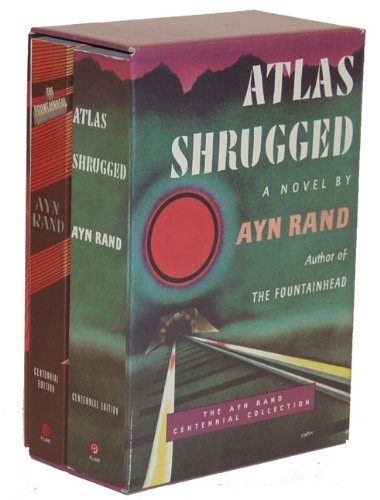
32. Atlas Shrugged (Centennial Ed. HC)
by Ayn Rand
Hardcover: 1192 Pages (2005-04-21)
list price: US$39.95 -- used & new: US$21.12
(price subject to change: see help)
Asin: 0525948929
Average Customer Review: 5.0 out of 5 stars
Canada | United Kingdom | Germany | France | Japan
Editorial Review

Book Description
The year 2005 marks Ayn Rand’s Centennial Year.

The astounding story of a man that said that he would stop the motor of the world—and did. Tremendous in scope, breathtaking in its suspense, Atlas Shrugged is unlike any other book you have ever read.

“A writer of great power. She has a subtle and ingenious mind and the capacity of writing brilliantly, beautifully, bitterly.”
—The New York Times ... Read more

Customer Reviews (28)

5-0 out of 5 stars Required Reading for the Sane
This must rate as one of the literary classics of the 20th century for Rand's philosophical insights and facility for cinematicly descriptive writing, an amazing feat for a Russian-born author writing in her second language.The application of Randian philosophy to current events, politics, and cultural climate leads one to the conclusion that Rand was more right than we'd like to admit.

The rating is for the ideas; the novel that is wrapped around them would rate just a little lower, knocked down by too many long monologues to express those ideas, especially a 50-page one at the crucial climax of the book that should have involved dialogue, action, and crises.

Still, this book packs such a vast array of (I think its safe to say) dangerous ideas that it can't be ignored.In fact, 50 years later, the ideas that have been ignored are glaringly obvious in current economic, political, and cultural loose thinking and the rotten fruits that have arisen from it.I felt as though I was watching Rand script some of the wrong-headed events I've witnessed in working around government projects the last several years.

Obviously, as a Christian, I can't agree with Rand's core idea that morality is only a result of rational or internal values (objectivism, as this philosophy has become known).God is the creator and source of all morality.

I do think that Rand is close to the truth in saying that the fall, the eating of the fruit of the tree of good and evil, made man his own moral compass.Rand believes that that event made man an Objectivist.I believe that event made us fallen sinners, because seeing good and evil, we are unable to always choose the good, thus we are inherently sinful and in need of God's miraculous salvation.Rand does not believe in the possibility of miracles or the need for salvation.

This should be required reading for politicians who want to enhance the "public welfare" or raise taxes so that government can "invest" in charity and other good deeds, and for those of any stripe who believe that they can act in the "public interest" by forcibly expropriating private property.

Rand's ideas have attained "cult" status; in fact, check my review of Jeff Walker's book "The Ayn Rand cult", as I plan to read his book next, whose back-cover blurbs promise to expose Objectivism as "a classic cult."

5-0 out of 5 stars Atlas Shrugged
Atlas Shrugged is a timeless classic about an industrialist with the weight of the world on her shoulders. After completing the book, I began to reflect on the interdependance of each member of society and the duty we have to one another. Ayn Rand changed the way I think about capitalism and economics. Interesting sub plots.

5-0 out of 5 stars What a book
This book has influenced my life and the way I view the world and events.The second most influencial book in my life (the Bible being the first) I have read this book over and over.I can see why she would have a cult following.I would highly recommend reading this book for everyone.

3-0 out of 5 stars Good book hampered by bad editing
Let me start off by stating that this is a book worth reading. In it, Ayn Rand propounds her philosophy of Objectivism (politically similar to Libertarianism) which, as she states, has the following core principles:

"My philosophy, in essence, is the concept of man as a heroic being, with his own happiness as the moral purpose of his life, with productive achievement as his noblest activity, and reason as his only absolute."
--Ayn Rand

There's not much to fault in those principles; and, it's easy to envision the benefit that could accrue from espousing them. Even the story itself has appeal: it takes place within an extremely socialistic society whose economy is foundering because all of its great industrialists are disappearing.

My problem with the book, and what made it, at times, almost torture to get through, is that the action of the story happens between a seemingly interminable series of long repetitive speeches expounding Rand's philosophy. For example, toward the end of the book, a character gives an uninterrupted speech of almost 70 pages; and, even more exasperating than the sheer length of the speech is the fact that it's essentially just a reiteration of points made earlier in the book by other characters -- and earlier in the speech by the character himself. This book would've been made considerably better if several hundred pages of tedious pontifications had been culled from it.

5-0 out of 5 stars A celebration of human normalcy
It is difficult to find a book of fiction that has caused so much controversy as this one, and its critics have a degree of zeal that is matched by its defenders. It is a gigantic philosophical tome, with characters that many have scoffed at as being larger than life, as representing a sterile view of the human psyche, and as being naïve and sophomoric in its world view. Hated in general by both conservatives and liberals, those who love the book envy those who are approaching it for the first time. It is a book for optimists; a book for those who love and celebrate life. But above all it is a book for normal people, because in the final analysis, even though its author may have viewed its characters as representing statistical outliers, as rare and distinctive visionaries who epitomize high intelligence and creativity, it represents what it means for a human to be normal.

It is abnormal and an aberration for humans to want to organize themselves in a socialist state with no personal rights and no freedom to make their own way. It is abnormal and an aberration for humans to wage war and destruction against themselves and others. It is abnormal and an aberration for humans to avoid responsibility for their actions and blame others for their failures. It is abnormal and an aberration for humans to hypothesize an imaginary deity and prostrate themselves in contemplation of it. It is abnormal and an aberration for humans to serve others without question and with no mutual respect. It is abnormal and an aberration for humans to sit still, to lose their kinetic energy, both physical and mental, and not overcome seemingly insurmountable odds.

Humans are in a state of normalcy when they create, build, think, and prosper, and unashamed when they are doing so. This novel, now appearing in print for fifty years, asks the reader to contemplate what would happen if the most creative and industrious of humans were to withdraw from society and leave it to those who took on the grotesqueness of inaction, envy, and sterile diatribes of socialist thought. It asks the reader to contemplate what it takes to have a productive, healthy, comfortable, technological society. Whose intelligence and entrepreneurial alertness are in full operation in such a society and what are the consequences if these are extinguished by the voluntary withdrawal of those who possess them?

The philosophical dialog one can find in this book has drawn the ire of many an academic philosopher and politician. The reviews of the book when it was first published fifty years were probably the most vituperative of all in print. But vehemence towards the book has not extinguished its relevance or its power to instigate critical reflection. It is an alternative view of ethics, one that dignifies human individuality and self-interest. It is an ethic that abhors the initiation of force and worships human ingenuity. The philosophical dialog inked on its pages is a testament to the center of human optimism, and it is a perfect reflection and celebration of human normalcy. ... Read more


33. It Usually Begins With Ayn Rand
by Jerome Tuccille
Paperback: 278 Pages (2007-11-05)
list price: US$20.95 -- used & new: US$20.07
(price subject to change: see help)
Asin: 0595477577
Average Customer Review: 3.5 out of 5 stars
Canada | United Kingdom | Germany | France | Japan
Editorial Review

Book Description
This edition of It Usually Begins With Ayn Rand contains much of the text that appeared in the original edition-revised and edited to conform to modern style-plus new chapters dealing with events that took place after the book was first published. Some of the new material deals with my campaign for Governor of New York as the Free Libertarian Part