
|
Help |
| Home - Philosophers - Rawls John (Books) | |
e99 Online Shopping Mall
|
|
Help |
| Home - Philosophers - Rawls John (Books) | |
| 1-20 of 100 | Next 20 |
click price to see details click image to enlarge click link to go to the store
| 1. A Theory of Justice: Original Edition by John Rawls | |
 | Paperback: 624
Pages
(2005-03-31)
list price: US$29.50 -- used & new: US$21.23 (price subject to change: see help) Asin: 0674017722 Average Customer Review: 
Canada | United Kingdom | Germany | France | Japan |
|
Editorial Review Product Description Customer Reviews (56)
| |
| 2. Political Liberalism (Columbia Classics in Philosophy) by John Rawls | |
 | Paperback: 576
Pages
(2010-03-04)
list price: US$24.95 -- used & new: US$15.48 (price subject to change: see help) Asin: 0231130899 Average Customer Review: 
Canada | United Kingdom | Germany | France | Japan |
|
Editorial Review Product Description This book continues and revises the ideas of justice as fairness that John Rawls presented inA Theory of Justice but changes its philosophical interpretation in a fundamental way. That previous work assumed what Rawls calls a "well-ordered society," one that is stable and relatively homogenous in its basic moral beliefs and in which there is broad agreement about what constitutes the good life. This book goes deeper to ask how a stable and just society of free and equal citizens can live in concord when divided by reasonable but incompatible doctrines. Customer Reviews (11)
| |
| 3. Lectures on the History of Political Philosophy by John Rawls | |
 | Paperback: 496
Pages
(2008-09-15)
list price: US$21.50 -- used & new: US$14.96 (price subject to change: see help) Asin: 067403063X Average Customer Review: 
Canada | United Kingdom | Germany | France | Japan |
|
Editorial Review Product Description This last book by the late John Rawls, derived from written lectures and notes for his long-running course on modern political philosophy, offers readers an account of the liberal political tradition from a scholar viewed by many as the greatest contemporary exponent of the philosophy behind that tradition. Rawls's goal in the lectures was, he wrote, "to identify the more central features of liberalism as expressing a political conception of justice when liberalism is viewed from within the tradition of democratic constitutionalism." He does this by looking at several strands that make up the liberal and democratic constitutional traditions, and at the historical figures who best represent these strands--among them the contractarians Hobbes, Locke, and Rousseau; the utilitarians Hume, Sidgwick, and J. S. Mill; and Marx regarded as a critic of liberalism. Rawls's lectures on Bishop Joseph Butler also are included in an appendix. Constantly revised and refined over three decades, Rawls's lectures on these figures reflect his developing and changing views on the history of liberalism and democracy--as well as how he saw his own work in relation to those traditions. With its clear and careful analyses of the doctrine of the social contract, utilitarianism, and socialism--and of their most influential proponents--this volume has a critical place in the traditions it expounds. Marked by Rawls's characteristic patience and curiosity, and scrupulously edited by his student and teaching assistant, Samuel Freeman, these lectures are a fitting final addition to his oeuvre, and to the history of political philosophy as well. Customer Reviews (3)
| |
| 4. Why Political Liberalism?: On John Rawls's Political Turn (Oxford Political Philosophy) by Paul Weithman | |
 | Hardcover: 400
Pages
(2010-12-03)
list price: US$65.00 -- used & new: US$60.91 (price subject to change: see help) Asin: 0195393031 Canada | United Kingdom | Germany | France | Japan |
|
Editorial Review Product Description | |
| 5. Justice as Fairness: A Restatement by John Rawls | |
 | Paperback: 240
Pages
(2001-05-16)
list price: US$25.50 -- used & new: US$17.92 (price subject to change: see help) Asin: 0674005112 Average Customer Review: 
Canada | United Kingdom | Germany | France | Japan |
|
Editorial Review Product Description This book originated as lectures for a course on political philosophy that Rawls taught regularly at Harvard in the 1980s. In time the lectures became a restatement of his theory of justice as fairness, revised in light of his more recent papers and his treatise Political Liberalism (1993). As Rawls writes in the preface, the restatement presents "in one place an account of justice as fairness as I now see it, drawing on all [my previous] works." He offers a broad overview of his main lines of thought and also explores specific issues never before addressed in any of his writings. Rawls is well aware that since the publication of A Theory of Justice in 1971, American society has moved farther away from the idea of justice as fairness. Yet his ideas retain their power and relevance to debates in a pluralistic society about the meaning and theoretical viability of liberalism. This book demonstrates that moral clarity can be achieved even when a collective commitment to justice is uncertain. Customer Reviews (7)
Since the work is essentially a restatement, any review must take into account the effectiveness of that which was restated.For this, I would like to mention one area that Rawls ammended; subsequently, I would like to comment on how this change provided a complete new hermeneutical framework for the book. At its core, the theory proposed by Rawls is based on a Kantian understanding of human persons and human freedom.Any familiar with Kant's political philosophy will remember the concept of the 'transcendental self', the self that is so completely free of human encumberances and entanglements that he is actually and literally free.This person literally has an autonomous free will and consequently has the capacity to be completely self-legislating.This is, of course, necessary if a person is to abide by the categorical imperative.Kant believes that a person cannot be free unless his will--his capacity to choose--is grounded in something pre-empirical.Rawls seems to believe this too.However, he understands that the idea of the 'trascendental self' is so shrouded in the obscurity of German Idealism as to be unhelpful for the average person.So, he sets out to bring the self to the earth and give it an imaginable, even a empirical, basis.And this is the function of the original position: to bring Kant's 'transcendental self' to the earth and provide a basis for it.This should be kept in mind throughout the reading. While I enoyed the book thoroughly, I have a number of issues.First, Rawls himself says that the work can be read independent of any prior knowledge, and I take this to be true.Nonetheless, reading Justice as Fairness without preliminary familiarity with A Theory of Justice is bound to make the reading considerably more difficult.The reasons for this are many, the most notable being that Justice as Fairness is a restatement of a theory presented in an earlier work.Its job, essentially, is to fill gaps, answer arguments, and provide clarification that lacked in the original version (not to be confused with the 'original position').While Rawls alludes to the problems he intends to fix, it's almost impossible to fully grasp without a cursory understanding of A Theory of Justice. In sum, the work is an excellent piece of analytical philosophy, one that is sure to be around for a while.Nonetheless, I would encourage anyone ready to dig into it to to read--or at least become familiar with--A Theory of Justice. Adam Glover
That said, I would agree with the previous reviewer that a reader should at least be conversant in Rawls' ethical theory as described in A Theory of Justice to get the most out of this book. However, to those uninterested in the evolution of his thought and how its shortcomings have been repaired, Justice as Fairness is still a momentous work and will probably be used in introduction to ethics or political philosophy classes everywhere. An obligatory note, since another reviewer is certain to mention Nozick: Nozick eventually became convinced that the Lockean proviso of justice in acquisitional holdings did not possess the requisite stability that would ensure that liberties owed to free and equal persons would be preserved and recanted some of the conclusions in Anarchy, Utopia, and State. As for Hayek's brilliant works, nobody seriously disagrees with his thesis that central economic planning leads inevitably to abuses as state oversteps individual liberties and that the mechanism of prices in a free market is the best aggregator and distributor of preferences. I just don't see what this has to do with libertarianism. Hayek is too fine a thinker to be shoehorned into such a confining box. ... Read more | |
| 6. A Brief Inquiry into the Meaning of Sin and Faith: With "On My Religion" by John Rawls | |
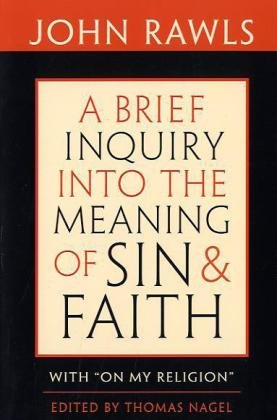 | Paperback: 288
Pages
(2010-05-01)
list price: US$16.95 -- used & new: US$10.13 (price subject to change: see help) Asin: 0674047532 Average Customer Review:
Canada | United Kingdom | Germany | France | Japan |
|
Editorial Review Product Description John Rawls never published anything about his own religious beliefs, but after his death two texts were discovered which shed extraordinary light on the subject. A Brief Inquiry into the Meaning of Sin and Faith is Rawls’s undergraduate senior thesis, submitted in December 1942, just before he entered the army. At that time Rawls was deeply religious; the thesis is a significant work of theological ethics, of interest both in itself and because of its relation to his mature writings. “On My Religion,” a short statement drafted in 1997, describes the history of his religious beliefs and attitudes toward religion, including his abandonment of orthodoxy during World War II. The present volume includes these two texts, together with an Introduction by Joshua Cohen and Thomas Nagel, which discusses their relation to Rawls’s published work, and an essay by Robert Merrihew Adams, which places the thesis in its theological context. The texts display the profound engagement with religion that forms the background of Rawls’s later views on the importance of separating religion and politics. Moreover, the moral and social convictions that the thesis expresses in religious form are related in illuminating ways to the central ideas of Rawls’s later writings. His notions of sin, faith, and community are simultaneously moral and theological, and prefigure the moral outlook found in Theory of Justice. Customer Reviews (3)
| |
| 7. Rawls's 'A Theory of Justice': An Introduction (Cambridge Introductions to Key Philosophical Texts) by Jon Mandle | |
 | Paperback: 222
Pages
(2009-11-16)
list price: US$29.99 -- used & new: US$14.93 (price subject to change: see help) Asin: 0521646677 Canada | United Kingdom | Germany | France | Japan |
|
Editorial Review Product Description | |
| 8. Rawls (The Routledge Philosophers) by Samuel Freeman | |
 | Hardcover: 576
Pages
(2007-07-17)
list price: US$100.00 -- used & new: US$80.00 (price subject to change: see help) Asin: 0415301084 Average Customer Review:
Canada | United Kingdom | Germany | France | Japan |
|
Editorial Review Product Description In this superb introduction, Samuel Freeman introduces and assesses the main topics of Rawls' philosophy. Starting with a brief biography and charting the influences on Rawls' early thinking, he goes on to discuss the heart of Rawls's philosophy: his principles of justice and their practical application to society. Subsequent chapters discuss Rawls's theories of liberty, political and economic justice, democratic institutions, goodness as rationality, moral psychology, political liberalism, and international justice and a concluding chapter considers Rawls' legacy. Clearly setting out the ideas in Rawls' masterwork, A Theory of Justice, Samuel Freeman also considers Rawls' other key works, including Political Liberalism and The Law of Peoples. An invaluable introduction to this deeply influential philosopher, Rawls is essential reading for anyone coming to his work for the first time. Customer Reviews (6)
| |
| 9. Rawls's 'A Theory of Justice': A Reader's Guide (Reader's Guides) by Frank Lovett | |
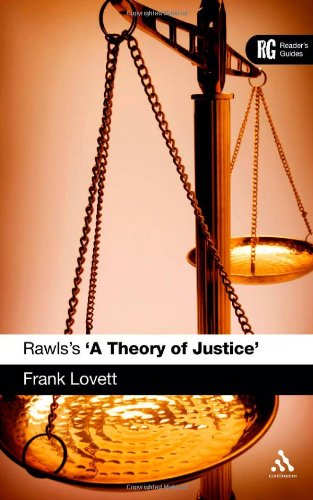 | Paperback: 176
Pages
(2011-01-06)
list price: US$24.95 -- used & new: US$16.83 (price subject to change: see help) Asin: 0826437818 Canada | United Kingdom | Germany | France | Japan |
|
Editorial Review Product Description | |
| 10. John Rawls: His Life and Theory of Justice by Thomas Pogge | |
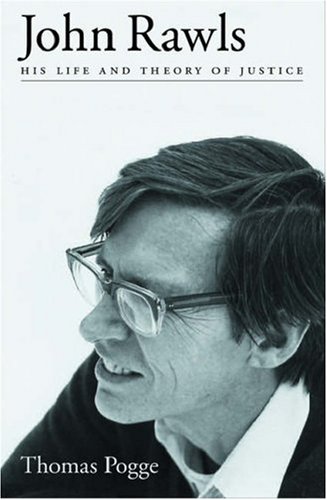 | Paperback: 240
Pages
(2007-01-27)
list price: US$25.00 -- used & new: US$18.00 (price subject to change: see help) Asin: 0195136373 Average Customer Review:
Canada | United Kingdom | Germany | France | Japan |
|
Editorial Review Product Description Customer Reviews (1)
| |
| 11. Rawls and Habermas: Reason, Pluralism, and the Claims of Political Philosophy by Todd Hedrick | |
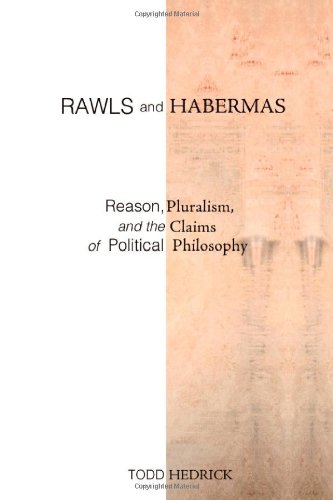 | Paperback: 256
Pages
(2010-06-01)
list price: US$21.95 -- used & new: US$17.09 (price subject to change: see help) Asin: 0804770778 Canada | United Kingdom | Germany | France | Japan |
|
Editorial Review Product Description | |
| 12. On Rawls (Wadsworth Notes) by Robert B. Talisse | |
 | Paperback: 96
Pages
(2001-01-08)
list price: US$15.95 -- used & new: US$11.61 (price subject to change: see help) Asin: 0534583695 Average Customer Review:
Canada | United Kingdom | Germany | France | Japan |
|
Editorial Review Product Description Customer Reviews (2)
| |
| 13. Collected Papers by John Rawls | |
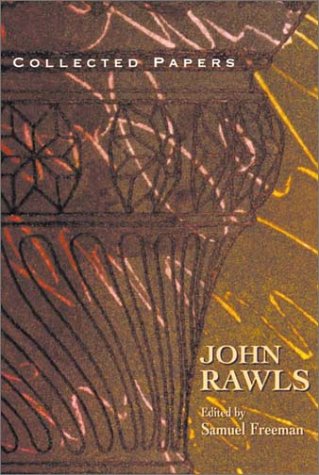 | Paperback: 672
Pages
(2001-03-02)
list price: US$34.00 -- used & new: US$29.04 (price subject to change: see help) Asin: 0674005694 Average Customer Review:
Canada | United Kingdom | Germany | France | Japan |
|
Editorial Review Product Description John Rawls's work on justice has drawn more commentary and aroused wider attention than any other work in moral or political philosophy in the twentieth century. Rawls is the author of two major treatises, A Theory of Justice (1971) and Political Liberalism (1993); it is said that A Theory of Justice revived political philosophy in the English-speaking world. But before and after writing his great treatises Rawls produced a steady stream of essays. Some of these essays articulate views of justice and liberalism distinct from those found in the two books. They are important in and of themselves because of the deep issues about the nature of justice, moral reasoning, and liberalism they raise as well as for the light they shed on the evolution of Rawls's views. Some of the articles tackle issues not addressed in either book. They help identify some of the paths open to liberal theorists of justice and some of the knotty problems which liberal theorists must seek to resolve. A complete collection of John Rawls's essays is long overdue. Customer Reviews (2)
Rawls' _CollectedPapers_ brings together nearly all of his major and minor shorterpublications on these and related issues. Many essays explore in greaterdepth issues raised by critics of _A Theory of Justice_ and _PoliticalLiberalism_, and all of them together paint a fascinating portrait ofRawls' philosophical development between 1951 and the present. ... Read more | |
| 14. John Rawls (Philosophy Now) by Catherine Audard | |
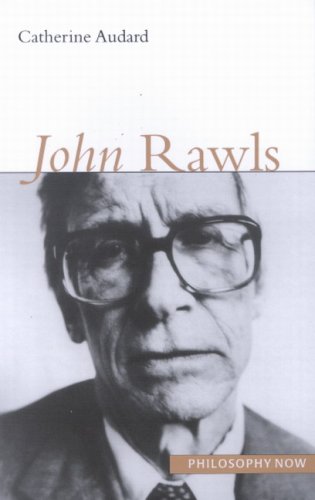 | Paperback: 328
Pages
(2007-04-30)
list price: US$27.95 -- used & new: US$17.02 (price subject to change: see help) Asin: 0773532374 Average Customer Review:
Canada | United Kingdom | Germany | France | Japan |
|
Editorial Review Product Description Customer Reviews (1)
| |
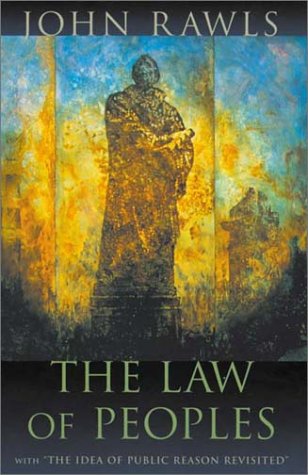
| 15. The Law of Peoples: with "The Idea of Public Reason Revisited" by John Rawls | |
 | Paperback: 208
Pages
(2001-03-02)
list price: US$22.50 -- used & new: US$13.98 (price subject to change: see help) Asin: 0674005422 Average Customer Review:
Canada | United Kingdom | Germany | France | Japan |
|
Editorial Review Product Description This book consists of two parts: the essay "The Idea of Public Reason Revisited," first published in 1997, and "The Law of Peoples," a major reworking of a much shorter article by the same name published in 1993. Taken together, they are the culmination of more than fifty years of reflection on liberalism and on some of the most pressing problems of our times by John Rawls. "The Idea of Public Reason Revisited" explains why the constraints of public reason, a concept first discussed in Political Liberalism (1993), are ones that holders of both religious and non-religious comprehensive views can reasonably endorse. It is Rawls's most detailed account of how a modern constitutional democracy, based on a liberal political conception, could and would be viewed as legitimate by reasonable citizens who on religious, philosophical, or moral grounds do not themselves accept a liberal comprehensive doctrine--such as that of Kant, or Mill, or Rawls's own "Justice as Fairness," presented in A Theory of Justice (1971). The Law of Peoples extends the idea of a social contract to the Society of Peoples and lays out the general principles that can and should be accepted by both liberal and non-liberal societies as the standard for regulating their behavior toward one another. In particular, it draws a crucial distinction between basic human rights and the rights of each citizen of a liberal constitutional democracy. It explores the terms under which such a society may appropriately wage war against an "outlaw society," and discusses the moral grounds for rendering assistance to non-liberal societies burdened by unfavorable political and economic conditions. Customer Reviews (9)
| |
| 16. Reclaiming the History of Ethics: Essays for John Rawls | |
 | Paperback: 428
Pages
(2008-05-29)
list price: US$50.00 -- used & new: US$46.27 (price subject to change: see help) Asin: 0521063507 Canada | United Kingdom | Germany | France | Japan |
|
Editorial Review Product Description | |
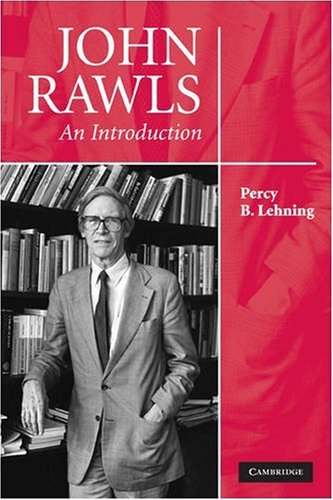
| 17. John Rawls: An Introduction by Percy B. Lehning | |
 | Paperback: 306
Pages
(2009-07-20)
list price: US$29.99 -- used & new: US$17.71 (price subject to change: see help) Asin: 0521727693 Canada | United Kingdom | Germany | France | Japan |
|
Editorial Review Product Description | |
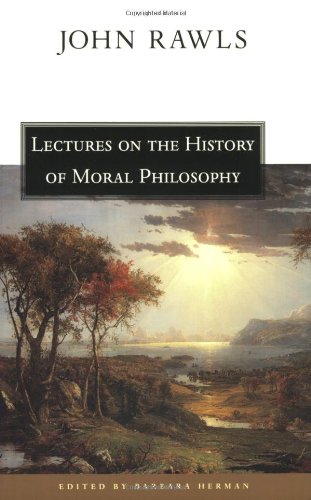
| 18. Lectures on the History of Moral Philosophy by John Rawls, Barbara Herman | |
 | Paperback: 414
Pages
(2000-11-15)
list price: US$27.00 -- used & new: US$18.90 (price subject to change: see help) Asin: 0674004426 Average Customer Review:
Canada | United Kingdom | Germany | France | Japan |
|
Editorial Review Product Description Central to Rawls’s approach is the idea that respectful attentionto the great texts of our tradition can lead to a fruitful exchange ofideas across the centuries. In this spirit, his book engages thinkerssuch as Leibniz, Hume, Kant, and Hegel as they struggle in brilliantand instructive ways to define the role of a moral conception in humanlife. The lectures delineate four basic types of moral reasoning:perfectionism, utilitarianism, intuitionism, and--the ultimate focusof Rawls’s course--Kantian constructivism. Comprising a superbcourse on the history of moral philosophy, they also afford uniqueinsight into how John Rawls has transformed our view of this history. Customer Reviews (2)
A warning, though: don't leap into this book as a "Moral Philosophy for Dummies" kind of guide. Although you don't have to be a guru, you need to have already read a bit on the subject in order to savour the delights of this book. I myself am taking my first (very wobbly) steps into a field which attempts, as the cover of the book says, to "define the role of a moral conception in human life." ... Read more | |
| 19. Legacy of John Rawls (Continuum Studies in American Philosophy) by Thom Brooks, Fabian Freyenhagen | |
 | Paperback: 240
Pages
(2007-12-15)
list price: US$49.95 -- used & new: US$40.96 (price subject to change: see help) Asin: 0826499872 Canada | United Kingdom | Germany | France | Japan |
|
Editorial Review Product Description | |
| 20. Habermas and Rawls: Disputing the Political (Routledge Studies in Contemporary Philosophy) | |
| Hardcover: 256
Pages
(2010-11-15)
list price: US$105.00 -- used & new: US$84.00 (price subject to change: see help) Asin: 0415876869 Canada | United Kingdom | Germany | France | Japan | |
|
Editorial Review Product Description Habermas and Rawls are two heavyweights of social and political philosophy, and they are undoubtedly the two most written about (and widely read) authors in this field. However, there has not been much informed and interesting work on the points of intersection between their projects, partly because their work comes from different traditions—roughly the European tradition of social and political theory and the Anglo-American analytic tradition of political philosophy. In this volume, contributors re-examine the Habermas-Rawls dispute with an eye toward the ways in which the dispute can cast light on current controversies about political philosophy more broadly. Moreover, the volume will cover a number of other salient issues on which Habermas and Rawls have interesting and divergent views, such as the political role of religion and international justice. | |
| 1-20 of 100 | Next 20 |
 A Tremendous Error
 The abandonment of political rationalism
 Major flaw of this book are misconceptions...