e99 Online Shopping Mall

Geometry.Net - the online learning center Help  
Home  - Philosophers - Schopenhauer Arthur (Books)

  Back | 21-40 of 100 | Next 20
A  B  C  D  E  F  G  H  I  J  K  L  M  N  O  P  Q  R  S  T  U  V  W  X  Y  Z  

click price to see details     click image to enlarge     click link to go to the store

$10.00
21. The Cambridge Companion to Schopenhauer
$3.99
22. The Wisdom of Life and Counsels
 
$31.38
23. Die Welt als Wille und Vorstellung
$23.99
24. Life of Arthur Schopenhauer
 
$20.00
25. Schopenhauer's World as Will and
$9.95
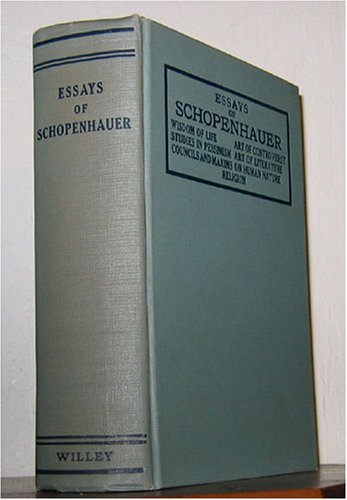
26. The Essays of Arthur Schopenhauer;
$3.93
27. Schopenhauer in 90 Minutes (Philosophers
$52.00
28. Schopenhauer, Philosophy and the
$34.45
29. The World As Will And Idea - Vol
$14.00
30. Arthur Schopenhauer: Knowledge
$12.85
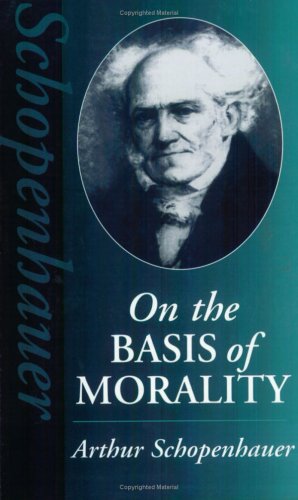
31. The Basis of Morality
$73.31
32. Schopenhauer (The Routledge Philosophers)
 
$30.98
33. El silencio de Goethe o La última
$7.17
34. El arte de tratar a las mujeres
 
35. The Complete Essays of Arthur
$24.99
36. Arte del buen vivir
$5.43
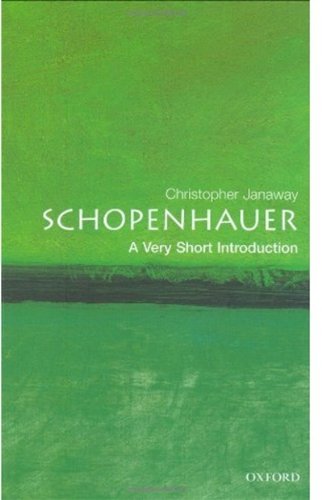
37. Schopenhauer: A Very Short Introduction
$149.00
38. Willing and Unwilling: A Study
$8.02
39. On the Suffering of the World
$34.95
40. In Search of Schopenhauer's Cat:

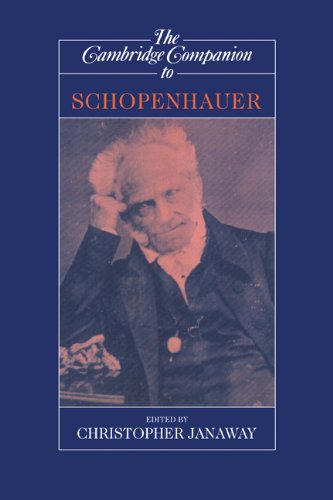
21. The Cambridge Companion to Schopenhauer (Cambridge Companions to Philosophy)
Paperback: 492 Pages (1999-10-13)
list price: US$32.99 -- used & new: US$10.00
(price subject to change: see help)
Asin: 0521629241
Average Customer Review: 4.0 out of 5 stars
Canada | United Kingdom | Germany | France | Japan
Editorial Review

Book Description
Schopenhauer (1788-1860) is something of a maverick figure in the history of philosophy. He produced a unique theory of the world and human existence based on his notion of will. This collection analyzes the related but distinct components of will from the point of view of epistemology, metaphysics, philosophy of mind, aesthetics, ethics, and the philosophy of psychoanalysis. New readers will find this the most convenient and accessible guide to Schopenhauer currently available. Advanced students and specialists will find a conspectus of recent developments in the interpretation of Schopenhauer. ... Read more

Customer Reviews (1)

4-0 out of 5 stars Mixed Bag on the Misanthropic Misogynist Metaphysician.
If you're new to Schopenhauer, this probably isn't the best place to start. Although most of these essays merit a read, some are utterly blighted by an academic pomposity & inscrutability that makes them all but unreadable.

Granted, some philosophers who were guilty of transgressions of style (such as Kant), were still truly deep thinkers. But there is no excuse for the academic wretchedness displayed in this gem from the book's first essay:"Such purported intimate knowledge of the ultimate reality behind or beneath the appearances seems to transgress the critical interdiction against seeking knowledge of the unknowable things in themselves and therefore to constitute a relapse into pre-Kantian dogmatism or transcendental realism, thus turning Schopenhauer's work into a puzzling conjunction of transcendental philosophy and transcendent metaphysics of the will." And this from a book that claims to purportedly "dispel the intimidation ... readers often feel when faced with the work of a difficult and challenging thinker"!

Along with such drivel, there is much that is good. All of Christopher Janaway's essays are excellently written, perceptive, and a pure joy to read. Along with Bryan Magee, I consider Janaway the most reliable authority on Schopenhauer.

Although Schopenhauer probably would have resented this, some of the best essays in the volume were written by women. I found the essays on Schopenhauer's Eastern influences by Moira Nicholls and the Nietzsche/Schopenhauer/Dionysus connection by Martha Nussbaum to be especially interesting & insightful.

If you're new to Arthur Schopenhauer, it would be best to start with Schopenhauer-A Very Short Introduction by Christopher Janaway, and then move on to Bryan Magee's The Philosophy of Schopenhauer. Then move on to The World as Will & Representation. It's truly a breeze to read when compared to Kant...or some of these essays. ... Read more


22. The Wisdom of Life and Counsels and Maxims
by Arthur Schopenhauer
Kindle Edition: 120 Pages (2004-07-01)
list price: US$4.99 -- used & new: US$3.99
(price subject to change: see help)
Asin: B000FC26NM
Average Customer Review: 5.0 out of 5 stars
Canada | United Kingdom | Germany | France | Japan

Customer Reviews (4)

4-0 out of 5 stars Advice for those new to S
After Nietzsche, Schopenhauer is often credited with being the 2nd most quoted philosopher but in spite of this he is probably among the least referenced 'major' philosophers. So considering that Schopenhauer is not really taken very seriously by academics one has to wonder who is quoting S and what value they find in his thinking, or his writing in any event. If you are reading this review I will assume you don't own this book and are probably new to the writings of S so I gear it towards that group of people in particular and hope you find the suggestions useful.

This small collection, just two excerpts from his larger and also last work, Parerga und Paralipomena (1851), is an ideal starting point to understand the appeal of S but I think only after one is loosely familiar with S the man and the broad outlines of his thinking should one read this collection. This assumes your interested in how he comes to his conclusions and are not just quote mining. S makes the point over and over again in these essays that knowledge from books alone is a groundless and untethered species of thought that has no cogent frame of reference and beyond being used deceptively in conversation or argument is useless and even dangerous. I'm not sure how to recommend that you get the experiential knowledge of what he talks about but you can certainly dig a bit more into the ideas behind the observations in this book.

Unfortunately, to really understand S you must also understand Kant and as that won't be a reasonable or enticing enough task for most people to commit to I think some path might be offered that can help simplify that work. The path I would have taken is a bit long and is really only for those really interested in S. First the books of Bryan Magee. Magee is the ideal expositor of S and his writing, like S's, is a model of clarity and it genuinely reeks of honest and harshly critical self evaluation. There are three books in particular from Magee that are of interest, 'Confessions of a Philosopher' which explains Magee and offers nice broad summaries of Kant and S that will be a useful foundation. 'The Philosophy of Schopenhauer' is Magee's seminal work on S and is required reading of course but so is the 'Tristan Chord' his book on the philosophy of Richard Wagner. The Tristan Chord is an excellent summary of the cultural and intellectual econiche near the end of S's life, the revolutionary mid 19th century . Magee introduces the sages of that age, S, Feuerbach, Marx & Engles, Hegel, Bakunin and Nietzsche as well as the most important artist of the age, Wagner, who was deeply influenced by all of these men, especially S, and had frequent discourse with many of them. With these three books behind you you can then dig into the World as Will and Representation. Starting with Volume 2 I believe is the standard recommendation. As you read S's one and only masterpiece you can dip into his 'self help' books, they are therapeutic, entertaining and have a grain of truth about them, but even as they are solid models of clarity and are eminently quotable they do not, in my opinion, stand alone as examples of his thinking and it's deceptive to view them that way.


5-0 out of 5 stars Schopenhauer as an exemplar
"Philosophy" is often refered to as a field of study in which questions regarding the nature of reality, beauty and man are taken up with vigor.Those who are interested in these topics and all of their tributary subjects are said to be "philosophers" or "philosophical" in nature.Others, whose concerns are strictly material, are considered to be "unphilosophical" in nature.They have no philosophical disposition towards anything: it is as if their behavior is guided by their immediate circumstances and that they are prey to interests that are common and trite.It is this very distinction between the "philosophical" and "unphilosophical" that I wish to refute by appealing to Schopenhauer as an exemplar of what it means to have a philosophy of life.
All of the reviews below adequately convey the merits of the book itself.But what is also important is understanding what this book represents within the context of philosophy itself.And what we discover from reading this book is that even the most vulgar man, a man considered by all measure to be morally and intellectually inept, has a philosophy of life.Schopenhauer was a genius and therefore had the capacity to articulate his thoughts in a powerfully original manner.His outlook on the world stands out from the rest precisely because his intellect is capable of penetrating to the heart of things and describe them in a manner that is at once lucid and compelling.Most of us, however, do not have the mental power nor the luxury of time to express our views on life in general.But I believe this book, when taken as a whole, will help us understand that every life is ultimately guided by a point of view which, underlying all its idiosyncratic characterstics, refers to philosophical assumptions and hence a philosophy of life.In sum, our relation to life is and always will be philosophical in nature.The difference between an ordinary man and Schopenhaure is merely a qualitative one. Schopenhauer's book proves that, and I inviteyou to see how it does.

5-0 out of 5 stars essential for anyone inclined to contemplation
arthur schopenhauer had a more accurate and realistic outlook on life than his student, friedrich nietzsche, who i also have a great deal of admiration for. which is not to say that going on tirades against life and intellectualizing everything is the way to go, but which is to say that anyone who recognizes the basic facts of existence is hardly going to reply with a tremendous "YES TO LIFE" as nietzsche so ridiculously and psychotically suggested. is schopenhauer a decadent, as nietzsche claimed? by his standards, yes, but let's remember that by nietzsche's standards he himself was a decadent of the worst kind. he had very few interpersonal relationships that were successful, he was an utter failure when it came to women, he was filled to the brim with bitterness and contempt for religion, and he was for the most part a solitary neurotic, who tried to conceal his own fear of life as some sign of nobility or superiority. i disagree with schopenhauer's supposed 'renunciation of life', but i am in decided agreement with his firm and unyielding belief that ultimate satisfaction and total happiness, those absurd myths which themselves bring terrible unhappiness to those who imagine they exist, are fictions created by society. both philosophers contradicted themselves constantly, but of the two i would say that nietzsche was by far the more hypocritical and blind to his own failings while so harshly critical of the failings of others. nietzsche preached the virtues of creativity and self realization as the highest possible goal man could reach for, and yet he attacked everything strange, odd, interesting, as 'decadent'. there is no better way to discourage creativity and perpetuate bourgeois values than to contemptuously dismiss everything unusual and unique as 'sick'. and all that 'will to power' BS gets pretty tiresome after awhile, especially considering that nietzsche himself was utterly lacking in any kind of power whatsoever, save that of the intellectual type. nietzsche dismisses with disgust everyone and everything that doesn't strive for worldly influence and domination, and yet three sentences later he will admit openly that the universe is basically subjective and that all meanings and goals are equally legitimate and equally relative. if that's the case, as i believe it is, why not enjoy ourselves and stop stressing about things like 'power' and 'greatness' that don't really matter in the bigger picture? anyone with the slightest experience of life will immediately agree with schopenhauer that our 'inner wealth' is what really matters, not the accidental and meaningless distractions of the external world. if this is decadence, roll in the decadence! this book is a must.

5-0 out of 5 stars Brilliantly written, but not for the tender-skinned.
I have to disagree with the other review I read on this work.I prefer Schopenhauer's 'pessimism' (which by the way, is written with great wit and humor and had me laughing quite a bit) to Nietzsche's destructive, puffed-up idealistic gas.This is not because I think pessimism is a good thing taken by itself, but rather that there are a great many things in life that SHOULD be avoided.I will say, however, that I think those who enjoy Nietzsche will have a true appreciation for this book (Nietzsche was deeply unfluenced by S.).He discusses an array of subjects, such as the emptiness of those things commonly pursued by the masses (money, status/position, vanity, sensual pleasure, etc.), and those most commonly ignored by most (temperance, good health, character, individuality, and developing one's mind).It is an eye-opener for people absorbed in their careers entrenched in the politics and daily grind of life.

Though riddled with hard-nosed realism and misanthropy, the book was positively entertaining and enjoyable.His style is fluid, prosaic, and imaginitive, unlike most German philosophy.In lieu of modern world events, it is probably more relevant a work today than ever before. ... Read more


23. Die Welt als Wille und Vorstellung I. ( Sämtliche Werke, 1).
by Arthur Schopenhauer
 Paperback: 735 Pages (2002-01-01)
-- used & new: US$31.38
(price subject to change: see help)
Asin: 3518282611
Canada | United Kingdom | Germany | France | Japan

24. Life of Arthur Schopenhauer
by William Wallace
Paperback: 238 Pages (2004-05-25)
list price: US$23.99 -- used & new: US$23.99
(price subject to change: see help)
Asin: 1402144407
Canada | United Kingdom | Germany | France | Japan
Editorial Review

Product Description
This Elibron Classics book is a facsimile reprint of a 1890 edition by Walter Scott, London. ... Read more


25. Schopenhauer's World as Will and Presentation, Volume 2 (Longman Library of Primary Sources)
by Arthur Schopenhauer
 Paperback: 850 Pages (2008-04-15)
list price: US$20.00 -- used & new: US$20.00
(price subject to change: see help)
Asin: 0321355806
Canada | United Kingdom | Germany | France | Japan
Editorial Review

Book Description
Part of the Longman Library of Primary Sources in Philosophy,” this second volume of Schopenhauer's World as Will and Presentation is framed by a pedagogical structure designed to make this important work of philosophy more accessible and meaningful for readers. A General Introduction includes the work's historical context, a discussion of historical influences, and biographical information on Arthur Schopenhauer.Annotations and notes from the editor clarify difficult passages for greater understanding, and a bibliography gives the reader additional resources for further study. ... Read more


26. The Essays of Arthur Schopenhauer; Counsels and Maxims
by Arthur Schopenhauer
Paperback: 88 Pages (2006-11-03)
list price: US$9.95 -- used & new: US$9.95
(price subject to change: see help)
Asin: 1406905364
Average Customer Review: 5.0 out of 5 stars
Canada | United Kingdom | Germany | France | Japan

Customer Reviews (1)

5-0 out of 5 stars The Essays of arthur Schopenhauer; counsels and Maxims
Arthur Schopenhauer is the only philosopher who seems to me to take Art, in all it's forms, seriously, as a form ofknowledge; he also seems to understand that we are essentially irrational creatures, fundamentally driven by our desires and emotions. he thus seems to be deeply in contact with those uncomfortable truths about ourselves which we would rather not know about.this makes the reading of him something that if taken seriously, can change one's life.
what higher complement can one make of a writer? He is vigorous in his so called pessimism, so he invigorates us. He is totally honest; He detests humbug and in clarity; he thinks that Art is something which can enoble us, and i agree with him. he is infintely insightful and deflationary of human pretention, always salutary; and last, but by no means least, i find him funny!

enough from me; Try him ! ... Read more


27. Schopenhauer in 90 Minutes (Philosophers in 90 Minutes)
by Paul Strathern
Paperback: 91 Pages (1999-11-25)
list price: US$9.95 -- used & new: US$3.93
(price subject to change: see help)
Asin: 1566632641
Average Customer Review: 4.5 out of 5 stars
Canada | United Kingdom | Germany | France | Japan
Editorial Review

Amazon.com
Schopenhauer in 90 Minutes is as effective in its biographical and philosophical summarizing as we've come to expect from Paul Strathern's unfolding series of introductions to the great thinkers. "As a man," Strathern writes, "Schopenhauer was a nasty piece of work, but his writings are immensely endearing." While never quite demonstrating how his philosophy "is the first since Socrates to be imbued with the entire personality of the man who propounds it" (though the sampling of excerpts in the back of the book certainly helps), Strathern does convey both Schopenhauer's prickly nature and its contradictions with the ascetic renunciation of the material world that he propounded in his writings. He also demonstrates how that asceticism was influenced by a "questionable use" of Eastern philosophical texts, and how his work would similarly inform that of philosophers like Nietzsche, Freud, and Wittgenstein. Book Description
In Schopenhauer in 90 Minutes, Paul Strathern offers a concise, expert account of Schopenhauer's life and ideas, and explains their influence on man's struggle to understand his existence in the world. The book also includes selections from Schopenhauer's writings; a brief list of suggested reading for those who wish to push further; and chronologies that place Schopenhauer within his own age and in the broader scheme of philosophy. ... Read more

Customer Reviews (4)

4-0 out of 5 stars Short Schope
A breezy read, definitely. And if you're new to this philosopher, not a bad place to start. Although there are a couple of errors (Wagner didn't read S until years after the Dresden uprising; Wagner & Nietzsche were converted to S via The World as Will and Representation, not his popular essays), and some questionable judgments (Parerga & Paralipomena isn't a philosophical curio at all), Schopenhauer In 90 Minutes is a great place to get the big picture.

The author is obviously sympathetic to Schopenhauer's brilliant insights (his metaphysical placement of the Will, as well as his system of aesthetics), and rightly critical of Schopenhauer's failings (the overbaked misogyny and occasional callousness). Still, as a previous reviewer remarked, calling Schopenhauer a "nasty piece of work" would be a definite overstatement. He was merely a very brilliant, solitary man who, through neglect and loneliness, inevitably went the way of the misanthrope.

5-0 out of 5 stars Misunderstood Genius- Understood!
I started reading this book with skepticism. I mean, how could anyone condense the core of Schopenhauers's life's work into a 90 minute (75 actually) read? I mean the _World as Will and Representation_ alone is a mammoth four volumes. And yet Strathern did it.... I don't know if he succeeded with the other volumes of this series, but by god, he did it with Schopenhauer- and managed to throw in all sorts of interesting, insightful tid-bits of his personal life (as well as placing it in the overall context of western philosophy.)

For those unfamiliar with Schopenhauer's core ideas they are just this: will is the cause of all things in the universe. Will is the thing-in-itself. There is blind will in "inanimate" matter and intelligent will in Man. In fact, in man is the will supreme. All nature is an expression of will- and man is a pattern of the universe, greatly reduced. Yet, will to be, will to create, is the cause of all evil and suffering and is therefore to be denied, if not extinguished. In this way, Schopenhauer always reminded me of a "cold-enlightened" Buddhist of the Theravadan school. However, Schopenhauer did hold that we would be reabsorbed into the great universal will at death- stripped of lesser animal consciousness.

By the way, it should be noted that this is all very different from Nietzsche's Will to Power- Nietzsche essentially turned Schopenhauer's idea of will on its head- and then went insane.

Oh, by the way, I do not agree with the author that Schopenhauer was a nasty piece of work. He was simply, totally, an original- this creates friction. He was also a completely confident authority that trusted his own intellect and intuition at all times- instead of diluting his ideas will appeals to authority and footnotes. He was also correct that Hegel was a fraud- and that Kant was pure genius.

5-0 out of 5 stars Schopenhauer in 90 Minutes by Paul Strathern
The thinker, Schopenhauer has a series of complex writings
which underlie academic discussion around the time of Goethe.
Schopenhauer felt that the universe would be blind without
purpose or the concept of being. The concept of a free will
brings with it misery and suffering as practical consequences.
Hope tends to be free of the egoistic side of man. Goethe
debated frequently with Schopenhauer. The fact that all colors
are an amalgum of light and dark lay at the foundation of
Goethe's discussions. Schopenhauer believed that the will
permeated everything. In fact, when the will replaces knowledge-
the result is obstinacy and ignorance. As an illustration,
the author showed that a true impression of someone could be
gleaned in letter-writing. This work is good, if you are a
student of Schopenhauer ; and, you find the need to integrate
his works into a unified whole for interpretive purposes.

4-0 out of 5 stars Another Worthy Entry in the Series
Once again, Paul Strathern has produced a succinct, entertaining, highly readable overview of a philosophical figure.The "in 90 Minutes" will not tell you everything you need to know about an individual, but youwill pick up a great introduction.I have read about ten of the books inthe series, and I enjoyed them all.Some of Strathern's conclusions strikeme as logically suspect, but an intelligent reader will not rely solely onhis opinions anyway."Schopenhauer in 90 Minutes" will give youa sense of who the man was, what he thought, and how he fits into theoverall scope of Western philosophy.Reading the book is the equivalent ofattending a great lecture: it offers some information, throws out someideas for consideration, and leaves you thinking after you have stumbledout of class into the blare of yellow sun. ... Read more


28. Schopenhauer, Philosophy and the Arts (Cambridge Studies in Philosophy and the Arts)
Paperback: 323 Pages (2007-11-05)
list price: US$52.00 -- used & new: US$52.00
(price subject to change: see help)
Asin: 0521044065
Canada | United Kingdom | Germany | France | Japan
Editorial Review

Book Description
This collection brings together thirteen new essays by some of the most respected contemporary scholars of Schopenhauer's aesthetics from a wide spectrum of philosophical perspectives. It examines the unique theory Schopenhauer developed to explain the life and work of the artist, and the influence his aesthetic philosophy has had on subsequent artistic traditions in such diverse areas as music, painting, poetry, literature, and architecture. The authors present Schopenhauer's thought as a vital and enduring contribution to aesthetic theory, and to the idealist vision that continues to guide Romantic and neo-Romantic art. ... Read more


29. The World As Will And Idea - Vol I
by Arthur Schopenhauer
Paperback: 568 Pages (2007-03-15)
list price: US$34.45 -- used & new: US$34.45
(price subject to change: see help)
Asin: 1406777080
Canada | United Kingdom | Germany | France | Japan
Editorial Review

Book Description
THE WORLD AS WILL AND IDEA By ARTHUR SCHOPENHAUER VOLUME I CONTAINING FOUR BOOKS Ob nicht Natur zuletzt sich doch ergrunde Goitbi LONDON ROUTLEDGE KEGAN PAUL LIMITED BROADWAY HOUSE, 68 - 74 CARTER LANE, E. C. CONTENTS FIRST BOOK. THE WORLD AS IDEA FIRST ASPECT. THE IDEA SUBOBDI NATF. P TO THE PRINCIPLE or SUFFICIENT REASON THK OBJECT OF EXPERIENCE AND SCIENCE , SECOND BOOK, THE WORLD AS WILL FIRST ASPECT. THE OBJECTIFICATIO OF THE WILL THIRD BOOK. THE WORLD AS IDEA SECOND ASPECT. THE IDEA INDEPEN DENT OF THE PRINCIPLE OF SUFFICIENT RKASON THE PLATONIC IDEA THE OBJECT OF ART . 217 FOURTH BOOK. THE WORLD AS WILL SECOND ASPECT. AFTER THE ATTAIN MENT OF SELF-KNOWLEDGE. ASSERTION AND DENIAL OF THE WILL TO LIVE 347 TRANSLATORS PREFACE THE style of Die Welt als Wille und Vorstellung is sometimes loose and involved, as is so often the case in German philosophical treatises. The translation of the book has consequently been a matter of no little diffi culty. It was found that extensive alteration of the long and occasionally involved sentences, however likely to prove conducive to a satisfactory English style, tended not only to obliterate the form of the original but even to imperil the meaning. Where a choice has had to be made, the alternative of a somewhat slavish adherence to Schopenhauers ipsissima verba has accordingly been pre ferred to that of inaccuracy. The result is a piece of work which leaves much to be desired, but which has yet consistently sought to reproduce faithfully the spirit as well as the letter of the original. As regards the rendering of the technical terms about which there has been so much controversy, the equiva lents used have only been adopted after careful consider ation of their meaning in the theory of knowledge. For example, Vorstellung has been rendered by idea, in preference to representation, which is neither accurate, intelligible, nor elegant. Idee, is translated by the vi TRANSLATORS 9 PREFACE. same word, but spelled with a capital, Idea. Again, Anschauung has been rendered according to the con text, either by perception simply, or by intuition or perception 1 Notwithstanding statements to the contrary in the text, the book is probably quite intelligible in itself, apart from, the treatise On the Fourfold Root of the Principle of Sufficient Reason. It has, however, been considered desirable to add an abstract of the latter work in an appendix to the third volume of this translation. R B. H, J. 1C PREFACE TO THE FIRST EDITION I PROPOSE to point out here how this book must be read in order to be thoroughly understood. By means of it I only intend to impart a single thought. Yet, notwith standing all my endeavours, I could find no shorter way of imparting it than this whole book. I holdjhisjbhought to be that which has very long been sought for under the name of philosophy, and the discovery of which is therefore regarded by those who are familiar with his tory as quite as impossible as the discovery of the philoso phers stone, although it was already said by Pliny Quam multa fieri non posse, priu quam sint facta, judicantur 1 Hist, riat 7, I. According as we consider the different aspects of this one thought which I am about to impart, it exhibits itself as that which we call metaphysics, that which we call ethics and that which we call aesthetics and cer tainly it must be all this if it is whatTTfave already acknowledged I take it to be. A system of thought must always have an architectonic connection or coherence, that is, a connection in which one part always supports the other, though the latter does not support the former, in which ultimately the foundation supports all the rest without being supported by it, and the apex is supported without supporting. On the other hand, a single thought, however compre riii PREFACE TO THE FIRST EDITION. hensive it may be, must preserve the most perfect unity... ... Read more


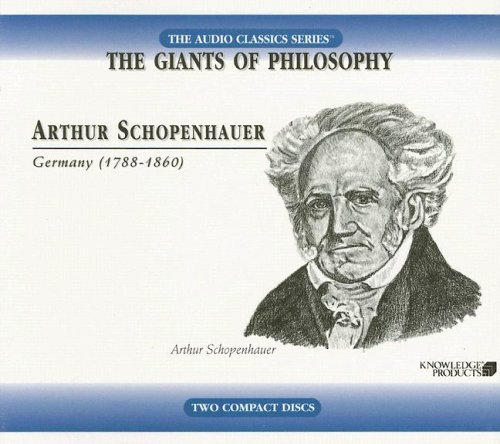
30. Arthur Schopenhauer: Knowledge Products (Giants of Philosophy) (Library Edition)
by Mark Stone
Audio CD: Pages (2006-04-01)
list price: US$18.00 -- used & new: US$14.00
(price subject to change: see help)
Asin: 0786169400
Average Customer Review: 4.5 out of 5 stars
Canada | United Kingdom | Germany | France | Japan
Editorial Review

Product Description
Arthur Schopenhauer was the most articulate and influential pessimist in the history of human thought. He was convinced that the space and time of ordinary life is an illusion, that the world consists of two aspects: representation (visible appearances) and will (hidden reality). Will is a unitary, blind, irrational force underlying all nature and expressing itself throughout it. Since human actions are blindly propelled by this will, not reason, prescriptive ethical rules have little force. We flourish only at each other’s expense; evil, pain, and suffering are not aberrations, but express the inner nature of the world. Our will to live is a continuing cycle of want, temporary fulfillment, and more want. New desires replace any satisfied ones, so no lasting happiness is possible. There is no overall end or purpose of life; our will to live is doomed ultimately to fail, and we die. ... Read more

Customer Reviews (2)

4-0 out of 5 stars Sufficient Rational?
Schopenhauer's discussion of the organic nature of our humanity, is exciting, up-lifting, and scary.He swept away many of the cobwebs of human thought and meta-physical mysteries. To him, the brain, the limbic system,(although his concepts pre-dated modern brain theory), are really what's at the heart of human reason.He helped me to understand, the nature of truth, which is sufficient rational, based upon very human perception.Why is art beautiful? Why are entire people's irrational? Schopenhauer's work opens doors that modern psychology, in Freud and Jung stepped into.

Heston's narration is very pleasant, and this treatment, although academic was very approachable for the dilettante.

Gare Henderson

5-0 out of 5 stars Excellent summary of Schopenhauer if you can track it down
This is the only audiobook exposition and analysis of Schopenhauer's works I've encountered (if you know of another please e-mail me!).It was done in the mid-1990's by Knowledge Products, and I've gathered that many of these titles (I believe there are 12, each one an approximately 2.5 hour affair covering major philosophers from Plato to Sartre) are going out of print.They are all narrated by Charlton Heston, but don't think you'll be stuck with the gravelly-voiced Moses for the entire two cassettes.The producers utilize a revolving cast of actors to bring to life the thinkers themselves-- in this one we hear them "play" Kant and Nietzsche as well as the anonymous reviewer in Britain who brought Schopenhauer to the public's attention in his piece on Arthur's final publication, _Parerga and Paralipomena_.You will think the vocal imitation (including heavy accents) of history's greatest minds either cheesy or effective; I am of the latter.There is a biographical portion, to my mind heavily borrowing from the opening chapter of perhaps the finest book on Schopenhauer in English, Bryan Magee's _Philosophy of Schopenhauer_, followed by an exegesis of Schopenhauer's thought.Schopenhauer was that most darkly cast of philosophers, despite being highly influential on artists, poets, and musicians of every sort. Many believe (and I among them) that his adaptation and extension of Kantian philosophy outclasses Hegel's, Fichte's, and Schelling's.The background and context to Schopenhauer's work is well represented, and the presentation is liberally peppered with selections from his writings.There are also reactions to Schopenhauer and a short criticism of his work to wrap things up.If anything, the reading of the final lines from Schopenhauer's central work, _The World As Will and Representation_, are worth this audiobook alone-- not to mention Heston's voicing (via the scriptwriter I assume) that Schopenhauer's view of life as purposeless touches on the "appalling." (!)(hilarious!) ... Read more


31. The Basis of Morality
by Arthur Schopenhauer
Paperback: 168 Pages (2007-06-01)
list price: US$12.95 -- used & new: US$12.85
(price subject to change: see help)
Asin: 1602065705
Canada | United Kingdom | Germany | France | Japan

32. Schopenhauer (The Routledge Philosophers)
by Julian Young
Hardcover: 271 Pages (2005-06-23)
list price: US$100.00 -- used & new: US$73.31
(price subject to change: see help)
Asin: 0415333466
Canada | United Kingdom | Germany | France | Japan
Editorial Review

Book Description
Arthur Schopenhauer (1788-1860) was one of the greatest writers and German philosophers of the Nineteenth century. His work influenced figures as diverse as Wagner, Freud and Nietzsche.

In this comprehensive introduction, Julian Young covers all the main aspects of Schopenhauer's philosophy. Beginning with an overview of Schopenhauer's life and work, he introduces the central aspects of his metaphysics fundamental to understanding his work as a whole: his philosophical idealism and debt to the philosophy of Kant; his attempt to answer the question of what the world is; his account of science; and in particular his idea that 'will' is the essence of all things.

Julian Young then introduces and assesses Schopenhauer's aesthetics, which occupies a central place in his philosophy. He carefully examines Schopenhauer's theories of the sublime, artistic genius and music, before assessing his ethics of compassion, his arguments for pessimism and his account of 'salvation'. In the final chapter, he considers Schopenhauer's legacy and his influence on the thought of Nietzsche and Wittgenstein, making this an ideal starting point for those coming to Schopenhauer for the first time. ... Read more


33. El silencio de Goethe o La última noche de Arthur Schopenhauer
by Unknown
 Paperback: Pages (1999-12-31)
-- used & new: US$30.98
(price subject to change: see help)
Asin: 8498320577
Canada | United Kingdom | Germany | France | Japan

34. El arte de tratar a las mujeres (Pensamiento)
by Arthur Schopenhauer
Paperback: 128 Pages (2006-05-28)
list price: US$11.95 -- used & new: US$7.17
(price subject to change: see help)
Asin: 9588160901
Canada | United Kingdom | Germany | France | Japan
Editorial Review

Book Description

Though the relationship between philosophers and women has historically been a conflicted one, the appearance of talented women in the arts and in philosophy during the last few years has, to a large extent, debunked the prejudice of philosophy as an exclusively masculine domain. Nevertheless, Arthur Schopenhauer vehemently opposed the shift towards gender equality within philosophical writing and thought, and the result of his resistance is presented in this poignant treatise on the passion and vision he finds within philosophy alongside descriptions of his tumultuous relationships with women.
Aunque la relación entre el filósofo y las mujeres ha sido históricamente conflictiva, el surgimiento de grandes figuras femeninas en las artes y el pensamiento a lo largo de los últimos años ha logrado, en mayor parte, desdibujar el prejuicio de la filosofía como un campo exclusivamente masculino. Pero Arthur Schopenhauer, gracias a la amarga experiencia sufrida en casa de su madre, se opusó con luminosa intuición a este cambio a una mayor igualdad entre los sexos. El resultado, un libro mordaz y ácido, se adentra en las pasiones y la visión del prestigioso filósofo junto con sus propias relaciones con las mujeres.
... Read more

35. The Complete Essays of Arthur Schopenhauer
by Arthur; Saunders, T. Bailey (Translated by) Schopenhauer
 Hardcover: Pages (1942)

Asin: B000OVAOQU
Canada | United Kingdom | Germany | France | Japan

36. Arte del buen vivir
by Arthur Schopenhauer
Paperback: Pages (2001)
list price: US$7.99 -- used & new: US$24.99
(price subject to change: see help)
Asin: 8471664151
Canada | United Kingdom | Germany | France | Japan

37. Schopenhauer: A Very Short Introduction (Very Short Introductions)
by Christopher Janaway
Paperback: 160 Pages (2002-05-16)
list price: US$9.95 -- used & new: US$5.43
(price subject to change: see help)
Asin: 0192802593
Average Customer Review: 5.0 out of 5 stars
Canada | United Kingdom | Germany | France | Japan
Editorial Review

Book Description
Schopenhauer is the most readable of German philosophers. This book gives a succinct explanation of his metaphysical system, concentrating on the original aspects of his thought, which inspired many artists and thinkers including Nietzsche, Wagner, Freud, and Wittgenstein.Schopenhauer's central notion is that of the will - a blind, irrational force that he uses to interpret both the human mind and the whole of nature. Seeing human behaviour as that of a natural organism governed by the will to life, Schopenhauerdeveloped radical insights concerning the unconscious and sexuality which influenced both psychologists and philosophers. ... Read more

Customer Reviews (4)

5-0 out of 5 stars A splendid introduction to an influential thinker
Schopenhauer, a German philosopher of the early 19th century, is a greatly neglected thinker today, despite being hugely influential in the late 19th and early 20th centuries, most notably on the thought of Nietzsche, Wagner and Freud.The latter in particular, although he denied it, was greatly influenced by him.Janaway convincingly extends the list to include Mahler, Jung, Mann and others.In fact, if you have not yet delved deeply into the work of Freud or Nietzsche, I would strongly recommend that you tackle Schopenhauer before doing so, and Janaway's is the perfect introduction.It is a well-informed, readable and balanced account, neither an apology nor a savaging.Schopenhauer's metaphysics have not stood the test of time, but his worldview, essentially pessimistic yet with promise of redemption, is still very relevant, and in any ways strikingly modern.If you are at all interested in the development of modern thought, especially that of the various German and Austrian schools, then you need to acquaint yourself with Schopenhauer, and I doubt you will find a better introduction than this book.

5-0 out of 5 stars First Rate
Janaway is a top-notch Schopenhauer scholar, so there is no question that he knows his subject forwards and backwards.The first time I tried to read this Short Introduction, I didn't get very far before setting it aside with the feeling that I just wasn't getting it. A year later, after reading a lot of Schopenhauer and a several longer treatments of his ideas, I found that Janaway's book was clear as a bell, and I read right through it.I'm not sure what to make of that, but I think that I just didn't approach this kind of material with the right attitude and that the fault was therefore entirely mine. See below.

In any case, this is a first-rate introduction to Schopenhauer, and a very well-written one, too. Schopenhauer himself was a very clear and careful writer (no Hegel, by far), and Janaway continues in that tradition. Schopenhauer's metaphysics is, of course, speculative and that can be a problem if, like me, you come to it from an analytic tradition where everything has to be provable to be considered meaningful or taken seriously.In reading Schopenhauer, or a book like this describing his philosophy, you need to suspend those criteria temporarily and to look at his system as one extremely smart man's best guess about the nature of the world. Call it a working hypothesis that is necessarily underdetermined by the possible empirical evidence. The judgment required therefore must be an overall one as to how well you think that picture fits with the world as you experience it, granting that some number of alternative systems are possible that would fit equally well. To some degree, it's an aesthetic judgment, or perhaps a decision about what kind of world view you can be comfortable with; the key question is whether you are willing to entertain the possibility that the empirical world might not be all there is.

If you are shopping around for a congenial view at that level, then Schopenhauer's ideas are well worth considering, and Janaway's introduction would be a good place to start. Or, if you just have a detached curiousity about what one of the giants of 19th-century philosophy had to say, then it's a good book for that purpose, also. One thing about Schopenhauer is that once you understand his view of things, you will have a hard time seeing the world in quite the same way as you previously did.

4-0 out of 5 stars By and large a solid introduction
This book focuses on the philosophy of Arthur Schopenhauer (1788-1860).

The author states in his preface that "This book aims to give a sympathetic but critical account of Schopenhauer's philosophy."Indeed, the book at times is certainly critical; the very last paragraph of the book begins "Though Schopenhauer's metaphysics is not credible as a system..."Janaway's basic message throughout seems to be that Schopenhauer is very important for the influence he had on others (for example, Wagner and Nietsche), for the unique and often troubling questions he raised, and for the new ideas he brought into philosophy - but he is not a Schopenhauer apologist.

The focus of the book is on Schopenhauer's ideas about philosophical topics like will, the body, the self, metaphysics, character, sexuality, the unconscious, art and aesthetic experience, ethics, and other issues.Special focus is given to Schopenhauer's The World as Will and Representation, which is presented as his greatest work, and much is made of the philosopher's idea of the will to life and physical reality as a manifestation of this will.

All in all I would say that Janaway does a decent job in introducing Schopenhauer's ideas, although his summary at times is a bit less clear than some of the other books in the Very Short Introduction series.

5-0 out of 5 stars A superb concise introduction to Schopenhauer's thought.
Concise yet engaging, this book is an excellent introduction to Schopenhauer's life and thought. The author's remarks on the difficulties and limitations of Schopenhauer's metaphysics are highly illuminating. His notes highlighting the important and influential aspects of this philosophy provide a perfect contrast to his critical remarks, and give the reader a sober, balanced view of the subject. All in all, this is a great book to read before and after delving into Schopenhauer's own works. ... Read more


38. Willing and Unwilling: A Study in the Philosophy of Arthur Schopenhauer (Nijhoff International Philosophy Series)
by J.P. Young
Hardcover: 188 Pages (1987-07-31)
list price: US$187.00 -- used & new: US$149.00
(price subject to change: see help)
Asin: 9024735564
Canada | United Kingdom | Germany | France | Japan

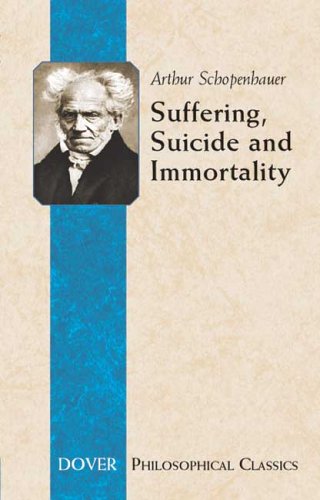
39. On the Suffering of the World
by Arthur Schopenhauer
Paperback: 131 Pages (2004-09-02)
-- used & new: US$8.02
(price subject to change: see help)
Asin: 0141018941
Canada | United Kingdom | Germany | France | Japan

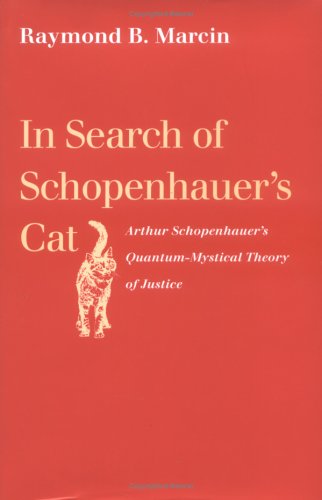
40. In Search of Schopenhauer's Cat: Arthur Schopenhauer's Quantum-Mystical Theory of Justice
by Raymond B. Marcin
Hardcover: 193 Pages (2006-02)
list price: US$34.95 -- used & new: US$34.95
(price subject to change: see help)
Asin: 0813214300
Average Customer Review: 5.0 out of 5 stars
Canada | United Kingdom | Germany | France | Japan

Customer Reviews (1)

5-0 out of 5 stars Hard to put down
This short book is hard to put down.It provides an excellent introduction to Schopenhauer's thought, focusing on the fact that he viewed the universe -- the reality that lies behind appearances -- as one.Marcin shows how Schopenhauer's view coincides with that of quantum physics, Eastern religion, and Christian mysticism.Schopenhauer's theory of justice derives from the fact that reality is one.You and I are one, so, if I do wrong to you, then I do wrong to myself.Schopenhauer's theory of justice, therefore, calls for compassion, not for individual rights, as, in reality, there are no individuals. ... Read more


  Back | 21-40 of 100 | Next 20
A  B  C  D  E  F  G  H  I  J  K  L  M  N  O  P  Q  R  S  T  U  V  W  X  Y  Z  

Prices listed on this site are subject to change without notice.
Questions on ordering or shipping? click here for help.

site stats