e99 Online Shopping Mall

Geometry.Net - the online learning center Help  
Home  - Philosophers - Singer Peter (Books)

  1-20 of 100 | Next 20
A  B  C  D  E  F  G  H  I  J  K  L  M  N  O  P  Q  R  S  T  U  V  W  X  Y  Z  

click price to see details     click image to enlarge     click link to go to the store

$18.93
1. The Way We Eat: Why Our Food Choices
$7.30
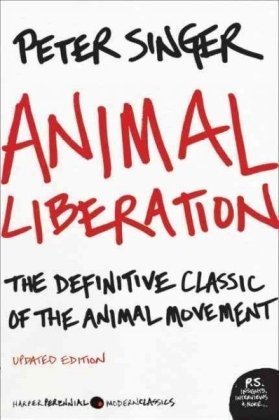
2. Animal Liberation
$7.95
3. One World: The Ethics of Globalization,
$14.35
4. Practical Ethics
$6.89
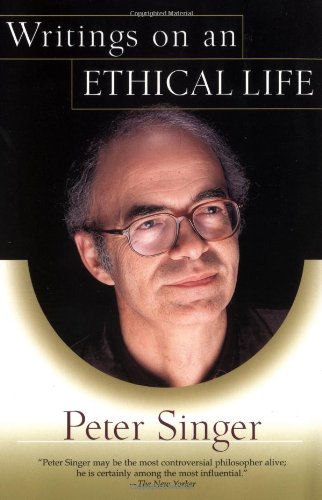
5. Writings on an Ethical Life
$12.99
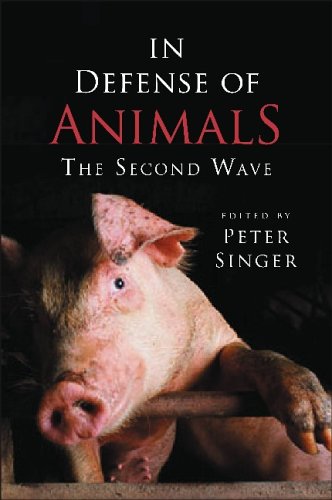
6. In Defense of Animals: The Second
$23.07
7. Repensar La Vida Y La Muerte/
$7.58
8. Rethinking Life and Death: The
$13.28
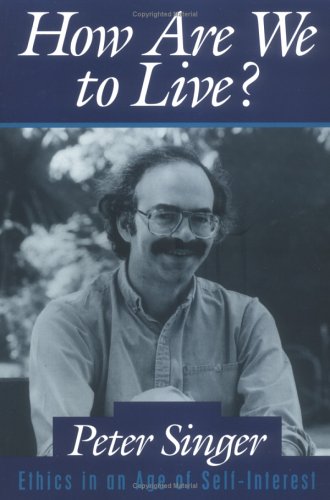
9. How Are We to Live?: Ethics in
$21.95
10. Ethics (Oxford Readers)
 
11. The Expanding Circle: Ethics and
12. Writings on an Ethical Life (ISNM)
$5.30
13. Hegel: A Very Short Introduction
 
$105.00
14. Biology (Eighth Edition) By Reven,
$75.00
15. The Cambridge Textbook of Bioethics
$16.12
16. A Darwinian Left: Politics, Evolution,
 
$63.95
17. At Play in the Fields of Consciousness:
$15.00
18. The Flexitarian Table: Inspired,
$28.10
19. Animal Philosophy: Essential Readings
$5.00
20. On Peter Singer (Wadsworth Philosophers

1. The Way We Eat: Why Our Food Choices Matter
by Peter Singer, Jim Mason
Hardcover: 288 Pages (2006-05-02)
list price: US$25.95 -- used & new: US$18.93
(price subject to change: see help)
Asin: B000RL9OCC
Average Customer Review: 4.0 out of 5 stars
Canada | United Kingdom | Germany | France | Japan

Customer Reviews (36)

5-0 out of 5 stars Only read if you care about yourself or the world around you
This book offers a very thought-provoking view into the world of food.Forget restaurant hygiene and other crazes, this book portrays the alarming state of the food industry as it operates in the USA today (with a slight glimpse into Europe as well).The authors do a very good job at presenting facts and issues surrounding the ethics (obviously) of the food industry, with a focus on farming.Unlike many other similar discussions, I felt the authors' approach was very easy to read (or digest, heh), with a seemingly open-minded view on the world.

Since finishing the read, I have altered my personal food buying decisions.I'm not perfect by any means, but I feel learning about the "what goes on behind closed doors" has helped me find a new appreciation for awareness and conscientiousness about food.I've given up some foods entirely, and am doing much more research in my buying decisions.I appreciate the education the book provided me, and already feel like a better person for the decisions it's helped me made.

Note: I'm an omnivore, and I *love* steaks.I'm just a bit more thoughtful than I was before about them.

5-0 out of 5 stars Everyone should read this
This is a superb book. Everyone should read this to know what they are truly consuming and how it effects our planet and its inhabitants. It's time that we are aware of the consequences of our food choices so that we may hopefully make better choices and decrease our impact on the planet.

5-0 out of 5 stars A great book on a broad range of subjects
I really thought this was a great book.It is well written (believe it or not it is a "page turner") and it covers a broad range of topics in an open minded and sober manner.It deals with ethical, envirnomental and economic political side of what we eat, as well as other topics and uses a narrative thread following 3 different families with different lifestyles.I got a lot out of it.

5-0 out of 5 stars Ethical Consumption
There are several books lining the shelves that contain information on animal rights, vegetarianism, and organic and fair trade food items.However, none seem quite as well-rounded, or nearly as objective and succinct as Peter Singer and Jim Mason's The Ethics of What We Eat.These two authors have put together an incredibly well-crafted and unbiased argument regarding making ethical choices at the grocery store, and "voting" with one's diet and wallet.

The book begins by taking the reader to the grocery store on a routine shopping trip with a few different families.The first family is what one might consider your stereotypical "meat and potatoes" American consumers.The second family, in contrast, are "conscientious omnivores" who pay fairly close attention to their purchases, buying certified organic and fair trade items, and eat little meat.The third family is vegan.The authors even foray into "dumpster diving" with a few people who contend that ethical eating involves not letting disposed of edibles go to waste.The day-to-day purchases (or scavenges) of each of these families are dissected and analyzed.Which one of these families is truly making the most ethically sound decisions when it comes to their daily food choices?What lies behind that "Certified Organic" label?What does it mean when something is labeled "free range" or "fair trade?"Is it worth paying extra money for something with the aforementioned labels?

While focusing quite a bit on factory farming, this book also discusses the ethics of buying locally grown food, sustainability of marine ecosystems, environmental impacts of food production (including water and gas use), and the global economy.Pros and cons are given for each side of each argument, and, though they ultimately seem to side with a vegan diet as being the most ethically sound decision, they do note that this may be too drastic a decision for many and leave it up to the reader to come to their own conclusions about what to place in their shopping cart.The authors are never "preachy" with regards to the information presented, as many of the books found in this genre so often are.

As if this book itself weren't packed full enough with useful information itself, the back of the book provides several good books, websites, and stores where more information can be found on any of the included issues.Overall, this book is very highly recommended for those who want to put some thought and attention into what they put on their plates and into their mouths.The food industry does indeed try to keep consumers in the dark, and it's time everyone took some initiative to educate themselves on their dietary choices.This is a great place to start.

3-0 out of 5 stars Well written, but the premise was a bit contrived
This book was very well written and well researched, but I felt that basing the whole book around the eating habits of these three families was a bit contrived.Also, although I figured (being familiar with Singers other books) the book was headed toward an advocation of a vegan lifestyle, I would have preferred that the authors be upfront about that and intersperse it throughout the whole book instead of waiting until the last 10 pages or so to get to their real point which was not to eat animals at all.

Still, it had a lot of good information and will hopefully make people more aware of what they are eating.However, I fear that they are probably just preaching to the choir. ... Read more


2. Animal Liberation
by Peter Singer
Paperback: 352 Pages (2001-12-01)
list price: US$14.95 -- used & new: US$7.30
(price subject to change: see help)
Asin: 0060011572
Average Customer Review: 4.5 out of 5 stars
Canada | United Kingdom | Germany | France | Japan
Editorial Review

Book Description

The Book That Started A Revolution

Since its original publication in 1975, this groundbreaking work has awakened millions of concerned men and women to the shocking abuse of animals everywhere -- inspiring a worldwide movement to eliminate much of the cruel and unnecessary laboratory animal experimentation of years past.

In this newly revised and expanded edition, author Peter Singer exposes the chilling realities of today's "factory forms" and product-testing procedures -- offering sound, humane solutions to what has become a profound environmental and social as well as moral issue. An important and persuasive appeal to conscience, fairness, decency and justice, Animal Liberation is essential reading for the supporter and the skeptic alike.

... Read more

Customer Reviews (94)

1-0 out of 5 stars The fruits of atheism
Singer would do well to read the Declaration of Independence, written by men far more ethical and wise than he:

"We hold these truths to be self-evident, that all men are created equal, that they are endowed by their Creator with certain unalienable Rights, that among these are Life, Liberty and the pursuit of Happiness."

This simple yet profound statement cuts directly to the heart of the so-called animal "rights" debate and shines a glaring spotlight on the moral and ethical bankruptcy of those who equate animals with people.

Simply put, they do not believe in the Judeo-Christian God.Whether such a god exists is beside the point.The ethical nihilism that is the natural result of atheism leads irrevocably to acceptance of the position that animals and people are equally deserving of consideration and freedom.After all, they would say, all living things are the accidental by-product of a mindless system of natural law that did not have us in mind and cares nothing for us.If you accept that premise, it's obvious that animals and humans deserve the same rights, if they deserve any at all.

For those of us who believe in a God who created Man in His image, the animal rights argument rings hollow from the start.This stance must make the animal rightist howl with indignation as it appeals to an objective moral authority above and beyond that of any human mind, specifically Singer's.

5-0 out of 5 stars Revolutionary book
This book is like an enlightment.Peter singer managed to dissecate the speciesist assumption that animals dont count on the ethics equation.
The book ranges from the explanation of the argument for animal rigths in a remarkable way, it traces the philosophical background of speciesism in history and it also show us examples of the consequences of our speciesism, factory farming, animal experimentation etc...
Its a must have to everyone that wants a better society for all, animals included.


5-0 out of 5 stars The Book That Changed My Life Forever
When I was just a seventeen-year-old teenager, the boss at my summer job gave me Animal Liberation to read because he didn't have the heart to throw a book out. He said PETA sent it to him because of his large donation. He wasn't a vegetarian but he did have a soft spot for the animals.

Anyway, half way through the book, I converted to vegetarianism. By the end of the book which coincided with the end of the week, I was a vegan and haven't looked back since that day which was 20 years ago.

Read this book and inform yourself. You don't have to become a vegan but it would be nice if you developed an awareness of how mankind treats animals and how he has forsaken his role as "shepherd."

Thanks.

5-0 out of 5 stars A great argument
I read this book about five years ago, and around then I was toying with the idea of being a vegetarian. This is the book that convinced me to stay the course. Although this book doesn't say everything, it doesn't need to. I certainly wouldn't call it the bible of vegetarianism either. Basically, this book, from my memories 5 years ago, was in 2 sections. First, there was a short section on animal testing and animal use in labratory science. Some of the things he details are absurd, such as an experiment that puts chimpanzees in dark isolation in inverted cones and see if they suffer depression (hmm, can anyone guess the results?), and one wonders if these were mostly ill-concieved experiments and not representative of the norm of science. Actually, I'll tell you. It's not. Most lab animals are treated fairly in science, although the same cannot be said for product testing. I know this because I've taken biologial classes and studied. Scientists need healthy specemins to experiment on. However, the fact does remain that scientists are far too cavalier with the well-being of sentient creatures. THe second section is an argument against our meat industry. The atrocities at these factory farms is well documented, and this book isn't inaccurate. He also presents a fairly convincing argument that animals do indeed have feelings. There is one argument that I remember really well. If we are justifying our treatment of animals by claiming that we are intellegent, then how do we justify inhumanely testing on a chimpanzee while actually assisting mentally retarded people who are less intellegent then smart chimpanzees? Shouldn't we be testing on them or eating them for food? Basically, he presents lots of arguments like the above, tackling it from a philosophical perspective. In the end, he builds a very solid case for vegetarianism, and it made an impression on my young mind that turned me to a clean and moral lifestyle. This review refers to the old version.

5-0 out of 5 stars A shot across the bows
This is one of the first accounts of what was to become one of the most contoversial movements in the world. Peter Singer, a moral philosopher, argues about the ethics of eating meat, biomedical experiments on animals, cattle farming, the meat industry, and other related topics. Written with his characteristic lucidity and clarity, this is no jittery, woolly, 'fascist animal rights lobby' book, but an intellectually rigorous, philosophically grounded tract on what it means to be human and what duties we owe other species who share the world with us. Clear-eyed, substantiated with impeccably-researched data and facts, and radiant with a moral energy that has all but left academic philosophical writing, it gives much-needed credibility to a burning, and often much abused and misrepresented, issue. Read him. ... Read more


3. One World: The Ethics of Globalization, SecondEdition (The Terry Lectures Series)
by Peter Singer
Paperback: 272 Pages (2004-03-11)
list price: US$14.00 -- used & new: US$7.95
(price subject to change: see help)
Asin: 0300103050
Average Customer Review: 3.5 out of 5 stars
Canada | United Kingdom | Germany | France | Japan
Editorial Review

Book Description
One of the world's most influential philosophers here considers the ethical issues surrounding globalization, showing how a global ethic rather than a nationalistic approach can provide illuminating answers to important problems. In a new preface, Peter Singer discusses how the recent Iraq war and its aftermath have changed the prospects for the ethical approach he advocates. Q: What was your original idea for the book? A: When people talk about globalization, they usually mean the lowering of barriers to free trade and the flow of investment.And they usually don't see these as ethical questions.I wanted to bring together several different issues that are also part of living in a more globalized world and show that they are, at their core, ethical questions.So as well as trade issues, I cover climate change, intervention across national borders to protect human rights, and aid from rich nations to poor ones. Q: Have world events in the past three years further shaped that idea and your arguments? A: Definitely.The attacks on 9/11 showed that even the mightiest power the world has never known is vulnerable to being attacked.But more significantly, the crisis over Iraq posed a choice between taking the path of international cooperation, and that of unilateral action.It was also a choice between the rule of law and the rule of force.Unfortunately, the United States made the wrong choice. Q: What do you hope the book will accomplish? A: I hope it will contribute to people seeing these questions as ethical issues and to looking at ethics from a more global-and therefore less national-perspective. ... Read more

Customer Reviews (20)

3-0 out of 5 stars More about the politics of globalization
This book has more of a political focus than an ethics focus.A serious shortcoming is the lack of appreciation for the Eastern perspective.There is no mention in the index of Buddha, Confucius, or Taoism.How can you consider globalization from a parochial perspective?I recommend this book by Canright: Achieve Lasting Happiness: Timeless Secrets to Transform Your Life."Achieve Lasting Happiness" proposes Confucian philosophy as a basis for universal ethics.Globalization will crush humanity unless there is a system of universal ethics as a counter balance to greed on a world-wide scope.

1-0 out of 5 stars This guy gives me the creeps
This book is the perfect example of how deluded left wing-intellectuals have become. With friends like this (and Chomsky, and Moore, and Gore) the left doesn't need any enemies.

I recommend Why Globalization Works (Yale Nota Bene) instead. A solid overview from someone who actually understands how the world works.

1-0 out of 5 stars POORLY WRITTEN BOOK
Peter Singer, inspite of his poor usage of commas, tries to make the point that economics could out do and render politics small and mostly insignificant stave for adjustments of the Golden Straight Jacket.

I think that a point on how economics and trade policies also works as a psuedo-war or carrot and stick type of negotiation fodder.Sanctions have long been used as a form of political tactic of agression or revenge but Singer fails to point this out.Rather he tries to portray everyone on the planet as being a bunch of scared sheep who are unable to control anything in this ocean of chaos that he calls Capatalism with no heart.

Also, he explains the genisis of ethics as having congieled from mammal feelings and behaviors.He then goes on to explain how those mammal traits are disctint from our closest non-human relatives.How can he compare mammals to our closest non-human relatives?It is pure nonsense!Monkeys, pigs, dogs, horses and cattle are all mammals and are our closest non-human relatives!This guy is a MORON!

Improving on that statement I will attack his stance on his "new ethic" that has spawned from our new technology and globalization.I shudder at the very idea that one, or a few, nations should impose their new found ethics onto contradictory morals, laws and ethics of smaller and less developed nations.For heavens sakes!

I think that Singer is a poor poor man who is misguided and confused.I feel sympathy for him and for his readers.
One atmosphere? What is he talking about here? Are CFC's for real?

Well I guess there is no argument, scientifically, against Chlorofluorocarbons existing or being real.Peter Singer is talking about everyone shares the Atmosphere.What I disagree with him on is his comparison he used to point the blame of pollution at America.On page 20 he said that one of Britain's nuclear plants leaked waste into the north sea and ruined shellfish and lobsters (and probably regular fish TOO) for Ireland and Norway too.Norway got nuclear waste on its shores and when it took Britain to court for it, the "author" (like he could WRITE) tries to make the point that Kiribati could likewise sure America because its pollution caused global warming which then caused the ice caps to melt which then caused the sea levels to rise which THEN caused the sea to submerge Kiribati's mud homes and farms. Wow, I think that is a textbook example of the slippery slope fallacy and makes for one terrible comparison.Britain's nuclear pollution was preventable, an accident (?) and was directly traceable to Britain whereas America is NOT the world's sole producer of pollution and there for is NOT solely responsible like Britain was.
God, I literally cannot read one page in this book without being outraged.I read this book with a pen and I do not need a bookmark for all I need to do is start reading where my comments in the margin stop.

5-0 out of 5 stars Worth your time.
I've read the pro's and con's of other reviews and would like to have a brief word with those considering this book as a future purchase.

Looking at the good reviews, one I could easily give becuase I find them very agreeable, one finds the essence of the book, a global utilitarian ethical viewpoint. After browsing the negative reviews I find useful criticism gone too far. There is good substance to their points, but more often they seem to be thinking aloud rather than providing a useful review.

My suggestion: If you have heard about this book or stumbled here by accident, buy this book. While there are always points of contention in the 'nitty-gritty' the essence of his thoughts are worth more than one read, and more than simple consideration. The world is a rapidly changing place and the four chapters presented in his book offer four distinct ways to view the globalization of mankind from an utilitarian ethical perspective. I admit my idealists leanings nevertheless if one doesn't agree with Singer's arguements, then there is no better place to start making counter-arguements. The book is easy to read in common vernacular and Singer gives a good overview of the backround to each chapter focus. You will be a better citizen of whichever state after reading this one.

2-0 out of 5 stars Outdated in a Dynamic World
While considered cutting edge at the time of publishing Singer's book "One World" simply doesn't go the distance a book should go in the dynamic world of today. Singer, basically, stops where essential liberal interests do which is a really bad thing for an ethicist to do. He doesn't get into a really nitty-gritty stuff such as seeing the consequences of leisurely, short-term benefits oriented political action as ultimately damaging for the system. By not going the distance Singer is cutting the branch on which he is sitting. Do not read. ... Read more


4. Practical Ethics
by Peter Singer
Paperback: 411 Pages (1999-01-30)
list price: US$26.99 -- used & new: US$14.35
(price subject to change: see help)
Asin: 052143971X
Average Customer Review: 3.5 out of 5 stars
Canada | United Kingdom | Germany | France | Japan
Editorial Review

Book Description
Peter Singer's remarkably clear and comprehensive Practical Ethics has become a classic introduction to applied ethics since its publication in 1979 and has been translated into many languages.For this second edition the author has revised all the existing chapters, added two new ones, and updated the bibliography.He has also added an appendix describing some of the deep misunderstanding of and consequent violent reaction to the book in Germany, Austria, and Switzerland where the book has tested the limits of freedom of speech.The focus of the book is the application of ethics to difficult and controversial social questions. ... Read more

Customer Reviews (39)

5-0 out of 5 stars Controversial and Compelling
Those who come to Singer's book expecting to be applauded for their preconceived notions of right and wrong may be disappointed.Singer's book is actually one long argument for his particular brand of consequentialist ethics, and it leaves aside any mollifying lip-service to contract ethics, deontological ethics, or relativist thinking.It refuses to traffic in over-simplified religious notions of morality, or in ethical systems based upon sheer self-interest.Singer is interested in a reasoned approach to ethics, and this is exactly what he delivers.

In this book, you will be introduced early to the basic principles of Singer's utilitarian ethics, and these principles will be reviewed again and again as the argument builds from issues of basic equality, through animal rights and medical ethics, to the ethics of international relations and environmentalism.The argument is cumulative, building upon itself in clear steps as it goes along.While I've read some folks who clearly don't get what Singer has to say, I think that can only happen when we let our own prejudices get in the way of understanding the book.I've never read a clearer account of an ethical system anywhere.

You may not agree with what Singer has to say.Many don't.But if you approach this book as an honest reader, rather than as a person hunting for reasons to be angry or offended, then you will find an elegance to Singer's approach which is to be found nowhere else.If this kind of honest reading is outside your range of interests, you may wish to ask yourself why you are reading philosophy in the first place.

The most compelling part of the book, for me, was Singer's thorough and patient discussion of the Principle of Equal Consideration of Interests.This principle, combined with a universal view of ethics and a healthy respect for realistic circumstances, can take the place of much more convoluted conceptions of rights and duties.I found the idea liberating when I first encountered it, and it has proved very "teachable" in my classroom.

Towards the end of the book, Singer makes some claims that I found myself questioning, but these claims did not detract seriously from my enjoyment of the book.Nor did they undermine the overall power of Singer's argument.

I highly recommend this book to people who are looking for a clear, consistent approach to humanist ethics.I also recommend it to those who enjoy reading carefully crafted arguments.The book may make you squirm.It may make you question your own practices.But it will not bore you.

1-0 out of 5 stars Not only unethical but impractical, too!
On 4/9/02, I had the opportunity to attend a presentation by Princeton's Peter Singer in Lawrenceville, NJ.I posed a question, citing two quotations from his "Practical Ethics, 2nd ed.":
1.) "That there is a huge gulf between humans and animals was unquestioned for most of the course of Western civilization....The use of language was another boundary line - but now chimpanzees, gorillas, and an orangutan have learnt Ameslan, the sign language of the deaf" (p.72);
2.)"Are animals self-conscious?There is now solid evidence that some are.Perhaps the most dramatic evidence comes from apes who can communicate with us using a human language" (p.111).

I began: "Professor, I read Practical Ethics two years ago, and I have not eaten a Big Mac since.I also think that you make a sympathetic case for the mistreatment of farm animals.However, I remain an unapologetic speceist.I have worked with deaf people for twenty years and have studied American Sign Language for twenty years.Though I do not believe that language is all that sets humans apart from non-humans, you seem to largely hang your hat on this.I know of no one who knows American Sign Language who maintains that non-humans can sign.Are there studies of which I am unaware?"

Singer began his reply: "Obviously, you are more of an expert in sign language than I."He then went on to acknowledge that the famed ape sign language studies had been criticized for "overinterpreting" what constituted sign language.I then asked, "So, you would no longer maintain that non-humans use Ameslan?"Singer did some fumbling around and replied, "Oh, I didn't say that."He then cited monkeys hitting picture buttons on computers as a possible indication that the critiques of the monkey sign language studies were off base.Huh?

I wanted to next reply: "Well Professor, I can see that it's not logic that you are teaching at Princeton."I deferred for fear of alienating the audience.Nevertheless, I was not allowed to ask additional questions.My on-deck question was: "Professor, it's been reported that you believe that human parents should be allowed to kill their newborns - up to several months.Is that true?"Of course, I already knew that to be true.

4-0 out of 5 stars Perfect, at least most of it...
This book is definitely worth reading for its incredibly convincing arguments regarding moral issues such as abortion, euthanasia, bestiality and infanticide.

However, in the last few chapters where Singer attempts to apply simple utilitarian principles to complex world issues, his conclusions become very flawed. For example, he concludes that the most ethical thing for people living in rich countries to do would be to donate 100% of their income beyond what they need for basic survival to help reduce world poverty. However, he completely ignores the fact that this would very quickly cause massive unemployment and general economic collapse (for example, every single entertainment-oriented industry would go bankrupt), which would lead to more overall poverty and suffering. This means that such extreme charity would in theory be less ethical than apathy and non-involvement. In fact, his arguments on euthanasia earlier in the book are (rather disturbingly) more convincing when applied to the poverty issue than his attempted arguments for charity. Of course, he doesn't address any of this.

In conclusion, read the first part of this book for its very enlightening arguments about ethics on a local scale. His positions on these issues are unparalleled in their clarity and defensibility. The chapters on world issues, however, ignore so many possible objections that reading them is only frustrating.

2-0 out of 5 stars Interesting but deeply flawed
Philosophers of all stripes agree that the essence of ethics is that they are universal. For example, the Golden Rule grants other people the same ethical status that you give yourself. Immanuel Kant's categorical imperative is similar. In 'Practical Ethics' Peter Singer claims that his version of utilitarianism does a better job of capturing the universal nature of ethics than these other approaches. His reasoning begins with the observation that ethics demands considering more than one's own self-interest. Therefore a truly universal system of ethics demands that we give equal consideration to everyone's interests. This principle of equal consideration of interests is the heart of Singer's utilitarian ethics.

1. Two Methods of Refuting a System of Ethics

There are two methods for refuting a system of ethics. The first is to find a logical inconsistency. The second is to appeal to the lack of intrinsic beauty and goodness of an ethical system. As Bertrand Russell observed, Nietzsche had a logically consistent ethics, but they were reprehensible.

Singer's Utilitarianism fails the test for beauty and goodness because it could potentially justify genocide on an ethnic or religious minority. Realize that nothing is intrinsically good or bad according to Singer's principle of the equal consideration of interests. Instead, an action is deemed good or bad based on how many people hold a given interest. If most people have an interest in favor of genocide, then utilitarianism says that genocide is the good. To paraphrase Benjamin Franklin, utilitarianism is two wolves and a lamb voting about what to have for dinner. Of course, there are utilitarian protections that make genocide more difficult than simply holding a vote. Strongly held interests count for more than weakly held interests (page 21), and the principle of declining marginal utility (page 24) further elevates the interests of the threatened minority group. But declining marginal utility is not a substitute for an unalienable right to life; it still places a finite value on a life, which can then be "outvoted" by the majority. A utilitarian justification of genocide is difficult, but by no means impossible. Even if the interests of a member of the minority group count ten times as much as that of the oppressors, it just means that the minority group must make up less than 10% of the population for genocide to be justified. If the minority group starts to internalize the hatred directed towards them, their interests to keep living will weaken, making genocide even more likely. For those with a background in modal logic, there is a possible world in which Singer's utilitarianism justifies genocide. Singer tacitly recognizes this; on page 94 he explains that the type of utilitarianism that results from maximizing interests is called preference utilitarianism, and on page 99 he says "if we are preference utilitarians we must allow that a desire to go on living can be outweighed by other desires."

Utilitarianism also fails the test for logical consistency because utilitarians cannot accept all of the logical consequences of their beliefs. The demands of rationality are as important in ethics as they are in science or mathematics. If A logically implies B, then belief in A must also imply belief in B (this can be proven in belief logic). Now substitute `utilitarianism' for `A' and `the possibility of your own death by genocide' for `B.' Most utilitarians would accept A but reject B. Few people would willingly consent to their death by genocide.

2. The Nature of Ethics

Failing either one of these two tests should be enough to sink utilitarianism, but there is also a a third objection, which is that Singer misunderstands the nature of ethics. Singer is correct that ethics demands considering more than your own self-interest, but he draws the wrong conclusion when he says that ethics should then be about the consideration of everyone's interests. This forces you to give the same consideration to bad interests, such as wanting to kill members of an ethnic minority, as does to good interests. Instead, ethics are really about right and wrong. Wanting to kill members of an ethnic minority is just as wrong whether one person feels that way, or all of society.

This leaves open the problem of distinguishing between right and wrong. One method of doing this is by appealing to an objective ethical standard such as unalienable rights. This is not likely to appeal to Singer, but the second method is more neutral. Singer accepts that ethics are (1) not about self-interest, (2) universal, and (3) rationality should guide our ethical thought. With this foundation in place, logic can reveal why some actions are wrong and others are right. Consider this analogy; a scientist may believe in a certain theory at one point in time, and then change his mind as new evidence is found. However, logic dictates that he would be irrational if he both supported and rejected the theory at the same time. That same principle applies to ethics. You cannot be rational and believe than an action is both ethical and unethical at the same time.

This is precisely the point being made in the second objection to utilitarianism: the example of genocide shows that supporters of utilitarianism cannot consistently hold their beliefs. In other words, logical consistency does a better job of capturing the universal nature of ethics. In Formal Ethics the logician Harry Gensler formalizes this intuitive view that universal ethics must be logically consistent and then uses it to derive a proof of the Golden Rule (he has a more accessible proof in another book, his Introduction to Logic). There is one caveat, which is that a literal version of the Golden Rule leads to absurdities (such as masochists being granted permission to harm others), but the sophisticated version Gensler proves avoids these problems. The moral of the story (pun intended) is that the Golden Rule captures the essence of the universal nature of ethics better than Singer's principle of equal consideration of interests.

3. Why Be Ethical?

A final objection to 'Pratical Ethics' is that Singer cannot present a reasonable defense of why you should be ethical. Why not just follow your own self-interest? This is a difficult challenge to all atheists. Singer takes a common approach, which is to defend morality on the grounds that being moral is really the best method of advancing your own self-interest. Singer begins with the observation that practical reasoning starts with wanting something (page 322). Societies reflect the majority of their members, so societies "want" what the majority wants. If society "wants" to be ethical, then it can reward people for being ethical with social approval (page 323). Thus being ethical advances your self-interest (page 326).

There are several problems with using self-interest as a justification for ethics. The first is that, as Singer concedes on page 335, "ethically indefensible behavior is not always irrational." In other words, ethics does not always coincide with self-interests. The second problem is that Singer's concept of ethics no longer makes any sense. In the opening chapter Singer claims that the essence of ethics is that it demands considering more than your own self-interest, but in the closing chapter he says that the only reason to be ethical is to advance your self-interest. This realization means that ethics is not *really* about "equal consideration of interests" but rather an elaborate hoop to jump through in order to get a pat on the back from society. A third problem with Singer's justification is how it would influence the process of switching from one system of ethics to another. If Singer is correct, then everyone's goal would be to make things that they like ethical, and to make things that they do not like unethical. That way they can easily get society's pat on the back without sacrifice. This reduces ethics to a system of relativism and/or emotivism (an ethical system in which "X is good" means "I like X"). Singer capably defeats both of those ethical systems early in the book, and his own ethics in the process.

Other books that utilitarian critics might enjoy are Introduction to Logic by Harry Gensler. It is hard work but doable. As an added bonus, it applies logical principles to ethics and concludes with a formal proof of the Golden Rule. Be sure to download the logicola software that goes with the book. Moral Theory: A Non-Consequentialist Approach by David Oderberg is a a defense of natural rights ethics against utilitarianism. Philosophical Foundations for a Christian Worldview by JP Moreland is hands down the best, and most rigorous, introduction to philosophy that I've seen.

2-0 out of 5 stars Important to understand his arguments; useful to pro-lifers and pro-choicers alike
While I largely disagree with Singer's conclusions, the book is clearly written. There is hardly any jumbling of language and certainly no use of arcane philosophical proofs to make a point. However, his arguments rely on utilitarian and consequentialist foundations, foundations that I find too shaky for solid moral decision-making. How exactly do we objectively quantify "pleasure" and "pain" (let alone another being's level of awareness)? I wouldn't suggest making life and death decisions based on such imprecise ideas.

By the way, I love the fact that Dr. Singer dismantles most of the everyday pro-choice arguments. He outlines a bunch of typical pro-choice arguments and he then proceeds to poke holes in them until they sink. Next, he brings the pro-choice argument to its philosophical and necessary conclusion: infanticide. Infanticide is a valid choice, so the reasoning goes. Don't believe me? Read the book, check out his logic, and take it up with Singer. So the Princeton professor airs the dirty laundry of the pro-choice logic (of course *he* doesn't think it's dirty laundry; he thinks infanticide is acceptable).

This does not mean all of his arguments are flawless. Professionals can and do make mistakes. After all, they are only human. Furthermore, Singer himself has adjusted his own arguments over time (even the updated version of this book is a bit out-of-date). For example, he has admitted that some personal life-and-death situations have made him appreciate that these issues are more complex than he had originally thought. Basically, real life is difficult to capture in an academic theory.

For a good rebuttal of Singer's abortion positions, check out Patrick Lee's book: Abortion and Unborn Human Life. Lee presents compelling pro-life arguments and a brief, yet powerful, critique of utilitarian and consequentialist arguments. Though Dr. Lee does not directly reference Singer, he smashes many of Singer's arguments. ... Read more


5. Writings on an Ethical Life
by Peter Singer
Paperback: 384 Pages (2001-09-01)
list price: US$15.00 -- used & new: US$6.89
(price subject to change: see help)
Asin: 0060007443
Average Customer Review: 4.0 out of 5 stars
Canada | United Kingdom | Germany | France | Japan
Editorial Review

Amazon.com
Peter Singer's arguments have penetrating moral accountability that can be quite unnerving to the reader who is expecting an afternoon on the couch with a cup of coffee and a book. In fact, words like influential, controversial, and much less flattering adjectives are invariably appended to his name. There is no doubt that the first two titles apply, but whether he is deserving of the less flattering adjectives remains for readers of this book to decide. Writings on an Ethical Life collects his thoughts on practical ethics over the last 30 years into a single volume. Singer begins from the premise that "the whole point of ethical judgments is to guide practice," which may not seem very remarkable nowadays, but in its day was virtually anathema to academic ethicists, who preferred abstract theorizing to practical moral reasoning.

Singer first gained eminence for his profoundly important early work on animal rights, arguing convincingly for vegetarianism and against the commonplace cruel treatment of animals by large commercial interests. However, he has probably attracted the most notoriety for his much-maligned writings in defense of abortion rights and certain forms of euthanasia. Singer is frequently misunderstood, misquoted, and demonized. Ironically, the ferocity of his detractors--particularly during his appointment as DeCamp Professor of Bioethics at Princeton University--has generated nearly unheard-of exposure for an academic philosopher. While a small portion of Singer's work has been catapulted into the limelight, lay audiences have often overlooked other equally important ideas--unfortunate, because he is a wonderfully plainspoken and powerful writer: "Where so many are in such great need, indulgence in luxury is not morally neutral, and the fact that we have not killed anyone is not enough to make us morally decent citizens of the world." It is no wonder Singer is so controversial and influential. --Eric de Place Book Description

Love him or hate him, you certainly can't ignore him. For the past twenty years, Australian philosopher and professor of bioethics Peter Singer has pushed the hot buttons of our collective conscience. In addition to writing the book that sparked the modern animal rights movement, Singer has challenged our most closely held beliefs on the sanctity of human life, the moral obligation's of citizens of affluent nations toward those living in the poorest countries of the world, and much more, with arguments that intrigue as often and as powerfully as they incite.

Writings On An Ethical Life offers a comprehensive collection of Singer's best and most provocative writing, as chosen by Singer himself. Among the controversial subjects addressed are the moral status of animals, environmental account-ablility, abortion, infanticide, euthanasia, and the ultimate choice of living an ethical life. This book provides an unsurpassed one-volume view of both the underpinnings and the applications of Singer's governing philosophy.

... Read more

Customer Reviews (21)

5-0 out of 5 stars Worth a look, no matter what your personal views.
I think that Peter Singer is possibly the most innovative and influential living ethicist.The precision with which he makes the case for animal rights and shatters the arguments against abortion and euthanasia are compelling and ground-breaking.I appreciate that Singer is a philosopher who has no problem taking sides.

5-0 out of 5 stars Uncomfortable reading
Singer writes about many subjects which are potentially disturbing to a complacent, wealthy American (such as myself). I found the essays to be a salutary reminder of my effect on the larger world, and refreshingly down-to-earth. These are not academic essays, but journalistic ones which address ethical matters of concern to every political person with a conscience.

2-0 out of 5 stars Not what I was expecting
For some reason I thought this would be a spiritual look at philosophy, life, etc.... a more "light", eastern-style book.After reading just a few pages, it seemed to me to be more a way of showcasing Singer's own intellect.I can't stomach books full of pseudo-intellectual double-speak.Just say what you gotta say, without trying to come off so damned intellectual!

5-0 out of 5 stars Changing and developing your ideas
Peter Singer divides this book into seperate issues regarding ethics. He addresses issues such as euthanasia, physician-assisted suicide, and infanticide. In discussing these issues he offers a powerful and compelling normative argument that will force you to question your own opinions and will, inevitably, help you to develop your opinions of these issues. It is a well-written and informative book that uses real facts and experiences to back his claims. No matter what, it WILL make you think of yourself and the world in new ways.

4-0 out of 5 stars Stimulating read
This book is a collection of thoughtful writings from several of the author's previous works, selected by the author himself.He describes himself as a "social democrat, utterly opposed to racist policies and a totalitarian state" and has a utilitarian philosophy with regard to ethics.(One of his books, which I have not read, is called "Practical Ethics".)From my objectivist viewpoint, these are contradictory sentiments which are reflected in the inconsistency of some of the essays, but the collection of essays does not directly address political or economic issues where utilitarian ideas can trample individual liberty. He gives "reason" some credit for helping to establish a code of ethics which we can live by, but doesn't see how it could be the sole foundation.He fails to mention or is unaware of Ayn Rand's work, nor does he refer to further thought in "her" philosophy of objectivism which does give the rational foundation for ethics that he struggles for in his early essays.
Although he mentions the experimental work by Harvard researchers Trivers and Hamilton on reciprocal altruism, he fails to make the association that benevolence (the calculated risk by one human that he takes by helping another unrelated human without any guarantee that he may receive any benefit from the relationship in return) is a part of our human nature.Indeed, evolutionary psychology was at play making man as a social creature responding and interacting with his fellow man, inculcating the "golden rule" as a survival enhancing trait, tens of thousands of years before man could even think up of a god that created the heavens and the earth, and that told him how to behave.Indeed, these rules of behavior cross all religions and philosophies to a certain degree.Ayn Rand's view on "selfishness" as a philosophic underpinning to objectivist philosophy was prescient in this regard, although the unfortunate simplistic interpretation given to her specific use of this term vilified her philosophy and helped prevent its serious consideration by most academic institutions.
Singer correctly points out that the dogmatic constraint Judeo-Christian philosophy places on us (i.e. the sanctity of human life) prevents most of us from opening our minds to rational discussion when it comes to life and death decisions.His well-reasoned and compelling presentation of abortion, infanticide and euthanasia was the highlight of this collection of essays, and begs for broader public discussion of these issues before we descend into the Dark Ages again.His arguments against "speciesism", the term he uses to describe man's discrimination against and maltreatment of other forms of conscious life (non-human animals), contradicts his own foundation for human abortion, infanticide, and euthanasia.He rightly feels that our ability to reason should help us to derive a generally accepted ethical code which allows us to make choices as individuals (and specifically not as a collective) about life and death decisions of "significant others" in our lives (such as an unborn child with Down's syndrome in the case of abortion, a child of our own born without a brain (anencephaly) in the case of infanticide, or a parent who is about to die painfully and wants his/her life ended sooner in the case of euthanasia).But if we use human life (or the potential for human life) as the standard of value for a moral philosophy (Ayn Rand's "man qua man") and we as individual human beings are allowed to be responsible for the important foregoing decisions in human life, why would it make sense to not control other "less human" forms of life?We humans are at the top of the heap of life forms on this planet; not the sheep or chimpanzees.As humans we can influence our fellow man to appreciate the nonfood value of other forms of animal life and of the natural world in general, and in this way help to save our biodiversity.Others of us can become vegetarians (as Singer has done) or donate money to causes which preserve natural habitats and create sanctuaries for animals.A healthy respect for animals should be taught by example.Cruelty to animals should be condemned.
I recommend this book to all those with an interest in understanding the ethical issues involved in abortion, infanticide, and euthanasia.It is probably a good introduction to Singer's other works, since he presumably took some of his best writing from those works.I would beware of the underlying utilitarian philosophic pragmatism lest we run down the road to serfdom and give up our individual liberty.

... Read more


6. In Defense of Animals: The Second Wave
Paperback: 264 Pages (2005-09-02)
list price: US$23.95 -- used & new: US$12.99
(price subject to change: see help)
Asin: 1405119411
Average Customer Review: 3.0 out of 5 stars
Canada | United Kingdom | Germany | France | Japan
Editorial Review

Book Description
Bringing together new essays by philosophers and activists, In Defense of Animals: The Second Wave highlights the new challenges facing the animal rights movement.

  • Exciting new collection edited by controversial philosopher Peter Singer, who made animal rights into an international concern when he first published In Defence of Animals and Animal Liberation over thirty years ago
  • Essays explore new ways of measuring animal suffering, reassess the question of personhood, and draw highlight tales of effective advocacy
  • Lays out “Ten Tips for Activists”, taking the reader beyond ethical theory and into the day-to-day campaigns for animal rights
  • ... Read more

    Customer Reviews (4)

    1-0 out of 5 stars He's a welfarest
    I whole heartily believe the only good thing Singer has done for animals is come up with the word Speciesism and define it. Other than that he is a Welfarest and I completely disagree with his approach to animal liberation.

    I think if many of you who are considering reading this book you will have better spent your time gaining a clearer understanding of Animal Welfarism VS Animal Rights/ abolitionism. Look up Gary Francione and Bob/ Jenna Torres stance on this debate first before purchasing this book.

    2-0 out of 5 stars Right argument, perhaps the wrong person arguing
    I have thought for several days about posting this review, but in the end I felt I could not remain silent. The ethical treatment of living beings is something my wife and I believe in very strongly. You do everything in your power to give those beings in your care a comfortable, fulfilling life be they animal or plant. Every day we grapple with the fact that for us to live we must destroy others, and we do not take this fact lightly. So when someone comes along with the powers of persuasion and the well constructed arguments Mr Singer has you tend to embrace the book, and say, "see this is what I meant."

    The problem is that Mr Singer also justifies the killing of human infants if they have some kind of "grave physical abnormality" like hemophilia. Mr Singer does not consider these infants "persons" because they do not have a sense of their own future; but the same argument could be made about the animals he is supposedly trying to save. A calf has no sense of its future, and it knows nothing about running and gamboling outside if it has never done it, so by extending Mr Singers arguments even the cruelest forms of producing veal is justifiable.

    The eugenics movement of the last century advocated the improvement of the human race by castrating or eliminating the physically and mentally imperfect. Mr Singer has taken the stand that it is justifiable to kill the imperfect to make room for the, supposed, perfect. A concept Adolf Hitler took to its terrible limits.

    I just find it sad that a movement as important as animal rights should have as one of its major voices a man who would have no philosophical problem killing me sixty year ago, or my grandson two years ago. You can kill a bleeder because they aren't really a person, but don't you dare kill a chicken.

    4-0 out of 5 stars In the future
    I think Peter Singer is right in the battle to protect the animals. He shows in the book why is necessary the men change his mind .

    5-0 out of 5 stars Contents:
    Articles and essays from different people like philosophers, biologists, activists and lobbyists. Here you learn first hand accounts of the stories that have made headlines around the world...the plight of the Silver Spring laboratory monkeys, the freeing of the Island of the Dragon dolphins, the successful campaigns against the Draize and LD50 tests, extinctions of species, and confinement of animals in farm factories and zoos. ... Read more


    7. Repensar La Vida Y La Muerte/ Rethinking Life and Death: El Derrumbe De Nuestra Etica Profesional/ the Collapse of Our Traditional Ethics (Paidos Transiciones / Transitions)
    by Peter Singer
    Paperback: 255 Pages (1997-07-17)
    list price: US$34.95 -- used & new: US$23.07
    (price subject to change: see help)
    Asin: 8449304148
    Canada | United Kingdom | Germany | France | Japan

    8. Rethinking Life and Death: The Collapse of Our Traditional Ethics
    by Peter Singer
    Paperback: 320 Pages (1996-04-15)
    list price: US$15.95 -- used & new: US$7.58
    (price subject to change: see help)
    Asin: 0312144016
    Average Customer Review: 4.0 out of 5 stars
    Canada | United Kingdom | Germany | France | Japan
    Editorial Review

    Book Description
    The new commandments according to Rethinking Life and Death. --If you must take human life, take responsibility for the consequences of your decisions.--All human life is not of equal worth; treat beings in accordance to the ethical situation at hand.--Respect a person's desire to live or die.A profound and provocative work, Rethinking Life and Death, in the tradition of Aldous Huxley's Brave New World, examines the ethical dilemmas that confront us as we near the twenty-first century. ... Read more

    Customer Reviews (8)

    1-0 out of 5 stars The collapse of Western Civilization
    With Singer's logical lapses and anti-human, anti-humanitarian biases he lead his readers and followers into collapse of Western Civilization as we know it.

    It is very scary that this book, and those like it, receive positive feedback. What a tragedy.

    5-0 out of 5 stars Another Well-Written Must Read by Singer
    I never would have thought that I would come across a work of non-fiction that I couldn't put down, but here it is!

    Fascinating and thought provoking, in Rethinking Life and Death, Singer shows how and why the western world has already started moving away from the Judeo-Christian sanctity of human life ethic.He sites the emphasis on 'brain death' and the acceptance of Galileo's discovery that we (humans) are not the center of the universe as the beginnings of the break down of this ethical system.

    Singer reports where many western nations currently fall both legally and in mainstream medical practice with regard to controversial topics including abortion, infanticide, stem cell research, euthanasia, and assisted suicide.Furthermore, Singer uses well-reasoned logical arguments to show why these current interpretations of the sanctity of human life ethic are unsustainable.

    In the last section of this book, Singer presents a working model for a new quality of life ethic and effortlessly shows how they would apply to situations in which our traditional ethic yields unsatisfactory results.Additionally, Singer shows the practical and moral justification for his most controversial stance - acceptance of infanticide.

    One thing I really thought was magnificent about this book is that, while Singer obviously supports a shift to whole-hearted acceptance of a quality of life ethic, he doesn't insist that as a reader you agree with him.Singer leaves perfectly open the door of maintaining a sanctity of (all) life ethic; he just makes sure the reader understands the consequences of such an ethic in its pure and unadulterated form.

    Once again, I have to compliment Singer on his amazing writing style.This book really reads more like a novel than a work of non-fiction.At the end of each section I was left on the edge of my seat, wondering what Singer would bring up next!Needless to say, I was never disappointed.Singer has wonderful wit and is equally critical of all sides of the argument.He also includes many telling narratives that make Rethinking Life and Death both entertaining and truly enlightening.

    It is in no way surprising that many religious types will condemn this book.After reading Rethinking Life and Death, there is only one reasonable conclusion that one can come to: the Judeo-Christian sanctity of human life ethic is logically and morally indefensible.As individuals we can certainly choose to put our heads in the sand and ignore the problem, but as Singer states, "The question is not whether [the Judeo-Christian sanctity of human life ethic] will be replaced, but what the shape of its successor will be."

    1-0 out of 5 stars BEWARE of this man!!
    Do you believe this man calls himself a professor of ETHICS?!?

    From page 210: "Human babies are not born self-aware, or capable of grasping that they exist over time. THEY ARE NOT PERSONS. Hence their lives would seem to be NO MORE WORTHY OF PROTECTION than the life of a fetus." (emphasis / capitalization added)

    From page 217: "In our book, Should the Baby Live?, my colleague Helga Kuhse and I suggested that a period of TWENTY-EIGHT DAYS AFTER BIRTH might be allowed before an infant is accepted as having the SAME RIGHT TO LIFE as others." [page 217 (capitalization added)]
    In other words: Infanticide? Sure! Go ahead, Singer says!

    Singer also once wrote an article on the practice of BESTIALITY. Called "Heavy Petting," Singer concludes his article by implying that "sex across the species ... ceases to be an offence to our status and dignity as human beings." http://www.nerve.com/Opinions/Singer/heavyPetting/main.asp

    What is going on at Princeton that they would continue to have this man representing them?!?

    5-0 out of 5 stars Another great book by Peter Singer
    I am a great fan of Peter Singer and this book has further strengthened my respect for him. The book starts by examining the inconsistencies and weak ethical foundations of the "sanctity of human life" ethic. He provides numerous examples of situations that have occurred since the invention of the respirator in the 1950's where the application of this ethic has led to disastrous outcomes. He describes the many inconsistent and arbitrary "patches" that we have applied to shore up this ethic, concluding that a new ethical standard is needed. He proposes a new ethical framework based upon factors such as quality of life and how the decision to end a life will affect the interests of the individual, family members and society as a whole.

    His arguments are clear and well supported and his writing style is lively and easy to read. This book is informative and provocative. I highly recommend it.

    4-0 out of 5 stars It's refreshing to see an author tackle such topics
    Peter Singer is a modern philosopher that's not afraid to drive down some dark moral alleys.In this book, he tackles the topics of brain death, organ harvesting, abortion, infanticide, and animal rights.For the most part, he does a fantastic job of establishing a premise and then logically progressing to a conclusion that may leave our traditional ethics in shambles.

    Dr. Singer's arguments related to quality of life, the rights of a fetus, and examining "brain death" for what it really is were persuasive and effective I thought.When he got to discussing the rights of animals as they relate to humans, though, I thought he got a little sloppy.Instead of leading you from A to B to C as he did earlier, he kind of goes from A to C to F, and ignores that there may be a G.His "consciousness equation" that he applies to infants born with only a brain stem, adults in a persistent vegetative state, and gorillas as a case against "speciesism" seems inappropriate and ignores the sum potential of each species.In my opinion, invalid generalizations lead to untenable conclusions.

    This is not to say that I believe that animal testing is justifiable or that pro-life advocates that aren't vegans aren't hypocrites: my personal beliefs are beside the point.It just seems that Singer's past as a founder of the Australian Animal Rights Movement betray him a little bit here and reduces the effectiveness of the argument as a whole.It is, however, refreshing to see an author tackle such pregnant topics without fear. ... Read more


    9. How Are We to Live?: Ethics in an Age of Self-Interest
    by Peter Singer
    Paperback: 262 Pages (1995-05)
    list price: US$23.00 -- used & new: US$13.28
    (price subject to change: see help)
    Asin: 0879759666
    Average Customer Review: 4.5 out of 5 stars
    Canada | United Kingdom | Germany | France | Japan

    Customer Reviews (9)

    5-0 out of 5 stars Well-researched accessible ethics.
    Unlike some of Peter Singer's other books, "How are we to live" is not a comprehensive opus on ethics, the history of ethics, or ethical systems. It is a book about the ethical dilemmas faced by modern self-interested Western society, and it is intended for a general audience rather than an academic one. I'm not a student or scholar of philosophy or ethics, yet I had no trouble understanding the content of this book, as such, I think it fulfils the author's aim of being accessible to lay readers.

    Early in the book, Singer presents some fascinating historical analysis of tends related to individual greed in the 1980s leading into the 1990s. It is worth reading for the first few chapters alone, where this analysis is presented.

    This book was published in the mid-1990s, and it shows substantial foresight. In later chapters, Singer talks about the need to take action to abate global warming and the greenhouse effect - a problem that is only now gaining the support of the general public.

    Peter Singer is a well-known advocate of animal rights and vegetarianism. His position on these subjects pops up regularly throughout the book and his personal values on this issue are unmistakable. As an omnivore, I have to concede that he made some very good points about the impact of meat eating on the environment; and about the treatment of non-human animals - I have been cutting down on meat since I read this book.

    I only have two reservations about the book. First, there is a chapter on Japanese society which does not seem to lead to any clear-cut point or conclusion that is related to the rest of the content of the book. Second, Singer's argument in the final chapter is that people who act ethically will lead happier lives, but the evidence he presents for this is scant. As it happens, I agree with him, that people who live outward-looking ethical lives will, more than likely, be happier people. As a philosophical speculation, it's an interesting one, and I think modern psychology is beginning to find the evidence to support this claim.

    3-0 out of 5 stars ethically I guess
    Singer is one of those perplexed individuals, myself included, who whilst endeavouring to lead a fair and meaningful life are struck by the increasing presence of those for whom material gain and peer recognition at any cost is the greatest motivator.

    It pisses me off. These greedy guys seem to get all the gain while us nice guys get left behind. Isnt there a silver lining to our restraint?. Isnt there some benefit to accrue to us ethical guys?. Why does the selfish unethical corporate climber next door get the new Merc when I have to make do with the rusting Toyota?. What Singer rightly points out to us nice guys is that the happiness and meaningfullness we think we might get from the selfish model is not there, and that it is indeed found through other rewards in applying the ethical and unselfish model.
    Singer explains the development of this view well, although I feel he relies too heavily on his own experiences rather than providing outside case histories, so to speak. Also some of his supporting examples are incorrect. The Alliance Party in New Zealand is a fizzer, and the single most significant contributor to the breakdown of ethical behaviour in New Zealand was the introduction of a State benefit for solo mothers. The family as a teacher of fundamental ethics was no longer required because the state shelled out to the mums thus allowing them to leave home and live there less than disciplined lives away from the watching eyes of mum and dad.
    Also, what Singer doesnt say is that its not that the ethics is not there in many of those selfish scallywags. Its just that the media has led them to believe that financial gain and recognition are now more important end results than the living of the ethical life. What the media has failed to let these types know though is that such a life carries long term costs such as personal depression, global resource depletion, divorce, disfunctional families, wars to name but a few.
    The next big test is to see how we teach our children to believe that the very principles that Singer is touching on here are of a higher priority than the principles of selfishness and greed as promoted by the Corporate/capitalist model. Its this replacement of pride in living an ethical life with pride in material gain at any cost that I suspect has motivated Singer in part anyway, to write this book.

    3-0 out of 5 stars Okay
    The book started out interesting, but after that, I don't think he has much to offer.It's like, he is telling you something you have already known.

    5-0 out of 5 stars Every person on this planet should read this book!
    An extremely important and relevant work from a highly intelligent,committed and ethical individual.Singer's clear and readable expounding of an enlightening yet surprisingly simple ethical outlookdefinitely has the potential to change, for the better, a readers approachboth to their own life and to their relationships to others, both human andnon-human.An absolute gem!

    5-0 out of 5 stars An audacious undertaking, and Singer pulls it off
    Singer tackles "the big one," the meaning of life, in this book, and damned if he doesn't figure it out. In my opinion. (Your mileage may vary.) His approach is take you through a few thousand years ofphilosophy/economics/political science to get to the answer that a lifespent trying to help others and reduce suffering is really the most moral,and most fulfilling one. It's a fascinating, and important, book. OK. I dohave one small quibble. (Forgive me, I'm a quibbler.) Singer, correctly, Ithink, sees some uses of psychotherapy as self-indulgent and an attempt torationalize away the moral emptiness that comes from leading a materialistically oriented life. However, I think he underestimates theneed for people to come to terms with the forces that create a self thatcan't keep its "owner" from suffering. You have to be able tohelp yourself as well as others. The process of individuation, of becomingyour own creative person, is important in human happiness. It's not asmoral as purely devoting yourself to others, but I think there is room forboth. I don't think Singer would disagree (maybe he would?). That, I thinkminor, quibble aside, I think the book is a really cool exploration of areally important question that we all ask ourselves, but that few(non-religious types) have spent enough time thinking about. I, for one,am glad that Peter Singer is around and thinking about it. ... Read more


    10. Ethics (Oxford Readers)
    Paperback: 432 Pages (1994-05-12)
    list price: US$32.95 -- used & new: US$21.95
    (price subject to change: see help)
    Asin: 0192892452
    Average Customer Review: 3.0 out of 5 stars
    Canada | United Kingdom | Germany | France | Japan
    Editorial Review

    Book Description
    This book is not a conventional reader in moral philosophy. To capture the essentials of what we know about the origins and nature of ethics, Peter Singer has drawn on anthropology, history, observation of non-human animals, the theory of evolution, game theory, and works of fiction, in addition to moral philosophy. By choosing some of the finest pieces of writing, old and new, in and about ethics, he conveys the intellectual excitement of the search for basic questions about how we ought to live. ... Read more

    Customer Reviews (3)

    5-0 out of 5 stars Great anthology
    Apart from being a fine philosopher, Singer is also an excellent editor. I have been using this anthology for years in ethics classes and students like it very much. The selections are short and to the point.There are selections from all historical periods covering most of the major viewpoints.What makes the anthology exceptional is that Singer also includes intriguing, unexpected material, like a short selection about the desert saints, a piece about a relationship between Kant and a friend, a short selection about Gandhi. There's also a fine selection of material about primate ethics. A really good book for classroom use, but also a great collection for the general reader.

    3-0 out of 5 stars to set the record straight...
    the review by Heersink seems factually incorrect.He claims that Singer overlooks Kant's Categorial Imperative, and doesn't even mention Aquinas in the section on Natural Law Theory.However, a perusal of the Table of Contents reveals that neither of these claims are true.While the other criticisms offered might yet hold (I have not read this book), false accusations by Heersink of incompetence on the part of Singer make the aforementioned review questionable.

    1-0 out of 5 stars Pass
    No matter how one feels about Peter Singer as an ethicist, this books shows he's thoroughly incompetent as an editor. I am rather surprised that Oxford University agreed to put its imprint on this volume as an "Oxford Reader." The selections from pivotal ethicists, e.g., Aristotle, Kant, Hume, Bentham, and Sidgwick are ridiculously lowly, inconsequential, or scattered, so "coherence" is lost. Their minor pericopes omit their critical and vital insights; all their important ideas are egregiously overlooked. E.g., Aristotle's doctrine of the mean, eudaimonia, Kant's doctrine of Kingdom of Ends, Categorical Imperative, are just some of the major omissions. Natural law theory doesn't mention the name of Aquinas. The selections that support an evolutionary orientation are a little bit better. The selection from Hume on benevolence is marginal. The essays by Ayer and Wittgenstein are great, but not enough to justify this book. I can't imagine what this book is good for. It certainly fails as an introduction to ethics. It also fails as a current controversy in ethics. It might be used as an intermediate ethics course for some of the pericopes. To say this book is a disappointment is an understatement.

    Disclaimer: Singer is a utilitarian. I don't know how anyone in the 21st C. can use utilitarianism as an "ethic" much less as a system of "morality." Scheffler, Williams, Nozick, et alia should have put this nonsense to rest, as Stalin, Pol Pot, Mao, and even Hitler were great utilitarians, which is precisely the point. But that aside, I think it skews his editorial judgments as well. For ethics, Aristotle, for morality, Kant, and for benevolence, Smith and Hume. Otherwise, leave the utilitarian calculus for tyrants. ... Read more


    11. The Expanding Circle: Ethics and Sociobiology
    by Peter Singer
     Hardcover: 190 Pages (1981-02)
    list price: US$10.95
    Isbn: 0374151121
    Average Customer Review: 5.0 out of 5 stars
    Canada | United Kingdom | Germany | France | Japan

    Customer Reviews (1)

    5-0 out of 5 stars Readable Philosophy
    This book is a short, lucid essay on the implications of sociobiology for ethical philosophy.Every part is interestingbut the high points include: (a) the discussion of why the fact/value dichotomy makes it impossible to derive ethical rules from the results of sociobiology; (b) the description of how the give-and-take of ethical argumentation leads to the adoption of an impartial point of view and, eventually, to a utilitarian ethics that encompasses all of humanity (the "expanding circle" of altruism to which the title refers); and (c) the analysis of why an impartial utilitarian ethic, to be effective, must be embodied in specific, inevitably-partial social rules that harness the realities of biological human nature.It's not too glib to say that Singer begins with Edward Wilson and ends with Edmund Burke.

    Readers should not pick up this book expecting to find an even-handed introduction to ethics.The argument develops Singer's own views, giving scant attention to alternative positions; one huge omission is the failure to discuss John Rawls' non-utilitarian version of the impartial point of view. That said, Singer's writing is clear and non-technical, the steps in his argument are carefully laid out, his judgments are sensible, and the issues he discusses are of perennial interest (even though sociobiology's heyday has come and gone).Popular philosophy rarely gets better than this. ... Read more


    12. Writings on an Ethical Life (ISNM)
    by Peter Singer
    Paperback: 381 Pages (2002-01-02)
    list price: US$18.60
    Isbn: 1841155519
    Canada | United Kingdom | Germany | France | Japan

    13. Hegel: A Very Short Introduction (Very Short Introductions)
    by Peter Singer
    Paperback: 152 Pages (2001-12-06)
    list price: US$9.95 -- used & new: US$5.30
    (price subject to change: see help)
    Asin: 019280197X
    Average Customer Review: 4.0 out of 5 stars
    Canada | United Kingdom | Germany | France | Japan
    Editorial Review

    Book Description
    Many people regard Hegel's work as obscure and extremely difficult, yet his importance and influence are universally acknowledged. Professor Singer eliminates any excuse for remaining ignorant of the outlines of Hegel's philosophy by providing a broad discussion of his ideas and an account of his major works. ... Read more

    Customer Reviews (10)

    4-0 out of 5 stars An excellent VSI
    The VSI series can be a bit mixed, but Singer's entry in the series on Hegel is outstanding.It offers a superlative introduction to the complexity of Hegel's thoughts and does so in clear and engaging prose.My primary complaint, although I sympathize with the reasons that Singer offers, is the scant treatment of the Science of Logic.It is immensely important to understanding Hegel, and other works, like The Philosophy of Right, which Singer devotes a chapter too, rest on the views put forward in the Science of Logic.My other complaint is Singer's repeated emphasis on Marx and Marxism in relation to Hegel.There are far more important ways, philosophically speaking, in which Hegel has influenced thinking.I would rather have seen discussion of the interplay of analytic philosophy with Hegel and his interpreters.Nonetheless, don't let these complaints mislead: Singer's VSI is excellent.Buy it.

    3-0 out of 5 stars I read it; I'm still a beginner.
    I have a couple of the "V. Short Introductions".Reading this book, one should bear in mind that by himself Singer is something of an anti-Hegelian, as well as an expert.His reservations spill over into his follow-up intro to Marx.Compared to Roger Scruton's V. Short Intro.s, Singer is summary and helpful, but after reading, you will remain a beginner. Scruton's intro to Kant is much, much harder, and much more rewarding.I feel like I still don't know anything about Hegel, and I think a slightly deeper introduction, by a more sympathetic commentator, is advisable. If you're as slow as I am, by all means take it out of the library.But put your money somewhere else.

    5-0 out of 5 stars Amazingly clear
    Peter Singer's clarity is astonishing. This Very Short Introduction is a great read, and so is the one he wrote on Marx. I wish he'd write more of these books, thy're a great way to get to know the basics on these thinkers without spending too much time on it.

    4-0 out of 5 stars A decent overview of a difficult philosopher
    The author here presents a short overview of the philosophy of Georg Wilhelm Friedrich Hegel (1770-1831).As with most of the books in the Very Short Introduction series from Oxford University Press, the presentation is clear, straightforward, and lucid.

    Singer's overview briefly cover's Hegel's life, and then turns to major works - Philosophy of History, Philosophy of Right, The Phenomenology of Mind, and Science of Logic.Each of these works is briefly discussed, with the longest discussion being reserved for the Phenomenology.It concludes with a brief look at the Young Hegelians; Karl Marx was one of them, and Hegel was an important influence on the development of Marx's philosophy.

    Singer clearly has a strong interest in Marx (he wrote the Very Short Introduction to Marx) and frequent references to Marx and Engels throughout the book reinforce Hegel's influence, if unintended, on the development of Communism.

    Recommended as a first foray into the study of Hegel - the original writings of the philosopher are quite difficult, but this volume makes Hegel's thought relatively accessible.

    5-0 out of 5 stars Excellent
    Probably not very many people will plunge into Hegel on their own, and most of those will quickly plunge back out.As Bryan Magee said, "His writing is almost uniquely obscure -- it positively repels the reader...One can read page after page of Hegel, racking one's brains and thinking: 'What the HELL does he mean?'" Hegel may just be one of those writers best approached through the secondary literature -- at least you will come away with something.

    Even if you intend to take the plunge, a preparatory introduction seems like a smart idea. I can't imagine a better warm-up than this little book by Peter Singer. It is a model of clear writing, and I have no doubt that Singer is superb in the classroom. He has taken a good deal of trouble to organize the book so that the reader is carefully shepherded along, step by step, through the ideas and arguments.It gives you the feeling of being in a seminar with a master teacher who really, really wants you to understand the material. This is a true introduction, not a once-over synopsis, a careful job in every sense of the term.Highest recommendation. ... Read more


    14. Biology (Eighth Edition) By Reven, Johnson, Losos, Mason, and Singer (Biology ( Eighth Edition))
    by Jonathan B. Losos, Kenneth A. Mason, Susan R. Singer, Peter H. Raven, George B. Johnson
     Hardcover: 1341 Pages (2008)
    -- used & new: US$105.00
    (price subject to change: see help)
    Asin: 0072965819
    Canada | United Kingdom | Germany | France | Japan

    15. The Cambridge Textbook of Bioethics
    Paperback: 554 Pages (2008-02-29)
    list price: US$75.00 -- used & new: US$75.00
    (price subject to change: see help)
    Asin: 0521694434
    Canada | United Kingdom | Germany | France | Japan
    Editorial Review

    Book Description
    Medicine and health care generate many bioethical problems and dilemmas that are of great academic, professional and public interest. This comprehensive resource is designed as a succinct yet authoritative text and reference for clinicians, bioethicists, and advanced students seeking a better understanding of ethics problems in the clinical setting. Each chapter illustrates an ethical problem that might be encountered in everyday practice; defines the concepts at issue; examines their implications from the perspectives of ethics, law and policy; and then provides a practical resolution. There are 10 key sections presenting the most vital topics and clinically relevant areas of modern bioethics. International, interdisciplinary authorship and cross-cultural orientation ensure suitability for a worldwide audience. This book will assist all clinicians in making well-reasoned and defensible decisions by developing their awareness of ethical considerations and teaching the analytical skills to deal with them effectively. ... Read more


    16. A Darwinian Left: Politics, Evolution, and Cooperation
    by Peter Singer
    Hardcover: 64 Pages (2000-04)
    list price: US$14.00 -- used & new: US$16.12
    (price subject to change: see help)
    Asin: 0300083238
    Average Customer Review: 4.0 out of 5 stars
    Canada |