e99 Online Shopping Mall

Geometry.Net - the online learning center Help  
Home  - Philosophers - Spinoza Baruch (Books)

  1-20 of 100 | Next 20
A  B  C  D  E  F  G  H  I  J  K  L  M  N  O  P  Q  R  S  T  U  V  W  X  Y  Z  

click price to see details     click image to enlarge     click link to go to the store

$14.00
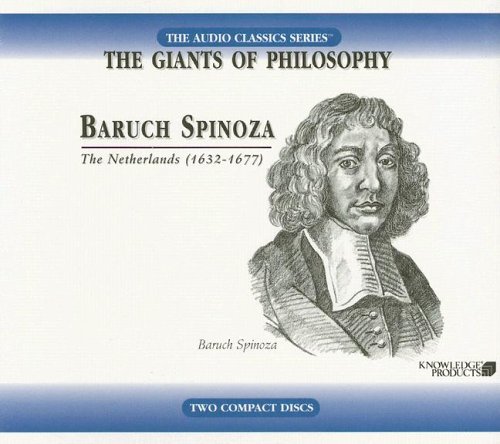
1. Baruch Spinoza: Knowledge Products
$6.35
2. On the Improvement of the Understanding
$5.44
3. The Bible in Modern Culture: Baruch
 
4. BARUCH SPINOZA.The Ethics and
 
$11.22
5. Principles of Cartesian Philosophy
 
6. Baruch Spinoza - Letters to Friend
 
7. Theological-Political Treatise:
8. Opera
 
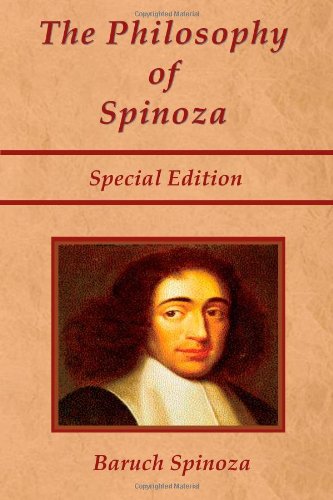
9. THE PHILOSOPHY OF SPINOZA
$14.38
10. Baruch de Spinoza in Selbstzeugnissen
 
11. Abhandlung uber die Verbesserung
 
12. Baruch Spinoza and Western Democracy:
 
13. Baruch Spinoza & Western Democracy
 
14. Philosophy of Baruch Spinoza (Studies
$42.94
15. Politischer Traktat =: Tractatus
16. Baruch de Spinoza. Werke in drei
 
$6.70
17. Baruch Spinoza: The Netherlands
 
18. Baruch Spinoza: The Giants of
 
$39.99
19. Baruch Spinoza. Porträt eines
 
20. Baruch Spinoza and Western Democracy:

1. Baruch Spinoza: Knowledge Products (Giants of Philosophy) (Library Edition)
by Thomas Cook
Audio CD: Pages (2006-04-01)
list price: US$18.00 -- used & new: US$14.00
(price subject to change: see help)
Asin: 0786169397
Canada | United Kingdom | Germany | France | Japan
Editorial Review

Product Description
A Portuguese Jew living in Holland, Spinoza was excommunicated because of the unorthodox view he took of God. Spinoza wrote in the rationalist style of a geometric proof to develop his idea of God as the infinite, indwelling cause of all things, a unified causal system that is virtually synonymous with nature. In this system, there is no free will, for all things are necessary and inevitable, and all objects, including humans, are part of God's active self-expression. Our minds can participate in the eternity of God by focusing on natural laws and the way all things follow from God or nature. Human fulfillment is possible, he believed, only by rejecting our finite, flawed selves and identifying with the eternal within us. Spinoza believed that by doing so we can love God with an immediate devotion without asking anything in return. ... Read more


2. On the Improvement of the Understanding
by Baruch Spinoza
Paperback: 48 Pages (2006-10-12)
list price: US$6.90 -- used & new: US$6.35
(price subject to change: see help)
Asin: 1406806846
Average Customer Review: 4.0 out of 5 stars
Canada | United Kingdom | Germany | France | Japan
Editorial Review

Book Description
This classic philosophical text seeks to define understanding, through the testing of ideas and perceptions.Download Description
[4] (1) By sensual pleasure the mind is enthralled to the extent of quiescence, as if the supreme good were actually attained, so that it is quite incapable of thinking of any other object; when such pleasure has been gratified it is followed by extreme melancholy, whereby the mind, though not enthralled, is disturbed and dulled. ... Read more

Customer Reviews (2)

5-0 out of 5 stars Spinoza's ethics: a unique book
This is a well known and widely read book, ever since its first publication, in latin, in 1677. It is an extraordinary example of multum in parvo - much in little: it has earned for its author a first-class positionin the history of philosophy. Benedictus de Spinoza (1632-1677) isunquestionably one of the world's greatest philosophers. In theEncyclopaedia Brittanica he is described as "author of one of thegreatest metaphysical systems in the history of philosophy". BertrandRussell in his History of Western Philosophy (available through Amazon)calls him "the noblest and most lovable of the greatphilosophers". Karl Jaspers, in his Introduction to Philosophy (againavailable through Amazon - Way to Wisdom) mentions that "Spinoza isthe metaphysician who with traditional and Cartesian concepts expresses aphilosophical faith. He is original in the metaphysical mood which he alonepossessed among the philosophers of his time. Of the philosophers of hiscentury he alone has followers today". Spinoza's importance inphilosophy derives, I believe, from the following points:(i)Spinoza's metaphysical edifice rests almost entirely on reason. Reason(Spinoza tells us that "clear reason is infallible", The Ethics,Part I, Prop. XV) is, in his system, both the source of all knowledge, andalso the means of clarifying and arranging all items of knowledge soobtained.(ii) Spinoza identifies God with Nature. Nature is given anall-encompassing, metaphysical meaning and is also called Substance("Substantia sive Deus sive Natura", "Substance otherwiseGod otherwise Nature"). Accordingly, Spinoza belongs to the naturalistschool of thought, along with most of the presocratic philosophers (Thales,Anaxagoras, Empedocles, Parmenides, Democritus, Leucipus) and the stoicphilosophers (Epicurus, Chrysiphus, Seneca, Lucretius). Nature is seen bothas an active causal principle (natura naturans) and as the effect of saidprinciple (natura naturata) (The Ethics, Part I, Prop. XXIX). (iii)Spinoza puts forward a logically coherent system of ethics. In fact, hechose so to name his main metaphysical work, and has added the subtitle:demonstrated in a geometrical manner ("Ethica, more geometricodemonstrata"). The Ethics is laid out in the form of definitions,axioms, propositions, demonstrations of said propositions, and scholia. InSpinoza's system ethical values are logically derived from firstprinciples. So much so, that a moral life is identified as "a way ofliving under the guidance of reason" (The Ethics, Part IV, Prop.XLVI). The moral precepts arrived at, by a process of logical analysis, areas strict as moral precepts based on religious faith. (iv) Spinozaestablishes a novel point of view in the age-old question of the existenceof good and evil. Spinoza identifies good with knowledge, in particularwith knowledge of God, and proceeds to deny the existence of evil. Heexplicitly states that "God has no knowledge of evil" (TheEthics, Part IV, Preface). Again, "The knowledge of evil is inadequateknowledge" (The Ethics, Part IV, Prop. LXIV). (v) Spinozatranscends logic itself in distinguishing three kinds of knowledge: (a)knowledge from hearsay, (b) knowledge arrived at by logical analysis, and(c) intuitive knowledge. By means of this "third kind ofknowledge" we may experience an immediate, intuitive intimation of God("cognitio Dei intuitiva", The Ethics, Part V, Prop. XXV).Accordingly, Spinoza is both a rationalist and a mystic. (vi)Spinoza's personal character and life was fully in accord with histeaching. He was always honest, truthful, and, in the words of B. Russell,"showed throughout his life a rare indifference to money. The few whoknew him loved him, even if they disapproved of his principles". Spinoza's metaphysical system, far from being one-sided and simplistic, hasbeen a constant source of inspiration and reappraisal to many thinkers.

3-0 out of 5 stars A bit over my head
I knew before reading this book that I liked Spinoza's philosophies on God and life,and I was looking forward to a more in depth study on his thoughts.This book, however, was not what I had in mind.The text wasdifficult to follow.It could be because it was published originally in1883 and translated from Latin.For beginners, like myself, I wouldn'trecommend it.For me, this book was too mathmatically formulated.Also,there were so many references throughout the book to other paragraphs thatit was distracting.All in all,good ideas but not a fun read. ... Read more


3. The Bible in Modern Culture: Baruch Spinoza to Brevard Childs
by Roy A. Harrisville, Walter Sundberg
Paperback: 357 Pages (2002-07)
list price: US$35.00 -- used & new: US$5.44
(price subject to change: see help)
Asin: 0802839924
Average Customer Review: 2.0 out of 5 stars
Canada | United Kingdom | Germany | France | Japan

Customer Reviews (1)

2-0 out of 5 stars Hard to read
For those who does not have english as their mother tongue, this book can be a bit difficult to read. The book is not easy-read, the language is hard and boring - and hence - failes as a teaching book! ... Read more


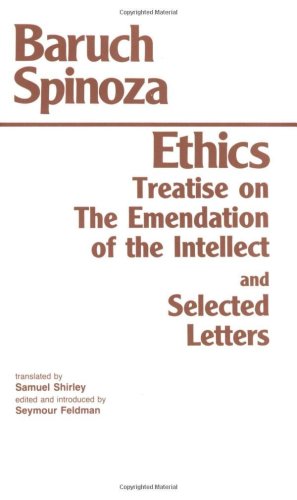
4. BARUCH SPINOZA.The Ethics and Selected Letters
by Samuel SHIRLEY
 Paperback: Pages (1982)

Asin: B00134VNJO
Canada | United Kingdom | Germany | France | Japan

5. Principles of Cartesian Philosophy
by Baruch Spinoza
 Paperback: 200 Pages (1961-01-01)
list price: US$16.00 -- used & new: US$11.22
(price subject to change: see help)
Asin: 0806530294
Canada | United Kingdom | Germany | France | Japan

6. Baruch Spinoza - Letters to Friend and Foe
 Hardcover: Pages (1966)

Asin: B000HHQJKQ
Canada | United Kingdom | Germany | France | Japan

7. Theological-Political Treatise: (Gebhardt Edition, 1925) (Hackett Classics)
by Baruch Spinoza, Seymour Feldman, Benedictus De Spinoza
 Paperback: 257 Pages (1998-03-01)
list price: US$14.95
Isbn: 0872203980
Average Customer Review: 4.5 out of 5 stars
Canada | United Kingdom | Germany | France | Japan
Editorial Review

Book Description

Rational examination of the Old Testament to show that freedom of thought and speech is consistent with the religious life. True religion consists in practice of simple piety, independent of philosophical speculation. Also unfinished essay on theory of government founded on common consent. One of Spinoza’s most important works. R. Elwes translation.
... Read more

Customer Reviews (13)

5-0 out of 5 stars Philosophy, the Elite, and the Future
"Men would never be superstitious, if they could govern all their circumstances by set rules, or if they were always favored by fortune..." Thus begins one of the greatest books in the history of philosophy. Spinoza is an esoteric writer; he doesn't shout everything he has to say, though an attentive reader has a chance, however slight, to discern at least part of it. The existence of this philosophical-political esotericism, first adequately described by Leo Strauss (in "Spinoza's Critique of Religion"), is now on the verge of becoming generally accepted. For a very good example of this new, but qualified, acceptance of Spinoza's esotericism from a left/postmodern perspective, check out the recent collection of essays, "The New Spinoza", edited by Montag & Stolze, especially the essay by Andre Tosel.

But the history of Spinoza reception is another story and another review. Many modern readers of Spinoza speak with vague unease about Spinoza's 'elitism', supposing it to be but another slight of the poor, weak and uneducated; we can perhaps begin to gauge the full length, breadth and depth of this philosophical 'elitism', and its true target, in a focused reading of the opening pages of the Preface to the Theologico-Political Treatise. "The human mind is readily swayed this way or that in times of doubt, especially when hope and fear are struggling for the mastery, though usually it is boastful, over-confident, and vain." Thus the problem with Man is not, strictly speaking, merely a lack of knowledge (and therefore the problem is not merely a lack of education) but also, and perhaps most importantly, a lack of self-control.

Immediately, Spinoza follows this sentence by saying, "[t]his as a general fact I suppose everyone knows, though few, I believe, know their own nature..." There is a disconnect not only between knowing and doing but also between 'knowing' in general and knowing oneself. In order to do good how important is it to know yourself? There are several ways to understand this. One possible way is to say that even those ('sainted' elites) that 'know' are, nevertheless, unable to control their emotional behavior. Perhaps it is even this emotiveness that is especially vulnerable to superstition...

But men, "in prosperity, are so over-brimming with wisdom [...] that they take every offer of advice as a personal insult"! Still, we are not surprised to read that "...superstition's chief victims are those persons who greedily covet temporal advantages...". (Note that it is not chiefly ordinary people that 'greedily covet temporal advantages' nor is it said that they are 'in prosperity'.) And, a little later, we learn that these people "are wont with prayers and womanish tears to implore help from God...".Indeed, Spinoza, when giving an example of this despicable behavior under duress turns to no less an exemplar than Alexander the Great - and his superstitious seeking of advice from seers. Now, the use of Alexander in this regard is a vital clue in our attempt to understand Spinoza's esotericism (i.e., his 'political' philosophy). The question is this: If Spinoza is indeed an elitist, exactly what is the position that can look down on not only the common people but also the actual 'elite'; i.e., the religious and political leaders?

Well, of course, Spinoza is a philosopher; indeed he is one of the greatest. This understanding of philosophy, as the heights from which one looks down on everyone, is an old one. See, for instance, Averroes (in the so-called 'Decisive Treatise') for an overt example of the philosophical attempt to control a faction of the medieval elite (i.e., the theologians) with another faction of the medieval elite - the Islamic Jurists. Also, one should of course consider Machiavelli's Prince for a somewhat more circumspect (or covert) example of philosophy attempting to control the direction of politics and the political elite. Spinoza's decision to view politics and theology (or politicians and theologians) as dangers that need to be moderated philosophically is thus not unprecedented. Also, on this line of thought one should perhaps also take into account Nietzsche who, in the 'Genealogy of Morals', seems to go so far as to present history itself as a struggle between priestly and warrior noble castes...

In electing to use Alexander as an example of superstition Spinoza is indicating that philosophy is above both religion and politics. Indeed, Spinoza continues in a (ahem) 'Nietzschean' vein and says, "that prophets have most power among the people, and are most formidable to rulers, precisely at those times when the state is in most peril. I think this is sufficiently plain to all, and will therefore say no more on the subject." Well perhaps not entirely plain; this basically says, for those that have ears to hear: 'Statesman! Either satisfy the common people or forfeit your right to rule to the prophets and their theologians.' Thus the 'war' between priestly and warrior castes was quietly noted, by Spinoza, long before Nietzsche. As an aside I should perhaps note that one also finds oneself (perhaps) nervously asking, at this point, are people today 'satisfied'?

Kojeve, the architect of the most recent apotheosis of the political (i.e., the Universal Homogenous State), seems to confirm this interpretation (in his "Introduction to the Reading of Hegel") by saying that as "long as History continues, or as long as the perfect State is not realized [...] the opposition of these two points of view (the "philosophical" and the religious or theological) is inevitable." Of course Kojeve, following a Hegel that never existed, attempts to convince us that politics and philosophy are exactly the same and that theology was ever nothing. His mistake, from the viewpoint of philosophy, can perhaps be said to be that he took sides in the interminable war between elites. ...But that is another story. However, Kojeve is correct insofar as he is understood to be maintaining that there is an unbridgeable gulf between the political and the religious...

Back to Spinoza. Satisfying the common people seems to be easier said than done. In a terrifyingly memorable passage - that is both a diagnosis and a prophecy - Spinoza writes, "[f]or, as the mass of mankind remains always at about the same pitch of misery, it never assents long to any one remedy, but is always best pleased by a novelty which has not yet proved illusive." Thus, given the perpetual emotional dissatisfaction of the people, Spinoza seems to be indicating that no one ever rules for long. He also seems to be indicating that emotions (at least among the 'mass of mankind') are uncontrollable and that the people are, in the long run, unsatisfiable. (...So exactly what is Enlightenment - and exactly why is Spinoza supporting it? ...Hmmm.)

"Superstition, then, is engendered, preserved and fostered by fear", Spinoza had earlier said. But fear is an opportunity for philosophy, I mean for philosophical intervention. Machiavelli (in 'The Prince', chapter 6), after all, had already confirmed that the oppression, dissatisfaction and dispersal of the people was, above all, an opportunity for the creative One. Spinoza says that, "Prophets have most power among the people, and are most formidable to rulers, precisely at those times when the state is in most peril." The fundamental argument (and struggle), of course, between philosophers and the political-religious elites, seems to be over the exact identity of the creative One. For the religiously inclined the creative one is God and those who act in his name, for the politically 'pious' the creative one is the (hereditary, patriotic or revolutionary) 'Prince'. For Machiavelli, Spinoza, and Nietzsche one suspects that, 'behind the scenes and between the lines', the creative one (the bringer of New Modes and Orders, to quote Machiavelli) can only be the philosopher.

Spinoza continues, quoting Curtius (the historian of Alexander): "The mob has no ruler more potent than superstition," and Spinoza immediately adds, "and is easily led, on the plea of religion, at one moment to adore its kings as gods, and anon to execrate and abjure them as humanity's common bane." Thus 'superstition' would seem potentially to be either a weapon of the religious or the political... This is a warning; but to exactly whom seems to be a bit unclear. I should mention that it is not impossible to read Machiavelli, with his high praise of ancient pagan religion, to be indicating much the same: that is, the necessary permanence of superstition. ...But, exactly what can and can't be done with superstition?

The way out of this (seemingly) unpredictable and uncontrollable mess? One possible solution, according to Spinoza, is given by the 'Turk'. They have instituted a system that invests "religion, whether true or false, with such pomp and ceremony, that it may rise superior to every shock..." Of course, as Spinoza indicates, this absolutism leaves no room for either individual freedom or a thoughtful philosophy. But then Spinoza adds, "yet in a free state no more mischievous expedient could be planned or attempted." So, after discussing (and discounting) the possibility of theocracy (the Turks) Spinoza advocates the system allegedly reigning in Amsterdam: freedom and commerce. (Whew!)

Now, in case some have been asleep for the past 300 years, I will point out that the rise of democracy was not always accomplished peaceably, nor, after its rise, has it been able to always maintain the peace. The test of being able to maintain the peace that Spinoza flings in the face of the Religion of his times can today, with equal appropriateness, be flung in the face of politics. I of course mean all politics. ...But that too is another book and another review.

Spinoza can be said to here begin a process that leads to us. I hope I have begun the process of showing that the target of Spinoza's contempt was not the common people, but the ignorance and weakness of all their tormenters. I also want to note, given both the nature of these elites and also the perpetual suffering of the people, that all solutions are transient. And that the early-modern philosophical turn to the politicos, made in the teeth of ceaseless religious war, was only a maneuver. Over the past century philosophy found itself again in an era of civil wars, revolutions and world wars; - one wonders where philosophy will now turn in its never-ending struggle to moderate elites...

Who will write the next Theologico-Political Treatise that will do to political Ideology what Spinoza here does to religious Revelation? Where is the next 'novelty'?

4-0 out of 5 stars As important as ever
Spinoza's monumental treatise on God, the Bible and the Society is one of the founderstones of modern thought, and does not need any new reviews. Many ideas expressed in the book can serve as models for standpoints also today in the intellectual debate about matters of religious freedom, critical analysis of texts and ideas, and political theory. The English translation in the Gebhardt Edition is clear and easily understood, and the book can be read without feeling the three centuries that have passed since the original was published in Latin. In the context of a new emerging wave of religious fundamentalism on one hand, and post-modernist denials of the importance of Reason on the other, the book is as important as ever to the intellectual heritage of modern Society.

5-0 out of 5 stars A GREAT AND RELEVANT WORK OF GENIUS
There are two points about the treatise I wish to talk about.

Spinoza's view of miracles in the Bible (Old Testament).He took up a trend that began years before.Maimonidese, for example, gives species survival, not Sin in the Garden, as the
reason for death.Spinoza takes all alerations in natural law
stated in the Bible to be poetic or symbolic, not real and not consistent with the Nature of God.

Secondly, Spinoza defends democracy over other forms of government is that in democracies there are numerous factions,
and it is difficult for any one faction to grain arbitrary power
as to engage in wars.For example, though not mentioned by Spinoza, Peter The Great saw one year alone as Czar when Russia was not at war.Spinoza thinks this sort of thing less probable in democratic government. Democracy's value is that it leadss to free, unhindered discussion of matters at hand.He does not exactly say it, but I think Spinoza took free and open discussion of issues as the principal "Sine qua non" of democracy. This is quite relevant to current US foreign and domestic policy.In early 2006 Harvard University's Kennedy School of Government publish a study by a
Harvard professor and another from U of Chicago on the Israel lobby;the study contends that US foreign policy is dictated by The Lobby, meaning Jewish pressure groups acting on Congress and the White House regardless of political party.The professors contend that free discussion and debate are impossible when "The Lobby" has a particular position. Congressmen and Senators live in fear of Jewish funding of opponents, smear tactics and other similar actions. They describe the Prime Minister in Israel as saying he had President Bush (the second) "wrapped around his finger."The Giant Question is:within Spinoza's notion of democracy, does Judaism de facto oppose democratic government and is Judaism inconsistent with democratic/representative government in a diverse democracy?The answer is of utmost importance.Another aspect of democracy is defended by Spinoza's argument for free and open and fearless debate is that fundamental decisions that shape society and direct governmental actions will be done in this open, fearless, free environment.The Suypreme Court's string of decisions starting in 1940 making states subject to the "Bill of Rights" is the antithesis of democracy.

Spinoza is a great introduction to real thought.And the Tretise is not difficult reading at all.

A great assignment for High School government or History.

5-0 out of 5 stars A deconstruction of the bible as a plea for religious freedom
This book came out in 1670 in a Holland that was a haven of freedom in a Europe under religious terror. Spinoza's relatives in Portugal had been murdered by the inquisition. When he was born, German catholics and protestants were fighting a 30-year war that cut Germany's population in half. 20 years before in Italy, Giordano Bruno had been burned at the stake for heresy, and France had been ravaged by its 16th-century religious wars. Religious violence abated only slowly after Spinoza's death, with
the Salem witchcraft trials 16 years later. On 7/1/1766, after failing to salute a catholic procession in Paris, an 19-year old boy had his tongue pulled out, and was beheaded and burned with a copy of a book found in his room! Today's death threats to Danish cartoonists hint at what Spinoza's world was like, and the courage it took for him to confront it. Besides living in Holland, Spinoza further protected his freedom by staying single, living with the bare minimum of possessions, and seeking no official post or recognition.

The point of this book, as announced in the preface, is that, as was practiced in his beloved Dutch republic, freedom of religion can be granted without prejudice to public peace and that, "without such freedom, piety cannot flourish nor the public peace be secure." Today, this point is obvious: the G7 countries, all have freedom of religion, and five of them -- the US, Japan, France, Italy and Canada -- have separation of church and state. In Spinoza's day, it wasn't, and he couldn't make his case based on empirical evidence. Instead, he makes it by deconstructing the Bible using Descartes' method, which is an astonishing choice. If Machiavelli, for example, had undertaken to prove the same point, he certainly would not have done it this way.

Spinoza spent his childhood memorizing the Torah in Hebrew, at the time and in the city where Descartes lived, and his fascination with Descartes is obvious even if their metaphysics disagree. One of Descartes' own applications of his method was on the art of cutting glasses for optics, which is how Spinoza earned his modest living. Among the many astonishing finds in this book is how, by simply reasoning on the original text, Spinoza arrived at conclusions on the authorship of the early books of the bible that nearly match those of modern scholars like Abba Eban, who have had full access to archeological evidence.

4-0 out of 5 stars heretical but genius quality work
though baruch de spinoza was a heretic and a genius he was a great jewish scholar before he was excommunicated and possesses scriptual interpretations like no other.Although his arugements are very true, logical, pretty clear, and have ample scriptural evidence his passages can still be somewhat dry and boring.This work is a great attempt at trying to present an eloquent theory of religious freedom without philosophical theologogy and expose the falseness of the bible while retaining its beautiful prose and itsbasic almost universal truths.It is rather long 278 (pages with notes) of huge pages it is great but it can be verbose and excessive ... Read more


8. Opera
by Baruch de Spinoza
Hardcover: 1224 Pages (2008-01-31)

Isbn: 3534208234
Canada | United Kingdom | Germany | France | Japan

9. THE PHILOSOPHY OF SPINOZA
by Baruch de Spinoza
 Hardcover: 376 Pages (1954)

Asin: B000GWFAVG
Canada | United Kingdom | Germany | France | Japan

10. Baruch de Spinoza in Selbstzeugnissen und Bilddokumenten
by Theun de Vries
Turtleback: 190 Pages (1970)
-- used & new: US$14.38
(price subject to change: see help)
Asin: 3499501716
Canada | United Kingdom | Germany | France | Japan

11. Abhandlung uber die Verbesserung des Verstandes =: Tractatus de intellectus emendatione (Samtliche Werke / Baruch de Spinoza)
by Benedictus de Spinoza
 Perfect Paperback: 122 Pages (1993)

Isbn: 3787311238
Canada | United Kingdom | Germany | France | Japan

12. Baruch Spinoza and Western Democracy: An Interpretation of His Philoso
by Joseph DUNNER
 Hardcover: Pages (1955)

Asin: B000MX9DAI
Canada | United Kingdom | Germany | France | Japan

13. Baruch Spinoza & Western Democracy
by Joseph Dunner
 Hardcover: Pages (1955)

Asin: B000SIG1CU
Canada | United Kingdom | Germany | France | Japan

14. Philosophy of Baruch Spinoza (Studies in Philosophy and the History of Philosophy)
 Hardcover: 323 Pages (1980-10)
list price: US$26.95
Isbn: 0813205506
Canada | United Kingdom | Germany | France | Japan

15. Politischer Traktat =: Tractatus politicus (Samtliche Werke / Baruch de Spinoza)
by Benedictus de Spinoza
Perfect Paperback: 246 Pages (1994)
-- used & new: US$42.94
(price subject to change: see help)
Asin: 3787311653
Canada | United Kingdom | Germany | France | Japan

16. Baruch de Spinoza. Werke in drei Bänden
by Baruch de Spinoza
Perfect Paperback: Pages (2006-09-30)

Isbn: 3787318143
Canada | United Kingdom | Germany | France | Japan

17. Baruch Spinoza: The Netherlands (1632-1677) (Giants of Philosophy)
 Audio Cassette: 3 Pages (1994-10)
list price: US$17.95 -- used & new: US$6.70
(price subject to change: see help)
Asin: 0938935216
Average Customer Review: 4.0 out of 5 stars
Canada | United Kingdom | Germany | France | Japan
Editorial Review

Book Description
Spinoza took the unorthodox view that God an eternal andinfinite being is identical with the world. We are therefore ourselvesmerely parts of the Deity. Human fulfillment is possible he believedonly by rejecting our finite flawed selves and identifying with theeternal within us. ... Read more

Customer Reviews (1)

4-0 out of 5 stars That's a nice brief overview.
I am a student at a Christian school. During my studies I had a lot of courses of philosophy. And I should acknowledge that philosophy of Baruch Spinoza was one (may be the only) obscure theme at the classes. His worldview is very hard to understand. I suppose that is the main reason of a variety of opinions concerning his philosophical system. The authors of The Giants of Philosophy have done a nice and successful attempt to present his worldview and life story in a brief and clear manner. I have found many interesting facts about his personality despite takingcourses and reading Spinoza's treaties previously. If you want to get a good overview of well known philosophers' lives and their systems I suggest you to get this audiobook set. It's worth and very good in helping you to save your time while travelling or doing household work. Try yourself! ... Read more


18. Baruch Spinoza: The Giants of Philosophy (Unabridged)
by Thomas Cook
 Audio Download: Pages
list price: US$19.95
Asin: B000GPCNUE
Canada | United Kingdom | Germany | France | Japan

19. Baruch Spinoza. Porträt eines freien Geistes, 1632-1677
by Arnold Zweig
 Hardcover: Pages (1968)
-- used & new: US$39.99
(price subject to change: see help)
Asin: B000M76DZC
Canada | United Kingdom | Germany | France | Japan

20. Baruch Spinoza and Western Democracy: An Interpretation of His Philosophical, Religious and Political Thought
by Joseph Dunner
 Hardcover: Pages (1955)

Asin: B000EWQ0Y4
Canada | United Kingdom | Germany | France | Japan

  1-20 of 100 | Next 20
A  B  C  D  E  F  G  H  I  J  K  L  M  N  O  P  Q  R  S  T  U  V  W  X  Y  Z  

Prices listed on this site are subject to change without notice.
Questions on ordering or shipping? click here for help.

site stats