e99 Online Shopping Mall

Geometry.Net - the online learning center Help  
Home  - Philosophers - Trotsky Leon (Books)

  Back | 41-60 of 100 | Next 20
A  B  C  D  E  F  G  H  I  J  K  L  M  N  O  P  Q  R  S  T  U  V  W  X  Y  Z  

click price to see details     click image to enlarge     click link to go to the store

 
$6.05
41. Trotsky for Beginners
 
42. 1905
 
43. Leon Trotsky on Black Nationalism
 
44. Leon Trotsky on Black Nationalism
 
$104.12
45. Permanent Revolution and Results
 
46. Third International After Lenin.
 
47. New Course
 
48. Leon Trotsky (Twayne's world leaders
 
49. Challenge of the Left Opposition
$24.75
50. From Trotsky to Gödel
 
51. The War Correspondence of Leon
 
52. Leon Trotsky (World Leaders Past
 
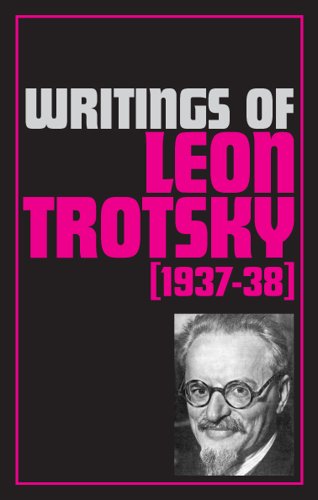
53. Writing of Leon Trotsky, 1932
 
$25.95
54. Writings of Leon Trotsky: (1932)
 
55. Leon Trotsky:The Third International
 
$25.95
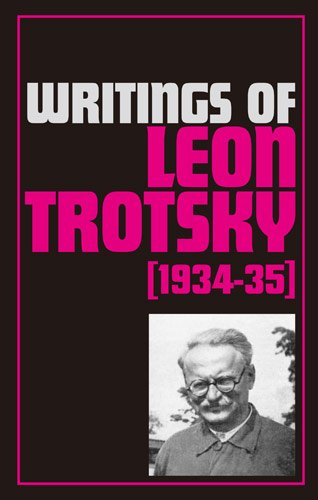
56. Writings of Leon Trotsky, 1934-1935
 
57. Writings of Leon Trotsky, 1934-35
 
58. "The Last Words of Adolf Joffe,
 
59. La pensee de Leon Trotsky (Pensee)
$30.00
60. Writings of Leon Trotsky: Supplement

41. Trotsky for Beginners
by Tariq Ali, Phil Evans
 Paperback: Pages (1980-06-12)
list price: US$6.95 -- used & new: US$6.05
(price subject to change: see help)
Asin: 0394738853
Average Customer Review: 4.5 out of 5 stars
Canada | United Kingdom | Germany | France | Japan

Customer Reviews (3)

5-0 out of 5 stars History as a smart cartoon.
My favorite page of this book is page 84, which has some small print at the bottom of the page, "Lenin sees Trotsky's position as attractive but too risky." The illustration shows a three-way argument among the leaders of the Bolshevik Central Committee on how to get an immediate armistice with Germany in World War One, for which Trotsky had been sent to Brest-Litovsk to negotiate peace at the end of November 1917. Somehow, page 82 reported, "The Allied Powers are desperately against Russia signing a separate peace with Germany." Trotsky's position in the argument on page 84 nicely avoided the possibility of conflict with the Allied Powers, "Prolong the negotiations. No war - No Peace - till the German workers revolt!" According to page 83, "The peace delegation at Brest-Litovsk distributed pamphlets to the German soldiers." The cartoon shows a soldier looking at a page and exclaiming, "It says - shoot your officers!!" The Germans might not have been used to reading that kind of thing, but there is a historical Who's Who on pages 168 to 173 which shows how much support there was for this when someone's idea of justice supported it. The Who's Who contains anarchist activists like Vera Zasulich, a Narodnik militant who "Shot and wounded the Governor of St. Petersburg, General Tepov" [which might not be spelled correctly] because a Narodnik student "was flogged for failing to remove his hat in Trepov's presence. Her trial and acquittal by the jury caused a sensation and was popularly supported." (p. 173). Back on page 76, following a cartoon that looks a lot like some famous painting of the last supper, there is even a picture of Joseph Stalin, who praised Trotsky in Pravda for the "practical organisation of the insurrection" (The October Revolution) only 84 years ago in November 1917, but the picture is saying, "I said that? No - you must be thinking of some other Stalin!" The humor of history is perfect for a cartoon book like this, which is history at a level which everybody ought to be able to understand. Unfortunately for the Soviets, they were probably not aware of the work of the young Karl Kraus in Vienna during this period, who observed, "Satires which the censor understands are rightly prohibited."This book is too true to be considered satire in a thoroughly comic society like our own.

5-0 out of 5 stars A good introduction to Trotsky's thought
Lev Davydovich Bronstein A.K.A. Leon Trotsky was certainly a very complicated figure as this book shows. Early on he opposed Lenin's conception of the hierarchal, tightly centralized working class party and was very active in the Petersburg Soviet of 1905. Lenin accepted Trotsky's view of "permenant revolution" after the February 1917 revolution and Trotsky joined forces with him to oppose the liberals and leftists in the workers and soldiers soviet who supported handing over power to the liberal bourgeoisie, in the case of the leftists apparently because they thought the bourgeoisie should have their revolution first. The Bolsheviks won overwhelming majorities in the soviets accros the nation. They seized power from the liberals and then proceeded to liquidate their opposition which seemed to be excused by Trotsky on the ground of centralising power in order to fight the Whites and the imperialist invaders and the especially brutal "war communism" was instituted. Trotsky directed the violent repression of the workers and sailors at Kronstadt in 1921. He pretty much played the good solider, occasionally making noises about the suppression of democratic debate and the growing power of the bueracracy until Stalin consolidated his power after Lenin's death in 1924. He unwaveringly opposed Stalin who finally expelled him from the country in 1929. He was murdered under Stalin's orders in Mexico in 1940.

Trotsky once in exile gave full flower to his best thinking. The bueracracy in the Soviet Union owned everything (the means of production,etc.) and would not give up power but perpetuate itself as dictatorships tend to do. Trotsky advocated destroying the bueracracy, reinstitue free debate and, according to Mr. Ali, wanted to "restore the Soviets." What this last means, I don't quite know. Does it mean he wanted to restore to them the power they held in 1917-18, as they were conceived to function during the revolution of 1905, perhaps even as the narodniks conceived them? Very interesting. Ali also points out that Trotsky saw clearly the menace of Hitlerism before just about everybody else did and advocated that the communists and social democrats join forces in a "united front" to try to stop Hitler which earned him even more violent abuse from Moscow and their sattelites in Germany. He vigorously attacked the "United Front" concept adopted at the seventh congress of the communist international in 1935 which called for Communists accross the world to join forces with social democrats and liberals in "popular fronts," effectively maintainging the status quo, which had such disasterous results in Spain during the civil war.

I thought Phil Evans's illustrations were entertaining.

4-0 out of 5 stars Trotsky For Begginers
An excellent introduction to some very complex and confusing history.This biography of Leon Trotsky, also explores some very complex marxist theory.Historically, it covers not only Trotsky's life and idea's, butthe Russian Revolution, the Russian civil war, and the usurpation of powerof the fledgling workers democracy by Joseph Stalin and his co-conspiritorsfrom the democratically elected politburo.This book is much moreentertaining then the new "For Begginers" series, as it has muchmore artistic diversity, then the mostly cartoon, drawing style of the newbooks.It contains colages, and many photos of historical figures andevents.Overall a great introduction to history, that is not taught inschool. ... Read more


42. 1905
by Leon Trotsky
 Unknown Binding: 488 Pages (1971)
list price: US$15.00
Isbn: 0394471776
Average Customer Review: 5.0 out of 5 stars
Canada | United Kingdom | Germany | France | Japan

Customer Reviews (1)

5-0 out of 5 stars Brian Wayne Wells, Esquire, reviews "1905" by Leon Trotsky
This is a history of the 1905 revolt in St. Petersburg Russia which became the "great prologue to the revolutionary drama of 1917."The book was written by one of the leading participants in that revolt--Leon Trotsky.

Unlike many of Trotsky's later writings this 1908 book covers the historical events of 1905without regard to political considerations of the Trotsky/Stalin conflict of the 1920s.Thus we are able to enjoy free-wheeling style of writing in the book free of the guarded language and descriptions which characterizes much of his other works.With its descriptions of the economic conditions of the Russian Empire at the turn of the century, the book reminds the reader of Lenin's 1899 book--"The Development of Capitalism in Russia."

When the book was brought out by Random House in 1972 and later in paperback by Vintage books it became a popular seller even in the mainstream book stores. Thus it has its place as a memorial to a different time in the United States when a spirit of unrest blew across the nation. ... Read more


43. Leon Trotsky on Black Nationalism & Self-Determination
 Library Binding: Pages (1994-02)

Isbn: 9994349163
Canada | United Kingdom | Germany | France | Japan

44. Leon Trotsky on Black Nationalism and Self Determination
 Paperback: Pages (1994-02)

Isbn: 9994349147
Canada | United Kingdom | Germany | France | Japan

45. Permanent Revolution and Results and Prospects
by Leon D. Trotsky
 Paperback: 281 Pages (1969-06)
list price: US$20.95 -- used & new: US$104.12
(price subject to change: see help)
Asin: 0873480317
Canada | United Kingdom | Germany | France | Japan

46. Third International After Lenin.
by Leon Trotsky
 Paperback: Pages (1976)

Asin: B000M40SRE
Canada | United Kingdom | Germany | France | Japan

47. New Course
by Leon Trotsky
 Paperback: Pages (1975-06)
list price: US$11.95
Isbn: 0472060996
Canada | United Kingdom | Germany | France | Japan

48. Leon Trotsky (Twayne's world leaders series ; TWLS 72)
by Robert D Warth
 Unknown Binding: 215 Pages (1977)
list price: US$12.50
Isbn: 0805777202
Canada | United Kingdom | Germany | France | Japan

49. Challenge of the Left Opposition 1926-1927 (Challenge of the Left Opposition)
by Leon Trotsky
 Hardcover: 548 Pages (1981-06)
list price: US$70.00
Isbn: 0873485661
Canada | United Kingdom | Germany | France | Japan

50. From Trotsky to Gödel
by Anita Burdman Feferman
Paperback: 432 Pages (2000-12-01)
list price: US$24.95 -- used & new: US$24.75
(price subject to change: see help)
Asin: 1568811489
Average Customer Review: 5.0 out of 5 stars
Canada | United Kingdom | Germany | France | Japan
Editorial Review

Product Description
This story of a highly intelligent observer of the turbulent 20th century who was intimately involved as the secretary and bodyguard to Leon Trotsky is based on extensive interviews with the subject, Jean van Heijenoort, and his family, friends, and colleagues.

The author has captured the personal drama and the professional life of her protagonist–ranging from the political passion of a young intellectual to the scientific and historic work in the most abstract and yet philosophically important area of logic–in a very readable narrative. ... Read more

Customer Reviews (1)

5-0 out of 5 stars Enthusiastically recommended for anyone interested in following van Heijenoort's challenging life
From Trotsky to Godel: The Life of Jean van Heijenoort is the true-life biography of a man in a prime position to observe twentieth-century turmoil. He served as a secretary and bodyguard to Leon Trotsky, and was intellectually and politically passionate; in his maturity, he contributed greatly to the realm of abstract philosophical logic. From Trotsky to Godel draws heavily upon interviews with van Heijenoort himself, as well as his friends, family, and colleagues. Enthusiastically recommended for anyone interested in following van Heijenoort's challenging life, and also for students of Trotsky seeking to round out their perspectives on the man and his writings. ... Read more


51. The War Correspondence of Leon Trotsky: The Balkan Wars 1912-1913
by Leon Trotsky
 Paperback: 524 Pages (1981-12)
list price: US$32.95
Isbn: 0913460680
Average Customer Review: 5.0 out of 5 stars
Canada | United Kingdom | Germany | France | Japan

Customer Reviews (4)

5-0 out of 5 stars A profound introduction to Balkan Politics and History
In the first Balkan War (October, 1912), the armies of Bulgaria, Montenegro, Serbia, and Greece attacked-and defeated-the army of the Ottoman Empire, coming within some 25 miles of Constantinople. Within three months, fighting resumed; but this second Balkan War was between the victors-over division of the Turkish spoils.

Today these battles may seem a mere historical footnote dwarfed by the First World War that began only a few months later. But to think so would be a failure to understand how it was the Balkan crisis that brought long-simmering anti-imperialist rivalries across Europe to the boiling point.

Indeed the political questions at play during this time continue to be central to subsequent events. How fortunate we are then, that Pathfinder has issued a new, improved edition of The War Correspondence of Leon Trotsky: The Balkan Wars, 1912-13.

Trotsky had been tried and exiled to Siberia after the 1905 Russian Revolution in which he played a central leadership role went down to defeat. In 1907 he escaped, winding up in Vienna-from where he continued to participate actively in the work and debates of the European socialist movement including in the Balkan countries.

A 1910 article, for example, "The Balkan Countries and Socialism" lays out a materialist analysis that retains its accuracy and usefulness for understanding many of the subsequent events in this part of the world: from the birth of a new, united Yugoslavia out of the partisan battles against German occupation during the Second World War to the hypocritical intervention into the region during the 1990s by United Nations and NATO forces capped by the Pax Americana imposed by Washington at Dayton.

"The frontiers between the dwarf states of the Balkan peninsula were drawn [by]...the Great Powers-in the fist place Russia and Austria-[that] have...a direct interest in setting the Balkan peoples and states against each other...This peninsula, richly endowed by nature, is senselessly split up into little bits...[rendering] impossible [the] development of Balkan industry and culture...

"The only way out of the national and state chaos is a union of all the peoples of the peninsula in a single economic and political entity on the basis of national autonomy....

"State unity of the Balkan Peninsula can be achieved in two ways: either from above, by expanding one Balkan state...at the expense of the weaker ones...or from below, through the peoples themselves coming together...and unfurling the banner of a Balkan federal republic..."

Is this not a great beginning for analyzing Balkan developments ever since?!

In 1912-13, Trotsky traveled through Belgrade, Sofia, Romania, and elsewhere, sending eyewitness accounts of the two wars to the popular Ukrainian leftist newspaper, Kievan Thought. These articles form the bulk of this extremely useful and educational collection.

Trotsky writes, with similar incisiveness, on the question of Macedonia, Armenia, the Young Turk movement, and the politics of anti-Semitism in Romania (on this subject, opening a window to a profound understanding of later events). His articles vary from political documents to moving descriptions of what war means for the workers and farmers swept up in its hellfire to interviews with all kinds of political personalities-from leading bourgeois politicians to rank and file soldiers. Of particular interest are his accounts of the early history of the various socialist parties in the region

His vivid portraits-particularly his appreciation of his longtime friend and collaborator, the Bulgarian communist Christian Rakovsky as well as of the founding Romanian socialist leader Konstantin Dobrogeanu-Gherea-are an excellent antidote to the bourgeois commentators, politicians and journalists who so often dehumanize the workers and farmers of this region, depicting them as, at best, helpless and irrational victims trapped in a cycle of "centuries-old" national and ethnic violence. Trotsky's writings make it clear that nothing could be further from the truth. The responsibility for that violence lies squarely at the feet of the imperialist powers that have long used the Balkans without regard for the [very] human beings who live there.

By outlining the theory and true history of the pioneering Balkan communists, Trotsky also helps make clear how the Stalinist regimes that later arose there and in the Soviet Union turned their backs on the real program of Marxism. This should be of great interest to workers and farmers in that part of the world looking for a way out from the dead-end that imperialist intervention has produced in the Balkans.

Pathfinder's new edition of this classic work features larger, much more readable type. A look through the maps, time charts, glossary, footnotes, and index of this book will make it clear that an extraordinary effort has been expended so that workers interested in acquiring a fundamental knowledge of Balkan history and politics can confidently begin right here.

5-0 out of 5 stars Trotsky's brilliant war correspondence
Trotsky saw in the Balkan Wars a portent of the Europe-wide war, which we know today as World War I. He risked cholera, malaria, and other ills, to file these articles, which expose the social breakdown in these small impoverished nations. He blasts the imperialist powers for using the conflict for their own purposes, for example when the Russian-French-British camp covered up massacres of Turkish Muslims. Anyone interested in the roots of anti-Semitism should read the article included here on the Jewish question in Romania. This book is a classic of Marxist reporting and a very good source of background information to anyone wanting to understand the current unraveling of the Balkans.

5-0 out of 5 stars 2000, and still the same
What's most frightening about this book is that ever so often I had the impression that I was reading about the present-day situation on the Balkan. Yes, the old dynasties were swept away in the aftermath of WWI, sothe names have changed, but the peoples on the Balkan peninsula are stillthe playthings of international capital and its henchmen in theparliaments. Unfortunately most modern reporters either hardly know how toformulate a correct phrase or have no clue about the social and economicbackground of the situation they write about. L.D. Trotsky, on the otherhand, combined a keen eye for the complex intersection of economy, politicsand religion with an expressive style. Not to forget his vitriolic humour.(And yes, I loved his snide remark about Austrian tardiness - verrrytrue!;-)) Despite the intricacy of the issues, these reports are easilyreadable.

5-0 out of 5 stars An indispensable reference on the background of Balkan fight
Trotsky's war correspondence from the Balkan Wars that just preceded WorldWar I is more than a fascinating collection of journalism by a dramatic andpassionate figure in modern history.It is also an indispensablebackgrounder for the fighting going on in the region today.Much ofTrotsky's reportage, e.g. on Serbian attempts to reduce the Albanianpopulation of Kosova by mass murder, will echo very loudly.To his credit,Trotsky sided whole-heartedly with the Albanian victims, in a way thatshames the modern defenders of media neutrality and global passivity in theface of ethnic terrorism.The beginning of all wisdom on the modern Balkanwars. ... Read more


52. Leon Trotsky (World Leaders Past and Present)
by Hedda Garza
 Hardcover: 112 Pages (1986-02)
list price: US$21.95
Isbn: 0877544441
Average Customer Review: 5.0 out of 5 stars
Canada | United Kingdom | Germany | France | Japan

Customer Reviews (1)

5-0 out of 5 stars How revolting
I knew Hedda Garza for about 20 years.She was a lunatic.She actually came out of the Communist Party USA Cesspool in the mid 1950s and never learned better.

Worse than that, she was constant thorn in the side of people trying to build a genuine socialist movement in this country, against the very people who Trotsky had trained.She constantly put up conservative pressures: antiGay, anti women's liberation, antieverything from her position as a writer of trashy confession stories for trashy publications and her nest in suburban Long Island.

Hedda topped that off by testifying as an FBI agent witness and as a spy for the US government in the successful suit in which the Socialist Workers Party convicted the US government for spying, burgluries, and other illegal harassment of socialists, antiwar activits, civil rights workers, and others fighting for social progress. More or less she tried to help the government fight the civil liberties of people in this country at a time when the government was being defeated and human rights were extended!

That this person dares to have anything to write about a man like Trotsky who dedicated his life and his honor every minute to the socialist future of humanity, that this person who heaped stupid calumny on people who were trained by Trotsky, on the movement he founded dares to write something like this is simply revolting, simply revolting.Reading Hedda Garaz on Trotsky is like reading something about Martin Luther King written by George Wallace! ... Read more


53. Writing of Leon Trotsky, 1932 (Writings of Leon Trotsky)
by Leon Trotsky
 Hardcover: 415 Pages (1973-09)
list price: US$65.00
Isbn: 0873483103
Average Customer Review: 4.0 out of 5 stars
Canada | United Kingdom | Germany | France | Japan

Customer Reviews (1)

4-0 out of 5 stars DEFEATED, BUT UNBOWED
DEFEATED, BUT UNBOWED-THE WRITINGS OF LEON TROTSKY, 1929-1940
BOOK REVIEWS

If you are interested in the history of the International Left in the first half of the 20th century or are a militant trying to understand some of the past lessons of our history concerning the communist response to various social and labor questions this book is for you. I have reviewed elsewhere Trotsky's writings published under the title The Left Opposition, 1923-1929 (in three volumes) dealing with Trotsky's internal political struggles for power inside the Russian Communist Party (and by extension, the political struggles insidethe Communist International) in order to save the Russian Revolution.This book is part of a continuing series of volumes in English of his writings from his various points of external exile from 1929 up until his death in 1940. These volumes were published by the organization that James P. Cannon, early American Communist Party and later Trotskyist leader founded, the Socialist Workers Party, during the 1970's and 1980's. (Cannon's writings in support of Trotsky's work are reviewed elsewhere in this space). Look in the archives in this space for other related reviews on and by this important world communist leader.

After the political defeat of the various Trotsky-led Left Oppositions 1923 to 1929 by Stalin and his state and party bureaucracy he nevertheless found it far too dangerous to keep Trotsky in Moscow. He therefore had Trotsky placed in internal exile at Ata Alma in the Soviet Far East in 1928. Even that turned out to be too much for Stalin's tastes and in 1929 he arranged for the external exile of Trotsky to Turkey. Although Stalin probably rued the day that he did it this exile was the first of a number of places which Trotsky found himself in external exile. Other places included, France, Norway and, finally, Mexico where he was assassinated by a Stalinist agent in 1940. As these volumes, and many others from this period attest to, Trotsky continued to write on behalf of a revolutionary perspective. Damn, did he write. Some, including a few of his biographers, have argued that he should have given up the struggle, retired to who knows where, and acted the role of proper bourgeois writer or professor. Please! These volumes scream out against such a fate, despite the long odds against him and his efforts on behalf of international socialist revolution. Remember this is a revolutionary who had been through more exiles and prisons than one can count easily, held various positions of power and authority in the Soviet state and given the vicissitudes of his life could reasonably expect to return to power with a new revolutionary upsurge. Personally, I think Trotsky liked and was driven harder by the long odds.

The political prospects for socialist revolution in the period under discussion are, to say the least, rather bleak, or ultimately turned out that way. The post-World War I revolutionary upsurge has dissipated leaving Soviet Russia isolated. Various other promising revolutionary situations, most notably the aborted German revolution of 1923 that would have gone a long way to saving the Russian Revolution, had come to nought. In the period under discussion there is a real sense of defensiveness about the prospects for revolutionary change. The specter of fascism loomed heavily and we know at what cost to the international working class. The capitulation to fascism by the German Communist and Social Democratic Parties in 1933, the defeat of theheroic Austrian working class in 1934, the defeat in Spain in 1939, and the outlines of the impending Second World War colored all political prospects, not the least Trotsky's.

Organizationally, Trotsky developed two tactical orientations. The first was a continuation of the policy of the Left Opposition during the 1920's. The International Left Opposition as it cohered in 1930 still acted as an external and unjustly expelled faction of the official Communist parties and of the Communist International and oriented itself to winning militants from those organizations. After the debacle in Germany in 1933 a call for new national parties and a new, fourth, international became the organizational focus. Many of the volumes here contain letters, circulars, and manifestos around these orientations. The daunting struggle to create an international cadre and to gain some sort of mass base animate many of the writings collected in this series. Many of these pieces show Trotsky's unbending determination to make a breakthrough. That these effort were, ultimately, militarily defeated during the course of World War Two does not take away from the grandeur of the efforts. Hats off to Leon Trotsky.

THE WRITINGS OF LEON TROTSKY, 1932, PATHFINDER PRESS, NEW YORK, 1973

As to the 1932 volume this reviewer recommends a careful reading of the following articles: The Left Opposition and the Right Opposition (a polemic against the tendency of his comrades to try to form a bloc with the defeated remnants of the Bukharinite Right Opposition in the Russian Party and internationally); International and National Questions (an important analysis of the question of the national to self-determination in the age of imperialism); Hands Off Rosa Luxemburg! (a spirited defense of that great revolutionary whom the Stalinists were trying eliminate from the revolutionary pantheon for her various political differences from the Bolsheviks); Peasant War in China and the Proletariat (a analysis of the Chinese Revolution after the defeat in the cities in 1927 and the subsequent drive to awaken the peasant masses to revolution as Japan began its imperialist siege); and, the Declaration to the Antiwar Congress in Amsterdam (a rather nice polemic against the muddle-headedness of depending on pacifists to stop the impending war everyone knew was coming).

... Read more


54. Writings of Leon Trotsky: (1932) (Writings of Leon Trotsky)
by Leon Trotsky
 Paperback: 415 Pages (1981-03)
list price: US$29.95 -- used & new: US$25.95
(price subject to change: see help)
Asin: 0873483111
Average Customer Review: 5.0 out of 5 stars
Canada | United Kingdom | Germany | France | Japan

Customer Reviews (14)

5-0 out of 5 stars DEFEATED, BUT UNBOWED
If you are interested in the history of the International Left in the first half of the 20th century or are a militant trying to understand some of the past lessons of our history concerning the communist response to various social and labor questions this book is for you. I have reviewed elsewhere Trotsky's writings published under the title The Left Opposition, 1923-1929 (in three volumes) dealing with Trotsky's internal political struggles for power inside the Russian Communist Party (and by extension, the political struggles insidethe Communist International) in order to save the Russian Revolution.This book is part of a continuing series of volumes in English of his writings from his various points of external exile from 1929 up until his death in 1940. These volumes were published by the organization that James P. Cannon, early American Communist Party and later Trotskyist leader founded, the Socialist Workers Party, during the 1970's and 1980's. (Cannon's writings in support of Trotsky's work are reviewed elsewhere in this space). Look in the see all my reviews aection in this space for other related reviews on and by this important world communist leader.

After the political defeat of the various Trotsky-led Left Oppositions 1923 to 1929 by Stalin and his state and party bureaucracy he nevertheless found it far too dangerous to keep Trotsky in Moscow. He therefore had Trotsky placed in internal exile at Ata Alma in the Soviet Far East in 1928. Even that turned out to be too much for Stalin's tastes and in 1929 he arranged for the external exile of Trotsky to Turkey. Although Stalin probably rued the day that he did it this exile was the first of a number of places which Trotsky found himself in external exile. Other places included, France, Norway and, finally, Mexico where he was assassinated by a Stalinist agent in 1940. As these volumes, and many others from this period attest to, Trotsky continued to write on behalf of a revolutionary perspective. Damn, did he write. Some, including a few of his biographers, have argued that he should have given up the struggle, retired to who knows where, and acted the role of proper bourgeois writer or professor. Please! These volumes scream out against such a fate, despite the long odds against him and his efforts on behalf of international socialist revolution. Remember this is a revolutionary who had been through more exiles and prisons than one can count easily, held various positions of power and authority in the Soviet state and given the vicissitudes of his life could reasonably expect to return to power with a new revolutionary upsurge. Personally, I think Trotsky liked and was driven harder by the long odds.

The political prospects for socialist revolution in the period under discussion were, to say the least, rather bleak, or ultimately turned out that way. The post-World War I revolutionary upsurge has dissipated leaving Soviet Russia isolated. Various other promising revolutionary situations, most notably the aborted German revolution of 1923 that would have gone a long way to saving the Russian Revolution, had come to nought. In the period under discussion there is a real sense of defensiveness about the prospects for revolutionary change. The specter of fascism loomed heavily and we know at what cost to the international working class. The capitulation to fascism by the German Communist and Social Democratic Parties in 1933, the defeat of theheroic Austrian working class in 1934, the defeat in Spain in 1939, and the outlines of the impending Second World War colored all political prospects, not the least Trotsky's.

Organizationally, Trotsky developed two tactical orientations. The first was a continuation of the policy of the Left Opposition during the 1920's. The International Left Opposition as it cohered in 1930 still acted as an external and unjustly expelled faction of the official Communist parties and of the Communist International and oriented itself to winning militants from those organizations. After the debacle in Germany in 1933 a call for new national parties and a new, fourth, international became the organizational focus. Many of the volumes here contain letters, circulars, and manifestos around these orientations. The daunting struggle to create an international cadre and to gain some sort of mass base animate many of the writings collected in this series. Many of these pieces show Trotsky's unbending determination to make a breakthrough. That these effort were, ultimately, militarily defeated during the course of World War Two does not take away from the grandeur of the efforts. Hats off to Leon Trotsky.

As to the 1929-33 Supplement the reviewer recommends a careful reading of the following articles: Tactics in the USSR (on how the opposition should conduct its propaganda campaign toward the rank and file of the Russian Communist Party); Prospects of the Communist League of America (on the internal difficulties facing the leadership and how to keep it from wreaking the fragile organization in the `dog days' of its existence), Andreas Nin and Victor Serge (notes on two key Left Oppositionists who would later break ranks with Trotsky): On an Entry into the SAP (an important organizational article on the tactics of revolutionary regroupment with forces moving to the left of the Socialist and Communist Parties in Germany); and Trouble in the French Section (how the personal squabbles of a propaganda group paralyze a small organization).

5-0 out of 5 stars Economic depression, war and working-class leadership
This is one of a 14-volume series of writings by Leon Trotsky, who along with V.I. Lenin was a central leader of the 1917 Russian Revolution. These volumes cover the years 1929-1940, when Trotsky led the political fight world-wide to maintain the continuity of Bolshevik's revolutionary perspective and leadership against the reactionary policies imposed by the Stalinist regime in the Soviet Union. Reading Trotsky carefully, one can learn a lot about history and about today's world, as well as how to apply Marxist methods to orient oneself for working-class political action.

This volume includes more than 100 articles and letters. They cover topics ranging from the economic depression and the rising inter-imperialist tensions leading to World War II, to the Stalinist frame-up trials in the Soviet Union, the Spanish Civil War, and detailed leadership questions posed in workers movements in different countries at the time. These volumes are lively, pointed and have extensive notes and chronologies to aid the reader today.

I'd also recommend some other titles written by Trotsky at this time, including The History of the Russian Revolution, The Fight Against Fascism in Germany, Trade Unions in the Epoch of Imperialist Decay, and The Transitional Program for Socialist Revolution, all available from the same publisher, Pathfinder Press.

5-0 out of 5 stars Important writings for the workers' movement today
This is a fascinating collection, well worth taking time to read and study.It's the first in a 14-volume collection of writings by Leon Trotsky, one of the central leaders of the 1917 Russian Revolution. This one has over 75 articles, letters and interviews written between February and December 1929.

This volume opens just as Trotsky was expelled from the Soviet Union by the bureaucratic misleaders headed by Joseph Stalin, who were increasingly fearful of any political debate in the country. Trotsky had been leading a political fight to reorient the Soviet Communist Party back to the revolutionary course it had followed in the early years of the revolution, before the death of V.I. Lenin.His writings here take up new developments in the Soviet Union, the challenges facing revolutionists -- especially clarifying their political perspectives and tasks under unexpected and difficult conditions, as well as major developments in world politics. Trotsky's dogged, realistic optimism in the possibility and necessity of working class victories and his determination to do all in his power to advance this struggle is really inspiring!

5-0 out of 5 stars Crucial Lessons for Fighting Fascism
This volume contains lessons crucial for those committed to the goal of emancipating working people and oppressed nations.

The workers movement of that time was misled by parties - social democratic and fake communist --which preferred imperialist "democracy" over workers revolution. This allowed fascism to triumph and, together with "democratic" imperialism, brought us the second world war which slaughtered tens of millions and included the U.S. - supposedly the most "democratic" imperialists - initiating the threat of human extinction with the nuclear bombing of Japan.

Trotsky explains how Lenin's program could have resulted in workers victories over capitalism all over Europe, as well as the overthrow of the murderous Stalin regime and the regeneration of the Soviet Union on a course of world revolution and workers democracy.

Studying Trotsky's writings today is timely as imperialism is again on the march toward fascism and war.

5-0 out of 5 stars Crucial Lessons for Fighting Fascism
This volume contains lessons crucial for those committed to the goal of emancipating working people and oppressed nations.

The workers movement of that time was misled by parties - social democratic and fake communist --which preferred imperialist "democracy" over workers revolution. This allowed fascism to triumph and, together with "democratic" imperialism, brought us the second world war which slaughtered tens of millions and included the U.S. - supposedly the most "democratic" imperialists - initiating the threat of human extinction with the nuclear bombing of Japan.

Trotsky explains how Lenin's program could have resulted in workers victories over capitalism all over Europe, as well as the overthrow of the murderous Stalin regime and the regeneration of the Soviet Union on a course of world revolution and workers democracy.

Studying Trotsky's writings today is timely as imperialism is again on the march toward fascism and war. ... Read more


55. Leon Trotsky:The Third International After Lenin ***The Selected Works of Leon Trotsky, Volume 1***
by Leon (translator-John G.Wright) Trotsky
 Hardcover: Pages (1936)

Asin: B000J0HCWA
Canada | United Kingdom | Germany | France | Japan

56. Writings of Leon Trotsky, 1934-1935 (Writings of Leon Trotsky)
by Leon Trotsky
 Paperback: 416 Pages (1974-09)
list price: US$29.95 -- used & new: US$25.95
(price subject to change: see help)
Asin: 0873484037
Average Customer Review: 4.0 out of 5 stars
Canada | United Kingdom | Germany | France | Japan

Customer Reviews (1)

4-0 out of 5 stars DEFEATED, BUT UNBOWED
If you are interested in the history of the International Left in the first half of the 20th century or are a militant trying to understand some of the past lessons of our history concerning the communist response to various social and labor questions this book is for you. I have reviewed elsewhere Trotsky's writings published under the title The Left Opposition, 1923-1929 (in three volumes) dealing with Trotsky's internal political struggles for power inside the Russian Communist Party (and by extension, the political struggles insidethe Communist International) in order to save the Russian Revolution.This book is part of a continuing series of volumes in English of his writings from his various points of external exile from 1929 up until his death in 1940. These volumes were published by the organization that James P. Cannon, early American Communist Party and later Trotskyist leader founded, the Socialist Workers Party, during the 1970's and 1980's. (Cannon's writings in support of Trotsky's work are reviewed elsewhere in this space). Look in the archives in this space for other related reviews on and by this important world communist leader.

After the political defeat of the various Trotsky-led Left Oppositions 1923 to 1929 by Stalin and his state and party bureaucracy he nevertheless found it far too dangerous to keep Trotsky in Moscow. He therefore had Trotsky placed in internal exile at Ata Alma in the Soviet Far East in 1928. Even that turned out to be too much for Stalin's tastes and in 1929 he arranged for the external exile of Trotsky to Turkey. Although Stalin probably rued the day that he did it this exile was the first of a number of places which Trotsky found himself in external exile. Other places included, France, Norway and, finally, Mexico where he was assassinated by a Stalinist agent in 1940. As these volumes, and many others from this period attest to, Trotsky continued to write on behalf of a revolutionary perspective. Damn, did he write. Some, including a few of his biographers, have argued that he should have given up the struggle, retired to who knows where, and acted the role of proper bourgeois writer or professor. Please! These volumes scream out against such a fate, despite the long odds against him and his efforts on behalf of international socialist revolution. Remember this is a revolutionary who had been through more exiles and prisons than one can count easily, held various positions of power and authority in the Soviet state and given the vicissitudes of his life could reasonably expect to return to power with a new revolutionary upsurge. Personally, I think Trotsky liked and was driven harder by the long odds.

The political prospects for socialist revolution in the period under discussion are, to say the least, rather bleak, or ultimately turned out that way. The post-World War I revolutionary upsurge has dissipated leaving Soviet Russia isolated. Various other promising revolutionary situations, most notably the aborted German revolution of 1923 that would have gone a long way to saving the Russian Revolution, had come to nought. In the period under discussion there is a real sense of defensiveness about the prospects for revolutionary change. The specter of fascism loomed heavily and we know at what cost to the international working class. The capitulation to fascism by the German Communist and Social Democratic Parties in 1933, the defeat of theheroic Austrian working class in 1934, the defeat in Spain in 1939, and the outlines of the impending Second World War colored all political prospects, not the least Trotsky's.

Organizationally, Trotsky developed two tactical orientations. The first was a continuation of the policy of the Left Opposition during the 1920's. The International Left Opposition as it cohered in 1930 still acted as an external and unjustly expelled faction of the official Communist parties and of the Communist International and oriented itself to winning militants from those organizations. After the debacle in Germany in 1933 a call for new national parties and a new, fourth, international became the organizational focus. Many of the volumes here contain letters, circulars, and manifestos around these orientations. The daunting struggle to create an international cadre and to gain some sort of mass base animate many of the writings collected in this series. Many of these pieces show Trotsky's unbending determination to make a breakthrough. That these effort were, ultimately, militarily defeated during the course of World War Two does not take away from the grandeur of the efforts. Hats off to Leon Trotsky.


THE WRITINGS OF LEON TROTSKY, 1934-35, PATHFINDER PRESS, NEW YORK, 1971

Asto the 1934-35 writings this reviewer recommends a careful reading of the following articles: Bonapartism and Fascism (an extremely subtle and well-thought article on the similarities and differences between these two political forms of government, The Case of Zinoviev, Kamenev and Others (the first inkling of the later Moscow show trials of the old Bolsheviks and others); The Workers' State, Thermidor and Bonapartism (an important theoretical and political correction about when the degeneration of the Russian Revolution began in earnest); and, the Seventh Congress of the Communist International (an analysis of the new `popular front' strategy at what turned out to be the last Congress of the Communist International).


... Read more


57. Writings of Leon Trotsky, 1934-35 (Writings of Leon Trotsky)
by Leon Trotsky
 Hardcover: 416 Pages (1972-06)
list price: US$65.00
Isbn: 0873481941
Canada | United Kingdom | Germany | France | Japan

58. "The Last Words of Adolf Joffe, a Letter to Leon Trotsky"
by Adolf Joffe
 Paperback: Pages (1950)

Asin: B000XTLLTM
Canada | United Kingdom | Germany | France | Japan
Editorial Review

Product Description
Binding Unknown ... Read more


59. La pensee de Leon Trotsky (Pensee)
by Denise Avenas
 Unknown Binding: 173 Pages (1975)

Isbn: 2708921614
Canada | United Kingdom | Germany | France | Japan

60. Writings of Leon Trotsky: Supplement (1934-40) (Writings of Leon Trotsky)
by Leon Trotsky
Paperback: 982 Pages (1979-10)
list price: US$34.00 -- used & new: US$30.00
(price subject to change: see help)
Asin: 0873485653
Canada | United Kingdom | Germany | France | Japan

  Back | 41-60 of 100 | Next 20
A  B  C  D  E  F  G  H  I  J  K  L  M  N  O  P  Q  R  S  T  U  V  W  X  Y  Z  

Prices listed on this site are subject to change without notice.
Questions on ordering or shipping? click here for help.

site stats