
|
Help |
| Home - Philosophers - Voegelin Eric (Books) | |
e99 Online Shopping Mall
|
|
Help |
| Home - Philosophers - Voegelin Eric (Books) | |
| 1-20 of 99 | Next 20 |
click price to see details click image to enlarge click link to go to the store
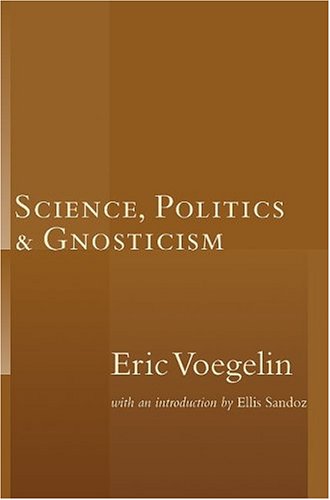
| 1. Science, Politics, And Gnosticism by Eric Voegelin | |
 | Paperback: 102
Pages
(2005-01-30)
list price: US$12.00 -- used & new: US$6.67 (price subject to change: see help) Asin: 1932236481 Average Customer Review: 
Canada | United Kingdom | Germany | France | Japan |
|
Editorial Review Product Description Customer Reviews (5)
After describing the characteristics of ancient Gnosticism, Voegelin defines his own approach to the "science of politics," derived mainly from Plato and Aristotle. He then proceeds to analyze thinkers such as Hegel, Marx, Nietzsche and Heidegger and to isolate what he feels to be their dominant motives. The one great theme of all Gnosticisms, ancient or modern, is the desire to do away with the notion of a given, "objective" world. If the project of world-transformation is to be made plausible, then nothing can be seen to be outside of human power. Social reality is a constructed thing, not a thing given or found, thereby allowing it to be "deconstructed." In the second, shorter essay, "Ersatz Religion," Voegelin describes the complex of ideas characteristic of modern Gnosticism such as millenialism, utopianism and positivism. As the title of the essay suggests, the religious impulse does not die after the murder of God; it gets redirected into "political religions." Politics then becomes a matter of belief and fanaticism, instead of rational discourse and debatable opinions. Despite the abstractness of some of its theoretical concerns, this book is very readable and jargon-free. Those with no prior reading in philosophy may need to look up a term now and again such as "ontology." I recommend it as a good, short introduction to the kind of sober and ordered thought that we so desperately need after the century of Hitler, Stalin, Mao, and Pol Pot.
| |
| 2. The Drama of Humanity and Other Miscellaneous Papers: 1939-1985 (Collected Works of Eric Voegelin, Volume 33) by Eric Voegelin | |
 | Hardcover: 496
Pages
(2004-12-06)
list price: US$64.95 -- used & new: US$64.94 (price subject to change: see help) Asin: 0826215459 Average Customer Review:
Canada | United Kingdom | Germany | France | Japan |
|
Editorial Review Product Description Customer Reviews (1)
| |
| 3. Published Essays: 1940-1952 (Collected Works of Eric Voegelin, Volume 10) by Eric Voegelin | |
 | Hardcover: 272
Pages
(2000-10-05)
list price: US$44.95 -- used & new: US$44.95 (price subject to change: see help) Asin: 0826213049 Canada | United Kingdom | Germany | France | Japan |
|
Editorial Review Product Description Published Essays, 1940-1952, includes some of Eric Voegelin's most provocative and interesting essays. Containing his first publications after he fled Vienna and settled in the United States following Hitler's annexation of Austria, this volume provides eyewitness commentary on the rise of National Socialism from the first days of World War II onward. A major study entitled "Growth of the Race Idea" presents a masterful summary of the two volumes on that subject Voegelin first published in 1933. A related essay of wide interest is entitled "Nietzsche, the Crisis, and the War." Another facet of Voegelin's thought incorporated within this volume of the Essays is his extraordinary analysis of the diplomatic correspondence conducted between the Western powers, the papacy, and the Great Khans, whose breathtaking expansion of the Mongol Empire for a time threatened to extinguish Western civilization itself and resulted in a two-century domination of Russia. Another major study is "The Origins of Scientism," an illuminating analysis of the grounds of much of modern philosophy and of all modern political ideologies. There are also surveys of the state of political theory in the late forties, penetrating studies of utopian thought with essays on Thomas More and Goethe, and a concluding essay that explores the intricacies of "Gnostic Politics"—a familiar theme from Voegelin's contemporaneous New Science of Politics. This volume of published essays shows Eric Voegelin at his most accessible best. | |
| 4. On the Form of the American Mind (The Collected Works of Eric Voegelin, Volume 1) by Eric Voegelin | |
| Hardcover: 312
Pages
(1995-09-01)
list price: US$49.95 -- used & new: US$49.95 (price subject to change: see help) Asin: 0807118265 Canada | United Kingdom | Germany | France | Japan | |
|
Editorial Review Product Description In 1924, not quite two years after receiving his doctorate from the University of Vienna, Eric Voegelin was named a Laura Spelman Rockefeller Memorial Fellow and thus given the opportunity to pursue postdoctoral studies in the United States. For the next twenty-four months, Voegelin worked with some of the most creative scholars in America and at several of the country's great universities, an experience that undoubtedly influenced his scholarly and personal perspectives throughout his life. A more immediate result was the publication in 1928 of On the Form of the American Mind, the young philosopher's first major work, in which his acute perceptions and analyses combine with a conceptual vocabulary struggling to find its own coherence and form. Analysis of On the Form of the American Mind indicates that Voegelin integrated the approaches of Lebensphilosophie into what Georg Misch called the "philosophical combination of anthropology and history," which characterized contemporary trends within the discourse of the Geisteswissenschaften and finally resulted in a theoretical paradigm of philosophical anthropology. Jürgen Gebhardt and Barry Cooper provide access to this brilliant study with their two-part introduction. The first part considers On the Form of the American Mind in the context of methodological debates ongoing in Germany at the time Voegelin was writing the book; the second describes Voegelin's American experience and compares his work with similar studies written during the post-World War I period. | |
| 5. Modernity Without Restraint: The Political Religions, The New Science of Politics, and Science, Politics, and Gnosticism (Collected Works of Eric Voegelin, Volume 5) by ERIC VOEGELIN | |
 | Hardcover: 352
Pages
(1999-11-01)
list price: US$49.95 -- used & new: US$39.96 (price subject to change: see help) Asin: 082621245X Average Customer Review:
Canada | United Kingdom | Germany | France | Japan |
|
Editorial Review Product Description Published together for the first time in one volume are Eric Voegelin's Political Religions, The New Science of Politics, and Science, Politics, and Gnosticism. Political Religions was first published in 1938 in Vienna, the year of Voegelin's forced emigration from Austria to the United States. The New Science of Politics was written in 1952 and established Voegelin's reputation as a political philosopher in America. Science, Politics, and Gnosticism was Voegelin's Inaugural Lecture at the University of Munich in 1958 and introduced him to the West German intellectual public. Although these books were written during remarkably different historical circumstances of Voegelin's life, all three present an analysis of modern Western civilization that has lost its spiritual foundations and is challenged by various ideological persuasions. Voegelin critiques in these texts a "modernity without restraint." It is a modernity with Hegelian, Marxian, Nietzschean, Heideggerian, positivist, Fascist, and other predominantly German characteristics. The author confronts this modernity with Western meaning as it emerged in ancient Greece, Rome, Israel, and Christianity and became transformed in the European Middle Ages, the Italian Renaissance, and the Anglo- American political formation. This three-in-one volume delves into the intellectual and spiritual complications of modernity, tracing its evolution from the ancient civilizations to the twentieth century. In his substantial new introduction, Manfred Henningsen explores the experiential background that motivated Voegelin's theoretical analyses and the new relevance that his work has gained in recent years with the unexpected collapse of state socialism in East Germany, Eastern Europe, and the Soviet Union. Modernity without Restraint will be a valuable addition to intellectual history and Voegelin studies. Customer Reviews (4)
Voegelin represents an interesting alternative to modernity and liberalism.And this book among his collected works serves as an excellent introduction to the thought of this profound thinker, philosopher of gnosticism. ... Read more | |
| 6. Lonergan and the Philosophy of Historical Existence (ERIC VOEGELIN INST SERIES) by Thomas J. McPartland | |
 | Hardcover: 320
Pages
(2000-07-20)
list price: US$49.95 -- used & new: US$4.99 (price subject to change: see help) Asin: 0826213456 Canada | United Kingdom | Germany | France | Japan |
|
Editorial Review Product Description Bernard Lonergan's ambitious study of human knowledge, based on his theory of consciousness, is among the major achievements of twentieth-century philosophy. He challenges the principles of contemporary intellectual culture by finding norms and standards not in external perceptions or reified concepts, but in the dynamism of consciousness itself. Lonergan and the Philosophy of Historical Existence explores the implications of Lonergan's approach to the philosophy of history in a number of distinct but related contexts, covering a variety of intellectual disciplines. Each chapter can be read independently, but the series of chapters provides a coherent unfolding of Lonergan's case that the norms of inquiry endure as a standard of human thought and action amid continuous changes and fluctuations in politics, morals, religion, science, and scholarship. The book explains how Lonergan's idea of development follows from his theory of consciousness and how his treatment of human development inevitably focuses on historical development. The central theme of the book is that Lonergan's philosophy of history makes a pronounced distinction between historicity and historicism. McPartland relates Lonergan's work to existentialist themes and, in the last chapters, to the work of Eric Voegelin. The book addresses the existentialist themes of dread, suffering, guilt, shame, and resentiment—within overall themes of history, philosophy, and religion. McPartland argues that Lonergan's unique perspective on scientific method, epistemology, metaphysics, and critical theory can illuminate what seem to be the quite alien topics of reason as religious experience, the anxiety of existence, the existential roots of bias, and mythopoesis and mystery. Here there is a remarkable parallel to the philosophy of history of Eric Voegelin. The concluding chapters of the book show how the equivalence of the two philosophies offers a mutually enriching dialogue between Lonergan's critical realism and Voegelin's existential exegesis. | |
| 7. Published Essays: 1934-1939 (Collected Works of Eric Voegelin, Volume 9) by Eric Voegelin | |
 | Hardcover: 184
Pages
(2001-05-01)
list price: US$39.95 -- used & new: US$39.95 (price subject to change: see help) Asin: 0826213375 Canada | United Kingdom | Germany | France | Japan |
|
Editorial Review Product Description In this collection of essays, which covers the years from 1934 to1939, we see Eric Voegelin in the role of both scholar and public intellectual in Vienna until he was forced to flee the Nazi terror that descended on Austria in 1938. Revealing the broad spectrum of thinking and scientific study of this relatively young scholar, Voegelin's essays range from Austrian politics, Austrian constitutional history, and European racism to questions of the formation and expression of public opinion, theories of administrative law, and the role of political science in public university education. Several essays serve as useful commentaries on, elaborations of, or synopses of arguments Voegelin made in the five books he had published between 1928 and 1938. Within these topical headings, there are multiple thematic threads that wind their way through these essays and that remain of interest to contemporary readers. Thirteen of the pieces contained in this collection are short items that Voegelin published in trade journals and newspapers, of which nine appeared in the Wiener Zeitung in 1934 and the Neue Freie Presse in 1937. In these we see two brief periods in which Voegelin played the role of public intellectual not only as a lecturer but also in print. These essays will be of interest to a wide range of scholars, including constitutional historians, historians of political science, political theorists, and students of Voegelin's later work. | |
| 8. Order and History (Volume 3): Plato and Aristotle (Collected Works of Eric Voegelin, Volume 16) by ERIC VOEGELIN | |
 | Hardcover: 464
Pages
(1999-12-01)
list price: US$54.95 -- used & new: US$31.49 (price subject to change: see help) Asin: 0826212506 Average Customer Review:
Canada | United Kingdom | Germany | France | Japan |
|
Editorial Review Product Description This third volume of Order and History completes Voegelin's study of Greek culture from its earliest pre- Hellenic origins to its full maturity with the dominance of Athens. As the title suggests, Plato and Aristotle is principally devoted to the work of the two great thinkers who represent the high point of philosophic inquiry among the Greeks. Through an absorbing analysis of the Platonic and Aristotelian vision of soul, polis, and cosmos, Voegelin demonstrates how the symbolic framework of the older myth was superseded by the more precisely differentiated symbols of philosophy. Although this outmoding and rejection of past symbols of truth might seem to lead to a chaotic and despairing relativism, Voegelin makes it the basis of a profound conception of the historical process: "the attempts to find the symbolic forms that will adequately express the meaning [of a society], while imperfect, do not form a senseless series of failures. For the great societies have created a sequence of orders, intelligibly connected with one another as advances toward, or recessions from, an adequate symbolization of the truth concerning the order of being of which the order of society is a part." In this view, history has no obvious "meaning," yet each society makes a similar venture after truth. Although every society works out its destiny under different conditions, each nonetheless creates symbols"in its deeds and institutions"which bear the meaning of its own existence. History, then, acquires a unity in the common endeavor toward meaning and order. The rationality and nobility of this view of history has much to say to the present age. Dante Germino's powerful introduction to this edition of Plato and Aristotle eloquently directs the reader into Voegelin's search through the thought of Plato foremost and Aristotle secondarily and toward a full understanding of their relevance to the "modern" world. This masterpiece, Germino argues, provides a welcome antidote to the spirit of an era Voegelin once called the Gnostic age. Customer Reviews (2)
I met Eric Voegelin once as a graduate student, and asked him, "why'd you publish all this stuff?"I've been digesting his answer ever since. It was "to resist totality and totalitarianism." Particularly, seen from this standpoint, a clear core of this book is his articulation of the Platonic concept of "metaxy," or the in-between character of life.In philosophical terms, this refers most directly and fully to "in-between" the Agathon (e.g., see myth of the cave and the Divided Line in the Republic) and the apeiron (explored most directly and deeply in the Timaeus). For the philosophically uninitiated, it is possible to speak of this in more mundane terms. An unstated corollary of Plato's notion of the "metaxy" is that life is always larger than our categories.From a Socratic/Platonic perspective, this may include but will entail more than the epistemological recognition that every way of seeing is a way of not seeing.The notion of the "metaxy" is most fundamentally a linguistic indice pointing to ontological plenty as the ground of life, albeit lived within bounds of existential scarcity.This is a notion commonly shared by the great civilizations of East and West.The notion of the "metaxy" underscores that life is lived within a tension between the "transcendent" and "immanent" dimensions of being. When we lose track of this tension, as we have to a great extent in the modern world, and subscribe to reductive ideological notions/understandings of life -- and most particularly, when we imagine that we can encapsulate life within the pride of our own "enlightened" categories -- on a political plane, there may be little to constrain the prideful actions of ideologies, irrespective of whether their clothing is Red or Black, or whether it is "left" or "right." Irrespective of the political stripe, repression and murder become "justified" in the pursuit of an ideological aim -- which in Voegelin's philosophical terms is to dissolve the "metaxy" in the usual modernist mode, through immanetizing the transcendent "eschaton." Voegelin's philosophical terms may sound remarkably abstract to the modern ear (recall Robert Dahl's silly review of Voegelin's The New Science of Politics for the American Political Science journal).Facile critiques such as Dahl's typically focus on the unfamiliar language while overlooking the elementary fact that what Voegelin is asking us to do in every aspect of his work is to take a journey that precisely allows us to see the world in terms other than that of our inherited climate of opinion.For those willing to be thorough scholars rather than merely play at it within the context of given suppositions, Voegelin's scholarship offers new vistas and incredibly rich fields of study.His scholarship offers the capacity to reflect upon and act in the world in a substantively grounded mode with implications for every discipline (see e.g., A.G. Ramos' New Science of Organizations). I submit that a key to understanding this text and the greater body of his work at large is to grasp the central significance of the "metaxy" -- not as a concept within the history of ideas -- but as a life referent of perennial relevance to the recurring challenge of resisting sophistic pretensions and the inherited or emergent ideologies of any time and place. This text demands a great deal.You'll develop insights into Plato and Aristotle available no where else.But for Voegelin, such studies were never a matter of antiquarian interest.They were a matter of developing meaningful referents for life.The value in this text is precisely in its yield, capable of resonating throughout your life and offering far more than the initial effort it will require of you. ... Read more | |
| 9. Autobiographical Reflections (Collected Works of Eric Voegelin, Volume 34) by Eric Voegelin | |
 | Hardcover: 592
Pages
(2006-03-20)
list price: US$64.95 -- used & new: US$41.47 (price subject to change: see help) Asin: 0826215890 Average Customer Review:
Canada | United Kingdom | Germany | France | Japan |
|
Editorial Review Product Description Customer Reviews (1)
| |
| 10. Worldview and Mind: Religious Thought and Psychological Development (Eric Voegelin Institute Series in Political Philosophy) (ERIC VOEGELIN INST SERIES) by Eugene Webb | |
 | Hardcover: 312
Pages
(2009-02-05)
list price: US$49.95 -- used & new: US$39.96 (price subject to change: see help) Asin: 0826218334 Canada | United Kingdom | Germany | France | Japan |
|
Editorial Review Product Description | |
| 11. HITLER AND THE GERMANS (The Collected Works of Eric Voegelin) by Eric Voegelin, Brendan Purcell | |
 | Paperback: 296
Pages
(2003-03-12)
list price: US$24.95 -- used & new: US$24.95 (price subject to change: see help) Asin: 0826214665 Average Customer Review:
Canada | United Kingdom | Germany | France | Japan |
|
Editorial Review Product Description Customer Reviews (1)
| |
| 12. History of Political Ideas (Volume 8): Crisis and the Apocalypse of Man (Collected Works of Eric Voegelin, Volume 26) by ERIC VOEGELIN | |
 | Hardcover: 520
Pages
(1999-07-30)
list price: US$59.95 -- used & new: US$37.54 (price subject to change: see help) Asin: 0826212336 Canada | United Kingdom | Germany | France | Japan |
|
Editorial Review Product Description Reaching into our own time, Crisis and the Apocalypse of Man confronts the disintegration of traditional sources of meaning and the correlative attempt to generate new sources of order from within the self. Voegelin allows us to contemplate the crisis in its starkest terms as the apocalypse of man that now seeks to replace the apocalypse of God. The totalitarian upheaval that convulsed Voegelin's world, and whose aftermath still defines ours, is only the external manifestation of an inner spiritual turmoil. Its roots have been probed throughout the eight volumes of History of Political Ideas, but its emergence is marked by the age of Enlightenment. In our postmodern era, discussions of the collapse of the "enlightenment project" have become commonplace. Voegelin compels us to follow the great-souled individuals who sought to go from disintegration of the present toward evocations of order for the future. Such thinkers as Comte, Bakunin, and Marx suffered through the crisis and fully understood the need for a new outpouring of the spirit. They resolved to supply the deficiency themselves. As a consequence they launched us irrevocably on the path of the apocalypse of man. One of the great merits of Voegelin's analysis is his exposition of the pervasive character of this crisis. It is not confined to the megalomaniacal dreamers of a revolutionary apocalypse; rather, echoes of it are found in the more moderate Enlightenment preoccupation with progress to be attained through application of the scientific method. Faith in the capacity of instrumental reason to answer the ultimate questions of human existence defined men such as Voltaire, Helvétius, Diderot, D'Alembert, and Condorcet. It remains the authoritative faith of our world today, Voegelin argues, demonstrated by our continuing inability to step outside the parameters of the Enlightenment. Are we condemned, then, to oscillate between the rational incoherence of a science that never delivers on its promises and a now discredited revolutionary idealism that wreaks havoc in practice? This is the question toward which Voegelin's final volume points. While not direct, his response is evident everywhere. Crisis and the Apocalypse of Man could have been written only by a man who had reached his own resolution of the crisis. | |
| 13. Order and History (Volume 1): Israel and Revelation (Collected Works of Eric Voegelin, Volume 14) by Eric Voegelin | |
 | Hardcover: 616
Pages
(2001-12-13)
list price: US$64.95 -- used & new: US$51.96 (price subject to change: see help) Asin: 0826213510 Average Customer Review:
Canada | United Kingdom | Germany | France | Japan |
|
Editorial Review Product Description Eric Voegelin's Israel and Revelation is the opening volume of his monumental Order and History, which traces the history of order in human society. This volume examines the ancient near eastern civilizations as a backdrop to a discussion of the historical locus of order in Israel. The drama of Israel mirrors the problems associated with the tension of existence as Israel attempted to reconcile the claims of transcendent order with those of pragmatic existence and so becomes paradigmatic. According to Voegelin, what happened in Israel was a decisive step, not only in the history of Israel, but also in the human attempt to achieve order in society. The uniqueness of Israel is the fact that it was the first to create history as a form of existence, that is, the recognition by human beings of their existence under a world-transcendent God, and the evaluation of their actions as conforming to or defecting from the divine will. In the course of its history, Israel learned that redemption comes from a source beyond itself. Voegelin develops rich insights into the Old Testament by reading the text as part of the universal drama of being. His philosophy of symbolic forms has immense implications for the treatment of the biblical narrative as a symbolism that articulates the experiences of a people's order. The author initiates us into attunement with all the partners in the community of being: God and humans, world and society. This may well be his most significant contribution to political thought: "the experience of divine being as world transcendent is inseparable from an understanding of man as human." Customer Reviews (2)
| |
| 14. What Is History? and Other Late Unpublished Writings (Collected Works of Eric Voegelin, Volume 28) by Eric Voegelin | |
| Hardcover: 280
Pages
(1990-09-01)
list price: US$44.95 -- used & new: US$44.94 (price subject to change: see help) Asin: 0807116033 Canada | United Kingdom | Germany | France | Japan | |
|
Editorial Review Product Description This volume contains the most significant pieces of unpublished writing completed by Eric Voegelin during an important time of his career. Spanning the period from the early 1960s to the late 1970s, these selections supplement the body of work Voegelin published after the appearance of the first three volumes of Order and History in 1956 and 1957. The five texts included here are "What Is History?" "Anxiety and Reason," "The Eclipse of Reality," "The Moving Soul," and "The Beginning and the Beyond." In their introduction to the volume, Thomas A. Hollweck and Paul Caringella place these writings in their proper context and discuss the ways in which they reveal clues to the evolution of Voegelin's thought. In "What Is History?" Voegelin considers the development of a transcendent structure of history while simultaneously rejecting the notion that history can have a universal meaning. "Anxiety and Reason" focuses on Voegelin's critically important theory of historiogenesis, which links events in pragmatic history with legendary and mythical events leading back to the beginning of the cosmic order. In "The Eclipse of Reality," Voegelin presents a critique of modernity by analyzing the work of Sartre, Schiller, Comte, and others. "The Moving Soul"--a "thought experiment" inspired by a remark Henry Margenau makes in The Nature of Physical Reality--attempts to reformulate the connections between physics and myth. The most important of these essays is "Me Beginning and the Beyond." Here Voegelin meditates on the universality of experience formed by the tension of existence under God. Publication of these previously unpublished writings will enable scholars to trace the genesis of many of the concerns that occupied Voegelin during a period in which the conception of his main work was undergoing frequent and perhaps fundamental changes. | |
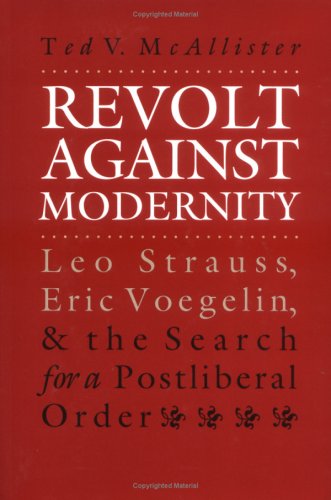
| 15. Revolt Against Modernity: Leo Strauss, Eric Voegelin, and the Search for a Postliberal Order by TedV. McAllister, Ted V. McAllister | |
 | Paperback: 340
Pages
(1997-09-01)
list price: US$19.95 -- used & new: US$17.95 (price subject to change: see help) Asin: 0700608737 Average Customer Review: 
Canada | United Kingdom | Germany | France | Japan |
|
Editorial Review Product Description Since the appearance in the 1950s of Strauss's Natural Right and History and Voegelin's Order and History, conservatives like Russell Kirk, Irving Kristol, and Allan Bloom have increasingly turned to these thinkers to support their attacks on liberalism and the modernist mindset. Like so many conservatives, Strauss and Voegelin rebelled against modernity, amorality--personified by Machiavelli, Hobbes, Rousseau, Kant, Hegel, and Nietzsche--and its promotion of individualism and materialism over communal and spiritual responsibility. While both disdained the reductionist "conservative" label, conservatives nevertheless appropriated their philosophy, in part because it restored theology and classical tradition to the moral core of civil society. For both men, modernity's debilitating disorder revealed surprising and disturbing relations among liberal, communist, and Nazi ideologies. In their eyes, modernity's insidious virus, so apparent in the Nazi and communist regimes, lies incubating within liberal democracy itself. McAllister's thorough reevaluation of Strauss and Voegelin expands our understanding of their thought and restores balance to a literature that has been dominated by political theorists and disciples of Strauss and Voegelin. Neither reverential nor dismissive, he reveals the social, historical, political, and philosophical foundations of their work and effectively decodes their frequently opaque or esoteric thinking. Well written and persuasively argued, McAllister's study will appeal to anyone engaged in the volatile debates over liberalism's demise and conservatism's rise. This book is part of the American Political Thought series. Customer Reviews (2)
| |
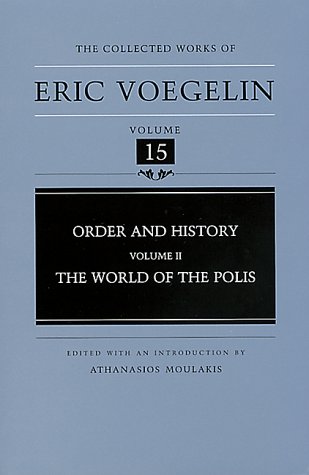
| 16. Order and History (Volume 2): The World of the Polis (Collected Works of Eric Voegelin, Volume 15) (v. 2) by Eric Voegelin | |
 | Hardcover: 488
Pages
(2000-06-30)
list price: US$59.95 -- used & new: US$47.96 (price subject to change: see help) Asin: 0826212832 Average Customer Review:
Canada | United Kingdom | Germany | France | Japan |
|
Editorial Review Product Description This second volume of Voegelin's magisterial Order and History, The World of the Polis, explores the ancient Greek symbolization of human reality. Taking us from the origins of Greek culture in the Pre-Homeric Cretan civilizations, through the Iliad and Odyssey, Hesiod, and the rise of philosophy with the Pre-Socratics Parmenides and Heraclitus, this masterful work concludes with the historians of the classical period. In The World of the Polis, Voegelin traces the emergence of the forms of the city-state and of philosophy from the ancient symbolism of myth. He maintains that the limits and ultimate goals of human nature are constant and that the central problem of every society is the same—"to create an order that will endow the fact of its existence with meaning in terms of ends divine and human." Thus, Voegelin shows how "the meaning of existence" achieved concrete expression in the typical political, social, and religious institutions of Greece and in the productions of its poets and thinkers. He deals with more than fifty Greek writers in the course of his analysis of the rise of myth and its representation of the divine order of the cosmos as the first great symbolic form of order, one later supplanted by the leap in being reflected in the emergence of philosophy. The book is a tour de force, a virtuoso performance by a scholar and philosopher of great power, learning, and imagination that places its subject matter in a new light. The editor's critical introduction places The World of the Polis in the broader context of Voegelin's philosophy of history. Scholars and students of political science, philosophy, and the history of ideas will find this work invaluable. Customer Reviews (1)
| |
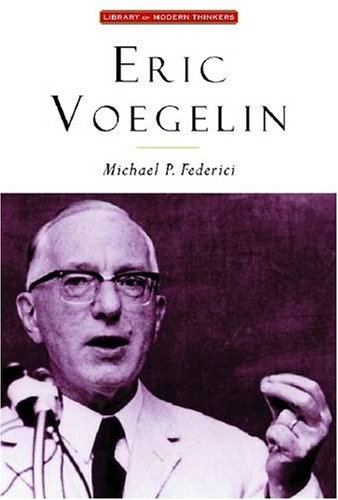
| 17. Eric Voegelin: The Restoration of Order (Library of Modern Thinkers) by Michael P. Federici | |
 | Paperback: 249
Pages
(2002-10)
list price: US$14.95 -- used & new: US$8.00 (price subject to change: see help) Asin: 1882926757 Average Customer Review:
Canada | United Kingdom | Germany | France | Japan |
Customer Reviews (3)
Even so, because Voegelin's work is so difficult, so loaded with new terms and complicated ideas, Federici's book also acquires an element of this density--probably unavoidable, but clarity does suffer somewhat at various points.Nevertheless, what emerges--even in the less clear parts--is a coherent picture of the corpus of Voegelin's work and thought.He sought to articulate a way out of a crisis that had been precipitated, by and large, by movements, particularly ideologies, that had distorted reality--for example, by immanentizing the transcendent.His solution, to put it extremely simply, was to revive Western tradition, largely through a greater openness of the soul to transcendent reality, to the past experiences of civilization. Voegelin was not without his critics, but his influence is far-reaching.Anyone interested in the disease that afflicts the West would do well to turn to Voegelin.And thanks to Federici, we now have a great starting point to do just that. ... Read more | |
| 18. Eric Voegelin and the Good Society by John J. Ranieri | |
 | Hardcover: 320
Pages
(1995-07)
list price: US$39.95 -- used & new: US$23.69 (price subject to change: see help) Asin: 0826210120 Canada | United Kingdom | Germany | France | Japan |
| 19. Disturbing Revelation: Leo Strauss, Eric Voegelin, and the Bible by John Ranieri | |
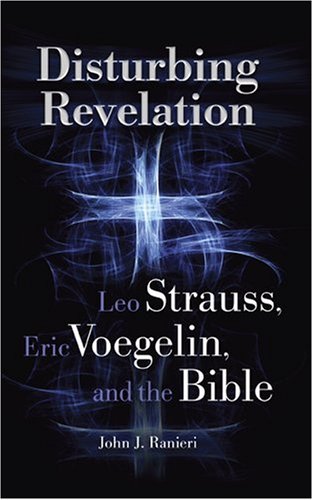 | Hardcover: 296
Pages
(2009-04-17)
list price: US$47.50 -- used & new: US$38.00 (price subject to change: see help) Asin: 0826218369 Canada | United Kingdom | Germany | France | Japan |
|
Editorial Review Product Description | |
| 20. Faith And Poltical Philosophy: The Correspondence between Leo Strauss and Eric Voegelin, 1934-1964 | |
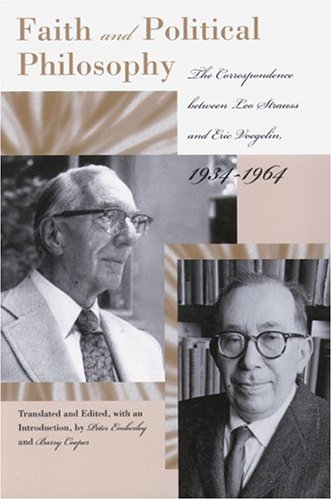 | Paperback: 280
Pages
(2004-08-20)
list price: US$29.95 -- used & new: US$26.94 (price subject to change: see help) Asin: 0826215513 Average Customer Review: 
Canada | United Kingdom | Germany | France | Japan |
|
Editorial Review Product Description Customer Reviews (2)
| |
| 1-20 of 99 | Next 20 |
 Difference between the 1993 edition and the 2004 edition is: