e99 Online Shopping Mall

Geometry.Net - the online learning center Help  
Home  - Philosophers - Weininger Otto (Books)

  1-20 of 65 | Next 20
A  B  C  D  E  F  G  H  I  J  K  L  M  N  O  P  Q  R  S  T  U  V  W  X  Y  Z  

click price to see details     click image to enlarge     click link to go to the store

$64.90
1. Sex And Character: An Investigation
$22.10
2. Sex And Character
$28.97
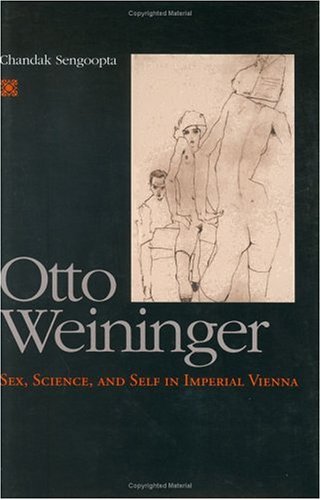
3. Otto Weininger: Sex, Science,
$26.99
4. Sex & Character
$32.95
5. Jews and Gender: Responses to
 
6. Das verfluchte Geschlecht: Motive
 
7. The Impuritans - A Glimpse of
 
8. Otto Weininger: Werk und Wirkung
 
9. Otto Weiningers Tod
 
10. Eine unbescheidene Charakterologie:
 
11. Otto Weininger, Eros und Psyche:
 
12. Otto Weiningers Tod
 
13. Quien Conoce a Otto Weininger
$66.56
14. Wittgenstein Reads Weininger
 
15. Sex and Character
 
$15.00
16. Sex and character
$34.00
17. Sexo Y Caracter/sex And Character
 
$96.76
18. A Translation of Weininger's Über
$30.95
19. Being and Not Being: Clinical
$25.00
20. Le Cas Otta Weininger (Perspectives

1. Sex And Character: An Investigation Of Fundamental Principles
by Otto Weininger, Ladislaus Lob, Daniel Steuer, Laura Marcus
Hardcover: 437 Pages (2005-04-30)
list price: US$75.00 -- used & new: US$64.90
(price subject to change: see help)
Asin: 0253344719
Average Customer Review: 3.5 out of 5 stars
Canada | United Kingdom | Germany | France | Japan
Editorial Review

Book Description
A CHOICE Outstanding Academic Title for 2005

From CHOICE
"This long-awaited new translation of Austrian thinker Otto Weininger'smasterwork...is simply splendid. Accurate, graceful, and complete--threequalities no other English translation can boast--it is light years beyondall previous translations. Why is this book a big deal, and why should onecare about it? For one thing, because it encapsulates Viennese intellectuallife around the turn of the 20th century insofar as it reflects thethinking of other intellectuals and artists--Freud, Kraus, and Broch, tomention three. But the more important reason is intrinsic: it raisesquestions about modernity, race, identity, gender, and fascism, questionsthat are still at the center of cultural debate. Those interested inEuropean history and thought, cultural and literary studies, and race andgender theory will find this book indispensable. Summing Up: Essential.Upper-division undergraduates through faculty." -- Nov. 2005, M. Uebel,University of Texas

Otto Weininger's controversial book Sex and Character, firstpublished in Vienna in 1903, is a prime example of the conflictingdiscourses central to its time: antisemitism, scientific racism andbiologism, misogyny, the cult and crisis of masculinity, psychologicalintrospection versus empiricism, German idealism, the women's movement andthe idea of human emancipation, the quest for sexual liberation, and thedebates about homosexuality.

Combining rational reasoning with irrational outbursts, in the context oftoday's scholarship, Sex and Character speaks to issues of gender, race,cultural identity, the roots of Nazism, and the intellectual history ofmodernism and modern European culture. This new translation presents, forthe first time, the entire text, including Weininger's extensive appendixwith amplifications of the text and bibliographical references, in areliable English translation, together with a substantial introduction thatplaces the book in its cultural and historical context.

... Read more

Customer Reviews (6)

4-0 out of 5 stars Interesting and insightful
I recently downloaded and read a translation of his original work. This was written around the turn of the 20th century, and its obvious at parts how influenced he was by the current views of his time. And keep in mind, men and women have changed considerably since then.
I believe Weininger does possess some excellent insight, although I don't agree with some of his ideas. There are some great insights on the nature of women, although I believe he goes too far into misogynistic thought. Still, I have gained insight into the behavior of intelligent women I have known,that until now puzzled me. I believe that true genius is much rarer in women than men, he believes no woman can be a true genius(at least by his definition). No question, some female geniuses have been hyped up by the feminist movement, and are not at the same level of genius as the males they are categorized with.
Another thing, in one section he says women are not really capable of jealousy towards another woman, when we all know this is false. One reason this error stands out is that women have become much more jealous and envious since his time.
When he goes into his views on Jews, the influence of his environment becomes more apparent. I disagree with most of what he said, and I am not Jewish. Jews are not individuals? Some of the most unique, independent thinkers I have met are Jews. And his obvious environmental bias against Jews throws his whole theory about women into question, although in my opinion it still holds up fairly well. The text is extremely verbose and heavy, he often seems to ramble on about an idea for longer than needed. Still, this book is a wortwhile read for any thinking man.

4-0 out of 5 stars Mysterious Work by Mysterious Author
I believe that many of the reviews for this book have really missed the point.If you view this book outside its historical context, there is no way by which you will understand it.Indeed, claims towards its misogyny and anti-Semitism must be put into context if we are to understand why it is that this young, sexually-confused, and Jewish man decided to write this seemingly bizarre piece at the turn of the 20th century.In particular, those who have read Michel Foucault's works on sexuality and psychoanalysis will find this work incredibly interesting.

While the work begins with a very modern conceptualization of sex, it reverts back to an extremely misogynistic view later in the book.By this I mean, whereas Weininger points to the fact that terms such as 'male' and 'female' are extremely imprecise, and that every individual fits in between this dichotomy, he later reverts to the opposite position, invoking terms that he himself diagnosed as being absolutes: 'Man', 'Woman', 'Male', and 'Female'.Thus, I believe that the interesting question with this book is the following: why does Weininger both point to a theory of bisexuality early in his work, and stick to an absolute model of sexuality later in the work?

This is very interesting from the point of the history of psychology and sexuality because as several scholars have pointed out, Freud falls into the same trap within his "Three Essays on the Theory of Sexuality" in attempting to define masculine and feminine sexual instincts.

Working off the works of Michel Foucault and Arnold Davidson, I believe that these contradictory theories of sexuality point to a fundamental change that was occuring in both the field of psychology and in theories of sexuality during the early 20th century.Previous models of sexuality and sex that relied upon anatomical distinctions began to be turned into functional representations.Thus, in this conceptual framework, sex became an instinct innate to the body, which identified or characterized a type of subject.

Indeed, Weininger argued that the foundation of psychology must move towards interpretation and away from mere sensations or biological specificities, thus placing into question the whole of one's character or personality.Whereas psychiatrists such as M.P. Legrain and Sigmund Freud located individual personalities to a certain extent in the sexual instinct, Weininger goes further to seat this within sex itself.

Towards the end of the book, Weininger goes beyond merely analyzing individual genders, for he applies these archetypal notions of `man' and `woman', or `masculine' and `feminine', to the idea of civilizations and races in later chapters of the book, paying particular attention to Judaism and the Jewish people. In order for this to have made conceptual sense, the concept of sex must have, at the least, broken with a specifically biological model of the sexes.Notions of `male' and `female' had to have become detached from anatomy and, instead, applicable to and determinate of the character of individual societies and classes, to name only a few examples.

In other words, in Weininger's book, one concretely observes the manner in which sex became problematized during the late 19th and early 20th century.Weininger disassociates sex from its biological manifestation and introduces an interprative approach that was to become the hallmark of psychoanlysis.Consequently, I do suggest you read this if you are interested in the history of psychoanalysis and theories of sexuality.

1-0 out of 5 stars Instruction Manual For Bigots & Misogynists
When I saw the glossy reprint/translation of this shamelessly bigoted, anti-woman, white-men-are-superior ejaculation in my local library I wondered why the publisher would have wasted trees and ink on such an effort - but of course, because there is a thriving market for "throw-backs" - humans who glorify old style (read: antiquated) world views as if they were the ancient scripts of ingenious, misunderstood gods. As long as we have these xenophobic, myopia afflicted folk amongst us, I think it is important that the population at large have access to what throw-backs consume as bedtime reading. Take note: racism and sexism are not dead or waning, just some what contained, and people like our dear M. Maguire bellow are just waiting for the more enlightened of us to nod off and stop caring.

Rating - One star because I have little sympathy for people who choose to live in a vacuum and drive themselves psychotic with grandiose excursions into "white man's burden" syndrome.

1-0 out of 5 stars A classic of early 20th century misogyny
In late 19th and early 20th century, misogyny ran rampant. Odd as it may seem, this period may represent the highest point of sexism, chauvinism and misogyny in modern Western culture. It was a period when being a bachelor was part of a proper life. This attitude reached unbeforeseen heights of craziness in such texts as Filippo Tommaso Marinetti's "Futurist Mafarka", a work of fiction where men successfully struggle against "the laws of matter and mechanics" that will end in men giving "supernatural birth", and the writings of some neo-Malthusians who recommended men be breast-fed until they grow breasts themselves, so that they could feed each other.

Probably the most read book of that period is this one: Otto Weiniger's "Sex and Character" - written when he was just 21 years old (he committed suicide just two years later, at 23). By contemporary standards, this book is pretty much a joke, and essentially everything in this book has been discredited scientifically, philosophically, and otherwise. Nevertheless, as usually happens with books that celebrate and justify the bigotry and fanaticism of an age, the book was tremendoulsy popular and influential.

A couple of quotes from the introduction of this book shed light on what this book is about: "The discussions, so much in favour nowadays, concerning the emancipation of women, sexuality, the relation of women to culture, and so forth, are deprived of their data by this publication. /.../ The abnormal type, the hysterical woman, leads up to a masterly psychological (not physiological) theory of hysteria, which is acutely and convincingly defined as "the organic mendacity of woman." /.../ he contrasts with the programme of the modern feminist movement, with its superficialities and its lies."

In his own words: "Where my exposition is anti-feminine,
and that is nearly everywhere..." That his book is devoid of any real scientific proof, even the author himself agrees: "My investigation may be objected to as in certain points not being supported by enough proof, but I see little force in such an objection." "Woman requires man to be sexual, because she only gains existence through his sexuality. Women have no sense of a man's love, as a superior phenomenon..." etc. etc. etc.

Later, the book turns into a run-of-the-mill anti-semitic conspiracy theory, and women (or rather, feminity) are likened to Jews. Plenty of such examples of the worthlessness and bigotry in this book abound, but I hope the above is sufficient to indicate that this book has at best some historical value, while the actual contents are utterly obsolete and laughable.

It is very unfortunate that even today there are people who truly consider this piece of completely obsolete gibberish as some sort of a Great Truth. Recommended for all the misogynic bigots out there.

5-0 out of 5 stars The Truth Hurts
I recently lost my old battered paperback copy of Weininger's "Sex and Character", and to say I was upset is an understatement. So I was delighted to be able to purchase this new version from Amazon, which in hardback form should last a lot longer than my old one. Which is good because this work of philosophy is simply the most important and enlightening material I have ever read and I want it to go with me to my grave. However I do wish that when modern publishers reprint this book that they would refrain from adding their worthless and prejudiced "tuppence worth" in the form of introductions, book-sleeve descriptions etc. They should simply publish Weininger's famous work in its original form without adding anything to it, as they are not qualified to judge the great Man. As Otto clearly mentions in his treatise, instead of rebutting his logical assertions as to the nature of womankind with equally logically derived and intelligent debate, women and the defenders of women (feminine males) simply slander him with the label Misogynist and Anti-semite (even though He was of Jewish origin himself and was therefore better placed than most to understand the mind of the Jew) etc etc, which has the desired effect of immediately stifling any intelligent analysis of his work. It seems people never change. 100 years after his death and what he predicted has come true. Western Society has sunk ever deeper and deeper into a feminine age. Western Society IS feminine: Absolutely material, devoid of a Soul, of any morality or ethics or religiousness. This is NOT because women have become stronger. As Otto clearly shows they are incapable of ever becoming anything other than they are by nature. It is that men have become weaker, less conscious, ie more feminine. Men have descended, thus giving the appearance that women have ascended. Thankyou so much Otto for your invaluable insights that have helped me to understand the nature of Man and especially woman. I suspect that when you wrote your work 100 years ago you knew it could only ever be understood and appreciated by the few rare Men of the World, of which you were one, and you wrote it for them. I owe you a debt of gratitude.
Men (you know who you are), I suggest you get a copy of Otto's timeless work now, before it disappears forever. I am still amazed that it is even available in this backward age of ours.


... Read more


2. Sex And Character
by Otto Weininger
Paperback: 380 Pages (2006-05-15)
list price: US$33.95 -- used & new: US$22.10
(price subject to change: see help)
Asin: 1428600620
Average Customer Review: 3.5 out of 5 stars
Canada | United Kingdom | Germany | France | Japan
Editorial Review

Book Description
Sex and Character - with interlinear translation, Otto Weininger, translation: Robert Willis. Through the distinction between the man type and the woman type, the young latter nineteenth-century Viennese thinker Otto Weininger attempts to bring the contrast of transcendent individuality and worldly individualism into sharper relief. Even further, he posits the existence of a deeper psychical realm that surpasses sexuality and gender, and that ultimately would liberate mankind of original sin, returning it to its naive state of innocence. In this undertaking, Weininger uses many philosophical, religious, empirical, aesthetic, literary, and historical references of the past to supplement his own insights. This translation follows the original German verbatim. I have chosen this method in order to retain its German stylistic character as much as possible. ... Read more

Customer Reviews (2)

4-0 out of 5 stars Brilliant and Profound- Don't beleive the Naysayers
Otto Weininger's treatise "sex and character" speaks about a wide variety of subjects concerning sexuality, genius, philosophy, and the deepest aspects of the soul. Weininger's work is very dense with philosophical and scientific jargon which makes it, in addition to it's difficult subject matter, a heavy read. It contains deep and mysterious truths of the human condition, harsh and shocking truths about the mind and soul. Many have accused Weininger of mysogyny, and while much about weininger's thought may sound mysogynistic, it should not be taken as a condemnation of women but of the aspect of female-ness.

A thought provoking and insightful examination of the sexes for students with a knowledge of philosphy and an interest in sexuality.

3-0 out of 5 stars Letting go of Otto
I read Otto's Sex and Character years ago and for a long long time agreed with its conclusions about the nature of women wholeheartedly. However I would now like to say that my whole previous belief system that I held for many years about the nature of women, a belief that was confirmed and reinforced by Otto's work, is something that I now have serious doubts about. I now believe I was in a state of delusion all those years, and that all those thoughts, attitudes and assumptions that I held about the nature of women were completely false. Reading this book was not a search for knowledge, but a search for confirmation of my pre-existing misconceptions, from a male mind that could have been even more deluded about the nature of women than my own. Far from enlightening me it only sank me deeper into delusion. I can no longer trust a word or a single conclusion in this book. Actually I'm glad, as my whole attitude toward Women has now done an about turn and is a lot more healthy. I no longer believe Women are "soul-less" as Otto claims, but are spiritually equal to men in every way. Sorry sisters, for my previous delusional and harmful ideas about you. I recently threw this book away, it offers nothing positive, healthy or constructive for the mind. ... Read more


3. Otto Weininger: Sex, Science, and Self in Imperial Vienna (The Chicago Series on Sexuality, History, and Society)
by Chandak Sengoopta
Hardcover: 256 Pages (2000-07-01)
list price: US$35.00 -- used & new: US$28.97
(price subject to change: see help)
Asin: 0226748677
Average Customer Review: 3.5 out of 5 stars
Canada | United Kingdom | Germany | France | Japan
Editorial Review

Book Description

Turn-of-the century Vienna is remembered as an aesthetic, erotic, and intellectual world: the birthplace of Freud and psychoanalysis, the waltz, and novels of Schnitzler. The contexts of this cultural vibrancy, Chandak Sengoopta argues, were darker and more complex than we might imagine.

This provocative, enlightening study explores the milieu in which the philosopher Otto Weininger (1880-1903) wrote his controversial book Sex and Character. Shortly after its publication, Weininger committed suicide at the age of twenty-three. His book, which argued that women and Jews were mere sexual beings who lacked individuality, became a bestseller.

Hailed as a genius by intellectuals such as Ludwig Wittgenstein and Karl Kraus, Weininger was admired, not for his prejudices, but for his engagement with the central issues of the time—the nature and meanings of identity. Sengoopta pays particular attention to how Weininger appropriated scientific language and data to defend his views and examines the scientific theories themselves.
... Read more

Customer Reviews (3)

2-0 out of 5 stars Disagree with previous review
In an earlier review, a reader noted, "Sengoopta believes since Weininger's father was antisemitic that it is doubtful Weininger had any Jewish idenity to start with."

I'm sure Weininger had a Jewish identity; that it was linked very early on with shame propelled him to write his awful gobbledygook. Self-hatred can be part of an identity as well, and we would all do well to remember that. If we don't know that, let's learn.

4-0 out of 5 stars Still unaccounted for...
"The genius is not the product of his age, is not to be explained by it, and we do him no honour if we attempt to account for him by it."-- Otto Weininger, Sex and Character, Part II, Chap 5.

...but explain him by his age is exactly what Sengoopta tries to do for Weininger. The book helps to situate Weininger in the scientific millieu of his time, as the Harrowitz and Hyams collection (-Jews and Gender: Responses to Otto Weininger-) earlier tried to do against a literary backdrop, and though we are grateful for these efforts, both fail to come terms with the seriousness of Weininger's philosophy. They repeat many of the usual dismissive assessments, either by trying to explain him as an unpleasant social phenomenon or personal pathology. We are still waiting for a genuinely philosophical exposition of Weininger's importance to moral philosophy in general and gender-based moral theories, in particular. We strongly suspect, for example, that radical feminism will one day discover a curious allegiance with Weininger. (Janik's -Essays on Wittgenstein and Weininger- in places, however, hints in a more thoughtful direction.)

5-0 out of 5 stars chandak sengoopta's otto weininger, a critique
dr. sengoopta's well researched book is the strange story of otto weininger, a jew, who wrote a treatise that 'proved' women and jews did not possess a rational and moral self; that they did not deserve or need equality, not to mention liberty, that only male aryans should be in charge of society. imagine a jew that hitler called 'wise'(though it is doubtful he ever read him) a jew that was throughly discredited following world war two as a racist and misogynist.then why read him?dr. sengoopta not only gives the reasons weininger is important in the understanding of ideas current in his time, but how to read him. afterall, this strange little man influenced (though not persuaded) freud, kafka, ludwig wittgenstein, the racist politics of vienna's mayor, karl leuger as well as literary figures such as james joyce and ford maddox ford, probably his most important contribution.his dramatic suicide, in beethoven's home, no less, made him the era's 'tragic genius'.(a concept karl kraus, the jewish critic, concurred).afterall, this was the age of arthur schnitzler (THE ROAD TO THE OPEN) when jewish intellectuals were attempting to find a role in viennese culture.for weininger it was an attempt to become GERMAN (he loved wagner)-the extreme path to the open.by becoming a protestant he would not only reject multicultural austria but become more german than the most ardent pan german. his only book, SEX AND CHARACTER, was his phd dissertation-an attempt to analyze the differences between men and women by the use of biology,science, psychology and humanistic social reform. a fanatic follower of kant, weininger believed only aryan men possessed a hyperemperical soul while desiring to resolve the woman question by redefining hysteria and devaluing motherhood.in his attack on women and modernism weininger saw the jews as the symbol of mammon, modernism and the feminization of culture.weininger's ideal society was a sterile dystopia where women would lose their sexuality and deserve to be politically equal...of course the human race would die out, but in pure kantian thought this minor difficulty would not matter, for weininger believed that sexual desire-and feminine beauty is only a creation of man's love-forces man to degenerate.the only true love is plutonic in the tradition of dante's beatrice. one of the more enlightened aspects of weininger is his belief in universal bisexuality, "sexual intermediacy", that is to say, all humans are a mixture of the masculine and the feminine in differing degrees. however, the most gifted woman can only be 50% masculine, thus inferior to the most effeminate male.weininger even proposed a mathematical formula to achieve the perfect conjunction.yes,even he realized that despite his ideal society males WOULD seek out women and mate...one could only hope to achieve the most satisfactory results through science. most of weininger's thought is absurb if not discusting to modern readers. Little gems such as 'all women are amoral',"are logically insane', "men have better memories","women can not differenate between feeling and thought", that they have no soul,and on and 0n AD NAUSEAM.perhaps even more repulsive is his racist ideas.naturally he swallowed houston chamberlain, artur de gobineau, wagner and schopenhauers antisemetic drivel and adapted it to his treatise. was this self-hatred?not according to dr. sengoopta, sengoopta believes since weininger's father was antisemetic that it is doubtful weininger had any jewish idenity to start with. weak in some areas but well read in the science of his day, weininger's book is a melange of science, biology, philosophy, cultural politics and personal anxiety.ironically, despite his contempt for women in the reproduction of the species woman is supreme.even weininger recognized bachofen's dictim: "the father is always a juristic fiction, whereas motherhood is a physical fact". with all his intellectual twists and turns weininger could never explain away woman's power over life, men and creativity. ... Read more


4. Sex & Character
by Otto Weininger
Paperback: 376 Pages (1906-01-01)
list price: US$26.99 -- used & new: US$26.99
(price subject to change: see help)
Asin: 1429740973
Average Customer Review: 2.0 out of 5 stars
Canada | United Kingdom | Germany | France | Japan
Editorial Review

Product Description
This volume is produced from digital images from the Cornell University Library Historical Monographs collection. ... Read more

Customer Reviews (3)

1-0 out of 5 stars Claptrap
An an antifeminist, I am always looking for well-thought-out antifeminist reading material, and this book does not qualify.

For example: it is true that there have been far more male than female geniuses, and there is scientific evidence that this is biologically based and will remain true no matter how "equal" opportunity and education become. (Since I am not an Ivy League dean, I can say that and NO ONE CAN STOP ME! HAHAHAHA!) However, Weininger claims that there have been *no* female geniuses and resorts to mystical mumbo-jumbo to explain why: "The man of genius possesses, like everything else, the complete female in himself; but woman herself is only a part of the Universe, and the part can never be the whole; femaleness can never include genius. This lack of genius on the part of woman is inevitable because woman is not a monad, and cannot reflect the Universe." Aside from that this hooptedoodle about monads and reflecting the Universe is pure speculation, it avoids the fact that there *have* been female geniuses.

His other theories on female inferiority go along the same lines: he points out common female flaws, with some truth, and then goes on to make sweeping statements about the utter lack of all virtues in all women, supporting them with more unproven mystical blather.

As a Jew, I was naturally curious about the assertions by other reviewers that the author, who was also Jewish, was antisemitic, and the attempts of other reviewers to defend him. Well, Weininger states, "We hate only qualities to which we approximate, but which we realise first in other persons. Thus the fact is explained that the bitterest Antisemites are to be found amongst the Jews themselves." (There is truth in this: Karl Marx was Jewish and was one of history's most rabid antisemites; Hitler drew inspiration from Marx's antisemitic writings.)

Weininger then goes on to demonstrate this by making several antisemitic statements: "The true conception of the State is foreign to the Jew, because he, like the woman, is wanting in personality; his failure to grasp the idea of true society is due to his lack of free intelligible ego. Like women, Jews tend to adhere together, but they do not associate as free independent individuals mutually respecting each other's individuality. As there is no real dignity in women, so what is meant by the word "gentleman" does not exist amongst the Jews." And much more in this vein, along with ominous remarks about how superior the "Aryan" is to Jews. Remember this book was written well before World War II, and such eugenic nonsense was commonplace at the time. In short, Weininger is indeed antisemitic.

In closing, this book is available online, so you don't have to waste your money if you're curious.

4-0 out of 5 stars Otto Weininger: Masculine Form Versus Feminine Matter
_Sex and Character_ by Otto Weininger is an interesting, if odd, book on the ontological natures of male and female.Weininger was a Jewish resident of Vienna during the first years of the 20th century (1903) when he wrote this book at the age of 23 and committed suicide shortly thereafter.What makes this book historically significant is that several authors, such as Freud and James Joyce, noted it and drew upon it in their work.Weininger's work was also known and praised (but doubtfully read) by Adolf Hitler.Weininger himself derives his ideas from Plato, Goethe, Kant, and Schopenhauer, resting in the German Idealist tradition.Weininger's basic premise is that the material world is a lower, feminine existence, and the higher world of ideal forms is masculine.He rejects the Darwinian explanation of human origins, noting that mankind has fallen from the state of the "masculine" ideals, such as individuality, worth/value, love and will and opposes them to the organic, "feminine" phenomena like pleasure, sexual desire, limitation of consciousness and impulse.Weininger concludes that women "do not actually exist" in an ontological sense because they belong to matter, which on a philosophic, esoteric level, has absolutely no meaning--only form gives a particle of matter or an idea a meaningful essence as a "thing-of-itself."His book is full of similar misogynist statements and he errs when he says that women do not have souls.He examines the phenomenon of prostitution from an interesting methodology by comparing the ideal "Absolute Mother" with the "Absolute Prostitute."The Mother's function is to perpetuate and care for the race, while the Prostitute is a more subversive character "outside of the race" concerned only with sexual pleasure as an end in itself and not with procreation.The Prostitute is a rationally unexplainable phenomenon amongst mankind something that is universal and whose origins do not necessarily have to do with economic disadvantages on the part of women.Weininger's chapter on Judaism compares the Jewish people as a unit to the feminine impulse of "pairing": that of finding and arranging marriages and sexual unions.The drive to pairing and matchmaking makes the Jews somewhat of a danger to Western (labeled "Aryan") man because it leans toward dissolution rather than construction, and therefore form.There is also a total dichotomy between the cosmological outlooks of Christianity and Judaism and that in the future, according to Weininger, there will be only two choices for mankind, Christianity and Judaism.Although noted for his "anti-Semitic" views, Weininger actually spends much of his book dealing with his philosophy of what constitutes a genius.A genius is a man who has attained a sense of mystical oneness with the universe, being able to place himself in proper perspective with the cosmos and the rest of humanity.For Weininger, genius actualizes itself in the fields of philosophy and art rather than science and mathematics, because philosophy and art deal with universal concepts whereas the sciences concern themselves only with equations and empirical data.The greatest geniuses are the founders of religions such as Christ and the Buddha.Regarding the question of women's emancipation, Weininger says that only the more masculine women are agitating for it as a political and social agenda.The reason that the "feminist" movement has been so successful is simply because so many modern women are in fact simply biologically and spiritually masculine in character (and many men are correspondingly feminine)._Sex and Character_ lacks internal cohesion in some points especially towards his conclusion, but it is altogether a welcome diversion from the PC feminist rhetoric so popular today.

1-0 out of 5 stars Otto Weininger, SEX & CHARACTER
This book is a reprint of the 1906 translation of the first edition of Otto Weininger's Geschlecht und Charakter (1903). Before he died, Weininger made many corrections and improvements which appear in the second and later editions.

The 1906 translation is notoriously inaccurate and incomplete. A proper and complete translation of the second edition is in the final stages of preparation, and will soon be available from the Indiana University Press.

Wait for it. ... Read more


5. Jews and Gender: Responses to Otto Weininger
by Nancy A. Harrowitz
Paperback: 341 Pages (1995-04)
list price: US$36.95 -- used & new: US$32.95
(price subject to change: see help)
Asin: 1566392497
Average Customer Review: 4.0 out of 5 stars
Canada | United Kingdom | Germany | France | Japan
Editorial Review

Book Description
In 1903 Otto Weininger, A Viennese Jew who converted to Protestantism, published Geschiecht und Charakter (Sex and Character), a book in which he set out to prove the moral inferiority and character deficiency of "the woman" and "the Jew." Almost immediately, he was acclaimed as a young genius for bringing these two elements together. Shortly thereafter, at the age of twenty-three, Weininger committed suicide in the room where Beethoven had died. Weininger's sensationalized death immortalized him as an intellectual who expressed the abject misogyny and antisemitism.

This collection of essays, many translated into English for the first time, examines Weininger's influence and reception in Western culture, particularly his impact on important writers such as Ludwig Wittgenstein, Sigmund Freud, Franz Kafka, and James Joyce. One essay considers the ways Weininger's ideas were used to further Nazi ideology, and several offer feminist approaches to interpreting the intersection of antisemitism and misogyny. The concluding essay explores Weininger's surprising role in Israel's ongoing sociopolitical self-definition through the bold production of Joshua Sobol's play, "The Soul of a Jew (Weininger's Last Night)."

This volume 's close examination of Weininger's ideas, and their subsequent appearance in other well-known texts, suggests how the legacies of prejudice affect Western culture today. ... Read more

Customer Reviews (1)

4-0 out of 5 stars mainly a retrospective
The subject of this book, Otto Weininger, played a minor but disturbing and uneasy role in the early twentieth century. A self-hating Jew, whose diatribes excited much comment when they were published. His derogatory remarks about women and Jews, and his attempt to associate these remarks together invoked much countering a century ago.

Perhaps the most interesting section concerns Freud's response to Weininger's claims, in the field of psychoanalysis. Most of the chapters cover replies that were originally published in French and German, probably rendering them inaccessible to the English-only reader.

Luckily, most of the controversies have now been settled. The book is mainly a retrospective. ... Read more


6. Das verfluchte Geschlecht: Motive der Philosophie Otto Weiningers im Werk Georg Trakls (Literarhistorische Untersuchungen)
by Ursula Heckmann
 Perfect Paperback: 259 Pages (1992)

Isbn: 3631451083
Canada | United Kingdom | Germany | France | Japan

7. The Impuritans - A Glimpse of that New World Whose Pilgrim Fathers are Otto Weininger...
by Harvey Wickham
 Hardcover: Pages (1929)

Asin: B000H467IS
Canada | United Kingdom | Germany | France | Japan

8. Otto Weininger: Werk und Wirkung (Quellen und Studien zur osterreichischen Geistesgeschichte im 19. und 20. Jahrhundert)
 Hardcover: 215 Pages (1984)

Isbn: 3215056518
Canada | United Kingdom | Germany | France | Japan

9. Otto Weiningers Tod
by Hermann Swoboda
 Hardcover: Pages (1923)

Asin: B000Q00Y1E
Canada | United Kingdom | Germany | France | Japan

10. Eine unbescheidene Charakterologie: Geistige Differenz von Judentum und Christentum : Otto Weiningers Lehre vom bestimmten Charakter (Tubinger Beitrage zur Religionswissenschaft)
by Waltraud Hirsch
 Perfect Paperback: 414 Pages (1997)

Isbn: 363131129X
Canada | United Kingdom | Germany | France | Japan

11. Otto Weininger, Eros und Psyche: Studien und Briefe, 1899-1902 (Sitzungsberichte / Osterreichische Akademie der Wissenschaften, Philosophisch-Historische Klasse)
 Paperback: 223 Pages (1990)

Isbn: 3700117566
Canada | United Kingdom | Germany | France | Japan

12. Otto Weiningers Tod
by SwobodaHermann
 Hardcover: Pages (1923)

Asin: B000YCDPRO
Canada | United Kingdom | Germany | France | Japan

13. Quien Conoce a Otto Weininger (Alfaguara Hispanica)
by Mercedes Soriano
 Paperback: 160 Pages (1998-07)
list price: US$5.95
Isbn: 842048105X
Canada | United Kingdom | Germany | France | Japan

14. Wittgenstein Reads Weininger
Hardcover: 206 Pages (2004-06-21)
list price: US$80.00 -- used & new: US$66.56
(price subject to change: see help)
Asin: 0521825539
Average Customer Review: 3.0 out of 5 stars
Canada | United Kingdom | Germany | France | Japan
Editorial Review

Book Description
Condemned for his misogyny, self-hatred, anti-semitism and homophobia, as well as praised for his uncompromising and outspoken approach to gender and morality, Otto Weininger was one of the most controversial and widely read authors of fin-de-siècle Vienna. The purpose of this new collection of essays is to explore the various ways in which Wittgenstein absorbed and responded to Weininger's ideas.Written by an international team of experts on Wittgenstein and Weininger, the volume is especially timely in the light of recent translations of Weininger's work. ... Read more

Customer Reviews (2)

5-0 out of 5 stars Au Contraire...
Though Mr. Solway has obviously read this book carefully, his insistence that the contributors have "nothing" to say clearly indicates that he has an unusual perspective on philosophy.If issues of philosophy and philosophical influence interest you, then you should not be deterred.The contributors are first-rate, and their insights are worth considering.

1-0 out of 5 stars An Investigation into Academic Nothingness
(A discussion of the book "Wittgenstein Reads Weininger")

This essay is in response to a particular academic book, but could have been a response to any of countless books typical of Western academic philosophy, or of the humanities in general. Thus the reader can appreciate the message of this essay without having read the actual book in question, since if the reader has read even one paragraph of Western academic philosophical drivel of any kind, they will have been more than sufficiently informed.

Upon reading "Wittgenstein reads Weininger", a compilation of writings by various Western academic philosophers, I asked myself what impression it had left on my mind, and how I could express that. The answer immediately formed itself in my mind: "Nothing".

There is no mistake. Indeed, from cover to cover, from one page to the next, and irrespective of author, the consistency is unmistakable. It is absolutely nothing. The theme is nothing, the execution is nothing, the intent, nothing. And there is absolutely nothing about the book that is not nothing.

For this reason "Wittgenstein reads Weininger" will only be of interest to the handful of Wittgenstein scholars, and then only grudgingly, since they already have more than enough of nothing to keep themselves occupied into the far future.

This all might sound unbelievable to some; for how could it be that such highly educated and handsomely paid professionals (who yet cry poor) conspire to produce a book that might as well have had all its pages left blank?

To illustrate how and why this happens, I will examine the actual "contents" of the book -remembering all the while, please note, that any expression I use describe this book, such as "having contents", must necessarily be poetic only, since there is in fact nothing to be described, and no real contents at all.

And since the nothingness in question is precisely that spoken of by Otto Weininger when he says that people can indeed truly be nothing, and enact nothing (specifically the criminal and the feminine-minded ), it will serve for us to examine this book from the perspective of Weininger's view. More specifically, I will examine how Weininger's ideas are represented in this book as a way of demonstrating the essential nothingness of the whole book, and by logical extension the essential nothingness of the whole of Western academic thought.

____________


The Introductory essay by David G. Stern and Béla Szabados:

It turns out that Ludwig Wittgenstein regarded Otto Weininger to be a "great genius" and would often recommended Weininger's books to his students and friends. Wittgenstein studied and meditated on Weininger's work for the duration of his life and listed Weininger as one of the people who most influenced his thinking.

Yet in the introductory essay of the book, Stern and Szabados personally accuse Weininger of being a mere pop-psychologist, as well as a peddler of the most powerful prejudices of others, and guilty of "racism, homophobia, and sexism". These are all extremely serious and damning accusations to be making in the opening pages of a supposedly scholarly book, but the authors feel no need to provide any evidence or argument to support their accusations - accusations which can easily be shown to be entirely false. Presumably the authors feel that the opening volley of fire is sufficient character assassination to lay the foundation for the rest of the book - which involves the dismembering and abusing a corpse - a corpse unable to defend itself.

At this point the obvious question to ask is whether Stern and Szabados really think these things they have stated about Weininger, or whether they are in fact merely echoing or channelling the popular prejudices of others - for the reason of self-defense (so as not to offend anyone they personally consider to be significant) - or perhaps also to flatter others (to please those they consider significant).

In the course of this essay I will show why I believe the latter is the case, for the reason that there cannot be any thinking taking place.

____________


The essay by Béla Szabados:

In his essay, Szabados makes the bold claim that Weininger makes "a priori and dogmatic generalizations about sexual, racial, and national characters". But true to the form so far displayed in this book, Szabados provides no evidence or argument whatsoever that Weininger's generalizations are either a priori or dogmatic. Rather, he dogmatically makes the claim, and expects us all to give it credence.

In fact, it is not hard to show that this claim made by Szabados is entirely false. Firstly, since Weininger's generalizations are based on personal observations, they therefore have an empirical basis, and are not "a priori". And secondly, since Weininger's generalizations are neither unwarranted, nor arrogant, being valid generalizations based on observable fact, it follows that they are not dogmatic. As we might expect, it is Szabados himself who is making dogmatic and even "a priori" generalizations about Weininger.

But as we shall see, it is perfectly normal for academics to damn their victims of the very crimes which they habitually commit themselves - and which they commit in the normal course of their professional duty to "fill the space" - a duty which has resulted in the publication of the book under question.

Szabados continues with the perplexing statement that "Weininger's desire to transcend our animality and his antifeminism are indeed prejudices . . .".

The desire to transcend animality is . . . a prejudice . . . ? Prejudiced against animals no doubt! . . . In much the same way that the desire to live a truthful life would indicate a "prejudice" against the lying and criminal life?

And too, "antifeminist" is a very strange criticism of Weininger, who wasarguably one of the greatest feminists of all time - there being probably no person in all history who has argued so strongly for the right of every woman to independence and self-determination, or argued so persuasively for her true freedom from the dictates of both men and other women.

True freedom must always begin with truth, and that is where Weininger starts. No amount of wishing equality will ever make it so.

Continuing, Szabados then accuses Weininger of "essentialism" - or, to paraphrase, "applying an ideal type in an extreme and inappropriate manner in every nook and cranny of our lives." But again, Szabados conveniently fails to provide any argument or evidence that Weininger does this.

For the fact is, that Weininger does not do this. While Weininger does indeed apply his types (eg, M and F, signifying masculine and feminine, or conscious and unconscious characteristics) extremely, and in every nook and cranny of our lives, he does so perfectly appropriately.If it were the case that Weininger was stuck on particular ideal types which were not fruitful, and to the exclusion of other possible types which might be more fruitful, then perhaps we could criticize his method as "inappropriate". But this is not the case. The evidence of Weininger's writings indicate that he is exceptionally flexible in his use of types, and that he uses those types only so far as they prove true and useful.

Later on, Szabados makes mention of "Weininger's inconsistencies", and claims that Weininger's thoughts result in "stereotype, prejudice, and absurdity". But here again, in accordance with all his fellow scholars, he never mentions what he thinks these inconsistencies, prejudices, and absurdities might be. Szabados does not argue a case, but rather, states his claims as facts that are beyond question. The end result of all these unsupported accusations is essentially no more than undignified mud-slinging.

____________


The essay by Allan Janik:

Allan Janik took twenty-six pages of dense text to say, essentially, that Wittgenstein saw things in a different way to some other people, and may have been inspired, in part, by Weininger's seeing things in a different way.

Janik's long essay does not bear further mention than this.

____________


The essay by Steven Burns:

In his essay, Steven Burns accuses Weininger of "essentializing and dichotomizing", but, like the others, doesn't put forward any argument to support his case - which makes any response very difficult. Is Weininger wrong to "dichotomize" between true and false? Is he wrong to dichotomize between consciousness and unconsciousness? Clearly he is not wrong to do so.

Burns objects to what he calls "Victorian dualisms" - which we can only presume to mean something like "unreasonably simplistic categories" - but he fails to give any specific examples of dualisms from Weininger's work that he believes to be "Victorian".

Burns does give some examples of Weininger's dualisms which don't seem to meet with his approval, but he doesn't specify whether he believes them to be "Victorian" or not. For example, Burns says that he doesn't like Weininger forever saying that things are either "A or not-A, or some mixture of the two".

We are of course left to presume that Burns thinks that this kind of categorizing oversimplifies matters in a way that is not useful. But Burns mounts no case for such a contention.

Burns says, "Wittgenstein showed us how many other paths there are than just two" - implying that Weininger was narrow-minded and inflexible with his use of dualisms. But if that criticism is correct, then we ought to be able to find dualisms in Weininger that are either wrong or not useful. Can we do it?

Let's look at Weininger's famous theme: the degree of consciousness or unconsciousness in a person (or in other words, the degree to which a person is "M"ale or "F"emale). Is there a third category possible, beside consciousness and unconsciousness (and all grades in between)? No, there is no third category possible. So Weininger's dualism is perfectly valid, and useful too. If Burns wishes to complain, then let him provide additional categories.

Likewise, if Burns thinks there is a problem with Weininger's dividing people into "seekers" and "priests" (i.e., seekers of wisdom, and possessors of wisdom), or dividing people into "sadists" and "masochists" (dualists and non-dualists), then Burns is not providing any argument which would demonstrate any problem.

With regards to the division of people into seekers and knowers of wisdom, it could possibly be argued that it is a faulty division since there are people who are so foolish that they neither have wisdom, yet nor do they seek it (. . . academic philosophers come readily to mind). But it could be said of such people that even they seek wisdom at least to some small degree - even if they are not aware of this fact themselves. This would make the division a valid one. And what is more, and importantly, Weininger does not say that this particular division necessarily applies to literally all people. Rather, Weininger applies his division only to a select group of people. What would be the point of strictly applying this division to a person who had the mentality of a vegetable? Even further, Weininger is clearly applying this division of people into "seekers" and "priests" not as some kind of final and absolute solution to all problems, but only as a kind of experimental application of thought that is useful only so far as it produces, or spins-off, helpful results, and when used in a certain context.

I suspect that Burns is not allowing Weininger the right to his own meaning for his own terms and modes of thought. Instead, Burns is projecting his own preferred meanings onto Weininger's words, and resulting in absurdities.

Burns seems to want to make a clown of Weininger - a clown who makes simple errors of logic and observation. For example, it would be clownish indeed for someone to suggest that we should divide all people into, say, "bakers" and "plumbers" - since it is obvious that many people are neither bakers nor plumbers. Yet this is indeed the kind of error Burns attributes to Weininger.

In fact Weininger, who, according to Abrahamsen "was praised for his invincible logic", simply does not present as someone who would make such spurious divisions. Rather, I suspect that the scholars are simply finding fault with tiny details of semantics - of their own creation - in order to dispose of someone they find both disturbing and a menace.

____________


The essay by Joachim Schulte:

Joachim Shulte is to be commended for two things; firstly, for writing in fairly readable English, and secondly for suggesting that there might be another way of reading Weininger's work than the way Western scholars have traditionally done.

Given the deep irony and humour in Weininger's work, Schulte says that he finds it "hard to understand why Weininger is generally taken to be nothing but a solemn, zealous and bigoted stickler for nasty and stupid principles." But if Schulte had any kind of understanding of the mind of the typical Western academic scholar then he wouldn't be so puzzled.

Towards the end of his essay Schulte accuses Weininger of being dated and "time bound" - which are things that no great genius ever is. And, like all the others, Schulte conveniently doesn't provide any evidence or argument for his claim. In doing so, Schulte has similarly made himself a small target through use of the "hit and run" method. That is, he slings the mud, inflicting the damage, but then provides no details that you can pursue for reparation.

Despite that major fault, Schulte's essay is probably the only one in this book that has elements that are moderately reasonable and human.

____________


The essay by Daniel Steuer:

Steuer does a serviceable job of summarizing a few of Weininger's ideas, but falls down badly where he says, "Let us call the Weininger a priori absolute, and ascribe the concept of a relative a priori to Wittgenstein." Since the fact is that Weininger's a priori is just as relative as is Wittgenstein's, and indeed is "established through the choice of a standard of comparison from within the empirical". For example, Weininger's continuum from consciousness (M) to unconsciousness (F), is a standard of comparison established out of empirical observations.It is notable that Steuer does not provide any examples of a dualism from Weininger that he would call "absolute a priori".

Steuer illustrates an "absolute a priori" when he describes an a priori dividing of dramatic space into only comedy and tragedy. And he then describes the obvious shortcomings of this division. As Wittgenstein says, "They are two of many possible types of drama, and they just seemed to be the only possible ones for a particular - and past - culture."

But Steuer makes the serious error of thinking that this illustration has something to do with Weininger, since Weininger doesn't divide empirical spaces up in such a way, and Steuer doesn't make any effort to show that he does.

To the contrary, it seems that Steuer is himself trying to establish an absolute a priori difference - i.e., one not based on observable facts - between Weininger and Wittgenstein on this issue.

Steuer makes an even more serious error when he disputes Weininger's use of the law of identity (i.e., A=A), saying that "Wittgenstein negates these principles." Unfortunately, the only way a person can negate anything is by using the law of identity, making Steuer's point ridiculously meaningless.

Finally, Steuer thinks he is saying something wise when he says "The philosopher should behave like one of Weininger's criminals: he should adapt to any environment, to any system." Yet this is precisely why Weininger says that academic philosophers are indeed criminals -because instead of adapting themselves to the one truth of the Universe, they instead adapt themselves to countless dreamworlds that are all disconnected from reality. In sharp contrast, the genius of which Weininger speaks - the true philosopher -is able to effortlessly adapt to all environments, since they are all part, all facets of his environment.

Steuer wins points for mentioning Kierkegaard's name, and thereby injecting a faint hint of humanity, but nothing else can be said in favour of his essay.

____________


The essay by David G. Stern

Stern discusses some of what Weininger has written about what animals symbolize. In it, he comes to the realization that "`Humanity' turns out to mean those very few people who can live up to Weininger's inhuman ideals of denying everything in this world in order to strive for one's own salvation, a salvation that turns on dwelling on the dangers of damnation."

Stern provides no reference for this claim, and it is clear that he has simply made it up. Firstly, Weininger's ideals are not inhuman, but are in fact truly human; secondly, nowhere does Weininger say that the genius denies everything in this world. Rather, the genius only denies what is falsein this world. And thirdly, Weininger certainly does not argue that salvation turns on "dwelling on the dangers of damnation".

This last point is easily revealed, since if it were truly the case that Weininger spent his short time on earth dwelling on the dangers of damnation, then he wouldn't have produced two timeless, masterpiece works by the age of twenty-three. David G. Stern should look down at his own feet instead of wasting his time nit-picking for faults in others.

Next, Stern makes the very strange claim that Weininger's ideals are not presented as the deliverances of Reason. Yet that is precisely how all of Weininger's ideas are presented. Reason is the whole of Weininger: from cover to cover, from top to toe, Reason is what Weininger is all about. Reason is what Weininger represents, and is what he sacrificed himself for. It would be strange indeed for someone who was "praised for his invincible logic" (Abrahamsen) to not present his ideas as deliverances of Reason.

And while Weininger writes about what he believes certain animals symbolize (necessarily for himself, at least, and in a certain context), Stern, very weirdly, goes on a lengthy discussion about whether we can know what is truly going on in the mind of animals - a discussion that has nothing whatsoever to do with Weininger, yet is presented as though it is somehow relevant.

For example, Weininger says that the dog symbolizes the criminal. But Stern, unbelievably, understands this to mean that Weininger holds the dog to be really criminal, and that the dog thinks criminally, and is thus truly evil! This is too crazy for words.

According to Stern, Weininger wants us to "understand animals entirely [my italics] in terms of the extent to which they express characteristically human concerns". Once again, this is entirely fanciful on Stern's part, and is blatantly made-up.

Weininger very wisely says nothing about what animals or plants are really thinking - or even if they are thinking at all - which makes Stern's whole case concerning "Weiningerian anthropocentrism" a pitiful non-event.

____________


The aim of the book under discussion, i.e., "Wittgenstein reads Weininger", was primarily to try and understand why Wittgenstein listed Weininger as one of his main influences, and, indeed, why he referred to Weininger as a "great genius".It also sought to offer an explanation as to why Wittgenstein said that, to paraphrase, "if one negates the whole of Weininger's book, it says an important truth".

As for the former, it is not hard to see Weininger's influence on Wittgenstein and why Wittgenstein should praise him as a great genius. But the question as to why Wittgenstein wished to negate the whole of Weininger's masterpiece work was not dealt with at all convincingly in this book.

Wittgenstein doesn't give us much information to go on, but I propose the following simple explanation for the "negation":

Wittgenstein lost three of his brothers to suicide. And Otto Weininger too, whom Wittgenstein perhaps thought of as a kind of brother, killed himself shortly after having written "Sex and Character". Throughout his life Wittgenstein was to be haunted by thoughts of suicide.

I suggest, then, that the whole issue of suicide was of huge significance to Wittgenstein, and was an issue to which he was particularly sensitive. He likely perceived a way of thinking in Weininger's book - an extreme and uncompromising way of thinking - which, it seemed to him, led to an untimely death - and it was especially this which he felt the need to "negate". Therefore it was not for any tight logical reason that Wittgenstein talked about "negating" Weininger's book, but rather it was for largely personal and emotional reasons - with his negating serving him perhaps in the manner of a small crucifix which might ward off some kind of demon.


Conclusion


When critiquing the work of academic philosophers, it is almost impossible to know what to do, for it is as though one were presented with a cloud of dense fog, and are invited to deal with it.

One is first struck with the obvious problem that it is impossible to tell whether the academic philosopher believes anything of what he writes, or whether one is expected to take it as some kind of a game or a joke. The content of their ideas is so fabricated, so artificial, having no relation whatsoever to the subject material, and so completely conforming with the latest fashions in academic thought, that one strongly suspects that they don't believe a word of what they write, but are instead simply contributing, almost cynically, to the mass of what academic philosophers have done before - not unlike the children's game of "sticks" where many small sticks are awkwardly and precariously balanced on each other to form a pile, until eventually the whole lot collapses under its own weight and you start again. Indeed it is not even part of the job description of an academic philosopher that they believe anything they say - so it is probably wrong to even expect it of them.

The academic philosopher too commonly seems to be mocking his own profession through some kind of perverse self-parody - perhaps as a form of confession to ease the burden of guilt for the crime.

But if academic philosophers don't believe anything they say, or if it is all in jest, and a joke, then what do they really say?

Nothing at all.

And that is precisely what we are faced with in this book.

Not once in this book did I read the words "I don't know". If the book contained these words, then it might have at least contained something - and thus something respectable. It is a fact that none of the authors who contributed to this book were qualified to pass comment on Weininger's work, and for that reason should have either remained silent, or gracefully and politely declined with a simple "I don't know". Instead, each author feels the duty to fabricate meaningless opinions, and pretend to have fathomed the subject material - giving the impression that the subject material is immaterial.

__


On the surface this book might appear more intelligent than previousmodern academic works about Weininger, since it does go so far as to suggest, though without any conviction, that an actual reading of Weininger's work might be useful. Yet its pages still fail to muster up an actual thought. The recognition of deep humour in Weininger's work by Joachim Schulte was the nearest this book came to that lofty achievement.

In summary, "Wittgenstein reads Weininger" shows what happens when people are paid to simply show up. And it shows what happens when scholars are allowed to judge the worth of their own work. For it happens that when the quality of thought of the average academic philosopher is appallingly low, that level becomes the professional standard. A sheer absence of thought, and even more, a complete absence of respect for the thought of others, becomes the highly paid craft of the Professor.

... Read more


15. Sex and Character
by Otto Weininger
 Hardcover: Pages (1906)

Asin: B000KL225K
Canada | United Kingdom | Germany | France | Japan

16. Sex and character
by Weininger; Otto
 Paperback: 356 Pages (2007-08-22)
list price: US$75.00 -- used & new: US$15.00
(price subject to change: see help)
Asin: 0722234201
Canada | United Kingdom | Germany | France | Japan

17. Sexo Y Caracter/sex And Character (Ensayo Losada España)
by Otto Weininger
Paperback: 544 Pages (2004-02-11)
list price: US$37.75 -- used & new: US$34.00
(price subject to change: see help)
Asin: 849332969X
Canada | United Kingdom | Germany | France | Japan

18. A Translation of Weininger's Über Die Letzten Dinge, 1904-1907,On Last Things (Studies in German Language and Literature, V. 28)
by Otto Weininger
 Hardcover: 157 Pages (2001-12)
list price: US$109.95 -- used & new: US$96.76
(price subject to change: see help)
Asin: 0773474005
Average Customer Review: 5.0 out of 5 stars
Canada | United Kingdom | Germany | France | Japan

Customer Reviews (1)

5-0 out of 5 stars Incredible collection of far-reaching concepts
The beauty of this collection of essays is its rare combination of depth and diversity, profoundly addressing many topics including (as a subset only) time, culture, science, criminality, sado-masochism, animal psychology, egotism, femininity and seekers and priests.

Containing a psychoanalysis of the criminal mind even Freud could not have written, it delves into equally fruitful analyses of the insane, the artist, scientist, egotist, psychologist and even those who mentally parallel animals (primarily the dog or horse types).

For the reader there is a perfect mix of aphorisms with long, intertwined essays combined with short fragments touching on major themes without excessive development. Weininger's ability to unite such diverse themes and concepts into a single coherent Weltanschauung (not without its very true-to-life paradoxes) is sheer genius.

A master debunker of myths and popular conceptions, Weininger is both ruthless and compassionate, scathingly critical and worshipfully reverential, certain beyond all doubt and open to all possibilities.

A must for the free thinker. Excellently translated. ... Read more


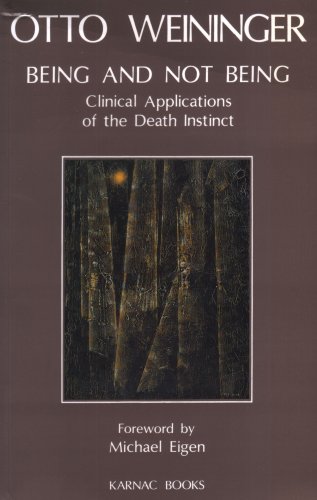
19. Being and Not Being: Clinical Applications of the Death Instinct
by OTTO WEININGER
Paperback: 192 Pages (1996-10-01)
list price: US$30.95 -- used & new: US$30.95
(price subject to change: see help)
Asin: 1855751259
Average Customer Review: 3.0 out of 5 stars
Canada | United Kingdom | Germany | France | Japan
Editorial Review

Book Description
From the Foreword by Michael Eigen:

I believe that there is in all of us a balance to destroy and protect, but in some of us the balance is tilted too much in one direction"". So says Dr. Otto Weininger at the beginning of his work. No problem is more important for our age. What enables a life to be predominantly constructive rather than destructive for self and world? What can psychoanalysis do to tip the balance for the better?

Dr. Weininger cuts through jargon to give many clear and useful portrayals of work with destructive tendencies in a variety of contexts. He has much to say about adults who seem to stall or live life in reverse. There are many individuals who feel numb or dead and undo whatever they try to build. Dr. Weininger shares his attempts to contain the pain of unlived or mislived lives and provide psychic nutrients that make constructive aliveness possible.

Dr. Weininger's book is rich in nutrients for the reader, also. Not only does he have helpful things to say about destructive process in adults, but his book contains a wealth of material on work with children. He traces death work to its sources in early feeding and sleeping problems, various somatic difficulties, phenomena like homesickness, and crisis of spirit that disabled and dying children must face.

This book is an eloquent plea for life, for emotional aliveness, for the possibility of living well together.

"Of all Melanie Klein's contributions, her emphasis on the importance of the daeth instinct in infantile mental life continues to be the most enigmatic and controversial. Professor Weininger's work goes a long way in lessening that enigma and controversy by giving clinical credibility to her concept. Klein who was accused of ignoring external reality. Weininger, in the contrary, contextualizes the effects of the death instinct well within the clinical immediacy of detailed case material. Hes has done a superb job in reconciling a difficult concept with practical clinical issues. This work represents a significant update of the Kleinian genre." - James S. Grotstein ... Read more

Customer Reviews (1)

3-0 out of 5 stars Not for the undecided
While the author's clinical experience seems extensive, this is not a book for those who have yet to decide whether Melanie Klein was on to something or not.The vignettes contain interpretations that are definitely in therealm of "through this lens I view the world".Clinicians ofother persuasions can come up with interpretations just as valid as thoseoffered by the author.There is no area of psychoanalytical work thatrequires such leaps of faith as dealing with preverbal individuals or veryyoung children just learning to talk.This is a technical book foradherents to Kleinian theory or for students who are interested in a verylucid explanation of said theory. ... Read more


20. Le Cas Otta Weininger (Perspectives critiques)
by Jacques le Ridier
Paperback: 255 Pages (1982)
-- used & new: US$25.00
(price subject to change: see help)
Asin: 2130376703
Canada | United Kingdom | Germany | France | Japan

  1-20 of 65 | Next 20
A  B  C  D  E  F  G  H  I  J  K  L  M  N  O  P  Q  R  S  T  U  V  W  X  Y  Z  

Prices listed on this site are subject to change without notice.
Questions on ordering or shipping? click here for help.

site stats