e99 Online Shopping Mall

Geometry.Net - the online learning center Help  
Home  - Philosophers - Zizek Slavoj (Books)

  1-20 of 100 | Next 20
A  B  C  D  E  F  G  H  I  J  K  L  M  N  O  P  Q  R  S  T  U  V  W  X  Y  Z  

click price to see details     click image to enlarge     click link to go to the store

$7.72
1. For They Know Not What They Do:
$16.40
2. Conversations with Zizek (Conversations)
$15.26
3. The Parallax View (Short Circuits)
$11.20
4. Violence: Big Ideas/Small Books
$12.52
5. Interrogating the Real
$10.75
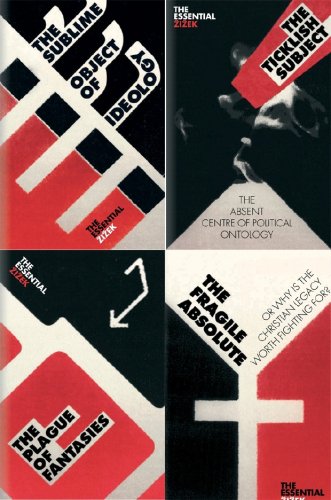
6. The Fragile Absolute: Or, Why
 
$21.95
7. The Sublime Object of Ideology
$11.84
8. The Universal Exception
$11.50
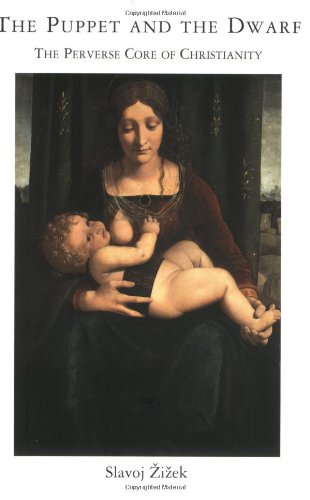
9. The Puppet and the Dwarf: The
$9.03
10. Iraq: The Borrowed Kettle
$7.26
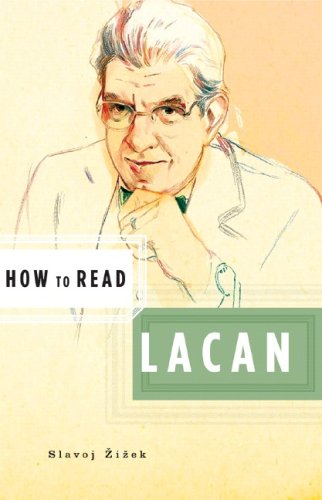
11. How to Read Lacan (How to Read)
$11.31
12. Revolution at the Gates: Zizek
$17.94
13. Looking Awry: An Introduction
$17.79
14. In Defense of Lost Causes
 
$12.56
15. The Ticklish Subject: The Absent
 
$87.09
16. Slavoj Zizek: Live Theory
$116.83
17. Slavoj Zizek: A Little Piece of
$7.91
18. Welcome to the Desert of the Real:
$11.45
19. Did Somebody Say Totalitarianism:
$14.95
20. The Art of the Ridiculous Sublime:

1. For They Know Not What They Do: Enjoyment as a Political Factor (Radical Thinkers)
by Slavoj Zizek
Paperback: 320 Pages (2008-01-01)
list price: US$12.95 -- used & new: US$7.72
(price subject to change: see help)
Asin: 1844672123
Canada | United Kingdom | Germany | France | Japan
Editorial Review

Book Description
A groundbreaking analysis of the roles of pleasure and desire in contemporary politics.

"Verso's beautifully designed Radical Thinkers series, which brings together seminal works by leading left-wing intellectuals, is a sophisticated blend of theory and thought. The authors whose writings are included in the series have worked tirelessly to expose the mechanisms by which culture and knowledge are manufactured, managed and controlled."—Ziauddin Sardar, New Statesman ... Read more


2. Conversations with Zizek (Conversations)
by Slavoj Zizek, Glyn Daly
Paperback: 171 Pages (2004-01-07)
list price: US$21.95 -- used & new: US$16.40
(price subject to change: see help)
Asin: 0745628974
Average Customer Review: 5.0 out of 5 stars
Canada | United Kingdom | Germany | France | Japan
Editorial Review

Book Description
In this new book, Slavoj Žižek and Glyn Daly engage in a series of entertaining conversations which illustrate the originality of Žižek’s thinking on psychoanalysis, philosophy, multiculturalism, popular/cyber culture, totalitarianism, ethics and politics.


  • An excellent introduction to one of the most engaging and controversial cultural theorists writing today.
  • Žižek is a Slovenian sociologist who trained as a Lacanian and uses Lacan to analyse popular culture and politics.
  • Illustrates the originality of Zizek’s thinking on psychoanalysis, philosophy, multi-culturalism, popular/cyber culture, totalitarianism, ethics and politics.
  • Provides a unique glimpse of Žižek’s humour and character and offers new material and fresh perspectives which will be of interest to followers of Zizek’s writings.
... Read more

Customer Reviews (3)

5-0 out of 5 stars The Easy Way
In order to familiarize yourself with the thoughts and strategies of any critic or philosopher without being exposed to the sufferings sustained in the painful job of reading extremely complex texts, you should always focus on the interviews made with the critic or the philosopher. You will get a much better grasp of highly complicated ideas suggested by philosophers such as Sartre, Foucault, and Said by reading through their published interviews. I mention those three authors for it has been claimed by some reviewers that they have turned the activity of giving an interview into an artform. Daly's interviews with Zizek does not spare us from Zizek's playful, and at times elusive, style when he goes down on Kinder chocolate, virtual reality, globalization, Hitchcock, Fight Club, etc... Zizek is as quick and as versatile as you may have imagined him to be from his previous books or lectures. Daly seems to know to press the right buttons in order to get Zizek off the ground. The chemistry in this book makes even Deleuze sound as a wild and attractive philosopher. However, you should beware Zizek's Lacan is quite different from the clinical readings of Lacan. It became quite clear already in 1989 in "the Sublime Object of Ideology" that Zizek preferred to focus on the underestimated Real in the Lacanian cognitive edifice. Daly explains in a very lucid way the importance of the Real to Zizek's Lacan, and he helps the reader to enter Zizek's streams of thought. This book helps any reader to understand Zizek's highly complex ideas in a very simple way. I would place this book among the other books of interviews made with the authors mentioned above, Sartre, Foucault, and Said. Daly and Zizek are preserving the artform.

5-0 out of 5 stars Most coherent text on Lacan and/or Zizek ever
Previous to reading this book I had read quite a few of Zizek's books, as well as some other secondary material on Lacan, and always seemed to miss the mark on some key conceptual understandings.They were always too technical, above my head, or hard to understand.In this book, by contrast, and probably in part because it's in an interview format, Zizek does an incredible job of succinctly explaining difficult Lacanian concepts in easy to understand terms.He also outlines his vision of politics and ethics, although if you want to see him defending his politics at his best, I reccomend Revolution at the Gates.The first part of the book also has the added bonus of giving alot of biographical information about Zizek, which, quite frankly, I couldn't care less about, but theory-heads might enjoy the story of his life.Daly also does a pretty good job explaining Zizek's interpretation of Lacan in the introduction - at least far better than most secondary material on Zizek.A great read if you want to get to understand Zizek and Lacan better but have had difficulty understanding his other books.

5-0 out of 5 stars a great introduction
Anyone interested in learning about Zizek should read this book. It is lively and accessible, a perfect way to get acquainted with a daunting thinker who writes faster than most of us read. ... Read more


3. The Parallax View (Short Circuits)
by Slavoj Zizek
Hardcover: 528 Pages (2006-02-17)
list price: US$24.95 -- used & new: US$15.26
(price subject to change: see help)
Asin: 0262240513
Average Customer Review: 3.5 out of 5 stars
Canada | United Kingdom | Germany | France | Japan
Editorial Review

Book Description
The Parallax View is Slavoj Zizek's most substantial theoretical work to appear in many years; Zizek himself describes it as his magnum opus. Parallax can be defined as the apparent displacement of an object, caused by a change in observational position. Zizek is interested in the "parallax gap" separating two points between which no synthesis or mediation is possible, linked by an "impossible short circuit" of levels that can never meet. From this consideration of parallax, Zizek begins a rehabilitation of dialectical materialism.

Modes of parallax can be seen in different domains of today's theory, from the wave-particle duality in quantum physics to the parallax of the unconscious in Freudian psychoanalysis between interpretations of the formation of the unconscious and theories of drives. In The Parallax View, Zizek, with his usual astonishing erudition, focuses on three main modes of parallax: the ontological difference, the ultimate parallax that conditions our very access to reality; the scientific parallax, the irreducible gap between the phenomenal experience of reality and its scientific explanation, which reaches its apogee in today's brain sciences (according to which "nobody is home" in the skull, just stacks of brain meat--a condition Zizek calls "the unbearable lightness of being no one"); and the political parallax, the social antagonism that allows for no common ground. Between his discussions of these three modes, Zizek offers interludes that deal with more specific topics--including an ethical act in a novel by Henry James and anti-anti-Semitism.

The Parallax View not only expands Zizek's Lacanian-Hegelian approach to new domains (notably cognitive brain sciences) but also provides the systematic exposition of the conceptual framework that underlies his entire work. Philosophical and theological analysis, detailed readings of literature, cinema, and music coexist with lively anecdotes and obscene jokes. ... Read more

Customer Reviews (7)

5-0 out of 5 stars Very insightful
It's a synthesis in Zizek's trajectory, but also it opens his work toward new discussions

2-0 out of 5 stars Very Provocative
The ambition of the "short circuit" book series in which this volume is published is to establish unexpected connections between aspects of the real, so as to create power blackouts within the system and to send electroshocks that will shake the reader out of its apathy. It purports to do to modern theory what Marx did with philosophy (short-circuiting philosophical speculation through the lens of political economy) or what Freud did with morality (short-circuiting the highest ethical notions through the lens of the unconscious, libidinal economy).

Slavoj Zizek's distinctive contribution to contemporary thought is to short-circuit radical theory through trivia, profanity and obscenity. In a way, he succeeds beautifully. No other author knows so many things about nothing, or is capable of establishing so many linkages between popular culture and philosophical speculation. And his ability to shock and disturb makes his text more akin to the performance of a contemporary artist than to the work of an academic.

The opening chapter sets the tone. After suggesting that Heidegger should also have included the f... word in his exploration of the metaphysical dimension of the concept of Fug as found in his Holtzwege, Zizek pursues by applying Hegelian dialectics to the whole gamut of sexual practices and proclivities. In a jubilating piece of sophomore humor, he deducts each sexual act and known licentious conjugation from the other through the rules of inversion, sublation, antinomy, double negation, and synthesis. Although the author then enters into self-denial mode, stating that "for a true philosopher there are more interesting things in the world than sex", the rest of the book demonstrates that sex, as well as profanity, is indeed the lens through which the philosopher's worldview is constructed.

Indeed, much as Adorno conceived the catastrophes and barbarisms of the twentieth century as inherent to the very project of Enlightenment, Zizek sees an obscene virtual supplement as an inverted mirror image that sustains our ideological edifice. According to his line of thought, this obscene underside forms the necessary supplement to the public values of personal dignity, democracy, and freedom. He sees this subversion at work in various contemporary events as well as in classical texts. Kant's abstract ethic called forth the literary excess of Sade, and each philosopher doubles as a pornographer.

Zizek's politics is even more bizarre. If one follows him closely, a religious fundamentalist is a liberal's best friend, and one should untap the revolutionary potential of slum dwellers who turn to Pentecostal Christianity or radical Islam for salvation by allying with their devout leaders. Lenin gets many praises, and so does Alain Badiou, whose "provocative idea that one should reinvent emancipatory terror today is one of his most profound insights". The proof of Stalinism's superiority over Fascism is found in the fact that many Gulag prisoners sent complimentary cards to Stalin on his birthday, whereas Jews in Auschwitz didn't send their best wishes to Hitler. Even proto-Fascists get some praises for their artistic tastes.

As is often the case with radicals, Zizek reserves his most cruel piques to fellow progressive thinkers and activists. Deconstructionists are shown the door early in the volume, and the author makes it clear that recourses to platitudes about the allegedly "undecided", "open" character of the narrative is an excuse for weak thinking. He notes that the oncoming reign of the multitude as prophesied by Hardt and Negri, with its insistence on decentralization of decision-making, radical mobility and flexibility, strongly resembles the world of global finance, the standard bete noire of the traditional left. He is a critic of the "cultural turn" and its interpretation of commodity fetishism, the idea that the workers' consciousness is obfuscated by the seduction of consumerist society and the manipulation of the ideological forces of cultural hegemony, so that the focus of critical work should shift to "cultural criticism", the disclosure of ideological mechanisms which keep the workers under the spell of bourgeois ideology. And he compares all forms of radical protests to the rite of "rumspringa" in Amish communities, where youngsters experience a phase of unbridled freedom before joining back the seclusion of their community, thereby ensuring their adherence to the system.

On the whole, I found this book very thought-provoking, and I was impressed by the author's ability to address so many subjects from an unconventional angle. But his provocations are rather gratuitous and will discourage many readers, who may feel further alienated by the author's politics.

3-0 out of 5 stars little-a-ness
"The clue to this book is in the little-a-ness: the simulacrum of the [...] is PARALLAX , the vernacular translation of the text itself being DOUBLEVISION. Well, fair enough, after a whole magnum of opus anyone's focus would be a little ,er, shall we say inconsequential."

Nice Cover!

There are some other things I might say about this book but Zizek, along with Bartleby, would probably prefer not.

Instead let me use my amazon review as an open letter to the Man. Listen man, you inspired a lot of people, showed them how to delegitimate the text of the default culture, took the argument forward.But now what you doing?This aint dialectics man.Maybe you are on the wrong drug, try some mellow green. It's not all about twos and ones it's aboutONE NO( not a dithering decline) and MANY YESES ( affirming transcendent autopeoses).


Use your head not your eyes and your appetite, come back and join the human race in our struggle to save ourselves and our world. Another World is Possible!

One Earth One LoveOne Struggle


5-0 out of 5 stars I've never met a man who knew so much about nothing
Any supposed shortcomings or uneven passages in this brilliant book are more than made up for by the sustained, detailed analyses of Kierkegaard, Heidegger, and recent developments in brain and cognitive science.What do these things have to do with the phenomenon of parallax?Everything.

In other respects, this book covers familiar pop-cultural ground --- Lynch, cartoons, star wars episodes 1-3, etc --- but it does so with renewed vigor and further insights.I'm thinking particularly of the chapter entitled "a boy meets a lady."This chapter contains probably the most perverse --- and therefore most accurate --- interpretation of Hegel's "absolute knowledge" I have ever heard.Please read, you like.

As to the skepticism my fellow reviewers express over Zizek's appropriation of Bartleby, all I can say is "not the letter but the spirit."He is clearly NOT suggesting that you never leave your workplace and try to subsist only on pine nuts until the authorities cart you away.He's interested in the negativity of Bartleby's gesture/motto as a double retort to both the frenetic activity that the capitalist epoch compells in its subjects and to the obsessive half-measures of the "resistance" movements that are the inherent supplement of global capital.

What is to be done in 2k6?The answer is seinfeldian: "everybody's doing something; we'll do nothing."What does this mean in real terms?Take voting in America for instance, as Zizek pointed out years ago, the choice for us is between coke and diet coke.Sure diet coke won't start a war in Iraq; it's healthier than that.It'll will wage an economic one instead, i.e. nafta, ftaa, etc.As Kerry seemed to always be implying in his election bid: I can make this a even BETTER empire.SO what is the way out of this forced/false choice?DON'T VOTE.Take America's already existing, statistical apathy (50% voter turn out) and turn it into a statistical boycott (somewhere near the mid-30s in percentile).This would make our elections invalid according to international election authorities insofar as the result cannot be construed as the will of the majority of the people.Does that bear legally on our government? Of course not, but it would be a hell of a lot more interesting than voting democrat and republican for another 150 years.

So remember, tell the green party it needs to commit suicide by advocating that no one vote.It's time to subtract logical positivism from out poltical thinking.And it's time to have Zizek as a guest on The Daily Show.

3-0 out of 5 stars Fall into the Gap
_The Parallax View_, which the ever-prolific Slavoj Zizek has declared the "magnum opus" of his substantial _oeuvre_, is a generally rewarding, if uneven, work.

I took from it this: every posited antinomy, opposition or other binarism conceals in itself a more pluriform nature, the terms themselves irreducible to themselves (a challenge to Western thoughts principle of identity: an entity is identical to itself[?]), leaving an irreducible bare difference(the old Derridean stand-by) that remains largely unaccountable but ontologically substantial nonetheless -- a locus of "the Real."Ultimately uncognizable, this difference, which for Zizek is the Lacanian "_object petit a_," opens a parallax gap wherein this difference, though uncognizable, nevertheless serves as a common referent among the actors of any ideological disagreement.

I found this a compelling thesis, and Zizek, though often given to an over-reliance on rhetorical questions, ellipses, and anacoluthon (this latter tendency perhaps inspired by St. Paul, himself an inveterate employer of anacoluthon, whom Z. frequently discusses in the early portions of _TPV_), is in the main persuasive. (I have to balk, however, at Z.'s frequent recourse to pop-cultural examples -- are overwrought, pandering summer blockbusters like _The Matrix_ and _The Revenge of the Sith_ really so fraught with important theoretical implications?)The real shortcoming of _TPV_, as I see it, comes in the final pages, wherein Z., having explicated his theory, waxes prescriptive, encouraging his readers to embody the "Bartleby-parallax" in order to avoid being caught up in the Hegelian pseudo-negations of counterhegemonic practices.We must be as resistant to the latter in our "preferring-not-to's" as to the hegemonic ills the latter are intended to redress -- "I prefer not to eat factory-farmed, adulterated, GM food; I prefer not to purchase food from an organic farming co-op." Because not to do so and to remain, rather, in the old dialectic of resorting to alternatives to dismaying hegemony, is to remain ensnared in the Foucauldian circuits of power that result in the eternal recursion and reinscription of extant relations.The parallactic Bartleby disrupts the workings of ideological apparatuses by cultivating an inner disposition of refusal until, according to Z., there opens up possibilities that are not determined by the dialectic.

This is precisely where Z. lost me.I recall Bartleby's fate: blind, starving, homeless, jailed ... eventually dead.And, for all of Z.'s hostility to what he calls "postmodern techno-gnosticism," Bartleby seem an odd exemplar, given the fact that Herman Melville, Bartleby's creator, often mused upon the tenets of Gnosticism (He composed a poem on gnosticism, and _The Confidence Man_, his last published novel, arguably lends itself to a gnostic reading).Z.'s recommendation here seems too close to Baudrillard's injunction to "be silent" in the face of popular media -- essentially to choose a mode of resistance likely futile, all while consoling oneself that futility is inevitable, until from the murky parallax gap of the Real messianically springs, like Athena from the head of Zeus, the possibility of truly efficacious revolution. ... Read more


4. Violence: Big Ideas/Small Books
by Slavoj Zizek
Paperback: 272 Pages (2008-07-22)
list price: US$14.00 -- used & new: US$11.20
(price subject to change: see help)
Asin: 0312427182
Canada | United Kingdom | Germany | France | Japan

5. Interrogating the Real
by Slavoj Zizek
Paperback: 381 Pages (2006-12-19)
list price: US$19.95 -- used & new: US$12.52
(price subject to change: see help)
Asin: 0826489737
Average Customer Review: 5.0 out of 5 stars
Canada | United Kingdom | Germany | France | Japan
Editorial Review

Book Description
Interrogating the Real is the first volume of the collected writings of Slavoj Zizek - undoubtedly one of the world's leading contemporary cultural commentators. Drawing upon the full range of his prolific output, the articles here cover psychoanalysis, philosophy and popular culture. Thematically organised, the book is divided into three sections and includes a new preface by Zizek himself, as well as an introduction by the editors and a helpful glossary for those coming to Zizek's work for the first time. This collection, along with the second volume - The Universal Exception - is an excellent introduction to the work of one of the most inspiring, provocative and entertaining cultural critics at work today. ... Read more

Customer Reviews (3)

5-0 out of 5 stars A critically important acquisition
The first collection in a series of essays by Slavoj Zizek, who is a Professor of Cultural Studies at the University of Ljubljana, Slovena and Visiting Professor at the New School for Social Research, New York and one of the leading contemporary cultural critics of the 20th century. A critically important acquisition for academic library Philosophy collections and student reading lists, this first volume of Professor Zizek's work is divided into three principle sections: 'Lacanian Orientations'; 'Philosophy Traversed by Psychoanalysis'; and 'The Fantasy of Ideology'. Enhanced with a glossary, an index, and an 'Author's Afterword: Why Hegel is a Lacanian', "Interrogating The Real" showcases impeccable scholarship and clearly documents Professor Zizek as an original and insightful philosopher in his own right.

5-0 out of 5 stars Incredible
What sizzling insistencies are presented here, served up on a platter of salad encrusted banana littered plenitude succulently garnished with mouth watering 1001 Nights Supa Sauce plus ultra crispy fries smoothly layered on delicious South Pacific grillings lightly and pliantly tossed and toasted in a sensational semiological batter, a perfect feast for the egregious sorts that salt away in the mines of academe with nary a twist or tryst such a work is a marvel to behold as it nestles willy nilly on the shelves of Opportune, suppurating and gently roasting in a chested blemish of buffoons...

5-0 out of 5 stars High theory's prankster at his best
I still have a few essays left in this little gem, but I would already highly recommend it because I have never had a better experience understanding Zizek.

First off, if you simply wish to gain a straight forward understanding of some of the possible theoretically usages of Lacan, Hegel, Kant, Foucault, Heidegger and a host of other heavy hitters then Zizek is your man. He loves a tangent, but he uses anecodotes, jokes and examples from popular culture to demonstrate difficult concepts in a clear way. (In my opion, that's what real genius is.)

Secondly, the essays are very witty, sometimes even hilarious. Whether Zizek is explaining that the Lacanian analyst is like Hannibal Lecter trying to eat Clarisse Starling's 'Dasein' or describing the perverse self-denials in Casablanca, he is always pretty snarky.

Lastly, I think Zizek, despite his penchant for silliness, does have a serious project. I think he wants people to use logic to transcend academic and psuedo-academic fads and to understand that human beings are miraculous and miraculously cracked. Zizek is miraculously cracked, that's for sure.
... Read more


6. The Fragile Absolute: Or, Why is the Christian Legacy Worth Fighting For?
by Slavoj Zizek
Paperback: 188 Pages (2001-10)
list price: US$18.95 -- used & new: US$10.75
(price subject to change: see help)
Asin: 1859843263
Average Customer Review: 3.0 out of 5 stars
Canada | United Kingdom | Germany | France | Japan
Editorial Review

Book Description
With typical brio and boldness, Slavoj Zizek argues in The Fragile Absolute that the subversive core of the Christian legacy is much too precious to be left to the fundamentalists. Here is a fitting contribution from a Marxist to the 2000th anniversary of one who was well aware that to practice love in our world is to bring in the sword and fire. ... Read more

Customer Reviews (6)

2-0 out of 5 stars red herring
zizek is trapped in lacan, hegel, heidegger...he has no solution to the loss of subjectivity because these philosophers are the reason for objectification...zizek, zisk means 'profit'...just like the greek myths were meant to instill mass objectification among its subjects, so too, the modern re-introduction via freud, lacan circulate the same objectivity, paramount for capital and social order, pretending to solve its enigma, the solution is the reason and cause...it all justifies objectivity by arguing the ultimate loss of self and realm of Other and chaos...its tautological...its fraudulent...the last chapter deals with Christianity, sort-of, the rest is weird lacanian, hegel mumbo...this is why zizek is popular, he has no solution nor wants one...read baudrillard if you are really interested in how capital controls

4-0 out of 5 stars Christianism-Leninism (Spanish)
En 1940, Walter Benjamin ilustraba la historia como una partida de ajedrez entre las fuerzas dominantes y un títere llamado "Materialismo Histórico" que era manejado por "Teología": una enana que se escondía por ser tan fea. Ahora es lo contrario: el "giro teológico" posmoderno es enseñar a la teología y esconder el materialismo histórico por asqueroso e intocable. Restos de un pasado paria. Si Marx aparece en Newsweek es por su crítica sofisticada del fetichismo. Lenin, en cambio, es impresentable: un fanático oriental, como Mao. Esta es la tesis de Slavoj Zizek quien retoma el cristianismo paulino como una versión pre-leninista de la revolución. Zizek arguye por una ética incondicional, consciente hasta las últimas, como en San Pablo y Lenin. El compromiso "revolucionario" no es solamente con el Nuevo Comienzo sino con el Terror que trae: la tarea de Lo Peor con sus mártires y purgas. Cuando vemos que todos los pueblos atrasados "aspiran" a la democracia, olvidamos que ésta sueña perversamente con paredones. El terrorismo fue lo mejor que pudo pasarle a la democracia: no la puso sobreaviso sino que le regaló más control migratorio, menos derechos civiles y más racismo.Pero la anestesia de la filosofía democrática prolifera con éticas y políticas cursis que ni se diferencian de un catálogo de perfumes. Espejos de un aristotelismo siempre mediocre: de liberales a socialistas. Por dichas taras, segun Zizek, cualquier autenticidad o radicalismo es fundamentalista y ortodoxa. La falta de pasión se complementa con la guerra global.El acto de guerra del 11-S todavía se considera impensable y la ausencia bélica se compensa con el más grande gasto militar de la historia.El consenso (u oportunismo trascendental) se ayuda con éticas "profesionales" e ideologías dormilonas: acción comunicativa, indecibilidad, autorrealización personal, los hombres son de Marte, las mujeres de Venus, etc. Es la evidencia borrega de la falta pública de evidencia. Por eso, para Zizek, la huida contemporánea a la "teología" es lo propio de las tendencias privatizantes en la sociedad cosmopolita. En la "hospitalidad" cosmopolita, la empatía se combina con la náusea: Se desinfectan las otras culturas de sus excrementos como se fumigan las religiones de su fe. Sus tradiciones son de un paraíso perdido y al mismo tiempo, estúpidas y sexistas. Como en el desapego budista, el otro encanta y al mismo tiempo apesta. Las "minorías" sexuales demandan derechos del Estado y al mismo tiempo quieren ser "contraculturales". En las Universidades occidentales, está bien ser anarquista pero con un puesto en propiedad.Para Zizek, en la sexualidad actual, donde lo normal es ser sadomasoquista; el Capital nos demanda perversiones sin subversiones. La Ley no sería la Represión, sino el imperativo del Goce, por lo que nos sumimos en una pulsión indiferente. El núcleo "perverso" del cristianismo, en Zizek, está en la muerte de Cristo como evento que encuentra su fidelidad posterior en el goce de la Ley. Cuando se quiere la Ley, ya no existe su Prohibición. Todo se le permite al cristiano porque "Dios es Amor".Por eso, la Iglesia nunca ha reprimido la perversión, sino que en nombre de lo Universal, -lo cual es histeria-hubo Cruzadas y violaciones, la confesión favorita de la lujuria laica y el que escoge ser cura puede gozar con todos los monaguillos que quiera. La diferencia con el Capital es que ahora, el Universal ni siquiera está regido por algo contingente, sino por la ambigüedad fría y vacía del oportunismo ideológico donde no hay ni democracia ni terror.

1-0 out of 5 stars SOS
This writing is what brings out the positivist in the best of us.Nonsense from beginning to end. What would Wittgenstein not say?

4-0 out of 5 stars Theology for Marxists, Atheists and Agnostics
A self-described "fighting atheist," though not a very conventional one, and an avowed Marxist, though not a very typical or orthodox one, Žižek writes rooted deeply within Lacanian psychoanalysis in order to produce some of the most intriguing, bewildering, and relevant philosophy concerned with post-modern conundrums such as relativism, agency, and subjecthood.

Žižek in this work embraces the shared Marxist and Christian messianic visions of history as an alternative to both the post-modern, New Age-Gnostic moral sludge dominating PC culture and the excesses of capital.The true heart of the work-and its most convincing parts as well-occur mid-way through in Žižek `s treatment of Pauline agape vs. the Law/Sindialectic as it relates to modern human rights.More or less, this is a desperate attempt to revive Marxism as an alternative to Liberalism. Good Luck.

Žižek writes in a frenetic, gregarious style that is endearing but not necessarily rigorous.His penchant for citing movies, novels and popular culture besides the likes of Schelling, Lacan, Hegel and Heidegger lightens the atmosphere, but the problem is that many things that he says, many conclusions he arrives at from overly generalized instances of cultural practice are just blatantly false.Also, it can be annoying when he rambles on for five pages about a movie you've never seen, thus, making any attempt to understand his point tedious. [Recommendation: definitely make sure you've watched Hitchcock's VERTIGO before reading this book].

For me, Žižek is one of the authors with whom I part ways with on the big questions but with whomI often side with on the smaller questions.His acuity in the realm of cultural interpretation and his applications of Lacanian psychoanalysis to politics are both haunting and memorable long after you've finished the books.Re-reading this book, I came across this passage in footnote #12 that sent shivers down my spine with it's accuracy.

3-0 out of 5 stars Too much psycho-analysis
Okay, I know Zizek is a Lacanian, but I was hoping that he'd get beyond his neo-Freudianism in this book--considering that its billed as an intersection between Marx and Christianity. Indeed, the topic is very intriguing and Zizek's fundamental thesis--that Christianity should be saved and joined with Marxism--is compelling. I especially liked his treatment of "agape"...
The problem, however, is that Zizek's Lacanianism blinds him to the history of Marxist criticism. He mentions Adorno and Horkheimer at several points, but it is evident that he has not read Lukacs or Debord. This fact is obvious in his chapter entitled "The Spectre of Capitalism" where he writes, as if he has some profound insight, "this reduction of heavenly chimeras to brutal economic reality generates a spectrality of its own". if he had read Lukacs--who preceded Adorno and Horkheimer--he would realize that he's speaking about the concept "reification" which even A & H understood, having read "History and Class Consciousness". And Debord's concept of spectacular society rounds out Lukacs' take on "reification" and basically nullifies Zizek's next chapter. aside from reiterating Lukacs and Debord in his own convoluted language (and appearing to sound original), Zizek also rips of Deleuze and Guattari at numerous points without giving credit.Funny thing this, since D & G would have had nothing but derision for Zizek's Lacanianiasm--psycho-analytic criticism, grounded in Freud, is nothing but Statist and pro-Capitalist since it reinforces the Oedipal triangle. You would think that even Zizek would notice this fact.

Aside from these theoretical problems, "The Fragile Absolute" is still a very compelling read.One has to wonder, however, why Zizek thinks the merging of Marxism and Christianity is some kind of "new" strategy; wasn't this the fundamental thesis ofLiberation Theology in the 1960s? ... Read more


7. The Sublime Object of Ideology (Phronesis)
by Slavoj Zizek
 Paperback: 336 Pages (1989-12)
list price: US$21.95 -- used & new: US$21.95
(price subject to change: see help)
Asin: 0860919714
Average Customer Review: 4.5 out of 5 stars
Canada | United Kingdom | Germany | France | Japan
Editorial Review

Book Description
Zizek takes a look through the Rear Window and other cultural classics at the question of human agency in a postmodern world. ... Read more

Customer Reviews (8)

5-0 out of 5 stars THE best introduction to hegel, marx, freud, and lacan
While it is undoubtedly true that to read most recent critical theorists one wants acquaintance with the philosophical and anti-philosophical canons, Zizek is a different story.This is because he excels at giving coherent and surprisingly entertaining expositions of some of the most difficult thinkers in western thought (especially lacan, hegel, and kant).Reading Zizek will make you want to read these other writers, and Zizek's interpretations are as original as they are accurate, in both cases impeccably so.

The aim of the book is manifold.Among other things it:

1. Rehabilitates Lacan's thinking against charges of obscurantism (sokal, gallop, noel carrol, et al).This is particularly true of the chapters entitled "che vuoi?" (what do you want?) and "you only die twice."The former chapter is a tour du force reading of Lacan's infamous semiotic diagrams on the dialetic of desire (see last chapter of "Ecrits" (short edition)).Improbably, this reading is built up as a response to one of the most "mainstream" debates in all of analytic philosophy: Kripke vs. Searle, anti-deescriptivism v descriptivism.Ultimately the claim is that Lacan represents the Enlightenment ideals more than anyone else today.

2. It challenges the prevailing determinist interpretation of hegel and makes an exceptionally persuasive case that hegel is THE thinker of contingency and indeterminacy and "the opened", so to speak.This is the task the conclusion of the book takes up, starting with a close-reading of the difference between Kant and Hegel's thinking on the sublime.The thing above all in Hegel's legacy is the format of hegel's reasoning, the often misunderstood dialectical triad.Read the last chapter for a definition and application of this mode of logic.

3. Begins by making the case that it was Marx and not Freud who "invented the symptom."Another original and persuasive argument, not to be missed.In edition to a new notion of ideology and how to critique it, this chapter includes one of the best short introductions Freud's theory of dreams I know of.

People often deride Zizek as a "comedian/philosopher" who makes too much light of serious matters (see the new yorker profile of 2003 for such a take).And this book certainly has its share of dirty and/or political jokes.What this view forgets, however, is that while Zizek is perfectly capable of turning serious matters into jokes, it his ability to look awry at the most trivial matters, to take the big Other's jokes seriously, that is perhaps his most enduring quality as a thinker.

5-0 out of 5 stars A True First Step
"The Sublime Object of Ideology" is perhaps the best introduction to the Zizek-Lacan line of thought in social psychology and psychoanalysis. If "Looking Awry" may be more fascinating because of its many examples from film (Hitchcock in particular), this one thoroughly explains those conceptual knots constantly resumed in Zizek's analyses.

5-0 out of 5 stars groundbreaking
Zizek brilliantly combines Lacan and Althusser in his reading of Marx and ideology. Unlike other pompous incomprehensible readings of complicated theorists e.g. Lacan and Althusser, Zizek offers a sharp, shrewd, and most important, a comprehensible text to his readers.
This book is probably the best introduction to the Zizek phenomenon. It is very theoritical, but it also introduces Zizek's famous references to movies and popular culture (Zizekian trademarks) in his attempt to explain complex Lacanian and Althusserian propositions. This is not a book only for those specializing in cultural or critical theory; it is written in a language which is accesible to a wider audience - Zizek turns complicated and highly philosophical ideas into a daily practice exercised by non-specialists too.
The most important and Zizek's greatest achievement is his transition from the Althusserian ideology as reality to fantasy as reality. The idea of reality as an imaginary construct - a human fantasy - is the idea that constantly haunts Zizek's later works. The acknowledgement of of some impossible Real kernel becomes Zizek's most effective tool in his attempts to expose our notion of reality as fantasy.
This book introduces Lacan's cognitive paradigm (Real/Imaginary/Symbolic) and Althusser's structuralist readings of ideology and society into cultural theory as never done before. This book is a must for everyone who has the courage to look into ideas that will shake the foundations of reality as we perceive it. It is in short - groundbreaking.

4-0 out of 5 stars Invigorating, diaphanous, decentered
Anyone thinking about reading this book ought first to have acquainted themself with the psychoanalytic theories of Jacques Lacan and the philosophy of Hegel.Zizek's work is far from a stand-alone, sustained, formula for ideological criticism; rather, it is a series of recastings of Marx, Stalin, anti-semitism, etc, through a Lacanian-Hegelian looking-glass.

That said, the book provides an invigorating handle on the notion of the Lacanian subject, the Real, and the Symbolic, as well as Hegelian dialectics (Zizek's "return to Hegel") as they apply to ideology.

4-0 out of 5 stars Making Ideology fun
I thought this was a fantastic book. I've read it several times and has allowed me to develop a new more contemporary understanding of ideology as well as gain a stronger grasp of Lacanian psychoanalytic concepts. I feel that this is definately Zizek's best work. ... Read more


8. The Universal Exception
by Slavoj Zizek
Paperback: 387 Pages (2007-08-15)
list price: US$18.95 -- used & new: US$11.84
(price subject to change: see help)
Asin: 0826495303
Canada | United Kingdom | Germany | France | Japan

9. The Puppet and the Dwarf: The Perverse Core of Christianity (Short Circuits)
by Slavoj Zizek
Paperback: 196 Pages (2003-10-12)
list price: US$18.95 -- used & new: US$11.50
(price subject to change: see help)
Asin: 0262740257
Average Customer Review: 4.0 out of 5 stars
Canada | United Kingdom | Germany | France | Japan
Editorial Review

Book Description
Slavoj Zizek has been called "an academic rock star" and "the wild man of theory"; his writing mixes astonishing erudition and references to pop culture in order to dissect current intellectual pieties. In The Puppet and the Dwarf he offers a close reading of today's religious constellation from the viewpoint of Lacanian psychoanalysis. He critically confronts both predominant versions of today's spirituality--New Age gnosticism and deconstructionist-Levinasian Judaism--and then tries to redeem the "materialist" kernel of Christianity. His reading of Christianity is explicitly political, discerning in the Pauline community of believers the first version of a revolutionary collective. Since today even advocates of Enlightenment like Jurgen Habermas acknowledge that a religious vision is needed to ground our ethical and political stance in a "postsecular" age, this book--with a stance that is clearly materialist and at the same time indebted to the core of the Christian legacy--is certain to stir controversy. ... Read more

Customer Reviews (7)

5-0 out of 5 stars Long lost texts reveal that Christianity is a Jewish plot!
In the face of the evangelical whoredom, Marxists are the last defenders of true religion.The Right Wing in the United States is trying to destroy the meaning of Christianity, but the Left is not going down without a fight.Jesus was not the reason for the season, but he was one of the most revolutionary thinkers of all time.This book insists that the "body of Christ" is a material phenomenon; that the community of believers can only be realized in revolution.Zizek is the best Slovenian philosopher I know, truly!

5-0 out of 5 stars philosophy rock star
i love it.liberalism is akin to nazism in it's refusal to question it's dogma of questioning dogma.and other gems.this guy is the forefront of philosophy today.

2-0 out of 5 stars Remember 11. Thesis
Firstly, the book is really full of interesting quotations, comments, reasonings and critiques. Secondly, very much badly organized and scattered in terms of argumentation. It gets sometimes very hard to follow the author's points. Thirdly, the main theme is in no way can be taken as more than an intellectual exercise of an intellectual pop star. The idea that chiristianity has a hard kernel which grasps the real human condition (the split inherent in the subject) is not even a pseudo-marxist or pseudo-lacanian view. What lacan borrows from Hegel's dialectic, his concept of divided self or marxist analysis of history is not in any way in conformity with chiristian idea of fall of man or the idea of trinity as such as the book puts forward. It just seems to be the cultural prejudice of a man from post-communist Balkans who has very litle real say in postmodern era but repeats very old euro-centrist teological stuff. We must remember marxist hard kernel in what Marx happened to say in "11. Thesis on Feurbach": "the critique of religion as essence is over". So is praise of so-called religious hard kernels.

5-0 out of 5 stars What can one say about Zizek?
Okay, so what can one say about Zizek?--at times brilliant, infuriating, outrageous...yes, all of the above. If you are looking for the secrets that unfold time and space itself, then, this is not the book for you. But, if you are looking for a fantastic read of applied Lacanian theory on religion and other cultural arenas, then, by all means this book is worth the buy. It is almost getting trite to hear people complain about Zizek's style, analysis, originality, etc...After all, he is only a man. Rather, to focus on the strengths of this book: it does a good job of introducing one to some interesting Lacanian issues, such as the the super-ego, the idea that the Other does not exist, Lacan's interesting thesis that God is not dead but unconscious, just to name a few. Also, many of the jokes that Zizek loves to tell are put into footnotes instead of the body of the text which gives the text more focus. Also, if one has been keeping up with Zizek's interventions into Christianity versus Judaism, then, one may be interested in this book because he does change some of his positions. All in all, this book represents some of Zizek's best work since "Ticklish Subject."

5-0 out of 5 stars Christianity as the original atheism?
You're either gonna read Zizek -- because you have to or because you just love this guy -- or you are not, regardless of any review. So I'll keep it brief: Yes, the rambling style can be distracting as well as entertaining when he gets it right.

The book is not so much about Christianity as it is about what Zizek claims to be the very core of it, where there is another dimension. And in discussing the core as such, the book takes off as a reading of the symbolic structure (Lacanian) that made it possible for the transition from Judaic Law to Christian Love; and St. Paul's role in it. Jesus' "Father why hast thou forsaken me?" is one of the loci of Zizek's defense of the "ex-timate" kernel of Christianity: 'Imitatio Christi' as sharing Jesus' own doubt -- not of God's existence but rather of His Impotence. And after taking some very general swipes at Buddhism for (supposedly) aiming for that state (Nirvana) in which all differences are leveled, Zizek presents the genius of Christianity as the religion of Difference in which the very separation between God and Man is God-as-Man. Zizek argues against the idea that the Fall and Redemption are polarities but that the Fall IS Redemption, the Opening of the very space of Redemption.

The crux of Zizek's "argument" boils down to what he says in the last page: "...It is possible today to redeem this core of Christianity only in thegesture of abandoning the shell of its institutional organization (and even more so, of its specific religious experience). The gap here is irreducible: either one drops the religious form, or one maintains the form but lose the essence. This is the ultimate heroic gesture that awaits Christianity: in order to save its treasure, it has to sacrifice itself -- like Christ, who had to die so that Christianity could emerge."

The basic attitude of the book is fueled by contempt for opportunistic liberals, academics, and intellectuals, in short, the Last Man, who drinks decaf and jogs to stay fit, and make a habit of demanding the highest ethical ideals from society KNOWING full well society cannot possibly deliver. Zizek's venom is aimed at the fact that this very impossibility allows intellectuals without any real moral commitment to wallow smug their safe, cushy university jobs and still feel good about themselves for having demonstrated a nobler social conscience: A life devoted to speaking dangerously with all the possibility of danger (and caffeine) removed.

Zizek's enlistment of G.K.Chesterton -- who was, himself, perverse enough to speak (and very convincingly too!) of the "Thrilling Romance of Orthodoxy" -- to kick off his argument is a brilliant move and that alone makes this book worth reading.

Read this book like it was a clearance sale where everything is 90% off: the only thing is, some very fine finds come attached to a lot of junk you don't need. So, keep the baby and throw out the bath water -- even if you know Zizek can convince you that it's really the bath water you should keep. ... Read more


10. Iraq: The Borrowed Kettle
by Slavoj Zizek
Paperback: 192 Pages (2005-11-28)
list price: US$16.00 -- used & new: US$9.03
(price subject to change: see help)
Asin: 1844675408
Average Customer Review: 4.0 out of 5 stars
Canada | United Kingdom | Germany | France | Japan
Editorial Review

Book Description
In order to render the strange logic of dreams, Freud cited the old joke about the borrowed kettle: (1) I never borrowed a kettle from you, (2) I returned it to you intact, (3) the kettle was already broken when I got it from you. Such an enumeration of inconsistent arguments, of course, confirms exactly what it endeavors to deny—that I returned a broken kettle to you…

That same inconsistency characterized the justification for the US-led invasion of Iraq, argues Zizek in this provocative study that can be considered a sequel to his acclaimed post-9/11 Welcome to the Desert of the Real. ... Read more

Customer Reviews (7)

3-0 out of 5 stars Allegories Ad Absurdum
...A long yarn consisting of provisional conclusions about the state of global politics from a critical theorist's perspective.The first part of the book directly relates to the war in Iraq, introduced by the very appropriate question "They Control Iraq, But Do They Control Themselves?"... A question that only a theorist schooled in psychoanalysis would ask, perhaps, but a very interesting question nonetheless.

In addressing this question, Zizek observes that "the problem... was that there were TOO MANY reasons for the war," and goes on to say "I should emphasize that Iraq: The Borrowed Kettle is not a book about Iraq - but the Iraqi crisis and war were not really about Iraq either" (but rather about the stakes of international politics).

The first third of the book (first 66 pages) is interesting and thought-provoking, although some of Zizek's analyses of the global context of war become superficial after a few pages.The second two parts ("appendices"), which comprise the majority of the book, don't really have anything to do with the war per se.Zizek takes the opportunity of the Iraq war to go off on a psycho-marxist rant about ethics and global affairs for 110 pages in these two appendices.A few thought-provoking ideas, here and there, but the profound conclusions that the reader expects never arrive.

Again, the conclusion of the book is quite interesting, but how and why the reader has arrived there is so osbscured by the morass of allegories that Zizek employs that it is not clear whether a such a path even exists.As a work of political theory, this book is testament to the vain, undisciplined character of much contemporary "critical" thought.Are there no rigorous taskmasters at Verso?Zizek needs one.

I wouldn't really bother with this book unless you are already interested in Zizek and/or you have a close familiarity with Marx (and Hegel), Freud, and Lacan (and maybe a little Foucault and Derrida).Otherwise, forget it.I already did.

If you are just interested in what Zizek has to say about the Iraq war, his articles are splayed all over the Internet.Just type "Zizek and Iraq" into a search engine.

3-0 out of 5 stars Worth reading--at least the first part
Zizek seems incapable of fully developing an argument, and he frequently appears to contradict what he was claiming only a few pages earlier.His knowledge of Iraq and the Middle East is superficial, not just by the standards of scholarship about the region, but even by the standards of a social theorist trying to get up to speed about a topic that is not his speciality.Nevertheless, these faults (or idiosyncracies) are frequently redeemed by the audacity of his thinking, never more so than when he is demanding that those of us on the left rethink our stale slogans like 'its not antisemitic to criticize zionism' or 'fundamentalists don't reflect the genuine tenets of Islam'.He can be quite hilarious, and he continues to reach for a genuine radicalism that allows for the possibility of ending capitalism.Unfortunately, only the first third of the book is focused on the title topic--the latter two essays ('appendices') offer too high a portion of Lacanian mental gymnastics to insights about the contemporary world for my taste.But definitely read that first essay.And the latter two can be fruitfully skimmed, at least.

5-0 out of 5 stars Its not about WMDs dummy.
I think its interesting to note that the irony of the two comments above, who claim that Zizek is actually wrong in the book since now they found those old shells with sarin residues, perfectly reinforces the logic of the book. The War was not about the weapons, and neither is book, as its focus was rather the pretexts under which modern war can be waged. The actual weapons here were irrelevant (plus finding a few artillerly shells with expired toxins surely dont qualify as the thousands of liters of deadly chemicals that were promiced to us before the invasion)- and yes Saddam did have WMDs at one point, we should know, we sold it to him - the focus of the book is on the status of "reality" and "truth" in the modern media culture, which are very disturbing.

Rather the book explores the implications and fallout of what might be considered a grand political experiment that was tried by the Bush administration on America and the world: make up a fake reason for war and handouts, break international law, put the media machine to reinforce your claims, see it be proven false, dont even bother covering ass but just change the topic (WMDs > Freeedom), refuse to talk about a blatant lie, get reelected, and then watch the world leaders come to make amends. This is what the Left is ignoring, and this is the challenge to "reality" that needs to be addressed.

So yes put down the New York Times, and read this book.

5-0 out of 5 stars away from the main discourse,we have Zizek
The real value of Zizek is he stimulates a discussion in a certain direction that you will never find within the establishment media press,(Michael Moore included here) for they own and control the discourse. Zizek is independent enough (and he knows he's an intellectual supported by the system) where he need not simply fall like sheep into line with the various/nefarious propaganda machines as practiced by The Heritage Fnd.Wm.Kristol,Thom.Freidman, Wm.Safire. They all have easy jobs simply make some nice waverings from Right to Left,Neoliberal is the buzz these days(you needn't be consistent either)summoning the time honored icons of truth,justice,civilization,terror where is it? etc. or in Safire's case simply Right-Wing all the way, no swinging allowed!, there is simply evil out(The "Other" or today "Islam"(those who have oil) (it was communism) there to be extinguished or made docile, so the discourse is further made one-dimensional.

So let's turn to the real world and that's where Zizek begins. Zizek uses Lacan's conception of reality where what is real is never really really "real" because it is "tainted" or "diseased" with the imaginary and the symbolic. So the line of arguments and facts he follows are always placed within this Lacanian context and it makes for interesting reading.
It is fairly commonplace now that Bush and Company always knew that Saddam had no weapons(WMD) otherwise why would Washington send over 150,000 troops ready to be slaughtered by these weapons. (We are talking about, well they, Washington etc. talked about weapons of MASS destruction, what does that mean?) Well weapons that can be sent to New York,intercontinental?It really doesn't matter for the WMD symbolic has been and continues to be grist for the mill of the media and now the Presidential Election.So Zizek is telling us; it is all a distraction from the real issues.And he here clearly sees it's all propaganda, and summons the "borrowed kettle" story from Freud as a means of identifying the "missing" component here.
As the book progresses(For Iraq is onlythe first part) there is/are some nice dialogues between pure theory, Lacan,Hegel and real facts, here, and Zizek is simply doing the intellectuals job relating philosophy and culture, politics to the reality,or "reality" which is now, or was "now".

4-0 out of 5 stars where's Nietzsche?
Well ,unlike a certain French intellectual he doesn't think
MidEast Wars are PR stunts. It's all well and good that he criticises do nothing pacifism but as a student of Lenin he should have looked for "internal contradictions" in the war and occupation
itself. Pehaps a Soreliazation of Nietzshe's squib about The Good
War justifying the Cause. ... Read more


11. How to Read Lacan (How to Read)
by Slavoj Zizek
Paperback: 128 Pages (2007-01-29)
list price: US$11.95 -- used & new: US$7.26
(price subject to change: see help)
Asin: 0393329550
Average Customer Review: 4.0 out of 5 stars
Canada | United Kingdom | Germany | France | Japan
Editorial Review

Book Description
The How to Read series provides a context and an explanation that will facilitate and enrich your understanding of texts vital to the canon. These books use excerpts from the major texts to explain essential topics, such as Jacques Lacan's core ideas about enjoyment, which re-created our concept of psychoanalysis. ... Read more

Customer Reviews (2)

4-0 out of 5 stars The Unconscious Un-idea
As an historian of ideas I have sought a methodology beneath and beyond ideational analysis, identifying the presuppositions of our ideas. It was not until reading a review of several books by Slavoj Zizek several months ago that I begin to realize that this task is the life work of Jacques Lacan (1901-81).

Zizek's HOW TO READ LACAN is an insightful introduction to realities that escape our conscious awareness, resting deep beneath geologic layers of symbolic pretensions.With a double doctorate in both philosophy and pyschoanalysis, Zizek is especially qualified to introduce us to Lacan's work, arguably the most renowned psychoanalyst since Sigmund Freud.

Not sharing Zizek's expertise in popular culture, this reviewer is not qualified to give HOW TO READ LACAN five stars.And yet, while enabling us to probe more deeply the microscopic dimensions of our daily lives, Zizek's reading of Lacan also empowers us to understand and stand under the macroscopic dimensions of geopolitics on the fragile planet that is our home.

An instance of this reading is Zizek's interpretation of Donald Rumsfeld's March 2003 rendition of 1) known knowns, 2) known unknowns and 3) unknown unknowns.Zizek continutes that what Rumsfeld "forgot to add was the crucial fourth term:the 'unknown knowns,' things we don't know that we know -- which is precisely the Freudian unconscious, the 'knowledge that doesn't know itself,' as Lacan use to say, the core of which is fantasy."These 'unknown knowns,' Zizek continues, are "the disavowed beliefs and suppositions we are not even aware of adhering to ourselves, but which nonetheless determine our acts and feelings."

4-0 out of 5 stars meat lake
Zizek admits in the introduction that he brings both arguments and material from his other published works to this How to Read manual. As a result, readers of Zizek will recognize the echoes of some jokes, lists and paragraphs. The limit of Zizek's sustained argumentation reaches about three pages. Each of the seven chapters will have a title, three or four pages will directly address that chapter's title and then fourteen or so pages will rehearse and mull topics of tangential relation. More of these topics of tangential relation are political, cultural, and philosophical rather than specifically Lacanian. Zizek sees Lacan as a tool for reading and interpreting, whose writings compel more ethical considerations than anything else. Each paragraph of Lacan that Zizek discusses proves its worth for its moment but makes little claim for its systematic application or perennial value. The attention of Lacan seems only slightly more mercurial than Zizek's. I find much of Zizek's discussion thought-provoking, clever, and engaging. I feel there is more Zizek than Lacan here, and I love reading Lacan. The list of materials for further reading is refined and helpful. Overall, this book smiles as it serves its tour of duty. ... Read more


12. Revolution at the Gates: Zizek on Lenin, the 1917 Writings
by V. I. Lenin
Paperback: 352 Pages (2004-06)
list price: US$19.00 -- used & new: US$11.31
(price subject to change: see help)
Asin: 1859845460
Average Customer Review: 4.0 out of 5 stars
Canada | United Kingdom | Germany | France | Japan
Editorial Review

Book Description
Lenin's writings of 1917 are testament to a formidable political figure. They reveal his ability to grasp the significance of an extraordinary moment in history. Whatever the discussion—the forthcoming crisis of capitalism, the possibility of redeeming violence, the falsity of liberal tolerance—Slavoj Zizek believes that Lenin's time has come again. ... Read more

Customer Reviews (4)

4-0 out of 5 stars Audacious Zizek re-publishes Lenin
Zizek audaciously republishes Lenin's works which were penned on the eve of the Russian Revolution. He points out that this leader was alone among the revolutionaries of his time in being able to clearly identify the emergence of a revolutionary situation and then lead a revolutionary movement to seize upon it. Zizek calls on people to see the genius of Lenin and study his works, especially in these times of great tumult. He challenges people who want to change the world to go beyond activism against oppression, or mere reflections or descriptions of what is. His book is a plea for the necessity of studying, and the importance of developing, revolutionary theory* in order to transform the world with an alert, dreaming eye toward what could be. A better world is possible....

*I noticed with pleased surprise (given that Zizek is no Maoist) that Professor Zizek has written the preface of an exciting new book by Bob Avakian and Bill Martin called Marxism and the Call of the Future. But then it makes sense in light of Zizek's thirst for elevating the discourse of radical politics and philosophy.

5-0 out of 5 stars Why Lenin Why Now?
It's always fascinating why an intellectual might be drawn toward a persona, well here one of the greatest political strategists of the century, the last one. Lenin is not one one can warm up to with the vagaries of history for his succession the monstrous detour from Trotsky to Stalin.
Marx yes with his early philosophical searchings of humanism, creating a new science of historical man/woman, and then his work on capital exposing the whys and wherefors for greed, profit,work, distribution and circulation, even Wall Street Sharks find Marx interesting if detestable. But Lenin (so we are told) failed to ignite a revolution that sustained itself, and won, like it is a game of soccer!, the deep complexities of Mother Russia transforming itself after centuries of barbarism was more than formidable.

Lenin for Zizek represents a way out of the impasse of the present, the current digitalization and virtualization of reality of the consumer of the culture of un-change,(to have a revolution, you need a revolution)The neo-liberal order it is clear still requires escape valves the World Bank and the IMF, wars famines,death squads,corruption, massacres, poverty and environmental rape to sustain itself. For there is a man at the end still waiting for surplus value. Lenin's work represents a way out of the impasse of subjectivity of change. Now that deconstruction, and structuralisms, postmodernities vigours haven't produced tangible change we have returned to the Badiou-ian "truth-event" for which Lenin is a guide to action of sorts.

Lenin for Zizek was one who worked his way out of the impasse he always found himself in as best he could, where he bewildered many of this comrades adopting positions few could see the immediate results. Lenin as well had to fall backwards,while in power making compromises with the Western democracies who simply wanteda reversion to the Czar for starts,then as a pretext to steal Mother Russia for natural and strategic purposes, something a perennial pattern we find now within the Middle East. Also for the burgeoning years of the 20th Century how can we have a functioning communist state,that confiscated the property of the former ruling classes, this revolution stuff might spill over into other industrial powers as it almost did in Germany.
The tour de force here is Zizek's essay "Repeating Lenin", a turgid yet focused theoretical romp into Left iconic history, shibboleths with Hegel and Lacan by his side. Zizek for instance finds affinity with Adorno's "Negative Dialectics", as another impasse similar to Lenin's "Philosophical Notebooks" of 1915. Both found themselves working their way through a reality. With Lenin though he assumed completion, the seizure of power, whereas with Adorno he found no way out toward change; cultural political or otherwise.

Lenin's primary texts are here reproduced, ones Zizek found useful.

5-0 out of 5 stars Theoretical shot in the arm for a stagnant Left
This review is in response to Žižek's latest call for a return to Lenin (specifically the material collected in the introduction and afterword to Revolution at the Gates).
Zizek's exhortation is explicitly aimed not at resurrecting a mythical "lost" revolutionary past, to continue, as if without interruption, the legacy of Lenin the Soviet institution. Rather, Žižek instructs us to repeat the "revolutionary spark" of Lenin circa 1917, when the Bolsheviks recognized the unique Augenblick of their contingent geopolitical situation and seized the moment, thus reinventing the Marxist project.Žižek claims that the left is today at a crossroads similar (indeed, homologous) to that of Lenin just before the October revolution: imperialist war rages on, colonialism (whether disguised as "post" or not) is rampant, global ecological catastrophe looms...and the current political coordinates offer no viable solution to these disastrous conditions.In this sense, returning to Lenin means reclaiming the freedom to engage in politics that extend beyond the borders of the liberal parliamentary-democratic consensus in order to authentically address today's most pressing social and political concerns.I can but only enthusiastically agree with such a rejection of the prohibitions on thought imposed by "post-ideological" liberal-democratic hegemony.
Now, this is obviously merely scratching the surface of Žižek's argument, and for all the theoretical nuancing involved in delimiting it as a call to repeat the revolutionary impulse of Lenin in today's political constellation, calling for a "return to Lenin" most certainly brings up a host of questions and problems.One concern I find particularly nagging: does a return to Lenin, even in the form of a revolutionary impulse translated and retrofitted to today's political coordinates, consequently mean a return to the vanguard Party?
Apparently, for Žižek it does.He justifies this conclusion via a rather convincing detour that begins with claiming the right to a politics of truth to establish a partisan universality. He then goes through a Hegelian reading of materialism in which it is demonstrated that an "external" position of knowledge cannot possibly exist.This leads to a discussion of the modalities of knowledge (the four discourses) accordint to Lacan in order to show that the Party should be identified with the subject-supposed-to-know (homologous to the Analyst) which represents the form of the activity of the masses. Importantly,here "form" is to be understood as the "traumatic kernel of the Real" that compels everything around it to become engaged with it.To me this implies that the Party is ostensibly merely an organizing principle that "quilts" the activity of the revolutionary masses: it "poses" as a knowledgably distilled interpretation of the collective will, but this organizing and interpretative knowledge is in actuality merely supposed knowledge to which the rank and file respond and develop their own knowledge which thus truly directs the revolutionary movement.
As can be expected, this text is punctuated with typical Zizekian commentary on film, literature and current events, constituting a performative analysis (analysis in the clinical sense, that is) of current leftist political theory.If the reader is familiar with the workings of Zizek's oblique approach to criticism, this text is very fruitful indeed.

1-0 out of 5 stars Zizek's Disappointment
With 'Revolution at the Gates' Zizek affirms that he past his zenith nearly a decade ago.

Far from the rigour of 'Sublime Object,' this collation of half-ideas traces the impotent gestures of the proto-Left's most recent failures. ... Read more


13. Looking Awry: An Introduction to Jacques Lacan through Popular Culture (October Books)
by Slavoj Zizek
Paperback: 188 Pages (1992-09-08)
list price: US$22.95 -- used & new: US$17.94
(price subject to change: see help)
Asin: 026274015X
Average Customer Review: 4.5 out of 5 stars
Canada | United Kingdom | Germany | France | Japan
Editorial Review

Book Description
Slavoj Zizek, a leading intellectual in the new social movements in Eastern Europe, provides a virtuoso reading of the psychoanalytic theory of Jacques Lacan through the works of contemporary popular culture, from horror fiction and detective thrillers to popular romances and Hitchcock films.

Slavoj Zizek is a Researcher in the Institute of Sociology at the University of Ljubljana, Slovenia. He ran as a proreform candidate for the presidency of the republic of Slovenia, then part of Yugoslavia, in 1990. ... Read more

Customer Reviews (5)

5-0 out of 5 stars Lacanian heresy inside!Beware of being tainted!
I am struck by the negative reviews that caution readers:"Zizek is not an orthodox Lacanian!Read him only if you have already understood Lacan!"This is, of course, the typically cultish--really Catholic--approach to Lacan that treats him as a holy text, pre-supposes a series of high priests who have been properly anoited and through whom one must receive the officially sanctioned interpretation.I don't read Zizek for Lacan--I read him for Zizek, and I encourage others to do likewise.*Looking Awry* and *Enjoy Your Symptom* are prehaps the easiest approaches to Zizek and his brand of cultural criticism, as they rely almost entirely on popular culture, especially film.Zizek's perverse (and often dirty) sense of humor and tendency to read against the grain at all costs are apparent on nearly every page, which makes this a very engaging read, indeed.Intellectually, there are some problems with his approach, of course--but Zizek's voice is such a refreshing change of pace, and his constant turn to a reading that you thought was impossible (but turns out to be preversely appealing) makes them all worthwhile.

5-0 out of 5 stars Perfect - if that's what you want.
That's what I wanted, at least: An illustration of the key Lacanian concepts. What Zizek'bokk gives you, in fact, is the key to reading Lacan.

Lacan's seminar is an unreadable text - if that's your first/second/third etc. time. Lacan, you see, does not make conclusions. To illustrate that:
- You are writing a paper on, let's say, "Gaze". You would like to know what's Lacan's take on gaze. You open "On Gaze as Object a" chapter from "Four Fundamentals".
- you read a paragraph. You do not quite understand what you have read.
- you read the following paragraph. Now, understanding this one is even more difficult, because Lacan is assuming that you have fully understood the previous one. Ok, third paragragh ... Should I continue?
- You either think that this book is non-sense or that you are stupid. Both conclusions are wrong.

As soon as you get the background - Lacan's non-sense makes perfect sense. Zizek give this background in a highly entertaining manner (his writing is a jewel - keeps you thinking "If only I could write like that!"). I am currently doing a PhD in literature, and I have to go through plenty of academic rubbish - dry and actually, useless critical books, that make use of Lacan, Foucault and others to get published and never be read. Zizec is a breath of fresh air.

Please believe me - do not give up on Lacan, do not call him bad names, (like "idiotic nonsense, nobody ever understood him, they were all pretending to understand him because they were afraid to look stupid in the 60s") - before you read Zizec.

5-0 out of 5 stars This book is great; those below who don't like it are clowns
Jacques Lacan's theories are completely, utterly undecipherable.The only way to begin to understand the fundamentals of psychoanalytic theory is to read somebody else writing on Lacan.And thank God Zizek does that for us.To understand Lacan, I've always had to turn to film theory critism--Laura Mulvey--but none of that ever goes beyond theories of the gaze, neglecting to dispell the mystery around some of the most basic concepts of Lacan.Zizek rolls through these various terms and ideas, always providing an exemplification of the idea in popular culture, usually in Hitchcock or within Sci-Fi genres, and then a clear-to-understand definition.So if you're confused as to what desire, drive, lack, objet a, other, Other, the Real, or the Thing are in terms of Lacanian jargon, this might be your book.

4-0 out of 5 stars Titling awry
This book is very interesting but I think it would have been better to call it "An Introduction to Popular Culture trhough Jaques Lacan". This would be a proper title because Zizek dedicates more space to tell us what some products of popular culture are about (i.e. Stephen King's novel "Pet Sematary"; Robert Sheckley's short story "The Store of the Worlds") than to explain, or even outline, the theories of Jaques Lacan. This in itself is not a critique, I just want to say that the title can be misleading. You will not find here an explanation or an introduction to Lacan, but rather a Lacanian reading or interpretation of some products of popular culture (novels, short stories and films.) If you are looking for an easy or brief rendering of Lacan, this book will not be of much help. Moreover, I would say that the readers who will profit the most are those who are already familiar with, or at least know something about, Lacanian thought. This said, I think that Zizek's Lacanian reading of popular works is very good in some cases, and somewhat poor in others. For example, he recalls the novel "Pet Sematary" but he explains almost nothing about it. The good cases, however, make it worth the effort to read the book (Zizek's writing is complicated, but so is Lacan's), and even if you do not agree with some of his points, they are still useful to encourage thought and discussion. If you are interested in the study of popular culture, the interpretation of film and literature, or in the application of Lacanian theory to social analysis, this book will certainly be of use.

3-0 out of 5 stars Looking Awry This Book
This book consists of three parts each of which treats so wide range of topics that there seems to be no logical consistency except Lacanian theory. In the first part, Zizek applys Lacanian theory on reality tovarious topics such as Zenofs paradox, Shakespearefs gHamleth, StephenKingfs gPet Semataryh, and Steven Spielbergfs gEmpire of the Sunh.Then, the second part focuses on Hitchcockfs works and the third partdiscusses gFantasy, Bureaucracy, Democracyh, however, both parts treatvarious works in popular culture, too. Actually, Zizek treatsLacanian theory on reality in the first part, on psychoanalysis in thesecond part, and on gthe Imaginary, the Symbolic, and the Realh in thethird part, and the third part arranges the preceding parts. But I feelthat this book is about how to analyze popular culture rather than aboutLacan. As an introduction to Jacques Lacan, I think this book is toodifficult. However, this bookfs style which does not have a logicalconsistency like an ordinary thesis might be more easy to know Lacaniantheory than compactly explaining book with many diagrams. ... Read more


14. In Defense of Lost Causes
by Slavoj Zizek
Hardcover: 208 Pages (2008-04-28)
list price: US$26.95 -- used & new: US$17.79
(price subject to change: see help)
Asin: 1844671089
Canada | United Kingdom | Germany | France | Japan
Editorial Review

Book Description
A witty, adrenalin-fuelled manifesto for universal values by the maverick philosopher.

Is global emancipation a lost cause? Are universal values outdated relics of an earlier age? In the postmodern world, ideologies of all kinds have been cast in doubt. In this combative new work, renowned theorist Slavoj Zizek takes on the reigning postmodern agenda with a manifesto for several "lost causes." From a provocative redemption of Heidegger's engagement with the Third Reich as "a right step in the wrong direction," to reasserting class struggle as the underlying reality of global capitalism, to a defense of the emancipatory legacy of Christianity against New Age spiritualism, Zizek confronts the failures of contemporary theory and proposes unexpected resolutions. ... Read more


15. The Ticklish Subject: The Absent Centre of Political Ontology
by Slavoj Zizek
 Paperback: 409 Pages (2000-06)
list price: US$20.00 -- used & new: US$12.56
(price subject to change: see help)
Asin: 1859842917
Average Customer Review: 5.0 out of 5 stars
Canada | United Kingdom | Germany | France | Japan
Editorial Review

Book Description
A spectre is haunting Western academia, the spectre of the Cartesian subject. The Ticklish Subject confronts Deconstructionists and Habermasians, cognitive scientists and Heideggerians, feminists and New Age obscurantists by unearthing a subversive core to this elusive spectre, and finding in this core the indispensable philosophical point of reference of any genuinely emancipatory politics. ... Read more

Customer Reviews (4)

4-0 out of 5 stars Good book in Kant and Hegel but dogmatic in psychoanalysis
I just finished the book and I thought the first part as very enlightening in his reading of Kant, Heidegger and Hegel, which in the case of Kant is the standard Lacanian reading on Moral Law. Zizek is critical about everything and his dialectical twists are excellent but psychoanalysis remains untouched and from this absolute premise -"the Unconscious is the discourse of the Other" he makes the most startling and dogmatic remarks of Deleuze and Foucault as philosophers of globalized perversion -that is their dismissal of the Big Other as post-Oedipal and therefore gurus of postmodern narcissistic subjectivity in late capitalism- to an ironic defense of Christianity as the empty place for paternal authority to put things "in place" fictitiously for the sake of socio-symbolic structure that keeps everything in the realm of appearance -appearance as Substance- and keeps us from the Monstrous Real. In the first case, Zizek argues: "Is not Deleuze's critique of Oedipus psychoanalysis an exemplary case of the perverse rejection of hysteria?" by limiting the symbolic authority and therefore imbues himself in an ethics of drive, which unlike of desire, chooses not to fulfill itself consciously in a mourning-loss like the hysteric. That, for Zizek, on his premises is the core of postmodern subjectivity. Like a good Hegelian, Zizek maintains -very nicely- the Unbehangen of the Universals by the act proper which is absolutely singular and arbitrary, but I don't think he understands the Nietzscheanism of Deleuze which transcends the will to Nothingness of the superego concerning the empty Law. For Zizek, that is the only way and ends paradoxically by stating that even if the Law will be always there, do not compromise your desire for anything, which can be read as either a new kind of empty Law or the Act that trascends subjetivity itself which I think it is exactly what Deleuze wants and not the same-old clises on the Anti-Oedipus and Mille Plateaux of fluiding subjectivities. I remember that for Deleuze the problem is not psychoanalysis itself but the familialist reduction of it into a daddy-mommy-me theater, instead of concentrating in extra-familial realities as societal delirium where schizophrenia can be explained. Zizek is great at explaining and dialectizing the topics of the unconscious, desire, law, etc but he does not dialectize its psychanalysis and doesn't even consider the difference as a positive affirmation beyond dialectic negation which Deleuze proved as a new form of thought in Difference and Repetition, Nietzche and Philosophy and Bergsonism. If he criticizes the radical clises Deleuzians, or New Agers, or whatever he should start by criticizing also the worldwide sects of Lacanians that "speak in tongues" and create "perversely" an esoteric "knowldege of the Other". Great book on the interpretation of Kant and Hegel but too dogmatic on psychoanalysis.

5-0 out of 5 stars Much better written than the last two books
If you had pretty much given up on Zizek after Metaseses of Enjoyment and Plague of Fantasies, both of which contain some embarassingly bad writing, you will be happy to rad this book.Routledge finally gave Zizek a new copyeditor, and what a difference she makes! ALthough Zizek's new concept of "the Act" smacks of Chrisitan mysticisim, the book is one of his stngest.It's otfen very insightful about academic trends and as entertaining as ever when it comes to film.he is one of the few theorists who manages to kep thinking, even if he repeats himsel