|
5.3. Local Isomorphisms
Let A be a coherent
analytic geometry. Recall that a mono (or subobject) is called a fraction
if it is coflat and normal.
A fraction with a local domain is
called a localization. Suppose V is
a prime of an object X with the generic residue P(V).
Denote by XV the intersection of all the analytic subobjects
of X containing P(V). Then XV is
a local object with P(V) as the simple prime, which is the
localization of X at
V. XV is also the intersection of all the analytic
subobjects of X which is not disjoint with V.
Definition 5.3.1. (a) A map f:
Y --> X is called a local
isomorphism if for any localization v: V --> Y,
the composition f°v:
V --> X is a localization.
(b) A mono u: U --> X is semisingular
mono if it is a complement of a set of strong objects {Vi}
of X (i.e. u generates the normal sieve  {Vi}). {Vi}).
Proposition 5.3.2. (a) The class of
local isomorphisms is closed under composition.
(b) A mono u: U --> X is a local isomorphism for any
prime W of U with u+1(W) = V,
the local map lW: UW -->
UV is an isomorphism (or a fraction) (cf. (5.2.11)).
(c) Any fraction is a local isomorphism.
(d) The pullback of a local isomorphism is a local isomorphism.
Proof. (a) - (c) follows directly from the fact that any composite
of fractions is a fraction..
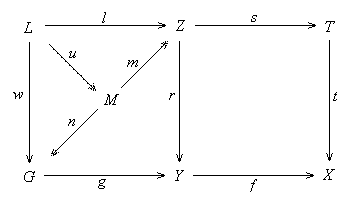
(d) Consider a local isomorphism f: Y --> X. Suppose
t: T --> X is a map and r: Z --> Y, s:
Z --> T is the pullback of f along t. We prove that s
is a local isomorphism. Suppose l: L --> Z is a localization
of Z. Suppose g: G --> Y is the local images of L
in Y under the map r with the local map w: L -->
G. Since f is a local isomorphism, f°g:
G --> X is a fraction. Let n: M --> G, m: M
--> Z be the pullback of (g, r). Then s°m
is the pullback of f°g
along t. As f°g
is a fraction, s°m
is also a fraction. Also m is a fraction as a pullback of g.
As g°w = r°l,
there is a map u: L --> M such that l = m°u
and u is a fraction as l is a fraction. Then s°l
= s°m°u
is a fraction. This shows that s is a local isomorphism.
 n n
Proposition 5.3.3. (a) Any fraction
is semisingular.
(b) Any semisingular mono is a local isomorphism.
(c) If A is strict then any local isomorphic
mono is a fraction.
Proof. (a) Suppose u: U --> X is fraction. Since
u is normal, u
is generated by u. But u
is generated by the set S of strong monos to X which is disjoint
with U by (1.5.2) as u is
coflat. This shows that u is the complement of S, thus is
semisingular.
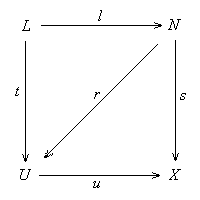
(b) Suppose u: U --> X is a complement of a set S
of strong monos to X. Consider a localization t: L -->
U. Suppose s: N --> X be the local image of L
in X. Since the simple prime of L is a subobject of the simple
prime of N, the simple prime of N is not contained in any
strong subobject in S. This implies that N is disjoint with
any strong subobject in S. Thus N factors through U.
Thus there is a mono r: N --> U such that u°r
= s. Since u°t
= s°l = u°r°l
and u is mono, we have t = r°l,
thus l is a fraction as t is a fraction. It follows that
s°l is a fraction.
So u is a local isomorphism.
 (c) will be proved in (5.5.7). n
Denote by Specr(X) the set of residues of an
object X. Denote by Specl(X) the set of
localizations of X. We have a bijection Specr(X)
--> Spec(X) sending each residue to its strong image,
and a bijection Specr(X) --> Specl(X)
sending each residue to the localization at it. Thus Specr(X)
and Specl(X) are natural topological spaces. We
obtain another two functors to the category of topological spaces, which
are equivalent to the analytic topology on A.
Proposition 5.3.4. (a) Any complementary
mono is finitely copresentable.
(b) Any analytic mono is finitely copresentable.
Proof. Let u: U --> X be the complement of a mono
v: V --> X. Since A/X
is locally finitely copresentable, u is an inverse limit of a systems
of finitely copresentable objects {ti: Ui
--> X |i I } in A/X
with the maps ui: U --> Ui, where I
is a cofiltered category. Let Wi be the pullback of V
along ti. The pullback of V along u is
0, which is the cofiltered limit of Wi. Since
0 is finitely copresentable, there is some i
I such that Wi = 0. Thus V is disjoint
with Ui, so ti factors through u
in a map g: Ui --> U. The relation u°g°ui
= ti°ui
= u implies that g°ui
is the identity of U. Thus the object U in A/X
is a split subobject of the object ti. Since the subcategory
of finitely copresentable objects in A/X
is closed under colimits, this implies that u: U --> X is
a finitely copresentable object in A/X. I } in A/X
with the maps ui: U --> Ui, where I
is a cofiltered category. Let Wi be the pullback of V
along ti. The pullback of V along u is
0, which is the cofiltered limit of Wi. Since
0 is finitely copresentable, there is some i
I such that Wi = 0. Thus V is disjoint
with Ui, so ti factors through u
in a map g: Ui --> U. The relation u°g°ui
= ti°ui
= u implies that g°ui
is the identity of U. Thus the object U in A/X
is a split subobject of the object ti. Since the subcategory
of finitely copresentable objects in A/X
is closed under colimits, this implies that u: U --> X is
a finitely copresentable object in A/X.
(b) follows from (a) as any analytic mono is a complementary mono.
n
Recall that a map f: Y --> X is a finitely
copresentable if it is a finitely copresentable object in the
category A/X.
Proposition 5.3.5. If f: Y
--> X is a finitely copresentable local isomorphism, then Spec(f):
Spec(Y) --> Spec(X) is an open map.
Proof. (a) We first prove that the image of Spec(f)
of a finitely copresentable local isomorphism is an open subset of Spec(X).
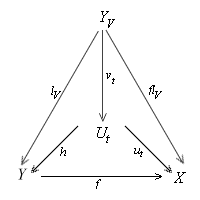
Suppose V --> Y is a prime and let lV: YV
--> Y be the localization of Y at V. Since f is
a local isomorphism, flV: YV --> X
is a localization, thus the local object YV is the intersection
of a collection {ui: Ui --> X |iÎI}of
analytic subobjects of X, and we may assume that I is is
cofiltered. Thus YV --> X is the inverse limit
of {ui: Ui --> X | iI
} in A/X. Since f is
is a finitely copresentable object in A/X,
there exists some t
I and a map h: Ut --> Y in A/X
(i.e. f°h = ut)
such that lV = h°vt,
where vt: YV --> Ut
is the inclusion. Then the open subset Spec(ut)(Spec(Ut)
= Spec(f)Spec(h)(Spec(Ut))
is in the image of Spec(f) which contains f+1(V).
This shows that Spec(f)(Spec(Y)) is an open
subset of Spec(X).
 (b) If u: U --> Y is an analytic mono, then u is a
finitely copresentable local isomorphism by (5.3.3)
and (5.3.4). Then f°u
is a finitely copresentable local isomorphism. By (a) the image of Spec(f°u):
Spec(U) --> Spec(X) is open. This shows that Spec(f)
is open. n
(b) If u: U --> Y is an analytic mono, then u is a
finitely copresentable local isomorphism by (5.3.3)
and (5.3.4). Then f°u
is a finitely copresentable local isomorphism. By (a) the image of Spec(f°u):
Spec(U) --> Spec(X) is open. This shows that Spec(f)
is open. n
Proposition 5.3.6. A fraction u:
U --> X is analytic iff the image of Spec(u)
is an open subset.
Proof. If u is analytic then Spec(u)
is an open embedding by (3.6.9.b), so the
condition is necessary. Conversely, assume the image Spec(u)(Spec(U)
is an open subset of Spec(X), which is the complement of
the closed subset defined by a strong subobject V of X. Clearly
U is disjoint with V as A is
spatial. We prove that the fraction U is a complement of V.
Since U is normal and the class of simple objects is uni-dense,
it suffices to prove that any map p: P --> X from a simple
object to X, which is disjoint with V, factors through
U. Let W = p+1(P) and Consider the
epi P --> p+1(P) = W. Since p
is disjoint with V, the prime W is not contained in
V, i.e. W is not in the closed subset determined by V,
thus W is contained in its complement Spec(u)(Spec(U)).
So W  U is not
initial. Since the inclusion W
U --> W is coflat and p: P --> W
is epic, p is not disjoint with W
U, thus p is not disjoint with U, thus p factors
through U as P is simple and U is a fraction. n U is not
initial. Since the inclusion W
U --> W is coflat and p: P --> W
is epic, p is not disjoint with W
U, thus p is not disjoint with U, thus p factors
through U as P is simple and U is a fraction. n
Proposition 5.3.7. A mono is analytic
iff it is a finitely copresentable fraction.
Proof. Suppose u: U --> X is a finitely copresentable
fraction. By (5.3.2.c) u is a local isomorphism,
so by (5.3.5) the image Spec(u)(Spec(U)
is an open subset of Spec(X), so u is analytic by
(5.3.6). Conversely, if u is analytic then
it is a fraction, and also finitely copresentable by (5.3.4).
n
[Next Section][Content][References][Notations][Home]
|